Jump to content
Twins Daily
  • Create Account
  • Twins Minor League Coverage

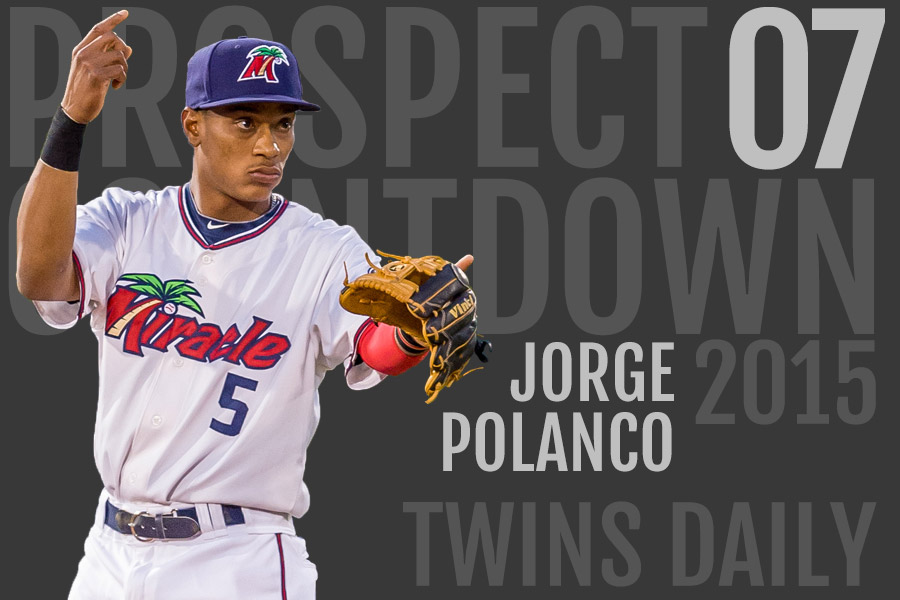
    TD Top Prospects: #7 Jorge Polanco


    Seth Stohs

    In 2009, the Miguel Sano signing got most of the headlines, but earlier that summer the Twins signed shortstop Jorge Polanco from the Dominican Republic for $750,000. At the time, he was 5-10 and maybe 150 pounds. Maybe. He was known primarily for his terrific middle infield defense. The last couple of seasons, he has figured things out with the bat. He became the youngest player promoted to the Twins since Joe Mauer in 2004 when he was called up in June, directly from Ft. Myers.

    Twins Video

    Age: 21 (DOB: 7/5/93)

    2014 Stats (Ft. Myers/New Britain): .288/.353/.395 (.748) with 23-2B, 6-3B, 7-HR

    ETA: early 2016

    2014 Ranking: #8

    What’s To Like

    Patience was a necessity as he grew and developed. It took him two years of struggles in the Gulf Coast League before advancing to the Appalachian League. He hit .318/.388/.514 (.903) with 22 extra base hits in 51 games at Elizabethton. In the talent-laden 2013 lineup, Polanco batted third and hit .308/.362/.452 with 47 extra base hits in 115 games. Who would have guessed that Polanco would be the first player from that Cedar Rapids roster to get to the big leagues?

    The reason that the Twins called him up for two short stints in 2014 was primarily because of 40-man roster issues. However, the Twins brass would not put a guy in a situation that they don’t believe he could handle. People frequently talk about his intelligence, maturity and poise.

    What’s Left To Work On

    Though he was originally signed as defensive-minded shortstop, he had spent most of his career starts at second base. However, in 2014, he made the move to over to shortstop. He struggled early in the year and ended with 35 errors in 119 games at the position. He’ll need to clean that up some, but he has the tools to be a quality shortstop, though many feel his best position may be second base.

    After hitting .291/.364/.415 (.780) with 29 extra base hits in 94 games with the Miracle, Polanco hit .281/.323/.342 (.665) with seven extra base hits in 37 games with the Rock Cats. He will have to show some more plate discipline in Chattanooga in 2015. He has never been one to walk a lot, but to be successful, I believe he will need his IsoD (Isolated Discipline = On Base Percentage minus Batting Average) to be at least 0.060, particularly if he is going to hit near the top of the order.

    What’s Next

    Polanco has the tools. He can play defense and has a good arm. He can hit, takes quality at-bats and runs well. He will never be a 20+ home run hitter, but he can hit a lot of doubles. He has the tools, though none of them are in the elite category. He has a pretty high floor meaning that he should be an everyday player somewhere in the middle infield. He has the chance to be a long-time major league starter.

    He should spend the majority of the 2015 season at Chattanooga where he will most likely again play primarily at shortstop. He should continue to get time at second base. And, should the Twins need a middle infielder, he will again be just a phone call away.

    TD Top Prospect #10: Nick Burdi

    TD Top Prospect #9: Trevor May

    TD Top Prospect #8: Eddie Rosario

    TD Top Prospect #7: Jorge Polanco

    TD Top Prospect #6:

    TD Top Prospect #5:

    TD Top Prospect #4:

    TD Top Prospect #3:

    TD Top Prospect #2:

    TD Top Prospect #1:


    Interested in learning more about the Minnesota Twins' top prospects? Check out our comprehensive top prospects list that includes up-to-date stats, articles and videos about every prospect, scouting reports, and more!

    View Twins Top Prospects

    Follow Twins Daily For Minnesota Twins News & Analysis

    Recent Twins Articles

    Recent Twins Videos

    Twins Top Prospects

    Marek Houston

    Cedar Rapids Kernels - A+, SS
    The 22-year-old went 2-for-5 on Friday night, his fourth straight multi-hit game. Heading into the week, he was hitting .246/.328/.404 (.732). Four games later, he is hitting .303/.361/.447 (.808).

    User Feedback

    Recommended Comments


    Featured Comments

    Of relevance to Polanco (remember, the guy this thread is supposed to be about?), it seems he did really really well in Winter Ball:


    http://www.baseballamerica.com/minors/baseballist-dozen-players-monitor-big-winter-ball-performances/


    A future middle-infield fixture for the Twins, Polanco showed the broad set of skills—feel to hit, gap power, strike-zone discipline—in the DL that make him a top prospect. Perhaps just as significantly, he played only one game at shortstop for Escogido, while spending most of his time as the double-play partner for former Twins shortstop Pedro Florimon.
    AVG  G  AB  R  H  2B  3B  HR  RBI  BB  SO  SB  OBP  SLG
    .326  23  89  12  29  4  3  1  6  12  15  3  .412  .472

    Edited by nytwinsfan

    I'm ready to break the mold. 

    1. There is a list of players in the minors that sound like they're ready for that MLB taste.

    2.  No matter what the Twins will tell you, you don't win with "innings eaters" or players with physical problem and hope and pray they'll get well beyond what their previous track record has shown.


    And......


    3.  The Philadelphia Phillies are in rebuilding mode, dumping salaries and veterans and are looking for prospects.


    Recently reported by Ken Rosenthal reported the Padres made a serious offer for Cole Hammels, but were turned down due to beliefs the Padres "a sufficiently promising single prospect asset".  See where I'm going here?


    The theory is:  Philles, in full-blown rebuild mode are looking for 2 things:  young highly rated prospects and dumping bloated salaries.  The Twins NEED starting pitching.  Now, not later.


    IF the Twins minor leagues are as good as many people think, why not take a shot?

    Hammels and Cliff Lee for:  [starting with] Buxton, Dozier and toss in a couple of the young flamethrowers.  I'm thinking it would at least get their attention.  Yes, I know Lee has about run out his career, but he has been very successful in BOTH leagues.  That's something you don't often see.  Hammels is an ace.  Dozier is easily replaceable by Polanco. 


    I'm ready for my beating :-)

    I'm not even considering trading Buxton at this point unless it involves getting Clayton Kershaw for the rest of his career


    Also, I think we should be careful when talking about trading Dozier. He is a great fielding second baseman that has developed some power and plate discipline as well as being an aggressive baserunner. To go along with all of that he seems to be a really nice guy and great person to have in the organization. That's someone I would want to hold onto as long as he is performing.

    With all due respect to Dozier's excellent season last year, it was an outlier.

    If it was an outlier, Dozier has been an outlier for around 1,100 plate appearances now.


    I question whether the home run power will stick around - those homers may turn into doubles instead - but the rest of his peripherals are rock-solid.

    Sorry, but I barely know you and I'd take your word over Heyman if the two of you disagreed. I don't doubt the possibility he's right in this situation, but his word brings no value to me. We can add Harold Reynolds to that :-)


    We don't need Heyman's word to establish Buxton's potential, it's pretty universally accepted that the kid has the requisite tools to be the game's best CF at some point in his career, it's now up to Buck to prove that 2014 was just a bump in the road and he quickly gets back on track from his (justified) lofty expectations. Trout will eventually pass the torch to someone... And while he may be the game's best hitter for quite a while longer, it might come sooner rather than later that he's no longer the best all-around pure CFer:


    http://www.fangraphs.com/blogs/has-mike-trout-gotten-slower/


    Mike Trout remains, to this day, an amazing baseball player. But he seems to be something of a changing baseball player. And the theory that I’ve heard seems to be that Trout has focused on trying to develop his power, and he’s lost some of his athleticism. Basically, he’s gotten bigger, and we can see some supporting evidence. He’s dramatically increased his rate of fly balls, and he’s pulling the ball more than ever. He isn’t stealing very many bases anymore, and his baserunning value is down, and his defensive value is way down. That last bit troubles some people. In Trout’s first full season, batting runs were responsible for 52% of his runs above replacement. This year, that’s shot up to 77%. The numbers indicate that Trout is morphing into someone who’s bat-first, and this seems early for a guy who just turned 23 a couple weeks ago.

    But what’s really happened to Trout’s foot speed? To what extent can we blame reduced baserunning and allegedly worse defense on just no longer running as fast? We have a lot of information here, but when it comes to speed, the information serves as a set of proxies.


    I first looked at infield singles. I decided to watch five of them from 2012, 2013, and 2014. Five isn’t very many, but speed also shouldn’t fluctuate very much, so we don’t need a massive sample size. All 15 of the infield singles were hit on the ground to the left side, and they all generated throws to first that allowed me to time Trout from contact to the base.


    Average times from contact to the bag:

    2012: 3.95 seconds

    2013: 4.05

    2014: 4.11

    It’s also of some interest — maybe more interest — to look at the best times from contact to the bag:

    2012: 3.83 seconds

    2013: 3.77

    2014: 4.00

    Based just on that, Trout’s fastest observed sprint last year wasn’t any slower than his fastest observed sprint in 2012. This year, though, none of the five infield singles I watched eclipsed four seconds, so maybe there’s a hint of something there. A fraction of a second seems somewhat insignificant, but then again the difference between the fastest and the slowest players in baseball is something like one second to first base, so everything is about fractions. This doesn’t not support the theory.

    On a whim, I also decided to watch some Trout groundball double plays, although this time I only compared 2012 and 2014. Again, I watched five each; this season, there have only been five. Average times from contact to the bag:

    2012: 4.00 seconds

    2014: 4.15

    Best times from contact to the bag:

    2012: 3.97 seconds

    2014: 4.07

    I don’t know what this means. The problem with looking at one guy in this way is that you have no idea of the greater context or significance. It would appear that Trout might no longer possess his old top sprinting speed, but he’s definitely still quick, and he’s still getting hits on infield groundballs. He’s still forcing opponents to rush. But, I am willing to buy that Trout is a touch slower. And to be honest, you’d expect as much, because the average player starts losing his athleticism early, and because Trout probably reached his athletic peak sooner than most. I don’t know the particulars of his individual physiology, but he looked decently bulky when he first came up.


    It was a bit of a thing when, prior to spring training 2013, Trout said he added weight. The Angels, however, downplayed the significance, and Trout explained that he wanted to show up a little heavier because he tends to lose some pounds in February and March. This year, Trout showed up a little down from where he was at the end of the 2013 season. Yet his baserunning value has further declined, and his defense, statistically, has further declined.

    Maybe we can blame the hamstring that has given Trout some issues. That would be an easy answer. I don’t know if it’s still a problem, and I don’t know if it ever was a big problem, but it could help explain taking fewer chances on the bases, and maybe taking fewer chances in the field. It would also, in a way, be encouraging, because hamstrings recover, and if Trout’s performing worse because of a lingering injury, then health could bring improvement. That still wouldn’t explain why Trout’s defense was so much worse last year compared to the year before, but maybe it’s a lot of noise.

    Here’s the theory: Trout is focusing on becoming more bat-first. With added bulk, he’s losing some ground in the field and on the bases, but he ought to blossom into an even better sort of slugger. I can see changes he’s making at the plate, but they seem largely independent of changes elsewhere. He’s a little bigger than he was in 2012, and he might indeed run a little slower than he did in 2012, but it doesn’t seem like that should cause such a swing in baserunning and defensive valuation. His speed is still well above-average, so that can’t fully explain a below-average DRS and UZR. It seems like Trout should still qualify as an all-around player. One shouldn’t exaggerate the physical changes that are taking place, and one shouldn’t exaggerate their effects. Is Trout really just not a good defensive center field anymore? I mean, maybe, but the reasons are likely to be complicated.


    Edited by jokin

    Hamels would require more than just Polanco.  The net would be to move a couple of players that would very likely contribute to a contender a couple years from now.  We maybe get to 500 but probably not if the projects without Hamels added are anywhere near accurate.  So we get a very good pitcher today that enter what is normal the decline phase for most pitchers.  We loose 6 years control and low cost for a couple players that are highly likely contribute to a contender if we don't manage to screw it up.


    Instead, don't try to make a real bad team into a bad team this year.  Trade Dozier for a top tier prospect when Polanco is ready for another piece we need.  Use the $22M Hamels would have been paid plus what you are saving in replacing Dozier as he heads into his arbitration years for a FA SP of Hamels caliber.  The net is a SP of Hamels caliber plus Polanco, plus whoever else would be required in a Hamels trade, plus whatever you get for Dozier.

    Edited by Major Leauge Ready

    If it was an outlier, Dozier has been an outlier for around 1,100 plate appearances now.


    I question whether the home run power will stick around - those homers may turn into doubles instead - but the rest of his peripherals are rock-solid.

    Without the home run power, he's a weak-hitting 2B.  Not sure where you're going here.

    Without the home run power, he's a weak-hitting 2B.  Not sure where you're going here.

    My point is that homers are not the only way to generate power. During his second half "power slump", Dozier's LD% remained solid as those homers turned into doubles. He was still hitting the ball hard, he was simply hitting that ball a slightly shorter distance.


    Dozier slugged .387 while hitting only five home runs in the second half. That's not the slugging percentage of a weak hitting second baseman.


    Create an account or sign in to comment

    You need to be a member in order to leave a comment

    Create an account

    Sign up for a new account in our community. It's easy!

    Register a new account

    Sign in

    Already have an account? Sign in here.

    Sign In Now

×
×
  • Create New...