


Twins Video
Masterson Is Just Another Nick Blackburn, Right?
Twins fans probably think of the last few seasons of Nick Blackburn when they think of sinkerball pitchers. Or Carlos Silva. Or, more current, Kyle Gibson.
That is not Justin Masterson.
Masterson’s sinker is a sight to behold. When looking at the raw Pitch F/X numbers which tells you how much it moved vertically, you will find that he is in rarified company. Of all pitchers who amassed 20 starts in 2014, only Masterson’s sinker fell in the negative numbers in terms of inches dropped at -0.4. This is a number reserved for the submarining sidearmer relievers. On average, the league’s sinkerballers held a 4.3-inch vertical change.
That seems impressive, right? For those of you who glazed over when all those meaningless numbers made an appearance: In layman’s terms, Masterson’s sinker shares similar downward movement usually reserved for curveballs only with fastball velocity. Still not convinced? Look at this example from Grantland posted earlier this year:
http://giant.gfycat.com/AnimatedInsecureAustralianshelduck.gif
What creates this action is both the grip and the delivery that differ from your standard sinkerball pitcher. Whereas most sinker pitchers use a two-seam fastball grip with a three-quarter arm slot delivery which generates more run than sink, Masterson’s grip is slightly different.
“It’s nothing too extreme,” Masterson told MLB Network’s analyst and former pitcher Dan Plesac on the 30-for-30 program a few spring trainings ago. “I hold it on the ends [of my fingers] and kinda got my thumb on the side.” What it looks like is a modified version of the two-seamer only with added pressure on the sides from his thumb.

The next factor related to the movement is the release. Compared to someone like Gibson (whose sinker has a career 5.9-inch vertical change), Masterson’s fingers are almost underneath the pitch at the release point -- not behind the ball and driving it towards the plate like Gibson:

With this grip and release enhanced by the arm slot of a sidewinding slinger, it is easy to see why since 2009 Masterson has a 59% ground ball rate, a 7.8% swinging strike rate (compared to the league-average of 5.5% on the pitch), and a 43.6% in-play rate (the best among sinkerballers in that time).
OK. Sure, yeah. But Masterson Was Terrible In 2014. Explain That, Nerd.
Yes. Very much so.
With a lower velocity and a greater amount of measurable movement in his sinker, hitters were not fooled by Masterson’s favorite pitch in 2014. “Sometimes you get a huge break [on the sinker] but it’s early and hitters can see that,” he said on MLB Network. “But sometimes it tightens up but it's that lateness and that’s what you really want to see.”
Masterson’s sinker -- which had long been susceptible to left-handed bats -- was being splattered by right-handed ones as well. Heading into 2014, opponents had posted a line of .279/.357/.388 with a 59% ground ball rate while averaging a velocity of 91.7 but he was able to hump it up into the upper-90s over the five previous seasons. This last year his sinker was pounded to the tune of .333/.442/.525 but with an improved 64% ground ball rate as his velocity dipped to 88.7 and he was barely able to crest 94 at maximum speed.
His command of the pitch disappeared. He was walking more with his sinker than he was striking out. In order to locate it better, Indians pitching coach Mickey Callaway said he tried to ease off the gas.
"The problem," Callaway said told reporters in early April, "is what he was doing mechanically, and then trying to ease up and throw strikes with his two seamer, it kind of compounded everything and made it worse. He probably should've taken the other route, drive some four-seamers in there, something that doesn't move and work off that.”
But later in April, following a few more starts, it became apparent that the velocity on the four-seamer that Callaway really wanted Masterson to mix in never arrived. In 2013, he threw 235 pitches 95 miles an hour or above. In 2014, he reached that plateau just once. “He can’t find that four-seam velocity that he had last year,” Callaway told the media at the end of that month. “I wouldn’t say he’s reinventing himself, he’s just playing the cards that he’s been dealt."
As the season wore on, Masterson copped to an injury to his right knee that sidelined him for the bulk of June. Masterson later told people that the knee injury had affected his mechanics to the point of reducing his velocity and command.
So What.
When the Twins requested Masterson’s medical records, as sources claim, the primary focus could be on the health of his right knee.
Following the season with the Cardinals, St. Louis’ general manager John Mozeliak said that Masterson told the team that he regretted not speaking out earlier about his ailments. Masterson’s knee injuries created issues with his mechanics, something the entire state of Missouri attempted to pinpoint on video. As Masterson told the Post-Dispatch there were various recommendations from all sources: he needed to refine his balance point, he needed to drive instead of drop, he needed to stay tall, he needed to keep his front knee closed and so on. All of these suggestions could conceivably help with his sinker command, but only one is aimed at regaining his velocity -- driving off that back leg.
Consider these examples which are indicative of the larger collection of video on Masterson. In 2012 when facing the Detroit Tigers, Masterson demonstrates a great amount of exertion and torque off of his back leg when driving towards home plate. This helps generate the high 90s velocity:
http://i.imgur.com/B8Fy1RT.gif
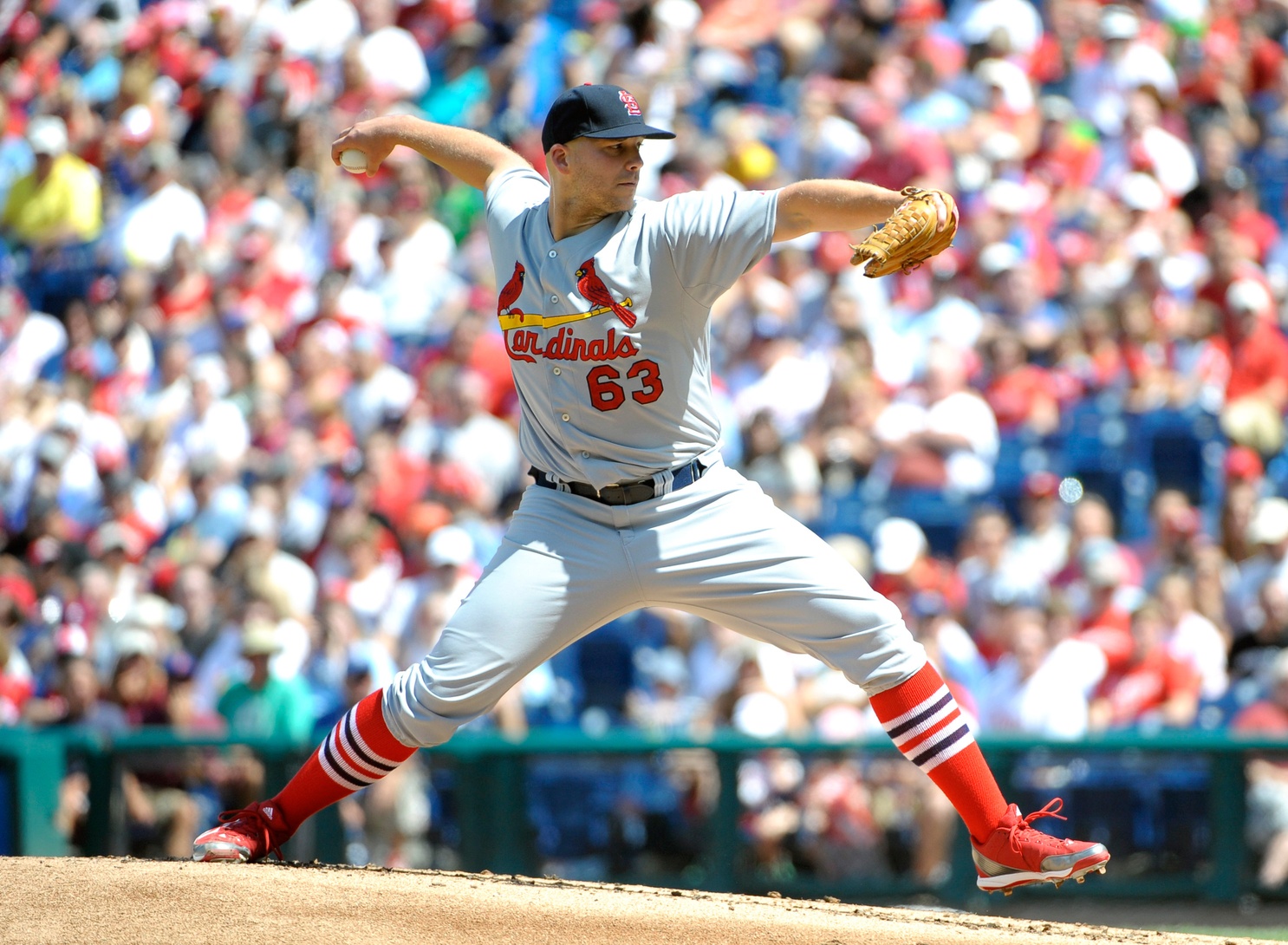
Meanwhile while in his first start with St. Louis, Masterson merely falls forward off of his back leg. There is little drive or engagement from his back leg.
http://i.imgur.com/ZG7A3tx.gif
An MRI in September revealed impingement in his right shoulder, which was given a cortisone shot. This could be related to the mechanical flaw seen in the last video. Certainly this type of delivery would place added stress on his arm and shoulder. The question is, to what extent?
Wrap This Up Please.
We know what Masterson can be.
He can be a quality starter who provides 200-ish innings with elite worm-burning skills and that could translate to approximately two wins above replacement (as he was in each season between 2010 and 2013). All of which is possible if he can curb the walks and regain his velocity. That appears contingent on his injuries. If it is just the knee -- and that heals this offseason -- there is no reason to think he cannot rebound to where he was prior to 2014. After all, he will be just 30 years old in 2015. On the other hand, if trying to pitch through a knee injury exacerbated his arm problems beyond what is known, there may be struggles ahead. Still, medical records should shed light on that and provide confidence one way or the other.
After turning down a large multi-year contract from the Indians, reportedly seeking $17M per year, Masterson figures to be aiming for a make-good contract. Unless his medical records say otherwise, he should be able to make-good.





Recommended Comments
Create an account or sign in to comment
You need to be a member in order to leave a comment
Create an account
Sign up for a new account in our community. It's easy!
Register a new accountSign in
Already have an account? Sign in here.
Sign In Now