


Twins Video
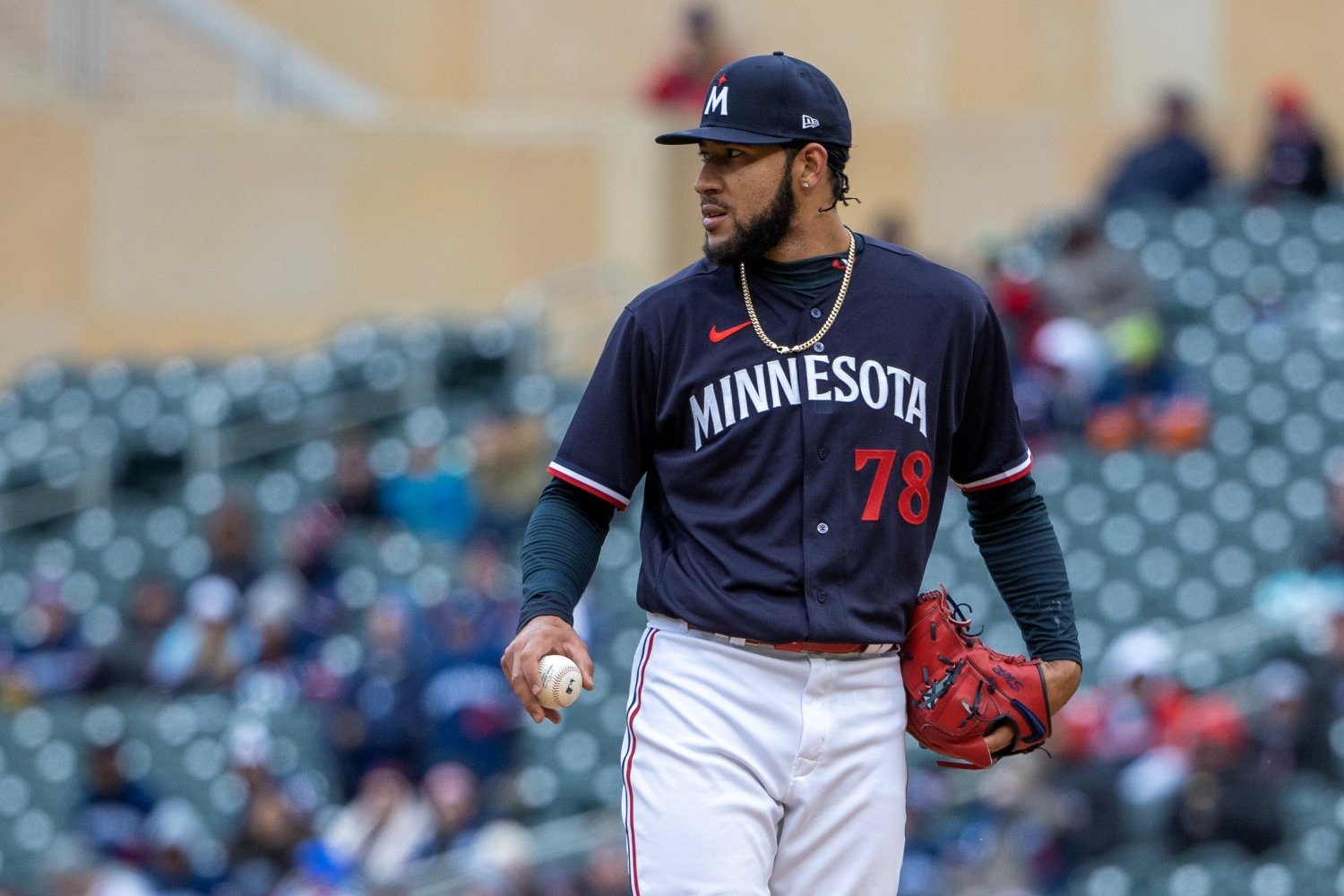
When Simeon Woods Richardson started half of a rain-necessitated doubleheader for the Twins earlier this month, it marked the third season in which he's made an appearance for the team. When they sent him back down to Triple-A St. Paul immediately afterward, it marked the third time that the visit to the big leagues had lasted exactly one outing. Woods Richardson's career has seen a lot of change and a lot of peaks and valleys already, but this time, he might stick on the MLB roster for a little while.
Earlier this week, the Twins demoted Louie Varland to St. Paul, ending a failed experiment to make him one of their back-end starters this season. Woods Richardson is taking the first start in the rotation vacancy created by that change, and he's positioned himself to be taken seriously as a candidate to keep this job for a while.
Our John Bonnes wrote about the boost in Woods Richardson's velocity this year back in spring training. After a disappointing 2023 in which he and the Twins tried to reinvent him by giving him a very cutterish fastball and saw his velocity slip south of 90 miles per hour, he came to Fort Myers throwing freer and more naturally, and the ball started exploding out of his hand. Woods Richardson's average fastball velocity this year is 93 miles per hour, and he's touched 95 more than once. He doesn't have a radical shape on the pitch anymore, but it's still shown good cut-ride action.

This is how Woods Richardson had success against the Tigers in Detroit two weeks ago; that newfound velocity is the foundation for everything. The rest of his arsenal is also interesting, though, and could be good enough to keep him ahead of the adjustment curve for a bit as he matriculates to the majors in a more complete way.
He doesn't have an elite collection of secondary pitches. Woods Richardson's slider is a bit like a cutter, really. It's thrown 85-88 miles per hour, with some unusual lift for a slider but plenty of movement separation from the fastball. One way to see why it's unusual is to study the direction of the spin he imparts out of the hand, on all his pitches.

The idea with charts like this is to communicate the direction of spin around a clock, akin to going around a baseball. Vertical breaking balls (like Woods Richardson's curveball, hanging off the bottom of the clock) have topspin, and thus tend to have a lot of downward movement. Some sliders are basically hard curves, with spin direction almost that low. More often, they're on the side of the clock (it'd be on the left side, between 8 and 10 o'clock, for a righty like Woods Richardson), showing the sidespin that creates horizontal sweep on the pitch.
Not so for Woods Richardson. His slider has something close to true backspin, like a four-seam fastball--or, more saliently, like many pitchers' cutters. It looks more like a fastball out of the hand this way, but the movement separation between the two offerings should tend to be smaller than for a slider with notably disparate spin direction from a guy's fastball. As we've seen, though, there's a fair amount of that separation for Woods Richardson. Let's put that separation onto the same clock-style diagram, to visualize it better. (These charts are based solely on spin and/or movement direction and the frequency of pitches that move that way; don't confuse the size of a bar with the magnitude of movement.)

Because of Woods Richardson's arm slot, and thanks to the way he positions the seams as he grips his slider, the ball swerves more than the spin tells the hitter it will. That's a good thing. There's still a lack of vertical differential between the two offerings and a smallish velocity gap to consider, and those things will cap the swing-and-miss potential of the pitch, but Woods Richardson should be able to be effective with this fastball-slider tandem.
There's a bit more in the way of bad news about his curveball and changeup. The curve has a lovely, aesthetically pleasing shape, but because it sits in the mid-70s, the hitter has a lot of time to recognize it and hold back, or adjust their swing. When he deploys it well in sequence, he can and does steal called strikes with the curve, but he hasn't gotten a whiff on that pitch all year, in MLB or Triple-A.
The changeup, meanwhile, does give an opposite-handed hitter a cue right out of Woods Richardson's hand; his spin direction on the change is noticeably different than on the fastball. The best changeups either create a huge amount of movement separation or disguise themselves well by having a similar spin axis out of the hand, then tailing off the fastball's line because of seam orientation and the way the seams interact with the air. Woods Richardson doesn't have either thing going for him, so he has to sell the change with his arm action and command it finely.
I would expect the tall righty to have a hard time against left-handed batters for a while in MLB. So far, taking both levels of competition together, lefties have posted a .353 wOBA against Woods Richardson, while he's held righties to an anemic .227. He's made enough changes to give himself a legitimate chance to survive as a starter, though, and given the level of the Twins' current need, that might be enough to earn Woods Richardson a window within which to make further adjustments.
How many games will the Minnesota Twins win in 2026?

Follow Twins Daily For Minnesota Twins News & Analysis



- gman, Bamboo Bat, Cory Engelhardt and 2 others
-
 5
5



Recommended Comments
Create an account or sign in to comment
You need to be a member in order to leave a comment
Create an account
Sign up for a new account in our community. It's easy!
Register a new accountSign in
Already have an account? Sign in here.
Sign In Now