


Twins Video
It's all relative, of course. The Twins rank 8th out of 15 American League clubs with a 4.21 ERA that is exactly average. They rank ninth in WHIP and 10th in FIP. So they haven't exactly been lighting the world on fire in that context.
But this is also a team that, two years ago, ranked dead last in ERA and WHIP while allowing 889 runs, second-most for a Twins club ever. This year they are on pace to allow 719, which would be about 60 fewer than last year when they reached the postseason.
And it goes beyond the numbers. Just ask yourself: when was the last time you had faith in almost every single member of a Twins pitching staff?
In the rotation, Jose Berrios has been tremendous outside of a hiccup in late April/early May that appears to be behind him. He ranks 12th in the AL in innings pitched, which would've seemed unthinkable not so long ago thanks to his tendency to rack up high pitch counts.
Newfound efficiency and control have enabled the right-hander, who turned 24 on Sunday, to pitch into the eighth inning four times in 11 starts, and into the seventh in two others. He has issued two or fewer walks in all but one of his turns. Berrios' 3.67 ERA remains in the good-not-great realm, thanks to that string of clunkers, but his recent performance feels more reflective of what we can expect going forward.
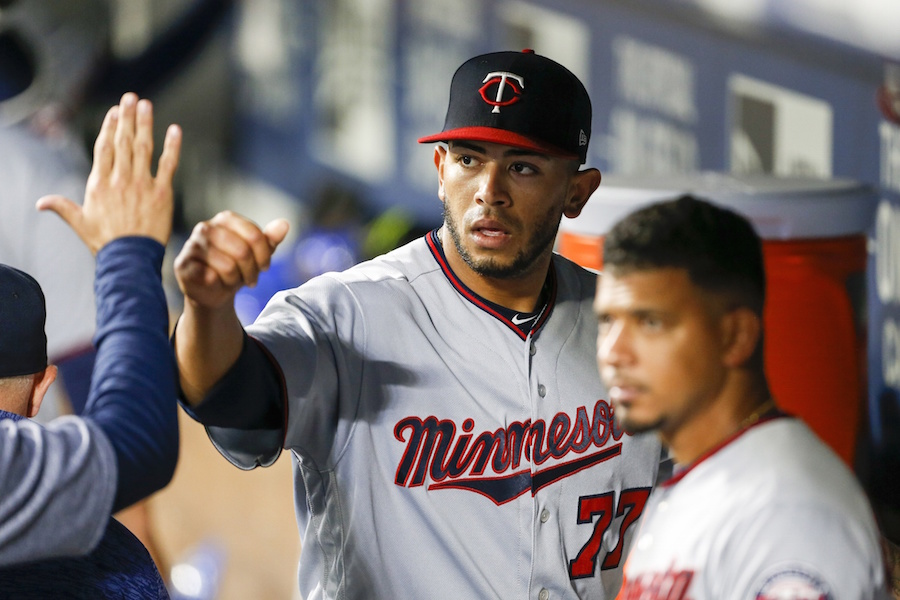
And then there is the amazing Fernando Romero, who doesn't turn 24 until December. Hailed as a potential ace as he came up through the minors, Romero has somehow been better than advertised during his initial run in the big leagues. The righty has been absurdly dominant through five starts, with a 1.88 ERA that ranks third among all American League pitchers with 20+ IP.
He won't maintain a sub-2 ERA forever, of course, but Romero has a formula that makes sustained ace-level performance feasible. Namely, he's getting grounders at a 50%+ rate while also averaging more than a strikeout per inning – one of five AL starters to hit both marks. Last year, Luis Severino was the league's only qualified SP to finish above those thresholds; he posted a 2.98 ERA for the Yankees.
The Twins have two starters pitching at an elite level, which is obviously encouraging, but what's really exciting is that it's a duo of young, controllable former top prospects with stuff and pedigree to match. This isn't Phil Hughes coming out of nowhere after years of mediocrity with the Yankees. This isn't Ervin Santana mustering the best season of his career at age 34.
The emergence of Berrios and Romero as a one-two punch atop the rotation is legitimately the best development to come along for this unit in more than a decade. We haven't seen a Minnesota starting corps this strong at the top since Johan Santana and Francisco Liriano were (so briefly) paired together at their peaks.
Injuries and setbacks are always on the table, as we know too well (the previous example serving as case-in-point), but let's enjoy this for what it is: the foundation for an actual championship-caliber rotation.
Almost equally encouraging is what's happened around Berrios and Romero.
Jake Odorizzi has been brilliant, with a 3.34 ERA and 1.28 WHIP through 11 starts. One can easily make the case that good fortune has aided his success – namely an 88 percent strand rate, and eight of 12 homers against him coming with bases empty. But Odorizzi's proneness to home runs is well known to everyone, including himself. He works around it. And I'm not convinced it's entirely luck that has led to hitters slashing .156/.221/.313 against him with men on. He's been buckling down.
Even if (when) he regresses a bit, Odorizzi can still be a solid mid-rotation piece and a fantastic return for Jermaine Palacios, who has a .473 OPS with Tampa's Double-A affiliate. Best of all, the Twins have optional control over Odorizzi at a reasonable cost in 2019, putting them in a great position of flexibility.
The same is true for Kyle Gibson, who has one more year of arbitration eligibility remaining. Gibson has finally swapped in his profile as a contact-heavy ground ball pitcher for that of a bat-missing filth-flinger, and this one suits him much better. His GB rate has dropped into the average range at 46.7%, but his swinging strike rate has skyrocketed to 11.9%, best among Twins starters and among the league's top 25.
Gibson's transformation has been keyed by a heater registering a career-high 92.5 MPH (thanks in part to his increased reliance on the harder four-seamer) and breaking balls that are inducing a mind-boggling 57% miss rate, highest in the majors.
Again, this isn't the mirage-like burst of success we've seen so often from Twins pitchers (including Gibby) in the recent past. This is a hurler on top of his game shoving some of the best stuff of anyone in the game. He has shown the ability to flat-out dominate when his command is there. And right now he's Minnesota's fourth starter.
Lastly, we come to Lance Lynn. He's one of only two pitchers on the Twins roster with an ERA above 4.02, and it is of course well above, at 6.34. I won't try to convince you he hasn't been bad – I've been as maddened as anyone by his inexplicable inability to throw it over the plate – but cautious optimism is warranted.
You've got the long track record of success. You've got the 3.98 ERA in four May starts, along with an improved strike rate (up to 63% from 56% in May) and decreased homer rate (only one allowed this month after five in April).
There's also this: remember when I mentioned earlier that Romero is one of five AL starters with a grounder rate over 50% and a K/9 over 9? Lynn is one of the others. Among that group – which also includes Lance McCullers, Charlie Morton and Garrett Richards – he's the only one that hasn't been very good.
The main reason for this is obvious, and entirely his own doing: he hasn't thrown enough strikes. But there are clear signs of improvement in this regard, and the peripherals show that when Lynn manages to throw the ball where he wants, it gets the result he wants.
Five starters locked in with a K/9 of 8.8 or higher. Incredible. Two years ago, the Twins had zero starting pitchers with a K/9 higher than 7.7.
Even if things go south again with Lynn, or any of the other four members of the rotation, Minnesota is well equipped for the occasion. Stephen Gonsalves is tearing it up in Rochester with a 2.39 ERA, 1.10 WHIP, and 10.9 K/9 rate. His success is the only reason we're not talking more about Zack Littell, who has also been phenomenal since his Triple-A promotion (2.05 ERA, 1.00 WHIP, 9.8 K/9).
Finally, Trevor May and Ervin Santana are on the comeback trail. There's enough quality depth in play for the Twins rotation that Santana's concerning velocity reports can easily be taken in stride.
Out in the bullpen, there is plenty more to like.
Fernando Rodney shook off his early troubles and rounded into form beautifully. He's been as reliable as any closer in the game over the past month, converting eight consecutive saves while allowing zero runs on only two hits. Yes, to repeat: Rodney has surrendered two hits – both singles – in a calendar month.
Even though his velocity is down a smidge from last year, it's absolutely remarkable to see a 41-year-old out there repeatedly hitting 95 on the gun. He's bringing the kind of overpowering stuff you wanna see in the ninth. Rodney currently looks like a slam-dunk addition for the front office.
So too does Addison Reed, who is nicely fulfilling his envisioned role as Twins bullpen ace. Reed ranks second among Minnesota relievers in appearances, and they've almost all come in high-leverage spots. He's responded by delivering consistently, helping him accrue a 0.56 WPA, which leads the bullpen. Reed is on pace to post the highest mark in that category since Glen Perkins in his career year, 2013.
As good as Reed's been, the star of this unit has been Ryan Pressly, who is finally pulling it all together at age 29. Last year, he had an odd tendency to get knocked around despite dazzling stuff, premium velocity, and good control. This year, the stuff has gotten even better and hitters just can't handle it.
Pressly's swinging strike rate has jumped from 12.2% to 16.8%, which ranks 11th out of 180 qualified MLB relievers. He's been especially lethal in May, where that figure has jumped to 19%. He has given up one home run thus far, after giving up 10 in 2017.
The strikeout parade continues with Zach Duke, who has rebounded spectacularly from his own early skid. Duke yielded five earned runs in his first four appearances, saddling him with a 16.88 ERA, but he's been whittling it down ever since. The lefty has been charged with just two earned runs in 19 appearances since then (1.26 ERA) while striking out 16. He's walked only two of 36 batters faced in May.
Duke has been lights-out against left-handed hitters (.569 OPS) and good enough against righties so as not to force strict platoon usage. When you combine his output with that of Rodney and Reed, it can hardly be overstated what a profound positive impact the front office's offseason moves have had on the bullpen.
One of their quieter additions is also paying dividends. The Twins signed Matt Magill to a minor-league deal in January, without much fanfare. He was the type of 28-year-old journeyman with an unimpressive track record who usually serves as organizational filler. Magill was mediocre with San Diego's Triple-A affiliate last year while usually throwing as a starter, and didn't make it to the majors all season.
But Minnesota was intrigued by Magill's past stints in the bullpen, and the velocity increases it triggered. So they've tried him there again with exceptional results.
Magill was sent down in spring training despite looking very good with an 8-to-2 K/BB ratio in five innings. At Triple-A, he kept it going with a 13-to-2 K/BB ratio over 8 2/3 frames to earn a call-up in late April. He has since looked the part of a major-league reliever, painting corners with 95 MPH fastballs while posting a 1.88 ERA and 1.16 WHIP through 11 appearances.
He hasn't pitched in many big spots, and could be replaced if May comes off the DL this week, but neither is through any fault of his own. Magill looks like a heck of a find.
Through all this, we haven't even mentioned the two key mainstays of last year's bullpen, who are also both pitching well. Taylor Rogers' inflated 5.59 ERA hides a 2.18 FIP. He had some ugly outings in late April, at the height of the team's slump, but has a 2.02 ERA in May and now looks like himself.
That's also the case for Trevor Hildenberger, who remains perhaps the most important long-term cog in this pen. He has a 2.31 ERA in May, where he's holding opponents to a .186 average and inducing whiffs at an 18% rate.
So there you have it. With about one-third of the season in the books, nearly every member of the Minnesota Twins pitching staff is looking like a positive asset. This is a huge credit to the front office, the coaching staff, and so many of these players who have turned corners personally.
For the pitchers to be cruising along like this while a lackluster offense drags the team down was not a scenario any of us envisioned, but here we are. The upshot is that if these guys can keep it up as they have, the Twins have potential to really become a complete team if and when the bats awaken.




Recommended Comments
Create an account or sign in to comment
You need to be a member in order to leave a comment
Create an account
Sign up for a new account in our community. It's easy!
Register a new accountSign in
Already have an account? Sign in here.
Sign In Now