


Twins Video
Both the Giants and Mets reportedly did not like what they saw on MRI and physical examination regarding his surgically-repaired ankle that he fractured when he was 19 years old and in the minor leagues. What exactly was seen hasn’t been reported, but generally speaking, there are only a couple of pathologies—such as arthritis—that could result in the teams’ physicians taking the stance they did. I do not have inside information on Correa’s condition and this is only educated speculation on my part. (For what it’s worth, the Twins’ doctors were also aware of the status of Correa’s ankle and felt confident enough in its structure to hand out a multi-hundred million dollar deal.)
The stench of the Giants’ and Mets’ findings resulted in Correa losing $150 million from what was originally promised to him, a fact that must sting deep within his core. Correa’s agent, Scott Boras, implied that the interpretation of the MRI his client underwent was the primary instigator behind his struggles to land with a team.
“[T]his scenario is about a large separation in the orthopedic community about functional fitness and clinical exam versus looking at an MRI,” Boras said during Correa’s introductory press conference. “It is a dramatic chasm between how some doctors feel and how other doctors feel about the longevity of a player’s performance.”
Boras is right on the money. Many doctors—particularly orthopedic doctors—subscribe to what is known as the biomedical model. To boil it down simply, the biomedical model believes that health is defined by the absence of pathology. To apply it to Correa, his ankle cannot be healthy because something was found on MRI; in other words, the ankle is something to be concerned about moving forward.
In many ways, the biomedical model of health is logical, which is why it was so heavily adopted by doctors, particularly in the United States, upon its introduction. However, logic and the body don’t always mesh well.
Let’s take MRIs for example. MRIs—which stand for magnetic resonance imaging—are wonderful for diagnosing soft tissue injuries, both those that are acute or chronic in nature. If an athlete tears their ACL or strains their hamstring, the extent and exact location of the damage is often determined by MRI.
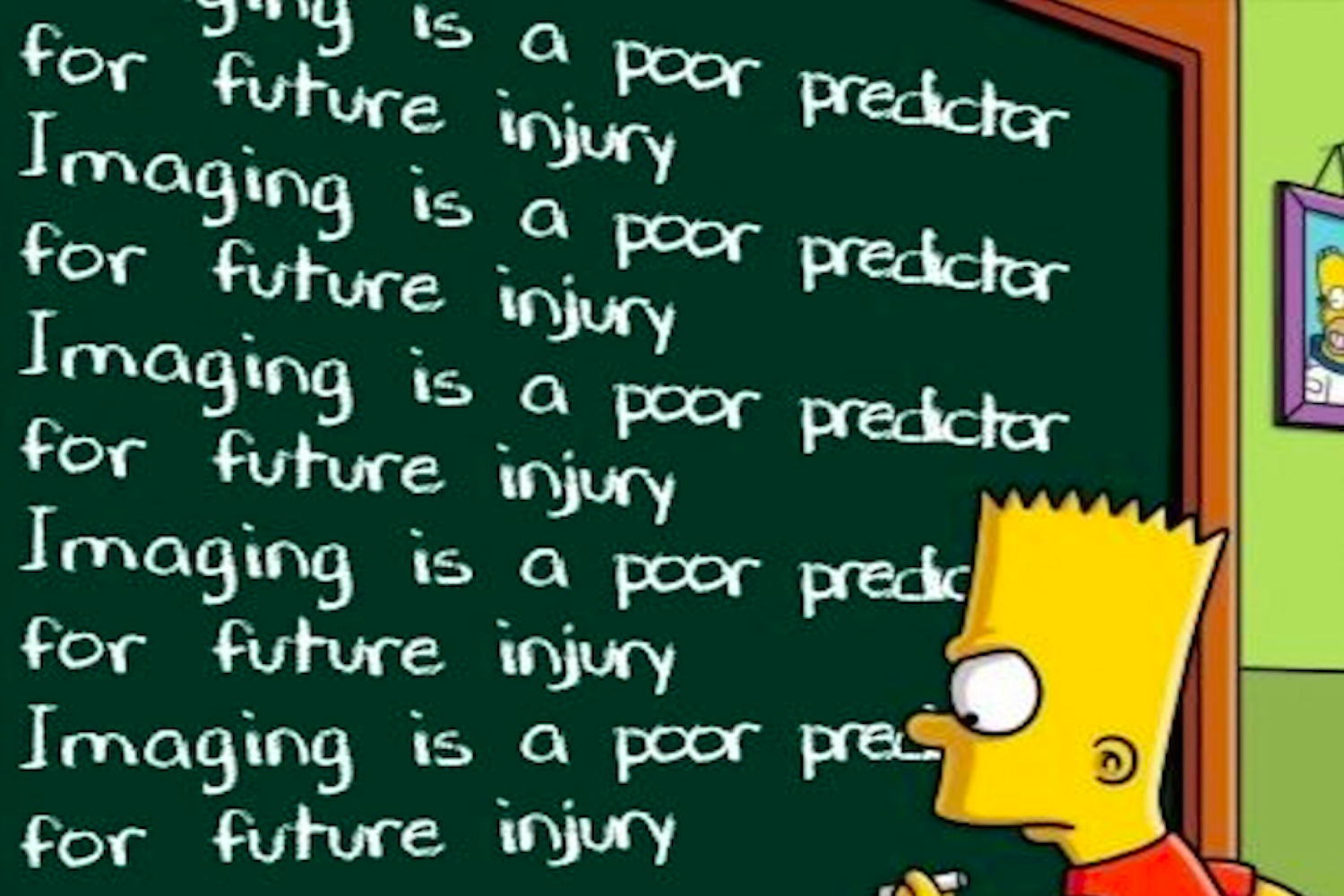
However, some in the field of orthopedics use what is found on MRI as a way to predict what will happen in the future. The thinking goes something like this: “Well, that individual has a tear in their meniscus. It may not bother them now, but it will in the future, so we better take care of it now.”
Again, this is a perspective based in logic. Damaged tissue or bone is “not normal” (i.e. pathological), the thought goes, and therefore must be remedied (i.e. turn the pathology back to health). However, over the decades, MRI’s ability to accurately predict future injury has been found to be dubious, at best. The meniscus tear or arthritis in the back don’t always come back to haunt the individual; sometimes they simply lay dormant, never causing disruption.
This isn’t logical and is a big reason why many in orthopedics—including myself, full disclosure—believe more in relying on past performance and abilities. “Functional fitness,” as Boras referred to it, is more concerned about “what have you done and what can you do” than “what could happen?”
Carlos Correa has never once gone on the injured list nor has he ever missed time due to ankle pain over the last decade. He has accumulated 32.3 fWAR, won a Platinum Glove, and is on pace to finish his career as a Hall of Famer. Sure, he may have some arthritis and/or some metal in his ankle, but it’s never impacted his ability to perform. Why all of a sudden should we think it will now or anytime in the future?
“One thing I learned throughout the whole process is that doctors have a difference of opinions,” Correa said during his press conference. “I had a lot of doctors tell me I was fine and I had some who said I wasn’t so fine.”
That is really all that Correa’s rollercoaster offseason boils down to. We like to think that medicine is a completely objective field. Players undergo tests, the results are read, and a decision is made. However, much of orthopedics—and especially physical exams—contain a fair amount of subjectivity.
Doctors often have differing opinions; that’s why second opinions exist (and aren’t called second “facts”). The Giants and Mets clearly had a larger issue with Correa’s ankle than the Twins, but that doesn’t inherently mean that the Twins are wrong (or, to be fair, does it mean they are inherently right).
An additional factor in play during Correa’s free agency discussions, it should be noted, was the sheer volume of his potential contracts and the ability for a team to insure such a deal. Suffice it to say, either the Giants or the Mets could have gotten their deals with Correa insured with relatively little issue. (The Twins did, after all.) However, what both teams seemingly did was use Correa’s MRI findings to justify backing out of their agreement and offer something more paltry in return.
The Mets took it even a step further. Their final offer to Correa was a six-year deal for $157.5 million, exactly half of their original, with multiple non-guaranteed years contingent on him passing a yearly physical. Additionally, according to USA Today's Bob Nightengale, they employed the opinion from the exact same orthopedic doctor as the Giants. (Said Boras, "I don’t understand the Mets. I gave them all of the information. We had them talk to four doctors. They knew the issue the Giants had. And yet, they still call the same doctor the Giants used for his opinion. There was no new information. So why negotiate a contract if you were going to rely on the same doctor?") As Aaron Gleeman, John Bonnes, and Dan Hayes discussed astutely in a recent Gleeman and the Geek Patreon podcast, why would Correa agree to such a deal, especially after experiencing firsthand the Mets’ physical exam process?
At the end of the day, the Mets, and to perhaps a lesser extent the Giants, tried to utilize Correa’s body against him in the name of saving money. What is particularly egregious is that the Mets knew full well that they may see something upon exam that they did not like. They agreed to sign him for 12 years and $315 million anyway, only to swiftly pull out the rug from underneath him.
It’s perfectly acceptable for doctors to approach a condition with different viewpoints and opinions. However, the case of Carlos Correa exposed the potential impact differences of opinions—and perhaps outdated medical models—can have on an individual, especially when “just doing business” is involved.
View our top trade candidates list, up to nearly 70 names and updated regularly!
View Trade Candidates







Recommended Comments
Create an account or sign in to comment
You need to be a member in order to leave a comment
Create an account
Sign up for a new account in our community. It's easy!
Register a new accountSign in
Already have an account? Sign in here.
Sign In Now