


Twins Video
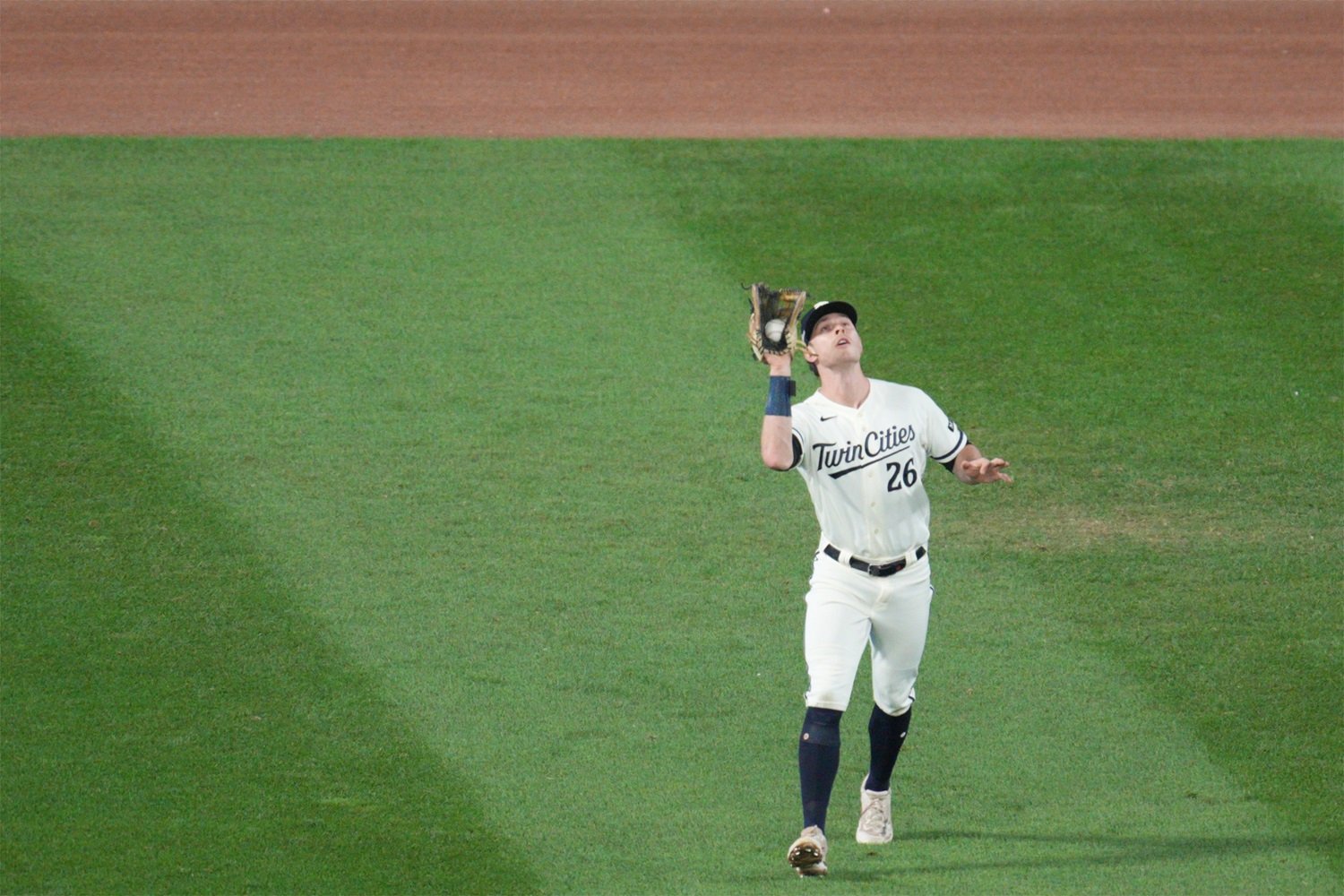
Kepler is now the longest tenured Twin, and following a rebound offensively, is entering the final year of his contract. Extending players as they enter their 30's in generally frowned upon in analytic circles, but there is precedent for a talented, yet up-and-down, hitter finding something in the second half of their career.
Max Kepler has been a lot of things in his long tenure as a Twin: A 36-homer leadoff man, smooth defender, and the posterchild for why looking at BABIP to project future performance is better left in 2012. He’s had injuries, stretches of historically poor contact quality, and countless trade rumors. It’s been a ride, and people have certainly had opinions about it.
Last year, Kepler reversed a years-long downtrend in performance by saying “Screw it, I’ll just swing harder and live with a few more strikeouts.” As a result, he had the second best year of his career and the Twins picked up his 2024 club option. They also traded his draft-mate from 2009, Jorge Polanco to the Mariners (where playing second base is like being a drummer for Spinal Tap). It appears that Kepler will play out the final year of his contract with the Twins, which is good news, because unlike in mid-2023, they don’t have anyone to replace him (unless you still believe in Trevor Larnach).
A lot of Twins fans have been done with Kepler for years now, but given his unique career arc and the team’s flimsier than expected outfield depth, it may make sense to extend him, rather than watch him leave in free agency following this year. Here’s why.
As Kepler enters his age 31 season, I wondered if there are any other players with similar trajectories in their careers. Someone who started solid enough, peaked to a point they got MVP votes, then leveled off before finding something at age 30. That got me thinking about Adrian Beltre, newly enshrined first-ballot Hall of Famer.
Stay with me here. They play different positions and hit from different sides, but let’s remember who Beltre was through his first decade or so in the majors. He got to the major leagues as an uber prospect, debuting at the age of 19 for a much more dysfunctional Dodgers team than we are used to these days. He acclimated himself well at the start, posting a 102 OPS+ in his first full season at age 20.
Baseball fans love players who can’t legally drink but can post league average numbers- Imagine what they can do once they fill out and learn the league! Well, Beltre didn’t really take off from there, producing four middling seasons leading up to his walk year in 2004.
He busted out that year, hitting 48 home runs, playing stellar defense and finishing second in the MVP voting to perhaps the greatest hitting season of Barry Bonds’ (or anyone’s) career. There it was! The talent that lay dormant for so long was finally translating to impact production. He secured a big contract from the Seattle Mariners… and then resumed being a roughly league-average hitter with good defense.
I don’t have to tell you how Max Keplery that is. In fact, through their age 30 seasons, Beltre had produced a 105 OPS+ for his career, while Kepler is at 104. The lows were lower for Kepler, and the highs were higher for Beltre, but the overall career arc is fairly similar. Neither struck out a lot, both played through injuries that sometimes sapped their performance, and both were revered as strong, yet somewhat odd, clubhouse presences.
Had Beltre continued to produce as he had in LA and Seattle, he would have fallen off the HOF ballot by now. But starting with a one year stop in Boston (which prompted agent Scott Boras to invent the term “pillow contract”), Beltre found a sweet spot in performance that didn’t quite reach his 2004 breakout peak, but was far more productive than his other years to that point. From that point forward, he hit for a 133 OPS+, played in a World Series, went viral countless times for his humorous exchanges with friend/nemesis Elvis Andrus, and waltzed into the Hall of Fame.
No one is predicting that for Kepler, but then again no one was counting on sustained dominance from Beltre 13 years ago, either. What if Max has figured something out and his 124 OPS+ from 2023 is repeatable?
My guess is that Kepler felt that the Twins’ brass were fed up with him in June of last year and that shook him up. He stopped caring about avoiding strikeouts, or taking walks, and became more process-oriented. He had the highest strikeout percentage of his career, and his lowest walk rate since 2017. Whatever the catalyst was, it worked, as his OPS the final three months was .840, 1.008, and .851. His Baseball Savant page was even more encouraging.
Ask any Red Sox fan (or executive) and they will tell you that not keeping Beltre after his 2010 re-emergence was a huge regret. Losing Polanco removes a ton of continuity from the clubhouse, so keeping Kepler around on an extension would make sense on a corporate level (as well as a human one). If he goes back to hitting for the league average and neither Emmanuel Rodríguez or Walker Jenkins displace him immediately, you just bank on the clubhouse pluses and the worry-free defense.
Judging by the Twins’ inability to trade him the past three-to-four offseasons, he may not even cost that much to retain. It all depends on how you project him going forward. His top Baseball-reference.com comparable is Colby Rasmus, a soft-spoken former top ten global prospect who performed in fits and starts throughout his career and was out of the league following his age 31 season. He did make a few postseason memories. Another comp further down is Darrell Evans, who followed Beltre’s exact career path of immediately being decent, being great for one year, flatlining, and then being a top 20 hitter in baseball for six years (123 OPS+ after age 35). Which camp will Kepler fall into?
There’s a very fine line as a 30-year-old position player between being a candidate for a three year, 45M contract, or a four year 80M one. I suspect the Twins would consider the former but scoff at the latter, and I would agree. Kepler is a guy who falls out of whack a lot at the plate, but usually figures it out somewhere along the line. He’ll end up with 20 home runs, an OPS below his talent level, and the sort of defense that, while not electrifying, acts as a security blanket preventing other outfield options from navigating right field at the Targe. That’s a solid investment at 15M annually.
Additionally, the Twins surest things after him are Byron Buxton and Matt Wallner in the outfield, and there are contact-related questions for outfield prospects Rodríguez (too little) and the newly acquired Gabriel González (too much).
The Twins brass are having these discussions. If Kepler departs after this year, they will likely be in the market for a corner outfielder who can hit and defend, especially if Wallner can’t legitimize his 2023 breakout. Another angle is that If Kepler produces another 120 OPS+ in 2024, he may receive a qualifying offer, which would depress his market elsewhere, or even lead to him accepting and returning for 2025 at a roughly 20M salary. That may be the Goldilocks scenario, as Rodríguez, González and Jenkins should all be in play for the 2026 season.
To be sure, the overwhelming odds are that Kepler will play out this last year with the Twins and become a free agent. Mid-market teams like the Twins, especially ones with analytic-leaning front offices, don't often extend players of his type. Indeed, it would have been ludicrous at the All-Star break to even have this conversation.
But Kepler pivoted at that point, and the Twins front office has shown they're capable of pivoting too. If they believed enough to keep starting Kepler through mid-2023, perhaps they can believe enough to believe that his late 2023 wasn't a mirage. Maybe Kepler's journey with the Twins doesn't need to end just yet.
What do you think? Would you sign up for three to four more years of Kepler, or roll the dice with the Twins’ minor-league outfielders and Wallner?
Are you optimistic about the Twins right now?

Follow Twins Daily For Minnesota Twins News & Analysis



- JD-TWINS, PatPfund, Oldgoat_MN and 2 others
-
 5
5


Recommended Comments
Create an account or sign in to comment
You need to be a member in order to leave a comment
Create an account
Sign up for a new account in our community. It's easy!
Register a new accountSign in
Already have an account? Sign in here.
Sign In Now