Jump to content
Twins Daily
  • Create Account
  • Twins News & Analysis

    Correa's Leadership, Part 1: Define Your Terms

    To paraphrase Justice Potter Stewart, 'Leadership—I know it when I see it.' We can all agree that leaders exist, but unpacking what makes a leader is more complicated.

    Greggory Masterson

    To paraphrase Justice Potter Stewart, 'Leadership—I know it when I see it.' We can all agree that leaders exist, but unpacking what makes a leader is more complicated. 

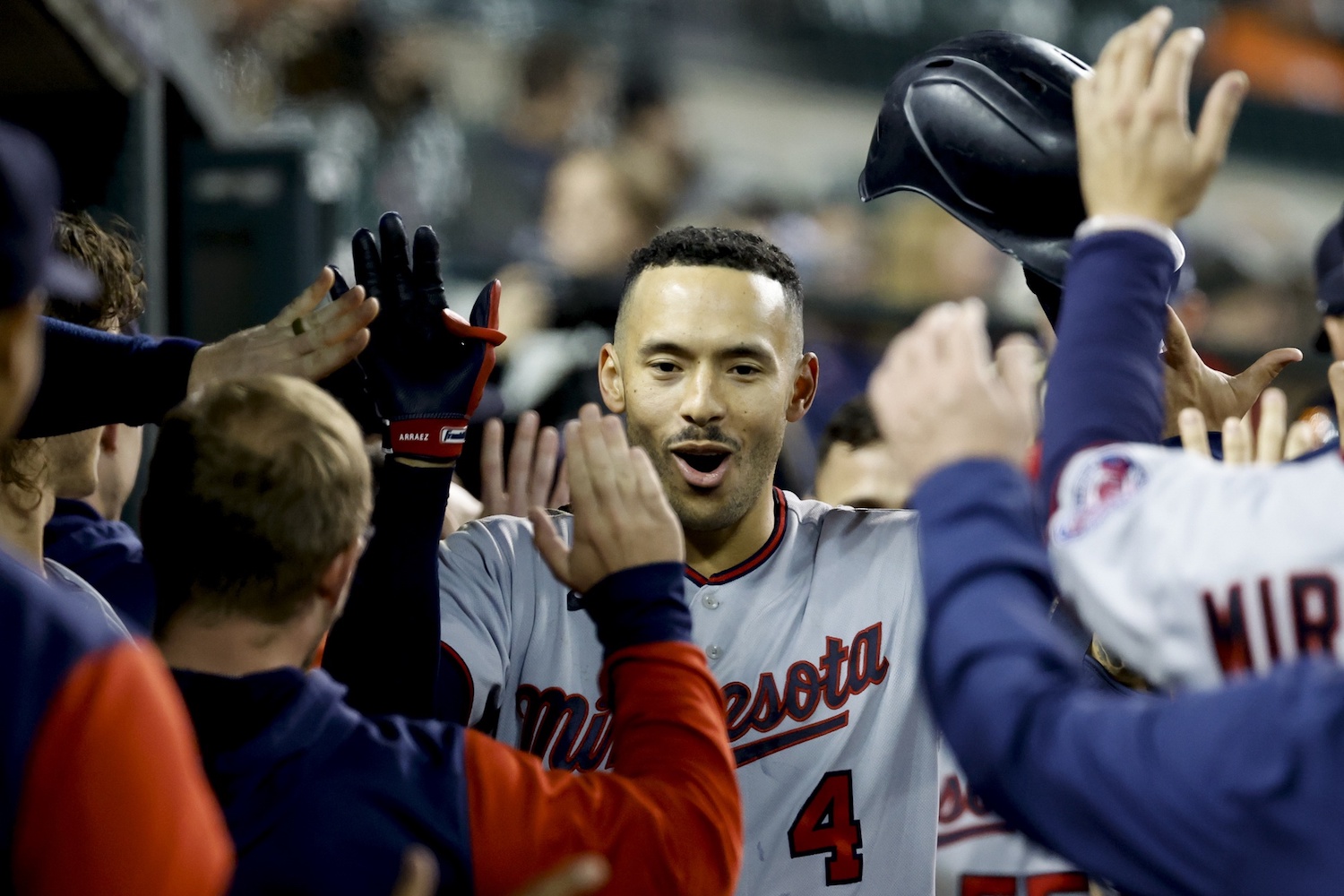
    Image courtesy of Rick Osentoski-USA TODAY Sports

    Twins Video

    Teammates, media, and fans laud Carlos Correa for his leadership ability. Shoot, players on other teams compliment Correa for being a leader: On Tuesday, Correa was caught putting his arm around Carson Williams, a 19-year old Rays prospect, after the youngster committed an error in a spring training game.

    When it comes to identifying what exactly he does as a leader, though, we can struggle to quantify it. Today, we’re starting an ol’ Gregg deep dive into leadership, its observable outcomes or benefits, and why Correa gets explicitly highlighted as a leader.

    You can take this series as a continuation of this blog post looking at what “clubhouse presence” might generally mean for a player like Correa. I’ll reference papers discussed there, so if you’re interested, check out that blog.

    Leadership Defined
    Let’s start at the top with a definition of leadership. Many will cite traits or behaviors like empowering others, providing support, giving guidance, or something like that. However, at its most basic level, leadership is influence. Leaders influence those who follow them into certain behaviors.

    Leaders can come in all forms. One easy way to think about them is informal or formal leaders who can be from inside or outside of a team. A player like Correa would be an informal leader inside the team.

    Under our definition of leadership, an excellent informal leader can change others’ behavior. Now, it’s possible to influence behavior positively or negatively, so it’s crucial to have the right type of leader. A bloviating blowhard can walk into a clubhouse and certainly influence their teammates, but if that influence isn’t beneficial for the team, then what’s the point?

    Even worse, a front office could bring a leader into the clubhouse, but the team could still reject that person as a leader. Clearly, this was not the case in Minnesota last year, at least from outsiders’ perspectives. So let’s move on to how players become leaders.

    Leader Emergence
    As mentioned in my previous blog post, players can have informal roles like leader that are not officially bestowed on them by the powers that be (as opposed to first baseman or leadoff hitter). Instead, their teammates agree that that person fills the role.

    In a study led by Jeemin Kim of Wilfred Laurier University, teams tended to be most satisfied with their play when verbal leaders made up 10-15% of the team. On a baseball team, that would be between two and four players, and Correa certainly fits that bill on this Twins team.

    Long ago, a psychologist named Robert F. Bales put forward a theory suggesting that three things mattered for a person to fill an informal role: being noticed, skills, and likeability. These three factors matter for all roles—not just leadership. For example, the role of clubhouse cancer would require a person to be very good at disrupting the clubhouse.

    Let’s stick, though, to the role of informal leader. That player needs to have influence, be likable (to some extent), and be noticed for his traits. Correa has the on-field ability of one of the top players in the sport. That helps, but plenty of talented players aren’t seen as leaders.

    Instead, he must also help guide teammates, provide an example for them, and be there for them—all of the things people think about when they think of a leader. He doesn’t need to be all of them, just enough of them to be noticed by his teammates.

    From a social scientist’s perspective, he has an increased potential to be noticed simply by his position in the field. Teams have what are called social networks—complex relationships between players. These networks can be mapped out and measured. Networks can come in all types, such as friendship or time spent playing together. Players with more friends on the team can have a wider friendship network, and teammates who have played longer can have stronger familiarity bonds with each other.

    A team is a series of different types of networks that can become somewhat confusing. For the visual of you out there, see the network I approximated based on coordination. Thicker lines indicate more substantial levels of coordination needed for the players at each position on the field. They’re also color-coded, with purple being the strongest, yellow being medium, and red being the weakest.

    image.png

    This map isn’t exact, but it gets the point across. If you look closely, shortstops and catchers appear to require the most coordination with their teammates. Catchers specifically work incredibly closely with their pitchers and then everyone else to some extent. Shortstops have, at minimum, a moderate level of coordination with everyone else on the team, save the pitcher (though even that could be higher if you consider the amount of coordination necessary for shifting and pitch selection).

    This diagram isn’t just me making things up to support my thoughts. As far back as the 1960s, social scientists observed this very thing. Having more ties and stronger ties makes a player more centralized in their network, and Oscar Grusky of UCLA discovered that the more central a player’s position was, the more likely they were to become a manager.

    This finding isn’t a new discovery in the baseball world, either. Many reading this already know that catchers and middle infielders are more likely to become managers than pitchers or outfielders. However, it’s worth noting that psychology has been on the same wavelength as conventional wisdom in this regard.

    All this is to say that a player like Carlos Correa is in a prime position to be identified as a leader by his teammates. In the next installment, I will look at what sort of leadership Correa exhibits that solidifies him as a leader.


    Bales, R. F. 1966. “Task roles and social roles in problem solving groups”. In Role theory: Concepts and research, Edited by: Biddle, B. J. and Thomas, E. J. 254–262. New York: John Wiley.

    Grusky, O. (1963). The effects of formal structure on managerial recruitment: A study of baseball organization. Sociometry, 26, 345–353. doi:10.2307/2786074
    https://www.jstor.org/stable/2786074

    Kim, J., Godfrey, M., & Eys, M. (2020). The antecedents and outcomes of informal roles in interdependent sport teams. Sport, Exercise, and Performance Psychology, 9(3), 277–291. https://doi.org/10.1037/spy0000179


    Follow Twins Daily For Minnesota Twins News & Analysis

    Recent Twins Articles

    Recent Twins Videos


    User Feedback

    Recommended Comments


    Featured Comments

    16 hours ago, DocBauer said:

    While some fans don't understand this, teams and agents have a great respect for the Twins organization, despite pockets not being nearly as deep as the major market teams.

    I'll probably write on this topic down the line--probably closer to the offseason when it's more relevant--but if you accept the idea that things that come up in other types of organizations (i.e., the business world) can be applied to some degree to sports teams, then, to some extent, non-monetary incentives can fill in monetary gaps. It's rarely the difference between 10 million and 20 million, but it's never a nonfactor.

    5 minutes ago, Greggory Masterson said:

    I'll probably write on this topic down the line--probably closer to the offseason when it's more relevant--but if you accept the idea that things that come up in other types of organizations (i.e., the business world) can be applied to some degree to sports teams, then, to some extent, non-monetary incentives can fill in monetary gaps. It's rarely the difference between 10 million and 20 million, but it's never a nonfactor.

    While money still matters a lot to agents and unions, we are seeing a shift in all sports of priorities for the players themselves.  The days of needing the best money to survive are long gone and players are choosing on other factors as the difference between 70 and 80 mil isn't that big a deal.  Location, chance at winning, chance at getting playing time faster, chance at endorsements to make up the difference etc.  Tom Brady is the poster boy for taking less to further other goals.

    24 minutes ago, Greggory Masterson said:

     If you're right, and Correa can't be looked to as a moral leader, he can still lead in other ways, such as lighting a fire under someone or the team as a whole or working with someone on their mechanics.

    Looking forward to it!  I think you're right, there are different ways/types of leadership.

    23 minutes ago, Jocko87 said:


    Over and over again is also doing that same thing until they got caught.  Was there something I'm not aware of after the trash cans?


    They did the trash can thing in like 120 games - from May onwards in that season..  It wasn't a one time thing.  For 5 months Correa woke up every day and decided yep, I'm going to cheat today.  And I respectfully disagree on the notion that Correa was too young to know right from wrong.  

    But the OP makes a great point, there are different types of leadership.  And like you say, people do make mistakes - I try not to judge people on their worst moments, since I certainly wouldn't want people to judge me based on my worst.   So I'm probably being too rigid here, and am open to seeing how this year goes because I do think Correa's in more of a position of leadership now that he's here long term.  But I also think the cheating thing is a much bigger deal than you are suggesting and needs to be part of the Correa story.  

    23 minutes ago, Woof Bronzer said:

    They did the trash can thing in like 120 games - from May onwards in that season..  It wasn't a one time thing.  For 5 months Correa woke up every day and decided yep, I'm going to cheat today.  And I respectfully disagree on the notion that Correa was too young to know right from wrong. 

    What he was thinking is not in evidence and speculating that we know his thoughts at the time is reckless.

    I didn't say that he didn't know right from wrong, that would be mind reading.  I will say emphatically that knowing right from wrong is a heck of a lot different from rising above to stop the thing the elders are doing.

    Agreed that it is part of the story, 100%.  I see it as unfortunate that it happened and believe he is a better person and leader for going through it. 

    I also contextualize it by noting that the tradition of cheating in baseball is only rivaled by the IOC, NASCAR, the NCAA and the United States Congress.

    1 hour ago, Jocko87 said:

    On Correas part, this is what he said in 2020 after the investigation finished.  "We were wrong for everything we did in 2017. It's not what we stand for. It's not what we want to portray as an organization, and we were definitely wrong about all that and we feel really sorry. We affected careers, we affected the game in some way, and looking back at it, it was just bad."

    That's a proper apology.  No waffling, no half accountability, no I'm sorry if you fell bad about the bad thing I did. 

    Then, in a really advanced leadership move, he defended his teammates from the accusations growing out of control.  Take responsibility for your mistakes but do not let your people be defamed with things they did not do.  Watch the Ken Rosenthal interview.  He is taking bullets for his teammates when he didn't have to.  If you are ever in a situation where someone does that for you, you don't forget it.  That's what leaders do. 

    Correa also said Altuve was too humble to use the trash cans to cheat, the trash cans. Now cue the video of Altuve shaking his jersey collar and reminding teammates not to touch his jersey as he jogged into home plate after his home run off Chapman. But, no trash cans, see? That reads to me like some high level Cris Carter clubhouse lawyering right there. Good for Altuve, sure. Of course Correa will defend his teammates, and no teammates are going to speak ill of another teammate, Twins or Astros. Some Astros apologized and stayed quiet and minded their own business when this came out. Correa, to me, seems incapable of being quiet. So, regarding how Correa handled the scandal, we are going to have to agree to disagree. Amicably I hope!

    Let's hope Correa is a new person and brought a new ethic to the Twins, absolutely.


    I don’t see how we can possibly know or judge Correa’s leadership value. Players are not going to lift the veil, beyond obligatory sound-bites, when it comes to what goes on in the clubhouse, on the road, etc. All we can expect to get is a general feeling of whether a player is liked or respected…or not. But that really doesn’t have anything to do with leading…all leaders have to start out as ‘respected’, but not all ‘respected’ players lead or want to be considered a leader.

    You’d hope your leaders emerge from a small pool of the best players. So, in that sense, Correa would be a great candidate. But how ‘good’ or ‘natural’ he is in that role…is probably known to some, but speculation for us.


    Create an account or sign in to comment

    You need to be a member in order to leave a comment

    Create an account

    Sign up for a new account in our community. It's easy!

    Register a new account

    Sign in

    Already have an account? Sign in here.

    Sign In Now

×
×
  • Create New...