


Twins Video
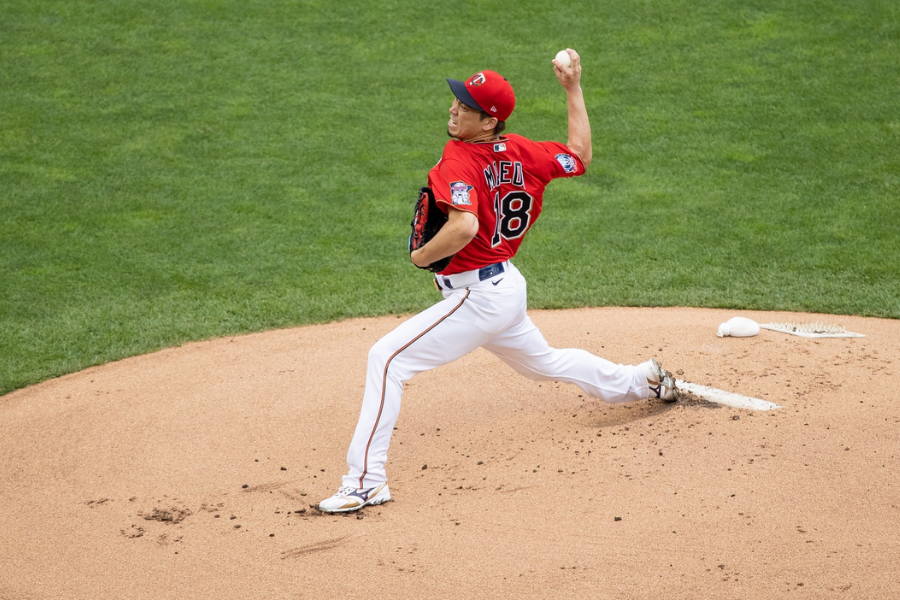
In Game 1 on Tuesday, Kenta Maeda will oppose Zack Greinke. That’s a pretty classic matchup, featuring veterans with ample postseason experience and the ability to dominate when they’re in command of their full arsenal. The numbers say Maeda is better than Greinke right now, though, and in watching the two pitch, one gets exactly the same impression. Maeda’s ability to pitch primarily with his secondary stuff has surpassed that of Greinke, as the former Cy Young winner has tried to manage a significant loss of velocity.

(To derive these estimates, I’ve averaged the player’s projected stats for 2020 from Baseball Prospectus’s PECOTA system with their actual numbers, giving both data points equal weight, because a 60-game season (shortened, in some cases, by trips to the injured list) shouldn’t color our perceptions of pitchers entirely. This is a reasonable projection of each pitcher’s true talent at this moment, from a purely statistical, performance-informed lens.)
Maeda can more easily miss bats, at this stage, and has a bigger margin for error, and it shows up in his advanced pitching metrics. Throwing both his slider and his changeup to hitters on either side of the plate makes a huge difference for him. Greinke, though known as an enthusiastic and frequent tinkerer, has never shown the willingness to lean on pitches other than his fastball as hard as Maeda has done in his first season with the Twins. That’s good news for the Twins, who struggle when a pitcher refuses to give in and throw them fastballs in traditional fastball counts.
Game 2 will probably be the first chance to see how Houston’s pitching plan for the series diverges from that of the Twins. Whereas Minnesota will go to their second-biggest name, the Astros reportedly plan to use Framber Valdez as a reliever. Valdez had the best numbers among all Astros starters this season. In fact, the only AL pitchers who finished with more Wins Above Replacement Player (WARP), according to Baseball Prospectus, were Shane Bieber and Maeda.
Instead of the left-handed Valdez, who might make multiple multi-inning appearances even in a three-game set, Baker will hand the ball to José Urquidy in Game 2. Interestingly, Urquidy bears some similarities to José Berríos. Both are relatively short right-handers. Both have big, two-plane breaking balls, though whereas Berríos throws just that one curve, Urquidy has both his slider and a truer curveball, with great vertical depth. Both are at their best when they’re able to work both laterally and vertically within the zone, making the most of their four-pitch mixes. Though far less experienced at the upper levels, Urquidy is only a year younger than Berríos.
Coming into this season, in fact, Urquidy might have been considered a better bet than Berríos. After his ascendant 2019, which culminated in a start in Game 4 of the World Series, he had better projected numbers than Berríos. He missed most of the season, though, after testing positive for COVID-19 at the beginning of the July training camp and spending the first month of the campaign on the injured list for undisclosed reasons.
Since returning to the Astros, Urquidy has a great ERA, but his peripheral numbers are much shakier. As a result, Berríos now projects as the better of the two starters.

We’ve seen such inconsistency from Berríos this year that it’s hard to feel overwhelmingly confident about this matchup. Urquidy has great stuff, not only with the aforementioned breaking balls, but with a four-seamer that works well at the top of the zone and a changeup that can really run away from left-handed batters. He’s probably somewhat closer to his preseason projections, and to his actual ERA, than to his dim advanced metrics, but with such a disrupted start to the season, it could also be that he’s just not going to be his best self in 2020.
If a Game 3 is necessary, the matchup of the starters will be as tight as the series itself. Michael Pineda has been solid since completing his suspension and rejoining the Twins rotation, but Lance McCullers, Jr. can dominate opposing batters with his power curveball, and he’s looked good since returning after a lengthy Tommy John rehab process.
Pineda’s slider should be highly effective against Houston’s heavily right-handed lineup, as it was when he faced similar offensive teams early this year. He’s fooled people a bit less with each start, though, and Rocco Baldelli figures to give him less time to struggle before going to the bullpen than he will with Maeda or Berríos. McCullers, meanwhile, has gotten right back into the habit of throwing a steady diet of curves, but they play a bit less effectively now that he seems to have left two miles per hour and a couple of inches of movement on the operating table.

If the series gets this far, it should be a tightly contested final game. These starters are almost identical in their overall quality at this point. It might well come down to whether Houston can still effectively deploy Valdez as a fireman after McCullers starts to flag, or whether the Twins can successfully fire their string of bullpen bullets past Houston and eke out a victory.
Overall, the Twins have the better starting staff for this short series. The margins are small enough, though, that variance will swallow the advantage. This battle won’t come down to which starters are better, because neither side’s are sufficiently better to show that here. It will come down, instead, to who executes better, avoids mental pitfalls, and is lifted at the right time by their manager. Given the track records of all six of these guys, though, it’s no easier to tell who might do those things right in a big game than it is to discern which one is better, in general. That’s what makes playoff baseball so much fun.





Recommended Comments
Create an account or sign in to comment
You need to be a member in order to leave a comment
Create an account
Sign up for a new account in our community. It's easy!
Register a new accountSign in
Already have an account? Sign in here.
Sign In Now