

Jump to content
Twins Daily
  • Create Account
  • Twins Draft Coverage

    Minnesota Twins 2025 MLB Draft Day 1 Recap: A Solid Shortstop & High Octane Arms

    Check out our recap of the Twins' day one picks in the 2025 MLB Draft.

    Jamie Cameron

    Twins Video

    The dust has settled on a frenetic day one of the 2025 MLB Draft. After 105 picks in an expanded opening day, the Twins have new prospects likely to join the organization soon. Here’s a rundown of their day one picks.

    16. Marek Houston, SS, Wake Forest (18th by consensus), slot value: $4,929,600
    Here’s an excerpt of our write-up on Houston from the consensus board:

    It's plus defense at shortstop, with good lateral quickness, soft hands, a great internal clock, and a plus arm combining for a complete offensive profile. He's 1B to Billy Carlson's 1A defensively for shortstops in this class.

    There's plenty to like in the offensive profile, too. It's a hit over power profile, headlined by strong bat-to-ball metrics and a history of walking more than he strikes out wherever he plays, including an excellent stint on the Cape after the 2024 season.

    Houston's power numbers (under the hood) didn't really hold up in ACC play. He finished the season with a .354/.458/.597 (1.055) line with 15 home runs and identical 15.4% strikeout and walk rates. Even so, it's an above-average hit and run, with plus defense and a plus arm at shortstop. He's a first-half of the first-round type of guy in this class.

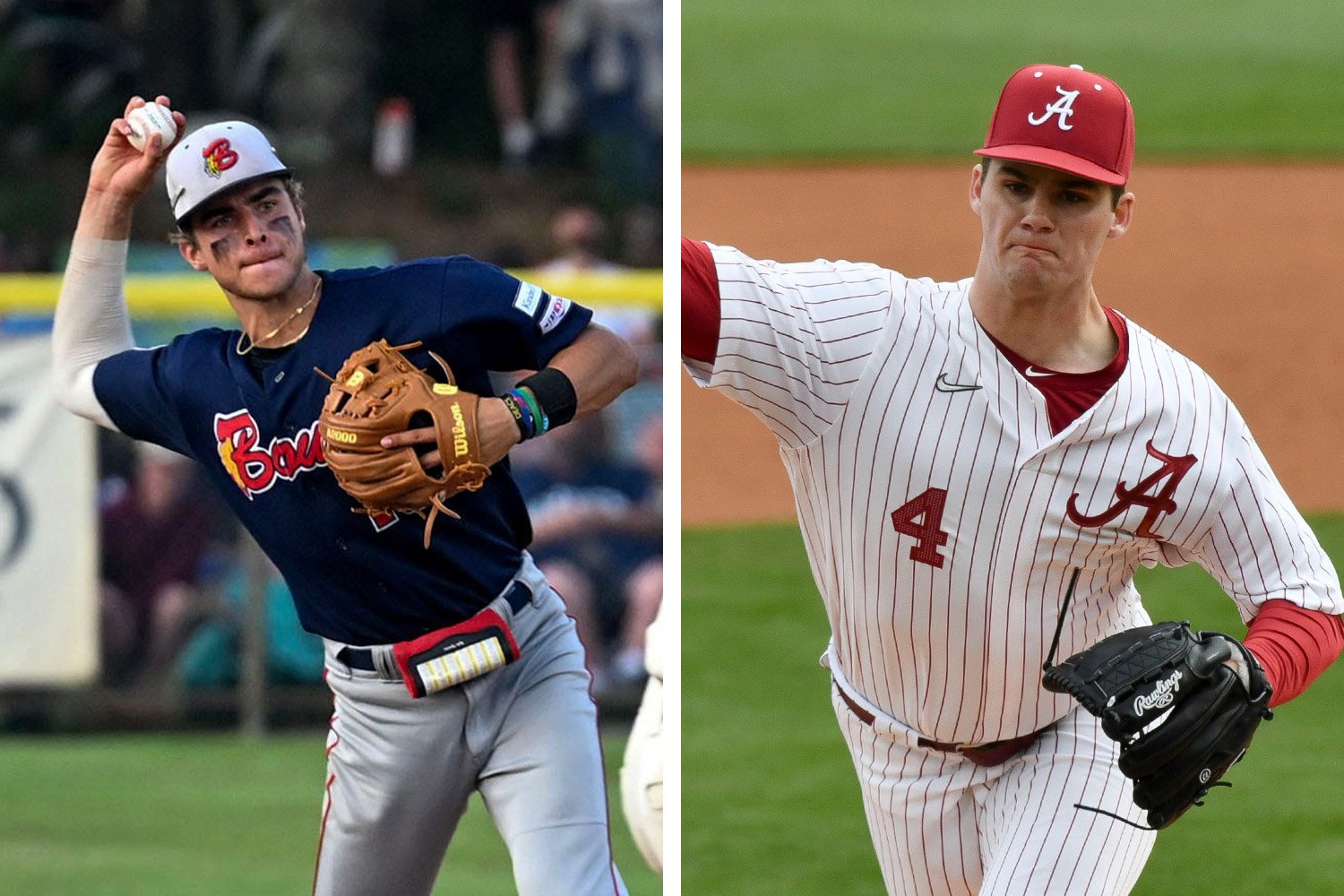
    36. Riley Quick, RHP, Alabama (32nd by consensus), slot value: $2,692,000
    Here’s an excerpt of our write-up on Quick from the consensus board:

    Quick is another riser in the 2025 cycle on the pitching side. A physically imposing frame at 6'6, 250, the stuff and the results are starting to come together for the Alabama righty after recovering from TJ surgery.

    Quick's fastball is a sinker that sits in the mid-90s. He can reach back for 98 mph. It generated a ground ball rate north of 60% in 2024, and it's easy to see why, with the pitch creating 20 inches or so of run. Quick has a relatively low release height for his size. He mixes in a sweeper, which is already above average and could be plus in time. His changeup, like his sinker, gets a ton of horizontal break.

    Quick delivery is relatively consistent for such a physical pitcher. It's easy to see him carrying a significant workload as a pro if he can stay healthy. Despite the size and stuff, Quick hasn’t missed the amount of bats you’d like to see. In 2025, he finished with a 3.49 FIP, 25.9 K%, and 8.9 BB% in 62 IP. If the right organization gets him, you can see him being a tweak or two away from being a monster.

    54. Quentin Young, SS, Oaks Christian HS, CA, (51st by consensus), slot value: $1,761,100
    Here’s an excerpt of our write-up on Young from the consensus board:

    At 6'5, 215, Quentin Young (nephew of Delmon and Dmitri) is a physical monster with a ton of projection in a super athletic frame. A right-handed hitter, there's a ton of raw power here, combined with some swing and miss concerns, particularly against off-speed stuff. It's a violent swing and aggressive approach at the plate that could be reined in to get to a little more refinement with his swing decisions and control of at-bats. He's easily got a plus arm, and with infield and outfield experience, that's likely a 3B/RF profile in time.

    How the hit tool develops and the pitch recognition, in particular, will likely govern Young's ceiling. He's committed to LSU, which may be a tough connection to break, depending on where he's taken.

    88. James Ellwanger, RHP, DBU, (86th by consensus, slot value: $893,000
    Here’s an excerpt of our write-up on Ellwanger from the consensus board:

    Ellwanger was a notable prospect prior to the 2023 draft and slipped due to signability concerns. He was taken by the Nats in the 19th round and is their type of prep power arm. It's an intriguing combination of size, stuff, and refinement needed, particularly on the secondary pitches and with his control.

    Ellwanger stands 6'5, 205, it's a lean frame with more strength to add. Even so, he can run his fastball up into the high 90s with good ride and armside run. There's a good curveball present too, an above-average pitch, with a slider and changeup that haven't proven to be as effective yet. Strike throwing has also been a challenge for Ellwanger at times. Despite too many free passes (13.5%), he's performed solidly in 2025. It's a 3.07 FIP and 33 K%. You'll need a drafting organization that knows what they're doing with pitchers, but the arm talent is considerable.

    Analysis
    We often talk about draft classes like financial portfolios. You want diversity in your class. The Twins accomplished that in some unique and fun ways on day one. In Houston, you have a high-floored, low-variance college shortstop who should stick at the position. If you’ve ever wondered what the Twins player development team could do with higher-octane starting arm talent, you’ll get that look with both Quick and Ellwanger. In Young, they’ve landed some of the best raw power in the draft class.

    The Twins haven’t recently drafted elite arm talent from college arms on day one. There are prep examples (Soto, Hill), but this represents a different approach. It also represents them leaning into one of the best demographics in the draft class. I wouldn’t expect to see Quick or Ellwanger pitch in 2026, and I’d equally expect to be blown away by the stuff in 2026.

    The Twins' recent pick most similar to Young is Brandon Winokur. Young has elite power for a prospect his age. His batting practice at the Draft Combine was nukes drilled into the seats at 112-115 mph. I’d expect to see rawness, refinement needed in the hit tool, and absolutely massive home runs when he debuts.

    Finally, there’s Houston. I didn’t love his profile, but that’s more of a personal preference. I like the pick plenty in the context of the other picks. So let’s dig in on some of his numbers from 2025. It’s an 86th percentile walk rate, 70th percentile strikeout rate, and 87th percentile in zone contact rate. Even if the power is fringe average, that’s a skill set that should provide solid value as he’s going to get on base and hit plenty. It’s a plus arm and above average speed, too (19/21 in stolen bases in 2025). If we’re looking at which tools will accrue value, for Houston, the org is betting on hit, run, defense, with 15 home run power at a premium defensive position. It makes sense.

    What are your thoughts on the Twins' day one? Share your thoughts in the comments.


    Check out our 2026 mock draft board, updated regularly, and with detailed player write-ups!

    View The Mock Draft Board

    Follow Twins Daily For Minnesota Twins News & Analysis

    Recent Twins Articles

    Recent Twins Videos

    Twins Top Prospects

    Marek Houston

    Cedar Rapids Kernels - A+, SS
    The 22-year-old went 2-for-5 on Friday night, his fourth straight multi-hit game. Heading into the week, he was hitting .246/.328/.404 (.732). Four games later, he is hitting .303/.361/.447 (.808).

    User Feedback

    Recommended Comments


    Featured Comments

    I would have taken Irish over Houston due to the fact he was one of the best college bats in the draft. If he couldn't stick at  CATCHER for some reason, there's a pretty good OF in there I think. But I don't dislike Houston at all.

    He and Culpepper give the Twins a pair of SS to follow Correa. Culpepper can also play 2B/3B depending on how things shake out. Keaschall can play 2B/1B/OF. Lee can play 3 spots, though I'm not expecting him to be the Correa heir. DeBarge may be the next Castro, but even better speed. Schobel is also being groomed as a SU player. And without even considering Lewis...and even Amick potentially...locking in at 3B or 1B, what they've done is create a potentially excellent and versatile INF with OF options. 

    Quick is very exciting. He's got everything you'd want in a top pitching prospect. If he hadn't missed 2024 from TJ, I wonder if he'd even be available at 16 this year? 

    Ellwanger is very similar in build, velocity, potential velocity, and an already good 2nd offering. But he's also only a sophomore...recently turned 21yo...and barely threw in 2024. So he's very raw. But there's a ton of talent to work with in both these arms. 

    I agree it would have been nice to grab another good HS arm to develop in the lower minors. But it sure sounds like it was a down year for prep arms. And a good year to invest in college arms.

    You've got to question a young bat that has contact issues. But when someone like Young is available, a good athlete with so much power and potential, you have to take the chance to see if that contact and recognition can develop. If it does, you've got someone really good and potentially dangerous. He's this year's version of a Winokur potential pick.

    They leaned in to position players more in 2024, so I can see this draft being a little more pitching heavy. I think they're off to a really good start. And I really do like the variety of talent so far.

    38 minutes ago, tarheeltwinsfan said:

    CH, I too was initially hoping the Twins would draft Ike Irish at 16, but I wonder why he didn't catch much, if any, this past season. I know he had a broken scapula, but I don't know how much that factored into the decision for him to play RF this season after the injury. He may have played RF because he is too good  a hitter to risk injuries at catcher. Or Auburn's second string catcher may have been better than Auburn's second string RF'er. Another considertion is that the Twins top two prospects (Jenkins and Rodriguez) are left-handed hitting outfielders and Irish bats lefty. In addition, Wallner and Larnach both bat lefty also and they are both  relatively young and still developing.  I just think the Twins have enough young lefty hitting outfielders and didn't want to take a chance on Irish's catching ability. 

    Bodine and Stevenson (30,35) were picked right ahead of Quick at 36. I wonder if one were available, would we have taken either? Also, Baltimore took Irish and Bodine so they are doubling down….. and they have lots of early picks

    9 minutes ago, Fatbat said:

    Bodine and Stevenson (30,35) were picked right ahead of Quick at 36. I wonder if one were available, would we have taken either? Also, Baltimore took Irish and Bodine so they are doubling down….. and they have lots of early picks

    Very good points Fatbat.

    19 minutes ago, chpettit19 said:

    I'd hate the "we have too many young, lefty outfielders" reasoning completely. Baltimore has a ton of lefty outfielders (Mullins, Cowser, Kjerstad, Bradfield Jr, Beavers) and a big-time, switch-hitting catcher plus a top 10-15 global prospect who's a lefty hitting catcher. Their 2nd pick was a switch-hitting catcher. So, they didn't seem to care about adding another lefty catcher/outfielder plus another catcher to their mix (oh, and they took another lefty outfielder at #37). I don't care about positional fit in a system at all. Get the best talent. You never know what your team is going to look like in the future. Should never be a consideration, in my opinion. Get the best talent you can and figure it out from there. But I understand some people prefer to try to chase better system fits. And I don't expect Larnach to be around much longer, honestly. I don't think they'll pay his arb increases.

    I don't know why they didn't draft him, and we never will. There are a billion very good reasons for them to not draft him. They very simply could've thought Houston was the better overall player. That's a good enough reason. My understanding (and that could be totally wrong) was that he didn't catch anymore because he couldn't throw well enough after the broken scapula. Again, could be totally wrong, but that's what I thought it was. I don't think he'll be a good outfielder defensively so if there's no chance he catches it'd change my opinion on things, but my understanding was that he only stopped catching because of the injury and that him going back behind the plate was going to be mostly about a team's willingness to wait on him defensively even if the bat was ready.

    I understand your points, but I feel Baltimore needed to draft college pitching way more than Baltimore needed  to draft 2 more catchers and another lefty hitting OF'er.  In other words we disagree on the theory of drafting for need vs. drafting the best available player. I realize I have over simplified our differences by my statement above, so I'm going to take a nap. LOL.

    3 hours ago, nicksaviking said:

    I don't love the Houston pick. Glove-first hitters don't tend to be more than utility players at the MLB level and the Twins desperately need offense. The guy is going to have to end up hitting, and not just singles.

    I like the pitchers, but if it becomes clear that they both should be relievers, I don't want the Twins farting around for years trying to force the issue as starters.

    Young's bat sounds like a huge boom or bust profile, but I'm all for rolling the dice. 

    Agreed. The first pick is fine, but I prefer upside there. We'll see. 

    39 minutes ago, Fatbat said:

    Bodine and Stevenson (30,35) were picked right ahead of Quick at 36. I wonder if one were available, would we have taken either? Also, Baltimore took Irish and Bodine so they are doubling down….. and they have lots of early picks

    They'll move Irish to the OF I'm guessing? Heck, if I'm them, I trade him for pitching in the off season. 


    Create an account or sign in to comment

    You need to be a member in order to leave a comment

    Create an account

    Sign up for a new account in our community. It's easy!

    Register a new account

    Sign in

    Already have an account? Sign in here.

    Sign In Now

×
×
  • Create New...

