



John Bonnes
-
Posts
6,782 -
Joined
-
Last visited
-
Days Won
4
Content Type
Profiles
News
Minnesota Twins Videos
2026 Minnesota Twins Top Prospects Ranking
2022 Minnesota Twins Draft Picks
Minnesota Twins Free Agent & Trade Rumors, Notes, & Tidbits
Guides & Resources
2023 Minnesota Twins Draft Picks
The Minnesota Twins Players Project
2024 Minnesota Twins Draft Picks
2025 Minnesota Twins Draft Pick Tracker
2026 Minnesota Twins Draft Tracker: Picks & Bonuses
Forums
Blogs
Events
Store
Downloads
Gallery
Everything posted by John Bonnes
-
 Aaron and John talk about the details of MLB's plan for a 2020 season, whether the Twins would be helped or hurt by the proposed changes, Rich Hill's rehab status, how to sell a Michael Jordan rookie card, and mailbag questions from listeners. You can listen by downloading us from iTunes, Spotify, Stitcher, iHeartRadio or find it at GleemanAndTheGeek.com. Or just click this link. Listen now Click here to view the article
 -
 Listen now
 -
I'll give a quick two cents: 1) The players' union has full vision to MLB's books, so they know how much of the revenue is affected by not having crowds at the games, so there shouldn't be any guessing. (Estimates are it's 1/4 to 1/3 of the revenues.) There can be a lot of sword-rattling at this point, but when they get the final proposal, I'm guessing it'll include everyone getting about 35-40% of their original salary, and the union will vote up or down on it, and it'll pass. 2) As for the legitimacy, the proof will be in the pudding. It'll come back with great pomp and circumstance (especially if the start is timed with 4th of July) and it sounds like it won't be alone, as soccer, golf and other sports are firing up, too. People will be pumped. It'll be weird with no crowds, but it might include some breakthrough broadcast ideas, too. I'll be shocked if many players opt out, though I don't know how to define "many." Maybe 1-2 per team? And it won't be all the superstars - it'll be those who are legit worried about the health of someone in their family due to high risks. Regardless, the fans of the expected good team that sucks will decry the legitimacy, but the competing teams's fan bases will be just fine with it all. So will the players and teams themselves.
-
Join Aaron and John as they watch the second half of Game 6 of the 1991 World Series. Watch along on YouTube here. You can listen by downloading us from iTunes, Spotify, Stitcher, iHeartRadio or find it at GleemanAndTheGeek.com. Or just click this link. Listen by clicking here. Click here to view the article
-
 Listen by clicking here.
 -
Join Aaron and John as they watch Game 6 of the 1991 World Series. (Watch along on YouTube here.) You can listen by downloading us from iTunes, Spotify, Stitcher, iHeartRadio or find it at GleemanAndTheGeek.com. Or just click this link. . . . LISTEN HERE. . . . Click here to view the article
-
 . . . LISTEN HERE. . . .
 -
The Greatest Twins Season that Never Happened
John Bonnes replied to Ted Schwerzler 's topic in Twins Daily Front Page News
This should absolutely be a series. Now do Liriano and the Twins 2006 season with Santana, Liriano and Radke in the playoffs. (RAGE)- 7 replies
-
- 2
-

-
- minnesota twins
- justin morneau
- (and 1 more)
-
Good lord is pottery hard.
-
Twins All-Decade Team, the '70s (The Hitters)
John Bonnes replied to Seth Stohs's topic in Twins Daily Front Page News
Good lord what glorious hair. -
Top 5 Minnesota Twins Trades that Built Contenders
John Bonnes replied to Nate Palmer's topic in Twins Daily Front Page News
Knoblauch? -
You're Going To Love Watching Baseball This Year
John Bonnes replied to John Bonnes's topic in Twins Daily Front Page News
It appears the tests are on the critical path. The line in the story is: "how quickly fast-result coronavirus tests will be so ubiquitous that there can be enough for thousands of MLB participants to take them a daily basis." I'm not advocating that precious tests get diverted to MLB players. If the pessimism for the start of the season is that we're just never going to have enough tests this summer to make daily testing feasible, I guess I can see that. Certainly, the federal government hasn't been capable of solving the issue right now. But the covid test issue is a billion dollar solution just waiting to be resolved by any number of American and world companies. I'll agree its the remaining greatest unknown for this plan. Maybe it's foolish to think it will be solved. But it's the key to not only the MLB season starting, but any number of industries. -
It is natural to focus on dates and locations, but those were not the important part of last week’s ESPN report that MLB and MLBPA had met with CDC, HHS and other health care officials to discuss a path for MLB games' restart. The important part is that if those three stakeholders – MLB, MLBPA, and federal health officials - see a path, then who is going to stop the return of baseball?This is not a negotiation between the MLB and MLBPA. They’re mostly aligned over trying to find their path to an enormous pot of money. Both will need to give up something dear to them. The owners will need to give up stadium revenues, because these games can’t be played in front of crowds. The players are going to need to give up their freedom, essentially being quarantined with their teammates and support staff for the duration of whatever constitutes spring training, the regular season and the postseason. That’s an enormous ask, but the quarantine is to protect the players. The owners have no dog in that fight; they’re not the ones who are going to get sick. That concern is between health officials and the union, or maybe more accurately is an MLBPA internal matter between players who want a paycheck and those willing to walk away for a year. Grandiose anti-plan media quotes don’t mean much in that context. One would get the same quotes if players were asked the flip side of the question: “So how do you feel about not getting paid?” Considering the minimum wage for a ballplayer is close to $3500 per game – and it obviously can be 50 times that for premier players – there is going to be a fair amount of appetite in accepting some separation from families. Plus, if that price is too high for some players to pay, there will undoubtedly be a provision for players to opt out. We don’t know where the season is going to take place yet, but we know the more important part – it’s going to be localized so travel is minimized. That’s likely why Phoenix was the initial suggestion – all those spring training complexes are in one metro area. Everybody can sleep in their own heavily-controlled room each night. Expanding half of the league to play in Florida is trickier. Florida’s Grapefruit League is more spread out. If the Fort-Myers-based Twins travel to the Clearwater-based Phillies (a three-hour drive) for a three-game set, the option is to travel six hours each day or find a quarantine-level secure place to stay in Clearwater. With the CDC concerned about the virus spreading from county to county, that may be too much for them to approve. If that problem seems to be too much to overcome, well, you ain’t seen nothing yet. There are 20 problems like that. For instance, there is the support staff for the players: from coaches and trainers to bus drivers and cleaning staff. Won’t they need to be quarantined, too? To handle all of those challenges and logistics requires a lot of resources– but there MLB and the MLBPA are in luck. Ten billion dollars are at stake, and roughly half of that goes to each side. The human mind has trouble imagining how much money that is, so engage in this quick mind exercise: Imagine you’re standing at one end of a football field. And along the sideline of that field is a bucket at every yard marker. 100 buckets.Now turn 90 degrees sideways, and there is another football field. Along its sideline are another 100 buckets.Now, extend those yardlines from both fields so they form a grid and put a bucket wherever they meet, so you have 100 buckets by 100 buckets or 10,000 buckets.Now look into one of those buckets. There is a million dollars. And that is the case for all 10,000 of those buckets. That’s $10 billion.Need to pay $40,000 apiece to a hundred quarantined support people for each team for those four months? That’s 120 buckets gone. Still leaves 9880 buckets. Need to buy 100,000 coronavirus tests for $200 apiece? That’s twenty more buckets. Still have 9860 left. Sure, there is a point where those buckets run out, but – well, that’s a lot of buckets. Plus, there is another reason to start spending those buckets to restart the season: for each game that is cancelled, for every day that passes that cannot be made up, sixty of those buckets disappear anyway. That’s why both sides are looking at just how soon games can start, but now we get to the areas where the team has limited control or options. The one mentioned in the original story was how quickly fast-result coronavirus tests will be so ubiquitous that there can be enough for thousands of MLB participants to take them a daily basis. For issues like this, MLB must work on what they can control and trust that American (or world) industry, or health officials’ increasing understanding of the virus, will get over existing barriers. MLB and the players can influence the timeline, but not control it. But does it matter to fans whether the games start on June 1st, July 1st or August 1st? Sooner would be better than later, but having a season is the important part. While it would be nice if it was 162 games and in front of crowds and played in traditional divisions and included 100% of the players – we’ll work with what we have. Baseball was played during World War II. The St. Louis Cardinals still celebrate that 1942 World Championship. A 2020 season is not inevitable, but it’s on the right path. Stakeholders are aligned, budgets determined, logistics worked, and contingencies planned. The obstacles are many, but the resources are plentiful and motivations are clear. Announcing a date and a place are not the first step; they’re the last step in the process. And yeah, I’m really encouraged by it, which calls into question my objectivity. So subjectively I’ll say: you’re going to get to watch baseball this year. And you’re going to love it, all the more because of what was done to get there. Click here to view the article
-
 This is not a negotiation between the MLB and MLBPA. They’re mostly aligned over trying to find their path to an enormous pot of money. Both will need to give up something dear to them. The owners will need to give up stadium revenues, because these games can’t be played in front of crowds. The players are going to need to give up their freedom, essentially being quarantined with their teammates and support staff for the duration of whatever constitutes spring training, the regular season and the postseason. That’s an enormous ask, but the quarantine is to protect the players. The owners have no dog in that fight; they’re not the ones who are going to get sick. That concern is between health officials and the union, or maybe more accurately is an MLBPA internal matter between players who want a paycheck and those willing to walk away for a year. Grandiose anti-plan media quotes don’t mean much in that context. One would get the same quotes if players were asked the flip side of the question: “So how do you feel about not getting paid?” Considering the minimum wage for a ballplayer is close to $3500 per game – and it obviously can be 50 times that for premier players – there is going to be a fair amount of appetite in accepting some separation from families. Plus, if that price is too high for some players to pay, there will undoubtedly be a provision for players to opt out. We don’t know where the season is going to take place yet, but we know the more important part – it’s going to be localized so travel is minimized. That’s likely why Phoenix was the initial suggestion – all those spring training complexes are in one metro area. Everybody can sleep in their own heavily-controlled room each night. Expanding half of the league to play in Florida is trickier. Florida’s Grapefruit League is more spread out. If the Fort-Myers-based Twins travel to the Clearwater-based Phillies (a three-hour drive) for a three-game set, the option is to travel six hours each day or find a quarantine-level secure place to stay in Clearwater. With the CDC concerned about the virus spreading from county to county, that may be too much for them to approve. If that problem seems to be too much to overcome, well, you ain’t seen nothing yet. There are 20 problems like that. For instance, there is the support staff for the players: from coaches and trainers to bus drivers and cleaning staff. Won’t they need to be quarantined, too? To handle all of those challenges and logistics requires a lot of resources– but there MLB and the MLBPA are in luck. Ten billion dollars are at stake, and roughly half of that goes to each side. The human mind has trouble imagining how much money that is, so engage in this quick mind exercise: Imagine you’re standing at one end of a football field. And along the sideline of that field is a bucket at every yard marker. 100 buckets. Now turn 90 degrees sideways, and there is another football field. Along its sideline are another 100 buckets. Now, extend those yardlines from both fields so they form a grid and put a bucket wherever they meet, so you have 100 buckets by 100 buckets or 10,000 buckets. Now look into one of those buckets. There is a million dollars. And that is the case for all 10,000 of those buckets. That’s $10 billion. Need to pay $40,000 apiece to a hundred quarantined support people for each team for those four months? That’s 120 buckets gone. Still leaves 9880 buckets. Need to buy 100,000 coronavirus tests for $200 apiece? That’s twenty more buckets. Still have 9860 left. Sure, there is a point where those buckets run out, but – well, that’s a lot of buckets. Plus, there is another reason to start spending those buckets to restart the season: for each game that is cancelled, for every day that passes that cannot be made up, sixty of those buckets disappear anyway. That’s why both sides are looking at just how soon games can start, but now we get to the areas where the team has limited control or options. The one mentioned in the original story was how quickly fast-result coronavirus tests will be so ubiquitous that there can be enough for thousands of MLB participants to take them a daily basis. For issues like this, MLB must work on what they can control and trust that American (or world) industry, or health officials’ increasing understanding of the virus, will get over existing barriers. MLB and the players can influence the timeline, but not control it. But does it matter to fans whether the games start on June 1st, July 1st or August 1st? Sooner would be better than later, but having a season is the important part. While it would be nice if it was 162 games and in front of crowds and played in traditional divisions and included 100% of the players – we’ll work with what we have. Baseball was played during World War II. The St. Louis Cardinals still celebrate that 1942 World Championship. A 2020 season is not inevitable, but it’s on the right path. Stakeholders are aligned, budgets determined, logistics worked, and contingencies planned. The obstacles are many, but the resources are plentiful and motivations are clear. Announcing a date and a place are not the first step; they’re the last step in the process. And yeah, I’m really encouraged by it, which calls into question my objectivity. So subjectively I’ll say: you’re going to get to watch baseball this year. And you’re going to love it, all the more because of what was done to get there.
 -
The Canseco brothers have LOTS better ideas that that.
-
I Ate Like the Minnesota Twins For a Day
John Bonnes replied to renabanena's topic in Twins Daily Front Page News
I love this story so much I want to marry it. Also, why DON'T we cook pasta in the sauce like all the time? My gawd that sounds good! -
Aaron and John talk about actual Twins roster moves (sort of), a new view of the Buxton-for-Syndergaard rumors, a baseball season possibly starting soon in South Korea, and Aaron's stint as the Twins' baseball manager. You can listen by downloading us from iTunes, Spotify, Stitcher, iHeartRadio or find it at GleemanAndTheGeek.com. Or just click this link. PLAY GLEEMAN AND THE GEEK Click here to view the article
-
 PLAY GLEEMAN AND THE GEEK
 -
Here's the outrageous thing about the salaries: improving it to a more livable wage is a rounding error to MLB teams. 8 minor league team * 25 man rosters is roughly 200 players. Say you wanted to bring them up to an average of $40K per year, or $20K for the six months of the season. That comes to an increase of about $10K per player, or $2M per year. That's less than a 1% increase against team revenues. And the benefits of doing so would be real. How many players would be more willing to take a chance on a career for that minor investment? How many would stick around another year on their dream? How many would perform better without the distractions of worrying how the hell they get through the season on almost nothing? It is truly penny-wise and pound-foolish the way MLB does this right now. This shutdown is just exacerbating a self-created problem.
-
The History of the Minnesota Twins Bomba Belt
John Bonnes replied to Matthew Taylor's topic in Twins Daily Front Page News
I love this idea. I would suggest one change in approach, and one reexamination: Approach: maybe, like the hall of fame, we have a three-year waiting period. The recent years are too tempting to examine in a too granular fashion. We can't see the forest, just the trees. I mean, if we had done this in 1982, we might have had Kenny Landreux get the belt in 1980 just because of his hitting streak. (Though, TBH, even then we knew that was a mediocre player having a fluke year). But I think a three year holding period would allow some perspective. Rexamination: It is damn hard not to give the belt to a guy who literally had a run of MVP-type season in the late 60s, but the Oliva/Killebrew battle for this belt in the 60s is real. I wonder if we shouldn't consider a Killebrew/Oliva/back to Killebrew sequence. I can see Oliva having it 64-66 - even though he literally lost the MVP vote to a teammate (Zoilo Versalles) one of those years, and was a rookie another one of those years. I would love a breakdown of this, in case anyone is up to it. -
Aaron and John break down the announced agreement between MLB and the players' union and how it impacts the Twins, including when and where games might be played, how much players will get paid, who will become free agents and how the next MLB Draft will work. You can listen by downloading us from iTunes, Spotify, Stitcher, iHeartRadio or find it at GleemanAndTheGeek.com. Or just click this link. http://traffic.libsy...3?dest-id=74590 Click here to view the article
-
 http://traffic.libsyn.com/gleemangeek/Ep_472.mp3?dest-id=74590
 -
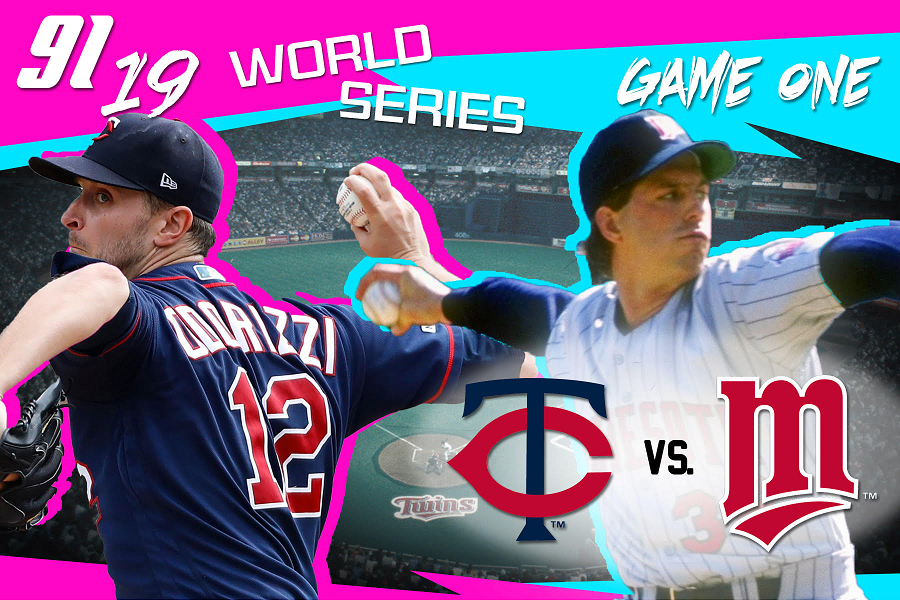
This week, with the help of Out of the Park, we’ve simulated the 91/19 World Series, a seven-game battle between the 1991 Twins and the 2019 Twins. Kent Hrbek, placed in an unfamiliar spot, drove home seven in a 16-3 rout of the 2019 Bomba Squad, leading the 1991 Twins to a 1-0 series lead in the 91/19 World Series. A surprising lineup decision paid off early, turning the Metrodome into a nearly four-hour long party.“The crowd was crazy,” said 2019 starting pitcher Jake Odorizzi. “I played in Tampa Bay, so this was pretty much the polar opposite of that. Not that it bothered me. What bothered me was Herbie. You have to tip your hat to him.” Hrbek had plenty of opportunities to tip his own hat to the 55,426 full-throated fans, most notably after a third inning grand slam put the 1991 Twins up 8-0. “Right place, right time,” laughed Hrbek. Getting Hrbek into the right place at the right time involved juggling the lineup. With Dan Gladden out tonight with an undisclosed leg injury, Kelly shifted some players around – and raised some eyebrows. Kent Hrbek batting second instead of his traditional cleanup spot? What is this? 2020? “We might know a few things in 1991,” smirked Kelly. Like maybe he wanted his best left-handed hitter getting to face the right-handed Odorizzi a few extra times? “Maybe that,” deadpanned Kelly. “Herbie can swing the bat. He can hit anywhere in the lineup.” Last night it could not have worked better. By the time the third inning had ended, Hrbek had three hits, two home runs, six RBI and had scored three runs. He had the first hit of the game - a single - in the first inning and came around to score on a Chili Davis single. In the second inning he blasted a line drive over the left field wall that also brought home Mike Pagliarulo and stretched the lead to 4-0. The big blow came in the third inning. Odorizzi, who struggled with his control the entire night, started the inning by walking Brian Harper and Gene Larkin. After striking out Greg Gagne, he also walked Pagliarulo, loading the bases. That ended his night. Still, the 2019 Twins nearly escaped. Ryne Harper was brought in to face the top of the order and struck out Chuck Knoblauch on three pitches. That brought up the second spot in the order….and Hrbek? “No, I don’t remember ever hitting second, or at least not starting a game there,” Hrbek said when asked about his spot in the order. “Maybe as a pinch-hitter?” But he was there last night, with the bases loaded, two outs, and a chance to turn this first game of the series into a laugher. Turn he did, on a 1-1 pitch, lifting a majestic fly ball over the baggy in right-center field. The party in the Metrodome stands began. It was a little different in the 2019 Twins dugout. “I have never heard sound like that in my life,” said Odorizzi. While he said the crowd noise didn’t bother him, Odorizzi never did get on track. He didn’t give up the backbreaking second home run, but he kept setting the table with walks while falling behind in the count. He lasted just 2 1/3 innings and walked six. He also gave up five hits while striking out two. The first seven runs of the game were charged to him. The early fireworks paved the way for, and overshadowed, a gem by 1991 starting pitcher Keven Tapani. Tapani nearly pitched a complete-game shutout. After striking out the first two batters in the ninth inning, a ground ball to second base should’ve ended his night. But Hrbek dropped a throw from Knoblauch, allowing Jorge Polanco to reach. Luis Arraez followed that with a double, bringing Tapani to 101 pitches and ending his night before the final out. "We'll need to turn to him again soon," said Kelly. David West came in and got the final out, but only after giving up a three-run bomb to Nelson Cruz that provided a little balm to an otherwise shell-shocked 2019 Twins squad. They’ll attempt to rebound tomorrow night with their ace Jose Berrios on the mound. But the 1991 Twins will have their own ace, Jack Morris, attempt to put them up 2-0 before they travel across downtown to Target Field for Game 3. You can find the boxscore and pitch-by-pitch results for Game One attached below. If you would like to learn more about Out of the Park 21, please click on this link. If you would like to try it, you can also download it for 10% off the regular price using the code TWINSDAILY. Download attachment: MLB Box Score, Minnesota 2019 Twins at Minnesota 1991 Twins Game 1.pdf Download attachment: Minnesota 2019 Twins @ Minnesota 1991 Twins Game Log Game 1.pdf Click here to view the article
-
91/19 World Series, Game 1: Right Time, Right Place for Herbie
John Bonnes posted an article in Twins
 “The crowd was crazy,” said 2019 starting pitcher Jake Odorizzi. “I played in Tampa Bay, so this was pretty much the polar opposite of that. Not that it bothered me. What bothered me was Herbie. You have to tip your hat to him.” Hrbek had plenty of opportunities to tip his own hat to the 55,426 full-throated fans, most notably after a third inning grand slam put the 1991 Twins up 8-0. “Right place, right time,” laughed Hrbek. Getting Hrbek into the right place at the right time involved juggling the lineup. With Dan Gladden out tonight with an undisclosed leg injury, Kelly shifted some players around – and raised some eyebrows. Kent Hrbek batting second instead of his traditional cleanup spot? What is this? 2020? “We might know a few things in 1991,” smirked Kelly. Like maybe he wanted his best left-handed hitter getting to face the right-handed Odorizzi a few extra times? “Maybe that,” deadpanned Kelly. “Herbie can swing the bat. He can hit anywhere in the lineup.” Last night it could not have worked better. By the time the third inning had ended, Hrbek had three hits, two home runs, six RBI and had scored three runs. He had the first hit of the game - a single - in the first inning and came around to score on a Chili Davis single. In the second inning he blasted a line drive over the left field wall that also brought home Mike Pagliarulo and stretched the lead to 4-0. The big blow came in the third inning. Odorizzi, who struggled with his control the entire night, started the inning by walking Brian Harper and Gene Larkin. After striking out Greg Gagne, he also walked Pagliarulo, loading the bases. That ended his night. Still, the 2019 Twins nearly escaped. Ryne Harper was brought in to face the top of the order and struck out Chuck Knoblauch on three pitches. That brought up the second spot in the order….and Hrbek? “No, I don’t remember ever hitting second, or at least not starting a game there,” Hrbek said when asked about his spot in the order. “Maybe as a pinch-hitter?” But he was there last night, with the bases loaded, two outs, and a chance to turn this first game of the series into a laugher. Turn he did, on a 1-1 pitch, lifting a majestic fly ball over the baggy in right-center field. The party in the Metrodome stands began. It was a little different in the 2019 Twins dugout. “I have never heard sound like that in my life,” said Odorizzi. While he said the crowd noise didn’t bother him, Odorizzi never did get on track. He didn’t give up the backbreaking second home run, but he kept setting the table with walks while falling behind in the count. He lasted just 2 1/3 innings and walked six. He also gave up five hits while striking out two. The first seven runs of the game were charged to him. The early fireworks paved the way for, and overshadowed, a gem by 1991 starting pitcher Keven Tapani. Tapani nearly pitched a complete-game shutout. After striking out the first two batters in the ninth inning, a ground ball to second base should’ve ended his night. But Hrbek dropped a throw from Knoblauch, allowing Jorge Polanco to reach. Luis Arraez followed that with a double, bringing Tapani to 101 pitches and ending his night before the final out. "We'll need to turn to him again soon," said Kelly. David West came in and got the final out, but only after giving up a three-run bomb to Nelson Cruz that provided a little balm to an otherwise shell-shocked 2019 Twins squad. They’ll attempt to rebound tomorrow night with their ace Jose Berrios on the mound. But the 1991 Twins will have their own ace, Jack Morris, attempt to put them up 2-0 before they travel across downtown to Target Field for Game 3. You can find the boxscore and pitch-by-pitch results for Game One attached below. If you would like to learn more about Out of the Park 21, please click on this link. If you would like to try it, you can also download it for 10% off the regular price using the code TWINSDAILY. MLB Box Score, Minnesota 2019 Twins at Minnesota 1991 Twins Game 1.pdf Minnesota 2019 Twins @ Minnesota 1991 Twins Game Log Game 1.pdf
 -
Aaron and John talk about the odds of 2020 featuring zero games vs. games with no crowds vs. games with crowds, plus the search for toilet paper, how paychecks and service time will work, and whether the Twins are helped or hurt by a sprint instead of a marathon.You can listen by downloading us from iTunes, Spotify, Stitcher, iHeartRadio or find it at GleemanAndTheGeek.com. Or just click this link. Listen Here! Click here to view the article
