



John Bonnes
-
Posts
6,782 -
Joined
-
Last visited
-
Days Won
4
Content Type
Profiles
News
Minnesota Twins Videos
2026 Minnesota Twins Top Prospects Ranking
2022 Minnesota Twins Draft Picks
Minnesota Twins Free Agent & Trade Rumors, Notes, & Tidbits
Guides & Resources
2023 Minnesota Twins Draft Picks
The Minnesota Twins Players Project
2024 Minnesota Twins Draft Picks
2025 Minnesota Twins Draft Pick Tracker
2026 Minnesota Twins Draft Tracker: Picks & Bonuses
Forums
Blogs
Events
Store
Downloads
Gallery
Everything posted by John Bonnes
-
 Click Here To Listen Now
 -
 For years you’ve wanted to go to the Diamond Awards. This year, they’re coming to you. They’re also free. Check that – they’re free AND you get stuff, just for registering. But you need to register soon. The Minnesota Twins’ Diamond Awards are going virtual, and everyone is invited. The event is Wednesday, December 9th at 7:00 PM. Last year tickets cost $150, but this year you’ll watch your favorite Twins’ players get their awards, bid on the silent auction and receive your very own viewing guide complete with a Bombo Mocktail Recipe absolutely free.Like previous years, it’s for a great cause: fighting crummy neurological diseases using innovative research and patient care for brain, nerve and muscle disorders at the University of Minnesota. Like previous years, it’ll honor Minnesota Twins’ players who are recipients of year-end Baseball Writers Association of America awards. But unlike previous years, you can attend no matter how far away you are. You don’t even have to leave your couch. In fact, they’ll send you your free Starting Lineup Viewing Guide provided you register by Tuesday, December 1st. It’s free, so do it now. It has all kinds of goodies, including a Bomba Mocktail recipe and kids activities. You’ll also get info on the great silent auction and how to watch the festivities. We’re all hunkering down for a long winter, so let’s have a little taste of summer in December. Register now, get your viewing guide and join the rest of Twins Daily’s community in celebrating the Twins and challenging some very nasty diseases. Do good, have fun, win Twins. Learn more or register here. Click here to view the article
 -
 Like previous years, it’s for a great cause: fighting crummy neurological diseases using innovative research and patient care for brain, nerve and muscle disorders at the University of Minnesota. Like previous years, it’ll honor Minnesota Twins’ players who are recipients of year-end Baseball Writers Association of America awards. But unlike previous years, you can attend no matter how far away you are. You don’t even have to leave your couch. In fact, they’ll send you your free Starting Lineup Viewing Guide provided you register by Tuesday, December 1st. It’s free, so do it now. It has all kinds of goodies, including a Bomba Mocktail recipe and kids activities. You’ll also get info on the great silent auction and how to watch the festivities. We’re all hunkering down for a long winter, so let’s have a little taste of summer in December. Register now, get your viewing guide and join the rest of Twins Daily’s community in celebrating the Twins and challenging some very nasty diseases. Do good, have fun, win Twins. Learn more or register here.
 -
Aaron and John discuss the likelihood of Minnesota Twins re-signing Nelson Cruz, free agent options if they can't, and the implications of the St. Paul Saints becoming the Twins' AAA team. You can listen by downloading us from iTunes, Spotify, Stitcher, iHeartRadio or find it at GleemanAndTheGeek.com. Or just click this link. Listen Here Now Click here to view the article
-
 Listen Here Now
 -
Aaron and John look at the suddenly diminished free agent starting pitchers market, including NL Cy Young winner Trevor Bauer, and try to find who fits best for the Minnesota Twins. You can listen by downloading us from iTunes, Spotify, Stitcher, iHeartRadio or find it at GleemanAndTheGeek.com. Or just click this link. LISTEN HERE NOW Click here to view the article
-
 LISTEN HERE NOW
 -
Aaron, John and Judi gather around the Gleeman family's kitchen table and talk growing up Gleeman, reminisce about the early days of the podcast, and talk a little Twins. You can listen by downloading us from iTunes, Spotify, Stitcher, iHeartRadio or find it at GleemanAndTheGeek.com. Or just click this link. CLICK HERE TO LISTEN NOW. Click here to view the article
-
 CLICK HERE TO LISTEN NOW.
 -
Aaron and John discuss the Twins turning down Sergio Romo's option, two new bullpen additions, negotiations with Nelson Cruz, rewatching Game 163, the AL Central's managerial merry-go-round and Aaron's favorite night ever. You can listen by downloading us from iTunes, Spotify, Stitcher, iHeartRadio or find it at GleemanAndTheGeek.com. Or just click this link. Download attachment: Listen Now Button Small.jpg Click here to view the article
-
Gleeman & The Geek, Ep 499: Reliever Remix and Offseason Needs
John Bonnes posted an article in Twins
-
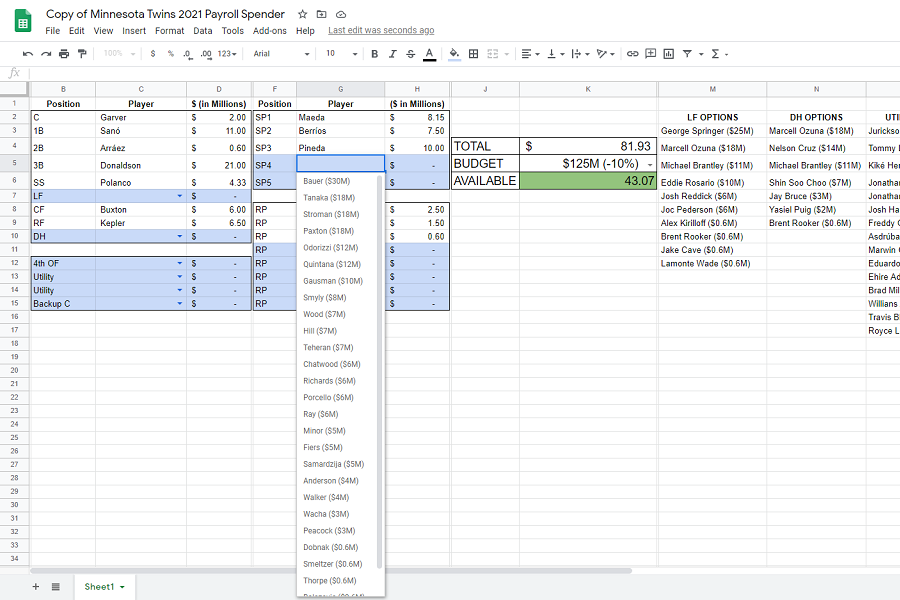 The Twins are facing at least six big decisions this offseason, so we've set up a google sheet at TwinsPayroll.com where you can answer those questions, and many more. At what level would you set the Twins' payroll? Would you bring back Nelson Cruz? How about Eddie Rosario? Or would you want to chase a big name free agent? When you click over, you'll be asked if you want to make your own copy. Say you do, then make your choices and the spreadsheet will add up the salaries and compare it to the whatever payroll level you think the Twins should adopt. Then, share yours by starting a thread in our Twins Talk Forum and other can weigh in on your choices. You can share your payroll with others by clicking on the "Share" button and copying a link. Then share the link on our forums so others can view your handiwork. It's fun. You'll also get a better sense of the decisions with which Derek Falvey and Thad Levine are wrestling this offseason. Plus, it'll make the rest of the offseason more fun, as you evaluate the team's moves and contrast them with your own. But mostly, it's fun. So click over, take your shot, and let us know what you think in the comments below. TwinsPayroll.com
 -
Aaron and John dive into the Twins payroll situation for the 2021 season, discuss why it matters, and review their Big Board draft, including why Josh Donaldson didn't make their lists. You can listen by downloading us from iTunes, Spotify, Stitcher, iHeartRadio or find it at GleemanAndTheGeek.com. Or just click this link. Click Hear To Listen Click here to view the article
-
 Click Hear To Listen
 -
What do you think the Twins should do this winter to prepare for the 2021 season? Do you have all (or at least some) of the answers? Show us by creating your own 2021 Twins team at TwinsPayroll.com.The Twins are facing at least six big decisions this offseason, so we've set up a google sheet at TwinsPayroll.com where you can answer those questions, and many more. At what level would you set the Twins' payroll? Would you bring back Nelson Cruz? How about Eddie Rosario? Or would you want to chase a big name free agent? When you click over, you'll be asked if you want to make your own copy. Say you do, then make your choices and the spreadsheet will add up the salaries and compare it to the whatever payroll level you think the Twins should adopt. Then, share yours by starting a thread in our Twins Talk Forum and other can weigh in on your choices. Download attachment: Twinspayroll share.png You can share your payroll with others by clicking on the "Share" button and copying a link. Then share the link on our forums so others can view your handiwork. It's fun. You'll also get a better sense of the decisions with which Derek Falvey and Thad Levine are wrestling this offseason. Plus, it'll make the rest of the offseason more fun, as you evaluate the team's moves and contrast them with your own. But mostly, it's fun. So click over, take your shot, and let us know what you think in the comments below. TwinsPayroll.com Click here to view the article
-
Aaron and John list their Twins' MVPs, review their AL Central over-under picks and catch up on the playoffs and some offseason news. You can listen by downloading us from iTunes, Spotify, Stitcher, iHeartRadio or find it at GleemanAndTheGeek.com. Or just click this link. Listen Here Now Click here to view the article
-
 Listen Here Now
 -
Twins' Payroll Points to Six Big Decisions
John Bonnes posted a topic in Twins Daily Front Page News
The Twins’ projected payroll is almost always the closest thing we have to a crystal ball. For the last fifteen years, it has been the lens through which we can understand offseason possibilities, and how aggressive or passive the team is likely to be. The same thing is true this year, but uff-da – that lens is sure covered with a bunch of gunk.Still, through the crud, we can see the Twins wrestling with six big decisions. The first is the biggest, and everything else is dependent on it: Decision 1: How much will the Twins budget in player payroll next year? This is always a small mystery, but we usually have an idea within $10 million or (at most) $20 million. This year? It could be as much as a $60 million swing between the lowest and highest number. Last year’s payroll was about $138 million. If it increases by 10% or so (which would be expected in a normal year), it could be as high as $150 million. If they anticipate zero fan revenue and being stuck with a full season of paying players, it’s possible it could be as low as … yikes. Your guess is as good as mine. Anything under $90M would be disastrous, so let’s set the floor there. The difference is even bigger than it looks, because $87 million is pretty much committed, so they could have anywhere from $3M to $63M to spend. Here’s a breakdown. For more on these numbers, make sure to watch . My best guess? It is reduced to $115-125M, leaving them $28M to $38M to spend. But they need to fill five pretty large holes that weren’t included in that $87M. Decision 2: How much to spend on a designated hitter? Nelson Cruz is a free agent. They can try and bring him back, but he’s going to cost $13-$15M. Or they can search for someone cheaper on the free agent market. Or they can plug in one of the Twins’ prospect bats, like Brent Rooker, Alex Kirilloff or Trevor Larnach, and save the money for another spot. Decision 3: Bring back Eddie Rosario? If the Twins offer Eddie Rosario arbitration, he will make around $10M. (That $10M is not included in the $87M figure.) Or they can sever ties and play some combination of prospects plus Jake Cave or Lamonte Wade Jr in left field for less than $1M, and save that money for another spot. Decision 4: How much to spend on a starting pitcher? Jake Odorizzi and Rich Hill (and Homer Bailey) are all free agents. The starting rotation next year still has Kenta Maeda, Jose Berrios, Michael Pineda and Randy Dobnak, but that leaves a spot open. If you believe the Twins need an ace, Trevor Bauer will be a free agent, but he could cost $30M. Is this where they should spend their money, or budget less for a back-end-of-the-rotation starter? Decision 5: Who must be paid in the bullpen? Trevor May is a free agent, and likely to earn $4-6M. Taylor Rogers will be eligible for arbitration and be due a raise up to $6-7M if the Twins offer it. Sergio Romo has a $5M team option. None of those are included in the committed $87M, so bringing them all back boosts the payroll almost $17M, or a little more than paying Nelson Cruz to return. Or should the Twins feel comfortable relying on their existing bullpen depth? Decision 6: How much to invest in a utility player? Both Marwin Gonzalez and Ehire Adrianza are free agents this offseason, and together they played 97 games (in a 60-game season). Should the Twins roll the dice with cheaper internal options, right after they went through a season depending on utility players due to injuries to Josh Donaldson and Luis Arraez, and as Jorge Polanco undergoes offseason surgery? How important is that compared to the other decisions? I’d encourage you to answer these questions yourself. Keep track of the totals. See where your payroll ends up. See if you can hit a number you’re comfortable with. I think you’ll find that tough choices are going to need to be made. Difficult priorities will need to be set. How brutal those choices are depends on a lot on the budget, and oddly enough, it doesn’t appear the Twins (or several other MLB teams) really know the answer to that question yet. Like a lot during the pandemic, the answer is to keep one’s head up and adjust. But those adjustments will still depend on payroll and its crystal ball. Even if it is cloudy. Click here to view the article -
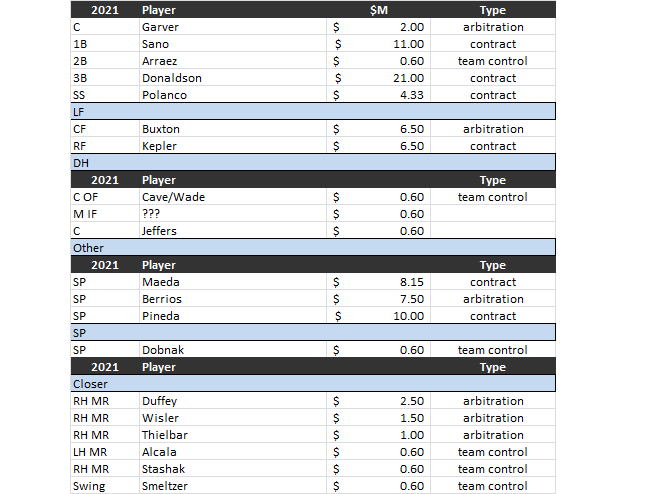 Still, through the crud, we can see the Twins wrestling with six big decisions. The first is the biggest, and everything else is dependent on it: Decision 1: How much will the Twins budget in player payroll next year? This is always a small mystery, but we usually have an idea within $10 million or (at most) $20 million. This year? It could be as much as a $60 million swing between the lowest and highest number. Last year’s payroll was about $138 million. If it increases by 10% or so (which would be expected in a normal year), it could be as high as $150 million. If they anticipate zero fan revenue and being stuck with a full season of paying players, it’s possible it could be as low as … yikes. Your guess is as good as mine. Anything under $90M would be disastrous, so let’s set the floor there. The difference is even bigger than it looks, because $87 million is pretty much committed, so they could have anywhere from $3M to $63M to spend. Here’s a breakdown. For more on these numbers, make sure to watch . My best guess? It is reduced to $115-125M, leaving them $28M to $38M to spend. But they need to fill five pretty large holes that weren’t included in that $87M. Decision 2: How much to spend on a designated hitter? Nelson Cruz is a free agent. They can try and bring him back, but he’s going to cost $13-$15M. Or they can search for someone cheaper on the free agent market. Or they can plug in one of the Twins’ prospect bats, like Brent Rooker, Alex Kirilloff or Trevor Larnach, and save the money for another spot. Decision 3: Bring back Eddie Rosario? If the Twins offer Eddie Rosario arbitration, he will make around $10M. (That $10M is not included in the $87M figure.) Or they can sever ties and play some combination of prospects plus Jake Cave or Lamonte Wade Jr in left field for less than $1M, and save that money for another spot. Decision 4: How much to spend on a starting pitcher? Jake Odorizzi and Rich Hill (and Homer Bailey) are all free agents. The starting rotation next year still has Kenta Maeda, Jose Berrios, Michael Pineda and Randy Dobnak, but that leaves a spot open. If you believe the Twins need an ace, Trevor Bauer will be a free agent, but he could cost $30M. Is this where they should spend their money, or budget less for a back-end-of-the-rotation starter? Decision 5: Who must be paid in the bullpen? Trevor May is a free agent, and likely to earn $4-6M. Taylor Rogers will be eligible for arbitration and be due a raise up to $6-7M if the Twins offer it. Sergio Romo has a $5M team option. None of those are included in the committed $87M, so bringing them all back boosts the payroll almost $17M, or a little more than paying Nelson Cruz to return. Or should the Twins feel comfortable relying on their existing bullpen depth? Decision 6: How much to invest in a utility player? Both Marwin Gonzalez and Ehire Adrianza are free agents this offseason, and together they played 97 games (in a 60-game season). Should the Twins roll the dice with cheaper internal options, right after they went through a season depending on utility players due to injuries to Josh Donaldson and Luis Arraez, and as Jorge Polanco undergoes offseason surgery? How important is that compared to the other decisions? I’d encourage you to answer these questions yourself. Keep track of the totals. See where your payroll ends up. See if you can hit a number you’re comfortable with. I think you’ll find that tough choices are going to need to be made. Difficult priorities will need to be set. How brutal those choices are depends on a lot on the budget, and oddly enough, it doesn’t appear the Twins (or several other MLB teams) really know the answer to that question yet. Like a lot during the pandemic, the answer is to keep one’s head up and adjust. But those adjustments will still depend on payroll and its crystal ball. Even if it is cloudy.
 -
If you're a Twins fan, you know by now that the team's biggest limitation is always payroll. So Tuesday night, John Bonnes was joined by Ted Schwerzler and Nate Palmer in a live discussion including the Twins Daily community. Find out what to expect this offseason, and some of the tough decisions the Twins will need to make. You can watch it on , Facebook, or Twitter or in the video below. FacebookTwitter Click here to view the article
-
 Facebook Twitter https://www.youtube.com/watch?v=mlAl6QrBFIk
 -
Aaron and John walk through each of the Twins' impending free agents and discuss whether or not a path exists in which they return to the team. You can listen by downloading us from iTunes, Spotify, Stitcher, iHeartRadio or find it at GleemanAndTheGeek.com. Or just click this link. Listen Now Here Click here to view the article
-
 Listen Now Here
 -
Aaron and John talk about another disappointing, early playoff exit for the Twins and go position-by-position through the lineup in search of a cure for 2021. You can listen by downloading us from iTunes, Spotify, Stitcher, iHeartRadio or find it at GleemanAndTheGeek.com. Or just click this link. Listen Now Click here to view the article
-
 Listen Now

