Western SD Fan
-
Posts
2,841 -
Joined
-
Last visited
-
Days Won
3
Content Type
Profiles
News
Minnesota Twins Videos
2026 Minnesota Twins Top Prospects Ranking
2022 Minnesota Twins Draft Picks
Minnesota Twins Free Agent & Trade Rumors, Notes, & Tidbits
Guides & Resources
2023 Minnesota Twins Draft Picks
The Minnesota Twins Players Project
2024 Minnesota Twins Draft Picks
2025 Minnesota Twins Draft Pick Tracker
2026 Minnesota Twins Draft Tracker: Picks & Bonuses
Forums
Blogs
Events
Store
Downloads
Gallery
Everything posted by Western SD Fan
-
Twins (Ober) vs Royals (Wacha): 08/06/26, 6:40 PM
Western SD Fan replied to Brock Beauchamp's topic in Archived Game Threads
Reminds me of the Fernando Rodney Experience -
Twins (Ober) vs Royals (Wacha): 08/06/26, 6:40 PM
Western SD Fan replied to Brock Beauchamp's topic in Archived Game Threads
-
Twins (Ober) vs Royals (Wacha): 08/06/26, 6:40 PM
Western SD Fan replied to Brock Beauchamp's topic in Archived Game Threads
He did, but that home run power was just too much for him. -
Plus considering they blew his last start allowing a Clemens walk off GS, Cameron probably wants to go out for the 9th as well.
-
I have noticed this year that they have not been putting up the expected runs scored bug in those situations. I wonder why? 🤔
-
Finally, a brain fart by someone other than the Twins!
-
I just got back here and I'm excited that we are finally getting to Cameron. We have a hit before the 7th inning today!
-
I'm not sure they would do it. Technically, Jenkins could hit in the minor league Field of Dreams game on Tuesday and the major league one on Thursday.
-
Twins (Ryan) Vs Royals (Dobnak) 8/4/26 6:40 CDT
Western SD Fan replied to Mortimerkenny21's topic in Archived Game Threads
True, but other than Buxton and Taylor Rogers, Perkins has no direct connection to the current team. A lot easier to disseminate and criticize game play when you are nearly a decade separated from it. Pablo is still active on the team. -
Twins (Ryan) Vs Royals (Dobnak) 8/4/26 6:40 CDT
Western SD Fan replied to Mortimerkenny21's topic in Archived Game Threads
Yep. He can be the secondary analyst in the booth deep diving into pitching mechanics, explaining PFP, things like that. Someone still has to be there to praise and criticize the game play when it is not correct. -
Twins (Ryan) Vs Royals (Dobnak) 8/4/26 6:40 CDT
Western SD Fan replied to Mortimerkenny21's topic in Archived Game Threads
That was my thought when someone commented complaining on why he was praising Joe Ryan, even when he was struggling on the mound. As a current teammate, what are you supposed to say? -
Twins (Ryan) Vs Royals (Dobnak) 8/4/26 6:40 CDT
Western SD Fan replied to Mortimerkenny21's topic in Archived Game Threads
Which is probably ok. With their current sense of direction, they may have landed in Phoenicia instead of Helles on their trip home. Guaranteed they missed their left turn at Albuquerque. -
Twins (Ryan) Vs Royals (Dobnak) 8/4/26 6:40 CDT
Western SD Fan replied to Mortimerkenny21's topic in Archived Game Threads
Don't hate the idea. I would think that means the end of the line for Lewis as he will run out of positions. Larnach is also either traded or not tendered a contract over the winter, and Bell just needs to be gone. Curious on what a contract would look like to ger him. -
Twins (Ryan) Vs Royals (Dobnak) 8/4/26 6:40 CDT
Western SD Fan replied to Mortimerkenny21's topic in Archived Game Threads
Roden almost had the question "Who moved my cheese?" Luckily he hit just odd enough to get the run in and claim a nibble. -
Twins (Ryan) Vs Royals (Dobnak) 8/4/26 6:40 CDT
Western SD Fan replied to Mortimerkenny21's topic in Archived Game Threads
Never thought of this until now. Dobnak has the perfect nickname to become a bingo caller. And your current bingo caller, Randy "Dobber" Dobnak! -
Twins (Ryan) Vs Royals (Dobnak) 8/4/26 6:40 CDT
Western SD Fan replied to Mortimerkenny21's topic in Archived Game Threads
TY for the correction. I confused Minter and Hoffman. I was thinking part of the reason Rojas was optioned was because we had 4 lefties in the bullpen and one had to go. -
Twins (Ryan) Vs Royals (Dobnak) 8/4/26 6:40 CDT
Western SD Fan replied to Mortimerkenny21's topic in Archived Game Threads
This makes sense. Don't want to shake everything up right away. Hoffman was more a of LH fireman in Toronto once he regained his composure after losing the closer role. I still see Hoffman closing games for us before the end of the season. Optioning Rojas would not have been my choice, but I can see where it makes sense as he still has options left. My personal preference would have been to honor Taylor Rogers for his service and see if he was willing to retire to make room for Hoffman, but that is a hard thing to do in middle of a season. -
Multiple things can be true at the same time. Of course, Tom's statements at the beginning of the season were designed to create interest in a team that many fans have quit paying attention to. It ultimately depends on how you are measuring and your expectations for the season. If you're measuring against a normal MLB GM trying to address needs to make a serious playoff push, this deadline was a clear half-measure. If you are measuring this against what other Twins GM's and current ownership have done since the year 2000, this is about as "all-in" as the Twins get. That is more indicative of how the Twins operate as a whole. Now to the expectations part. If your expectations were to make a real push for a WS or a deep playoff run, this was just a half-measure and likely not moving the needle other than the relievers will help us not lose winnable games in the late innings. I'm not concerned on what we gave up for Kremer. I'm more concerned about Kremer himself as a pitcher being able to meaningfully contribute. I'm not sure he is any better than Zebby, who's spot he replaced in the rotation, and who many people here want converted to a bullpen arm. My expectations were to make moves to keep us in contention while not selling the farm for a marginal chance at a playoff spot. I think we accomplished that with this deadline. Compared to where many people pegged this team at the beginning of the season, we are close to playing with house money at this point. Sometimes it's about staying the course, even if we don't know what the course is at times. We could have maximized some trade potential, such as moving Jeffers and Larnach, I am fine that we did not do this. That is probably the fan in me vs what the correct move would have been to make. Look up Tankathon's SOS linked here: MLB Remaining Schedule Strength | Tankathon Compare this to the WC standings. Most of the teams that are near, or chasing us, have weaker SOS than us the rest of the season. That doesn't mean we can't make it. It's just another tool to use when aligning your expectations on how the deadline went and how it aligns with Tom Pohlad's statements.
-
I'm curious on how the QO will work for Jeffers this offseason. It was reported that he would decline any QO that was offered to him. The players hate the QO and I would guess many of the owners hate it as well, especially the ones who have to pay the QO tax. My opinion is that the QO does not survive the next CBA. The QO must be offered and rejected prior to the end of the current CBA (Dec 1st). If the QO really doesn't survive the CBA, has Jeffers's value really went up because he is expected to refuse the QO? How would they account for this if the QO doesn't survive the new CBA? Would there be a transition offseason? That has been a missing piece on where I think Jeffers's value ultimately lands.
-
Was listening to Foul Territory earlier today. Their rumors were that the Yankees actually believe Austin Wells's bat is picking up. They like his defense and handling of the pitching staff. This could very well be setting up the fan base to when 6 pm ET rolls around and they didn't pick up a catcher.
-
Should Derek Shelton Have Loaded the Bases?
Western SD Fan replied to Matthew Taylor's topic in Twins Daily Front Page News
You and Shelton had the same philosophy. In the postgame presser, Shelton said the exact same thing. He didn't want to face Young if he didn't have to. Chose to go after Emerson. Emerson did his job and won the game. Happens in baseball. -
Some of us have survived better than others. 😉
-
Sorry. I wasn't paying attention and misread it. Too many people here stamping their feet demanding they want him up here yesterday. Just trying to point out why that is not happening.
-
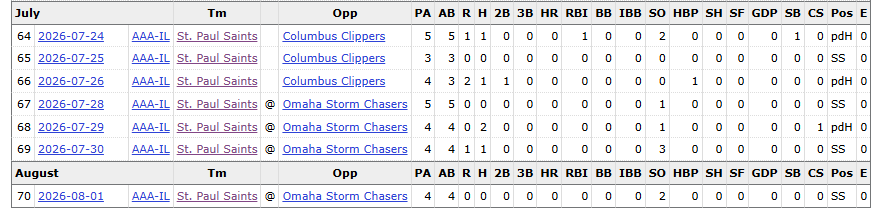
In the postgame presser, Shelton said he did not want to face Young in any situation. Young has been torturing the Twins all weekend. He took a risk to get Emerson and Rivas out, didn't pan out. I'll refer you to the handy chart I posted earlier from baseball-reference. Today is the first time since coming off the IL that Culpepper is playing SS for the 3rd game in a row. We all complain about Buxton's lack of availability. I want Culpepper's to be at least that good before he is called up here. I could see him being called up in another week after they make sure he isn't showing any lingering signs from his glute injury that put him on the IL. I know everyone wants him up here. The best ability is still availability.