



Brandon Warne
-
Posts
1,486 -
Joined
-
Last visited
Content Type
Profiles
News
Minnesota Twins Videos
2026 Minnesota Twins Top Prospects Ranking
2022 Minnesota Twins Draft Picks
Minnesota Twins Free Agent & Trade Rumors, Notes, & Tidbits
Guides & Resources
2023 Minnesota Twins Draft Picks
The Minnesota Twins Players Project
2024 Minnesota Twins Draft Picks
2025 Minnesota Twins Draft Pick Tracker
2026 Minnesota Twins Draft Tracker: Picks & Bonuses
Forums
Blogs
Events
Store
Downloads
Gallery
Everything posted by Brandon Warne
-

Article: One Of These Things
Brandon Warne replied to Seth Stohs's topic in Twins Daily Front Page News
Susac -
WARNE: Are the Twins Buyers or Sellers?
Brandon Warne commented on Brandon Warne's blog entry in BW on the Beat
I think you unintentionally hit on a key point: do you (try) add all those pieces, or just try to squeak by as a wild card team? Because last I checked, the wild card winner last year went to the World Series. -
The hottest talk on Twins fans’ lips after the promotions of Byron Buxton and Miguel Sano has been whether or not this is a team that should buy or sell at the trade deadline that looms in a mere three and a half weeks. It’s a legitimate question with no easy answer, as the Twins have hung around in a heavily competitive division.And if you buy into the idea that the Tigers could fall back a bit with the loss of Miguel Cabrera, and that the White Sox and Indians have yet to play their best ball of the season — all distinct possibilities — the Central could get even wilder before the season draws to a close. The entire American League is bonkers. Coming into play Monday, the Twins are tied with Baltimore — incidentally, the club’s current opponent — for the fifth and final playoff spot. If that wasn’t enough, 13 of the 15 AL clubs are five or fewer games out of a playoff spot. No AL team is more than 6.5 games out. This hurts buying teams two-fold. First of all, any team that is ‘buying’ so to speak needs a seller. The two teams in the AL that are more than five games out of a playoff spot are Chicago — coming off a spending spree in the offseason — and Oakland, whom Fangraphs’ BaseRuns (best explained here) suggests are playing so far below their ceiling that they should be neck and neck with division-leading Houston. Dealing with Billy Beane in July can be a risky proposition for opposing teams, too. The Twins have done it before — Orlando Cabrera in 2009 — but it takes a certain need for each side to find a match. The NL side is a little different, with just nine of 15 teams within five games of a playoff spot, and four teams — Milwaukee, Colorado, Miami and Philadelphia — at least 10 games back. Each of those teams have premium talent that could be pried away, with the possible exception of Miami, but that also requires a steep price in terms of prospects — of which the Twins have. But the other complicating factor with a team being in the thick of it in a heavily competitive AL race is that even the slightest hiccup can leave you in the dust with a veritable dogpile of teams each gaining ground on someone each night. With that many teams involved, at least a few of them each will win on a given night, making any sort of a slide potentially catastrophic in even the short term. And when you look at this Twins roster, it doesn’t appear to be built terribly well for a playoff run. The same BaseRuns concept that suggests the A’s should be a potential playoff team pegs the Twins as having played like a 35-47 team as opposed to their 43-39 mark. Personally, that doesn’t appear too surprising when considering how leaky the team has been in certain facets of the game at times. The bullpen has the ninth-worst ERA in baseball at 3.88. As a group, they’ve fanned just 6.0 batters per nine — dead last across MLB — and are one of just two teams that are under 7.0 in that respect. The vastly improved rotation is in the top half in ERA, but ranks second to last in K/9 and is only about average in terms of groundball rate. On the offensive side, it’s been about Brian Dozier and a rotating cast of characters that have picked up the slack at one time or another. Dozier is the clear leader on the team with a 128 OPS+ — OPS scaled to where 100 is average — with Joe Mauer, Torii Hunter and Trevor Plouffe the only other regulars above average — and just by a few ticks. Nothing about the Twins offense — with the exception of doubles, triples and strikeouts — are among the top half of AL teams. So you don’t have an offense, starting staff or bullpen that really sticks out. Balanced teams can make the playoffs, too, but it most likely would require some sort of ‘boost.’ But where would that boost come from, and where would it go? The Twins don’t really profile as a team that needs help in the outfield. Granted, there’s still no telling what exactly the team can or will get from Buxton or Aaron Hicks, but this isn’t a club in a position to shove one of those two aside for a Marlon Byrd, to throw out a random name who will be available. That’s before also considering Oswaldo Arcia — on a seven-game hitting streak at Rochester where he’s hitting .448/.484/.828 — will also probably rejoin the team at some point, too. Is a run this year so important that you can shove aside players who’ll soon be out of options to take that chance? It hardly seems possible. The rotation already has a bottleneck with Trevor May squeezed out with Ervin Santana’s return, so there isn’t really a good fit there. Similarly, trading legitimate prospects for bullpen help hasn’t exactly worked out well for this club (or any other) in years past either (Matt Capps for Wilson Ramos, etc.). In the infield it would seem only shortstop is open. Jorge Polanco had a really rough first game at Rochester on Saturday, but club sources suggested he was markedly better after some early work on Sunday — his 22nd birthday. If he, Danny Santana or Eduardo Escobar aren’t the future of the position, then a look outside could be merited. That just doesn’t feel like a Twins move either, though. The same can be said for catcher, where Kurt Suzuki has been underwhelming in pretty much every facet of the game. He’s only signed for one more year, so even a starting catcher’s salary could be moved aside if the Twins were to inquire on someone like Jonathan Lucroy. Still again, that’s a splashy move that doesn’t seem to fit the Twins’ usual blueprint, and can also be costly another way. And that way is in terms of trade cost. The Twins could move the likes of Polanco, Jose Berrios, Kohl Stewart, Max Kepler and others. Trading prospects makes sense in a lot of ways, considering the attrition rate of the average prospect versus their trade market value, but at the same time the Twins need to rely on the graduation of some of these prospects emerging to help sustain an extended window as the Buxtons and Sanos mature, and need reinforcements to go alongside them. So does trading from your depth in the minor leagues actually narrow your contention window? Maybe not, considering the team will have Sano and Buxton ostensibly for at least six years — all of which should be pretty good years for the club, barring some sort of disaster — but it’s worth wondering if making a run at the beginning of their careers — and the end of Mauer’s for instance — is worth pushing all the chips in the middle for. And is that season now? Is the division and league as vulnerable as it’ll get in the short- or long-term? Maybe that is the case, considering there’s no dominating team right now. The Red Sox and Yankees are a bit more down than they’ve been in recent years, and some of the teams who were supposed to take giant steps forward — the Clevelands and Seattles of the world — have failed to step up. There’s no easy answer for how the Twins should approach this deadline, but there’s also a fairly good chance that in the next 25 or so days, the team will provide its own answer. If they’re in the thick of it in that last week in July, it’s going to be an interesting deadline for the first time in a long time. This content originated at Cold Omaha here; please consider clicking through to support the content. Click here to view the article
-
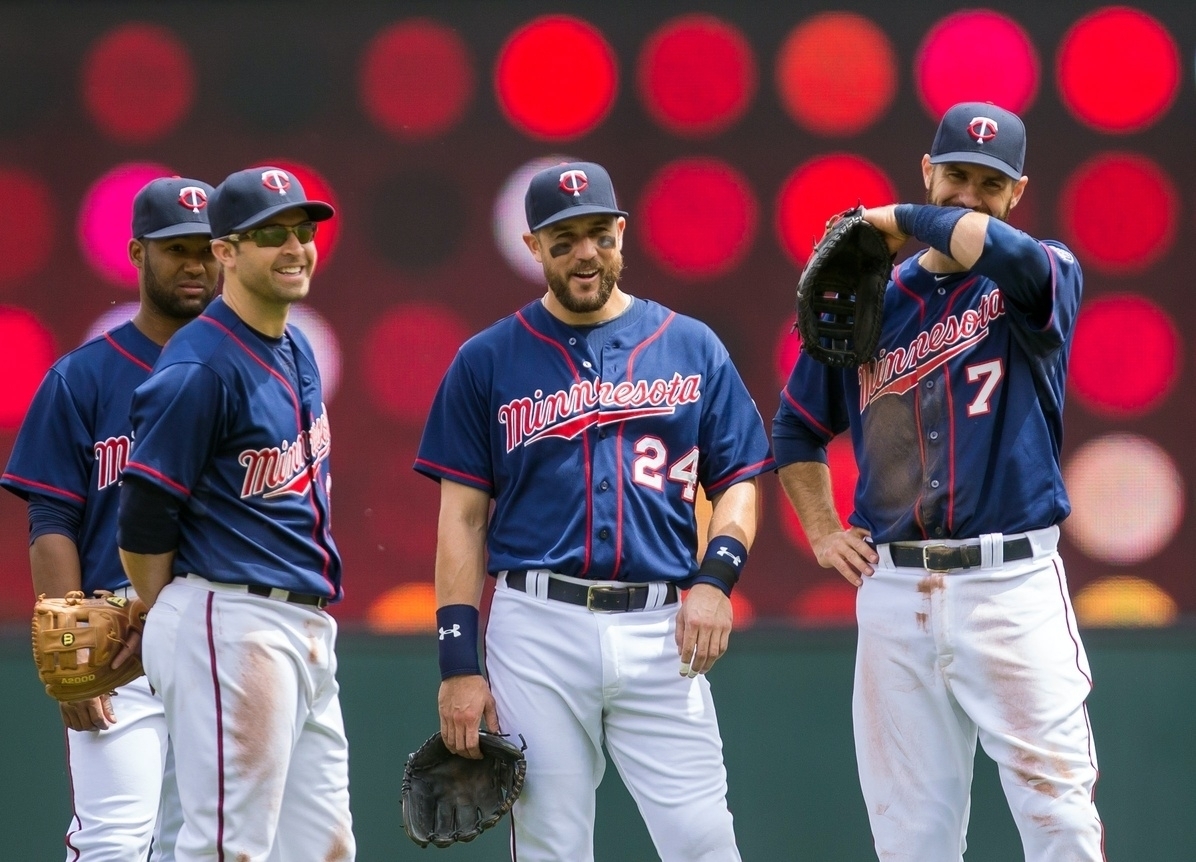 And if you buy into the idea that the Tigers could fall back a bit with the loss of Miguel Cabrera, and that the White Sox and Indians have yet to play their best ball of the season — all distinct possibilities — the Central could get even wilder before the season draws to a close. The entire American League is bonkers. Coming into play Monday, the Twins are tied with Baltimore — incidentally, the club’s current opponent — for the fifth and final playoff spot. If that wasn’t enough, 13 of the 15 AL clubs are five or fewer games out of a playoff spot. No AL team is more than 6.5 games out. This hurts buying teams two-fold. First of all, any team that is ‘buying’ so to speak needs a seller. The two teams in the AL that are more than five games out of a playoff spot are Chicago — coming off a spending spree in the offseason — and Oakland, whom Fangraphs’ BaseRuns (best explained here) suggests are playing so far below their ceiling that they should be neck and neck with division-leading Houston. Dealing with Billy Beane in July can be a risky proposition for opposing teams, too. The Twins have done it before — Orlando Cabrera in 2009 — but it takes a certain need for each side to find a match. The NL side is a little different, with just nine of 15 teams within five games of a playoff spot, and four teams — Milwaukee, Colorado, Miami and Philadelphia — at least 10 games back. Each of those teams have premium talent that could be pried away, with the possible exception of Miami, but that also requires a steep price in terms of prospects — of which the Twins have. But the other complicating factor with a team being in the thick of it in a heavily competitive AL race is that even the slightest hiccup can leave you in the dust with a veritable dogpile of teams each gaining ground on someone each night. With that many teams involved, at least a few of them each will win on a given night, making any sort of a slide potentially catastrophic in even the short term. And when you look at this Twins roster, it doesn’t appear to be built terribly well for a playoff run. The same BaseRuns concept that suggests the A’s should be a potential playoff team pegs the Twins as having played like a 35-47 team as opposed to their 43-39 mark. Personally, that doesn’t appear too surprising when considering how leaky the team has been in certain facets of the game at times. The bullpen has the ninth-worst ERA in baseball at 3.88. As a group, they’ve fanned just 6.0 batters per nine — dead last across MLB — and are one of just two teams that are under 7.0 in that respect. The vastly improved rotation is in the top half in ERA, but ranks second to last in K/9 and is only about average in terms of groundball rate. On the offensive side, it’s been about Brian Dozier and a rotating cast of characters that have picked up the slack at one time or another. Dozier is the clear leader on the team with a 128 OPS+ — OPS scaled to where 100 is average — with Joe Mauer, Torii Hunter and Trevor Plouffe the only other regulars above average — and just by a few ticks. Nothing about the Twins offense — with the exception of doubles, triples and strikeouts — are among the top half of AL teams. So you don’t have an offense, starting staff or bullpen that really sticks out. Balanced teams can make the playoffs, too, but it most likely would require some sort of ‘boost.’ But where would that boost come from, and where would it go? The Twins don’t really profile as a team that needs help in the outfield. Granted, there’s still no telling what exactly the team can or will get from Buxton or Aaron Hicks, but this isn’t a club in a position to shove one of those two aside for a Marlon Byrd, to throw out a random name who will be available. That’s before also considering Oswaldo Arcia — on a seven-game hitting streak at Rochester where he’s hitting .448/.484/.828 — will also probably rejoin the team at some point, too. Is a run this year so important that you can shove aside players who’ll soon be out of options to take that chance? It hardly seems possible. The rotation already has a bottleneck with Trevor May squeezed out with Ervin Santana’s return, so there isn’t really a good fit there. Similarly, trading legitimate prospects for bullpen help hasn’t exactly worked out well for this club (or any other) in years past either (Matt Capps for Wilson Ramos, etc.). In the infield it would seem only shortstop is open. Jorge Polanco had a really rough first game at Rochester on Saturday, but club sources suggested he was markedly better after some early work on Sunday — his 22nd birthday. If he, Danny Santana or Eduardo Escobar aren’t the future of the position, then a look outside could be merited. That just doesn’t feel like a Twins move either, though. The same can be said for catcher, where Kurt Suzuki has been underwhelming in pretty much every facet of the game. He’s only signed for one more year, so even a starting catcher’s salary could be moved aside if the Twins were to inquire on someone like Jonathan Lucroy. Still again, that’s a splashy move that doesn’t seem to fit the Twins’ usual blueprint, and can also be costly another way. And that way is in terms of trade cost. The Twins could move the likes of Polanco, Jose Berrios, Kohl Stewart, Max Kepler and others. Trading prospects makes sense in a lot of ways, considering the attrition rate of the average prospect versus their trade market value, but at the same time the Twins need to rely on the graduation of some of these prospects emerging to help sustain an extended window as the Buxtons and Sanos mature, and need reinforcements to go alongside them. So does trading from your depth in the minor leagues actually narrow your contention window? Maybe not, considering the team will have Sano and Buxton ostensibly for at least six years — all of which should be pretty good years for the club, barring some sort of disaster — but it’s worth wondering if making a run at the beginning of their careers — and the end of Mauer’s for instance — is worth pushing all the chips in the middle for. And is that season now? Is the division and league as vulnerable as it’ll get in the short- or long-term? Maybe that is the case, considering there’s no dominating team right now. The Red Sox and Yankees are a bit more down than they’ve been in recent years, and some of the teams who were supposed to take giant steps forward — the Clevelands and Seattles of the world — have failed to step up. There’s no easy answer for how the Twins should approach this deadline, but there’s also a fairly good chance that in the next 25 or so days, the team will provide its own answer. If they’re in the thick of it in that last week in July, it’s going to be an interesting deadline for the first time in a long time. This content originated at Cold Omaha here; please consider clicking through to support the content.
 -
The hottest talk on Twins fans’ lips after the promotions of Byron Buxton and Miguel Sano has been whether or not this is a team that should buy or sell at the trade deadline that looms in a mere three and a half weeks. It’s a legitimate question with no easy answer, as the Twins have hung around in a heavily competitive division. And if you buy into the idea that the Tigers could fall back a bit with the loss of Miguel Cabrera, and that the White Sox and Indians have yet to play their best ball of the season — all distinct possibilities — the Central could get even wilder before the season draws to a close. The entire American League is bonkers. Coming into play Monday, the Twins are tied with Baltimore — incidentally, the club’s current opponent — for the fifth and final playoff spot. If that wasn’t enough, 13 of the 15 AL clubs are five or fewer games out of a playoff spot. No AL team is more than 6.5 games out. This hurts buying teams two-fold. First of all, any team that is ‘buying’ so to speak needs a seller. The two teams in the AL that are more than five games out of a playoff spot are Chicago — coming off a spending spree in the offseason — and Oakland, whom Fangraphs’ BaseRuns (best explained here) suggests are playing so far below their ceiling that they should be neck and neck with division-leading Houston. Dealing with Billy Beane in July can be a risky proposition for opposing teams, too. The Twins have done it before — Orlando Cabrera in 2009 — but it takes a certain need for each side to find a match. The NL side is a little different, with just nine of 15 teams within five games of a playoff spot, and four teams — Milwaukee, Colorado, Miami and Philadelphia — at least 10 games back. Each of those teams have premium talent that could be pried away, with the possible exception of Miami, but that also requires a steep price in terms of prospects — of which the Twins have. But the other complicating factor with a team being in the thick of it in a heavily competitive AL race is that even the slightest hiccup can leave you in the dust with a veritable dogpile of teams each gaining ground on someone each night. With that many teams involved, at least a few of them each will win on a given night, making any sort of a slide potentially catastrophic in even the short term. And when you look at this Twins roster, it doesn’t appear to be built terribly well for a playoff run. The same BaseRuns concept that suggests the A’s should be a potential playoff team pegs the Twins as having played like a 35-47 team as opposed to their 43-39 mark. Personally, that doesn’t appear too surprising when considering how leaky the team has been in certain facets of the game at times. The bullpen has the ninth-worst ERA in baseball at 3.88. As a group, they’ve fanned just 6.0 batters per nine — dead last across MLB — and are one of just two teams that are under 7.0 in that respect. The vastly improved rotation is in the top half in ERA, but ranks second to last in K/9 and is only about average in terms of groundball rate. On the offensive side, it’s been about Brian Dozier and a rotating cast of characters that have picked up the slack at one time or another. Dozier is the clear leader on the team with a 128 OPS+ — OPS scaled to where 100 is average — with Joe Mauer, Torii Hunter and Trevor Plouffe the only other regulars above average — and just by a few ticks. Nothing about the Twins offense — with the exception of doubles, triples and strikeouts — are among the top half of AL teams. So you don’t have an offense, starting staff or bullpen that really sticks out. Balanced teams can make the playoffs, too, but it most likely would require some sort of ‘boost.’ But where would that boost come from, and where would it go? The Twins don’t really profile as a team that needs help in the outfield. Granted, there’s still no telling what exactly the team can or will get from Buxton or Aaron Hicks, but this isn’t a club in a position to shove one of those two aside for a Marlon Byrd, to throw out a random name who will be available. That’s before also considering Oswaldo Arcia — on a seven-game hitting streak at Rochester where he’s hitting .448/.484/.828 — will also probably rejoin the team at some point, too. Is a run this year so important that you can shove aside players who’ll soon be out of options to take that chance? It hardly seems possible. The rotation already has a bottleneck with Trevor May squeezed out with Ervin Santana’s return, so there isn’t really a good fit there. Similarly, trading legitimate prospects for bullpen help hasn’t exactly worked out well for this club (or any other) in years past either (Matt Capps for Wilson Ramos, etc.). In the infield it would seem only shortstop is open. Jorge Polanco had a really rough first game at Rochester on Saturday, but club sources suggested he was markedly better after some early work on Sunday — his 22nd birthday. If he, Danny Santana or Eduardo Escobar aren’t the future of the position, then a look outside could be merited. That just doesn’t feel like a Twins move either, though. The same can be said for catcher, where Kurt Suzuki has been underwhelming in pretty much every facet of the game. He’s only signed for one more year, so even a starting catcher’s salary could be moved aside if the Twins were to inquire on someone like Jonathan Lucroy. Still again, that’s a splashy move that doesn’t seem to fit the Twins’ usual blueprint, and can also be costly another way. And that way is in terms of trade cost. The Twins could move the likes of Polanco, Jose Berrios, Kohl Stewart, Max Kepler and others. Trading prospects makes sense in a lot of ways, considering the attrition rate of the average prospect versus their trade market value, but at the same time the Twins need to rely on the graduation of some of these prospects emerging to help sustain an extended window as the Buxtons and Sanos mature, and need reinforcements to go alongside them. So does trading from your depth in the minor leagues actually narrow your contention window? Maybe not, considering the team will have Sano and Buxton ostensibly for at least six years — all of which should be pretty good years for the club barring some sort of disaster — but it’s worth wondering if making a run at the beginning of their careers — and the end of Mauer’s for instance — is worth pushing all the chips in the middle for. And is that season now? Is the division and league as vulnerable as it’ll get in the short- or long-term? Maybe that is the case, considering there’s no dominating team right now. The Red Sox and Yankees are a bit more down than they’ve been in recent years, and some of the teams who were supposed to take giant steps forward — the Clevelands and Seattles of the world — have failed to step up. There’s no easy answer for how the Twins should approach this deadline, but there’s also a fairly good chance that in the next 25 or so days, the team will provide its own answer. If they’re in the thick of it in that last week in July, it’s going to be an interesting deadline for the first time in a long time. This content originated at Cold Omaha here; please consider clicking through to support the content.
-
There isn’t a more polarizing figure on the Minneapolis sports landscape than Joe Mauer. It’s not hard to see, either. For instance, have a look at social media when Mauer gets a day off — any day off — and how the average fan reacts to it. Never mind the fact that Mauer came into Wednesday tied with Brian Dozier for the most games played on the team.One certainly can’t fault the average fan for suggesting Mauer hasn’t played particularly well this season, however. Mauer is hitting just .263/.334/.370, good for a 95 OPS+ that really puts this offensive era into context. With this latest era of pitching dominance, an OPS just over .700 has become a quasi-baseline for offensive competence, though that requires a few levels of nuance being stripped away. And that doesn’t favor Mauer. Where it hurts is that the AL slash line for first basemen this year is .252/.333/447. Incidentally, Mauer’s pretty close on the first two marks, but his power falls short. Way short, in fact. That aggregate slash line results in a .781 positional OPS, which is eclipsed only by its NL counterpart (.271/.347/.464, an .811 collective mark). Some people will point to Mauer’s RBI pace — roughly 75 if he were to have 600 PA — as a potential place he has improved, though it seems odd that it would have an opposite correlation with his worst offensive season. Others have suggested Mauer’s .403/.516/.522 line with runners in scoring position indicates he’s activated some sort of clutch gene, especially in correlation with his improved RBI totals. And while I reject the idea of clutch in baseball as a general rule — if you can arbitrarily raise your performance in certain situations, why wouldn’t you always? — I do think there’s something more at play there, and we’ll dig into it a bit here. The talk early in the season was about how Mauer had re-worked some mechanical things in an effort to try pull the ball more. Very early returns suggested he was doing just that, and in fact was doing it at the expense of his usual bread and butter, which was hitting to the opposite field. Let’s make one thing clear here: Mauer might be one of, if not the finest, opposite field hitters of his era. Or any recent era, for that matter. For his career, this is how Mauer’s batted results have played out: To left (opposite) field: .436/.427/.679 (1.106 OPS; .470 wOBA) To center field: .372/.369/.491 (.859 OPS; .372 wOBA) To right field: .277/.277/.396 (.673 OPS; .291 wOBA) Keep in mind, this is his 12th big league season, so this is from a ton of data. It’s hard to replicate context because those numbers don’t include walks — walks don’t have specific fields, that is — but essentially with this year’s numbers he’s been Bryce Harper to left field, Brian Dozier to center field and this year’s Michael Cuddyer (ICYMI, bad) to right over his career. That gives one a pretty good idea of how great Mauer has been to left and to center. And when we had checked in back in late April, Mauer was hitting .450/.450/.500 to the pull side in early returns. At that same point, Mauer was hitting just .077/.077/.077 to the opposite field, and stories were abundant about his seismic shift to becoming a pull hitter. Well, flash forward almost 70 days, and what do we find? To left (opposite) field: .388/.378/.613 (.991 OPS; .419 wOBA) To center field: .274/.267/.333 (.601 OPS; .258 wOBA) To right field: .299/.299/.403 (.701 OPS; .306 wOBA) I don’t know about you all, but that looks a lot like vintage Joe Mauer, with one huge, huge exception: center field has been absolutely dead. Now there are some things we can’t know simply from these numbers. For instance, frequency. We don’t know how often Mauer is hitting to left and capitalizing on such great numbers, at least not in comparison to center or right. A look at his season numbers suggests not too terribly often. Fortunately, we do have frequency numbers. Here’s Mauer’s hits breakdown by field: 31 to left; 41.9% 23 to center; 31.1% 20 to right; 27.0% But how does that compare to his career numbers: 657 to left; 40.7% 603 to center; 37.4% 354 to right; 21.9% Now, what does that tell us, exactly? To be sure, maybe not as much as we’d like. It does suggest Mauer’s still wearing out left, and that he isn’t entirely ignoring right like his career rates indicate. But this is still just hits. In other words, we’re ignoring outs to each side. Maybe checking instances of batted balls going to each field will give us a deeper look. In 2015, here are the percentage of instances Mauer has hit to each specific field (via Fangraphs’ database): 82 to left; 34.9% 86 to center; 36.6% 67 to right; 28.5% For his career, he looks like this: 1543 to left; 34.6% 1636 to center; 36.7% 1280 to right; 28.7% That’s sort of uncanny, but it’s almost exactly in line with his career rates. Wow. So Mauer has returned to being supernaturally good at hitting the baseball the other way, but still hasn’t been particularly good. What gives? It’s hard not to keep coming back to center field being a dead zone for Mauer after being so good to him early in his career. And with the advent of shifts in recent years, could that be affecting Mauer adversely? Most certainly. He even conceded as much in a recent chat with Cold Omaha. “There’s been a lot of times where they’ve put the shortstop up the middle and maybe taken a couple hits away,” Mauer said. “So that could be the reason.” Coincidentally, Mauer hitting well with runners in scoring position does lend credence to the shifting idea, since teams aren’t as apt to shift in those situations. After all, teams need to hold runners in those spots, so you won’t see a shortstop to the right of second, and so on. There probably isn’t enough data to make a definitive conclusion, but it’s an interesting theory. Manager Paul Molitor suggested Mauer went through a phase where he was struggling with pitches he could hit, and perhaps lost a bit of his feel at the plate in terms of timing being a little off. The second half of Mauer’s June (.292/.386/.458 from June 16-30) was also markedly better than the first half (.188/.291/.271 from June 1-15), coinciding with Molitor’s timeline and almost directly with a pair of opposite field home runs he hit off Cardinals reliever Kevin Siegrist and four days later off Chicago’s John Danks. Both of those went to the opposite field. “I think that confidence was buoyed by that home run he hit in the Cardinals series,” Molitor added. Molitor also agreed with the idea that teams are taking away Mauer’s hot spots on the field. “We’ve seen different formations against Joe,” Molitor said. “Some people really bunch that middle. It’s how a team feels that their pitching staff is going to be able to handle him best, and then executing and trying to have their people in the right place. You can see how they do try to take a little bit more of the pull side at shortstop, and the third baseman can get over and protect that five hole a little bit. Outfields are tough for him, too, because they don’t worry about the right field corner. They really can rotate around to the other side, and it just doesn’t give him a lot of room. Left-center is covered. Left field line is covered. Right-center is covered. So yeah, it’s just kind of his tendencies and what they hit, and he kind of is one of those guys that charts don’t lie. He has places where he hits the ball more frequently, and sometimes it works against him.” A Cold Omaha exclusive with hitting coach Tom Brunansky was particularly illuminating, in which he basically broke down not only what Mauer has been doing so far this season, but steps he and Joe can take to try fight back against the shifts. Brunansky said, foundationally, pretty much everything has been the same in terms of what Mauer is trying to do at the plate. “It’s just that the consistency of what he wants,” Brunansky said. “It’s a certain spot we want to get the hands and have them stop to get ready to fire. Some days he gets it, and there’s days where it keeps moving a little bit. And then he gets a little barrel lag, so we still keep working. That’s been the goal that we’ve worked on since day one. You saw the effects the other night of being able to drive the ball out of the ballpark. When those hands stop and they stay short, he’s able to get the barrel to especially pitches that are up. Both were high fastballs that are kind of tough for anybody else to get to that he can go plane out and get that pitch.” Brunansky was of course referring to the home runs against Siegrist and Danks, and was especially effusive in his praise of how Mauer took the former deep on a 94-95 mph pitch in hitting zone three. “You’re talking 94-95 elevated,” Brunansky said of the Siegrist offering. “And his barrel, to keep the barrel through the plane enough to contact that ball. That’s pretty tough to do. So you know everything has to be solid up top. If he has any kind of lag and loses his barrel just an eighth of an inch, he’s probably going to pop that pitch up.” For a hitter about whom some have whispered might be suffering from a slowing bat or reflexes, that’s an encouraging sign. So what was the deal with the pull-heavy mantra early in the season? “I think the whole premise with pull was to get him to use the lower half,” Brunansky noted. “And to get the extension that he had lost a little bit, due to the injuries and everything that he had.” Brunansky went on to say that he felt Joe always had it within to revert back to what he called his “moneyball”, which is to say letting the ball get deep and spraying it out to left field. “But he really wasn’t driving it, and that was the frustrating part,” Brunansky continued. “Then you see the defenses shift, and everybody just wedge over and cheat in. OK, I understand it if physically we can’t do what we need to do. But the health was back, the rotation was back. Working the pull side, all that constitutes is a finish. It’s extension. If you go and look at the video of the home run he hit the other day, the extension is where he caught the pitch out in front. Even though it went to left field, he still caught the ball out front like you’re supposed to. If he catches that deep, those aren’t home runs. And then plus, too, he wanted to make sure that we showed the league that we’re making an adjustment. We’re not just going to sit here and let them do this to us. We wanted to spread that field back up and create some more gaps for him.” That seems to gibe with the idea that Brunansky and Mauer are both aware that he’s being game-planned a bit and trying to counteract it. So does that mean they think Mauer is inherently a “shiftable hitter?” As you might expect, Brunansky had a good answer for that as well. Quote Brunansky homes in on a couple of different points that are interesting. He seems to concede that Mauer is, at least to some degree, a shiftable hitter, much like Molitor said as well. But he also went into depth with the idea that Joe, as he’s aged, has evolved as a hitter — and not necessarily in a positive way. That part is less encouraging. The numbers flesh that out, too, at least in some respects. On the positive side, Mauer is striking out at a 15.8 percent clip entering play Wednesday — his lowest mark since 2012. The deeper peripherals aren’t as encouraging, however. His contact rate is 85 percent, which is up from the last two years but still more than two percent below his career rate. His zone contact rate is down 2.5 percent from his career rate, and he’s swinging more this year than in any other year of his career. Unfortunately, that increase is across the board, so it’s not just 4.2 percent more pitches overall against his career numbers, but when fleshed out boils down to 3.5 percent more pitches in the strike zone, and more concerning, 5 percent more pitches outside of the zone. In short, he’s doing much, much less with more swings. It’s hard to draw a definitive, one-size-fits-all conclusion from this data, but here’s a try: Mauer’s already on a natural decline, and shifts have hastened it to the point where he’ll have to react, or remain a well below average offensive first baseman. At this point, it’s fair to wonder if that’s even possible. The column originated at Cold Omaha here; please consider clicking through to support the content. nytwinsfan likes thisLike ThisReport Entry Click here to view the article
-
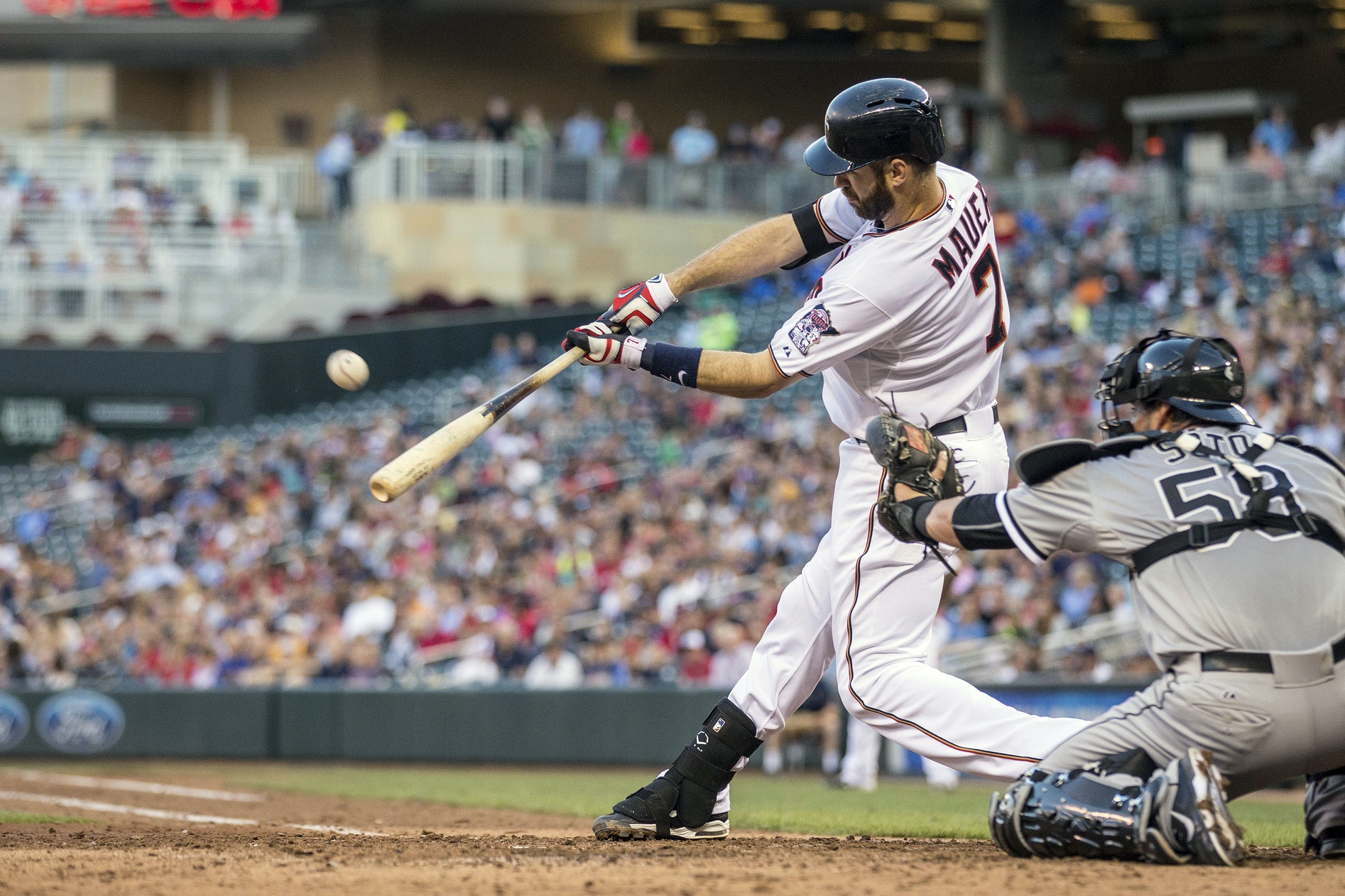 One certainly can’t fault the average fan for suggesting Mauer hasn’t played particularly well this season, however. Mauer is hitting just .263/.334/.370, good for a 95 OPS+ that really puts this offensive era into context. With this latest era of pitching dominance, an OPS just over .700 has become a quasi-baseline for offensive competence, though that requires a few levels of nuance being stripped away. And that doesn’t favor Mauer. Where it hurts is that the AL slash line for first basemen this year is .252/.333/447. Incidentally, Mauer’s pretty close on the first two marks, but his power falls short. Way short, in fact. That aggregate slash line results in a .781 positional OPS, which is eclipsed only by its NL counterpart (.271/.347/.464, an .811 collective mark). Some people will point to Mauer’s RBI pace — roughly 75 if he were to have 600 PA — as a potential place he has improved, though it seems odd that it would have an opposite correlation with his worst offensive season. Others have suggested Mauer’s .403/.516/.522 line with runners in scoring position indicates he’s activated some sort of clutch gene, especially in correlation with his improved RBI totals. And while I reject the idea of clutch in baseball as a general rule — if you can arbitrarily raise your performance in certain situations, why wouldn’t you always? — I do think there’s something more at play there, and we’ll dig into it a bit here. The talk early in the season was about how Mauer had re-worked some mechanical things in an effort to try pull the ball more. Very early returns suggested he was doing just that, and in fact was doing it at the expense of his usual bread and butter, which was hitting to the opposite field. Let’s make one thing clear here: Mauer might be one of, if not the finest, opposite field hitters of his era. Or any recent era, for that matter. For his career, this is how Mauer’s batted results have played out: To left (opposite) field: .436/.427/.679 (1.106 OPS; .470 wOBA) To center field: .372/.369/.491 (.859 OPS; .372 wOBA) To right field: .277/.277/.396 (.673 OPS; .291 wOBA) Keep in mind, this is his 12th big league season, so this is from a ton of data. It’s hard to replicate context because those numbers don’t include walks — walks don’t have specific fields, that is — but essentially with this year’s numbers he’s been Bryce Harper to left field, Brian Dozier to center field and this year’s Michael Cuddyer (ICYMI, bad) to right over his career. That gives one a pretty good idea of how great Mauer has been to left and to center. And when we had checked in back in late April, Mauer was hitting .450/.450/.500 to the pull side in early returns. At that same point, Mauer was hitting just .077/.077/.077 to the opposite field, and stories were abundant about his seismic shift to becoming a pull hitter. Well, flash forward almost 70 days, and what do we find? To left (opposite) field: .388/.378/.613 (.991 OPS; .419 wOBA) To center field: .274/.267/.333 (.601 OPS; .258 wOBA) To right field: .299/.299/.403 (.701 OPS; .306 wOBA) I don’t know about you all, but that looks a lot like vintage Joe Mauer, with one huge, huge exception: center field has been absolutely dead. Now there are some things we can’t know simply from these numbers. For instance, frequency. We don’t know how often Mauer is hitting to left and capitalizing on such great numbers, at least not in comparison to center or right. A look at his season numbers suggests not too terribly often. Fortunately, we do have frequency numbers. Here’s Mauer’s hits breakdown by field: 31 to left; 41.9% 23 to center; 31.1% 20 to right; 27.0% But how does that compare to his career numbers: 657 to left; 40.7% 603 to center; 37.4% 354 to right; 21.9% Now, what does that tell us, exactly? To be sure, maybe not as much as we’d like. It does suggest Mauer’s still wearing out left, and that he isn’t entirely ignoring right like his career rates indicate. But this is still just hits. In other words, we’re ignoring outs to each side. Maybe checking instances of batted balls going to each field will give us a deeper look. In 2015, here are the percentage of instances Mauer has hit to each specific field (via Fangraphs’ database): 82 to left; 34.9% 86 to center; 36.6% 67 to right; 28.5% For his career, he looks like this: 1543 to left; 34.6% 1636 to center; 36.7% 1280 to right; 28.7% That’s sort of uncanny, but it’s almost exactly in line with his career rates. Wow. So Mauer has returned to being supernaturally good at hitting the baseball the other way, but still hasn’t been particularly good. What gives? It’s hard not to keep coming back to center field being a dead zone for Mauer after being so good to him early in his career. And with the advent of shifts in recent years, could that be affecting Mauer adversely? Most certainly. He even conceded as much in a recent chat with Cold Omaha. “There’s been a lot of times where they’ve put the shortstop up the middle and maybe taken a couple hits away,” Mauer said. “So that could be the reason.” Coincidentally, Mauer hitting well with runners in scoring position does lend credence to the shifting idea, since teams aren’t as apt to shift in those situations. After all, teams need to hold runners in those spots, so you won’t see a shortstop to the right of second, and so on. There probably isn’t enough data to make a definitive conclusion, but it’s an interesting theory. Manager Paul Molitor suggested Mauer went through a phase where he was struggling with pitches he could hit, and perhaps lost a bit of his feel at the plate in terms of timing being a little off. The second half of Mauer’s June (.292/.386/.458 from June 16-30) was also markedly better than the first half (.188/.291/.271 from June 1-15), coinciding with Molitor’s timeline and almost directly with a pair of opposite field home runs he hit off Cardinals reliever Kevin Siegrist and four days later off Chicago’s John Danks. Both of those went to the opposite field. “I think that confidence was buoyed by that home run he hit in the Cardinals series,” Molitor added. Molitor also agreed with the idea that teams are taking away Mauer’s hot spots on the field. “We’ve seen different formations against Joe,” Molitor said. “Some people really bunch that middle. It’s how a team feels that their pitching staff is going to be able to handle him best, and then executing and trying to have their people in the right place. You can see how they do try to take a little bit more of the pull side at shortstop, and the third baseman can get over and protect that five hole a little bit. Outfields are tough for him, too, because they don’t worry about the right field corner. They really can rotate around to the other side, and it just doesn’t give him a lot of room. Left-center is covered. Left field line is covered. Right-center is covered. So yeah, it’s just kind of his tendencies and what they hit, and he kind of is one of those guys that charts don’t lie. He has places where he hits the ball more frequently, and sometimes it works against him.” A Cold Omaha exclusive with hitting coach Tom Brunansky was particularly illuminating, in which he basically broke down not only what Mauer has been doing so far this season, but steps he and Joe can take to try fight back against the shifts. Brunansky said, foundationally, pretty much everything has been the same in terms of what Mauer is trying to do at the plate. “It’s just that the consistency of what he wants,” Brunansky said. “It’s a certain spot we want to get the hands and have them stop to get ready to fire. Some days he gets it, and there’s days where it keeps moving a little bit. And then he gets a little barrel lag, so we still keep working. That’s been the goal that we’ve worked on since day one. You saw the effects the other night of being able to drive the ball out of the ballpark. When those hands stop and they stay short, he’s able to get the barrel to especially pitches that are up. Both were high fastballs that are kind of tough for anybody else to get to that he can go plane out and get that pitch.” Brunansky was of course referring to the home runs against Siegrist and Danks, and was especially effusive in his praise of how Mauer took the former deep on a 94-95 mph pitch in hitting zone three. “You’re talking 94-95 elevated,” Brunansky said of the Siegrist offering. “And his barrel, to keep the barrel through the plane enough to contact that ball. That’s pretty tough to do. So you know everything has to be solid up top. If he has any kind of lag and loses his barrel just an eighth of an inch, he’s probably going to pop that pitch up.” For a hitter about whom some have whispered might be suffering from a slowing bat or reflexes, that’s an encouraging sign. So what was the deal with the pull-heavy mantra early in the season? “I think the whole premise with pull was to get him to use the lower half,” Brunansky noted. “And to get the extension that he had lost a little bit, due to the injuries and everything that he had.” Brunansky went on to say that he felt Joe always had it within to revert back to what he called his “moneyball”, which is to say letting the ball get deep and spraying it out to left field. “But he really wasn’t driving it, and that was the frustrating part,” Brunansky continued. “Then you see the defenses shift, and everybody just wedge over and cheat in. OK, I understand it if physically we can’t do what we need to do. But the health was back, the rotation was back. Working the pull side, all that constitutes is a finish. It’s extension. If you go and look at the video of the home run he hit the other day, the extension is where he caught the pitch out in front. Even though it went to left field, he still caught the ball out front like you’re supposed to. If he catches that deep, those aren’t home runs. And then plus, too, he wanted to make sure that we showed the league that we’re making an adjustment. We’re not just going to sit here and let them do this to us. We wanted to spread that field back up and create some more gaps for him.” That seems to gibe with the idea that Brunansky and Mauer are both aware that he’s being game-planned a bit and trying to counteract it. So does that mean they think Mauer is inherently a “shiftable hitter?” As you might expect, Brunansky had a good answer for that as well. Quote Brunansky homes in on a couple of different points that are interesting. He seems to concede that Mauer is, at least to some degree, a shiftable hitter, much like Molitor said as well. But he also went into depth with the idea that Joe, as he’s aged, has evolved as a hitter — and not necessarily in a positive way. That part is less encouraging. The numbers flesh that out, too, at least in some respects. On the positive side, Mauer is striking out at a 15.8 percent clip entering play Wednesday — his lowest mark since 2012. The deeper peripherals aren’t as encouraging, however. His contact rate is 85 percent, which is up from the last two years but still more than two percent below his career rate. His zone contact rate is down 2.5 percent from his career rate, and he’s swinging more this year than in any other year of his career. Unfortunately, that increase is across the board, so it’s not just 4.2 percent more pitches overall against his career numbers, but when fleshed out boils down to 3.5 percent more pitches in the strike zone, and more concerning, 5 percent more pitches outside of the zone. In short, he’s doing much, much less with more swings. It’s hard to draw a definitive, one-size-fits-all conclusion from this data, but here’s a try: Mauer’s already on a natural decline, and shifts have hastened it to the point where he’ll have to react, or remain a well below average offensive first baseman. At this point, it’s fair to wonder if that’s even possible. The column originated at Cold Omaha here; please consider clicking through to support the content. nytwinsfan likes this Like This Report Entry
 -
There isn’t a more polarizing figure on the Minneapolis sports landscape than Joe Mauer. It’s not hard to see, either. For instance, have a look at social media when Mauer gets a day off — any day off — and how the average fan reacts to it. Never mind the fact that Mauer came into Wednesday tied with Brian Dozier for the most games played on the team. One certainly can’t fault the average fan for suggesting Mauer hasn’t played particularly well this season, however. Mauer’s hitting just .263/.334/.370, good for a 95 OPS+ that really puts this offensive era into context. With this latest era of pitching dominance, an OPS just over .700 has become a quasi-baseline for offensive competence, though that requires a few levels of nuance being stripped away. And that doesn’t favor Mauer. Where it hurts is that the AL slash line for first basemen this year is .252/.333/447. Incidentally, Mauer’s pretty close on the first two marks, but his power falls short. Way short, in fact. That slash line results in a .781 positional OPS, which is eclipsed only by its NL counterpart (.271/.347/.464; an .811 collective mark). Some people will point to Mauer’s RBI pace — roughly 75 if he were to have 600 PA — as a potential place he has improved, though it seems odd that it would have an opposite correlation with his worst offensive season. Others have suggested Mauer’s .403/.516/.522 line with runners in scoring position indicates he’s activated some sort of clutch gene, especially in correlation with his improved RBI totals. And while I reject the idea of clutch in baseball as a general rule — if you can arbitrarily raise your performance in certain situations, why wouldn’t you always? — I do think there’s something more at play there, and we’ll dig into it a bit here. The talk early in the season was about how Mauer had re-worked some mechanical things in an effort to try pull the ball more. Very early returns suggested he was doing just that, and in fact was doing it at the expense of his usual bread and butter, which was hitting to the opposite field. Let’s make one thing clear here: Mauer might be one of, if not the finest opposite field hitters of his era. Or any recent era, for that matter. For his career, this is how Mauer’s batted results have played out: To left (opposite) field: .436/.427/.679 (1.106 OPS; .470 wOBA) To center field: .372/.369/.491 (.859 OPS; .372 wOBA) To right field: .277/.277/.396 (.673 OPS; .291 wOBA) Keep in mind, this is his 12th big league season, so this is a ton of data. It’s hard to replicate context because those numbers don’t include walks — walks don’t have specific fields, that is — but essentially with this year’s numbers he’s been Bryce Harper to left field, Brian Dozier to center field and this year’s Michael Cuddyer (ICYMI, bad) to right over his career. That gives one a pretty good idea of how great Mauer has been to left and to center. And when we had checked in back in late April, Mauer was hitting .450/.450/.500 in early returns to the pull side. At that same point, Mauer was hitting just .077/.077/.077 to the opposite field, and stories were abundant about his seismic shift to becoming a pull hitter. Well, flash forward almost 70 days, and what do we find? To left (opposite) field: .388/.378/.613 (.991 OPS; .419 wOBA) To center field: .274/.267/.333 (.601 OPS; .258 wOBA) To right field: .299/.299/.403 (.701 OPS; .306 wOBA) I don’t know about you all, but that looks a lot like vintage Joe Mauer, with one huge, huge exception: center field has been absolutely dead. Now there are some things we can’t know simply from these numbers. For instance, frequency. We don’t know how often Mauer is hitting to left and capitalizing on such great numbers, at least not in comparison to center or right. A look at his season numbers might suggest not too terribly often. Fortunately, we do have frequency numbers. Here’s Mauer’s hits breakdown by field: 31 to left 23 to center 20 to right That comes out to roughly 41.9 percent to left, 31.1 percent to center and 27 percent to right. But how does that compare to his career numbers: 657 to left 603 to center 354 to right So that comes out to roughly 40.7 percent to left, 37.4 percent to center and 21.9 percent to right. Now, what does that tell us, exactly? To be sure, maybe not as much as we’d like. It does suggest Mauer’s still wearing out left, and that he isn’t entirely ignoring right like his career rates. But this is still just hits. In other words, we’re ignoring outs to each side. Maybe checking instances of batted balls going to each field will give us a deeper look. In 2015, here are the percentage of instances Mauer has hit to each specific field (via Fangraphs’ database): 82 to left 86 to center 67 to right So just 34.9 percent of Mauer’s batted balls have gone to left. As for center, that’s 36.6 percent, and for right he’s at 28.5 percent. For his career, he looks like this: 1543 to left 1636 to center 1280 to right That breaks down to 34.6 percent pull, 36.7 percent to center and 28.7 percent to right. That’s sort of uncanny, but it’s almost exactly in line with his career rates. Wow. So Mauer has returned to being supernaturally good at hitting the baseball the other way, but still hasn’t been particularly good. What gives? It’s hard not to keep coming back to center field being a dead zone for Mauer after being so good to him early in his career. And with the advent of shifts in recent years, could that be affecting Mauer adversely? Most certainly. He even conceded as much in a recent chat with Cold Omaha. “There’s been a lot of times where they’ve put the shortstop up the middle and maybe taken a couple hits away,” Mauer said. “So that could be the reason.” Coincidentally, Mauer hitting well with runners in scoring position does lend credence to the shifting idea, since teams aren’t apt to shift in those situations. After all, teams need to hold runners in those spots, so you won’t see a shortstop to the right of second, and so on. There probably isn’t enough data to make a definitive conclusion, but it’s an interesting theory. Manager Paul Molitor suggested Mauer went through a phase where he was struggling with pitches he could hit, and perhaps lost a bit of his feel at the plate in terms of timing being a little off. The second half of Mauer’s June (.292/.386/.458 from June 16-30) was also markedly better than the first (.188/.291/.271 from June 1-15), coinciding with Molitor’s timeline and almost directly with a pair of opposite field home runs he hit off Cardinals reliever Kevin Siegrist and four days later of Chicago’s John Danks. Both of those went to the opposite field. “I think that confidence was buoyed by that home run he hit in the Cardinals series,” Molitor added. Molitor also agreed with the idea that teams are taking away Mauer’s hot spots on the field. “We’ve seen different formations against Joe,” Molitor said. “Some people really bunch that middle. It’s how a team feels that their pitching staff is going to be able to handle him best, and then executing and trying to have their people in the right place. You can see how they do try to take a little bit more of the pull side at shortstop, and the third baseman can get over and protect that five hole a little bit. Outfields are tough for him, too, because they don’t worry about the right field corner. They really can rotate around to the other side, and it just doesn’t give him a lot of room. Left-center is covered. Left field line is covered. Right-center is covered. So yeah, it’s just kind of his tendencies and what they hit, and he kind of is one of those guys that charts don’t lie. He has places where he hits the ball more frequently, and sometimes it works against him.” A Cold Omaha exclusive with hitting coach Tom Brunansky was particularly illuminating, in which he basically broke down not only what Mauer has been doing so far this season, but steps he and Joe can take to try fight back against the shifts. Brunansky said foundationally, pretty much everything has been the same in terms of what Mauer is trying to do at the plate. “It’s just that the consistency of what he wants,” Brunansky said. “It’s a certain spot we want to get the hands and have them stop to get ready to fire. Some days he gets it, and there’s days where it keeps moving a little bit. And then he gets a little barrel lag, so we still keep working. That’s been the goal that we’ve worked on since day one. You saw the effects the other night of being able to drive the ball out of the ballpark. When those hands stop and they stay short, he’s able to get the barrel to especially pitches that are up. Both were high fastballs that are kind of tough for anybody else to get to that he can go plane out and get that pitch.” Brunansky was of course referring to the home runs against Siegrist and Danks, and was especially effusive in his praise of how Mauer took the former deep on a 94-95 mph pitch in hitting zone three. “You’re talking 94-95 elevated,” Brunansky said of the Siegrist offering. “And his barrel, to keep the barrel through the plane enough to contact that ball. That’s pretty tough to do. So you know everything has to be solid up top. If he has any kind of lag and loses his barrel just an eighth of an inch, he’s probably going to pop that pitch up.” For a hitter whom some have whispered might be suffering from a slowing bat or reflexes, that’s an encouraging sign. So what was the deal with the pull-heavy mantra early in the season? “I think the whole premise with pull was to get him to use the lower half,” Brunansky noted. “And to get the extension that he had lost a little bit, due to the injuries and everything that he had.” Brunansky went on to say that he felt Joe always had it within to revert back to what he called his “moneyball”, which is to say letting the ball get deep and spraying it out to left field. “But he really wasn’t driving it, and that was the frustrating part,” Brunansky continued. “Then you see the defenses shift, and everybody just wedge over and cheat in. OK, I understand it if physically we can’t do what we need to do. But the health was back, the rotation was back. Working the pull side, all that constitutes is a finish. It’s extension. If you go and look at the video of the home run he hit the other day, the extension is where he caught the pitch out in front. Even though it went to left field, he still caught the ball out front like you’re supposed to. If he catches that deep, those aren’t home runs. And then plus, too, he wanted to make sure that we showed the league that we’re making an adjustment. We’re not just going to sit here and let them do this to us. We wanted to spread that field back up and create some more gaps for him.” That seems to jive with the idea that Brunansky and Mauer are both aware that he’s being game-planned for a bit and trying to counteract it. So does that mean they think Mauer is inherently a “shiftable hitter?” As you might expect, Brunansky had a good answer for that as well. Brunansky hones in on a couple different points that are interesting. He seems to concede that Mauer is, at least to some degree, a shiftable hitter, much like Molitor said as well. But he also went into depth with the idea that Joe, as he’s aged, has evolved as a hitter — and not necessarily in a positive way. That part is less encouraging. The numbers flesh that out, too, at least in some respects. On the positive side, Mauer is striking out at 15.8 percent clip entering play Wednesday — his lowest mark since 2012. The deeper peripherals aren’t as encouraging, however. His contact rate is 85.5 percent, which is up from the last two years but still more than two percent below his career rate. His zone contact rate is down 2.5 percent from his career rate, and he’s swinging more this year than any other year of his career. Unfortunately, that increase is across the board, so it’s not just 4.2 percent more pitches overall against his career numbers, but when fleshed out boils down to 3.5 percent more pitches in the strike zone, and more concerningly 5 percent more pitches outside of the zone. In short, he’s doing much, much less with more swings. It’s hard to draw a definitive, one-size-fits-all conclusion from this data, but here’s a try: Mauer’s already on a natural decline, and shifts have hastened it to the point where he’ll have to react, or remain a well below average offensive first baseman. At this point, it’s fair to wonder if that’s even possible. The column originated at Cold Omaha here; please consider clicking through to support the content.
-
I wonder how hard this would be to suss out...probably easier for someone with database skills. AKA not me.
-
Watching Byron Buxton hit with two strikes on Sunday led me to wonder what the rest of the team is doing with their two-strike opportunities. Not just what kind of batting line they’re putting together — generally bad — but how often are they striking out when the count reaches two strikes?For a little bit of context, the average American League batter is hitting .179/.247/.274 with two strikes, and has struck out 39.5 percent of the time coming into Monday’s action. It’s not terribly surprising to see that hitters are completely at the mercy of pitchers with two strikes, but it’s nice to have some sort of grasp of what we’re working with here. So, here’s what each Twins player with somewhat regular playing time has done this season in two-strike counts (in order of most to fewest plate appearances): Brian Dozier – .180/.260/.302 with 57 strikeouts in 154 opportunities (37 percent whiff rate) Joe Mauer – .208/.266/.292 with 45 strikeouts in 143 opportunities (31.5 percent whiff rate) Trevor Plouffe – .205/.280/.362 with 55 strikeouts in 143 opportunities (38.5 percent whiff rate) Torii Hunter – .205/.274/.279 with 42 strikeouts in 135 opportunities (31.1 percent whiff rate) Kurt Suzuki – .156/.226/.234 with 23 strikeouts in 84 opportunities (27.4 percent whiff rate) Eduardo Escobar – .214/.250/.337 with 45 strikeouts in 104 opportunities (43.3 percent whiff rate) Danny Santana – .133/.122/.134 with 49 strikeouts in 98 opportunities (50 percent whiff rate) Kennys Vargas – .158/.210/.211 with 43 strikeouts in 81 opportunities (53.1 percent whiff rate) Eddie Rosario – .210/.234/.323 with 32 strikeouts in 64 opportunities (50 percent whiff rate) Shane Robinson – .170/.235/.213 with 16 strikeouts in 51 opportunities (31.4 percent whiff rate) Aaron Hicks – .175/.250/.175 with 17 strikeouts in 44 opportunities (38.6 percent whiff rate) Eduardo Nunez – .226/.273/.419 with 12 strikeouts in 33 opportunities (36.4 percent whiff rate) Oswaldo Arcia – .172/.194/.379 with 15 strikeouts in 31 opportunities (48.4 percent whiff rate) Chris Herrmann – .067/.176/.167 with 15 strikeouts in 34 opportunities (44.1 percent whiff rate) Byron Buxton – .143/.200/.286 with nine strikeouts in 16 opportunities (60 percent whiff rate) ———– Now these may not be terribly statistically significant because they represent a pretty small sampling, but I do think there’s some value in seeing which guys have been easier or more difficult for pitchers to put away with two strikes. With that said, any surprises in the figures? There’s some interesting dissonance with Suzuki, who is very difficult to strike out but still hasn’t done much with the two-strike pitches he’s put in play. Would you have pegged Nunez as the Twins’ best two-strike hitter? I’m not sure I’d have. It’s not terribly surprising — or fair — to see that Buxton has probably struggled the most in two-strike counts, but he can be added to a mounting list of young players who have struggled badly when in the hole at the plate. It is also not terribly surprising that Santana struggled with two strikes, but these numbers really drive home just how big of a hole he was in when he’d reach a two-strike count. If nothing else, this is a fun little exercise to see if your brain sees (a very little part of) the game the way the numbers do. This content first appeared on Cold Omaha here; please consider clicking through to support the content. Click here to view the article
-
 For a little bit of context, the average American League batter is hitting .179/.247/.274 with two strikes, and has struck out 39.5 percent of the time coming into Monday’s action. It’s not terribly surprising to see that hitters are completely at the mercy of pitchers with two strikes, but it’s nice to have some sort of grasp of what we’re working with here. So, here’s what each Twins player with somewhat regular playing time has done this season in two-strike counts (in order of most to fewest plate appearances): Brian Dozier – .180/.260/.302 with 57 strikeouts in 154 opportunities (37 percent whiff rate) Joe Mauer – .208/.266/.292 with 45 strikeouts in 143 opportunities (31.5 percent whiff rate) Trevor Plouffe – .205/.280/.362 with 55 strikeouts in 143 opportunities (38.5 percent whiff rate) Torii Hunter – .205/.274/.279 with 42 strikeouts in 135 opportunities (31.1 percent whiff rate) Kurt Suzuki – .156/.226/.234 with 23 strikeouts in 84 opportunities (27.4 percent whiff rate) Eduardo Escobar – .214/.250/.337 with 45 strikeouts in 104 opportunities (43.3 percent whiff rate) Danny Santana – .133/.122/.134 with 49 strikeouts in 98 opportunities (50 percent whiff rate) Kennys Vargas – .158/.210/.211 with 43 strikeouts in 81 opportunities (53.1 percent whiff rate) Eddie Rosario – .210/.234/.323 with 32 strikeouts in 64 opportunities (50 percent whiff rate) Shane Robinson – .170/.235/.213 with 16 strikeouts in 51 opportunities (31.4 percent whiff rate) Aaron Hicks – .175/.250/.175 with 17 strikeouts in 44 opportunities (38.6 percent whiff rate) Eduardo Nunez – .226/.273/.419 with 12 strikeouts in 33 opportunities (36.4 percent whiff rate) Oswaldo Arcia – .172/.194/.379 with 15 strikeouts in 31 opportunities (48.4 percent whiff rate) Chris Herrmann – .067/.176/.167 with 15 strikeouts in 34 opportunities (44.1 percent whiff rate) Byron Buxton – .143/.200/.286 with nine strikeouts in 16 opportunities (60 percent whiff rate) ———– Now these may not be terribly statistically significant because they represent a pretty small sampling, but I do think there’s some value in seeing which guys have been easier or more difficult for pitchers to put away with two strikes. With that said, any surprises in the figures? There’s some interesting dissonance with Suzuki, who is very difficult to strike out but still hasn’t done much with the two-strike pitches he’s put in play. Would you have pegged Nunez as the Twins’ best two-strike hitter? I’m not sure I’d have. It’s not terribly surprising — or fair — to see that Buxton has probably struggled the most in two-strike counts, but he can be added to a mounting list of young players who have struggled badly when in the hole at the plate. It is also not terribly surprising that Santana struggled with two strikes, but these numbers really drive home just how big of a hole he was in when he’d reach a two-strike count. If nothing else, this is a fun little exercise to see if your brain sees (a very little part of) the game the way the numbers do. This content first appeared on Cold Omaha here; please consider clicking through to support the content.
 -
WARNE: What are the Twins Doing With Two Strikes Offensively?
Brandon Warne posted a blog entry in BW on the Beat
Watching Byron Buxton hit with two strikes on Sunday led me to wonder what the rest of the team is doing with their two-strike opportunities. Not just what kind of batting line they’re putting together — generally bad — but how often are they striking out when the count reaches two strikes? For a little bit of context, the average American League batter is hitting .179/.247/.274 with two strikes, and has struck out 39.5 percent of the time coming into Monday’s action. It’s not terribly surprising to see that hitters are completely at the mercy of pitchers with two strikes, but it’s nice to have some sort of grasp of what we’re working with here. So, here’s what each Twins player with somewhat regular playing time has done this season in two-strike counts (in order of most to fewest plate appearances): Brian Dozier – .180/.260/.302 with 57 strikeouts in 154 opportunities (37 percent whiff rate) Joe Mauer – .208/.266/.292 with 45 strikeouts in 143 opportunities (31.5 percent whiff rate) Trevor Plouffe – .205/.280/.362 with 55 strikeouts in 143 opportunities (38.5 percent whiff rate) Torii Hunter – .205/.274/.279 with 42 strikeouts in 135 opportunities (31.1 percent whiff rate) Kurt Suzuki – .156/.226/.234 with 23 strikeouts in 84 opportunities (27.4 percent whiff rate) Eduardo Escobar – .214/.250/.337 with 45 strikeouts in 104 opportunities (43.3 percent whiff rate) Danny Santana – .133/.122/.134 with 49 strikeouts in 98 opportunities (50 percent whiff rate) Kennys Vargas – .158/.210/.211 with 43 strikeouts in 81 opportunities (53.1 percent whiff rate) Eddie Rosario – .210/.234/.323 with 32 strikeouts in 64 opportunities (50 percent whiff rate) Shane Robinson – .170/.235/.213 with 16 strikeouts in 51 opportunities (31.4 percent whiff rate) Aaron Hicks – .175/.250/.175 with 17 strikeouts in 44 opportunities (38.6 percent whiff rate) Eduardo Nunez – .226/.273/.419 with 12 strikeouts in 33 opportunities (36.4 percent whiff rate) Oswaldo Arcia – .172/.194/.379 with 15 strikeouts in 31 opportunities (48.4 percent whiff rate) Chris Herrmann – .067/.176/.167 with 15 strikeouts in 34 opportunities (44.1 percent whiff rate) Byron Buxton – .143/.200/.286 with nine strikeouts in 16 opportunities (60 percent whiff rate) ———– Now these may not be terribly statistically significant because they represent a pretty small sampling, but I do think there’s some value in seeing which guys have been easier or more difficult for pitchers to put away with two strikes. With that said, any surprises in the figures? There’s some interesting dissonance with Suzuki, who is very difficult to strike out but still hasn’t done much with the two-strike pitches he’s put in play. Would you have pegged Nunez as the Twins’ best two-strike hitter? I’m not sure I’d have. It’s not terribly surprising — or fair — to see that Buxton has probably struggled the most in two-strike counts, but he can be added to a mounting list of young players who have struggled badly when in the hole at the plate. It is also not terribly surprising that Santana struggled with two strikes, but these numbers really drive home just how big of a hole he was in when he’d reach a two-strike count. If nothing else, this is a fun little exercise to see if your brain sees (a very little part of) the game the way the numbers do. This content first appeared on Cold Omaha here; please consider clicking through to support the content. -
Article: Brian Dozier Is Entering Elite Territory
Brandon Warne replied to Ted Schwerzler 's topic in Twins Daily Front Page News
Learn to love OBP and SLG, and have a look at league average values. Brian Dozier, if he plays like he has so far all season, would then be considered a superstar. -
The Twins snapped a five-game losing streak with a 4-3 in over the Rangers on Sunday. The club is now 4-9 in June and has sunk to 34-28, 1.5 games behind the Royals who were incidentally rained out in St. Louis on Sunday — the exact place the Twins open a series Monday. But “sunk” and six games over .500 doesn’t really make sense in the grand scheme of things. After all, wasn’t this a team that was supposed to lose 90 again, or thereabouts? And while even the latest updated projections have the Twins finishing at or around .500, that’s still pretty much playing to the level the projections set out for the team the rest of the way, with the solid start factored in. In other words, few outside Minnesota think the club is for real. And maybe it isn’t, but it isn’t because of the recent skid, which simply exemplifies the ebbs and flows of a long season. Last year’s San Francisco Giants — the World Series winners, if you don’t recall — had a six-game losing streak in June last year, and another in late July as well as a five-game skid in August. These things happen. But if the Twins are to build on this start to prove legitimacy, where do they need to go from here? A lot of minds will look to the minors, from which the Twins recently dipped to bring up Eddie Rosario, Byron Buxton and even Jorge Polanco for a brief stint. They’ve already quasi-addressed the shortstop situation by sending out Danny Santana, whose struggles had gotten to the point where he was legitimately a liability in each phase of the game. To Santana’s credit, he’s off to a fast start down at Rochester, with hits in all six games he’s been on the squad, and a batting line of .375/.385/.458. All but one of his starts have been at short (the other at DH), so there doesn’t seem to be any buzz about moving him around. The outfield is pretty crowded anyhow. Similarly while we’re talking about Triple-A and outfielders, Oswaldo Arcia continues to struggle down there. He has just one hit in his last 13 plate appearances after a nice handful of games in early June and is now hitting just .154/.175/.212 down there, prompting some to wonder if this might be an extended stay for Arcia. Another popular name on Twins fans’ lips when it comes to promotions is Josmil Pinto, but there’s cold water to be splashed on that for a number of reasons. Well, perhaps the reasons are related, as Pinto went on the 7-day disabled list with concussion symptoms late last week, and that came on the heels of a stretch where he had hit just .102/.154/.245 over his last 15 pre-injury games. It’s extremely worrisome on a few fronts, as it’s possibly linked to the spring training concussion that perhaps cost him a spot on the Opening Day Twins roster. And if it is, did it crop back up recently, or is it something he’d been dealing with for an extended period of time — hence the struggles? Among position players that brings us full circle back to Polanco, who has played shortstop exclusively in the field this season at Double-A Chattanooga and was hitting .316/.361/.433 coming into Monday’s action against Birmingham. Polanco has also swiped 13 bags in 19 attempts and has committed 14 errors in 53 games at short. Errors are rarely a good barometer for guys playing in the minors, where field conditions pale in comparison to the big leagues. The belief seems to be that Polanco might be a bit steadier in the field, so perhaps he’ll get a longer look if the Twins decide they want to shift Eduardo Escobar to more of a utility role. Keep in mind, Escobar is hitting just .240/.267/.371, so while he had a much better year last year, the Twins may be apt to move on Polanco if they think it improves the team moving forward in the near future. Pitching-wise you can keep an eye on Alex Meyer, as he’s taken to the bullpen relatively well. He’s still walking batters at a similar rate, but in his six appearances as a reliever, he’s worked 10.2 innings with 15 strikeouts, six walks and an opponents’ batting line of .184/.311/.237. That’s also brought his season ERA down to 5.76 from 7.09. It’s unclear if Meyer is the next arm that’s likely to come up from Triple-A Rochester, but there are a few other potential prospects/suspects. Lester Oliveros is suspended for seven games for throwing at the head of Austin Romine, a Yankees catching prospect. Even before then, Oliveros had hit the skids a bit in recent weeks, sending his ERA up to 4.15. His WHIP and K/9 have both plummeted badly as the months have gone on this season, and he’s a non-roster player, so that’s another hurdle he has to clear to be called up as well. Beyond that, the Triple-A pen has Logan Darnell and A.J. Achter who project as middle relief arms — Achter’s having the better year — and Caleb Thielbar who would likely be a situational lefty, though he’s struggled with control this year. The Chattanooga bullpen has proven to be filthy and probably has more of the guys prospect types should be watching for in terms of difference makers for the Twins moving into the future. Names like Cole Johnson (graduated to Rochester recently), J.T. Chargois, Nick Burdi, Zach Jones and Jake Reed are all in the picture. Chargois was recently promoted, while Burdi, Jones and Reed all throw in the upper 90s. Burdi has been solid since a rough April: 1.86 ERA, 22-5 K/BB ratio, .236/.288/.33 opponents’ line. Reed had a really nice May — 3.75 ERA, 9.0 K/9, 1.08 WHIP — but struggled in April and thus far in June. Jones has been solid throughout but was otherworldly in April (1.29 ERA, 16.7 K/9). Essentially, the Twins have plenty of options to dip into the minors should they need help at pretty much any position. Keep in mind, we also didn’t talk about a certain Mr. Miguel Sano (.306/.409/.528 in June) or teammate Max Kepler (.359/.400/.583 in May), who is on the 40-man roster and as a result could move quickly if the Twins find a need in a corner. So when people ask if I see the Twins making any moves in July, this is where I see the club going. I don’t know what the future will look like and if the Twins will still be over .500 in six or seven weeks, but I do know that they’ll have options down on the farm to supplement whatever that have going — or consequently, not going — at that time. This content originated at Cold Omaha here; please consider clicking through to help support it.
-
When will Twins face the Mauer Problem?
Brandon Warne commented on huhguy's blog entry in Blog huhguy
Calling up Kepler or Sano wouldn't result in cutting Mauer either way. The best thing the Twins could do is to consider making Mauer a part-time player, but that wouldn't come until next year probably at the earliest. Maybe the next thing is to move him down in the order, though. That won't come until the lower half is doing more than they are now, however. -
Article: Why I'm Not Buying The Twins-For Now
Brandon Warne replied to Brandon Warne's topic in Twins Daily Front Page News
Aye, good call. Mathematically it sees the same team, but doesn't project any _further_ regression to their preseason models. Thanks. -
Adding Punch To The Twins Offense
Brandon Warne commented on Ted Schwerzler 's blog entry in Off The Baggy
Well, he has a no-trade clause, is playing at a career-worst level and has a bad contract thanks to what we'd have to imagine is the concussion. So, maybe choose your words better because concussions aren't a joking matter, and to answer your second question, well, never. Who is offering 'prospects' -- as ambiguous as that is -- for Mauer right now? -
It’s early June, and the Minnesota Twins are not only keeping their proverbial heads above water, but in fact have the second-most wins and the best winning percentage in the entire American League. Yes this Twins team, who was picked by national types to be among the five or so worst teams in baseball, is leading the charge in one of the better divisions in baseball.Baseball is truly a weird game. The Twins are 32-17 since a 1-6 start. They’re 31-16 against teams that aren’t from Detroit. They’re getting contributions from unlikely sources, winning games they have no business winning and having post-win dance parties which seem to have made baseball in Minnesota fun again. Fans seem to be noticing, as just over 100,000 people streamed through the gates for the Milwaukee Brewers series over the weekend. But I don’t think it’s sustainable. Even since I wrote the piece detailing how I’m not a Twins fan due to my work obligations, I’ve still seen scores of people imploring me to simply enjoy this current run. But I don’t really think a writer’s job changes too terribly much based on how good a team is. Sure, you might be more apt to see guys hang around for postgame comments, but with a team that has Torii Hunter, you immediately have that accountability anyhow. It isn’t my job to ride the wave; it’s my job to analyze streaks and tendencies to find out if I truly feel it can keep on going. And for a few reasons, I’m not sure it can. That isn’t to say this team hasn’t had great success. To be clear, being 10 games over .500 at any point in the season was never part of the plan. Think about all the projections that came up in the preseason. Most pegged the Twins at a 72-win team, again possibly prolonging the 90-loss streak into the first year of the Paul Molitor regime. Pretty much all of those projections have done an about face; Fangraphs’ latest projection has the Twins dead even at 81-81. That’s not only an 11-game improvement from last year, but just three games off the projected pace to win the division outright. As I mentioned before the season, I figured the AL Central on the whole would be a dogfight, separated by fewer than 10 games from top to bottom. The revised projections seem to flesh that out, with not only the winning team taking home 84 wins (a virtual tie between Kansas City and Cleveland at this second) and the last place team (Chicago) winning 76, but with the Tigers sneaking into third place with 83 wins and leaving the Twins in fourth. Still, that would make for an insane rest of the season if the first four spots have just three games separating them. But let’s talk about the rest of the division for a minute. To say Detroit is staggering is putting it nicely, as the Tigers are 13-17 over their last 30 games, 7-13 over the last 20 and 2-8 over the last 10. It’s gotten worse, not better for the aging Tigers as the season has worn on. But even so, if this Tigers team seems vulnerable, keep in mind they’re getting Victor Martinez and Justin Verlander back over a short span. That could provide a huge boost. For how well the Twins have been cruising, Kansas City is still nipping at their heels, just a game down coming into today’s action. As most expected their rotation has been suspect (4.55 ERA; 25th in MLB) and their bullpen has been unbelievable (1.75 ERA; No. 1 in MLB), and their offense is impossible to strike out. Cleveland has probably the best rotation in the AL, but it has been let down by poor luck and bad defense. Most projections still have them winning the division. And as for the White Sox coming off their free agent spending spree, well, they aren’t too far down to make a hard-charging run before all is finished. And maybe that’s the biggest detriment to the Twins, who have to continue playing at this pace to fend off all comers, which includes the heel-nipping Royals starting Monday night. In the Twins’ favor is their 20-9 record at home, and to be quite honest the 13-14 mark on the road is not terribly far off from what most playoff teams do — dominate at home and stay afloat on the road. But is it fair to say the Twins have gotten fat off playing subpar teams? Yeah, maybe a little. The Twins are 24-12 against teams presently under .500, and just 9-11 against teams currently over. That means as of today, the Twins have played 36 games against teams with more losses than wins. No other team in the division has played more than 28, as you’ll see here: Record against teams under .500 (AL Central): Twins – 24-12 Royals – 16-7 Tigers – 13-15 Indians – 14-9 White Sox – 13-11 Interestingly, the team (Detroit) who has played the second-most games against lower-level teams is under .500 against them. And while it’s true that you have to take advantage of those opportunities when they’re presented, it does call into question the sustainability of this run over the long term. Another thing that could potentially become a problem is lineup depth. Consider this top four on any given day: .267/.341/.530 .281/.335/.452 .269/.329/.370 .250/.321/.434 That’s not exactly a star-studded top four in a lineup, but it’s more than enough to get the job done in today’s game. That’s Brian Dozier up top, Hunter, Joe Mauer and finally a still pretty decent line from a currently slumping Trevor Plouffe. Now, have a look at a handful of candidates that could fill out the bottom five of the lineup on any given day: .245/.318/.325 .218/.235/.291 .230/.252/.355 .247/.291/.296 .288/.301/.400 Those are the slash lines for Kurt Suzuki, Danny Santana, Eduardo Escobar, Aaron Hicks and Eddie Rosario. You could also lump in Eduardo Nunez (.300/.340/.460 in just 53 PA), but either way this is not a group that inspires confidence. Sending out Santana for a resurgent Kennys Vargas (.308/.403/.519 in 16 Triple-A games) after Sunday’s game represents progress, but this is a bottom half that simply isn’t going to be competitive over the long haul. The other thing that stands out is that aside from a few more extra-base hits — three home runs, specifically — Escobar is having roughly the same season Santana is. In that sense, keep an eye on Jorge Polanco, who is hitting .315/.346/.440 down at Double-A Chattanooga. And while it would be foolish to suggest the pitching staff hasn’t made big strides this year, it’s still a rotation that doesn’t strike anyone out, and is backed by a largely piecemeal bullpen. The simplest way to explain it is that while the results have been better, the process has not. So while the team’s 3.84 ERA coming into Monday — still just eighth in the AL — is markedly better than last year’s 4.57 mark, the peripherals don’t really show a huge leap. Last year’s team struck out 6.5 batters per nine innings. This year’s iteration is at just 5.9. The league average last year was 7.7 K/9, and is 7.6 this year. So even as the league has taken a slight step back, the Twins took it a step further. Last year’s team had a 3.97 FIP (fielding independent pitching, a barometer of what the team’s ERA ought to normalize to over time); this year’s bunch has a 4.10. As we’ve seen with Mike Pelfrey and Kyle Gibson, strikeouts aren’t necessarily a must to be a successful starter. That isn’t to say that they can both sustain sub-3.00 ERA marks without strikeout jumps, but pitching isn’t a one-size-fits-all proposition either. With that said, the Twins’ staff isn’t really groundball heavy like Gibson and Pelfrey each are, ranking eighth in the AL with a roughly league-average 44.2 percent groundball rate. Considering Pelfrey (55.2 percent) and Gibson (53.2 percent) are both well above that mark, that means there are a fair share of other guys who come up way under that mark, and will need a little added help to keep their ERAs down. The theory behind that is if a guy isn’t striking too many hitters out, grounders are the next best step for run prevention because there are so few extra-base hits that come via the groundball. Basically speaking, a hitter has to roll one over the first- or third-base bag for an extra-base hit. Statistically in 2015, just 1.9 percent of grounders resulted in extra-base hits across both leagues. For fly balls, that spikes to 11.5 percent and for line drives a staggering 24.4 percent. The nice thing for the Twins moving forward is that they can address their fly ball tendencies one way, and it’s one the fans will be largely happy about: promoting Byron Buxton. There’s some buzz around town that the move could come sooner rather than later, and an outfield of Rosario-Buxton-Hicks would spell death to fly balls in a way that Twins fans haven’t seen since the days of the Soul Patrol. This bunch could be even better, and that would allow Molitor to keep Hunter fresh with more days DH’ing, with Rosario rotating in and out depending on how Vargas does with this go-round. Again, it would be nice for Molitor to have too many guys going well with the stick rather than needing to simply fill out the bottom of the order with guys who aren’t carrying their weight. That the Twins have managed to continue winning despite that might suggest a certain moxie, but most likely it’s been getting key hits at key times, something that doesn’t necessarily play itself out on a regular basis over the course of a 162-game season. The important thing to remember is that even if the Twins can’t keep it up over the long haul, nobody can take away the early-season wins, and any step forward represents a good look into the future. Even if this team finishes 81-81 as the projections suggest, that’s A. still in the thick of it in September and B. a huge improvement over last year. This post originated at Cold Omaha here; please consider clicking through to support the content. Click here to view the article
-
 Baseball is truly a weird game. The Twins are 32-17 since a 1-6 start. They’re 31-16 against teams that aren’t from Detroit. They’re getting contributions from unlikely sources, winning games they have no business winning and having post-win dance parties which seem to have made baseball in Minnesota fun again. Fans seem to be noticing, as just over 100,000 people streamed through the gates for the Milwaukee Brewers series over the weekend. But I don’t think it’s sustainable. Even since I wrote the piece detailing how I’m not a Twins fan due to my work obligations, I’ve still seen scores of people imploring me to simply enjoy this current run. But I don’t really think a writer’s job changes too terribly much based on how good a team is. Sure, you might be more apt to see guys hang around for postgame comments, but with a team that has Torii Hunter, you immediately have that accountability anyhow. It isn’t my job to ride the wave; it’s my job to analyze streaks and tendencies to find out if I truly feel it can keep on going. And for a few reasons, I’m not sure it can. That isn’t to say this team hasn’t had great success. To be clear, being 10 games over .500 at any point in the season was never part of the plan. Think about all the projections that came up in the preseason. Most pegged the Twins at a 72-win team, again possibly prolonging the 90-loss streak into the first year of the Paul Molitor regime. Pretty much all of those projections have done an about face; Fangraphs’ latest projection has the Twins dead even at 81-81. That’s not only an 11-game improvement from last year, but just three games off the projected pace to win the division outright. As I mentioned before the season, I figured the AL Central on the whole would be a dogfight, separated by fewer than 10 games from top to bottom. The revised projections seem to flesh that out, with not only the winning team taking home 84 wins (a virtual tie between Kansas City and Cleveland at this second) and the last place team (Chicago) winning 76, but with the Tigers sneaking into third place with 83 wins and leaving the Twins in fourth. Still, that would make for an insane rest of the season if the first four spots have just three games separating them. But let’s talk about the rest of the division for a minute. To say Detroit is staggering is putting it nicely, as the Tigers are 13-17 over their last 30 games, 7-13 over the last 20 and 2-8 over the last 10. It’s gotten worse, not better for the aging Tigers as the season has worn on. But even so, if this Tigers team seems vulnerable, keep in mind they’re getting Victor Martinez and Justin Verlander back over a short span. That could provide a huge boost. For how well the Twins have been cruising, Kansas City is still nipping at their heels, just a game down coming into today’s action. As most expected their rotation has been suspect (4.55 ERA; 25th in MLB) and their bullpen has been unbelievable (1.75 ERA; No. 1 in MLB), and their offense is impossible to strike out. Cleveland has probably the best rotation in the AL, but it has been let down by poor luck and bad defense. Most projections still have them winning the division. And as for the White Sox coming off their free agent spending spree, well, they aren’t too far down to make a hard-charging run before all is finished. And maybe that’s the biggest detriment to the Twins, who have to continue playing at this pace to fend off all comers, which includes the heel-nipping Royals starting Monday night. In the Twins’ favor is their 20-9 record at home, and to be quite honest the 13-14 mark on the road is not terribly far off from what most playoff teams do — dominate at home and stay afloat on the road. But is it fair to say the Twins have gotten fat off playing subpar teams? Yeah, maybe a little. The Twins are 24-12 against teams presently under .500, and just 9-11 against teams currently over. That means as of today, the Twins have played 36 games against teams with more losses than wins. No other team in the division has played more than 28, as you’ll see here: Record against teams under .500 (AL Central): Twins – 24-12 Royals – 16-7 Tigers – 13-15 Indians – 14-9 White Sox – 13-11 Interestingly, the team (Detroit) who has played the second-most games against lower-level teams is under .500 against them. And while it’s true that you have to take advantage of those opportunities when they’re presented, it does call into question the sustainability of this run over the long term. Another thing that could potentially become a problem is lineup depth. Consider this top four on any given day: .267/.341/.530 .281/.335/.452 .269/.329/.370 .250/.321/.434 That’s not exactly a star-studded top four in a lineup, but it’s more than enough to get the job done in today’s game. That’s Brian Dozier up top, Hunter, Joe Mauer and finally a still pretty decent line from a currently slumping Trevor Plouffe. Now, have a look at a handful of candidates that could fill out the bottom five of the lineup on any given day: .245/.318/.325 .218/.235/.291 .230/.252/.355 .247/.291/.296 .288/.301/.400 Those are the slash lines for Kurt Suzuki, Danny Santana, Eduardo Escobar, Aaron Hicks and Eddie Rosario. You could also lump in Eduardo Nunez (.300/.340/.460 in just 53 PA), but either way this is not a group that inspires confidence. Sending out Santana for a resurgent Kennys Vargas (.308/.403/.519 in 16 Triple-A games) after Sunday’s game represents progress, but this is a bottom half that simply isn’t going to be competitive over the long haul. The other thing that stands out is that aside from a few more extra-base hits — three home runs, specifically — Escobar is having roughly the same season Santana is. In that sense, keep an eye on Jorge Polanco, who is hitting .315/.346/.440 down at Double-A Chattanooga. And while it would be foolish to suggest the pitching staff hasn’t made big strides this year, it’s still a rotation that doesn’t strike anyone out, and is backed by a largely piecemeal bullpen. The simplest way to explain it is that while the results have been better, the process has not. So while the team’s 3.84 ERA coming into Monday — still just eighth in the AL — is markedly better than last year’s 4.57 mark, the peripherals don’t really show a huge leap. Last year’s team struck out 6.5 batters per nine innings. This year’s iteration is at just 5.9. The league average last year was 7.7 K/9, and is 7.6 this year. So even as the league has taken a slight step back, the Twins took it a step further. Last year’s team had a 3.97 FIP (fielding independent pitching, a barometer of what the team’s ERA ought to normalize to over time); this year’s bunch has a 4.10. As we’ve seen with Mike Pelfrey and Kyle Gibson, strikeouts aren’t necessarily a must to be a successful starter. That isn’t to say that they can both sustain sub-3.00 ERA marks without strikeout jumps, but pitching isn’t a one-size-fits-all proposition either. With that said, the Twins’ staff isn’t really groundball heavy like Gibson and Pelfrey each are, ranking eighth in the AL with a roughly league-average 44.2 percent groundball rate. Considering Pelfrey (55.2 percent) and Gibson (53.2 percent) are both well above that mark, that means there are a fair share of other guys who come up way under that mark, and will need a little added help to keep their ERAs down. The theory behind that is if a guy isn’t striking too many hitters out, grounders are the next best step for run prevention because there are so few extra-base hits that come via the groundball. Basically speaking, a hitter has to roll one over the first- or third-base bag for an extra-base hit. Statistically in 2015, just 1.9 percent of grounders resulted in extra-base hits across both leagues. For fly balls, that spikes to 11.5 percent and for line drives a staggering 24.4 percent. The nice thing for the Twins moving forward is that they can address their fly ball tendencies one way, and it’s one the fans will be largely happy about: promoting Byron Buxton. There’s some buzz around town that the move could come sooner rather than later, and an outfield of Rosario-Buxton-Hicks would spell death to fly balls in a way that Twins fans haven’t seen since the days of the Soul Patrol. This bunch could be even better, and that would allow Molitor to keep Hunter fresh with more days DH’ing, with Rosario rotating in and out depending on how Vargas does with this go-round. Again, it would be nice for Molitor to have too many guys going well with the stick rather than needing to simply fill out the bottom of the order with guys who aren’t carrying their weight. That the Twins have managed to continue winning despite that might suggest a certain moxie, but most likely it’s been getting key hits at key times, something that doesn’t necessarily play itself out on a regular basis over the course of a 162-game season. The important thing to remember is that even if the Twins can’t keep it up over the long haul, nobody can take away the early-season wins, and any step forward represents a good look into the future. Even if this team finishes 81-81 as the projections suggest, that’s A. still in the thick of it in September and B. a huge improvement over last year. This post originated at Cold Omaha here; please consider clicking through to support the content.
 -
Garza debuted 14 months (less two days) after he signed.
-
Adam Walker: Looking for Comps
Brandon Warne commented on jorgenswest's blog entry in Blog jorgenswest
Careful. "Strikeout rate doesn't matter" isn't one-size-fits-all. -
WARNE: Why I’m Not Buying the Minnesota Twins — For Now
Brandon Warne commented on Brandon Warne's blog entry in BW on the Beat
Via PITCHf/x, the Twins have thrown changeups 6.6 percent of the time this year, and 8.7 percent last year. Now that might not include Pelfrey's split change or Nolasco's split, but it's still probably about the same rate as last year. -
WARNE: Why I’m Not Buying the Minnesota Twins — For Now
Brandon Warne commented on Brandon Warne's blog entry in BW on the Beat
Yep, I can 'buy' all of that too. Good stuff. -
WARNE: Why I’m Not Buying the Minnesota Twins — For Now
Brandon Warne posted a blog entry in BW on the Beat
It’s early June, and the Minnesota Twins are not only keeping their proverbial heads above water, but in fact have the second-most wins and the best winning percentage in the entire American League. Yes this Twins team, who was picked by national types to be among the five or so worst teams in baseball, is leading the charge in one of the better divisions in baseball. Baseball is truly a weird game. The Twins are 32-17 since a 1-6 start. They’re 31-16 against teams that aren’t from Detroit. They’re getting contributions from unlikely sources, winning games they have no business winning and having post-win dance parties which seem to have made baseball in Minnesota fun again. Fans seem to be noticing, as just over 100,000 people streamed through the gates for the Milwaukee Brewers series over the weekend. But I don’t think it’s sustainable. Even since I wrote the piece detailing how I’m not a Twins fan due to my work obligations, I’ve still seen scores of people imploring me to simply enjoy this current run. But I don’t really think a writer’s job changes too terribly much based on how good a team is. Sure, you might be more apt to see guys hang around for postgame comments, but with a team that has Torii Hunter, you immediately have that accountability anyhow. It isn’t my job to ride the wave; it’s my job to analyze streaks and tendencies to find out if I truly feel it can keep on going. And for a few reasons, I’m not sure it can. That isn’t to say this team hasn’t had great success. To be clear, being 10 games over .500 at any point in the season was never part of the plan. Think about all the projections that came up in the preseason. Most pegged the Twins at a 72-win team, again possibly prolonging the 90-loss streak into the first year of the Paul Molitor regime. Pretty much all of those projections have done an about face; Fangraphs’ latest projection has the Twins dead even at 81-81. That’s not only an 11-game improvement from last year, but just three games off the projected pace to win the division outright. As I mentioned before the season, I figured the AL Central on the whole would be a dogfight, separated by fewer than 10 games from top to bottom. The revised projections seem to flesh that out, with not only the winning team taking home 84 wins (a virtual tie between Kansas City and Cleveland at this second) and the last place team (Chicago) winning 76, but with the Tigers sneaking into third place with 83 wins and leaving the Twins in fourth. Still, that would make for an insane rest of the season if the first four spots have just three games separating them. But let’s talk about the rest of the division for a minute. To say Detroit is staggering is putting it nicely, as the Tigers are 13-17 over their last 30 games, 7-13 over the last 20 and 2-8 over the last 10. It’s gotten worse, not better for the aging Tigers as the season has worn on. But even so, if this Tigers team seems vulnerable, keep in mind they’re getting Victor Martinez and Justin Verlander back over a short span. That could provide a huge boost. For how well the Twins have been cruising, Kansas City is still nipping at their heels, just a game down coming into today’s action. As most expected their rotation has been suspect (4.55 ERA; 25th in MLB) and their bullpen has been unbelievable (1.75 ERA; No. 1 in MLB), and their offense is impossible to strike out. Cleveland has probably the best rotation in the AL, but it has been let down by poor luck and bad defense. Most projections still have them winning the division. And as for the White Sox coming off their free agent spending spree, well, they aren’t too far down to make a hard-charging run before all is finished. And maybe that’s the biggest detriment to the Twins, who have to continue playing at this pace to fend off all comers, which includes the heel-nipping Royals starting Monday night. In the Twins’ favor is their 20-9 record at home, and to be quite honest the 13-14 mark on the road is not terribly far off from what most playoff teams do — dominate at home and stay afloat on the road. But is it fair to say the Twins have gotten fat off playing subpar teams? Yeah, maybe a little. The Twins are 24-12 against teams presently under .500, and just 9-11 against teams currently over. That means as of today, the Twins have played 36 games against teams with more losses than wins. No other team in the division has played more than 28, as you’ll see here: Record against teams under .500 (AL Central): Twins – 24-12 Royals – 16-7 Tigers – 13-15 Indians – 14-9 White Sox – 13-11 Interestingly, the team (Detroit) who has played the second-most games against lower-level teams is under .500 against them. And while it’s true that you have to take advantage of those opportunities when they’re presented, it does call into question the sustainability of this run over the long term. Another thing that could potentially become a problem is lineup depth. Consider this top four on any given day: .267/.341/.530 .281/.335/.452 .269/.329/.370 .250/.321/.434 That’s not exactly a star-studded top four in a lineup, but it’s more than enough to get the job done in today’s game. That’s Brian Dozier up top, Hunter, Joe Mauer and finally a still pretty decent line from a currently slumping Trevor Plouffe. Now, have a look at a handful of candidates that could fill out the bottom five of the lineup on any given day: .245/.318/.325 .218/.235/.291 .230/.252/.355 .247/.291/.296 .288/.301/.400 Those are the slash lines for Kurt Suzuki, Danny Santana, Eduardo Escobar, Aaron Hicks and Eddie Rosario. You could also lump in Eduardo Nunez (.300/.340/.460 in just 53 PA), but either way this is not a group that inspires confidence. Sending out Santana for a resurgent Kennys Vargas (.308/.403/.519 in 16 Triple-A games) after Sunday’s game represents progress, but this is a bottom half that simply isn’t going to be competitive over the long haul. The other thing that stands out is that aside from a few more extra-base hits — three home runs, specifically — Escobar is having roughly the same season Santana is. In that sense, keep an eye on Jorge Polanco, who is hitting .315/.346/.440 down at Double-A Chattanooga. And while it would be foolish to suggest the pitching staff hasn’t made big strides this year, it’s still a rotation that doesn’t strike anyone out, and is backed by a largely piecemeal bullpen. The simplest way to explain it is that while the results have been better, the process has not. So while the team’s 3.84 ERA coming into Monday — still just eighth in the AL — is markedly better than last year’s 4.57 mark, the peripherals don’t really show a huge leap. Last year’s team struck out 6.5 batters per nine innings. This year’s iteration is at just 5.9. The league average last year was 7.7 K/9, and is 7.6 this year. So even as the league has taken a slight step back, the Twins took it a step further. Last year’s team had a 3.97 FIP (fielding independent pitching, a barometer of what the team’s ERA ought to normalize to over time); this year’s bunch has a 4.10. As we’ve seen with Mike Pelfrey and Kyle Gibson, strikeouts aren’t necessarily a must to be a successful starter. That isn’t to say that they can both sustain sub-3.00 ERA marks without strikeout jumps, but pitching isn’t a one-size-fits-all proposition either. With that said, the Twins’ staff isn’t really groundball heavy like Gibson and Pelfrey each are, ranking eighth in the AL with a roughly league-average 44.2 percent groundball rate. Considering Pelfrey (55.2 percent) and Gibson (53.2 percent) are both well above that mark, that means there are a fair share of other guys who come up way under that mark, and will need a little added help to keep their ERAs down. The theory behind that is if a guy isn’t striking too many hitters out, grounders are the next best step for run prevention because there are so few extra-base hits that come via the groundball. Basically speaking, a hitter has to roll one over the first- or third-base bag for an extra-base hit. Statistically in 2015, just 1.9 percent of grounders resulted in extra-base hits across both leagues. For fly balls, that spikes to 11.5 percent and for line drives a staggering 24.4 percent. The nice thing for the Twins moving forward is that they can address their fly ball tendencies one way, and it’s one the fans will be largely happy about: promoting Byron Buxton. There’s some buzz around town that the move could come sooner than later, and an outfield of Rosario-Buxton-Hicks would spell death to fly balls in a way that Twins fans haven’t seen since the days of the Soul Patrol. This bunch could be even better, and that would allow Molitor to keep Hunter fresh with more days DH’ing with Rosario rotating in and out depending on how Vargas does with this go-round. Again, it would be nice for Molitor to have too many guys going well with the stick rather than needing to simply fill out the bottom of the order with guys who aren’t carrying their weight. That the Twins have managed to continue winning despite that might suggest a certain moxie, but most likely it’s been getting key hits at key times, something that doesn’t necessarily play itself out on a regular basis over the course of a 162-game season. The important thing to remember is that even if the Twins can’t keep it up over the long haul, nobody can take away the early-season wins, and any step forward represents a good look into the future. Even if this team finishes 81-81 as the projections suggest, that’s A. still in the thick of it in September and B. a huge improvement over last year. This post originated at Cold Omaha here; please consider clicking through to support the content. -
Article: Mauer: Productive Season Or Worst Season
Brandon Warne replied to kamarainen's topic in Twins Daily Front Page News
Mauer has a little longer leash, and that's where Arcia's limited sample size ends. So basically, Arcia spent 2/3 of his season as a disappointment before turning it on at the end. Mauer's OPS also never started with a 5, either.



