



Brandon Warne
-
Posts
1,486 -
Joined
-
Last visited
Content Type
Profiles
News
Minnesota Twins Videos
2026 Minnesota Twins Top Prospects Ranking
2022 Minnesota Twins Draft Picks
Minnesota Twins Free Agent & Trade Rumors, Notes, & Tidbits
Guides & Resources
2023 Minnesota Twins Draft Picks
The Minnesota Twins Players Project
2024 Minnesota Twins Draft Picks
2025 Minnesota Twins Draft Pick Tracker
2026 Minnesota Twins Draft Tracker: Picks & Bonuses
Forums
Blogs
Events
Store
Downloads
Gallery
Everything posted by Brandon Warne
-

Article: Mauer: Productive Season Or Worst Season
Brandon Warne replied to kamarainen's topic in Twins Daily Front Page News
Arcia raised his OPS 200 points in the six days before his injury. -
Thank you. I appreciate hearing these things because I really enjoy writing them, but can also use the encouragement.
-
Aaron Thompson marches to the beat of his own drum. That probably isn’t a shock to many, as he falls in a number of subsets that we’ve grown accustomed to seeing oddities from. Bert Blyleven will frequently suggest pitchers are a different sort on Twins telecasts, but beyond that Thompson is also a reliever as well as left-handed — two things that push him further down the oddball spectrum in baseball circles.Twins general manager Terry Ryan — a fellow former left-handed pitcher in his own right — said as much in a pregame chat with the media earlier this month. “He’s a unique personality, I can tell you that,” Ryan said. “He’s a little different egg, in a good way. He’s just a good fella. He’s a good worker and a good teammate. He’s left-handed, too, don’t ever forget that.” Ryan also hinted in a later chat that Thompson is one of the more heady players on the team, and opined that if he wanted a future in coaching, that it’d probably be there for the taking for him in the future. More on that later. Thompson also has a pretty good left-handed confidant out there in the bullpen in coach Eddie Guardado. Guardado was the first name off Torii Hunter’s lips in a recent chat with Cold Omaha on what the difference was between this year’s team and last year’s. “Guardado is huge,” Hunter remarked. “A lot of guys go to them and ask him questions and he gives it to them. I think he’s probably one of the biggest parts of that bullpen down there; he gives them that bulldog mentality.” It’s not just bark, but also bite for Guardado, even at age 44. When diminutive utility man Eduardo Escobar got a little lippy before Wednesday’s series finale against the Red Sox, the former closer — with the aid of catcher Kurt Suzuki — gave the infielder turned outfielder a bit of a beatdown. All in good fun of course, but it simply feeds the notion that this is part of what has contributed to a much looser and carefree clubhouse atmosphere so far this season. Winning also helps. And the funny thing is that as loose as the roster is, it’s one Thompson nearly didn’t make. In fact, he didn’t, but once rosters were set and he was on his way to Rochester, word of the Ervin Santana suspension came down and suddenly Thompson was a lefty in luck. Thompson surely hasn’t been used like a 25th man, however. Only Seth Maness of the Cardinals and Jeremy Jeffress of the Brewers have appeared in more games than Thompson coming into Friday's action. He’s not really being used as a LOOGY — lefty one-out guy — either, as he has more appearances recording four or more outs (eight) than he does recording one or zero outs (six). The splits back it up, too, as he’s faced 56 right-handed hitters and 39 lefties. To Thompson’s credit, he doesn’t do too much differently against righties or lefties either, with one interesting exception. He scorns the changeup against left-handed hitters as most pitchers will to same-side hitters — “I don’t use a lot of changeups and stuff to lefties. It’s a real specific thing. You think lefties like it down and in, and you throw a pitch if they’re out in front of and fooled, it’s still down and in. Bad news.” — but the real interesting thing he does is that he moves on the rubber based on the handedness of the hitter he’s about to face. The reasoning is simple, but intuitive: “That’s the way I practice is to execute angles and things that have worked for me. I don’t move pitch to pitch, just batter to batter. It’s really not like a trick.” One should note that Thompson has, despite his usage, nuked lefties (.121/.205/.152) and has been somewhat pedestrian against righties (.308/.339/.423). He also hasn’t been used for a full inning in his last eight appearances as well, so perhaps his role is and will continue evolving. And maybe that’s more about his teammates — the continued excellence of Blaine Boyer for instance — than it is him. It’s hard to say. So where did Thompson come from? It might surprise you that 10 years ago, Thompson was a first-round pick (22nd overall) of the Florida Marlins. In fact, Thompson was one of five first-round picks — including the supplemental round — for the Marlins that year, along with Chris Volstad (No. 16), Jacob Marceaux (No. 29), Ryan Tucker (No. 34) and Sean West (No. 44). For comparison’s sake, the Twins nabbed Matt Garza (No. 25) and a hulking slugger named Hank Sanchez (No. 39) who barely made it out of Rookie League that year. Current Twin Mike Pelfrey was the No. 9 pick in that draft as well. Only Marceaux never made the big leagues of those five picks for the Marlins, and the sheer number of picks came thanks to losing Armando Benitez and Carl Pavano in free agency the previous winter. Thompson is the last one still kicking around in the big leagues, with Volstad still active in Triple-A with the Pirates (3-1, 3.60 ERA, 5.6 K/9, 1.42 WHIP). It wasn’t always an easy road for Thompson either; in fact, it’s really never been easy for him. It seems sort of crazy to think about it, but this free spirit of sorts was caught being a yes-man for a very long time before things clicked. Thompson remembers the day when the light flipped on, and he decided he was just fed up and was going to start doing things differently. “You all remember Logan Darnell, right?” Thompson said of his former teammate and current 40-man lefty down at Rochester. “I was in Double-A in 2012 with him and I was still starting. And it was like the fourth or fifth start in a row where it was in the sixth inning, and I had given up a run or two with two outs and two guys on and we’re up one or two — basically a pitch away from having a quality, good outing — and I give up a homer. I remember sitting in the shower with Logan, saying, ‘I don’t know if I want to cry or quit, but something’s gonna effin’ change.’ At that moment, I was just like, ‘It doesn’t have to be like that.’ Why did I feel like I had failed? Because we lost. If we won the game and I gave up nine runs, I don’t care because the team won. In the end, that’s really all that matters.'” The story checks out, and seems to correspond with a time around late July in that season when he allowed five or more earned runs three times in a five-start span. Interestingly, with his season ERA at 5.74 at that point, the Rock Cats shifted him to the bullpen the rest of the way, and he closed out the season with a 2.19 ERA and an opponents’ batting line of .277/.320/.362. That seems like a heck of a place to start out from. But to fully grasp Thompson’s struggles is to see that he was a former first- rounder being moved to the pen, and that was hardly the biggest of his issues. That was the fifth season Thompson has spent time at Double-A, and looking back it’s a level that didn’t treat him very well: 18-46, 4.95 ERA, 5.8 K/9 and a 1.54 WHIP. None of that resembles the look of a future big leaguer, let alone someone who has pitched in what BaseballReference.com terms ‘high pressure situations’ in 14 of his 24 appearances so far this season. Thompson’s struggles at Double-A go back to him being a yes-man, and they have to do with his repertoire. No pitcher who has thrown 20 or more innings this year relies on their slider more than Thompson, who has thrown it 50.9 percent of the time via PITCHf/x. It’s been a very good pitch for Thompson in a couple of respects, as it has induced a solid whiff rate of 17.9 percent, while opponents are hitting just .200/.255/.340 against it. It’s a pitch that was taught to him by current Marlins bullpen coach Reid Cornelius; it’s also a pitch that his next organization took away. “It was a cutter when I learned it,” Thompson said, reflecting on how different speeds on the pitch reflect different breaks, and throwing it slower like he has in 2015 can give it added depth. That typically reflects in it being termed a slider (slower, longer sweeping break) as opposed to a cutter (firmer, less break and depth at the plate). “I call it a cutter because of the mentality of it. It’s as though you’re throwing a fastball — an aggressive pitch. When I think slider, that’s like deception. I think of it as a cutter, though, a fastball that moves.” Thompson said he’s thrown it at times between 87-89 mph — “faster than my four-seamer” — and then it’s a true cutter, but in an effort to miss more bats, he’ll slow it down to get more movement, though he relies heavily on what Suzuki has to say on a day-to-day, or perhaps pitch-by-pitch basis. Thompson found himself with the Nationals in 2009, traded straight up for OBP machine Nick Johnson at the trade deadline that season. And in the lefty’s mind, that’s sort of where the trouble started. “They didn’t want me to throw it,” Thompson said of the cutter/slider hybrid. “So I was trying to please them. I had something I knew worked for me and threw it in the trash for two years. With the Pirates (two years later), I didn’t even bring it back. Then it’s funny, because the Pirates DFA’d me and put me in the bullpen in Double-A in my fourth or fifth year in Double-A. So I said, ‘Screw this. I’m going to throw that pitch again.’ I remember, I was good when I did that. It was funny, because I was in the big leagues a month and a half later. I’m not saying I said, ‘Screw them.’ I said no, they told me to believe in myself, and that’s really all I’m going to do. It’s funny how, there’s obviously been some downs since then, too, but none of it had to do with the pitch.” Speaking of ups and downs, it’s sort of ironic that Thompson’s first big break with the Twins came due to a suspension; it’s also how his time started with the team. Thompson was dinged 50 games at the beginning of the 2012 season for recreational drug use, and that makes for sort of an interesting parallel on each side of his Twins stint. The Twins stood by him — water under the bridge according to Ryan — and it’s paying dividends thus far, even if it’s been probably a longer play than either side anticipated. But even with the various struggles, Thompson said all he wants to do on the mound is compete. It wasn’t always that easy, either. “I think for a long time in my career I tried to pitch to what would appease a coach or a front office, and the funny thing is if you get the guy out, everybody is happy,” Thompson said. “I was a yes-man for a long time, I think finally it got to a point where if I could just compete out there, everybody could at least appreciate that. It’s the guys who don’t appear to be competing that guys get fed up with. I think for a while I might have looked that way in my past, but that wasn’t the case. I just didn’t really know how to compete. I had to learn how to do that, I guess, at a higher level.” In a way it’s sort of funny that a guy who can be known to skateboard to the ballpark could ever be a yes-man, but Thompson’s personal evolution has been anything but conventional. This post originated at Cold Omaha here; please consider clicking through to support the content. Click here to view the article
-
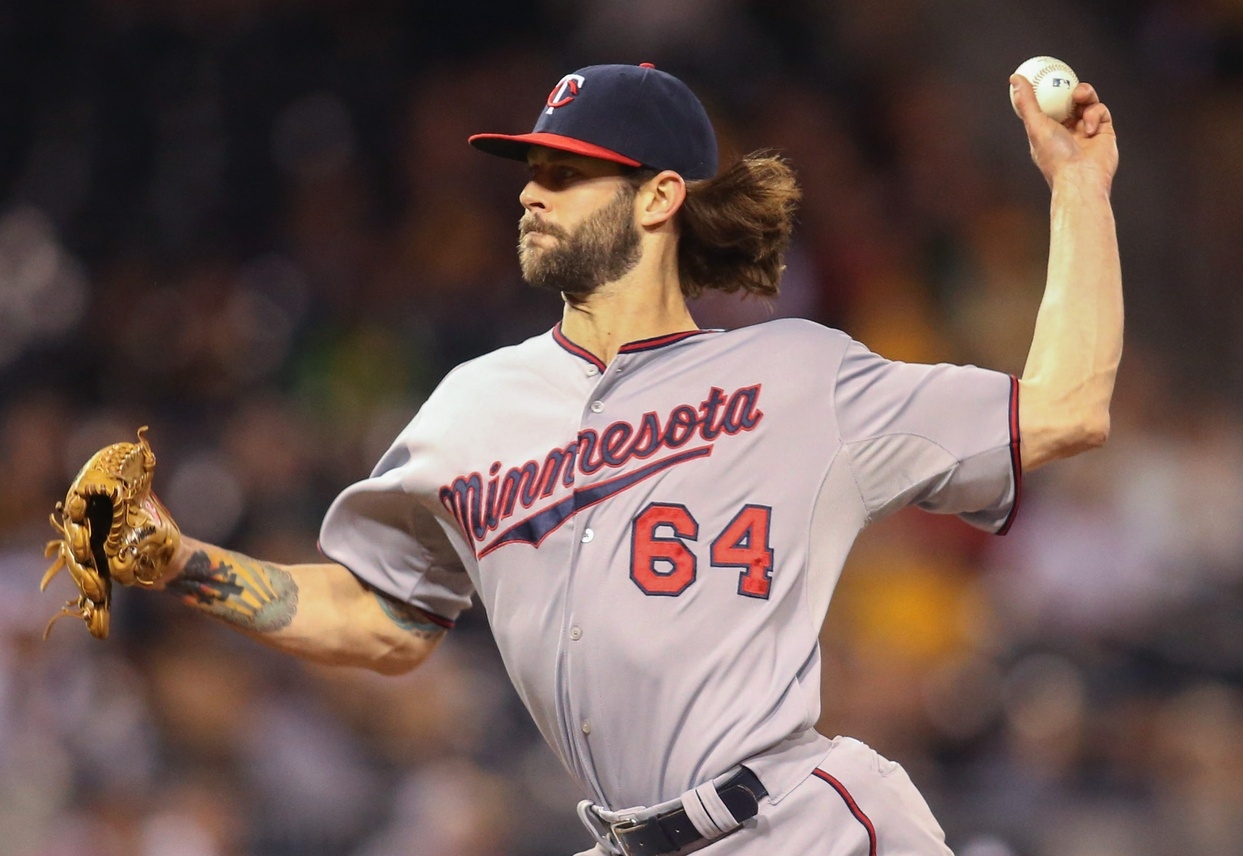 Twins general manager Terry Ryan — a fellow former left-handed pitcher in his own right — said as much in a pregame chat with the media earlier this month. “He’s a unique personality, I can tell you that,” Ryan said. “He’s a little different egg, in a good way. He’s just a good fella. He’s a good worker and a good teammate. He’s left-handed, too, don’t ever forget that.” Ryan also hinted in a later chat that Thompson is one of the more heady players on the team, and opined that if he wanted a future in coaching, that it’d probably be there for the taking for him in the future. More on that later. Thompson also has a pretty good left-handed confidant out there in the bullpen in coach Eddie Guardado. Guardado was the first name off Torii Hunter’s lips in a recent chat with Cold Omaha on what the difference was between this year’s team and last year’s. “Guardado is huge,” Hunter remarked. “A lot of guys go to them and ask him questions and he gives it to them. I think he’s probably one of the biggest parts of that bullpen down there; he gives them that bulldog mentality.” It’s not just bark, but also bite for Guardado, even at age 44. When diminutive utility man Eduardo Escobar got a little lippy before Wednesday’s series finale against the Red Sox, the former closer — with the aid of catcher Kurt Suzuki — gave the infielder turned outfielder a bit of a beatdown. All in good fun of course, but it simply feeds the notion that this is part of what has contributed to a much looser and carefree clubhouse atmosphere so far this season. Winning also helps. And the funny thing is that as loose as the roster is, it’s one Thompson nearly didn’t make. In fact, he didn’t, but once rosters were set and he was on his way to Rochester, word of the Ervin Santana suspension came down and suddenly Thompson was a lefty in luck. Thompson surely hasn’t been used like a 25th man, however. Only Seth Maness of the Cardinals and Jeremy Jeffress of the Brewers have appeared in more games than Thompson coming into Friday's action. He’s not really being used as a LOOGY — lefty one-out guy — either, as he has more appearances recording four or more outs (eight) than he does recording one or zero outs (six). The splits back it up, too, as he’s faced 56 right-handed hitters and 39 lefties. To Thompson’s credit, he doesn’t do too much differently against righties or lefties either, with one interesting exception. He scorns the changeup against left-handed hitters as most pitchers will to same-side hitters — “I don’t use a lot of changeups and stuff to lefties. It’s a real specific thing. You think lefties like it down and in, and you throw a pitch if they’re out in front of and fooled, it’s still down and in. Bad news.” — but the real interesting thing he does is that he moves on the rubber based on the handedness of the hitter he’s about to face. The reasoning is simple, but intuitive: “That’s the way I practice is to execute angles and things that have worked for me. I don’t move pitch to pitch, just batter to batter. It’s really not like a trick.” One should note that Thompson has, despite his usage, nuked lefties (.121/.205/.152) and has been somewhat pedestrian against righties (.308/.339/.423). He also hasn’t been used for a full inning in his last eight appearances as well, so perhaps his role is and will continue evolving. And maybe that’s more about his teammates — the continued excellence of Blaine Boyer for instance — than it is him. It’s hard to say. So where did Thompson come from? It might surprise you that 10 years ago, Thompson was a first-round pick (22nd overall) of the Florida Marlins. In fact, Thompson was one of five first-round picks — including the supplemental round — for the Marlins that year, along with Chris Volstad (No. 16), Jacob Marceaux (No. 29), Ryan Tucker (No. 34) and Sean West (No. 44). For comparison’s sake, the Twins nabbed Matt Garza (No. 25) and a hulking slugger named Hank Sanchez (No. 39) who barely made it out of Rookie League that year. Current Twin Mike Pelfrey was the No. 9 pick in that draft as well. Only Marceaux never made the big leagues of those five picks for the Marlins, and the sheer number of picks came thanks to losing Armando Benitez and Carl Pavano in free agency the previous winter. Thompson is the last one still kicking around in the big leagues, with Volstad still active in Triple-A with the Pirates (3-1, 3.60 ERA, 5.6 K/9, 1.42 WHIP). It wasn’t always an easy road for Thompson either; in fact, it’s really never been easy for him. It seems sort of crazy to think about it, but this free spirit of sorts was caught being a yes-man for a very long time before things clicked. Thompson remembers the day when the light flipped on, and he decided he was just fed up and was going to start doing things differently. “You all remember Logan Darnell, right?” Thompson said of his former teammate and current 40-man lefty down at Rochester. “I was in Double-A in 2012 with him and I was still starting. And it was like the fourth or fifth start in a row where it was in the sixth inning, and I had given up a run or two with two outs and two guys on and we’re up one or two — basically a pitch away from having a quality, good outing — and I give up a homer. I remember sitting in the shower with Logan, saying, ‘I don’t know if I want to cry or quit, but something’s gonna effin’ change.’ At that moment, I was just like, ‘It doesn’t have to be like that.’ Why did I feel like I had failed? Because we lost. If we won the game and I gave up nine runs, I don’t care because the team won. In the end, that’s really all that matters.'” The story checks out, and seems to correspond with a time around late July in that season when he allowed five or more earned runs three times in a five-start span. Interestingly, with his season ERA at 5.74 at that point, the Rock Cats shifted him to the bullpen the rest of the way, and he closed out the season with a 2.19 ERA and an opponents’ batting line of .277/.320/.362. That seems like a heck of a place to start out from. But to fully grasp Thompson’s struggles is to see that he was a former first- rounder being moved to the pen, and that was hardly the biggest of his issues. That was the fifth season Thompson has spent time at Double-A, and looking back it’s a level that didn’t treat him very well: 18-46, 4.95 ERA, 5.8 K/9 and a 1.54 WHIP. None of that resembles the look of a future big leaguer, let alone someone who has pitched in what BaseballReference.com terms ‘high pressure situations’ in 14 of his 24 appearances so far this season. Thompson’s struggles at Double-A go back to him being a yes-man, and they have to do with his repertoire. No pitcher who has thrown 20 or more innings this year relies on their slider more than Thompson, who has thrown it 50.9 percent of the time via PITCHf/x. It’s been a very good pitch for Thompson in a couple of respects, as it has induced a solid whiff rate of 17.9 percent, while opponents are hitting just .200/.255/.340 against it. It’s a pitch that was taught to him by current Marlins bullpen coach Reid Cornelius; it’s also a pitch that his next organization took away. “It was a cutter when I learned it,” Thompson said, reflecting on how different speeds on the pitch reflect different breaks, and throwing it slower like he has in 2015 can give it added depth. That typically reflects in it being termed a slider (slower, longer sweeping break) as opposed to a cutter (firmer, less break and depth at the plate). “I call it a cutter because of the mentality of it. It’s as though you’re throwing a fastball — an aggressive pitch. When I think slider, that’s like deception. I think of it as a cutter, though, a fastball that moves.” Thompson said he’s thrown it at times between 87-89 mph — “faster than my four-seamer” — and then it’s a true cutter, but in an effort to miss more bats, he’ll slow it down to get more movement, though he relies heavily on what Suzuki has to say on a day-to-day, or perhaps pitch-by-pitch basis. Thompson found himself with the Nationals in 2009, traded straight up for OBP machine Nick Johnson at the trade deadline that season. And in the lefty’s mind, that’s sort of where the trouble started. “They didn’t want me to throw it,” Thompson said of the cutter/slider hybrid. “So I was trying to please them. I had something I knew worked for me and threw it in the trash for two years. With the Pirates (two years later), I didn’t even bring it back. Then it’s funny, because the Pirates DFA’d me and put me in the bullpen in Double-A in my fourth or fifth year in Double-A. So I said, ‘Screw this. I’m going to throw that pitch again.’ I remember, I was good when I did that. It was funny, because I was in the big leagues a month and a half later. I’m not saying I said, ‘Screw them.’ I said no, they told me to believe in myself, and that’s really all I’m going to do. It’s funny how, there’s obviously been some downs since then, too, but none of it had to do with the pitch.” Speaking of ups and downs, it’s sort of ironic that Thompson’s first big break with the Twins came due to a suspension; it’s also how his time started with the team. Thompson was dinged 50 games at the beginning of the 2012 season for recreational drug use, and that makes for sort of an interesting parallel on each side of his Twins stint. The Twins stood by him — water under the bridge according to Ryan — and it’s paying dividends thus far, even if it’s been probably a longer play than either side anticipated. But even with the various struggles, Thompson said all he wants to do on the mound is compete. It wasn’t always that easy, either. “I think for a long time in my career I tried to pitch to what would appease a coach or a front office, and the funny thing is if you get the guy out, everybody is happy,” Thompson said. “I was a yes-man for a long time, I think finally it got to a point where if I could just compete out there, everybody could at least appreciate that. It’s the guys who don’t appear to be competing that guys get fed up with. I think for a while I might have looked that way in my past, but that wasn’t the case. I just didn’t really know how to compete. I had to learn how to do that, I guess, at a higher level.” In a way it’s sort of funny that a guy who can be known to skateboard to the ballpark could ever be a yes-man, but Thompson’s personal evolution has been anything but conventional. This post originated at Cold Omaha here; please consider clicking through to support the content.
 -
WARNE: Thompson Shedding Yes Man Attitude, Flourishing
Brandon Warne posted a blog entry in BW on the Beat
Aaron Thompson marches to the beat of his own drum. That probably isn’t a shock to many, as he falls under a number of subsets that we’ve grown accustomed to seeing oddities from. Bert Blyleven will frequently suggest pitchers are a different sort on Twins telecasts, but beyond that Thompson is also a reliever as well as left handed — two things that push him further down the oddball spectrum in baseball circles. Twins general manager Terry Ryan — a fellow former left-handed pitcher in his own right — said as much in a pregame chat with the media earlier this month. “He’s a unique personality, I can tell you that,” Ryan said. “He’s a little different egg, in a good way. He’s just a good fella. He’s a good worker and a good teammate. He’s left-handed, too, don’t ever forget that.” Ryan also hinted in a later chat that Thompson is one of the more heady players on the team, and opined that if he wanted a future in coaching, that it’d probably be there for the taking for him in the future. More on that later. Thompson also has a pretty good left-handed confidant out there in the bullpen in coach Eddie Guardado. Guardado was the first name off Torii Hunter’s lips in a recent chat with Cold Omaha on what the difference was between this year’s team and last year’s. “Guardado is huge,” Hunter remarked. “A lot of guys go to them and ask him questions and he gives it to them. I think he’s probably one of the biggest parts of that bullpen down there; he gives them that bulldog mentality.” It’s not just bark, but also bite for Guardado, even at age 44. When diminutive utility man Eduardo Escobar got a little lippy before Wednesday’s series finale against the Red Sox, the former closer — with the aid of catcher Kurt Suzuki — gave the infielder turned outfielder a bit of a beatdown. All in good fun of course, but it simply feeds the notion that this is part of what has contributed to a much looser and carefree clubhouse atmosphere so far this season. Winning also helps. And the funny thing is that as loose as the roster is, it’s one Thompson nearly didn’t make. In fact, he didn’t, but once rosters were set and he was on his way to Rochester, word of the Ervin Santana suspension came down and suddenly Thompson was a lefty in luck. Thompson surely hasn’t been used like a 25th man, however. Only Seth Maness of the Cardinals and Jeremy Jeffress of the Brewers have appeared in more games than Thompson coming into Thursday’s action. He’s not really being used as a LOOGY — lefty one-out guy — either, as he has more appearances recording four or more outs (eight) than he does recording one or zero outs (six). The splits back it up, too, as he’s faced 56 right-handed hitters and 39 lefties. To Thompson’s credit, he doesn’t do too much differently against righties or lefties either, with one interesting exception. He scorns the changeup against left-handed hitters as most pitchers will to same-side hitters — “I don’t use a lot of changeups and stuff to lefties. It’s a real specific thing. You think lefties like it down and in, and you throw a pitch if they’re out in front of and fooled, it’s still down and in. Bad news.” — but the real interesting thing he does is that he moves on the rubber based on the handedness of the hitter he’s about to face. The reasoning is simple, but intuitive: “That’s the way I practice is to execute angles and things that have worked for me. I don’t move pitch to pitch, just batter to batter. It’s really not like a trick.” One should note that Thompson has, despite his usage, nuked lefties (.121/.205/.152) and has been somewhat pedestrian against righties (.308/.339/.423). He also hasn’t been used for a full inning in his last eight appearances as well, so perhaps his role is and will continue evolving. And maybe that’s more about his teammates — the continued excellence of Blaine Boyer for instance — than it is him. It’s hard to say. So where did Thompson come from? It might surprise you that 10 years ago, Thompson was a first-round pick (22nd overall) of the Florida Marlins. In fact, Thompson was one of five first-round picks — including the supplemental round — for the Marlins that year, along with Chris Volstad (No. 16), Jacob Marceaux (No. 29), Ryan Tucker (No. 34) and Sean West (No. 44). For comparison’s sake, the Twins nabbed Matt Garza (No. 25) and a hulking slugger named Hank Sanchez (No. 39) who barely made it out of Rookie League that year. Current Twin Mike Pelfrey was the No. 9 pick in that draft as well. Only Marceaux never made the big leagues of those five picks for the Marlins, and the sheer number of picks came thanks to losing Armando Benitez and Carl Pavano in free agency the previous winter. Thompson is the last one still kicking around in the big leagues, with Volstad still active in Triple-A with the Pirates (3-1, 3.60 ERA, 5.6 K/9, 1.42 WHIP). It wasn’t always an easy road for Thompson either; in fact, it’s really never been easy for him. It seems sort of crazy to think about it, but this free spirit of sorts was caught being a yes man for a very long time before things clicked. Thompson remembers the day when the light flipped on, and he decided he was just fed up and was going to start doing things differently. “You all remember Logan Darnell, right?” Thompson said of his former teammate and current 40-man lefty down at Rochester. “I was in Double-A in 2012 with him and I was still starting. And it was like the fourth or fifth start in a row where it was in the sixth inning, and I had given up a run or two with two outs and two guys on and we’re up one or two — basically a pitch away from having a quality, good outing — and I give up a homer. I remember sitting in the shower with Logan, saying, ‘I don’t know if I want to cry or quit, but something’s gonna effin’ change.’ At that moment, I was just like, ‘It doesn’t have to be like that.’ Why did I feel like I had failed? Because we lost. If we won the game and I gave up nine runs, I don’t care because the team won. In the end, that’s really all that matters.'” The story checks out, and seems to correspond with a time around late July in that season where he allowed five or more earned runs three times in a five-start span. Interestingly, with his season ERA at 5.74 at that point, the Rock Cats shifted him to the bullpen the rest of the way, and he closed out the season with a 2.19 ERA and an opponents’ batting line of .277/.320/.362. That seems like a heck of a place to start out from. But to fully grasp Thompson’s struggles is to see that he was a former first rounder being moved to the pen, and that was hardly the biggest of his issues. That was the fifth season Thompson has spent time at Double-A, and looking back it’s a level that didn’t treat him very well: 18-46, 4.95 ERA, 5.8 K/9 and a 1.54 WHIP. None of that resembles the look of a future big leaguer, let alone someone who has pitched in what BaseballReference.com terms ‘high pressure situations’ in 14 of his 24 appearances so far this season. Thompson’s struggles at Double-A go back to him being a yes man, and they have to do with his repertoire. No pitcher who has thrown 20 or more innings this year relies on their slider more than Thompson, who has thrown it 50.9 percent of the time via PITCHf/x. It’s been a very good pitch for Thompson in a couple respects, as it has induced a solid whiff rate of 17.9 percent, while opponents are hitting just .200/.255/.340 against it. It’s a pitch that was taught to him by current Marlins bullpen coach Reid Cornelius; it’s also a pitch that his next organization took away. “It was a cutter when I learned it,” Thompson said, reflecting on how different speeds on the pitch reflect different breaks, and throwing it slower like he has in 2015 can give it added depth. That typically reflects in it being termed a slider (slower, longer sweeping break) as opposed to a cutter (firmer, less break and depth at the plate). “I call it a cutter because of the mentality of it. It’s as though you’re throwing a fastball — an aggressive pitch. When I think slider, that’s like deception. I think of it as a cutter, though, a fastball that moves.” Thompson said he’s thrown it at times between 87-89 mph — “faster than my four-seamer” — and then it’s a true cutter, but in an effort to miss more bats, he’ll slow it down to get more movement, though he relies heavily on what Suzuki has to say on a day-to-day, or perhaps pitch-by-pitch basis. Thompson found himself with the Nationals in 2009, traded straight up for OBP machine Nick Johnson at the trade deadline that season. And in the lefty’s mind, that’s sort of where the trouble started. “They didn’t want me to throw it,” Thompson said of the cutter/slider hybrid. “So I was trying to please them. I had something I knew worked for me and threw it in the trash for two years. With the Pirates (two years later), I didn’t even bring it back. Then it’s funny, because the Pirates DFA’d me and put me in the bullpen in Double-A in my fourth or fifth year in Double-A. So I said, ‘Screw this. I’m going to throw that pitch again.’ I remember, I was good when I did that. It was funny, because I was in the big leagues a month and a half later. I’m not saying I said, ‘Screw them.’ I said no, they told me to believe in myself, and that’s really all I’m going to do. It’s funny how, there’s obviously been some downs since then, too, but none of it had to do with the pitch.” Speaking of ups and downs, it’s sort of ironic that Thompson’s first big break with the Twins came due to a suspension; it’s also how his time started with the team. Thompson was dinged 50 games at the beginning of the 2012 season for recreational drug use, and that makes for sort of an interesting parallel on each side of his Twins stint. The Twins stood by him — water under the bridge according to Ryan — and it’s paying dividends thus far, even if it’s been probably a longer play than either side anticipated. But even with the various struggles, Thompson said all he wants to do on the mound is compete. It wasn’t always that easy, either. “I think for a long time in my career I tried to pitch to what would appease a coach or a front office, and the funny thing is if you get the guy out, everybody is happy,” Thompson said. “I was a yes man for a long time, I think finally it got to a point where if I could just compete out there, everybody could at least appreciate that. It’s the guys who don’t appear to be competing that guys get fed up with. I think for a while I might have looked that way in my past, but that wasn’t the case. I just didn’t really know how to compete. I had to learn how to do that, I guess, at a higher level.” In a way it’s sort of funny that a guy who can be known to skateboard to the ballpark could ever be a yes man, but Thompson’s personal evolution has been anything but conventional. This post originated at Cold Omaha here; please consider clicking through to support the content. -
if you can get fair value for Plouffe, sure. I just don't think that'll happen. And I agree, you don't move Sano off until you have to. But if you keep both, Plouffe is clearly the better option at the position defensively. And to the Vargas/Mauer/Arcia/Sano conundrum, Vargas isn't quite on their level in my opinion, and regardless, Sano plays over all of them except Mauer on a daily basis.
-
No contract probably works against you in that case. I'm not completely against this, I just prefer they keep Plouffe because guys like him don't come around every day, and he can play someplace other than third. But more importantly for me, I think I'd move Sano off third.
-
Does this player exist? Maybe Jonathan Lucroy? Teams that have these guys aren't trading them, especially not for a guy like Plouffe. Don't get me wrong, Plouffe is a nice player -- I wrote this exact article two weeks ago -- but he has more value to the Twins than on the open market. Might be a lot more.
-
Incidentally, yes it would. That's when paydays start to get unwieldy is around that time.
-
That is not accurate.
-
Article: Aaron Hicks' New Swing Paying Dividends
Brandon Warne replied to Kevin's topic in Twins Daily Front Page News
Terry watched Rochester play in Syracuse a couple weeks ago -
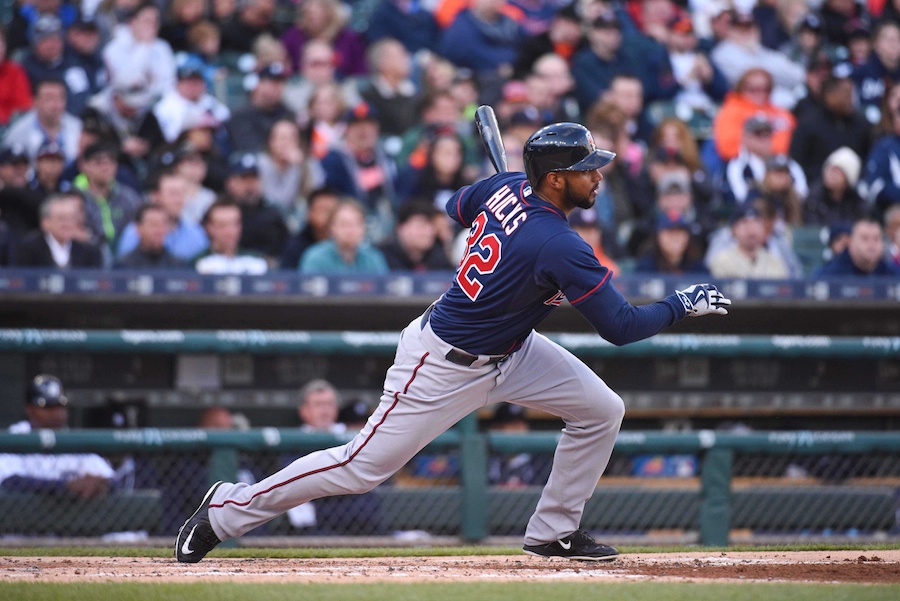 Well, message received. Hicks obliterated the International League to the tune of a .336/.415/.561 batting line over 27 games, essentially forcing the hands of the Twins brass to get him back up here and see what, if any, changes he had made and if they’d stick. Of Hicks’ 36 hits in those 27 games, 16 had gone for extra bases, and he’d also stolen a couple bases without an unsuccessful attempt. In short, it was time. Hicks made his debut in Detroit, and through four games hasn’t gone hitless yet as a drastically-altered approach and mechanics seem to have taken hold, at least in early returns. From both sides of the plate, Hicks has adopted a pronounced leg kick with lots of hand movement as he prepares to load for his swing. Both elements were evident on Friday night as Hicks poked a 1-1 pitch from Tampa Bay starter Jake Odorizzi into left field for his only hit of the game in the seventh inning, just two pitches before Danny Santana tripled him home with the tying run. Where did this all come from, though? Hicks said that, funnily enough, the change boiled down to him and a few of his guys messing around in the batting cages in the offseason. They were taking turns mimicking the leg kicks of established hitters like Yasiel Puig, Robinson Cano and Hanley Ramirez when before long, Hicks realized there might be something more than just a little goofing off to break up the winter doldrums. “I started to like it,” Hicks said. “From then on it was kind of a point where I was just like, you know what, I’m going to try this. We were just having fun in offseason hitting, and it just kind of led to me being comfortable with it and taking solid swings.” The change, which Hicks says has been key in terms of timing, having power and staying consistent, really took hold in spring training, where he had some help in the tinkering to fine tune it. “I came to spring training with the leg kick,” Hicks said. “Torii helped tinker it for me as far as what I needed to do to be able to get my foot down in time. There was tinkering all through the spring.” Hicks added that it didn’t really sink in that the change was permanent until the end of spring, when he was in minor league camp. Twins general manager Terry Ryan said before Friday’s game that players experiment with leg kicks quite frequently, and that the organization doesn’t have an issue with it as long as the hitter thinks it will help, and the manager and hitting instructor agree. In Hicks’ case and everyone else’s, Ryan said that the kicks typically evolve, based on comfort level and where exactly the evolution of that adjustment takes them. Ultimately, the club hoped Hicks would trip the trigger a bit from a passive hitter to a bit more aggressive — aggressively patient in Hicks’ own words — and in the mind of the hitter, that’s already happening. “I feel like with the leg kick I’ve been more aggressive,” Hicks said. “Swinging early in counts and being able to make contact early, and not missing pitches.” Hicks again hearkened back to spring training for when he felt the adjustment taking hold, as he went into spring camp with the idea that he wanted to get in as many swings as possible, which could potentially (and did) lead to fewer walks, but also more opportunities to get hits. Foundationally, a drastic change like this can need time for it to ‘take’ so to speak, especially with the amount of movement in his setup and the need to keep his head still throughout. Hicks said that hasn’t been too much of an issue, as he’s actually been more worried about a different part of his swing; one that’s more close to the issue at hand. “I think for me it’s more important to have my hands ready all the time to be able to fire them whenever I need to,” Hicks noted. “A leg kick is going to generate my timing mechanism so I need to have my hands ready.” In short, it’s a young player looking to make adjustments to not just be a guy on the team, but one of the key contributors. “To stick is the most important part,” Hicks said of his third trip to the big leagues. “Being able to play the way I know how to play and to help this team win games. That’s the most important thing. Producing is key. I want to be here long term. Not just to stay here, but be a guy who can help this team win.” Manager Paul Molitor stopped shy of endorsing Hicks as in the big leagues to stay, but heaped effusive praise on some of the aspects in his center fielder’s game that had fallen shy in the past and likely led to his demotion to open the 2015 campaign. “He’s done well,” Molitor said. “His at-bats across the board have been better. What I’ve tried to watch so far is that he’s seemed very engaged in the field defensively, in the dugout watching, trying to gain an edge. Those are the things that he needs to do to be a consistent player here.” Molitor didn’t stop there, as he said he’d like to see a continued evolution from Hicks as a player in all facets. “He has to understand that he’s the kind of player that can go 0-for-4 and still influence a game, whether it’s defensively, or he gets on base with a walk and steals a base and creates a run-scoring situation. Just to become more complete in the way he goes about his game, and realizing what he can bring to the team to help them win on that given day.” It seems as though Hicks has received that message. His outfield defense has been smooth — a sight for the sore eyes of the Twins faithful — and though he hasn’t taken his first walk — history tells us those will be coming soon in ample supply — it appears as though he may be on his way to influencing games in a number of ways, just like you’d expect someone you used a high first-round pick on. Ryan said that he senses a different air about Hicks; that he’s more confident and it’s for good reason. “He held up his end of the bargain (at Triple-A),” Ryan said. “He went down there and got to work. Consequently, he got promoted and rewarded.”
 -
This content originally appeared at Cold Omaha here, please consider clicking through as a measure of support. After making the team out of spring training two years straight, Aaron Hicks was sent back to Triple-A Rochester as lesser options made the team ahead of him. The message to Hicks was clear: Force your way back up here. Well, message received. Hicks obliterated the International League to the tune of a .336/.415/.561 batting line over 27 games, essentially forcing the hands of the Twins brass to get him back up here and see what, if any, changes he had made and if they’d stick. Of Hicks’ 36 hits in those 27 games, 16 had gone for extra bases, and he’d also stolen a couple bases without an unsuccessful attempt. In short, it was time. Hicks made his debut in Detroit, and through four games hasn’t gone hitless yet as a drastically-altered approach and mechanics seem to have taken hold, at least in early returns. From both sides of the plate, Hicks has adopted a pronounced leg kick with lots of hand movement as he prepares to load for his swing. Both elements were evident on Friday night as Hicks poked a 1-1 pitch from Tampa Bay starter Jake Odorizzi into left field for his only hit of the game in the seventh inning, just two pitches before Danny Santana tripled him home with the tying run. Where did this all come from, though? Hicks said that, funnily enough, the change boiled down to him and a few of his guys messing around in the batting cages in the offseason. They were taking turns mimicking the leg kicks of established hitters like Yasiel Puig, Robinson Cano and Hanley Ramirez when before long, Hicks realized there might be something more than just a little goofing off to break up the winter doldrums. “I started to like it,” Hicks said. “From then on it was kind of a point where I was just like, you know what, I’m going to try this. We were just having fun in offseason hitting, and it just kind of led to me being comfortable with it and taking solid swings.” The change, which Hicks says has been key in terms of timing, having power and staying consistent, really took hold in spring training, where he had some help in the tinkering to fine tune it. “I came to spring training with the leg kick,” Hicks said. “Torii helped tinker it for me as far as what I needed to do to be able to get my foot down in time. There was tinkering all through the spring.” Hicks added that it didn’t really sink in that the change was permanent until the end of spring, when he was in minor league camp. Twins general manager Terry Ryan said before Friday’s game that players experiment with leg kicks quite frequently, and that the organization doesn’t have an issue with it as long as the hitter thinks it will help, and the manager and hitting instructor agree. In Hicks’ case and everyone else’s, Ryan said that the kicks typically evolve, based on comfort level and where exactly the evolution of that adjustment takes them. Ultimately, the club hoped Hicks would trip the trigger a bit from a passive hitter to a bit more aggressive — aggressively patient in Hicks’ own words — and in the mind of the hitter, that’s already happening. “I feel like with the leg kick I’ve been more aggressive,” Hicks said. “Swinging early in counts and being able to make contact early, and not missing pitches.” Hicks again hearkened back to spring training for when he felt the adjustment taking hold, as he went into spring camp with the idea that he wanted to get in as many swings as possible, which could potentially (and did) lead to fewer walks, but also more opportunities to get hits. Foundationally, a drastic change like this can need time for it to ‘take’ so to speak, especially with the amount of movement in his setup and the need to keep his head still throughout. Hicks said that hasn’t been too much of an issue, as he’s actually been more worried about a different part of his swing; one that’s more close to the issue at hand. “I think for me it’s more important to have my hands ready all the time to be able to fire them whenever I need to,” Hicks noted. “A leg kick is going to generate my timing mechanism so I need to have my hands ready.” In short, it’s a young player looking to make adjustments to not just be a guy on the team, but one of the key contributors. “To stick is the most important part,” Hicks said of his third trip to the big leagues. “Being able to play the way I know how to play and to help this team win games. That’s the most important thing. Producing is key. I want to be here long term. Not just to stay here, but be a guy who can help this team win.” Manager Paul Molitor stopped shy of endorsing Hicks as in the big leagues to stay, but heaped effusive praise on some of the aspects in his center fielder’s game that had fallen shy in the past and likely led to his demotion to open the 2015 campaign. “He’s done well,” Molitor said. “His at bats across the board have been better. What I’ve tried to watch so far is that he’s seemed very engaged in the field defensively, in the dugout watching, trying to gain an edge. Those are the things that he needs to do to be a consistent player here.” Molitor didn’t stop there, as he said he’d like to see a continued evolution from Hicks as a player in all facets. “He has to understand that he’s the kind of player that can go 0-for-4 and still influence a game, whether it’s defensively, or he gets on base with a walk and steals a base and creates a run-scoring situation. Just to become more complete in the way he goes about his game, and realizing what he can bring to the team to help them win on that given day.” It seems as though Hicks has received that message. His outfield defense has been smooth — a sight for the sore eyes of the Twins faithful — and though he hasn’t taken his first walk — history tells us those will be coming soon in ample supply — it appears as though he may be on his way to influencing games in a number of ways, just like you’d expect someone you used a high first-round pick on. Ryan said that he senses a different air about Hicks; that he’s more confident and it’s for good reason. “He held up his end of the bargain (at Triple-A),” Ryan said. “He went down there and got to work. Consequently, he got promoted and rewarded.”
-
WARNE: Pelfrey Showing Glimpses After Long Road Back From Tommy John
Brandon Warne commented on Brandon Warne's blog entry in BW on the Beat
Appreciate that! -
Frustration is a word that has followed Twins right-hander Mike Pelfrey around for a while. Whether it was how he pitched on his road back from Tommy John surgery, to the surgery itself or even just the puzzling season he had last year when he gave the team virtually nothing in terms of production, the word frustration has been on the front burner as it pertains to Pelfrey. But don’t think for a second that the pitcher himself isn’t frustrated, too. “That’s all I’ve ever really known is to go out there and pitch,” Pelfrey said. “Whether I’m right or not, I want to pitch.” And it was that mentality that willed him back from elbow surgery in less than a year. In fact, he was throwing in spring training games a lot earlier than that. “We’re in spring training and it’s been nine-and-a-half months and I’m pitching in a game, and I’m thinking ‘Man, I worked my butt off, but this is way too early,’” Pelfrey said of 2013, his first season with the Twins after spending seven seasons in Queens with the New York Mets. “But I felt OK doing it.” Pelfrey admits he probably wouldn’t have come back as fast as he did knowing all he does now, but he showed enough in stretches in the second half of 2013 to convince the Twins to re-sign him to a two-year deal which expires at the end of this season. To say early returns on that deal were iffy would be putting it nicely, as Pelfrey gave the Twins just five winless starts with a 7.99 ERA before hitting the disabled list after an ugly May Day start against the Dodgers. He wouldn’t see the big leagues again all season, and to hear Pelfrey tell it, he was just about ready to be finished. “If I didn’t have one more year left (on his current deal), I would have walked off last year on my rehab assignment in Rochester,” Pelfrey said. “And I said this year, if I don’t perform and stay healthy, I’m coming home. This is going to be it for me in 2015.” He’s not close to crossing that bridge right now, however. In fact, and this probably won’t come as any surprise, Pelfrey says this is the best he’s felt with the club. “It I could go back, I’d have probably taken a step back and I probably would have said something at the beginning of last year. I’d have said ‘Hey, I’m not right. I don’t know what’s wrong, but I’m totally not right.’ But right now, this is definitely the best I’ve felt.” And while underlying peripheral statistics say otherwise, Pelfrey’s early-season results have been generally positive. Not only has he been among MLB’s best in terms of added velocity in early-season action, but he’s returned to his heavy groundballing ways — a career-best 58.3 percent rate as of this writing — thanks to a new program that he picked up in the offseason. “I did a lot of shoulder strengthening stuff this offseason through a weighted ball program, and I think it’s really helped,” Pelfrey said. The program is the brainchild of Dr. Tom House, who is better known for his time as Texas Rangers pitching coach 20 years ago as well as his stint with USC baseball and his tutelage of Rinku Singh and Dinesh Patel, who are better known as the Indian pitchers from “Million Dollar Arm.” House’s methods are unconventional — he’s famous for having his pitchers throw footballs, something Pelfrey said is part of his program but not part of his in-season regimen — but he has gotten results, and he seems to have Pelfrey’s endorsement. “This is the first time I’ve ever done it,” Pelfrey said of the program which is called Velocity Plus Arm Care. “One day I went and looked it up and paid $500 just to do it. They sent me a program and these balls. I did it religiously, and I think it’s a big thing.” The first thing Pelfrey noticed in the spring after putting in the work with the program was not only how good he felt but the movement of his pitches. “For the first time in a couple years, I didn’t have to make the ball move,” Pelfrey said. “It was just doing it on its own.” There’s little doubt that increased movement has led to Pelfrey’s increase in ground balls, something that’ll remain a key issue for him as long as his strikeout rate remains below the league average. In the end, all Pelfrey wants to do is pitch. He was admittedly frustrated about the potential move to the bullpen, but he said that stemmed from frustration after all the work he put in to get healthy and work as a starter. That would appear to just be a part of Pelfrey’s makeup as a competitor, because by his own admission, all he wants to do is get on the mound. “Everybody wants to talk about the money and all that stuff,” Pelfrey said. “I couldn’t care less. I want to pitch.” — TWINS BY THE NUMBERS .306 – The Twins’ team wOBA — a number that takes all offensive contributions and adjusts them into a tidy little number that is scaled to on-base percentage. The Twins’ latest surge has them up to 22nd across the league, after languishing at the bottom in early-season play. 4 – Just four teams have fewer steals than the Twins with 10 (Dodgers, Rockies, White Sox and Nationals). The Twins have also been caught on nine occasions, for a paltry 52.6 percent rate of success. Generally speaking, teams would ideally steal bases at about a 75 percent clip to make it worth the risk. 21.1 percent – The Twins’ team strikeout rate, which is the ninth-highest in baseball. .317 – The Twins’ collective BABIP (batting average on balls in play). This is generally a pretty good indicator of batted-ball luck. At .317, the Twins stand a pretty good chance of regressing back to the mean. 10 – Number of intentional walks the offense has drawn as a unit. Only five teams have drawn more. 8 – Number of bunt hits for the Twins — No. 1 across the MLB. This content originally appeared at Cold Omaha here. Please click through to support it. Click here to view the article
-
Pelfrey Showing Glimpses After Long Road Back From Tommy John
Brandon Warne posted an article in Twins
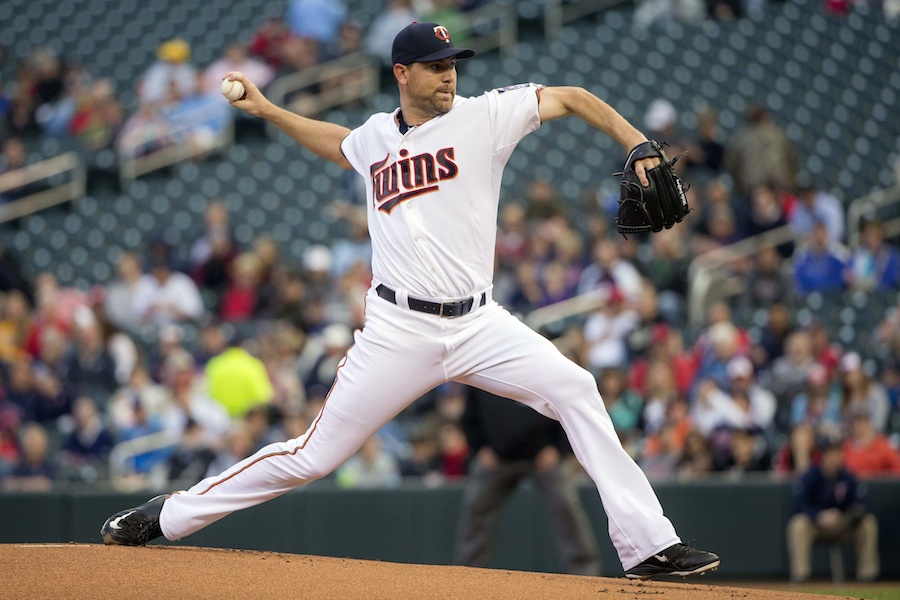 Frustration is a word that has followed Twins right-hander Mike Pelfrey around for a while. Whether it was how he pitched on his road back from Tommy John surgery, to the surgery itself or even just the puzzling season he had last year when he gave the team virtually nothing in terms of production, the word frustration has been on the front burner as it pertains to Pelfrey. But don’t think for a second that the pitcher himself isn’t frustrated, too. “That’s all I’ve ever really known is to go out there and pitch,” Pelfrey said. “Whether I’m right or not, I want to pitch.” And it was that mentality that willed him back from elbow surgery in less than a year. In fact, he was throwing in spring training games a lot earlier than that. “We’re in spring training and it’s been nine-and-a-half months and I’m pitching in a game, and I’m thinking ‘Man, I worked my butt off, but this is way too early,’” Pelfrey said of 2013, his first season with the Twins after spending seven seasons in Queens with the New York Mets. “But I felt OK doing it.” Pelfrey admits he probably wouldn’t have come back as fast as he did knowing all he does now, but he showed enough in stretches in the second half of 2013 to convince the Twins to re-sign him to a two-year deal which expires at the end of this season. To say early returns on that deal were iffy would be putting it nicely, as Pelfrey gave the Twins just five winless starts with a 7.99 ERA before hitting the disabled list after an ugly May Day start against the Dodgers. He wouldn’t see the big leagues again all season, and to hear Pelfrey tell it, he was just about ready to be finished. “If I didn’t have one more year left (on his current deal), I would have walked off last year on my rehab assignment in Rochester,” Pelfrey said. “And I said this year, if I don’t perform and stay healthy, I’m coming home. This is going to be it for me in 2015.” He’s not close to crossing that bridge right now, however. In fact, and this probably won’t come as any surprise, Pelfrey says this is the best he’s felt with the club. “It I could go back, I’d have probably taken a step back and I probably would have said something at the beginning of last year. I’d have said ‘Hey, I’m not right. I don’t know what’s wrong, but I’m totally not right.’ But right now, this is definitely the best I’ve felt.” And while underlying peripheral statistics say otherwise, Pelfrey’s early-season results have been generally positive. Not only has he been among MLB’s best in terms of added velocity in early-season action, but he’s returned to his heavy groundballing ways — a career-best 58.3 percent rate as of this writing — thanks to a new program that he picked up in the offseason. “I did a lot of shoulder strengthening stuff this offseason through a weighted ball program, and I think it’s really helped,” Pelfrey said. The program is the brainchild of Dr. Tom House, who is better known for his time as Texas Rangers pitching coach 20 years ago as well as his stint with USC baseball and his tutelage of Rinku Singh and Dinesh Patel, who are better known as the Indian pitchers from “Million Dollar Arm.” House’s methods are unconventional — he’s famous for having his pitchers throw footballs, something Pelfrey said is part of his program but not part of his in-season regimen — but he has gotten results, and he seems to have Pelfrey’s endorsement. “This is the first time I’ve ever done it,” Pelfrey said of the program which is called Velocity Plus Arm Care. “One day I went and looked it up and paid $500 just to do it. They sent me a program and these balls. I did it religiously, and I think it’s a big thing.” The first thing Pelfrey noticed in the spring after putting in the work with the program was not only how good he felt but the movement of his pitches. “For the first time in a couple years, I didn’t have to make the ball move,” Pelfrey said. “It was just doing it on its own.” There’s little doubt that increased movement has led to Pelfrey’s increase in ground balls, something that’ll remain a key issue for him as long as his strikeout rate remains below the league average. In the end, all Pelfrey wants to do is pitch. He was admittedly frustrated about the potential move to the bullpen, but he said that stemmed from frustration after all the work he put in to get healthy and work as a starter. That would appear to just be a part of Pelfrey’s makeup as a competitor, because by his own admission, all he wants to do is get on the mound. “Everybody wants to talk about the money and all that stuff,” Pelfrey said. “I couldn’t care less. I want to pitch.” — TWINS BY THE NUMBERS .306 – The Twins’ team wOBA — a number that takes all offensive contributions and adjusts them into a tidy little number that is scaled to on-base percentage. The Twins’ latest surge has them up to 22nd across the league, after languishing at the bottom in early-season play. 4 – Just four teams have fewer steals than the Twins with 10 (Dodgers, Rockies, White Sox and Nationals). The Twins have also been caught on nine occasions, for a paltry 52.6 percent rate of success. Generally speaking, teams would ideally steal bases at about a 75 percent clip to make it worth the risk. 21.1 percent – The Twins’ team strikeout rate, which is the ninth-highest in baseball. .317 – The Twins’ collective BABIP (batting average on balls in play). This is generally a pretty good indicator of batted-ball luck. At .317, the Twins stand a pretty good chance of regressing back to the mean. 10 – Number of intentional walks the offense has drawn as a unit. Only five teams have drawn more. 8 – Number of bunt hits for the Twins — No. 1 across the MLB. This content originally appeared at Cold Omaha here. Please click through to support it.
 -
WARNE: Pelfrey Showing Glimpses After Long Road Back From Tommy John
Brandon Warne posted a blog entry in BW on the Beat
Frustration is a word that has followed Twins right-hander Mike Pelfrey around for a while. Whether it was how he pitched on his road back from Tommy John surgery, to the surgery itself or even just the puzzling year he had last year where he gave the team virtually nothing in terms of production, the word frustration has been on the front burner as it pertains to Pelfrey. But don’t think for a second that the pitcher himself isn’t frustrated, too. “That’s all I’ve ever really known is to go out there and pitch,” Pelfrey said. “Whether I’m right or not, I want to pitch.” And it was that mentality that willed him back from elbow surgery less in less than a year. In fact, he was throwing in spring training games a lot earlier than that. “We’re in spring training and it’s been nine-and-a-half months and I’m pitching in a game, and I’m thinking ‘Man, I worked my butt off, but this is way too early,’” Pelfrey said of 2013, his first season with the Twins after spending seven seasons in Queens with the New York Mets. “But I felt OK doing it.” Pelfrey admits he probably wouldn’t have come back as fast as he did knowing all he does now, but he showed enough in stretches in the second half of 2013 to convince the Twins to re-sign him to a two-year deal which expires at the end of this season. To say early returns on that deal were iffy would be putting it nicely, as Pelfrey gave the Twins just five winless starts with a 7.99 ERA before hitting the disabled list after an ugly May Day start against the Dodgers. He wouldn’t see the big leagues again all season, and to hear Pelfrey tell it, he was just about ready to be finished. “If I didn’t have one more year left (on his current deal), I would have walked off last year on my rehab assignment in Rochester,” Pelfrey said. “And I said this year, if I don’t perform and stay healthy, I’m coming home. This is going to be it for me in 2015.” He’s not close to crossing that bridge right now, however. In fact, and this probably won’t come as any surprise, Pelfrey says this is the best he’s felt in his third year with the club. “It I could go back, I’d have probably taken a step back and I probably would have said something at the beginning of last year. I’d have said ‘Hey, I’m not right. I don’t know what’s wrong, but I’m totally not right.’ But right now, this is definitely the best I’ve felt.” And while underlying peripheral statistics say otherwise, Pelfrey’s early-season results have been generally positive. Not only has he been among MLB’s best in terms of added velocity in early-season action, but he’s returned to his heavy groundballing ways — a career-best 58.3 percent rate as of this writing — thanks to a new program that he picked up in the offseason. “I did a lot of shoulder strengthening stuff this offseason through a weighted ball program, and I think it’s really helped,” Pelfrey said. The program is the brainchild of Dr. Tom House, who is better known for his time as Texas Rangers pitching coach 20 years ago as well as his stint with USC baseball and his tutelage of Rinku Singh and Dinesh Patel, who are better known as the Indian pitchers from “Million Dollar Arm.” House’s methods are unconventional — he’s famous for having his pitchers throw footballs, something Pelfrey said is part of his program but not part of his in-season regimen — but he has gotten results, and he seems to have Pelfrey’s endorsement. “This is the first time I’ve ever done it,” Pelfrey said of the program which is called Velocity Plus Arm Care. “One day I went and looked it up and paid $500 just to do it. They sent me a program and these balls. I did it religiously, and I think it’s a big thing.” The first thing Pelfrey noticed in the spring after putting in the work with the program was not only how good he felt but the movement of his pitches. “For the first time in a couple years, I didn’t have to make the ball move,” Pelfrey said. “It was just doing it on its own.” There’s little doubt that increased movement has led to Pelfrey’s increase in ground balls, something that’ll remain a key issue for him as long as his strikeout rate remains below the league average. In the end, all Pelfrey wants to do is pitch. He was admittedly frustrated about the potential move to the bullpen, but he said that stemmed from frustration after all the work he put in to get healthy and work as a starter. That would appear to just be a part of Pelfrey’s makeup as a competitor, because by his own admission, all he wants to do is get on the mound. “Everybody wants to talk about the money and all that stuff,” Pelfrey said. “I couldn’t care less. I want to pitch.” — TWINS BY THE NUMBERS .306 – The Twins’ team wOBA — a number that takes all offensive contributions and adjusts them into a tidy little number that is scaled to on-base percentage. The Twins’ latest surge has them up to 22nd across the league, after languishing at the bottom in early-season play. 4 – Just four teams have fewer steals than the Twins with 10 (Dodgers, Rockies, White Sox and Nationals). The Twins have also been caught on nine occasions, for a paltry 52.6 percent rate of success. Generally speaking, teams would ideally steal bases at about a 75 percent clip to make it worth the risk. 21.1 percent – The Twins’ team strikeout rate, which is the ninth-highest in baseball. .317 – The Twins’ collective BABIP (batting average on balls in play). This is generally a pretty good indicator of batted-ball luck. At .317, the Twins stand a pretty good chance to regress back to the mean in this respect. 10 – Number of intentional walks the offense has drawn as a unit. Only five teams have drawn more. 8 – Number of bunt hits for the Twins — No. 1 across the MLB. This content originally appeared at Cold Omaha here. Please click through to support it. -
Trevor May’s career got off to an inauspicious start. After wearing out Triple-A pretty well — 2.85 ERA, 8.6 K/9, 1.16 WHIP — May was summoned for an Aug. 9 start last season against the A’s. May only lasted two innings, struck out none and walked seven as just 28 of his 63 pitches went for strikes.May didn’t complete five innings until his third start, and didn’t pick up a win until his fifth. As August came to an end, May’s ERA sat at 10.42. September was markedly better — if still not perfect — for May, as he posted a 6.08 ERA with 29 strikeouts and eight walks in 26.2 innings. Over his final four starts, he threw at least 90 pitches in each, and never fewer than 60 strikes. If you wanted the breakdown of May’s September versus his August, here it is: he threw nearly the same number of balls (non-strikes) in August (151) as September (157). The difference is, he threw nearly 80 more strikes in September. For a guy who has at times had issues throwing strikes in his career, that’s a reasonably big difference. May himself will tell you he felt he turned the corner in September, most specifically when preparing for his final start against the Tigers. May didn’t mince words either, as a guy who isn’t shy about saying what he feels. “I have a distinct memory of going into that start in Detroit kind of being like ‘I’m sick of letting guys dictate how I pitch. I’m really kind of tired of this Tigers team having the best time ever when they’re hitting,’” May said of his preparation for a six inning, seven strikeout performance against the Tigers. May was handed his sixth loss, but from a statistical standpoint, it was probably his second-best start of his cup of coffee with the big club. May considers that a jump-off point for his offseason. “I just wanted to go after them,” he noted. “They got me a little bit, but I thought I had them guessing and some guys swinging through things they thought they were going to hit.” After that start, May said he realized he had run out of ‘physical gas’, and that he made a promise to himself that the poise, confidence and aggressiveness was going to be there coming into 2015 because, as he said “You can’t pitch without it.” May doesn’t dodge questions about his control issues in the minors, and even last season. “I’m past the point of having jitters or just off my debut or all that stuff,” he said. “It’s time to get the job done.” May’s control woes were two-fold, at some points there were issues he could fix mechanically, and at other times it was just mind versus body. “There were times my body simply wouldn’t do what my brain said,” May noted. “But the vast majority of the times my big walk games were because I had a little bit of fear of throwing the ball over the plate. I’m not shy about that; it was happening.” But it hasn’t happened this year; in fact, through five starts since his call-up, he’s walked just five batters, and just four unintentionally. May made 29 appearances last year (28 starts), and walked four or more batters on six occasions — a rather large adjustment. May attributes that to not only a philosophical change, but facing that fear head-on and pummeling it into submission. “Just being relentless,” May said of his new mentality. “Just making them beat you 100 percent of the time is, I think, a good philosophy for me to have.” Since May is relatively new to the Twins landscape, he broke down his repertoire a little bit as well. He throws a fastball and a changeup as his strikeout pitches — his words — while the curve has been something he’s been working on with improved success in between-games action, whether it’s playing catch or side sessions. BrooksBaseball.net credits him with throwing 21 curves in Tuesday night’s game, which is more than any other two starts this year combined, so clearly that offering has evolved a bit. Each pitch for May has a different usage, like you’ll find with pretty much every pitcher. The two-seamer — termed a sinker via Brooks’ tracking logarithm — is what he considers his groundball pitch, which the statistics prove to be true with a 58.3 percent groundball rate in his brief big league career. Incidentally, the slider has proven heavy with a 50 percent groundball rate as well, so even though May is predominantly a fly ball pitcher — he says it’s due to the run on his four-seamer — he has a couple offerings that can kill worms if he finds himself in such a situation. The pitch we honed in on in discussions was the changeup, however. May has been a power pitcher as he’s risen through the ranks, but the changeup is something he’s wanted to reaffirm, and has done so with gusto this season. Thus far in his time in the majors, May has compiled a stellar 19.4 percent whiff rate on the pitch, a clean 10 percent-plus more than any of his other pitches. So while the fastball might be a strikeout pitch in May’s eyes, the changeup is without a doubt his putaway pitch. He’s keenly aware of it, too. In fact, future teammate Torii Hunter approached him after the Detroit start last year gushing about it. “You got me with the changeup,” Hunter admitted. “I couldn’t see it at all.” Kurt Suzuki was on board as well, and asked May early in the spring if he was “ready to throw some changeups this year?” May’s breakdown of the changeup is rather intriguing. “It moves exactly like my four-seamer does,” May said. “It’s an illusion. With the changeup, some guys get good action. For example, Gibby throws his as a sinker, so they see sinker action. So his action actually makes his changeup better. I kind of have a riding fastball as it is, so guys kinda have a tendency to swing under it because it’s going up over bats. But then the changeup is the same but it stays down and goes under there. It’s kind of an optical illusion, that’s what makes it so good.” The nuance of the changeup is one of baseball’s great mysteries, at least to the casual fan. What might be difficult to understand for someone who hasn’t faced a good one is that it’s nearly imperceptible if the pitcher throws it with the proper motion and mechanics. Essentially, it’s a pitch that’s designed to look like a fastball out of the hand — same arm speed, same arm slot — but the deception is when you find yourself finishing your swing as the ball crosses the plate. “It’s one of the harder pitches to throw,” May said. “I think fans see a lot of spin and they think breaking balls are the hardest thing to hit because it’s moving up or down or whatever. But if it’s picked up early, it’s not as hard to hit as a good changeup. A guy with a good changeup, if you can’t see, if it looks exactly the same and you can’t determine how fast it’s coming at you, you’re simply not going to hit it hard.” Well, as long as May keeps dealing with his changeup, it seems quite likely he can keep this early-season roll going. The Twins obviously thought well enough of his start to keep him in favor of veteran Tommy Milone, so maybe there’s some fire to go with May’s smoke here. This post originated at Cold Omaha. Please consider clicking through to support this content. Click here to view the article
-
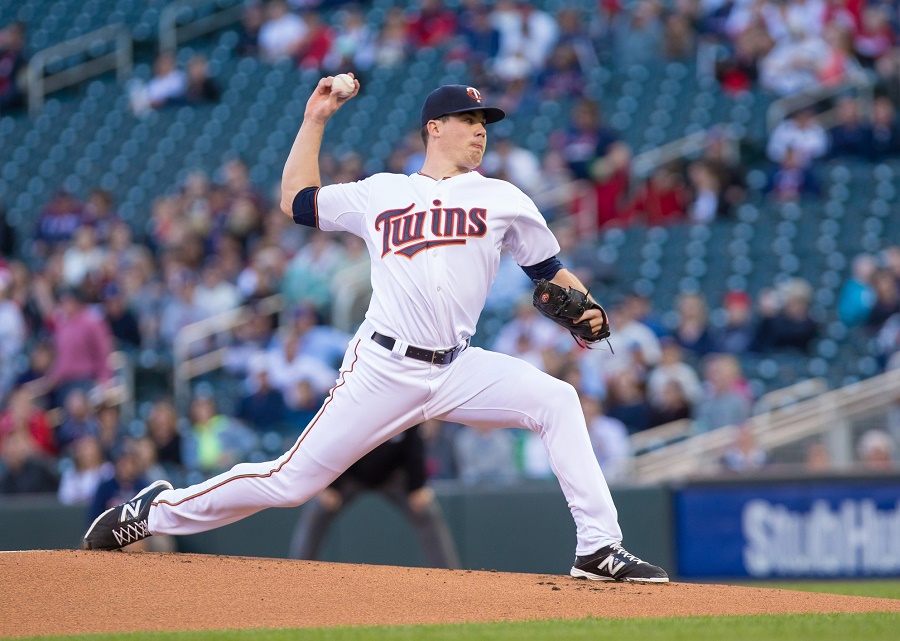 May didn’t complete five innings until his third start, and didn’t pick up a win until his fifth. As August came to an end, May’s ERA sat at 10.42. September was markedly better — if still not perfect — for May, as he posted a 6.08 ERA with 29 strikeouts and eight walks in 26.2 innings. Over his final four starts, he threw at least 90 pitches in each, and never fewer than 60 strikes. If you wanted the breakdown of May’s September versus his August, here it is: he threw nearly the same number of balls (non-strikes) in August (151) as September (157). The difference is, he threw nearly 80 more strikes in September. For a guy who has at times had issues throwing strikes in his career, that’s a reasonably big difference. May himself will tell you he felt he turned the corner in September, most specifically when preparing for his final start against the Tigers. May didn’t mince words either, as a guy who isn’t shy about saying what he feels. “I have a distinct memory of going into that start in Detroit kind of being like ‘I’m sick of letting guys dictate how I pitch. I’m really kind of tired of this Tigers team having the best time ever when they’re hitting,’” May said of his preparation for a six inning, seven strikeout performance against the Tigers. May was handed his sixth loss, but from a statistical standpoint, it was probably his second-best start of his cup of coffee with the big club. May considers that a jump-off point for his offseason. “I just wanted to go after them,” he noted. “They got me a little bit, but I thought I had them guessing and some guys swinging through things they thought they were going to hit.” After that start, May said he realized he had run out of ‘physical gas’, and that he made a promise to himself that the poise, confidence and aggressiveness was going to be there coming into 2015 because, as he said “You can’t pitch without it.” May doesn’t dodge questions about his control issues in the minors, and even last season. “I’m past the point of having jitters or just off my debut or all that stuff,” he said. “It’s time to get the job done.” May’s control woes were two-fold, at some points there were issues he could fix mechanically, and at other times it was just mind versus body. “There were times my body simply wouldn’t do what my brain said,” May noted. “But the vast majority of the times my big walk games were because I had a little bit of fear of throwing the ball over the plate. I’m not shy about that; it was happening.” But it hasn’t happened this year; in fact, through five starts since his call-up, he’s walked just five batters, and just four unintentionally. May made 29 appearances last year (28 starts), and walked four or more batters on six occasions — a rather large adjustment. May attributes that to not only a philosophical change, but facing that fear head-on and pummeling it into submission. “Just being relentless,” May said of his new mentality. “Just making them beat you 100 percent of the time is, I think, a good philosophy for me to have.” Since May is relatively new to the Twins landscape, he broke down his repertoire a little bit as well. He throws a fastball and a changeup as his strikeout pitches — his words — while the curve has been something he’s been working on with improved success in between-games action, whether it’s playing catch or side sessions. BrooksBaseball.net credits him with throwing 21 curves in Tuesday night’s game, which is more than any other two starts this year combined, so clearly that offering has evolved a bit. Each pitch for May has a different usage, like you’ll find with pretty much every pitcher. The two-seamer — termed a sinker via Brooks’ tracking logarithm — is what he considers his groundball pitch, which the statistics prove to be true with a 58.3 percent groundball rate in his brief big league career. Incidentally, the slider has proven heavy with a 50 percent groundball rate as well, so even though May is predominantly a fly ball pitcher — he says it’s due to the run on his four-seamer — he has a couple offerings that can kill worms if he finds himself in such a situation. The pitch we honed in on in discussions was the changeup, however. May has been a power pitcher as he’s risen through the ranks, but the changeup is something he’s wanted to reaffirm, and has done so with gusto this season. Thus far in his time in the majors, May has compiled a stellar 19.4 percent whiff rate on the pitch, a clean 10 percent-plus more than any of his other pitches. So while the fastball might be a strikeout pitch in May’s eyes, the changeup is without a doubt his putaway pitch. He’s keenly aware of it, too. In fact, future teammate Torii Hunter approached him after the Detroit start last year gushing about it. “You got me with the changeup,” Hunter admitted. “I couldn’t see it at all.” Kurt Suzuki was on board as well, and asked May early in the spring if he was “ready to throw some changeups this year?” May’s breakdown of the changeup is rather intriguing. “It moves exactly like my four-seamer does,” May said. “It’s an illusion. With the changeup, some guys get good action. For example, Gibby throws his as a sinker, so they see sinker action. So his action actually makes his changeup better. I kind of have a riding fastball as it is, so guys kinda have a tendency to swing under it because it’s going up over bats. But then the changeup is the same but it stays down and goes under there. It’s kind of an optical illusion, that’s what makes it so good.” The nuance of the changeup is one of baseball’s great mysteries, at least to the casual fan. What might be difficult to understand for someone who hasn’t faced a good one is that it’s nearly imperceptible if the pitcher throws it with the proper motion and mechanics. Essentially, it’s a pitch that’s designed to look like a fastball out of the hand — same arm speed, same arm slot — but the deception is when you find yourself finishing your swing as the ball crosses the plate. “It’s one of the harder pitches to throw,” May said. “I think fans see a lot of spin and they think breaking balls are the hardest thing to hit because it’s moving up or down or whatever. But if it’s picked up early, it’s not as hard to hit as a good changeup. A guy with a good changeup, if you can’t see, if it looks exactly the same and you can’t determine how fast it’s coming at you, you’re simply not going to hit it hard.” Well, as long as May keeps dealing with his changeup, it seems quite likely he can keep this early-season roll going. The Twins obviously thought well enough of his start to keep him in favor of veteran Tommy Milone, so maybe there’s some fire to go with May’s smoke here. This post originated at Cold Omaha. Please consider clicking through to support this content.
 -
Package Danny Santana with someone (Nolasco?) for Cole Hamels?
Brandon Warne commented on Target Field of Dreams's blog entry in Target Field of Dreams' Blog
The short answer is no. The long answer is nooooooooo. -
Yes I do
-
Trevor May’s career got off to an inauspicious start. After wearing out Triple-A pretty well — 2.85 ERA, 8.6 K/9, 1.16 WHIP — May was summoned for an Aug. 9 start last season against the A’s. May only lasted two innings, struck out none and walked seven as just 28 of his 63 pitches went for strikes. May didn’t complete five innings until his third start, and didn’t pick up a win until his fifth. As August came to an end, May’s ERA sat at 10.42. September was markedly better — if still not perfect — for May, as he posted a 6.08 ERA with 29 strikeouts and eight walks in 26.2 innings. Over his final four starts, he threw at least 90 pitches in each, and never fewer than 60 strikes. If you wanted the breakdown of May’s September versus his August, here it is: he threw nearly the same number of balls (non-strikes) in August (151) as September (157). The difference is, he threw nearly 80 more strikes in September. For a guy who has at times had issues throwing strikes in his career, that’s a reasonably big difference. May himself will tell you he felt he turned the corner in September, most specifically when preparing for his final start against the Tigers. May didn’t mince words either, as a guy who isn’t shy about saying what he feels. “I have a distinct memory of going into that start in Detroit kind of being like ‘I’m sick of letting guys dictate how I pitch. I’m really kind of tired of this Tigers team having the best time ever when they’re hitting,’” May said of his preparation for a six inning, seven strikeout performance against the Tigers. May was handed his sixth loss, but from a statistical standpoint, it was probably his second-best start of his cup of coffee with the big club. May considers that a jump-off point for his offseason. “I just wanted to go after them,” he noted. “They got me a little bit, but I thought I had them guessing and some guys swinging through things they thought they were going to hit.” After that start, May said he realized he had run out of ‘physical gas’, and that he made a promise to himself that the poise, confidence and aggressiveness was going to be there coming into 2015 because, as he said “You can’t pitch without it.” May doesn’t dodge questions about his control issues in the minors, and even last season. “I’m past the point of having jitters or just off my debut or all that stuff,” he said. “It’s time to get the job done.” May’s control woes were two-fold, at some points there were issues he could fix mechanically, and at other times it was just mind versus body. “There were times my body simply wouldn’t do what my brain said,” May noted. “But the vast majority of the times my big walk games were because I had a little bit of fear of throwing the ball over the plate. I’m not shy about that; it was happening.” But it hasn’t happened this year; in fact, through five starts since his call-up, he’s walked just five batters, and just four unintentionally. May made 29 appearances last year (28 starts), and walked four or more batters on six occasions — a rather large adjustment. May attributes that to not only a philosophical change, but facing that fear head-on and pummeling it into submission. “Just being relentless,” May said of his new mentality. “Just making them beat you 100 percent of the time is, I think, a good philosophy for me to have.” Since May is relatively new to the Twins landscape, he broke down his repertoire a little bit as well. He throws a fastball and a changeup as his strikeout pitches — his words — while the curve has been something he’s been working on with improved success in between-games action, whether it’s playing catch or side sessions. BrooksBaseball.net credits him with throwing 21 curves in Tuesday night’s game, which is more than any other two starts this year combined, so clearly that offering has evolved a bit. Each pitch for May has a different usage, like you’ll find with pretty much every pitcher. The two-seamer — termed a sinker via Brooks’ tracking logarithm — is what he considers his groundball pitch, which the statistics prove to be true with a 58.3 percent groundball rate in his brief big league career. Incidentally, the slider has proven heavy with a 50 percent groundball rate as well, so even though May is predominantly a fly ball pitcher — he says it’s due to the run on his four-seamer — he has a couple offerings that can kill worms if he finds himself in such a situation. The pitch we honed in on in discussions was the changeup, however. May has been a power pitcher as he’s risen through the ranks, but the changeup is something he’s wanted to reaffirm, and has done so with gusto this season. Thus far in his time in the majors, May has compiled a stellar 19.4 percent whiff rate on the pitch, a clean 10 percent-plus more than any of his other pitches. So while the fastball might be a strikeout pitch in May’s eyes, the changeup is without a doubt his putaway pitch. He’s keenly aware of it, too. In fact, future teammate Torii Hunter approached him after the Detroit start last year gushing about it. “You got me with the changeup,” Hunter admitted. “I couldn’t see it at all.” Kurt Suzuki was on board as well, and asked May early in the spring if he was “ready to throw some changeups this year?” May’s breakdown of the changeup is rather intriguing. “It moves exactly like my four-seamer does,” May said. “It’s an illusion. With the changeup, some guys get good action. For example, Gibby throws his as a sinker, so they see sinker action. So his action actually makes his changeup better. I kind of have a riding fastball as it is, so guys kinda have a tendency to swing under it because it’s going up over bats. But then the changeup is the same but it stays down and goes under there. It’s kind of an optical illusion, that’s what makes it so good.” The nuance of the changeup is one of baseball’s great mysteries, at least to the casual fan. What might be difficult to understand for someone who hasn’t faced a good one is that it’s nearly imperceptible if the pitcher throws it with the proper motion and mechanics. Essentially, it’s a pitch that’s designed to look like a fastball out of the hand — same arm speed, same arm slot — but the deception is when you find yourself finishing your swing as the ball crosses the plate. “It’s one of the harder pitches to throw,” May said. “I think fans see a lot of spin and they think breaking balls are the hardest thing to hit because it’s moving up or down or whatever. But if it’s picked up early, it’s not as hard to hit as a good changeup. A guy with a good changeup, if you can’t see, if it looks exactly the same and you can’t determine how fast it’s coming at you, you’re simply not going to hit it hard.” Well, as long as May keeps dealing with his changeup, it seems quite likely he can keep this early-season roll going. The Twins obviously thought well enough of his start to keep him in favor of veteran Tommy Milone, so maybe there’s some fire to go with May’s smoke here. This post originated at Cold Omaha. Please consider clicking through to support this content.
-
The Minnesota Twins promoted well-regarded prospect Eddie Rosario from Triple-A Rochester on Monday. Rosario wasn’t in uniform in time to start the game, and ultimately didn’t get in as the Twins eked out a close 8-7 win.Rosario, a two-time top-100 prospect according to Baseball Prospectus, was hitting just .242/.280/.370 at Rochester, leaving some to question why Aaron Hicks didn’t get the call instead due to his superior statistics. Manager Paul Molitor suggested it was not necessarily a long-term solution, which might have in turn led to a more permanent option being selected from the Red Wings. “He’s gonna get a chance to play in the short term,” Molitor noted. — The move that corresponded with Rosario’s promotion was putting outfielder Oswaldo Arcia on the disabled list with a right hip flexor strain. The injury isn’t entirely dissimilar from what forced Phil Hughes from his previous start, but perhaps just a bit more severe. Arcia said he first felt it when fielding a ball in the outfield and making a throw on Sunday, and it again seized up on him when he poked a single in a later at-bat. “When I tried to run hard, oh!” he colorfully quipped while talking to reporters in the clubhouse Monday afternoon. Arcia moved about with a considerable limp, and took a bit of ribbing from the team’s special assistant Tony Oliva, who is part of the uniformed personnel before games, and is no stranger to lower body injuries. Terry Ryan said he doesn’t expect an extended stay on the disabled list for Arcia. “I would hope after 15 days he’d be plenty ready to go,” Ryan said. “I don’t think anybody in there medical-wise is all that worried It’ll be one of those longstanding deals.” Arcia intimated to reporters before the game that he figured he’d be good to go in seven-to-10 days. — Also in the discussion for call-up in Arcia’s stead were Hicks (.289/.375/.494), Josmil Pinto (.299/.382/.403) and even Eric Fryer, who has been quite good (15-for-27 to start the season) in limited time splitting reps behind the plate in Rochester with Pinto. Ryan’s reasoning for possibly bringing up a catcher was that it would allow Chris Herrmann the flexibility to play in the outfield as well, but the team ultimately opted against it because both Rosario and Hicks offered the added flexibility of being able to handle center field. In that sense, it really seems as though the final decision came down to Rosario v. Hicks, with the Twins deciding they wanted to get a quick look at Rosario in his first cup of coffee in the big leagues. “This will be an opportunity to get his feet wet up here and see what it’s all about,” Ryan said of Rosario. “We’ll see how he responds and see what we’ve got.” Both Ryan and Molitor were complimentary of Hicks and Pinto as well, suggesting that this was by no means an easy decision. “Aaron’s doing fine,” Molitor said. “I’ve heard some really good things about him. His day could come soon as well.” Ryan added, “If this was a lockdown decision, you guys wouldn’t even be asking. But it wasn’t, we just haven’t had any outfielders go down recently.” — OLD FRIEND UPDATE Sam Fuld pinch ran for the A’s in the ninth inning after starting the game on the bench and is hitting just .216/.278/.341 in the early going while playing almost exclusively in center field. The plan was for Fuld and Craig Gentry to split time out there, but with Coco Crisp shelved with an elbow injury to start the season — he’s currently on a rehab assignment — both players have seen a good chunk of time, with Gentry mostly in left and Rule 5 player Mark Canha mixing in as well. Catcher Drew Butera was designated for assignment by the Los Angeles Angels after hitting just .190/.190/.190 in 21 plate appearances spanning 10 games. The 31-year-old Butera will have the option of refusing the assignment to the minor leagues should it come to that, but for now he’s been passed over by Carlos Perez as the primary backup to starting catcher Chris Iannetta. — TRIVIA Who did Joe Mauer hit his first career home run off? — AROUND THE AFFILIATES Rochester (14-9): Idle on Monday. Alex Meyer went seven innings, allowing just three earned runs with six strikeouts and four walks in Sunday’s win over Norfolk. Old friend Chris Parmelee (0-for-3, two walks) batted third for the Tides. Chattanooga (13-11): Byron Buxton continued his red-hot tear with a two-run walkoff home run in the bottom of the ninth to give the Lookouts a 2-0 win over Jacksonville. Zack Jones had pitched a scoreless ninth with two strikeouts and a pair of hits and ultimately got the win. Buxton’s home run and an earlier single from Sano accounted for all of the Lookouts’ hits for the day. Fort Myers (9-16): The Miracle’s woes continued, as they were held to just five hits as Matt Benedict, Isaac Sanchez and Brett McKinney of Bradenton held Fort Myers scoreless. Recently-promoted outfielder Zach Granite was the only Miracle player with more than one hit (2-for-4). Cedar Rapids (14-11): The Kernels scored the game’s final six runs en route to a 9-3 win over homestanding Wisconsin. The Kernels pounded out five doubles and a triple, with T.J. White (3-for-4) and Max Murphy (2-for-4) leading the way. Jared Wilson tossed six strong innings with seven strikeouts and three earned runs, and Zach Tillery took it the rest of the way, fanning four with just one hit allowed over the final three frames. — Speaking of Buxton — who was not in consideration for the roster opening vacated by Arcia, Ryan and Molitor both noted on Monday — it’s worth noting that this is a young man who is on an absolute tear. This is a guy who was hitting exactly his listed weight (.190) after play on April 26. But from April 27 to May 3 — so not yet including Monday’s heroics — Buxton hit .483/.543/.828 with two doubles and four triples over that seven-game span. That brought his season line up to .283/.357/.506, which is much more Buxton-like and could signify that the rust accrued over a mostly-lost 2014 season is dissipating. The Twins won’t tip their hand on plans for the uber-talented youngster, but reading between the lines, the club won’t wait a second longer than necessary once he is deemed ready. — BY THE NUMBERS 0 – Number of walks issued by Glen Perkins in 12 innings of work so far this season. 0 – Also the number of walks drawn by shortstop Danny Santana before he coaxed a four-pitch walk in the eighth. Santana was the last of 180 ‘qualified’ players in the big leagues to draw a walk this season. Santana and Jordan Schafer were the only two Twins to draw walks on the night; they came into the game with two walks combined over 150 plate appearances. 0 – Number of stolen bases for Jordan Schafer in three attempts. 0 – Number of teams striking out fewer batters than the Twins pitching staff, which entered play Monday at 5.3. The next worst — Texas — is still a full strikeout better at 6.4. 0 – Similarly, no teams came into Monday with a worse xFIP than the Twins at 4.60. In short, some numbers don’t believe the Twins’ team ERA of 4.03 — 19th league wide — is sustainable. Only time will tell. — TRIVIA ANSWER Joe Mauer homered off Detroit reliever Esteban Yan on June 6, 2004 — a three-run homer that gave the Twins the lead in the bottom of the eighth in an eventual 6-5 win. Click here to view the article
-
Warne Notebook: Arcia's Replacement, Buxton Heating up, Affiliate Report
Brandon Warne posted an article in Twins
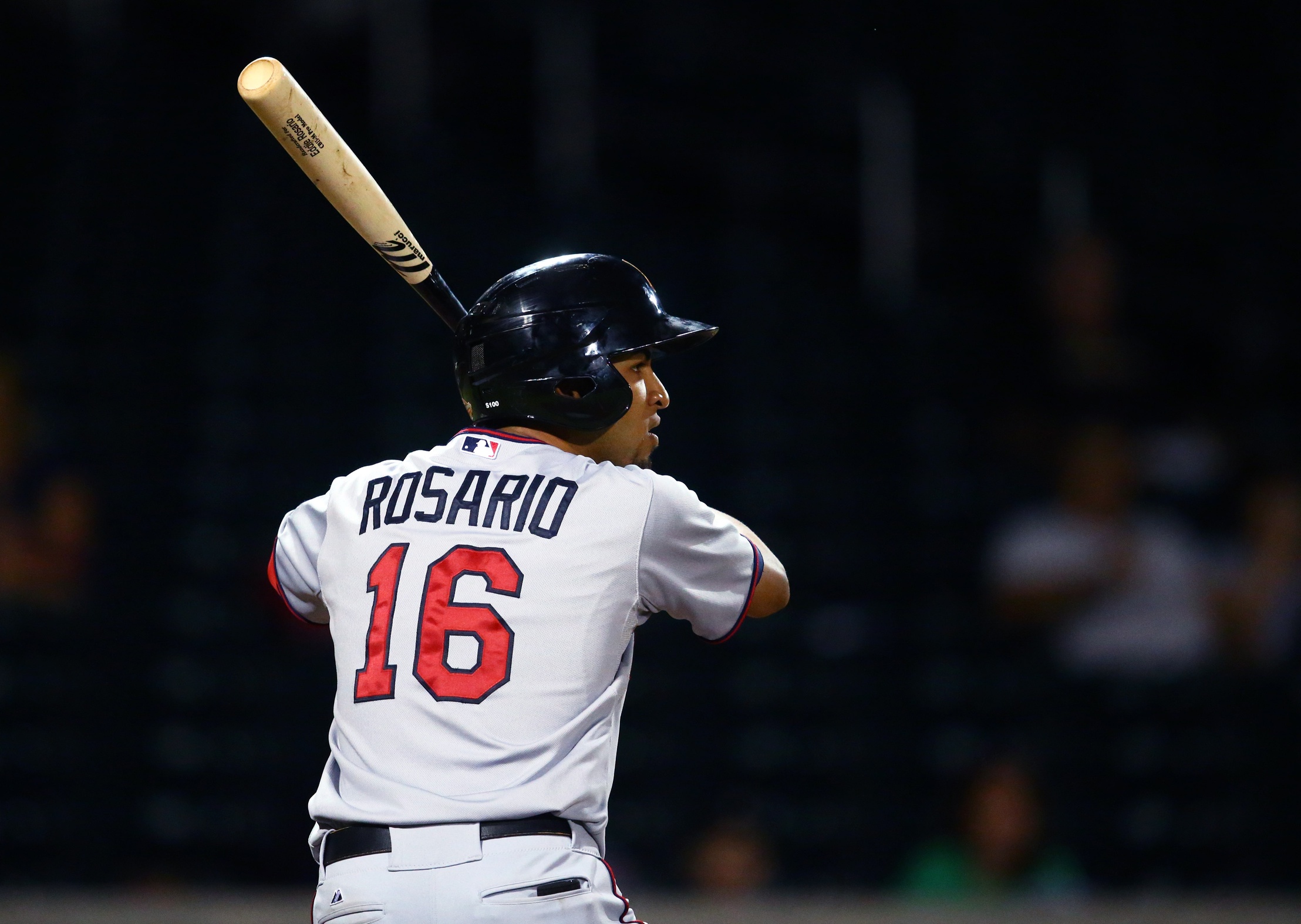 Rosario, a two-time top-100 prospect according to Baseball Prospectus, was hitting just .242/.280/.370 at Rochester, leaving some to question why Aaron Hicks didn’t get the call instead due to his superior statistics. Manager Paul Molitor suggested it was not necessarily a long-term solution, which might have in turn led to a more permanent option being selected from the Red Wings. “He’s gonna get a chance to play in the short term,” Molitor noted. — The move that corresponded with Rosario’s promotion was putting outfielder Oswaldo Arcia on the disabled list with a right hip flexor strain. The injury isn’t entirely dissimilar from what forced Phil Hughes from his previous start, but perhaps just a bit more severe. Arcia said he first felt it when fielding a ball in the outfield and making a throw on Sunday, and it again seized up on him when he poked a single in a later at-bat. “When I tried to run hard, oh!” he colorfully quipped while talking to reporters in the clubhouse Monday afternoon. Arcia moved about with a considerable limp, and took a bit of ribbing from the team’s special assistant Tony Oliva, who is part of the uniformed personnel before games, and is no stranger to lower body injuries. Terry Ryan said he doesn’t expect an extended stay on the disabled list for Arcia. “I would hope after 15 days he’d be plenty ready to go,” Ryan said. “I don’t think anybody in there medical-wise is all that worried It’ll be one of those longstanding deals.” Arcia intimated to reporters before the game that he figured he’d be good to go in seven-to-10 days. — Also in the discussion for call-up in Arcia’s stead were Hicks (.289/.375/.494), Josmil Pinto (.299/.382/.403) and even Eric Fryer, who has been quite good (15-for-27 to start the season) in limited time splitting reps behind the plate in Rochester with Pinto. Ryan’s reasoning for possibly bringing up a catcher was that it would allow Chris Herrmann the flexibility to play in the outfield as well, but the team ultimately opted against it because both Rosario and Hicks offered the added flexibility of being able to handle center field. In that sense, it really seems as though the final decision came down to Rosario v. Hicks, with the Twins deciding they wanted to get a quick look at Rosario in his first cup of coffee in the big leagues. “This will be an opportunity to get his feet wet up here and see what it’s all about,” Ryan said of Rosario. “We’ll see how he responds and see what we’ve got.” Both Ryan and Molitor were complimentary of Hicks and Pinto as well, suggesting that this was by no means an easy decision. “Aaron’s doing fine,” Molitor said. “I’ve heard some really good things about him. His day could come soon as well.” Ryan added, “If this was a lockdown decision, you guys wouldn’t even be asking. But it wasn’t, we just haven’t had any outfielders go down recently.” — OLD FRIEND UPDATE Sam Fuld pinch ran for the A’s in the ninth inning after starting the game on the bench and is hitting just .216/.278/.341 in the early going while playing almost exclusively in center field. The plan was for Fuld and Craig Gentry to split time out there, but with Coco Crisp shelved with an elbow injury to start the season — he’s currently on a rehab assignment — both players have seen a good chunk of time, with Gentry mostly in left and Rule 5 player Mark Canha mixing in as well. Catcher Drew Butera was designated for assignment by the Los Angeles Angels after hitting just .190/.190/.190 in 21 plate appearances spanning 10 games. The 31-year-old Butera will have the option of refusing the assignment to the minor leagues should it come to that, but for now he’s been passed over by Carlos Perez as the primary backup to starting catcher Chris Iannetta. — TRIVIA Who did Joe Mauer hit his first career home run off? — AROUND THE AFFILIATES Rochester (14-9): Idle on Monday. Alex Meyer went seven innings, allowing just three earned runs with six strikeouts and four walks in Sunday’s win over Norfolk. Old friend Chris Parmelee (0-for-3, two walks) batted third for the Tides. Chattanooga (13-11): Byron Buxton continued his red-hot tear with a two-run walkoff home run in the bottom of the ninth to give the Lookouts a 2-0 win over Jacksonville. Zack Jones had pitched a scoreless ninth with two strikeouts and a pair of hits and ultimately got the win. Buxton’s home run and an earlier single from Sano accounted for all of the Lookouts’ hits for the day. Fort Myers (9-16): The Miracle’s woes continued, as they were held to just five hits as Matt Benedict, Isaac Sanchez and Brett McKinney of Bradenton held Fort Myers scoreless. Recently-promoted outfielder Zach Granite was the only Miracle player with more than one hit (2-for-4). Cedar Rapids (14-11): The Kernels scored the game’s final six runs en route to a 9-3 win over homestanding Wisconsin. The Kernels pounded out five doubles and a triple, with T.J. White (3-for-4) and Max Murphy (2-for-4) leading the way. Jared Wilson tossed six strong innings with seven strikeouts and three earned runs, and Zach Tillery took it the rest of the way, fanning four with just one hit allowed over the final three frames. — Speaking of Buxton — who was not in consideration for the roster opening vacated by Arcia, Ryan and Molitor both noted on Monday — it’s worth noting that this is a young man who is on an absolute tear. This is a guy who was hitting exactly his listed weight (.190) after play on April 26. But from April 27 to May 3 — so not yet including Monday’s heroics — Buxton hit .483/.543/.828 with two doubles and four triples over that seven-game span. That brought his season line up to .283/.357/.506, which is much more Buxton-like and could signify that the rust accrued over a mostly-lost 2014 season is dissipating. The Twins won’t tip their hand on plans for the uber-talented youngster, but reading between the lines, the club won’t wait a second longer than necessary once he is deemed ready. — BY THE NUMBERS 0 – Number of walks issued by Glen Perkins in 12 innings of work so far this season. 0 – Also the number of walks drawn by shortstop Danny Santana before he coaxed a four-pitch walk in the eighth. Santana was the last of 180 ‘qualified’ players in the big leagues to draw a walk this season. Santana and Jordan Schafer were the only two Twins to draw walks on the night; they came into the game with two walks combined over 150 plate appearances. 0 – Number of stolen bases for Jordan Schafer in three attempts. 0 – Number of teams striking out fewer batters than the Twins pitching staff, which entered play Monday at 5.3. The next worst — Texas — is still a full strikeout better at 6.4. 0 – Similarly, no teams came into Monday with a worse xFIP than the Twins at 4.60. In short, some numbers don’t believe the Twins’ team ERA of 4.03 — 19th league wide — is sustainable. Only time will tell. — TRIVIA ANSWER Joe Mauer homered off Detroit reliever Esteban Yan on June 6, 2004 — a three-run homer that gave the Twins the lead in the bottom of the eighth in an eventual 6-5 win.
 -
WARNE NOTEBOOK: Arcia’s Replacement; Buxton Heating Up; Affiliate Reports
Brandon Warne posted a blog entry in BW on the Beat
The Minnesota Twins promoted well-regarded prospect Eddie Rosario from Triple-A Rochester on Monday. Rosario wasn’t in uniform in time to start the game, and ultimately didn’t get in as the Twins eked out a close 8-7 win. Rosario, a two-time top-100 prospect according to Baseball Prospectus, was hitting just .242/.280/.370 at Rochester, leaving some to question why Aaron Hicks didn’t get the call instead due to his superior statistics. Manager Paul Molitor suggested it was not necessarily a long-term solution, which might have in turn led to a more permanent option being selected from the Red Wings. “He’s gonna get a chance to play in the short term,” Molitor noted. — The move that corresponded with Rosario’s promotion was putting outfielder Oswaldo Arcia on the disabled list with a right hip flexor strain. The injury isn’t entirely dissimilar from what forced Phil Hughes from his previous start, but perhaps just a bit more severe. Arcia said he first felt it when fielding a ball in the outfield and making a throw on Sunday, and it again seized up on him when he poked a single in a later at-bat. “When I tried to run hard, oh!” he colorfully quipped while talking to reporters in the clubhouse Monday afternoon. Arcia moved about with a considerable limp, and took a bit of ribbing from the team’s special assistant Tony Oliva, who is part of the uniformed personnel before games, and is no stranger to lower body injuries. Terry Ryan said he doesn’t expect an extended stay on the disabled list for Arcia. “I would hope after 15 days he’d be plenty ready to go,” Ryan said. “I don’t think anybody in there medical-wise is all that worried it’ll be one of those longstanding deals.” Arcia intimated to reporters before the game that he figured he’d be good to go in seven-to-10 days. — Also in the discussion for call-ups in Arcia’s stead were Hicks (.289/.375/.494), Josmil Pinto (.299/.382/.403) and even Eric Fryer, who has been quite good (15-for-27 to start the season) in limited time splitting reps behind the plate in Rochester with Pinto. Ryan’s reasoning for possibly bringing up a catcher was that it would allow Chris Herrmann the flexibility to play in the outfield as well, but the team ultimately opted against it because both Rosario and Hicks offered the added flexibility of being able to handle center field. In that sense, it really seems as though the final decision came down to Rosario v. Hicks, with the Twins deciding they wanted to get a quick look at Rosario in his first cup of coffee in the big leagues. “This will be an opportunity to get his feet wet up here and see what it’s all about,” Ryan said of Rosario. “We’ll see how he responds and see what we’ve got.” Both Ryan and Molitor were complimentary of Hicks and Pinto as well, suggesting that this was by no means an easy decision. “Aaron’s doing fine,” Molitor said. “I’ve heard some really good things about him. His day could come soon as well.” Ryan added, “If this was a lockdown decision, you guys wouldn’t even be asking. But it wasn’t, we just haven’t had any outfielders go down recently.” — OLD FRIEND UPDATE Sam Fuld pinch ran for the A’s in the ninth inning after starting the game on the bench and is hitting just .216/.278/.341 in the early going while playing almost exclusively in center field. The plan was for Fuld and Craig Gentry to split time out there, but with Coco Crisp shelved with an elbow injury to start the season — he’s currently on a rehab assignment — both players have seen a good chunk of time with Gentry mostly in left and Rule 5 player Mark Canha mixing in as well. Catcher Drew Butera was designated for assignment by the Los Angeles Angels after hitting just .190/.190/.190 in 21 plate appearances spanning 10 games. The 31-year-old Butera will have the option of refusing the assignment to the minor leagues should it come to that, but for now he’s been passed over by Carlos Perez as the primary backup to starting catcher Chris Iannetta. — TRIVIA Who did Joe Mauer hit his first career home run off? — AROUND THE AFFILIATES Rochester (14-9): Idle. Alex Meyer went seven innings, allowing just three earned runs with six strikeouts and four walks in Sunday’s win over Norfolk. Old friend Chris Parmelee (0-for-3, two walks) batted third for the Tides. Chattanooga (13-11): Byron Buxton continued his red-hot tear with a two-run walkoff home run in the bottom of the ninth to give the Lookouts a 2-0 win over Jacksonville. Zack Jones had pitched a scoreless ninth with two strikeouts and a pair of hits and ultimately got the win. Buxton’s home run and an earlier single from Sano accounted for all of the Lookouts’ hits for the day. Fort Myers (9-16): The Miracle’s woes continued, as they were held to just five hits as Matt Benedict, Isaac Sanchez and Brett McKinney of Bradenton held Fort Myers scoreless. Recently-promoted outfielder Zach Granite was the only Miracle player with more than one hit (2-for-4). Cedar Rapids (14-11): The Kernels scored the game’s final six runs en route to a 9-3 win over homestanding Wisconsin. The Kernels pounded out five doubles and a triple, with T.J. White (3-for-4) and Max Murphy (2-for-4) leading the way. Jared Wilson tossed six strong innings with seven strikeouts and three earned runs, and Zach Tillery took it the rest of the way, fanning four with just one hit allowed over the final three frames. — Speaking of Buxton — who was not in consideration for the roster opening vacated by Arcia, Ryan and Molitor both noted on Monday — it’s worth noting that this is a young man who is on an absolute tear. This is a guy who was hitting exactly his listed weight (.190) after play on April 26. But from April 27 to May 3 — so not yet including Monday’s heroics — Buxton hit .483/.543/.828 with two doubles and four triples over that seven-game span. That brought his season line up to .283/.357/.506, which is much more Buxton-like and could signify that the rust accrued over a mostly-lost 2014 season is dissipating. The Twins won’t tip their hand on plans for the uber-talented youngster, but reading between the lines, the club won’t wait a second longer than necessary once he is deemed ready. — BY THE NUMBERS 0 – Number of walks issued by Glen Perkins in 12 innings of work so far this season. 0 – Also the number of walks drawn by shortstop Danny Santana before he coaxed a four-pitch walk in the eighth. Santana was the last of 180 ‘qualified’ players in the big leagues to draw a walk this season. Santana and Jordan Schafer were the only two Twins to draw walks on the night; they came into the game with two walks combined over 150 plate appearances. 0 – Number of stolen bases for Jordan Schafer in three attempts. 0 – Number of teams striking out fewer batters than the Twins pitching staff, which entered play Monday at 5.3. The next worst — Texas — is still a full strikeout better at 6.4. 0 – Similarly, no teams came into Monday with a worse xFIP than the Twins at 4.60. In short, some numbers don’t believe the Twins’ team ERA of 4.03 — 19th league wide — is sustainable. Only time will tell. — TRIVIA ANSWER Joe Mauer homered off Detroit reliever Esteban Yan on June 6, 2004 — a three-run homer that gave the Twins the lead in the bottom of the eighth in an eventual 6-5 win. This post originated at Cold Omaha here, please click through to give us a read there as well.


