



Parker Hageman
-
Posts
4,162 -
Joined
-
Last visited
-
Days Won
6
Content Type
Profiles
Minnesota Twins News, Rumors & Analysis
Minnesota Twins Videos
2026 Minnesota Twins Top Prospect Rankings
2022 Minnesota Twins Draft Picks & Signing Bonuses
Minnesota Twins Trade & Free Agent Rumors
Minnesota Twins Fan Guides & Resources
2023 Minnesota Twins Draft Picks & Signing Bonuses
2024 Minnesota Twins Draft Picks & Signing Bonuses
2025 Minnesota Twins Draft Picks & Signing Bonuses
2026 Minnesota Twins Draft Picks & Signing Bonuses
Forums
Blogs
Events
Store
Downloads
Gallery
Everything posted by Parker Hageman
-

Will Max Kepler Take the Next Step in 2018?
Parker Hageman replied to Tom Froemming's topic in Twins Daily Front Page News
I put this together last November because I was fascinated by the difference in mindset between two hitters like Justin Turner and Max Kepler. When you break it down, both finished the year with very similar power numbers but had two totally different approaches upstairs. https://twitter.com/ParkerHageman/status/929445391304740864 Turner is all about getting on plane early and getting the ball in the air -- his goal, he said, is to hit the bottom of the baseball. Kepler, on the other hand, says he tries to get on top of the baseball and chop it. Now, Kepler doesn't actually hit down on the ball. He catches a lot of balls on the upswing, such as in the example in the video (as Mr. Turner was kind enough to point out). The notable difference between the two types of swings is that Turner's bat path gets under which Kepler's comes in at a steeper plane. Unless he's on-time for every pitch, Kepler's swing will incite more grounders and pop-ups as his barrel is shorter through the zone. In the end, all hitters have their own approach. I don't think either one is better than the other (although I prefer to see hitters getting the ball in the air). If Kepler maintains the same swing, he'll likely wind up with more contact and a higher average than Turner. And he will have decent power numbers, albeit possibly fewer big flies. -
Will Max Kepler Take the Next Step in 2018?
Parker Hageman replied to Tom Froemming's topic in Twins Daily Front Page News
One thing I want to caution about when talking launch angles in regards to Max Kepler and comparing his LA to other players with lower infield fly rates is that Statcast often loses those types of batted balls in the system and those events don't get accounted for. According to FiveThirtyEight, somewhere around 50% of all pop-ups were unaccounted for in 2016. https://fivethirtyeight.com/features/mlbs-hit-tracking-tool-misses-a-lot-of-hits/ What does that mean for a guy like Kepler who had a higher than average infield fly rate? It means that there some of the unfavorable batted ball data (low exit velocity and extreme LA) were likely expunged from his data set. In one regard, he might actually have a lower exit velocity average (pop flies ain't hit hard) but he might actually have a better launch angle average than reported. This is the unfortunate grey area that existing when doing the analysis with Statcast data and I hope MLB does the right thing eventually and allows more people to review their data set in the open. -
Twins Daily's Long-Term Future And Writers
Parker Hageman replied to John Bonnes's topic in Twins Daily Front Page News
Let me pitch something to all of you... We have a section at the top of the front page called "Organizational Chart" [LINK] which has information on all of the players in the system. Last offseason, we populated that with some of Seth's notes from his previous prospect handbook, giving a brief scouting report of the minor leaguers -- such as this one of Byron Buxton. To be honest, it was tedious to update as players moved each level, got hurt, traded or released throughout the season but I feel like this could be a valuable tool. Has anyone visited the Org Charts before? Would anyone use that if they had scouting report and bio information? -
Because Duke actually worked his way back in 2017 he's less of a gamble than the guys that required minor league contracts (not less of an investment risk, mind you) and more probable to get back to his pre-TJ performance. So it is understandable why he got a major league deal. To be fair, I do believe the Twins will still sign a few projects to minor league deals -- Jake Petricka might be one of those guys.
-
Right. Which happens to a lot of pitchers, and a lot of them on the previous list as well were gambles at one time. Neshek, Hunter, Holland, Kintzler and Morrow all recently had one-year deals to prove they could return to form. Now, after doing so, they are getting massive deals and we're pining over why the Twins didn't sign them. All pitchers are a gamble to some degree. It's possible that Duke picks up where he left off at the end of 2017 and continues to produce at that level. It's possible his arm falls off tomorrow. However, I believe with an offseason to recover and with the potential to improve his methodology, he can regain and rebound to his pre-TJ days.
-
See, that's the problem. When you actually look at the results from those guys on the list you would find that Zach Duke has been as good or an even better pitcher than most of the dozen you have mentioned. Over the last three years Duke has had the same expected FIP (3.71) as Nicasio (3.71) and Neshek (3.71) and better xFIP than Cishek (3.84), Holland (3.93), McGee (3.94) and Kintzler (3.97). Over the last three years Duke has averaged a higher percentage of strikeouts (24.9%) than McGee (24.8), Cishek (24.4), Shaw (23.0), Morrow (22.3), Hunter (21.8) and Kintzler (14.8). Over the last three years Duke has had a better swinging strike rate (11%) than Hunter (10.6), Nicasio (10.5), Cishek (10.3), McGee (9.8), Kintzler (6.4). Over the last three years Duke has had a ground ball rate (57.4%) higher than everyone but Kintzler (58.2%). Now, if you look back over the last four years (since 2014), Duke's numbers are even better... In that time, Duke's xFIP (3.23) is better than everyone's except Wade Davis (2.96). In that time, Duke's GB% (57.5) is just barely under Kintzler's (57.8). In that time, Duke's K% (26.7) is better than everyone's except McGee (27.4), Holland (31.3) and Davis (33.0). In that time, Duke's hard hit ball% (24.1) is lower than everyone's except Shaw (21.7). There is a lot to like about Duke. There is also a lot to be wary of -- like the high walk rate, the higher home run rate, and the low velocity (lowest fastball velocity out of any of those guys). But you can't deny that Duke hasn't been successful. When you compare him to the group you presented, it's a sneaky good signing! Look at the years (more important to me) and dollars those guys got: Morrow (2 yr, $21M), Minor (3 yr, $28M), Hunter (2 yr, $18M), Shaw (3 yr, $27M), McGee (3 yr, $27M), Neshek (2 yr, $16.5M), Cishek (2 yr, $6.5M), and Kintzler (2 yr, $10M). Davis and Holland will likely wind up with massive deals. If I'm the Twins, I would certainly settle for the similar results as these guys are likely going to produce at a one-year deal. If I'm the Twins, I'm more excited about the arms developing in my system. This is an understandably unsexy signing but it's not a "Craig Breslow" signing. Duke is far from perfect and obviously a risk at his age and injury history, but when you look at the numbers, he's a much better option than first glance.
- 47 replies
-
- 10
-

-
Twins Daily's Long-Term Future And Writers
Parker Hageman replied to John Bonnes's topic in Twins Daily Front Page News
I should say, the first part of my post was very sincere. -
Twins Daily's Long-Term Future And Writers
Parker Hageman replied to John Bonnes's topic in Twins Daily Front Page News
There are a lot of great ideas and suggestions in here. Once we make our first million, we will definitely be handing out kickbacks to all of you. -
But what if you are signing a guy who is cheap and also just plain good? And -- AND -- has the opportunity to be even better? Take a look at the difference over the last three seasons between Jake McGee (who just got a 3 year, $27M deal from the Rockies and Zach Duke: LINK. With the exception of the saves (wanking motion), Duke has actually been better than McGee. And he's added more to his team's ledger than McGee (1.78 Wins Probability Added vs 1.56 for McGee). I realize celebrating the idea that the Pohlad's are pinching pennies is lame -- and I'd rather have ballplayers make the money they deserve -- however Duke is clearly going to come at a discount because of his recent surgery, age (35 vs 31), and radar gun readings (89 vs 95 MPH). In the end, Duke has proven that he can get hitters out as effectively (or even more) than McGee. If you are looking at the deal through that lens then the deal looks pretty good. And that is even before the team layers on any changes and insight like increasing the amount of lower arm angle pitches that could make his overall numbers better. Without question Duke may flop. He's aging, post-TJ, and the volatility of relievers from year to year often is one big game of Russian roulette.
- 47 replies
-
- 11
-
-
That's in reference to the professional pitchers in the "modern" Tommy John era from his 2006-2016 chart. Personally, I probably wouldn't include Crosby on the list other than as an asterisk considering he was returning to HS ball. It's impressive, no doubt, but the level which a pitcher needs to return to at the HS level vs professional level is vastly different. If we really need to nitpick, it probably should be read as 8th fastest in the Tommy John era.
-
First, not at all like that. In Breslow's case, he was trying to find a thing that had success. Duke already has that thing. Second, comparing Breslow to Duke is silly. Even during his best years, Breslow never put up the kind of secondary numbers that Duke did as a reliever.
-
No, he dropped down versus right-handed batters too. Had better numbers vs RHB out of the low slot as well.
-
Thanks to KFAN’s Paul Lambert, who leaked out on Christmas morning that the Minnesota Twins and 34-year-old relief pitcher Zach Duke had reached an agreement, people like me spent the remainder of the holiday ignoring their family and going over scouting reports and video of Duke. On Tuesday, the Twins made it official, announcing they have signed Duke to a reported one-year, $2 million deal with a potential to earn another $1.5 million with performance bonuses. As far as free agent relief arms go, it’s a modest sum and notably less than the $5 million per year deal he signed with the White Sox three years ago. On the surface, a one-year contract to a Tommy John surviving journeyman left-handed reliever who can’t crack 90 appears uninspired. However, if you look closer, there is the possibility this becomes a very savvy, very valuable move by this front office. Image courtesy of Jeff Curry-USA TODAY Sports Thanks to KFAN’s Paul Lambert, who leaked out on Christmas morning that the Minnesota Twins and 34-year-old relief pitcher Zach Duke had reached an agreement, people like me spent the remainder of the holiday ignoring their family and going over scouting reports and video of Duke. On Tuesday, the Twins made it official, announcing they have signed Duke to a reported one-year, $2 million deal with a potential to earn another $1.5 million with performance bonuses. As far as free agent relief arms go, it’s a modest sum and notably less than the $5 million per year deal he signed with the White Sox three years ago. On the surface, a one-year contract to a Tommy John surviving journeyman left-handed reliever who can’t crack 90 appears uninspired. However, if you look closer, there is the possibility this becomes a very savvy, very valuable move by this front office. When Duke transitioned into a reliever, he noticed that the majority of the bullpenners were chucking mid-90s heat. Duke never averaged a season over 90 miles per hour in his entire career. He needed something that would help him get hitters out, he needed deception. It was while with the Brewers, Duke began occasionally dropping his arm slot and alternating from a three-quarter and sidearm look. Sometimes hitters got his normal look… ...And sometimes they got his drop-down slot. It launched his best statistical season of his career. Duke’s ground ball rate shot up to near 60 percent and he struck out over 30 percent of hitters faced. That offseason, the Chicago White Sox signed him to a three-year, $15 million deal. Duke continued to post those solid numbers (with an unfortunate spike in home runs allowed with Chicago but, hey, it’s windy there) and he was ultimately traded to St. Louis where he tore his UCL and required Tommy John surgery in October 2016. Written off for the 2017 season, Duke made a hard-charge comeback from the surgery and was back in the Cardinals’ bullpen by the end of July of this past year -- a little over ten months removed from his UCL rebuild. The 266 recovery days is the shortest turnaround in the Tommy John era. If Duke is healthy -- and his medical tests by the Minnesota Twins prior to signing a one-year deal suggests that he is -- there is no reason to think that he cannot replicate a similar level of production as he provided the Brewers, White Sox and Cardinals. That being said, there is a way Duke might actually be *better* going forward because of this one simple fact: He has been infinity better when throwing from the lower arm slot. The numbers, courtesy of Statcast, between Duke’s regular three-quarter slot and his sidearm slot are stark. Since 2015, Statcast has tracked 2,351 pitches from him -- 1,249 have been thrown from the three-quarter slot (53%) and 1,023 (44%) were thrown from the sidearm slot. Now, take a look at the difference in results: That’s huge. Everything from the lower arm slot is getting better results: More ground balls, more strikeouts, less solid contact. Imagine instead of saying “Three-Quarter” and “Sidearm” that chart said “Pitcher A” and “Pitcher B”. Wouldn’t you want to have “Pitcher B” on the mound for you? Given the data, it makes one wonder why Duke wouldn’t transition to the lower arm slot full-time. Some would argue that Duke’s multiple and varied arm slots actually enhances his lower arm slot -- something like throwing a fastball from the three-quarter slot sets up his slider from down below. The logic is that with the variation, hitters will have to look for a wider release window for the pitch. However, hitters appear to be able to pick up the ball fairly effortlessly from the three-quarter slot so it is safe to assume that Duke’s lower arm slot is not enhancing his three-quarter slot (or, if it is, marginally so). In many ways, asking Duke to favor the sidearm slot is akin to the development teams have had over the last few seasons of encouraging pitchers to lean heavily on their breaking balls. According to Fangraphs, Yankees pitchers threw a league-low 44% fastballs last season. Not far behind them were the Indians, Rays and Astros -- all forward-thinking, data-driven front offices. Hitters made more contact against fastballs. They were having more success against that pitch. Why not have your pitchers throw their best pitch more often? Same thing should be asked about Duke. Why not focus on pitching the way which provided the most success? Duke’s deception isn’t that he gives them different looks. His deception is releasing the ball from an angle that hitters don’t see that often. In 2017, there were 180 left-handed pitchers who released the ball within the similar vertical window as Duke did from three-quarter slot. There were just 43 who threw from the same vertical window as he did from the sidearm slot -- and most of those pitchers did it less than a handful of times. In the first group hitters saw 154,000 pitches come from that angle. From the latter, they saw just 6,200. The more you dig into the numbers, the clearer it is that Duke should be throwing from the lower slot at a higher rate than he has been in the past. Save the three-quarter slot to mess with a hitter’s vision. This Twins have beefed up their front office, including adding Josh Kalk (a pitching data pioneer in the PitchFX era) to the analytics team, and have plenty of sharp individuals who have reviewed this exact data and possibly came to the same conclusion. If the organization’s analytics arm actually identified this potential, ran it by the decision-makers, and they were able to secure a low-cost reliever who has a decent upside with a minor modification, that would be a super savvy maneuver never seen in these parts. Either way, even if they don’t get Duke to reduce his reliance on the three-quarter arm slot, the Twins still have themselves a decent bullpen arm at a substantially low cost. View full article
-
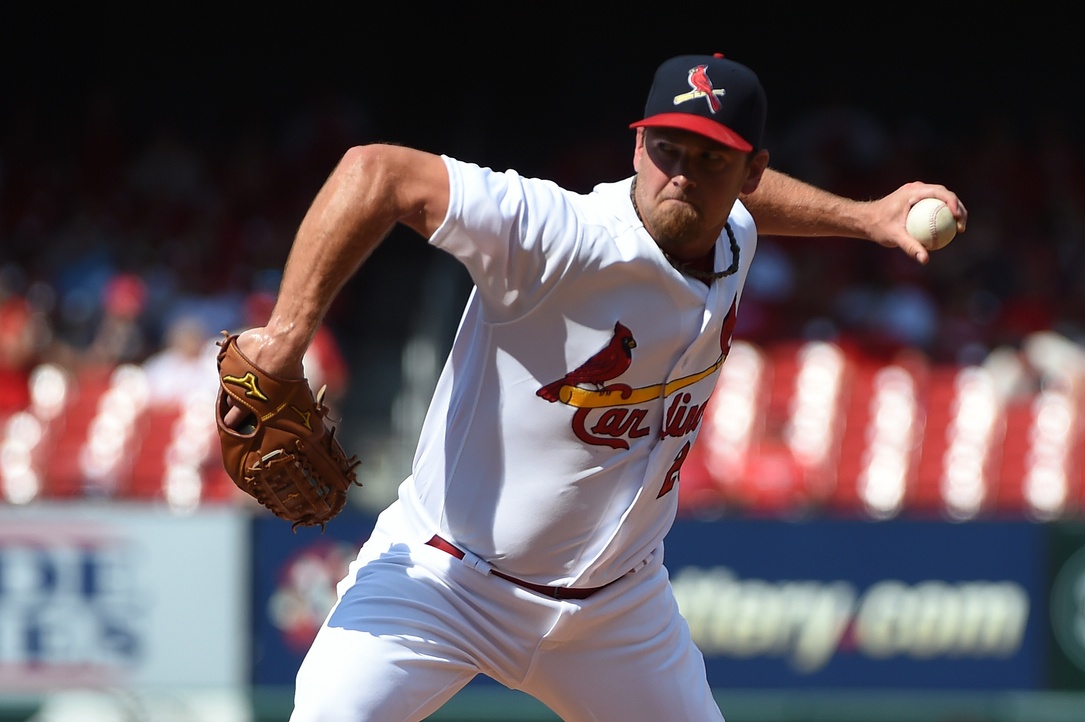 When Duke transitioned into a reliever, he noticed that the majority of the bullpenners were chucking mid-90s heat. Duke never averaged a season over 90 miles per hour in his entire career. He needed something that would help him get hitters out, he needed deception. It was while with the Brewers, Duke began occasionally dropping his arm slot and alternating from a three-quarter and sidearm look. Sometimes hitters got his normal look… ...And sometimes they got his drop-down slot. It launched his best statistical season of his career. Duke’s ground ball rate shot up to near 60 percent and he struck out over 30 percent of hitters faced. That offseason, the Chicago White Sox signed him to a three-year, $15 million deal. Duke continued to post those solid numbers (with an unfortunate spike in home runs allowed with Chicago but, hey, it’s windy there) and he was ultimately traded to St. Louis where he tore his UCL and required Tommy John surgery in October 2016. Written off for the 2017 season, Duke made a hard-charge comeback from the surgery and was back in the Cardinals’ bullpen by the end of July of this past year -- a little over ten months removed from his UCL rebuild. The 266 recovery days is the shortest turnaround in the Tommy John era. If Duke is healthy -- and his medical tests by the Minnesota Twins prior to signing a one-year deal suggests that he is -- there is no reason to think that he cannot replicate a similar level of production as he provided the Brewers, White Sox and Cardinals. That being said, there is a way Duke might actually be *better* going forward because of this one simple fact: He has been infinity better when throwing from the lower arm slot. The numbers, courtesy of Statcast, between Duke’s regular three-quarter slot and his sidearm slot are stark. Since 2015, Statcast has tracked 2,351 pitches from him -- 1,249 have been thrown from the three-quarter slot (53%) and 1,023 (44%) were thrown from the sidearm slot. Now, take a look at the difference in results: That’s huge. Everything from the lower arm slot is getting better results: More ground balls, more strikeouts, less solid contact. Imagine instead of saying “Three-Quarter” and “Sidearm” that chart said “Pitcher A” and “Pitcher B”. Wouldn’t you want to have “Pitcher B” on the mound for you? Given the data, it makes one wonder why Duke wouldn’t transition to the lower arm slot full-time. Some would argue that Duke’s multiple and varied arm slots actually enhances his lower arm slot -- something like throwing a fastball from the three-quarter slot sets up his slider from down below. The logic is that with the variation, hitters will have to look for a wider release window for the pitch. However, hitters appear to be able to pick up the ball fairly effortlessly from the three-quarter slot so it is safe to assume that Duke’s lower arm slot is not enhancing his three-quarter slot (or, if it is, marginally so). In many ways, asking Duke to favor the sidearm slot is akin to the development teams have had over the last few seasons of encouraging pitchers to lean heavily on their breaking balls. According to Fangraphs, Yankees pitchers threw a league-low 44% fastballs last season. Not far behind them were the Indians, Rays and Astros -- all forward-thinking, data-driven front offices. Hitters made more contact against fastballs. They were having more success against that pitch. Why not have your pitchers throw their best pitch more often? Same thing should be asked about Duke. Why not focus on pitching the way which provided the most success? Duke’s deception isn’t that he gives them different looks. His deception is releasing the ball from an angle that hitters don’t see that often. In 2017, there were 180 left-handed pitchers who released the ball within the similar vertical window as Duke did from three-quarter slot. There were just 43 who threw from the same vertical window as he did from the sidearm slot -- and most of those pitchers did it less than a handful of times. In the first group hitters saw 154,000 pitches come from that angle. From the latter, they saw just 6,200. The more you dig into the numbers, the clearer it is that Duke should be throwing from the lower slot at a higher rate than he has been in the past. Save the three-quarter slot to mess with a hitter’s vision. This Twins have beefed up their front office, including adding Josh Kalk (a pitching data pioneer in the PitchFX era) to the analytics team, and have plenty of sharp individuals who have reviewed this exact data and possibly came to the same conclusion. If the organization’s analytics arm actually identified this potential, ran it by the decision-makers, and they were able to secure a low-cost reliever who has a decent upside with a minor modification, that would be a super savvy maneuver never seen in these parts. Either way, even if they don’t get Duke to reduce his reliance on the three-quarter arm slot, the Twins still have themselves a decent bullpen arm at a substantially low cost.
-
GET THE BALL IN THE AIR. That's it. It's that simple* Blankenhorn made several adjustments since the middle of last season, adding a leg mid-season in 2016 and then adding barrel tip to his swing this season (this is one effective way to increase power/bat speed). https://twitter.com/ParkerHageman/status/852216794144284690 The strikeouts are a concern, as is the platoon splits. I'm very interested in seeing what this kid is capable of doing at the next stop. *It's incredibly hard.
-
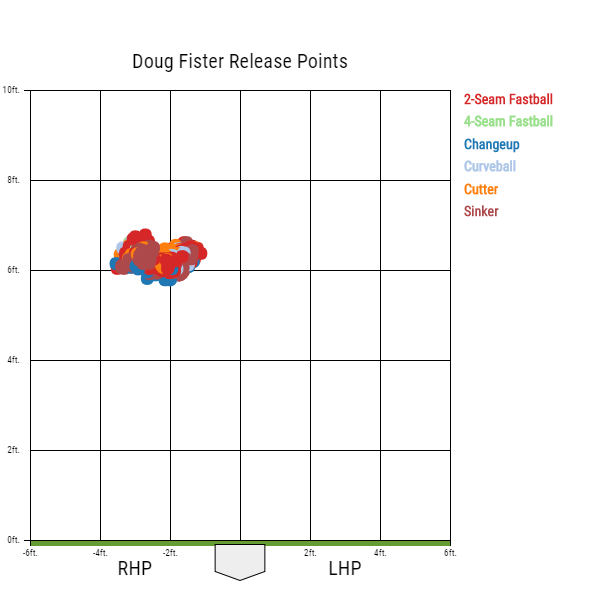
This is a fairly common phenomenon when looking at release point charts for pitchers. There are pitchers who have made adjustments on the rubber in-season -- shifting from first base side to third base side -- and so the release point cluster will shift along with it. Here's Doug Fister's release point chart. Like Meyer, Fister also moved from one side of the rubber to the other in-season.
-
You all keep this ship afloat. Great work.
-
The difference between the two is all in the swing plane. The top (recently added Jacob Pearson) has a more level swing plane than the bottom (Alex Kirilloff). The easiest way to spot the difference is based on how they finish. Pearson finishes his swing at the middle of his body while Kirilloff finishes up. Kirilloff's swing operates more like this... That uppercut motion will lead to more fly balls. If you look at the swings of the top 50 HR hitters in baseball today, their swing plans will follow closer to the example above. Pearson, on the other hand, has a more line drive oriented swing. This doesn't mean he *can't* hit home runs, it just means that when he does, it will likely be more of the line drive type whereas Kirilloff will have a higher percentage of fly balls. When you see this, you realize why Pearson, while almost the exact same size as Kirilloff (an inch shorter and ten pounds lighters according to their HS Perfect Game profiles) is considered to have "modest power potential" by Baseball America. It's entirely possible that Pearson tweaks his swing plane and adds more lift. It is also entirely possible that he stays the same, adds strength and deposits a few more liners than expected.
-
There's an actual difference between the two swings that should be telling to this. Gonna need to reach down deep and tap into your inner ball guy.
-
YOU BE THE SCOUT I posted this on my Twitter account yesterday. It's two swings from two different prospects shortly before they were drafted out of high school. Both players went to a short-season rookie ball league. One hit seven home runs that season. The other hit none. Based on this view of the swing, can you tell which player had home run capabilities and which one did not? https://twitter.com/ParkerHageman/status/938977484229500928 [NOTE: The answer is posted on my Twitter account but put your scout hat and polo on and see if you can make the call.]
-
Twins Hire Minor League Pitching Coordinator
Parker Hageman replied to Parker Hageman's topic in Twins Minor League Talk
It does happen from time-to-time. There are some people who have bounced between minor league player development roles and college coaching positions. Jeff Pickler was University of Arizona's assistant coach before landing a job with the Dodgers. I will add that Maki seems to be one of the few who did not have an extensive college career nor played affiliated baseball. That is a new twist. -
Twins Hire Minor League Pitching Coordinator
Parker Hageman replied to Parker Hageman's topic in Twins Minor League Talk
That's a good question. Maki played at Franklin & Marshall from 2001-2004, which is the same conference as Thad Levine/Jeremy Zoll's Haverford, but he was playing well after Levine and shortly before Zoll's time. Falvey was rostered on the Trinity (DIII) team roughly the same time as Maki (2002-2004) but it doesn't appear that the teams ever faced each other. By the time Maki was coaching at University of New Haven (2007), Falvey was scouting the Cape Cod League. It's possible they made some connection there. Another interesting note on Maki's background, before he landed he University of New Haven job, he interned for a local independent league team and tried to contact MLB teams for work but didn't get any offers. It was his former college coach (now coaching at Columbia) who helped get him a job at New Haven. Not long after that, that coach brought him on at Columbia. -
The Minnesota Twins reached into the collegiate ranks to find their next minor league pitching coordinator. According to D1Baseball.com's Aaron Fitt, the Twins have hired Duke Baseball's Pete Maki. Maki has an extensive college coaching background, first with the University of New Haven followed by eight years at Columbia University. He joined the Blue Devils program in 2015 and was reportedly instrumental in helping the team reach the College World Series Regionals after a 55-year drought for the school. In his time, Maki's staff recorded ERA of 3.29 in 2015, 3.83 in 2016, and 4.84 in 2017 in a very tough conference. Maki replaces Eric Rasmussen, who held the position for nine years before being fired in September. “I was blindsided,” Rasmussen told the News-Press's David Dorsey in September. “Right now, I’m looking forward to seeing what I’m going to do with my life. Looking backward doesn’t sit well with me right now. I felt like I did a pretty good job. There’s a new focus in the front office. Now they’re going to make changes and bring in their own people." There is not a lot available regarding Maki's methods or philosophies on pitching, but there is some insight to his practices on Facebook, such as making sure his pitchers retain athletic movements through fielding/throwing like an infielder.
-
Can Phil Hughes Surprise Us?
Parker Hageman replied to Nick Nelson's topic in Twins Daily Front Page News
Found this storyline interesting. Driveline Baseball spend time studying how to add and subtract spin rate. You can easily manipulate the ball to reduce spin rate. In there studies, there was no answer for how to increase spin rate -- with the exception of adding tact to the ball. From Kyle Boddy's interview with Baseball America last year... Now, maybe Hughes didn't mean "spin rate". Maybe he just meant spin, like a different movement out of his fastball instead of the times it rotated to the plate. Either way, his spin rate dropped some from 2016 to 2017. Bigger picture, what someone discovers what it takes to manipulate spin rate and add it to the fastball is going to be celebrated heavily. -
From The Handbook: Building On Buxton
Parker Hageman replied to Parker Hageman's topic in Twins Daily Front Page News
It is certainly possible. At the end of the year, to me, the data suggested we are seeing more "luck" -- hate calling it that but a lot of his additional hits this year were from grounders -- and health. Thread here if you are on twitter ---> https://twitter.com/ParkerHageman/status/911683284534464512 Two years ago Brunansky tried to get him to pull the ball more in spring training. He did try to pull the ball more throughout the season but most of it was on the ground. The problem is, when he pulls, he does so on the ground -- 83.2% of the time. This is why you saw teams setting their SS up the middle over the second base bag and 2B playing deep. This season he pulled the ball less and was able to find more hits on grounders as he sprayed them all over the infield. I don't know if Rowson had some influence and talked him into abandoning the notion that he show actively pull more, but that has been a noticeable difference for him.
