


Parker Hageman
-
Posts
4,162 -
Joined
-
Last visited
-
Days Won
6
Content Type
Profiles
Minnesota Twins News, Rumors & Analysis
Minnesota Twins Videos
2026 Minnesota Twins Top Prospect Rankings
2022 Minnesota Twins Draft Picks & Signing Bonuses
Minnesota Twins Trade & Free Agent Rumors
Minnesota Twins Fan Guides & Resources
2023 Minnesota Twins Draft Picks & Signing Bonuses
2024 Minnesota Twins Draft Picks & Signing Bonuses
2025 Minnesota Twins Draft Picks & Signing Bonuses
2026 Minnesota Twins Draft Picks & Signing Bonuses
Forums
Blogs
Events
Store
Downloads
Gallery
Everything posted by Parker Hageman
-
 Baseball Prospectus editor Aaron Gleeman asked me to participate in a conversation about the upcoming Minnesota Twins season and, to both of our surprise, it was very optimistic. (So much so that I'm now wondering what the hell is wrong with me.) Check out our expectations and feel free to share yours on this thread.
-
Launch Angles In The Outfield
Parker Hageman replied to Parker Hageman's topic in Twins Daily Front Page News
Absolutely. Pitchers have had much more success going upstairs with their fastball over hitting the lower part of the zone. In 2017, hitters posted a 729 OPS against fastballs in the upper third and a 837 OPS on fastballs in the lower third. Anthony Rizzo -- one of the best low fastball hitters -- batted .187 on fastballs up. Logan Morrison, big uppercut swing, hit .165. And so on. It's one of the reasons that Derek Falvey wants to have his pitchers throw the fastball up in the zone more. The Twins went from throwing fastballs up in the zone 28% of the time in 2016 (22nd) to 39% in 2017 (6th) in 2017. There's no question, particularly with the addition of Jake Odorizzi, that they will be throwing more fastballs up this season. -
Launch Angles In The Outfield
Parker Hageman replied to Parker Hageman's topic in Twins Daily Front Page News
You know one of the best ways to beat the shift? Hit it *over* the infield. But, to your point, I think the game will adapt when teams start placing a fourth outfield in the field when a hitter with extreme air splits comes up. Then you might see hitters adjusting to poking the ball to the open space. -
By now, you are probably sick of hearing the words “launch angle”. I assure you, you are not alone. But there is something we must discuss on this topic so stay with me. On a recent spring training broadcast Twins radio announcer Dan Gladden noted that more teams are “teaching launch angles”, which is true, but the practice has been out for several years. Some teams have reaped the benefits of elevating for several years. Now, however, the launch angle discussion is a widespread epidemic across the industry and there are, oddly, people taking exception to the movement. This is how baseball works: Several teams find an advantage in something different – be it infield shifts, outfield shifts, catchers with superior receiving skills, or having hitters focus on lifting the baseball – and, if that works, other teams quickly saturate that edge until it is simply the norm. Consider this, infield shifts are now commonplace across the board. This was once a practice that only a handful of forward-thinking teams would use sparingly. Eventually, even Ron Gardenhire started instituting the shift. Think about that. According to Fangraphs, in the 2008 season there were just 2,350 plate appearances where a traditional infield shift was used. This past season, the shift was used in 28,072 plate appearances. Everyone is getting shifted to some degree. If you show a tendency to hit a ground ball to a certain location, odds are a team will choke that space into nothingness. In 2017 hitters who put the ball on the ground had a batting average of .241. Meanwhile, hitters who put the ball in the air as a fly ball hit .251. Why is a higher launch angle so vital as well as such a wedge topic? In a recent Twin Cities Business article, Minnesota Twins’ Director of Analytics, Daniel Adler, put it succinctly. “The uppercut swing is like the three-point shot in the NBA,” he said. “When they go in, you get 50 percent more points. Fly-ball-based hits become home runs, which justify [a swing that gives up the opportunity for] ground-ball-based hits.” It is impossible to defend the long ball. More long balls is better. Ipso facto, it is beneficial to have your hitters hit more long balls. (And that’s even before you consider MLB has introduced a juiced ball to the game.) In short, there’s so much more value to be had by putting the ball in the air versus putting it on the ground – even with the added risk of striking out. Teams are beginning to understand that. Nevertheless, some baseball purists may argue that they don’t care to see contact sacrificed in the name of offense. Some would prefer to see a well-placed grounder through the right side of the infield to move a runner up a base. While this may hinder some fans viewing experience, the game is clearly trending in the direction of elevation. Given that more teams have observed this value and have more players, like Justin Turner and Josh Donaldson touting its merits to teammates, it’s no surprise to see the concepts are catching on with others. For instance Turner’s teammate catcher Yasmani Grandal spent the offseason trying to gain more lift. "If I just took 50 ground balls out of the equation, that could give me the opportunity to be great in this game," he told the LA Times. Grandal has already shown some power so why would he risk more strikeouts for more fly balls? “[Y]ou still come to the conclusion that you're still not the best in the game," he said, "so why not try to make a change to hopefully be the best?” Grandal is not alone. The Braves’ Christian Colon has been working on it. Mets center field Juan Lagares spent the offseason working on increasing his launch angle. The entire Nationals team is jumping on board. On the other end of the spectrum you have guys like Cleveland’s Jason Kipnis and the Twins’ Max Kepler. Kipnis recently hit a ton of home runs in a spring game and was asked if he changed anything. "If you ever hear me say the words, 'launch angle' or anything like that, I'm lying right to your face," Kipnis told reporters. "That's not anything I've ever worked on or cared about. I work on hitting the ball hard where it's pitched and staying balanced and on time.” Kepler echoed Kipnis’s thoughts. “For me it’s not about launch angle,” Kepler said. “It’s about getting my bat head in the zone as early as possible. I used to enter straight down. Now I’m just trying to enter more on a level path, but I’ve still got my hands going a similar route.” While they don’t have to care about launch angle, launch angle is happening whether they care or not. Launch angle is like velocity, it’s always happening (unless, of course, you swing and miss). In Kepler's case, he has actually increased his launch angle from 2016 to 2017 more than anyone on the Twins' roster (outside of Eduardo Escobar, who not coincidentally, hit a career high home runs in 2017). To Kepler's point, he doesn't have to worry about launch angles or even have the word pass through his earholes if he doesn't want them to. He only needs to keep trending the direction he has -- a higher average launch angle -- and that can be achieved, as he said, by getting the bat in the zone earlier and on plane with the pitch. Then there is the confused Justin Upton. In a recent interview with Fangraphs, Upton said “I don’t try to hit the ball in the air. To be brutally honest with you, I’ve never in my career tried to hit the ball in the air. I’ve always tried to hit line drives, and if you just miss a line drive it becomes a deep fly ball.” This is where the misunderstanding comes in. Most people hear about increasing launch angles and fly ball revolution and assume it means taking a home run derby g-hack. Getting the ball in the air is not just about deep fly balls. It’s about keeping it off the ground. Line drives, by the way, are hit in the air. Don’t you want to hit more line drives? Despite his argument to the contrary, Justin Upton is very much trying to hit the ball in the air. Here’s the dirty secret: You don’t necessarily have to have an uppercut swing in order to increase your launch angle. Yes, long flies equal power but long line drives are just as potent. Getting the ball in the air is about the point of contact, both on the ball and where in relation to the plate. For Turner, who was trying to hit few ground balls, he was focused on where he was hitting the ball. “If you hit down on the ball and hit the top of the ball, you’re still hitting a ground ball. If you hit the center of the ball, the margin of error is so tiny to create backspin, you have to really, really good to do that. That’s where this new swing plane comes in. This loftier swing plane makes it a lot easier to hit the bottom of the ball,” Turner said. https://twitter.com/CoachLisle/status/770591991793090560/photo/1 The second part is about being able to add lift is where the contact in relationship to the plate. Turner said he was trying to attack the ball – catching it out front, in the parlance -- rather than letting it travel deep. When you let it travel too much, the contact point often results in ground balls. Over the last two years, Joe Mauer has had a 4.3 degree launch angle – one of the lowest in the game. Part of that is due to his approach of letting the ball travel in the zone before making late contact. For Mauer, that is by design. He’s trying to shoot the ball the other way or up the middle. He rarely pulls the ball because of this. https://twitter.com/ParkerHageman/status/968666007580573696 Twins’ Derek Falvey recently discussed hitting with the Star Tribune and he brought up a key aspect about training – the notion of internal versus external cueing. External cueing is the practice of telling a hitter to swing with an uppercut to hit the ball in the air more versus internal cueing which sets up various practice methods in order to a hitter to achieve the intended results on their own. For instance, what the Rays recently did by placing screens across the infield is a form of internal cueing. Hitters will have to adjust their swing to achieve the desired results of adding lift. A person has a better chance of success if you provide them with activities that will force the person to accomplish the intended goal – just like how Kris Bryant’s father had him aim for targets up on the top of the batting cage in order to create an uppercut swing path. These practices lead to more balls in the air and thus a higher launch angle. An uppercut swing will certainly lead to more bottom ball contact but it isn’t a prerequisite. Hitters can be trained without even knowing they are training. Bottom line: Hit it in the air. Image courtesy of Adam Hunger-USA TODAY Sports View full article
-
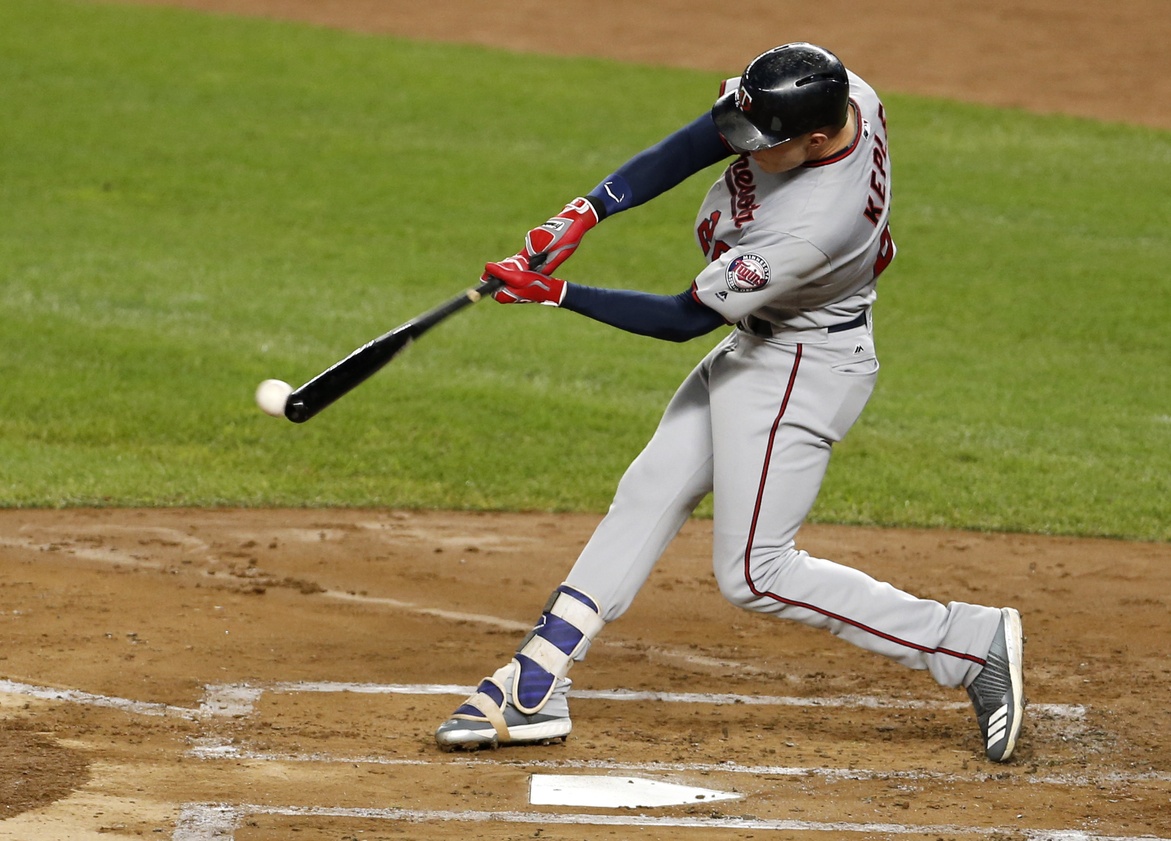 This is how baseball works: Several teams find an advantage in something different – be it infield shifts, outfield shifts, catchers with superior receiving skills, or having hitters focus on lifting the baseball – and, if that works, other teams quickly saturate that edge until it is simply the norm. Consider this, infield shifts are now commonplace across the board. This was once a practice that only a handful of forward-thinking teams would use sparingly. Eventually, even Ron Gardenhire started instituting the shift. Think about that. According to Fangraphs, in the 2008 season there were just 2,350 plate appearances where a traditional infield shift was used. This past season, the shift was used in 28,072 plate appearances. Everyone is getting shifted to some degree. If you show a tendency to hit a ground ball to a certain location, odds are a team will choke that space into nothingness. In 2017 hitters who put the ball on the ground had a batting average of .241. Meanwhile, hitters who put the ball in the air as a fly ball hit .251. Why is a higher launch angle so vital as well as such a wedge topic? In a recent Twin Cities Business article, Minnesota Twins’ Director of Analytics, Daniel Adler, put it succinctly. “The uppercut swing is like the three-point shot in the NBA,” he said. “When they go in, you get 50 percent more points. Fly-ball-based hits become home runs, which justify [a swing that gives up the opportunity for] ground-ball-based hits.” It is impossible to defend the long ball. More long balls is better. Ipso facto, it is beneficial to have your hitters hit more long balls. (And that’s even before you consider MLB has introduced a juiced ball to the game.) In short, there’s so much more value to be had by putting the ball in the air versus putting it on the ground – even with the added risk of striking out. Teams are beginning to understand that. Nevertheless, some baseball purists may argue that they don’t care to see contact sacrificed in the name of offense. Some would prefer to see a well-placed grounder through the right side of the infield to move a runner up a base. While this may hinder some fans viewing experience, the game is clearly trending in the direction of elevation. Given that more teams have observed this value and have more players, like Justin Turner and Josh Donaldson touting its merits to teammates, it’s no surprise to see the concepts are catching on with others. For instance Turner’s teammate catcher Yasmani Grandal spent the offseason trying to gain more lift. "If I just took 50 ground balls out of the equation, that could give me the opportunity to be great in this game," he told the LA Times. Grandal has already shown some power so why would he risk more strikeouts for more fly balls? “[Y]ou still come to the conclusion that you're still not the best in the game," he said, "so why not try to make a change to hopefully be the best?” Grandal is not alone. The Braves’ Christian Colon has been working on it. Mets center field Juan Lagares spent the offseason working on increasing his launch angle. The entire Nationals team is jumping on board. On the other end of the spectrum you have guys like Cleveland’s Jason Kipnis and the Twins’ Max Kepler. Kipnis recently hit a ton of home runs in a spring game and was asked if he changed anything. "If you ever hear me say the words, 'launch angle' or anything like that, I'm lying right to your face," Kipnis told reporters. "That's not anything I've ever worked on or cared about. I work on hitting the ball hard where it's pitched and staying balanced and on time.” Kepler echoed Kipnis’s thoughts. “For me it’s not about launch angle,” Kepler said. “It’s about getting my bat head in the zone as early as possible. I used to enter straight down. Now I’m just trying to enter more on a level path, but I’ve still got my hands going a similar route.” While they don’t have to care about launch angle, launch angle is happening whether they care or not. Launch angle is like velocity, it’s always happening (unless, of course, you swing and miss). In Kepler's case, he has actually increased his launch angle from 2016 to 2017 more than anyone on the Twins' roster (outside of Eduardo Escobar, who not coincidentally, hit a career high home runs in 2017). To Kepler's point, he doesn't have to worry about launch angles or even have the word pass through his earholes if he doesn't want them to. He only needs to keep trending the direction he has -- a higher average launch angle -- and that can be achieved, as he said, by getting the bat in the zone earlier and on plane with the pitch. Then there is the confused Justin Upton. In a recent interview with Fangraphs, Upton said “I don’t try to hit the ball in the air. To be brutally honest with you, I’ve never in my career tried to hit the ball in the air. I’ve always tried to hit line drives, and if you just miss a line drive it becomes a deep fly ball.” This is where the misunderstanding comes in. Most people hear about increasing launch angles and fly ball revolution and assume it means taking a home run derby g-hack. Getting the ball in the air is not just about deep fly balls. It’s about keeping it off the ground. Line drives, by the way, are hit in the air. Don’t you want to hit more line drives? Despite his argument to the contrary, Justin Upton is very much trying to hit the ball in the air. Here’s the dirty secret: You don’t necessarily have to have an uppercut swing in order to increase your launch angle. Yes, long flies equal power but long line drives are just as potent. Getting the ball in the air is about the point of contact, both on the ball and where in relation to the plate. For Turner, who was trying to hit few ground balls, he was focused on where he was hitting the ball. “If you hit down on the ball and hit the top of the ball, you’re still hitting a ground ball. If you hit the center of the ball, the margin of error is so tiny to create backspin, you have to really, really good to do that. That’s where this new swing plane comes in. This loftier swing plane makes it a lot easier to hit the bottom of the ball,” Turner said. https://twitter.com/CoachLisle/status/770591991793090560/photo/1 The second part is about being able to add lift is where the contact in relationship to the plate. Turner said he was trying to attack the ball – catching it out front, in the parlance -- rather than letting it travel deep. When you let it travel too much, the contact point often results in ground balls. Over the last two years, Joe Mauer has had a 4.3 degree launch angle – one of the lowest in the game. Part of that is due to his approach of letting the ball travel in the zone before making late contact. For Mauer, that is by design. He’s trying to shoot the ball the other way or up the middle. He rarely pulls the ball because of this. https://twitter.com/ParkerHageman/status/968666007580573696 Twins’ Derek Falvey recently discussed hitting with the Star Tribune and he brought up a key aspect about training – the notion of internal versus external cueing. External cueing is the practice of telling a hitter to swing with an uppercut to hit the ball in the air more versus internal cueing which sets up various practice methods in order to a hitter to achieve the intended results on their own. For instance, what the Rays recently did by placing screens across the infield is a form of internal cueing. Hitters will have to adjust their swing to achieve the desired results of adding lift. A person has a better chance of success if you provide them with activities that will force the person to accomplish the intended goal – just like how Kris Bryant’s father had him aim for targets up on the top of the batting cage in order to create an uppercut swing path. These practices lead to more balls in the air and thus a higher launch angle. An uppercut swing will certainly lead to more bottom ball contact but it isn’t a prerequisite. Hitters can be trained without even knowing they are training. Bottom line: Hit it in the air.
-
Why Do We Care About Launch Angle?
Parker Hageman commented on Parker Hageman's blog entry in Baseball Good
The concept is about keeping the ball off the ground. There are five defenders in the infield. There are only three in the outfield. Line drives are off the ground. Increasing launch angle is not just about trying to hit tanks into the second deck with every swing. It is for some players but not all. It is about putting the best swing on the ball to maximize the line drives and long flies (go back to what Justin Upton said -- he said he isn't *trying* to hit long flies but often that is the result for his swing). To your point about it not being for everybody, that's true to some degree. The issue I see however is that too many coaches and evaluators profile kids based on size and speed assuming the player can't drive the ball and that their best option is to hit the ball into the ground. It's easier to tell them just to make contact versus teaching them to move properly. But you look at the undersized players in the league -- the Jose Altuves, the Dustin Pedroias, the Scooter Gennetts, the Brian Doziers -- these guys were all trained at some point just to make contact and shoot the ball the other way. As was the case with Dozier, he had to battle most of the coaching staff in the minor leagues to hit the way he does now. I don't think anybody would want him to go away from hitting the ball in the air. https://twitter.com/108_Performance/status/962676743730589705 Last, the notion of "working the count" is also becoming a thing of the past. More teams are now recognizing the value in jumping on that first pitch fastball or first pitch strike versus being behind in the count. First pitch swings are up to nearly 29% after being at 26% in 2010. I always like to look at teams like the Rays to see if there is any sizeable shift in their approach -- which is usually fueled by some form of analytics -- and in this case, they have radically embraced swinging early in the count. In 2013 they were at 27% and middle of the pack in comparison to the rest of MLB. This year they led baseball with a 37% first-pitch swinging rate. If the first pitch of the at-bat was a fastball in the strike zone, the Rays swung 52% of the time (the rest of the league swung just 43% of the time). They were also the fourth highest (behind Houston, Cubs and Texas) when it came to hitting home runs on first pitch fastballs in the strike zone. So this was clearly by design. I don't know if that quite addresses your question on that topic but it does show how much the game is shifting. -
I mean, Mariano Rivera threw the exact same pitch for 20 years. But the idea of sequencing is huge. He can set that pitch up with one of three pitches he uses effectively -- including his outstanding curveball and change. Check out this sequence of 2 straight curveballs and then a backdoor two-seamer.
-
Topkin: Jose De Leon to have Tommy John surgery
Parker Hageman replied to Seth Stohs's topic in Other Baseball
The interesting angle to me is that while this trade was being considered, it was at a time when Josh Kalk, who is being touted as an analytics pitching guru, was with the Rays. Presumably, he and his team review all facets of DeLeon and signed off on this deal. This goes to show that no matter how advanced the data and analytics teams might be, it's still not going to keep pitchers from breaking down. Obviously there are a lot of things to consider about this. It's possible that Kalk and his team spotted flaws and risk potential but decided to green light it based on the low cost. Perhaps they figured even if he does have injuries, he'd still be able to provide value after recovery. It might be worth a Logan Forsyth but not a Brian Dozier. Lots of factors in the decision-making process for the Rays. -
Why Do We Care About Launch Angle?
Parker Hageman commented on Parker Hageman's blog entry in Baseball Good
Getting the bottom of the baseball has been around for a long time. The biggest different is the terminology and the ability to measure it. -
By now, you are probably sick of hearing the words “launch angle”. I assure you, you are not alone. On a recent spring training broadcast, Twins radio announcer Dan Gladden noted that more teams are “teaching launch angles” but the practice has been out for several years. However, you know if Gladden is talking about it then the concept has certainly gone mainstream. This is how baseball works: Several teams find an advantage in something different – be it infield shifts, outfield shifts, catchers with superior receiving skills, or having hitters focus on lifting the baseball – and, if that works, other teams quickly saturate that edge until it is simply the norm. Consider this, infield shifts are now commonplace across the board. This was once a practice that only a handful of forward-thinking teams would use sparingly. Eventually, even Ron Gardenhire started instituting the shift. Think about that. According to Fangraphs, in the 2008 season there were just 2,350 plate appearances where a traditional infield shift was used. This past season, the shift was used in 28,072 plate appearances. Everyone is getting shifted to some degree. If you show a tendency to hit a ground ball to a certain location, odds are a team will choke that space into nothingness. In 2017 hitters who put the ball on the ground had a batting average of .241. Meanwhile, hitters who put the ball in the air as a fly ball hit .251. Why is a higher launch angle so vital as well as such a wedge topic? In a recent Twin Cities Business article, Minnesota Twins’ Director of Analytics, Daniel Adler, put it succinctly. “The uppercut swing is like the three-point shot in the NBA,” he said. “When they go in, you get 50 percent more points. Fly-ball-based hits become home runs, which justify [a swing that gives up the opportunity for] ground-ball-based hits.” It is impossible to defend the long ball. More long balls is better. Ipso facto, it is beneficial to have your hitters hit more long balls. (And that’s even before you consider MLB has introduced a juiced ball to the game.) In short, there’s so much more value to be had by putting the ball in the air versus putting it on the ground – even with the added risk of striking out. Teams are beginning to understand that. At the same time, baseball purists may argue that they don’t care to see contact sacrificed in the name of offense. Some would prefer to see a well-placed grounder through the right side of the infield to move a runner up a base. While this may hinder some fans viewing experience, the game is clearly trending that direction. Given that more teams have observed this value and have more players, like Justin Turner and Josh Donaldson touting its merits to teammates, it’s no surprise to see the concepts are catching on with others. Turner’s teammate catcher Yasmani Grandal spent the offseason trying to gain more lift. "If I just took 50 ground balls out of the equation, that could give me the opportunity to be great in this game," he told the LA Times. Grandal has already shown some power so why would he risk more strikeouts for more fly balls? “[Y]ou still come to the conclusion that you're still not the best in the game," he said, "so why not try to make a change to hopefully be the best?” Grandal is not alone. The Braves’ Christian Colon has been working on it. Mets center field Juan Lagares spent the offseason working on increasing his launch angle. The entire Nationals team is jumping on board. On the other end of the spectrum you have guys like Cleveland’s Jason Kipnis and the Twins’ Max Kepler. Kipnis recently hit a ton of home runs in a spring game and was asked if he changed anything. "If you ever hear me say the words, 'launch angle' or anything like that, I'm lying right to your face," Kipnis told reporters. "That's not anything I've ever worked on or cared about. I work on hitting the ball hard where it's pitched and staying balanced and on time.” Kepler echoed Kipnis’s thoughts. “For me it’s not about launch angle,” Kepler said. “It’s about getting my bat head in the zone as early as possible. I used to enter straight down. Now I’m just trying to enter more on a level path, but I’ve still got my hands going a similar route.” While they don’t have to care about launch angle, launch angle is happening whether they care or not. Launch angle is like velocity, it’s always happening (unless, of course, you swing and miss). Then there is the confused Justin Upton. In a recent interview with Fangraphs, Upton said “I don’t try to hit the ball in the air. To be brutally honest with you, I’ve never in my career tried to hit the ball in the air. I’ve always tried to hit line drives, and if you just miss a line drive it becomes a deep fly ball.” This is where the misunderstanding comes in. Most people hear about increasing launch angles and fly ball revolution and assume it means taking a home run derby g-hack. Getting the ball in the air is not just about deep fly balls. It’s about keeping it off the ground. Line drives, by the way, are hit in the air. Don’t you want to hit more line drives? Despite his argument to the contrary, Justin Upton is very much trying to hit the ball in the air. Here’s the dirty secret: You don’t necessarily have to have an uppercut swing in order to increase your launch angle. Yes, long flies equal power but long line drives are just as potent. Getting the ball in the air is about the point of contact, both on the ball and where in relation to the plate. For Turner, who was trying to hit few ground balls, he was focused on where he was hitting the ball. “If you hit down on the ball and hit the top of the ball, you’re still hitting a ground ball. If you hit the center of the ball, the margin of error is so tiny to create backspin, you have to really, really good to do that. That’s where this new swing plane comes in. This loftier swing plane makes it a lot easier to hit the bottom of the ball,” Turner said. The second part is about being able to add lift is where the contact in relationship to the plate. Turner said he was trying to attack the ball – catching it out front, in the parlance -- rather than letting it travel deep. When you let it travel too much, the contact point often results in ground balls. Over the last two years, Joe Mauer has had a 4.3 degree launch angle – one of the lowest in the game. Part of that is due to his approach of letting the ball travel in the zone before making late contact. For Mauer, that is by design. He’s trying to shoot the ball the other way or up the middle. He rarely pulls the ball because of this. https://twitter.com/ParkerHageman/status/968666007580573696 Twins’ Derek Falvey recently discussed hitting with the Star Tribune and he brought up a key aspect about training – the notion of internal versus external cueing. External cueing is the practice of telling a hitter to swing with an uppercut to hit the ball in the air more versus internal cueing which sets up various practice methods in order to a hitter to incorporate those methods on their own. For instance, what the Rays recently did by placing screens across the infield is a form of internal cueing. Hitters will have to adjust their swing to achieve the desired results of adding lift. A person has a better chance of success if you provide them with activities that will force the person to accomplish the intended goal – just like how Kris Bryant’s father had him aim for targets up on the top of the batting cage in order to create an uppercut swing path. These practices lead to more balls in the air and thus a higher launch angle. An uppercut swing will certainly led to more bottom ball contact but it isn’t a prerequisite. Hitters can be trained without even knowing they are training. Bottom line: Hit it in the air.
-
Absolutely. The amount of information and insight that is available to today's pitchers is amazing. When I was in high school in the late 1990s, I was more or less self-taught. I picked up a copy of Tom House's The Pitching Edge and used that as my reference point of almost everything (which was both good and bad). As far as learning new pitches, it was something that spread word-of-mouth. A coach would try to teach you something, or a dad or a teammate goofing around. There was a guy in my high school who graduated and was drafted by the Marlins a few years ahead of me. He came back to our school for winter workouts and tried to teach the pitchers how to throw sliders. His cue was "throw one half of the ball away" while you were throwing. I don't think any of us wound up with a killer slider from that instruction. I learned how to throw a breaking ball by trial and error. Now, with the amount of high resolution/slo-mo video available of a ball leaving a pitcher's hand, I realize now how wrong my release actual was.
-
More or less what Gil4 said. When it comes to throwing a cutter, the pressure on the middle finger is emphasized vs the index finger, as with McCullers. Notably, too, is that most cutters are thrown with a modified four-seam grip or along the horseshoe of the baseball. Here is Kenley Jansen talking about his grip: And, of course, perhaps the Godfather of the Cutter, Mariano Rivera: Now, Dan Warthen of the New York Mets and purveyor of the Warthen Slider, has taught his pitchers a variation of the slider/cutter combo referred to as a slutter in which the pitcher's thumb is moved similarly to how McCullers throws his new two-seamer, giving it a better whip-action out of the hand.
- 11 comments
-
- 1
-

-
- pitch gripslance mccullers
- pitchingninja
- (and 2 more)
-
And people wonder why strikeouts are going up.
- 11 comments
-
- 2
-
-
- pitch gripslance mccullers
- pitchingninja
- (and 2 more)
-
If anyone has been following this thread, I'm sliding my entries over to the blog section. I feel like there is not as much community interaction I was hoping for here and the blogs will be able to make it easier to go to the newest topic without having to dig through six pages of this thread. You can read the inaugural entry on Lance McCullers two-seamer here: http://twinsdaily.com/blog/992/entry-9340-improving-your-two-seamer/
-
Here's a great piece of advice from a professional player for pitchers trying to learn or coaches trying to teach players to throw a better two-seam fastball. Houston Astros' pitcher Lance McCullers Jr, who recently diced the Twins lineup in spring training action, has incorporated a new grip on his two-seam fastball that is giving him (so far anyways) superior movement over his two-seamer a year ago. I mean, just watch this unfair action he dumped on the poor, unsuspecting Ehire Adrianza. That's some filth flarn filth. Fortunately for us, McCullers created a video breakdown of what he is doing differently when he grips the ball. The essential takeaway is that (1) McCullers is now tucking his thumb under the ball and (2) placing his index finger on the seam move and using that to generate the push, helping create the spin necessary to dive back across the zone. In short, McCullers is trying to achieve laminar flow to create the nasty movement we see above. For further background on this concept, be sure to watch Cleveland's Trevor Bauer . McCullers was asked on Twitter if pitchers are constantly tinkering with their grips throughout the season. "As easy as that would seem, we only get so many throws in season to work on our stuff," McCullers responded. "That time is usually trying to improve on what you already know. Trying a new grip and pitch takes time and reps only the offseason can really provide." For more pitching insight, be sure to follow Pitching Ninja on Twitter.
- 11 comments
-
- 1
-
-
- pitch gripslance mccullers
- pitchingninja
- (and 2 more)
-
Trevor May also took up Pilates. That...well, that didn't lead to a breakout year.
-
Care to elaborate on that?
-
GET SOME SLEEP! All you high school and college players reading this, do yourself a favor and get more sleep. Student-athletes can be run ragged during the school year, with early classes and pre-school workouts, but make sure you get a solid seven-to-eight hours a night. One of the hotter topics coming out of camps this spring has been teams altering their workout schedules in order to optimize the recovery times and improve learning retention. And the data behind it shows it can do The Cardinals are one such example highlighted at MLB.com: The Kansas City Royals were another such club to introduce a later start time to their camp. The science behind it is to be able to retain things learned and help commit it to muscle memory more efficiently. While additional sleep can help the body recover quicker, sleep has also been shown to help in other areas on the field. One such 2013 study theorized that the reason hitters tended to chase more pitches outside of the strike zone as the season progressed was that they would be getting less and less sleep due to the rigorous schedule. More sleep would give a player an improved comprehension of the strike zone. Along the same line, a 2017 study found that players who received one additional hour of sleep per night for a five-night cycle have a better reaction time. Results show that after five nights of sleep extension, professional baseball players from an MLB organization demonstrated a 13-percent improvement on a cognitive processing speed test by reacting 122 milliseconds faster. They also responded 66 milliseconds faster on a test of selective attention when confronted with distractors. According to the authors, a fastball takes approximately 400 milliseconds to travel from the pitcher to the hitter, requiring batters to have optimal visual search strategies to distinguish and react to different types of pitches. Think about that. It's a built-in advantage for you at the plate to have a split-second more time to react to a pitch. It's one of the easiest and cheapest performance-enhancing drug out there. Yet another study found that getting more sleep can lead to longer careers. Those players who struggled to get the prerequisite shuteye found themselves out of the game sooner than those with an abundance of rest -- presumably because they let their plate discipline and reaction time slip from lack of sleep. Coaches can aid in this process as well. In Major League spring training, workouts are pushed back. In-season, teams make efforts to allow for additional sleep. Instead of arriving at 11 AM for a 7:05 PM after a cross-country flight, Cubs' manager Joe Maddon has instituted "American Legion Week". When enacted, Maddon orders his players to stay away from the ballpark until an hour before the game, opting for rest versus batting practice, going so far as saying pre-game BP is overrated (more on that at a later date). This is not a new revelation at all. Scientists have been studying the effect of sleep on the human body for years. As disinterested as they seem in the health of their players' brains at times, the NFL has been at the forefront of implementing sleep regulations. MLB teams, on the other hand, has been slower to embrace the science. While one football game can be more physically taxing, Major League Baseball's arduous schedule and cross-country travel can chip away at the sleeping habits of its workers more so that football. As the NFL study found, if players continually get four hours of sleep or less in a cycle, it's the equivalent of aging yourself 11 years. All this being said -- if it is good enough for professional athletes, it certainly would behoove you to try to get more rest.

-
Once a fast-rising, hard-throwing reliever in the system, JT Chargois was limited to two outings in 2017 and was later diagnosed with a stress reaction in his elbow. Chargois, who had his UCL surgically repaired in 2013, has been slow to recover from the latest injury. According to the Pioneer Press's Mike Berardino, the Twins may be attempting to clear him through waivers, removing him from the 40-man roster and reassigning him to Rochester. Chargois has spent the offseason working out but there has been little update on his throwing program. It's possible that, given his status, he will sneak through and be able to recover and rebuild in the organization. UPDATE: The Twins lose Chargois on the waviers to the Los Angeles Dodgers.
-
Twins Daily 2018 Top Prospects: #1 Royce Lewis
Parker Hageman replied to Nick Nelson's topic in Twins Daily Front Page News
The reality is, everyone is on social media platforms. My understanding is that they liked that Lewis stayed away from it. -
Twins Daily 2018 Top Prospects: #1 Royce Lewis
Parker Hageman replied to Nick Nelson's topic in Twins Daily Front Page News
One of the things the Cubs did when Epstein took over was to instruct their scouting staff to find not only high caliber players but HIGH CHARACTER players as well when they were drafting. From the NY Times: I can't help but think about this when considering Royce Lewis. The Twins' decision to select Lewis over the higher profile Hunter Greene may come down to just that. Insiders say the Twins staff preferred Lewis' makeup to Greene's, citing Lewis' lack of social media presence, staying a safe distance out of the limelight, and a solid family life. There is probably more details behind that selection (after all, the Twins went heavier into the analytics side of the draft than they ever did before). This isn't to say Greene lacks character (he is highly involved in charity work already), but there was something about Lewis that separated him from Greene. -
Getting Rid Of The Bad Odor Might Be Izzi
Parker Hageman replied to Cody Christie's topic in Twins Daily Front Page News
While I agree with a lot of what is being said here, statistically speaking, there is little upgrade to be had between the Twins OF defense and the Rays, after all, the Rays had the second best defensive unit in baseball last year. According to Runs Saved, the Rays were the 2nd best outfield unit (45 RS) and the Twins were 4th (23 RS). Rays' center fielder Kevin Keirmaier had 22 RS while Buxton had 24. While I do think Buxton is a superior defender the difference is not that significant, I don't see this moving the needle in anyway for Odorizzi. -
Yeah, again, it's a common mistake because of the movement, but there's no grip evidence that he throws a splitter (unlike Odorizzi). And part of the reason I brought it up in the comments section was because I noticed Rhett and Aaron's articles citing that as such. As a background: MLB's pitchfx data uploads into a raw format without any cleaning and labels a lot of his pitches as a splitter based on algorithms on those movement metrics (which is why BaseballSavant.com's data has him throwing a splitter instead of a changeup). I would guess Rhett Bollinger simply looked there for information (or maybe some other MLB database) which carries the raw pitch data. When the Twins first signed him I initially went there and assumed he threw a split-change. Places like BrooksBaseball.com (and Baseball Prospectus) employ methods to clean it up to ensure pitches are categorized accurately. Those guys actually go through images and get confirmation on what type of pitch each pitcher has before categorizing them. It's the nerdiest of baseball data nerd stuff. So when you look at Fangraphs' "Pitch Info Pitch Type" section under a player's page, that's the data that has been scrubbed. Pitch Info is the group that runs Brooks Baseball. Under the generic Pitch Type section for Sanchez and Odorizzi, it has both pitchers throwing Changeups and no Splitters. However, snce Pitch Info knows Odorizzi throws his with a split grip, they have moved those pitches to the Split Fastball category. It's splitting hairs at this point (pun intending) because if you get the same movement regardless of the grip, should the pitch be categorized by the movement or the grip?
-
Will the Real Kyle Gibson Please Stand Up?
Parker Hageman commented on Jamie Cameron's blog entry in Curveball Blog
Excellent write-up. I also want to stress how good Gibson's slider was last year. https://twitter.com/ParkerHageman/status/952241529745231872 -
Just a point of clarification: Sanchez does not throw a splitter or a split change. He has a circle grip that moves more similarly to a splitter movement -- which is probably why Fangraphs has it quantified as such.