



Nick Nelson
-
Posts
8,372 -
Joined
-
Last visited
-
Days Won
56
Content Type
Profiles
Minnesota Twins News, Rumors & Analysis
Minnesota Twins Videos
2026 Minnesota Twins Top Prospect Rankings
2022 Minnesota Twins Draft Picks & Signing Bonuses
Minnesota Twins Trade & Free Agent Rumors
Minnesota Twins Fan Guides & Resources
2023 Minnesota Twins Draft Picks & Signing Bonuses
The Minnesota Twins Players Project
2024 Minnesota Twins Draft Picks & Signing Bonuses
2025 Minnesota Twins Draft Picks & Signing Bonuses
2026 Minnesota Twins Draft Picks & Signing Bonuses
Forums
Blogs
Events
Store
Downloads
Gallery
Everything posted by Nick Nelson
-
It was fairly evident in spring training that the Twins might have some issues this year with right-handers in the bullpen. Rolling into the season with a declining Casey Fien, a mediocre Blaine Boyer and a handful of unproven youngsters, the unit lacked reliable options. Indeed, righty relief has been a persistent problem for Minnesota, and the team made a deadline move to address it with the acquisition of Kevin Jepsen. Yet, the most impactful addition to the bullpen has come from the inside. Trevor May has been a monster in his new role. Image courtesy of Brooks Baseball It was fairly evident in spring training that the Twins might have some issues this year with right-handers in the bullpen. Rolling into the season with a declining Casey Fien, a mediocre Blaine Boyer and a handful of unproven youngsters, the unit lacked reliable options. Indeed, righty relief has been a persistent problem for Minnesota, and the team made a deadline move to address it with the acquisition of Kevin Jepsen. Yet, the most impactful addition to the bullpen has come from the inside. Trevor May has been a monster in his new role. The above graph from Brooks Baseball provides a visualization of May's pitch velocities over the course of the 2015 season. You can see that since the 25-year-old switched gigs upon Ervin Santana's early-July return to the rotation, he's added substantial heat to each of his offerings – most notably the fastball, which has recently been sizzling in at more than 95 MPH. The increased gas has unsurprisingly coincided with heightened effectiveness for all of May's pitches, and that has been reflected in his results. Over the past calendar month, he has made 12 relief appearances and hasn't allowed a single run. The only damage that's been dealt against the righty during that span was in a spot start against Cleveland, when he gave up a couple runs in three innings. Every time May trots out to the mound in the late innings, he looks more and more comfortable. His numbers are growing increasingly dominant as he acclimates to his new duties. Here in August, he has faced 33 batters as a reliever and allowed only five hits, with 13 strikeouts and one walk. It's becoming quite clear that May is one of those starting pitchers that uncovers a new level of performance pitching in shorter stints. Such players are not all that rare. Kansas City's Wade Davis is a familiar example. But of course, Davis had exhausted his opportunities as a starter, delivering 64 starts worth of mediocrity in Tampa before the Rays finally decided to try him in the pen. That hasn't been the case for May. Most would agree that his demotion was undeserved, and you can make a pretty good argument that he's pitched better as a starter this year than anyone currently in the rotation. And so the Twins face an interesting conundrum going forward. Right-handed relief will probably still be a prioritized need in the offseason as they gear up for true contention efforts in 2016, and May is looking like their best bet. He has the makings of a lights-out setup guy in front of Glen Perkins. Meanwhile, the rotation is already shaping up to be a bit crowded with Ervin Santana, Phil Hughes, Ricky Nolasco, Kyle Gibson, Jose Berrios, Tyler Duffey and maybe Tommy Milone all in play. As is always the case, May can be a far more valuable player as a quality starter than as an excellent reliever. It seems ridiculous to give up on his arm in a role where it can make a far greater impact, and it also seems quite unfair to him. He'd prefer to start and has done nothing to forfeit that chance other than pitching his ass off in relief. But with all things considered, one can see the appeal of committing to him as a late-inning weapon and dramatically lessening some of the club's ongoing bullpen concerns. What say you? View full article
-
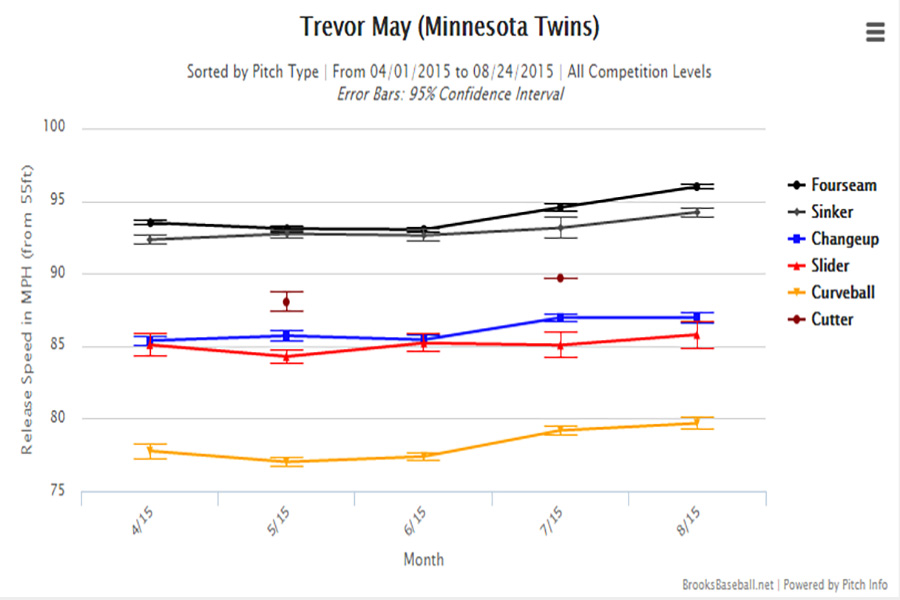 The above graph from Brooks Baseball provides a visualization of May's pitch velocities over the course of the 2015 season. You can see that since the 25-year-old switched gigs upon Ervin Santana's early-July return to the rotation, he's added substantial heat to each of his offerings – most notably the fastball, which has recently been sizzling in at more than 95 MPH. The increased gas has unsurprisingly coincided with heightened effectiveness for all of May's pitches, and that has been reflected in his results. Over the past calendar month, he has made 12 relief appearances and hasn't allowed a single run. The only damage that's been dealt against the righty during that span was in a spot start against Cleveland, when he gave up a couple runs in three innings. Every time May trots out to the mound in the late innings, he looks more and more comfortable. His numbers are growing increasingly dominant as he acclimates to his new duties. Here in August, he has faced 33 batters as a reliever and allowed only five hits, with 13 strikeouts and one walk. It's becoming quite clear that May is one of those starting pitchers that uncovers a new level of performance pitching in shorter stints. Such players are not all that rare. Kansas City's Wade Davis is a familiar example. But of course, Davis had exhausted his opportunities as a starter, delivering 64 starts worth of mediocrity in Tampa before the Rays finally decided to try him in the pen. That hasn't been the case for May. Most would agree that his demotion was undeserved, and you can make a pretty good argument that he's pitched better as a starter this year than anyone currently in the rotation. And so the Twins face an interesting conundrum going forward. Right-handed relief will probably still be a prioritized need in the offseason as they gear up for true contention efforts in 2016, and May is looking like their best bet. He has the makings of a lights-out setup guy in front of Glen Perkins. Meanwhile, the rotation is already shaping up to be a bit crowded with Ervin Santana, Phil Hughes, Ricky Nolasco, Kyle Gibson, Jose Berrios, Tyler Duffey and maybe Tommy Milone all in play. As is always the case, May can be a far more valuable player as a quality starter than as an excellent reliever. It seems ridiculous to give up on his arm in a role where it can make a far greater impact, and it also seems quite unfair to him. He'd prefer to start and has done nothing to forfeit that chance other than pitching his ass off in relief. But with all things considered, one can see the appeal of committing to him as a late-inning weapon and dramatically lessening some of the club's ongoing bullpen concerns. What say you?
-

Are The Twins Drowning In Bad Contracts?
Nick Nelson replied to Nick Nelson's topic in Twins Daily Front Page News
Theoretically you guys are right and I doubt many here would disagree with you. But in reality... You have to know that's how it's going to be, right? Few teams would simply bail on these kinds of investments and the Twins almost certainly aren't one of them.- 72 replies
-
- 1
-

-
- phil hughes
- ervin santana
- (and 1 more)
-
Are The Twins Drowning In Bad Contracts?
Nick Nelson replied to Nick Nelson's topic in Twins Daily Front Page News
Definitely agree on Nolasco. With Santana, I don't think the question is whether TR overpaid, but whether it was a smart/necessary contract in the first place. If they planned on extending Hughes in the same offseason, it meant locking into three of those "#3 type" veteran starters long-term, and that diminishes a flexibility. It'd be one thing if at least one of those guys was a true top-of-the-rotation starter, but as we're seeing, they're not.- 72 replies
-
- 5
-
-
- phil hughes
- ervin santana
- (and 1 more)
-
In his second season with the Twins, and his first since signing a five-year, $58 million extension during the offseason, Phil Hughes has taken a major step backward. He has allowed the most hits and homers in the league. His fastball velocity has dipped while his K-rate has bottomed out. There's been talk of dead arm, and now he's on the shelf with a bad back after his worst start in a Twins uniform. Not exactly the signs you like to see from a 29-year-old with four more guaranteed years left on his deal. But sadly, Hughes' contract isn't the ugliest one the Twins are presently shackled to. Far from it. Image courtesy of Brad Rempel, USA Today In his second season with the Twins, and his first since signing a five-year, $58 million extension during the offseason, Phil Hughes has taken a major step backward. He has allowed the most hits and homers in the league. His fastball velocity has dipped while his K-rate has bottomed out. There's been talk of dead arm, and now he's on the shelf with a bad back after his worst start in a Twins uniform. Not exactly the signs you like to see from a 29-year-old with four more guaranteed years left on his deal. But sadly, Hughes' contract isn't the ugliest one the Twins are presently shackled to. Far from it. As we all know, there's been plenty of lamentation surrounding Joe Mauer's contract, and the gripes carry more legitimacy now that the former MVP has gone from undeserving whipping boy to actual liability. But Mauer is at least in the lineup everyday, typically batting third and producing enough to stay afloat. While he is undoubtedly overpaid at this point, Mauer has been providing some modicum of value to the team and has an elite track record to fall back on. That's more than can be said of the pitchers signed to the two largest free agent contracts in franchise history over the past two offseasons – contracts that have up to this point turned out so disastrously that it almost defies belief. Ricky Nolasco inked a four-year, $49 million deal in November of 2013. Since then, he has given the Twins 191 innings with a 5.40 ERA and 1.54 WHIP. This year he has been limited to seven starts and it appears that he won't return due to a nagging ankle injury. The prized free agent signing of the past offseason, Ervin Santana, has overshadowed Nolasco in terms of money and misfortune. His four-year, $55 million pact eclipsed Nolasco's as the most lucrative ever for the Twins, and his has gotten off to an even worse start. While the injuries for Nolasco have been frustrating, it's hard to fault a guy for getting hurt; meanwhile, the trouble that kept Santana off the field was self-induced, as he missed the first 80 games this year due to a steroid suspension. Since returning, Santana has delivered one of the worst stretches of performance in his career. He has given up nine homers in eight starts and his substandard 13.8 percent strikeout rate is radically out of line with his norm. The hope was that his return in early July would further stabilize a rotation that had been surprisingly effective in the first half, but instead, Santana's lousy output has coincided with a complete meltdown for the unit as a whole. The Twins are tied to Nolasco, Santana and Hughes through 2017 for a total of almost $75 million, with the latter two deals running even longer. The monetary aspect is less bothersome than the lengthy commitments, because having these three vets entrenched limits the club's flexibility to plug in youngsters or seek out other options. In general, the Twins are mired in questionable contracts. Of their six highest-paid players – Mauer, Santana, Nolasco, Torii Hunter, Hughes and Kurt Suzuki – not one has even been an average performer this year. All but Hunter are locked in to return next year and at this point there's not a whole lot of reason to believe any will be above average then, either. Granted, this is a snapshot being taken at a time that is hopefully the low point for this collective group. It's hard to imagine that Santana and Hughes will continue to struggle to this degree, although the potential injury implications of their plummeting strikeout rates are concerning. Either way, there's no denying that Terry Ryan's forays into free agency now that he finally has the financial freedom that was never available to him in his past tenure have been roundly brutal. Even the instances of success, namely the original contracts for Suzuki and Hughes, have been tainted by doubling down after strong (and unprecedented) first impressions, which unsurprisingly have not turned out to signal transformative career turnarounds. Certainly there's been a lot of bad luck at play, but to what extent are Ryan and the front office culpable for all these repeatedly floundering contracts? While the salaries shouldn't be all that disturbing to the standard fan – it's not our money – the long-term commitments to what's looking like a whole lot of veteran mediocrity, for a young rebuilding team, could be very damaging from a competitive standpoint. That's a problem. View full article
- 72 replies
-
- 2
-
-
- phil hughes
- ervin santana
- (and 1 more)
-
 As we all know, there's been plenty of lamentation surrounding Joe Mauer's contract, and the gripes carry more legitimacy now that the former MVP has gone from undeserving whipping boy to actual liability. But Mauer is at least in the lineup everyday, typically batting third and producing enough to stay afloat. While he is undoubtedly overpaid at this point, Mauer has been providing some modicum of value to the team and has an elite track record to fall back on. That's more than can be said of the pitchers signed to the two largest free agent contracts in franchise history over the past two offseasons – contracts that have up to this point turned out so disastrously that it almost defies belief. Ricky Nolasco inked a four-year, $49 million deal in November of 2013. Since then, he has given the Twins 191 innings with a 5.40 ERA and 1.54 WHIP. This year he has been limited to seven starts and it appears that he won't return due to a nagging ankle injury. The prized free agent signing of the past offseason, Ervin Santana, has overshadowed Nolasco in terms of money and misfortune. His four-year, $55 million pact eclipsed Nolasco's as the most lucrative ever for the Twins, and his has gotten off to an even worse start. While the injuries for Nolasco have been frustrating, it's hard to fault a guy for getting hurt; meanwhile, the trouble that kept Santana off the field was self-induced, as he missed the first 80 games this year due to a steroid suspension. Since returning, Santana has delivered one of the worst stretches of performance in his career. He has given up nine homers in eight starts and his substandard 13.8 percent strikeout rate is radically out of line with his norm. The hope was that his return in early July would further stabilize a rotation that had been surprisingly effective in the first half, but instead, Santana's lousy output has coincided with a complete meltdown for the unit as a whole. The Twins are tied to Nolasco, Santana and Hughes through 2017 for a total of almost $75 million, with the latter two deals running even longer. The monetary aspect is less bothersome than the lengthy commitments, because having these three vets entrenched limits the club's flexibility to plug in youngsters or seek out other options. In general, the Twins are mired in questionable contracts. Of their six highest-paid players – Mauer, Santana, Nolasco, Torii Hunter, Hughes and Kurt Suzuki – not one has even been an average performer this year. All but Hunter are locked in to return next year and at this point there's not a whole lot of reason to believe any will be above average then, either. Granted, this is a snapshot being taken at a time that is hopefully the low point for this collective group. It's hard to imagine that Santana and Hughes will continue to struggle to this degree, although the potential injury implications of their plummeting strikeout rates are concerning. Either way, there's no denying that Terry Ryan's forays into free agency now that he finally has the financial freedom that was never available to him in his past tenure have been roundly brutal. Even the instances of success, namely the original contracts for Suzuki and Hughes, have been tainted by doubling down after strong (and unprecedented) first impressions, which unsurprisingly have not turned out to signal transformative career turnarounds. Certainly there's been a lot of bad luck at play, but to what extent are Ryan and the front office culpable for all these repeatedly floundering contracts? While the salaries shouldn't be all that disturbing to the standard fan – it's not our money – the long-term commitments to what's looking like a whole lot of veteran mediocrity, for a young rebuilding team, could be very damaging from a competitive standpoint. That's a problem.
-
Is that true? I've always believed more balls are hit to LF because there are far more right-handed hitters. I'd be curious to see an overall distribution chart though. Either way, I do agree Hicks seems like a more natural fit in right, mainly because of his arm (not that Rosario's is too shabby).
-
Byron Buxton hit his first Triple-A home run on Sunday afternoon, and later delivered a walk-off hit in the 12th inning, finishing 3-for-6 to raise his batting average to .404. The rise of the 21-year-old phenom has coincided with the decline – and gradual phasing out – of 40-year-old Torii Hunter in Minnesota. And in many ways, that's fitting. Image courtesy of Jesse Johnson, USA Today Byron Buxton hit his first Triple-A home run on Sunday afternoon, and later delivered a walk-off hit in the 12th inning, finishing 3-for-6 to raise his batting average to .404. The rise of the 21-year-old phenom has coincided with the decline – and gradual phasing out – of 40-year-old Torii Hunter in Minnesota. And in many ways, that's fitting. While Buxton was pushing his hitting streak in the minors to 11 games on Sunday, Hunter was sitting for the Twins, again. The veteran has been out of the starting lineup for six of Minnesota's last 18 games. It's not clear whether the increased rest is more attributable to Hunter's performance or his physical state, but I suspect the two are closely tied together. To his credit, Hunter had a very nice first half for the Twins, and his monster month of May was a big factor in the team rattling off 20 wins. Since the end of May, however, Hunter has hit .206/.262/.388, and since his 40th birthday on July 18th he's batting .156. Outside of one strong game in Cleveland in which he went 3-for-5 with a homer, he is 1-for-31 in the month of August. Frequent days off should continue to be routine for Hunter the rest of the way, perhaps even more so as the season winds down, and that will set the stage nicely for Buxton to gain experience as a September call-up as he prepares to take the reins as everyday center fielder in 2016. The expectation is that Buxton will rejoin the Twins when rosters expand – maybe on September 1st or maybe a week later when the Red Wings season ends. Buck might not play every day, and doesn't need to, but should get plenty of time in center with Aaron Hicks spelling Hunter and Eddie Rosario in the outfield corners. The benefit there is twofold, because Hicks needs to get used to playing in left and right if he's going to stick around in Minnesota. At this point there's little reason to have Hunter as a daily fixture in the lineup, and Paul Molitor already appears to be acknowledging that based on his usage patterns. But the wizened vet will still be present in the clubhouse, and that was at least a part of his perceived value to the Twins, who paid a hefty price to bring him aboard for one year. I have to imagine that having three young outfielders like Buxton, Rosario and Hicks playing alongside one another in September while having access to Hunter's influence is what Terry Ryan envisioned when he offered the contract. View full article
-
 While Buxton was pushing his hitting streak in the minors to 11 games on Sunday, Hunter was sitting for the Twins, again. The veteran has been out of the starting lineup for six of Minnesota's last 18 games. It's not clear whether the increased rest is more attributable to Hunter's performance or his physical state, but I suspect the two are closely tied together. To his credit, Hunter had a very nice first half for the Twins, and his monster month of May was a big factor in the team rattling off 20 wins. Since the end of May, however, Hunter has hit .206/.262/.388, and since his 40th birthday on July 18th he's batting .156. Outside of one strong game in Cleveland in which he went 3-for-5 with a homer, he is 1-for-31 in the month of August. Frequent days off should continue to be routine for Hunter the rest of the way, perhaps even more so as the season winds down, and that will set the stage nicely for Buxton to gain experience as a September call-up as he prepares to take the reins as everyday center fielder in 2016. The expectation is that Buxton will rejoin the Twins when rosters expand – maybe on September 1st or maybe a week later when the Red Wings season ends. Buck might not play every day, and doesn't need to, but should get plenty of time in center with Aaron Hicks spelling Hunter and Eddie Rosario in the outfield corners. The benefit there is twofold, because Hicks needs to get used to playing in left and right if he's going to stick around in Minnesota. At this point there's little reason to have Hunter as a daily fixture in the lineup, and Paul Molitor already appears to be acknowledging that based on his usage patterns. But the wizened vet will still be present in the clubhouse, and that was at least a part of his perceived value to the Twins, who paid a hefty price to bring him aboard for one year. I have to imagine that having three young outfielders like Buxton, Rosario and Hicks playing alongside one another in September while having access to Hunter's influence is what Terry Ryan envisioned when he offered the contract.
-
What Happened To Oswaldo Arcia?
Nick Nelson replied to Nick Nelson's topic in Twins Daily Front Page News
Good call, DW. Thx -
What Happened To Oswaldo Arcia?
Nick Nelson replied to Nick Nelson's topic in Twins Daily Front Page News
Good point Parker. Although you'd certainly like to see him producing more than a 750 OPS against righties in AAA. -
Oswaldo Arcia debuted in the majors in 2013 at the age of 22, and last year he played in 103 games as a sophomore. Between the two campaigns he hit .241/.302/.441, and while his .743 OPS over that span may not seem terribly impressive, it was above average and that's a rare achievement for such a young hitter. Additionally, his 34 home runs were the third-most of any under-24 player in the big leagues, trailing only Mike Trout and Yasiel Puig. While he certainly had his warts, it was clear that Arcia had the makings of an imposing offensive threat, as his monster numbers in the minor leagues had foretold. The natural assumption was that the slugger would slot into the middle of the Minnesota lineup for many years to come. Opening the season as the regular right fielder, Arcia was off to a decent start this season, batting .276/.338/.379 through 19 games, but he landed on the disabled list in early May and since then things have deteriorated to the point where his future with the Twins looks extremely murky. Image courtesy of Brad Rempel, USA Today Oswaldo Arcia debuted in the majors in 2013 at the age of 22, and last year he played in 103 games as a sophomore. Between the two campaigns he hit .241/.302/.441, and while his .743 OPS over that span may not seem terribly impressive, it was above average and that's a rare achievement for such a young hitter. Additionally, his 34 home runs were the third-most of any under-24 player in the big leagues, trailing only Mike Trout and Yasiel Puig. While he certainly had his warts, it was clear that Arcia had the makings of an imposing offensive threat, as his monster numbers in the minor leagues had foretold. The natural assumption was that the slugger would slot into the middle of the Minnesota lineup for many years to come. Opening the season as the regular right fielder, Arcia was off to a decent start this season, batting .276/.338/.379 through 19 games, but he landed on the disabled list in early May and since then things have deteriorated to the point where his future with the Twins looks extremely murky. Arcia's hip injury healed up within a few weeks and he was ready to return to the field in late May. He reported to Rochester for a rehab assignment and went 0-for-11 in his first four games, so the Twins -- pleased with the impact of Eddie Rosario in the outfield -- elected to option Arcia and keep him in Triple-A. At the time, that seemed like a temporary move, but two-and-a-half months later, Arcia remains stuck in the minors, and he's doing very little to help his case. Following a torrid stretch in early July in which he smashed eight home runs in 13 games, pushing himself to the brink of a recall, Arcia has fallen in the tank worse than ever. Since the International League All-Star break ended on July 16th, Arcia is hitting .125/.220/.225 in 24 games, with strikeouts in 30 percent of his plate appearances. His overall .221/.286/.407 line with the Red Wings would look bad for any 24-year-old corner outfielder, but is almost unfathomable from a guy who has been a successful big-league hitter for two years and had previously torched Triple-A to the tune of .312/.388/.595. Something's going on here. I can surmise three possibilities: 1) He's hurt. It would hardly be the first time. Injuries have plagued Arcia in recent years, causing him to miss significant time in both 2013 and 2014. Maybe his hip issue from earlier this season has reemerged, or maybe something new is affecting him. Whatever the case, there have been no specific reports of any ongoing health problems for Arcia in Triple-A (although he did leave Thursday's game after getting hit in the knee with a pitch). 2) He's sulking. Arcia is a pretty emotional guy. He pumps his fists enthusiastically after big hits and slams his bat down after strikeouts. Could it be that his frustration with being mired in Triple-A after establishing himself as a big-league hitter is hampering his performance? I tend to doubt it but wouldn't rule it out. 3) He has gotten fundamentally worse as a hitter. Or maybe he's just slumping. He has been a pretty streaky hitter in the past. But this slump is dragging on and on, against pitchers that Arcia should be feasting against, and has in the past. Have opponents figured out new ways to take advantage of Arcia's lacking discipline? Has he gotten in his own head too much or screwed up his mechanics? Whatever the issues, he and Rochester hitting coach Tim Doherty have thus far been unable to solve them. Given that the Twins are almost completely focused on building toward contention over the next couple years, having a key young piece like Arcia play his way out of their plans is painful. The silver lining here is that Eddie Rosario and Aaron Hicks are doing enough for the Twins right now to position themselves as quality options for entrenchment alongside Byron Buxton in the outfield going forward, while Max Kepler's marvelous season at Chattanooga adds to the encouraging youthful depth. Still, one has to wonder just what has happened to Arcia's once-promising bat, and what the Twins will do with him this offseason now that his minor-league options have dried up. View full article
-
 Arcia's hip injury healed up within a few weeks and he was ready to return to the field in late May. He reported to Rochester for a rehab assignment and went 0-for-11 in his first four games, so the Twins -- pleased with the impact of Eddie Rosario in the outfield -- elected to option Arcia and keep him in Triple-A. At the time, that seemed like a temporary move, but two-and-a-half months later, Arcia remains stuck in the minors, and he's doing very little to help his case. Following a torrid stretch in early July in which he smashed eight home runs in 13 games, pushing himself to the brink of a recall, Arcia has fallen in the tank worse than ever. Since the International League All-Star break ended on July 16th, Arcia is hitting .125/.220/.225 in 24 games, with strikeouts in 30 percent of his plate appearances. His overall .221/.286/.407 line with the Red Wings would look bad for any 24-year-old corner outfielder, but is almost unfathomable from a guy who has been a successful big-league hitter for two years and had previously torched Triple-A to the tune of .312/.388/.595. Something's going on here. I can surmise three possibilities: 1) He's hurt. It would hardly be the first time. Injuries have plagued Arcia in recent years, causing him to miss significant time in both 2013 and 2014. Maybe his hip issue from earlier this season has reemerged, or maybe something new is affecting him. Whatever the case, there have been no specific reports of any ongoing health problems for Arcia in Triple-A (although he did leave Thursday's game after getting hit in the knee with a pitch). 2) He's sulking. Arcia is a pretty emotional guy. He pumps his fists enthusiastically after big hits and slams his bat down after strikeouts. Could it be that his frustration with being mired in Triple-A after establishing himself as a big-league hitter is hampering his performance? I tend to doubt it but wouldn't rule it out. 3) He has gotten fundamentally worse as a hitter. Or maybe he's just slumping. He has been a pretty streaky hitter in the past. But this slump is dragging on and on, against pitchers that Arcia should be feasting against, and has in the past. Have opponents figured out new ways to take advantage of Arcia's lacking discipline? Has he gotten in his own head too much or screwed up his mechanics? Whatever the issues, he and Rochester hitting coach Tim Doherty have thus far been unable to solve them. Given that the Twins are almost completely focused on building toward contention over the next couple years, having a key young piece like Arcia play his way out of their plans is painful. The silver lining here is that Eddie Rosario and Aaron Hicks are doing enough for the Twins right now to position themselves as quality options for entrenchment alongside Byron Buxton in the outfield going forward, while Max Kepler's marvelous season at Chattanooga adds to the encouraging youthful depth. Still, one has to wonder just what has happened to Arcia's once-promising bat, and what the Twins will do with him this offseason now that his minor-league options have dried up.
-
On Pitch Framing And Glen Perkins
Nick Nelson replied to Parker Hageman's topic in Twins Daily Front Page News
Is it really an about-face? From what I can tell, his comments last year were discussing the value of pitch-framing as a concept, whereas these latest quotes questioned the validity of current metrics designed to measure it.- 30 replies
-
- 5
-
-
- glen perkins
- kurt suzuki
- (and 1 more)
-
Yep, they waited a couple days to send him down. Nothing about the timing of this makes sense to me unless they planned on calling up Berrios. They must have known they were going to need an extra starter this week.
-
I don't think they can recall him within 10 days of sending him down unless someone goes on the DL.
-
This season we have already seen two of Minnesota's "Big Three" prospects debut in the majors, with Byron Buxton and Miguel Sano both taking the big step. It's beginning to look very likely that we will see the third in a Twins uniform in the near future – perhaps as soon as this weekend. Image courtesy of Tommy Gilligan, USA Today This season we have already seen two of Minnesota's "Big Three" prospects debut in the majors, with Byron Buxton and Miguel Sano both taking the big step. It's beginning to look very likely that we will see the third in a Twins uniform in the near future – perhaps as soon as this weekend. After delivering his best outing yet for Rochester on Saturday, firing seven scoreless innings with nine strikeouts, Jose Berrios now sports numbers in Triple-A that are equally impressive to the ones he posted in Double-A before being promoted. And when I say equal, I mean almost eerily identical: Berrios at AA: 15 GS, 90.2 IP, 3.08 ERA, 1.11 WHIP, 9.1 K/9, 2.4 BB/9, 0.6 HR/9, .232 BAA Berrios at AAA: 7 GS, 44.2 IP, 3.02 ERA, 1.12 WHIP, 8.7 K/9, 2.4 BB/9, 0.6 HR/9, .232 BAA Despite becoming the youngest pitcher in the International League at age 21, Berrios has transitioned without skipping a beat. He has completed seven innings in four of his last five starts and has a 1.59 ERA during that span. He's big-league ready. The Twins currently have an opening in their rotation with Tommy Milone on the disabled list and Tyler Duffey back in Triple-A after one bad start. Milone is expected to come off the disabled list when he's eligible on Sunday, but that leaves the Twins needing a spot starter on Saturday (or before), unless they want to start Kyle Gibson on short rest, which seems inadvisable considering how he's pitched lately. Calling Berrios up to make one start doesn't really make sense, since it would mean adding him to the 40-man roster (there is currently a vacancy) and burning an option to send him back down, but it's easy to see a scenario where the Twins simply keep him around. His workload will soon become a consideration (he's currently at 135 innings, nearly eclipsing last year's career-high 139), so there's benefit in transitioning him into a temporary long relief role for the time being. And the Twins do look like a team that's going to be needing another starter soon, even with Milone set to return and fill out the rotation. Phil Hughes has been suffering from dead arm, with velocity dropping and results reflecting. Mike Pelfrey has been throwing batting practice for about two months. Milone had a 7.98 post-break ERA prior to landing on the shelf. There are big-picture arguments against calling Berrios up this year, mostly relating to the control of his service clock. But he's an impact player, and while you can make a good case that the fledgling Twins should already be throwing in the towel, they likely feel an obligation – to their players and their fans – to make a legitimate push as long they're within the range of contention. Berrios might be the only prospect left in the system that could actually make a meaningful difference in the team's fortunes the rest of the way. So I think a Berrios appearance this week seems like a pretty good bet. He's done everything that could be asked of him in the minors, and while he would become the youngest pitcher to start a game in the big leagues this year, there are plenty of indications that he's up to the challenge. View full article
-
 After delivering his best outing yet for Rochester on Saturday, firing seven scoreless innings with nine strikeouts, Jose Berrios now sports numbers in Triple-A that are equally impressive to the ones he posted in Double-A before being promoted. And when I say equal, I mean almost eerily identical: Berrios at AA: 15 GS, 90.2 IP, 3.08 ERA, 1.11 WHIP, 9.1 K/9, 2.4 BB/9, 0.6 HR/9, .232 BAA Berrios at AAA: 7 GS, 44.2 IP, 3.02 ERA, 1.12 WHIP, 8.7 K/9, 2.4 BB/9, 0.6 HR/9, .232 BAA Despite becoming the youngest pitcher in the International League at age 21, Berrios has transitioned without skipping a beat. He has completed seven innings in four of his last five starts and has a 1.59 ERA during that span. He's big-league ready. The Twins currently have an opening in their rotation with Tommy Milone on the disabled list and Tyler Duffey back in Triple-A after one bad start. Milone is expected to come off the disabled list when he's eligible on Sunday, but that leaves the Twins needing a spot starter on Saturday (or before), unless they want to start Kyle Gibson on short rest, which seems inadvisable considering how he's pitched lately. Calling Berrios up to make one start doesn't really make sense, since it would mean adding him to the 40-man roster (there is currently a vacancy) and burning an option to send him back down, but it's easy to see a scenario where the Twins simply keep him around. His workload will soon become a consideration (he's currently at 135 innings, nearly eclipsing last year's career-high 139), so there's benefit in transitioning him into a temporary long relief role for the time being. And the Twins do look like a team that's going to be needing another starter soon, even with Milone set to return and fill out the rotation. Phil Hughes has been suffering from dead arm, with velocity dropping and results reflecting. Mike Pelfrey has been throwing batting practice for about two months. Milone had a 7.98 post-break ERA prior to landing on the shelf. There are big-picture arguments against calling Berrios up this year, mostly relating to the control of his service clock. But he's an impact player, and while you can make a good case that the fledgling Twins should already be throwing in the towel, they likely feel an obligation – to their players and their fans – to make a legitimate push as long they're within the range of contention. Berrios might be the only prospect left in the system that could actually make a meaningful difference in the team's fortunes the rest of the way. So I think a Berrios appearance this week seems like a pretty good bet. He's done everything that could be asked of him in the minors, and while he would become the youngest pitcher to start a game in the big leagues this year, there are plenty of indications that he's up to the challenge.
-
Kennys Vargas was named Player of the Week in the Southern League following a 7-game stretch in which he batted .522 with three homers. Seth hinted at it last night and today it was made official: Vargas has been promoted to Rochester, with Danny Santana landing on the disabled list. It's a well deserved bump for Vargas, whose demotion to Double-A never made a whole lot of sense to me considering his big numbers in Triple-A earlier this year. It looks like he's in position to return to the Twins as a September call-up next month.
-
Prior to Sunday's series finale against the Indians, Paul Molitor expressed confidence that starting pitcher Phil Hughes would be able to provide a little relief for a beleaguered staff that had been battered for 26 runs on 33 hits between Friday and Saturday. Modestly setting the expectation at five innings seemed reasonable given that Hughes had made it that distance in all but two of his 54 starts since the beginning of 2014. Instead, he looked as bad as he ever has in a Twins uniform, lasting only three innings while allowing seven runs on nine hits. It's been that kind of second half so far for Molitor and his spiraling club. Image courtesy of Tommy Gilligan, USA Today Prior to Sunday's series finale against the Indians, Paul Molitor expressed confidence that starting pitcher Phil Hughes would be able to provide a little relief for a beleaguered staff that had been battered for 26 runs on 33 hits between Friday and Saturday. Modestly setting the expectation at five innings seemed reasonable given that Hughes had made it that distance in all but two of his 54 starts since the beginning of 2014. Instead, he looked as bad as he ever has in a Twins uniform, lasting only three innings while allowing seven runs on nine hits. It's been that kind of second half so far for Molitor and his spiraling club. Since beating Oakland 5-0 in their first game after the All-Star break, the Twins have been in full meltdown mode, winning only five of 21 games with the competition looking increasingly lopsided. Simultaneously, every facet of the roster that Molitor had come to rely on over the first three months is sputtering. Hughes now sports a 5.53 ERA in five post-break starts, and has been part of a systematic failure for a rotation that has collectively recorded only four wins in 22 contests since the All-Star Game after a first-half turnaround that was one of the big stories in baseball. Here's what all of the Twins starters have done since the break. (Context: The average American League starter has a 4.12 ERA and 1.28 WHIP this year.) Phil Hughes: 5.53 ERA, 1.48 WHIP Kyle Gibson: 8.59 ERA, 1.72 WHIP Ervin Santana: 5.16 ERA, 1.45 WHIP Mike Pelfrey: 4.30 ERA, 1.43 WHIP Tommy Milone: 7.98 ERA, 1.43 WHIP And of course we saw what happened to Tyler Duffey in his lone start. Despite some troubling indicators (namely a dreadfully low strikeout rate), Minnesota's starting pitching continued to be reliably solid throughout the first half of the season. Over the past three weeks it has been anything but. Of course, the rotation isn't the only previously steady unit that has unraveled. Twins hitters batted a respectable .256 before the break but are at .221 since, following Sunday's three-hit effort against Corey Kluber. The quality output from Aaron Hicks and Miguel Sano hasn't offset struggles everywhere else in the lineup, including from cornerstones that the Twins have come to count on so heavily. Brian Dozier, whose production in the first half bordered on MVP-caliber, is hitting .212/. 272/.424 since he homered in the All-Star Game. Joe Mauer, who appeared to be returning to form to some extent when he batted .325 with an .829 OPS in 20 games leading up the break, has sunk back into sub-mediocrity, with a .244/.306/.333 slash line in 21 games since. Torii Hunter is batting .209 since the break and Trevor Plouffe is at .203. And then there's Glen Perkins, whose post-break struggles epitomize this ongoing funk. As a media-friendly Minnesota native with three consecutive All-Star appearances under his belt, the long-tenured Perkins has sort of become the unofficial ambassador for the team. He was automatic in the first half, and his ability to nail down every narrow ninth-inning lead was a huge part of the club's unexpected success. Plenty of players have seen their performance drop off since that four-day mid-July respite, but nobody has looked as unlike himself as Perkins, who has blown two of four save attempts while getting slammed by opponents to the tune of .387/.424/.774 in seven appearances. He's been the only completely trustworthy option in a bullpen that has been shaky for most of the year, so the impact his ineffectiveness is magnified. As good as the Twins looked back in May, they've looked equally bad during this latest stretch, across every phase of the game. Suddenly the good vibes are drying up quickly as this begins to look like a team that could approach 90 losses. Amazingly, in spite of this lengthy slump, the Twins are still clinging to second place in a Central division that many pegged at the start of the season as one of the best in baseball. Monday's day off seems like a critical one, as players and coaches look inward and search for answers in an effort to turn the tide on this immense team-wide slump. What can be done? View full article
-
 Since beating Oakland 5-0 in their first game after the All-Star break, the Twins have been in full meltdown mode, winning only five of 21 games with the competition looking increasingly lopsided. Simultaneously, every facet of the roster that Molitor had come to rely on over the first three months is sputtering. Hughes now sports a 5.53 ERA in five post-break starts, and has been part of a systematic failure for a rotation that has collectively recorded only four wins in 22 contests since the All-Star Game after a first-half turnaround that was one of the big stories in baseball. Here's what all of the Twins starters have done since the break. (Context: The average American League starter has a 4.12 ERA and 1.28 WHIP this year.) Phil Hughes: 5.53 ERA, 1.48 WHIP Kyle Gibson: 8.59 ERA, 1.72 WHIP Ervin Santana: 5.16 ERA, 1.45 WHIP Mike Pelfrey: 4.30 ERA, 1.43 WHIP Tommy Milone: 7.98 ERA, 1.43 WHIP And of course we saw what happened to Tyler Duffey in his lone start. Despite some troubling indicators (namely a dreadfully low strikeout rate), Minnesota's starting pitching continued to be reliably solid throughout the first half of the season. Over the past three weeks it has been anything but. Of course, the rotation isn't the only previously steady unit that has unraveled. Twins hitters batted a respectable .256 before the break but are at .221 since, following Sunday's three-hit effort against Corey Kluber. The quality output from Aaron Hicks and Miguel Sano hasn't offset struggles everywhere else in the lineup, including from cornerstones that the Twins have come to count on so heavily. Brian Dozier, whose production in the first half bordered on MVP-caliber, is hitting .212/. 272/.424 since he homered in the All-Star Game. Joe Mauer, who appeared to be returning to form to some extent when he batted .325 with an .829 OPS in 20 games leading up the break, has sunk back into sub-mediocrity, with a .244/.306/.333 slash line in 21 games since. Torii Hunter is batting .209 since the break and Trevor Plouffe is at .203. And then there's Glen Perkins, whose post-break struggles epitomize this ongoing funk. As a media-friendly Minnesota native with three consecutive All-Star appearances under his belt, the long-tenured Perkins has sort of become the unofficial ambassador for the team. He was automatic in the first half, and his ability to nail down every narrow ninth-inning lead was a huge part of the club's unexpected success. Plenty of players have seen their performance drop off since that four-day mid-July respite, but nobody has looked as unlike himself as Perkins, who has blown two of four save attempts while getting slammed by opponents to the tune of .387/.424/.774 in seven appearances. He's been the only completely trustworthy option in a bullpen that has been shaky for most of the year, so the impact his ineffectiveness is magnified. As good as the Twins looked back in May, they've looked equally bad during this latest stretch, across every phase of the game. Suddenly the good vibes are drying up quickly as this begins to look like a team that could approach 90 losses. Amazingly, in spite of this lengthy slump, the Twins are still clinging to second place in a Central division that many pegged at the start of the season as one of the best in baseball. Monday's day off seems like a critical one, as players and coaches look inward and search for answers in an effort to turn the tide on this immense team-wide slump. What can be done?
-
While the lone player selected ahead of him in the 2012 draft, Carlos Correa, continues to build his case as already being the best shortstop in baseball at age 21, Byron Buxton is wrapping up yet another lengthy stay on the disabled list, his fourth in two years. The 21-year-old outfielder is expected to report to Rochester for a rehab stint today. This latest setback for Buxton has been a huge downer, but not necessarily for the reasons you'd expect. Image courtesy of Jesse Johnson, USA Today While the lone player selected ahead of him in the 2012 draft, Carlos Correa, continues to build his case as already being the best shortstop in baseball at age 21, Byron Buxton is wrapping up yet another lengthy stay on the disabled list, his fourth in two years. The 21-year-old outfielder is expected to report to Rochester for a rehab stint today. This latest setback for Buxton has been a huge downer, but not necessarily for the reasons you'd expect. Of course it would have been nice to have Buxton around over these past several weeks, purely from a spectator standpoint. He's exciting to watch, and he's also a critical component of this emerging young core. When you watch Buck fly around the bases and outfield, you truly feel like you're watching the future, and with the Twins rapidly spiraling out of contention, that's really all we have to cling onto. But his absence has been offset by the emergence of Aaron Hicks, who has taken advantage of his renewed opportunity in a big way. Considering the extent to which Buxton was struggling at the plate before getting hurt, it seems safe to say that the Twins benefited in the short term by replacing him in center. The big negative in this whole scenario is more of a long-term consideration -- unfortunate since that's where this organization's gaze is set. Buxton has only played in 11 big-league games this season, but he has been burning through MLB service time during the entirety of his stay on the disabled list, and will continue to do so at least until his rehab assignment officially comes to a close. My assumption is that the Twins will keep the speedy outfielder in Triple-A once he is activated, but until he is officially optioned to the minors he'll keep adding onto that clock. When it's all said and done he'll likely have logged almost two months of MLB service time (at least), while providing almost no benefit to the team. That isn't anyone's fault, of course. The Twins were right to call him up when they did and couldn't have possibly anticipated him getting hurt less than two weeks later. It is just another in a long line of gut-punch bad breaks for the top prospect, but unlike the multiple injuries that plagued Buxton last year in the minors, this one affects the amount of time that the club will control his services when he's in his true prime, and also could escalate his price more quickly. Hopefully that will all become moot, with Buxton developing into a star player and Minnesota locking him up on a long-term deal, negating this hiccup. That all starts with a successful return to the field and a strong finish to the season, setting him up to take over center field at the start of 2016, for good. View full article
-
 Of course it would have been nice to have Buxton around over these past several weeks, purely from a spectator standpoint. He's exciting to watch, and he's also a critical component of this emerging young core. When you watch Buck fly around the bases and outfield, you truly feel like you're watching the future, and with the Twins rapidly spiraling out of contention, that's really all we have to cling onto. But his absence has been offset by the emergence of Aaron Hicks, who has taken advantage of his renewed opportunity in a big way. Considering the extent to which Buxton was struggling at the plate before getting hurt, it seems safe to say that the Twins benefited in the short term by replacing him in center. The big negative in this whole scenario is more of a long-term consideration -- unfortunate since that's where this organization's gaze is set. Buxton has only played in 11 big-league games this season, but he has been burning through MLB service time during the entirety of his stay on the disabled list, and will continue to do so at least until his rehab assignment officially comes to a close. My assumption is that the Twins will keep the speedy outfielder in Triple-A once he is activated, but until he is officially optioned to the minors he'll keep adding onto that clock. When it's all said and done he'll likely have logged almost two months of MLB service time (at least), while providing almost no benefit to the team. That isn't anyone's fault, of course. The Twins were right to call him up when they did and couldn't have possibly anticipated him getting hurt less than two weeks later. It is just another in a long line of gut-punch bad breaks for the top prospect, but unlike the multiple injuries that plagued Buxton last year in the minors, this one affects the amount of time that the club will control his services when he's in his true prime, and also could escalate his price more quickly. Hopefully that will all become moot, with Buxton developing into a star player and Minnesota locking him up on a long-term deal, negating this hiccup. That all starts with a successful return to the field and a strong finish to the season, setting him up to take over center field at the start of 2016, for good.
-
When Tommy Milone landed on the disabled list with an elbow strain over the weekend, it was Tyler Duffey who got the call to take his place. Though Jose Berrios and Trevor May were also strong candidates for the assignment, Duffey is the most logical choice at this time, and plenty deserving. His big-league debut Wednesday night in Toronto will mark a big moment in what is shaping up to be one of the organization's most impressive developmental success stories in years. Image courtesy of Kelsie Redburn, Rochester Red Wings When Tommy Milone landed on the disabled list with an elbow strain over the weekend, it was Tyler Duffey who got the call to take his place. Though Jose Berrios and Trevor May were also strong candidates for the assignment, Duffey is the most logical choice at this time, and plenty deserving. His big-league debut Wednesday night in Toronto will mark a big moment in what is shaping up to be one of the organization's most impressive developmental success stories in years. Berrios and May have also been success stories, of course, but not quite in the same sense. The Twins spent the No. 32 overall pick in the 2012 draft to acquire Berrios, widely viewed as one of the best high school pitchers in the class. And they had to give up a quality big-league asset (Ben Revere) six months later in order to bring aboard May, who was one of the Philadelphia's more established arms in the minors. Duffey was selected 128 picks after Berrios, in the fifth round. He had been a dominant closer at Rice University but was one of several collegiate relief arms that the Twins targeted with designs on being converted to a starter. In most cases, that didn't pan out. In his case, it has worked out beautifully. Duffey began transitioning into a starting role in 2013 and has been working in that capacity exclusively since the start of 2014. His results have gradually grown better and better since the switch, and that's an extremely promising sign. Last year, his first fully committed to starting, Duffey put up a 3.68 ERA while averaging 6.8 K/9. He allowed 17 homers in 149 innings. This year, competing at the highest levels of the minors, he has a 2.66 ERA while averaging 8.0 K/9. He has allowed one home run in 132 innings. As encouraging as the improved results are, so too is his steadily increasing workload, which suggests that his arm is responding well to the rigors of starting. Last year he made 25 starts; in the first 13, he completed seven innings only once. He made it that distance six times in his final 12 turns. This year he has already completed seven-plus frames 10 times in his 21 starts between Double-A and Triple-A. Though the reverse path is quite common, there is a litany of hurdles involved with turning a reliever into a starter, and it's pretty rare to see it work out so well (thus, my reservations about drafting Tyler Jay sixth overall this year). But gambling on Duffey with a fifth-round pick was a savvy move for the Twins and now, just over three years later, they'll see the dividends on a major-league mound. View full article
-
 Berrios and May have also been success stories, of course, but not quite in the same sense. The Twins spent the No. 32 overall pick in the 2012 draft to acquire Berrios, widely viewed as one of the best high school pitchers in the class. And they had to give up a quality big-league asset (Ben Revere) six months later in order to bring aboard May, who was one of the Philadelphia's more established arms in the minors. Duffey was selected 128 picks after Berrios, in the fifth round. He had been a dominant closer at Rice University but was one of several collegiate relief arms that the Twins targeted with designs on being converted to a starter. In most cases, that didn't pan out. In his case, it has worked out beautifully. Duffey began transitioning into a starting role in 2013 and has been working in that capacity exclusively since the start of 2014. His results have gradually grown better and better since the switch, and that's an extremely promising sign. Last year, his first fully committed to starting, Duffey put up a 3.68 ERA while averaging 6.8 K/9. He allowed 17 homers in 149 innings. This year, competing at the highest levels of the minors, he has a 2.66 ERA while averaging 8.0 K/9. He has allowed one home run in 132 innings. As encouraging as the improved results are, so too is his steadily increasing workload, which suggests that his arm is responding well to the rigors of starting. Last year he made 25 starts; in the first 13, he completed seven innings only once. He made it that distance six times in his final 12 turns. This year he has already completed seven-plus frames 10 times in his 21 starts between Double-A and Triple-A. Though the reverse path is quite common, there is a litany of hurdles involved with turning a reliever into a starter, and it's pretty rare to see it work out so well (thus, my reservations about drafting Tyler Jay sixth overall this year). But gambling on Duffey with a fifth-round pick was a savvy move for the Twins and now, just over three years later, they'll see the dividends on a major-league mound.


