



Nick Nelson
-
Posts
8,322 -
Joined
-
Last visited
-
Days Won
56
Content Type
Profiles
News
Minnesota Twins Videos
2026 Minnesota Twins Top Prospects Ranking
2022 Minnesota Twins Draft Picks
Minnesota Twins Free Agent & Trade Rumors, Notes, & Tidbits
Guides & Resources
2023 Minnesota Twins Draft Picks
The Minnesota Twins Players Project
2024 Minnesota Twins Draft Picks
2025 Minnesota Twins Draft Pick Tracker
2026 Minnesota Twins Draft Tracker: Picks & Bonuses
Forums
Blogs
Events
Store
Downloads
Gallery
Everything posted by Nick Nelson
-

Article: Price Dropping For Intriguing Trade Target
Nick Nelson replied to Nick Nelson's topic in Twins Daily Front Page News
These are all reasons that the cost to obtain Storen figures to be much lower than you'd normally expect for a player with his ability. It's a risk worth taking IMO. Also, for all the people concerned that Storen will be pouty and ineffective if he's not in the closer role... he's been operating as a setup man for the Nats for the past three years (behind Soriano and Clippard) and has posted a 2.79 ERA during that span. -
Article: Price Dropping For Intriguing Trade Target
Nick Nelson replied to Nick Nelson's topic in Twins Daily Front Page News
Whether you believe he should be or not, he is. I assure you of that. Also, Perkins' numbers are good across the board, going well beyond saves. The late-season physical breakdowns in two straight years are perturbing though, which is a big part of the season I feel they need to go get another top-tier late-inning arm if they have true championship aspirations next year. -
Last Wednesday, while the Twins were entangled in a 12-inning thriller with the Royals, the Mets and Nationals were facing off in a key NL East battle in Washington. With the score tied 2-2 late in a must-win for the Nats, Drew Storen gave up a two-run homer to the red-hot Yoenis Cespedes. We learned over the weekend that after that inning, Storen went to the clubhouse, slammed his locker and broke his thumb, ending his season.It was a sadly fitting end to what's been a tremendously frustrating year for the right-hander. He lost his hold on the closer role when the Nationals acquired Jonathan Papelbon from the Phillies in late July, despite the fact that Storen had been extremely effective, converting 29 of 31 save chances with a 1.73 ERA and 44-to-9 K/BB ratio in 36 innings. One can hardly blame Nats GM Mike Rizzo for upgrading the back end of his bullpen with an elite power arm, but it was a raw deal for Storen. He publicly voiced his displeasure following the trade, and also started to pitch very poorly, allowing multiple runs in four straight outings at one point in mid-August. You have to believe that Wednesday's incident was in some way triggered by pent-up frustration. The string of unfortunate events has dropped the 28-year-old Storen's stock to an all-time low entering an offseason where his alienated ballclub was already expected to shop him heavily. This presents an intriguing opportunity for teams that are on the lookout for bullpen help, and especially for the Twins. Minnesota has been known to have had interest in Storen in the past. In 2011, the Twins and Nats were rumored to be working on a deal involving the righty and Denard Span, though nothing materialized. Storen would be an excellent fit based on the Twins' current needs. With Casey Fien and Blaine Boyer both likely to depart, and the remaining right-handed relievers – such as Ryan Pressly, Michael Tonkin, J.R. Graham and A.J. Achter – looking suspect to varying degrees, this bullpen needs another impact late-inning arm to complement Kevin Jepsen, and one more established than Trevor May (who should be given another chance to start anyway). You could hardly ask for a better candidate than Storen, who has spent his entire career pitching well in high-leverage situations, the last few weeks notwithstanding. Of course, the biggest potential snag in such a scenario is that Storen clearly wants to close, and there will be no such opening here with Glen Perkins entrenched. But Storen may just have to come to terms with the reality of his situation. He's not going to get the ninth inning next year in Washington, with Papelbon still under contract, and it's doubtful that the Nats will allow him to dictate where he ends up in a trade. Storen is due for free agency following the 2016 season, so he might have to bear down, do his thing in a setup role and hope to gain interest as a closer on the open market. That would be a nice coup for the Twins, as they'd get a top-tier relief arm and also an ideal contingency plan behind Perkins, who has had health problems in two straight seasons and will be 33. What do you think? Does Storen make sense as a target for the Twins? And what would you give up to acquire him? Click here to view the article
-
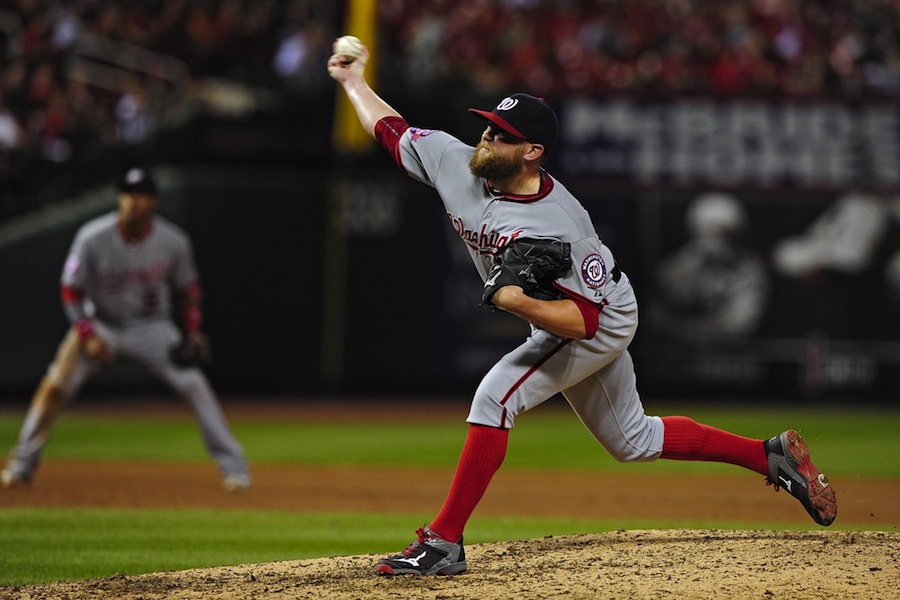 It was a sadly fitting end to what's been a tremendously frustrating year for the right-hander. He lost his hold on the closer role when the Nationals acquired Jonathan Papelbon from the Phillies in late July, despite the fact that Storen had been extremely effective, converting 29 of 31 save chances with a 1.73 ERA and 44-to-9 K/BB ratio in 36 innings. One can hardly blame Nats GM Mike Rizzo for upgrading the back end of his bullpen with an elite power arm, but it was a raw deal for Storen. He publicly voiced his displeasure following the trade, and also started to pitch very poorly, allowing multiple runs in four straight outings at one point in mid-August. You have to believe that Wednesday's incident was in some way triggered by pent-up frustration. The string of unfortunate events has dropped the 28-year-old Storen's stock to an all-time low entering an offseason where his alienated ballclub was already expected to shop him heavily. This presents an intriguing opportunity for teams that are on the lookout for bullpen help, and especially for the Twins. Minnesota has been known to have had interest in Storen in the past. In 2011, the Twins and Nats were rumored to be working on a deal involving the righty and Denard Span, though nothing materialized. Storen would be an excellent fit based on the Twins' current needs. With Casey Fien and Blaine Boyer both likely to depart, and the remaining right-handed relievers – such as Ryan Pressly, Michael Tonkin, J.R. Graham and A.J. Achter – looking suspect to varying degrees, this bullpen needs another impact late-inning arm to complement Kevin Jepsen, and one more established than Trevor May (who should be given another chance to start anyway). You could hardly ask for a better candidate than Storen, who has spent his entire career pitching well in high-leverage situations, the last few weeks notwithstanding. Of course, the biggest potential snag in such a scenario is that Storen clearly wants to close, and there will be no such opening here with Glen Perkins entrenched. But Storen may just have to come to terms with the reality of his situation. He's not going to get the ninth inning next year in Washington, with Papelbon still under contract, and it's doubtful that the Nats will allow him to dictate where he ends up in a trade. Storen is due for free agency following the 2016 season, so he might have to bear down, do his thing in a setup role and hope to gain interest as a closer on the open market. That would be a nice coup for the Twins, as they'd get a top-tier relief arm and also an ideal contingency plan behind Perkins, who has had health problems in two straight seasons and will be 33. What do you think? Does Storen make sense as a target for the Twins? And what would you give up to acquire him?
 -
Article: Suzuki Scare Exposes Abysmal Catcher Depth
Nick Nelson replied to Nick Nelson's topic in Twins Daily Front Page News
The Padres also got Derek Norris, who was coming off an All-Star season with the A's, for two good-not-great pitching prospects. I think it's logical to assume that a quality catcher is extremely difficult to pry away in a trade, but reality hasn't necessarily backed that up. -
Roller coasters can be scary. No moment in Wednesday night's roller coaster 12-inning victory against the Royals was scarier than in the 10th when Kurt Suzuki reached up the third base line to catch a wayward toss from Blaine Boyer and got railed by incoming speedster Jarrod Dyson, who was attempting the score the winning run. Suzuki caught the ball, got the out, and then struggled to stand up as he grasped his knee in pain. He needed to be helped off the field. Twins fans watched it all go down with a feeling of dread -- not only over Suzuki's well being, but also over the thought of trying to chase down a wild card spot without a major-league caliber player available at one of the field's most important positions.Thankfully, Suzuki was diagnosed with only a bruised knee and he's not expected to miss extended time. But the scare highlights a grim reality: this organization is bereft of catching talent. If Suzuki's injury were serious, the Twins would be forced to rely on a combination of Chris Herrmann and Eric Fryer, two players that have proven through numerous opportunities that they simply don't belong in the big leagues. Herrmann is a mediocre defender with a .185/.250/.286 career slash line in the majors, and he's the better of the two, which tells you all you need to know. There's no help in the minors. Josmil Pinto, who at one time appeared to be Suzuki's successor, has endured a brutal season in Rochester marred by concussion issues, likely removing him from the discussion permanently in light of the questions that already existed about his defensive aptitude behind the plate. Meanwhile, young hopefuls Stuart Turner and Mitch Garver have fallen off the map offensively at Double-A and Single-A after promising 2014 campaigns. They are looking more like suspects than prospects at this point, although the Twins are sending both to the Arizona Fall League with hopes of turning them around. In any case, there's no short-term help available, which is an ominous fact in light of Suzuki's injury and especially in the scope of the coming season. As the Twins look ahead to all-out contention efforts in 2016, they've got a backup-caliber starter locked in behind the plate and nothing much behind him on the depth chart. It's clear that this position is going to be Priority No. 1, by a longshot, entering the offseason. We'll cover all the possibilities for addressing it -- via free agency, trade and otherwise -- both here on the site and in our annual Offseason Handbook, which you'll be hearing more about as October approaches. Click here to view the article
-
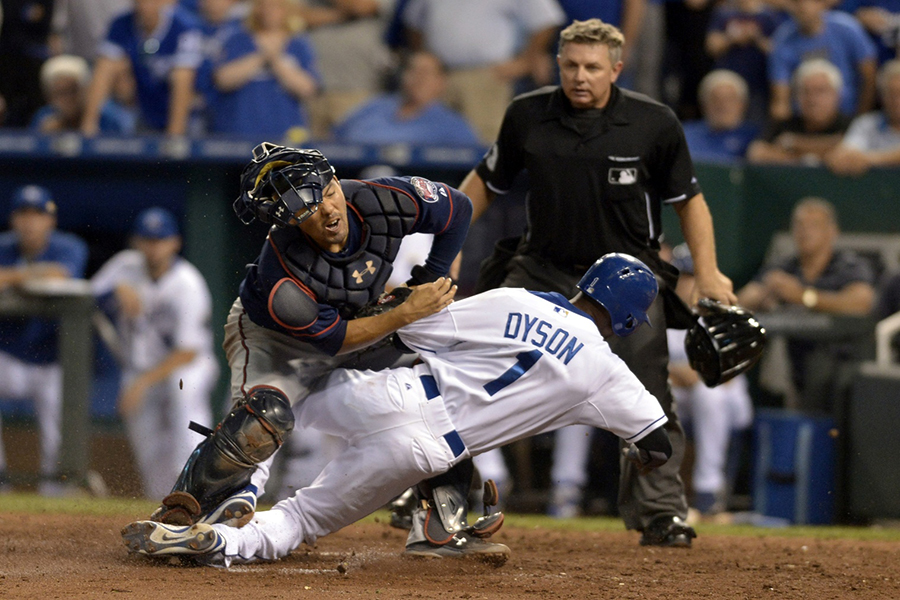 Thankfully, Suzuki was diagnosed with only a bruised knee and he's not expected to miss extended time. But the scare highlights a grim reality: this organization is bereft of catching talent. If Suzuki's injury were serious, the Twins would be forced to rely on a combination of Chris Herrmann and Eric Fryer, two players that have proven through numerous opportunities that they simply don't belong in the big leagues. Herrmann is a mediocre defender with a .185/.250/.286 career slash line in the majors, and he's the better of the two, which tells you all you need to know. There's no help in the minors. Josmil Pinto, who at one time appeared to be Suzuki's successor, has endured a brutal season in Rochester marred by concussion issues, likely removing him from the discussion permanently in light of the questions that already existed about his defensive aptitude behind the plate. Meanwhile, young hopefuls Stuart Turner and Mitch Garver have fallen off the map offensively at Double-A and Single-A after promising 2014 campaigns. They are looking more like suspects than prospects at this point, although the Twins are sending both to the Arizona Fall League with hopes of turning them around. In any case, there's no short-term help available, which is an ominous fact in light of Suzuki's injury and especially in the scope of the coming season. As the Twins look ahead to all-out contention efforts in 2016, they've got a backup-caliber starter locked in behind the plate and nothing much behind him on the depth chart. It's clear that this position is going to be Priority No. 1, by a longshot, entering the offseason. We'll cover all the possibilities for addressing it -- via free agency, trade and otherwise -- both here on the site and in our annual Offseason Handbook, which you'll be hearing more about as October approaches.
 -
On Saturday night, the Minnesota Twins debuted an outfield alignment that figures to be quite common in the coming years: Eddie Rosario in left, Byron Buxton in center, Aaron Hicks in right. With all three possessing excellent range and arm strength, it has the potential to become one of the best defensive units in the majors. So it's only fitting that Saturday's game ended with Buxton making a great running catch with the bases loaded and two outs to salvage a victory.Kevin Jepsen, who was awarded a save after narrowly protecting the ninth-inning lead in that game, was certainly grateful to Buxton for bailing him out. And that's a feeling that will be shared by many Twins pitchers going forward. Run prevention has been a sizable issue for Minnesota over the past several seasons, and lousy outfield defense has been an overlooked culprit in that equation. Sure, it doesn't help when your pitchers are allowing the opposition to put everything in play, but that weakness is magnified substantially when nobody's tracking anything down in the vast green expanses that comprise the outfields in major-league parks. Last year, trudgers Josh Willingham and Oswaldo Arcia were the primary recipients of playing time in the outfield corners for a Twins team whose pitchers allowed the fifth-highest percentage of fly balls in baseball. It should come as no surprise that Minnesota converted batted balls into outs at a lower rate than any other MLB team. They entered this season with Arcia and Torii Hunter in the corners, representing a minimal upgrade if any. But over the course of the season, Arcia has banished himself to the minors and Hunter has shown his age. Meanwhile, a new wave of youngsters has entered (or in one case reentered) the picture. Defense enthusiasts have long anticipated a day where Rosario, Buxton and Hicks would all share the same outfield. It was an eventuality delayed by injuries, first to Hicks and then to Buxton, but it finally became reality on Saturday night. Coincidentally, Ervin Santana was the starting pitcher for the Twins in that game. The Twins signed Santana to a four-year deal during the offseason, locking him up through 2018. Eleven days later, they signed Phil Hughes to a three-year extension, committing to him through 2019. Those two starters are now the most deeply entrenched members of the rotation going forward. And fortunately, they figure to benefit as much as anyone from this outstanding group of outfielders. Santana and Hughes don't have a ton of commonalities as pitchers, but they do have this one: both tend to give up a lot of fly balls and line drives. This can manifest in bad ways, as we've seen this year; the pair has combined to give up 39 home runs in 35 starts. For fly ball pitchers, the long balls can come in sporadic bunches, often attributable to bad luck as much as anything, but the high volume of balls hit in the air to the outfield is inherently constant. Hurlers like Santana and Hughes rely heavily on the players behind them to prevent baseballs from dropping onto the grass, and that's what made the idea of an Arcia/Robinson/Hunter trio so groan-inducing at the outset. An alignment of Rosario, Buxton and Hicks essentially gives the Twins three center fielders ranging around out there. It's not an exaggeration to suggest that each has a realistic shot at being an elite fielder at his respective position. We've already seen all three players make countless game-changing plays with their gloves and arms. Hopefully they can all do enough with their bats to keep themselves in the lineup for a long time, because watching them play in the same outfield is a treat, and if you want evidence of how valuable a top-tier defensive outfield can be, look no further than the team the Twins are currently facing in Kansas City. Click here to view the article
- 52 replies
-
- 3
-

-
- byron buxton
- eddie rosario
- (and 1 more)
-
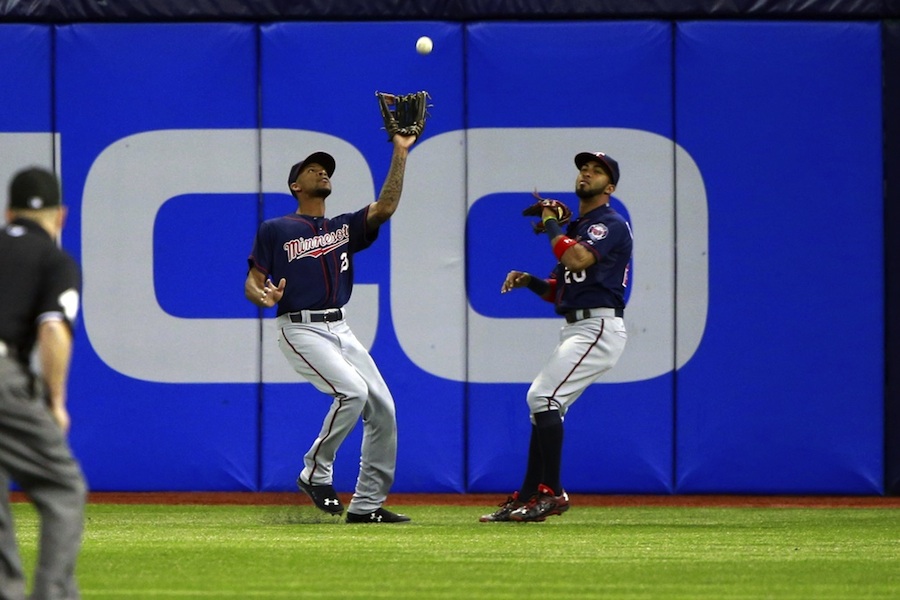 Kevin Jepsen, who was awarded a save after narrowly protecting the ninth-inning lead in that game, was certainly grateful to Buxton for bailing him out. And that's a feeling that will be shared by many Twins pitchers going forward. Run prevention has been a sizable issue for Minnesota over the past several seasons, and lousy outfield defense has been an overlooked culprit in that equation. Sure, it doesn't help when your pitchers are allowing the opposition to put everything in play, but that weakness is magnified substantially when nobody's tracking anything down in the vast green expanses that comprise the outfields in major-league parks. Last year, trudgers Josh Willingham and Oswaldo Arcia were the primary recipients of playing time in the outfield corners for a Twins team whose pitchers allowed the fifth-highest percentage of fly balls in baseball. It should come as no surprise that Minnesota converted batted balls into outs at a lower rate than any other MLB team. They entered this season with Arcia and Torii Hunter in the corners, representing a minimal upgrade if any. But over the course of the season, Arcia has banished himself to the minors and Hunter has shown his age. Meanwhile, a new wave of youngsters has entered (or in one case reentered) the picture. Defense enthusiasts have long anticipated a day where Rosario, Buxton and Hicks would all share the same outfield. It was an eventuality delayed by injuries, first to Hicks and then to Buxton, but it finally became reality on Saturday night. Coincidentally, Ervin Santana was the starting pitcher for the Twins in that game. The Twins signed Santana to a four-year deal during the offseason, locking him up through 2018. Eleven days later, they signed Phil Hughes to a three-year extension, committing to him through 2019. Those two starters are now the most deeply entrenched members of the rotation going forward. And fortunately, they figure to benefit as much as anyone from this outstanding group of outfielders. Santana and Hughes don't have a ton of commonalities as pitchers, but they do have this one: both tend to give up a lot of fly balls and line drives. This can manifest in bad ways, as we've seen this year; the pair has combined to give up 39 home runs in 35 starts. For fly ball pitchers, the long balls can come in sporadic bunches, often attributable to bad luck as much as anything, but the high volume of balls hit in the air to the outfield is inherently constant. Hurlers like Santana and Hughes rely heavily on the players behind them to prevent baseballs from dropping onto the grass, and that's what made the idea of an Arcia/Robinson/Hunter trio so groan-inducing at the outset. An alignment of Rosario, Buxton and Hicks essentially gives the Twins three center fielders ranging around out there. It's not an exaggeration to suggest that each has a realistic shot at being an elite fielder at his respective position. We've already seen all three players make countless game-changing plays with their gloves and arms. Hopefully they can all do enough with their bats to keep themselves in the lineup for a long time, because watching them play in the same outfield is a treat, and if you want evidence of how valuable a top-tier defensive outfield can be, look no further than the team the Twins are currently facing in Kansas City.
 -
Danny Santana and Kennys Vargas were both in Minnesota's Opening Day lineup this year, batting leadoff and fifth. Following impressive rookie campaigns, both were viewed as important young staples for the rebuilding Twins. Now, nearing the end of tumultuous sophomore seasons, both return from the minors as September call-ups, needing to prove that there's still a place for them in the team's plans.Regression was widely expected for Santana and Vargas in light of some ominous statistical indicators that came along with their overall outstanding production in 2014 – namely a lack of plate discipline exhibited by each. Yet, few could have anticipated that the dropoff in both cases would be so dramatic. Vargas was demoted twice, first to Triple-A and then to Double-A. Santana was given an extremely (some might say overly) long leash and still couldn't do anything to justify his place in the lineup. He was optioned at the end of July with a miserable .541 OPS and 16 errors at shortstop. Now, both players return to the fold as September call-ups, and with some momentum behind them. Vargas has shown tremendously improved patience at the plate since his latest demotion, drawing 42 walks against 52 strikeouts in 56 games between Double-A and Triple-A while hitting .277/.418/.492. Santana ended the month of August on a blistering tear at Rochester, with six straight multi-hit games and a .403 batting average in his last 15 contests. Despite their fine work in the minors, neither player is going to be in line for regular playing time this month, and maybe not even a substantial role. Eduardo Escobar has excelled at short since Santana's removal, hitting .295/.375/.577 in August with much sharper defense and surprisingly strong plate discipline (14 strikeouts and 10 walks in 88 plate appearances). At this point the Twins need to be planning around Escobar as their shortstop. Santana can help out this month as a pinch-runner and bench guy, but I think his opportunity is gone. For Vargas, there appears to be a bit more hope. For one thing, his improvement in the minors was more encouraging in that he clearly improved his approach, as opposed to Santana whose 15-game torrid stretch came attached to a 12-to-0 K/BB ratio. Obviously Miguel Sano is entrenched at DH for the time being but long-term the Twins would like to find a place in the field for him. If Vargas can demonstrate the same adjustments that he made in the minors when he gets his chances, he can re-establish himself as a legit DH option going forward, although I don't think there's anything he can do at this point to ensure himself a spot on next year's Opening Day roster. Ultimately both players are going to have their work cut out for them this month, because they've dug themselves pretty deep holes and their sporadic playing time will make it tougher to maintain the grooves they've found in the minors. The Twins have put themselves in position to contend for a postseason berth without getting much of anything from two players that were viewed as key cogs at the outset of the season. Now both will have a chance to contribute to a contending team – albeit in significantly reduced roles. Can Vargas and/or Santana end a negative season on a positive note? Click here to view the article
-
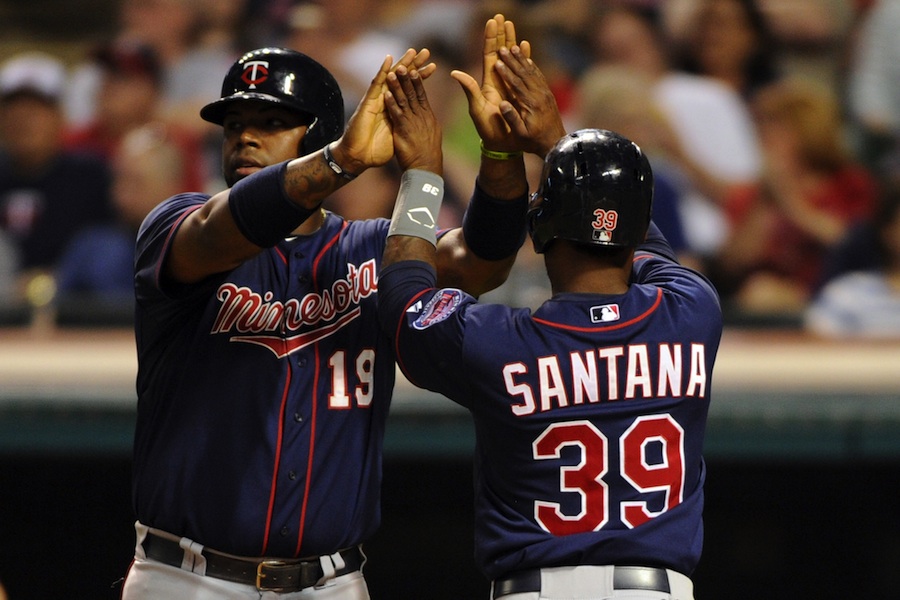 Regression was widely expected for Santana and Vargas in light of some ominous statistical indicators that came along with their overall outstanding production in 2014 – namely a lack of plate discipline exhibited by each. Yet, few could have anticipated that the dropoff in both cases would be so dramatic. Vargas was demoted twice, first to Triple-A and then to Double-A. Santana was given an extremely (some might say overly) long leash and still couldn't do anything to justify his place in the lineup. He was optioned at the end of July with a miserable .541 OPS and 16 errors at shortstop. Now, both players return to the fold as September call-ups, and with some momentum behind them. Vargas has shown tremendously improved patience at the plate since his latest demotion, drawing 42 walks against 52 strikeouts in 56 games between Double-A and Triple-A while hitting .277/.418/.492. Santana ended the month of August on a blistering tear at Rochester, with six straight multi-hit games and a .403 batting average in his last 15 contests. Despite their fine work in the minors, neither player is going to be in line for regular playing time this month, and maybe not even a substantial role. Eduardo Escobar has excelled at short since Santana's removal, hitting .295/.375/.577 in August with much sharper defense and surprisingly strong plate discipline (14 strikeouts and 10 walks in 88 plate appearances). At this point the Twins need to be planning around Escobar as their shortstop. Santana can help out this month as a pinch-runner and bench guy, but I think his opportunity is gone. For Vargas, there appears to be a bit more hope. For one thing, his improvement in the minors was more encouraging in that he clearly improved his approach, as opposed to Santana whose 15-game torrid stretch came attached to a 12-to-0 K/BB ratio. Obviously Miguel Sano is entrenched at DH for the time being but long-term the Twins would like to find a place in the field for him. If Vargas can demonstrate the same adjustments that he made in the minors when he gets his chances, he can re-establish himself as a legit DH option going forward, although I don't think there's anything he can do at this point to ensure himself a spot on next year's Opening Day roster. Ultimately both players are going to have their work cut out for them this month, because they've dug themselves pretty deep holes and their sporadic playing time will make it tougher to maintain the grooves they've found in the minors. The Twins have put themselves in position to contend for a postseason berth without getting much of anything from two players that were viewed as key cogs at the outset of the season. Now both will have a chance to contribute to a contending team – albeit in significantly reduced roles. Can Vargas and/or Santana end a negative season on a positive note?
 -
Amidst their organizational swoon in recent years, the Twins have typically set a modest goal at the outset of each season: play meaningful games in September. That shouldn't be all that challenging, especially in the era of four wild-card teams, but it's an accomplishment that has eluded the Twins.Here's where the club stood entering the month of September in each of the past four seasons ("Games Behind" indicates how far they were from a postseason spot of any kind, rather than their division deficit): 2014: 59-77, 15.0 GB 2013: 58-76, 16.0 GB 2012: 53-75, 19.0 GB 2011: 57-79, 18.0 GB This year, Minnesota enters the month of September at 67-63, trailing the Rangers by just one game for the American League's second wild-card position. While the Twins aren't exactly favored to reach the playoffs (MLB.com lists their postseason odds at 19.8 percent) they are very legitimately in the mix, and if they can keep rolling as they have been lately, with eight wins in their last 10 contests, they're going to make things very interesting as the season winds down. This week's series against a White Sox club that the Twins have beaten up on this year presents a key opportunity. Punching Bag The Twins have scored more victories against Chicago (9) than any other opponent this year. They have won three of four series against the Sox and have taken six of seven games at home. Twins pitching has been able to shut down an offense that ranks last in the AL in OPS, limiting them to 35 runs total in 13 games – a measly 2.7 R/G average. Power v. Power Last year Jose Abreu captured Rookie of the Year honors with a transcendent slugging performance. His 2014 numbers for the White Sox: 145 G, 622 PA, .317/.383/.581, 36 HR, 35 2B, 107 RBI Here's how Miguel Sano's numbers this year would project in the same number of games: 145 G, 610 PA, .287/.398/.591, 39 HR, 39 2B, 118 RBI As you can see, Sano is having a similar – though slightly superior – campaign to the one that earned Abreu accolades last year. Sano is also on a 100-walk full-season pace, which would double Abreu's total, so the Twins' rookie is showing more patience despite being five years younger than the Cuban import was last season. Lefties Looming As you'll see in the pitching match-up breakdowns below, the White Sox will send three straight left-handed starters to the mound in this series, with gradually decreasing levels of intimidation. As a team, the Twins are hitting .259/.313/.408 against southpaws, compared to .244/.298/.398 against righties – a 25-point improvement in OPS. In particular, here are three hitters to watch against Chicago's port-sider brigade: Miguel Sano: 811 OPS v. LHP Brian Dozier: 805 OPS v. LHP Trevor Plouffe: 783 OPS v. LHP Also very much worth noting: Aaron Hicks has CRUSHED left-handed pitching to the tune of .342/.392/.562. He started a rehab stint over the weekend and may return during this series. PITCHING MATCH-UPS Tuesday, 7:10 PM: LHP Chris Sale vs. RHP Tyler Duffey Sale has been an absolute strikeout machine this year. If his 12.0 K/9 sustains, it will be the highest rate for a major-league starting pitcher since Randy Johnson's 13.4 in 2001. Although he has been dominant for the most part, Sale has been susceptible to the occasional clunker, and the Twins have been responsible for a few of those. "The Condor" has yielded more than three earned runs in six of his 25 starts; half of those have been against Minnesota. Duffey is riding a nice hot streak. Since getting shelled by the Blue Jays in his big-league debut, the righty has rebounded nicely, allowing only four total runs over his last three starts while averaging a strikeout per inning. If he can keep the ball in the zone he should be able to take care of business at home against the light-hitting Sox. Forecast (via Weather.com): High of 88, mostly cloudy Wednesday, 7:10 PM: LHP Carlos Rodon vs. LHP Tommy Milone The third overall pick in last year's draft, Rodon is already up in the majors and showing the electric stuff that made him one of the nation's most coveted young arms. He has had his ups and downs, and numerous bouts of wildness, but once he gets in the zone with his mid-90s heater and nasty slider, he's difficult to touch. In the month of August, Rodon put up a 2.48 ERA and held opponents to a .200 average. The Sox went 4-1 in his starts. Milone has been the type of decent, middling starter this year that his track record paints him as. He generally does enough to give the Twins a shot to win, but hasn't turned in a quality start since July 8th. He has beaten the White Sox both times he's matched up with them this season. Forecast: High of 89, mostly sunny Thursday, 12:10 PM: LHP John Danks vs. RHP Kyle Gibson This is certainly the easiest assignment in the series. Danks has been typically mediocre, with a 6-12 record and 4.82 ERA. He has pitched better since the All-Star break but remains quite hittable. The last time the Twins faced him, in June, they broke out of a huge offensive slump to tack nine runs on him in 5 1/3 innings. Gibson was in quite the funk for a while there after the break, but has looked much better his last couple times out. He needs to miss more bats. Only once in his last seven outings has he struck out more than four hitters. Forecast: High of 88, sunny Click here to view the article
-
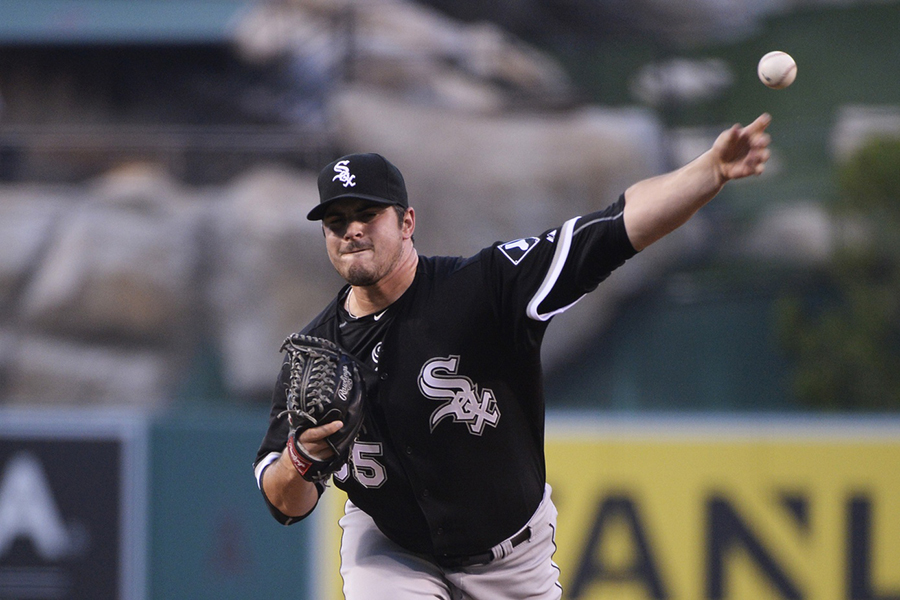 Here's where the club stood entering the month of September in each of the past four seasons ("Games Behind" indicates how far they were from a postseason spot of any kind, rather than their division deficit): 2014: 59-77, 15.0 GB 2013: 58-76, 16.0 GB 2012: 53-75, 19.0 GB 2011: 57-79, 18.0 GB This year, Minnesota enters the month of September at 67-63, trailing the Rangers by just one game for the American League's second wild-card position. While the Twins aren't exactly favored to reach the playoffs (MLB.com lists their postseason odds at 19.8 percent) they are very legitimately in the mix, and if they can keep rolling as they have been lately, with eight wins in their last 10 contests, they're going to make things very interesting as the season winds down. This week's series against a White Sox club that the Twins have beaten up on this year presents a key opportunity. Punching Bag The Twins have scored more victories against Chicago (9) than any other opponent this year. They have won three of four series against the Sox and have taken six of seven games at home. Twins pitching has been able to shut down an offense that ranks last in the AL in OPS, limiting them to 35 runs total in 13 games – a measly 2.7 R/G average. Power v. Power Last year Jose Abreu captured Rookie of the Year honors with a transcendent slugging performance. His 2014 numbers for the White Sox: 145 G, 622 PA, .317/.383/.581, 36 HR, 35 2B, 107 RBI Here's how Miguel Sano's numbers this year would project in the same number of games: 145 G, 610 PA, .287/.398/.591, 39 HR, 39 2B, 118 RBI As you can see, Sano is having a similar – though slightly superior – campaign to the one that earned Abreu accolades last year. Sano is also on a 100-walk full-season pace, which would double Abreu's total, so the Twins' rookie is showing more patience despite being five years younger than the Cuban import was last season. Lefties Looming As you'll see in the pitching match-up breakdowns below, the White Sox will send three straight left-handed starters to the mound in this series, with gradually decreasing levels of intimidation. As a team, the Twins are hitting .259/.313/.408 against southpaws, compared to .244/.298/.398 against righties – a 25-point improvement in OPS. In particular, here are three hitters to watch against Chicago's port-sider brigade: Miguel Sano: 811 OPS v. LHP Brian Dozier: 805 OPS v. LHP Trevor Plouffe: 783 OPS v. LHP Also very much worth noting: Aaron Hicks has CRUSHED left-handed pitching to the tune of .342/.392/.562. He started a rehab stint over the weekend and may return during this series. PITCHING MATCH-UPS Tuesday, 7:10 PM: LHP Chris Sale vs. RHP Tyler Duffey Sale has been an absolute strikeout machine this year. If his 12.0 K/9 sustains, it will be the highest rate for a major-league starting pitcher since Randy Johnson's 13.4 in 2001. Although he has been dominant for the most part, Sale has been susceptible to the occasional clunker, and the Twins have been responsible for a few of those. "The Condor" has yielded more than three earned runs in six of his 25 starts; half of those have been against Minnesota. Duffey is riding a nice hot streak. Since getting shelled by the Blue Jays in his big-league debut, the righty has rebounded nicely, allowing only four total runs over his last three starts while averaging a strikeout per inning. If he can keep the ball in the zone he should be able to take care of business at home against the light-hitting Sox. Forecast (via Weather.com): High of 88, mostly cloudy Wednesday, 7:10 PM: LHP Carlos Rodon vs. LHP Tommy Milone The third overall pick in last year's draft, Rodon is already up in the majors and showing the electric stuff that made him one of the nation's most coveted young arms. He has had his ups and downs, and numerous bouts of wildness, but once he gets in the zone with his mid-90s heater and nasty slider, he's difficult to touch. In the month of August, Rodon put up a 2.48 ERA and held opponents to a .200 average. The Sox went 4-1 in his starts. Milone has been the type of decent, middling starter this year that his track record paints him as. He generally does enough to give the Twins a shot to win, but hasn't turned in a quality start since July 8th. He has beaten the White Sox both times he's matched up with them this season. Forecast: High of 89, mostly sunny Thursday, 12:10 PM: LHP John Danks vs. RHP Kyle Gibson This is certainly the easiest assignment in the series. Danks has been typically mediocre, with a 6-12 record and 4.82 ERA. He has pitched better since the All-Star break but remains quite hittable. The last time the Twins faced him, in June, they broke out of a huge offensive slump to tack nine runs on him in 5 1/3 innings. Gibson was in quite the funk for a while there after the break, but has looked much better his last couple times out. He needs to miss more bats. Only once in his last seven outings has he struck out more than four hitters. Forecast: High of 88, sunny
 -
Article: Vargas Patiently Waiting For Another Shot
Nick Nelson replied to Nick Nelson's topic in Twins Daily Front Page News
I wouldn't say that's true. He has 14 HR in 400 MLB PA, which translates to about a 20-HR full-season pace. Not bad for a 25-year-old. It is the other aspects of his game that have lagged. -
Following an impressive rookie showing in 2014, the Twins hoped that Kennys Vargas would develop into a fixture at designated hitter for them this season. Unfortunately, he failed in two separate chances and has now been in the minors since early July. As Mike Radcliff stated in Parker Hageman's excellent article on Max Kepler, sometimes "it takes patience" with prospects, and patience is exactly what could get Vargas back to the big leagues in September.The slugger exhibited a consistently bad plate approach during his first two stints with the big club, striking out 48 times with only seven walks in 166 appearances. He swung frequently at pitches outside the zone but made contact only 49.6 percent of the time – only three qualified hitters in baseball have a lower rate. Pitchers made simple adjustments and Vargas became an easy out. During his second turn with the Twins this year, after returning from a May demotion to Rochester, the switch-hitter struck out 18 times in 54 plate appearances and didn't draw a single walk. It was ugly. The front office became so frustrated that they bumped him all the way back to Double-A, even though he'd crushed at Rochester earlier in in the season. There were rumblings that he may have exhausted his opportunities with the organization. When the Twins sent Vargas down to Chattanooga, he was given a clear directive: take better at-bats. It was the only way he was going to turn around his suddenly fledgling career. And to his credit, Vargas has just done that. In 51 games between Double-A and Triple-A since his latest demotion, he has struck out 46 times with 39 walks in 219 plate appearances. That's a 17.8 percent walk rate, which is a huge improvement over his previous 10.6 percent mark in the minors, and obviously dwarves his 4.8 percent rate in the majors. This has enabled Vargas to post an excellent .416 OBP even though his hitting has been good-not-great (.274 average and .491 slugging percentage). We all know that the big Puerto Rican, whose size and swing have been compared to David Ortiz, is a terror when he makes contact, capable of crushing the ball as hard as anyone in the league. Working the count has been an issue, but the numbers since he was last shipped down serve as a hopeful harbinger that he's ready to take a step forward in that department. Obviously there's a huge difference between the pitching in Double-A/Triple-A and the majors, especially for a 25-year-old with considerable MLB experience, but Vargas has clearly taken to heart the need for improved strike zone control. He's never shown this kind of patience in his career, at any level. And so I don't think I'm alone when I say I'd like to see Vargas get another shot. Unfortunately, the guy who replaced him at DH isn't going anywhere. Miguel Sano has shown the type of discipline at the plate that was amiss for Vargas, and he's also putting together one of the most impressive power displays for a 22-year-old rookie in the game's history. With Joe Mauer and Trevor Plouffe entrenched at the infield corners, it's tough to see a path to regular playing time for Vargas, barring injury. Still, you have to think that the Twins, who are very much in the postseason mix as we approach September call-up season, would love to have Vargas' intimidating bat available for occasional starts and – more importantly – pinch-hitting duty down the stretch. If the 25-year-old can turn things around, it will go down as a perfect example of how patience can pay off – both for player and organization. Click here to view the article
-
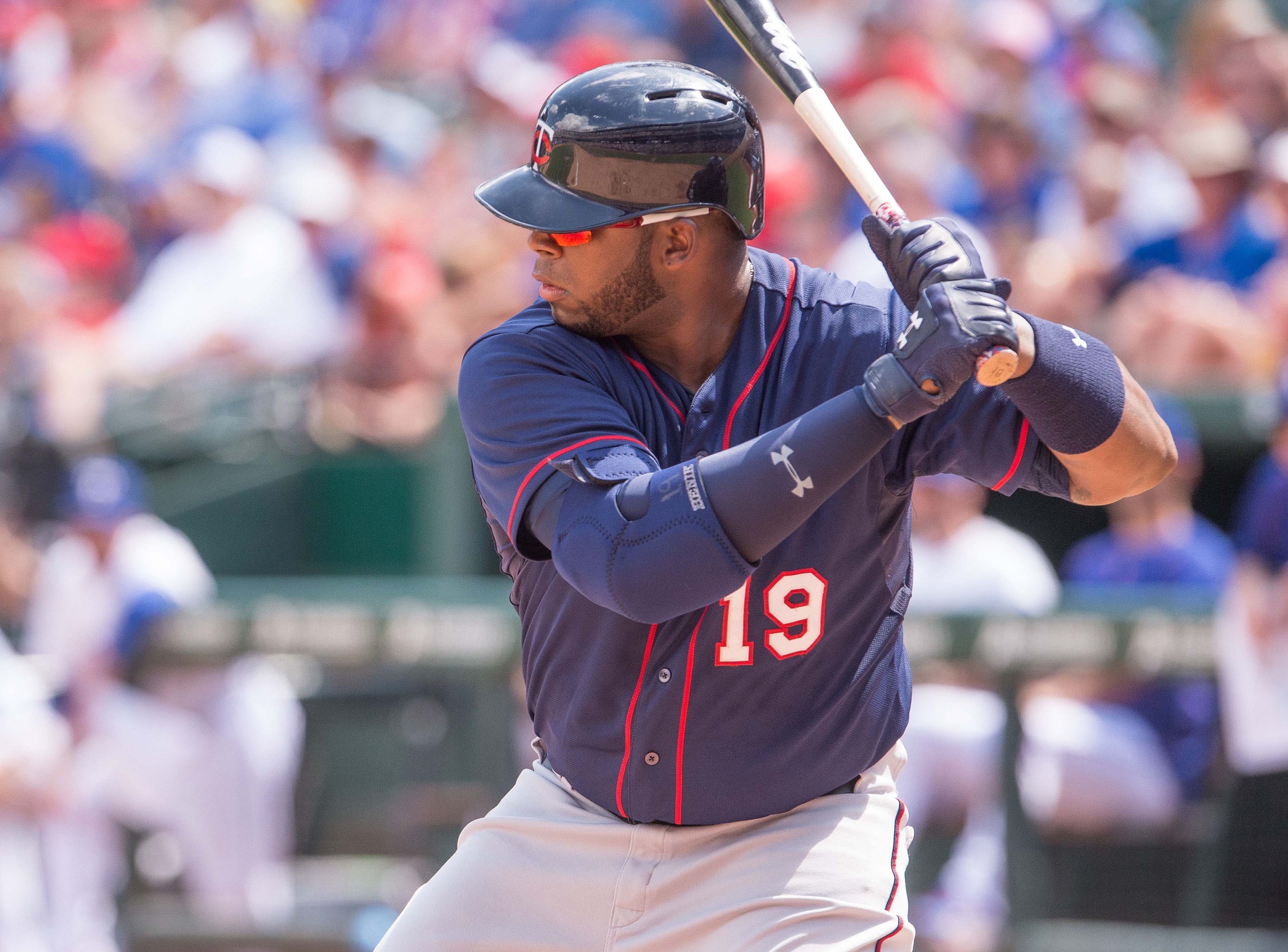 The slugger exhibited a consistently bad plate approach during his first two stints with the big club, striking out 48 times with only seven walks in 166 appearances. He swung frequently at pitches outside the zone but made contact only 49.6 percent of the time – only three qualified hitters in baseball have a lower rate. Pitchers made simple adjustments and Vargas became an easy out. During his second turn with the Twins this year, after returning from a May demotion to Rochester, the switch-hitter struck out 18 times in 54 plate appearances and didn't draw a single walk. It was ugly. The front office became so frustrated that they bumped him all the way back to Double-A, even though he'd crushed at Rochester earlier in in the season. There were rumblings that he may have exhausted his opportunities with the organization. When the Twins sent Vargas down to Chattanooga, he was given a clear directive: take better at-bats. It was the only way he was going to turn around his suddenly fledgling career. And to his credit, Vargas has just done that. In 51 games between Double-A and Triple-A since his latest demotion, he has struck out 46 times with 39 walks in 219 plate appearances. That's a 17.8 percent walk rate, which is a huge improvement over his previous 10.6 percent mark in the minors, and obviously dwarves his 4.8 percent rate in the majors. This has enabled Vargas to post an excellent .416 OBP even though his hitting has been good-not-great (.274 average and .491 slugging percentage). We all know that the big Puerto Rican, whose size and swing have been compared to David Ortiz, is a terror when he makes contact, capable of crushing the ball as hard as anyone in the league. Working the count has been an issue, but the numbers since he was last shipped down serve as a hopeful harbinger that he's ready to take a step forward in that department. Obviously there's a huge difference between the pitching in Double-A/Triple-A and the majors, especially for a 25-year-old with considerable MLB experience, but Vargas has clearly taken to heart the need for improved strike zone control. He's never shown this kind of patience in his career, at any level. And so I don't think I'm alone when I say I'd like to see Vargas get another shot. Unfortunately, the guy who replaced him at DH isn't going anywhere. Miguel Sano has shown the type of discipline at the plate that was amiss for Vargas, and he's also putting together one of the most impressive power displays for a 22-year-old rookie in the game's history. With Joe Mauer and Trevor Plouffe entrenched at the infield corners, it's tough to see a path to regular playing time for Vargas, barring injury. Still, you have to think that the Twins, who are very much in the postseason mix as we approach September call-up season, would love to have Vargas' intimidating bat available for occasional starts and – more importantly – pinch-hitting duty down the stretch. If the 25-year-old can turn things around, it will go down as a perfect example of how patience can pay off – both for player and organization.
 -
Article: Nolasco Stuck In No Man's Land
Nick Nelson replied to Nick Nelson's topic in Twins Daily Front Page News
I did think about bringing up the idea of shifting Nolasco to the bullpen, but it seems like a longshot since he's made 1 relief appearance in the last 7 years and has never gained much experience in the role. Could still happen though. Hughes to the bullpen is an interesting idea, as he was an absolutely dominant reliever for the Yankees back in '09. But I suspect he'll get quite a bit more leash as a starter based on his 2015 season and his contract. -
Yesterday I posed a question for readers about Trevor May, noting his spectacular numbers as a reliever and pondering whether the Twins should view him as a solution to their bullpen needs going forward. The comments section featured a lively discussion and there wasn't much consensus on the best course of action. One thing did appear to to be unanimous, however, and has for some time: No one seems to want Ricky Nolasco in the 2016 rotation, blocking May or any other talented youngster.The distaste for Nolasco amongst Twins fans is certainly understandable. As we all know, his contract has been an unmitigated disaster up to this point. In his first season with the club after becoming the highest-paid free agent in franchise history, he went 6-12 with a 5.38 ERA and 1.52 WHIP, both career-worst marks. This year, his numbers didn't look any better on the surface before he went down with an ankle injury that ended his season after just two months. In seven starts, he had a 5.53 ERA and 1.65 WHIP. However, there were some positive signs hidden within those bloated numbers, and I'm not talking about his irrelevant 5-1 win/loss record. In 32 2/3 innings, Nolasco had a solid 28-to-10 K/BB ratio, and he was showing slightly improved velocity on his fastball. His FIP checked in at a shiny 2.82. His main problem was that he was giving up a ton of hits, but the .394 BABIP looks awfully flukish when you consider that he gave up only one home run and 13 total extra-base hits in those seven starts. Nolasco wasn't getting pounded, he was giving up singles in bunches, with an unsustainably low 59.7 percent strand rate. That kind of misfortune tends to even out over extended time, but the righty never had the chance for normalization to set in because he has been on the disabled list since the end of May. His ankle issues have been frustrating, undoubtedly for him as much as anyone. It was apparently an old injury that resurfaced, and Nolasco took a cortisone shot before ultimately going under the knife in July to try and correct it. While he's unlikely to throw another pitch this season, Nolasco will have a full offseason to heal up and return next year. At that point, his quality peripherals, along with his track record and his not-all-that-advanced age (he'll turn 33 in December), offer plenty of reason to believe that he can rebound and return to being the useful starter that the Twins thought they were signing in the first place. That's why all the talk I keep seeing about Nolasco being a "sunk cost," and the suggestions that he should simply be cut outright this winter, strike me as a little ridiculous. He is owed $25 million after this season. I know it's not our money, but does it really seem wise to just flush it down the drain when we've barely had a chance to see what Nolasco can do when he's right physically? It's not, and it's not realistic. Nolasco will be here at the start of the 2016 season. If things get off to a similarly brutal start, then at that time I could perhaps see the Twins taking the rather drastic step of cutting ties and eating many millions of dollars. But they won't do so before then, nor should they. However, it is not unthinkable that another club could take interest in the veteran starter during the offseason and flip another bulky contract for his, or take on a share of what he's owed with the Twins picking up the rest. There were some rumblings of the Twins and Padres working on something with Nolasco and James Shields leading up to the deadline, though nothing materialized. If you're looking to see a Twins rotation next April that doesn't include Nolasco – and who could blame you, since there figure to be several more trustworthy options available – that might be your best bet. Click here to view the article
-
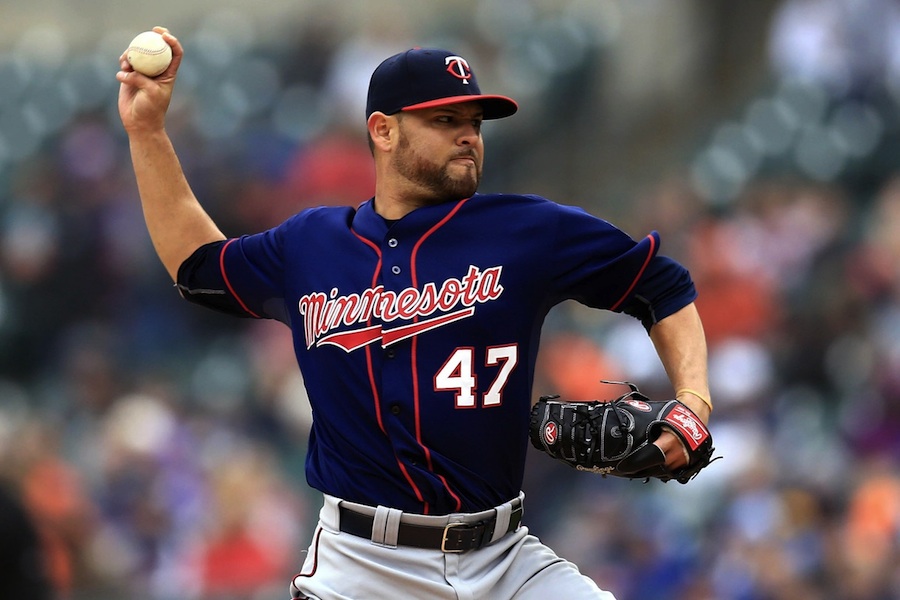 The distaste for Nolasco amongst Twins fans is certainly understandable. As we all know, his contract has been an unmitigated disaster up to this point. In his first season with the club after becoming the highest-paid free agent in franchise history, he went 6-12 with a 5.38 ERA and 1.52 WHIP, both career-worst marks. This year, his numbers didn't look any better on the surface before he went down with an ankle injury that ended his season after just two months. In seven starts, he had a 5.53 ERA and 1.65 WHIP. However, there were some positive signs hidden within those bloated numbers, and I'm not talking about his irrelevant 5-1 win/loss record. In 32 2/3 innings, Nolasco had a solid 28-to-10 K/BB ratio, and he was showing slightly improved velocity on his fastball. His FIP checked in at a shiny 2.82. His main problem was that he was giving up a ton of hits, but the .394 BABIP looks awfully flukish when you consider that he gave up only one home run and 13 total extra-base hits in those seven starts. Nolasco wasn't getting pounded, he was giving up singles in bunches, with an unsustainably low 59.7 percent strand rate. That kind of misfortune tends to even out over extended time, but the righty never had the chance for normalization to set in because he has been on the disabled list since the end of May. His ankle issues have been frustrating, undoubtedly for him as much as anyone. It was apparently an old injury that resurfaced, and Nolasco took a cortisone shot before ultimately going under the knife in July to try and correct it. While he's unlikely to throw another pitch this season, Nolasco will have a full offseason to heal up and return next year. At that point, his quality peripherals, along with his track record and his not-all-that-advanced age (he'll turn 33 in December), offer plenty of reason to believe that he can rebound and return to being the useful starter that the Twins thought they were signing in the first place. That's why all the talk I keep seeing about Nolasco being a "sunk cost," and the suggestions that he should simply be cut outright this winter, strike me as a little ridiculous. He is owed $25 million after this season. I know it's not our money, but does it really seem wise to just flush it down the drain when we've barely had a chance to see what Nolasco can do when he's right physically? It's not, and it's not realistic. Nolasco will be here at the start of the 2016 season. If things get off to a similarly brutal start, then at that time I could perhaps see the Twins taking the rather drastic step of cutting ties and eating many millions of dollars. But they won't do so before then, nor should they. However, it is not unthinkable that another club could take interest in the veteran starter during the offseason and flip another bulky contract for his, or take on a share of what he's owed with the Twins picking up the rest. There were some rumblings of the Twins and Padres working on something with Nolasco and James Shields leading up to the deadline, though nothing materialized. If you're looking to see a Twins rotation next April that doesn't include Nolasco – and who could blame you, since there figure to be several more trustworthy options available – that might be your best bet.
 -
It was fairly evident in spring training that the Twins might have some issues this year with right-handers in the bullpen. Rolling into the season with a declining Casey Fien, a mediocre Blaine Boyer and a handful of unproven youngsters, the unit lacked reliable options. Indeed, righty relief has been a persistent problem for Minnesota, and the team made a deadline move to address it with the acquisition of Kevin Jepsen. Yet, the most impactful addition to the bullpen has come from the inside. Trevor May has been a monster in his new role.The above graph from Brooks Baseball provides a visualization of May's pitch velocities over the course of the 2015 season. You can see that since the 25-year-old switched gigs upon Ervin Santana's early-July return to the rotation, he's added substantial heat to each of his offerings – most notably the fastball, which has recently been sizzling in at more than 95 MPH. The increased gas has unsurprisingly coincided with heightened effectiveness for all of May's pitches, and that has been reflected in his results. Over the past calendar month, he has made 12 relief appearances and hasn't allowed a single run. The only damage that's been dealt against the righty during that span was in a spot start against Cleveland, when he gave up a couple runs in three innings. Every time May trots out to the mound in the late innings, he looks more and more comfortable. His numbers are growing increasingly dominant as he acclimates to his new duties. Here in August, he has faced 33 batters as a reliever and allowed only five hits, with 13 strikeouts and one walk. It's becoming quite clear that May is one of those starting pitchers that uncovers a new level of performance pitching in shorter stints. Such players are not all that rare. Kansas City's Wade Davis is a familiar example. But of course, Davis had exhausted his opportunities as a starter, delivering 64 starts worth of mediocrity in Tampa before the Rays finally decided to try him in the pen. That hasn't been the case for May. Most would agree that his demotion was undeserved, and you can make a pretty good argument that he's pitched better as a starter this year than anyone currently in the rotation. And so the Twins face an interesting conundrum going forward. Right-handed relief will probably still be a prioritized need in the offseason as they gear up for true contention efforts in 2016, and May is looking like their best bet. He has the makings of a lights-out setup guy in front of Glen Perkins. Meanwhile, the rotation is already shaping up to be a bit crowded with Ervin Santana, Phil Hughes, Ricky Nolasco, Kyle Gibson, Jose Berrios, Tyler Duffey and maybe Tommy Milone all in play. As is always the case, May can be a far more valuable player as a quality starter than as an excellent reliever. It seems ridiculous to give up on his arm in a role where it can make a far greater impact, and it also seems quite unfair to him. He'd prefer to start and has done nothing to forfeit that chance other than pitching his ass off in relief. But with all things considered, one can see the appeal of committing to him as a late-inning weapon and dramatically lessening some of the club's ongoing bullpen concerns. What say you? Click here to view the article
-
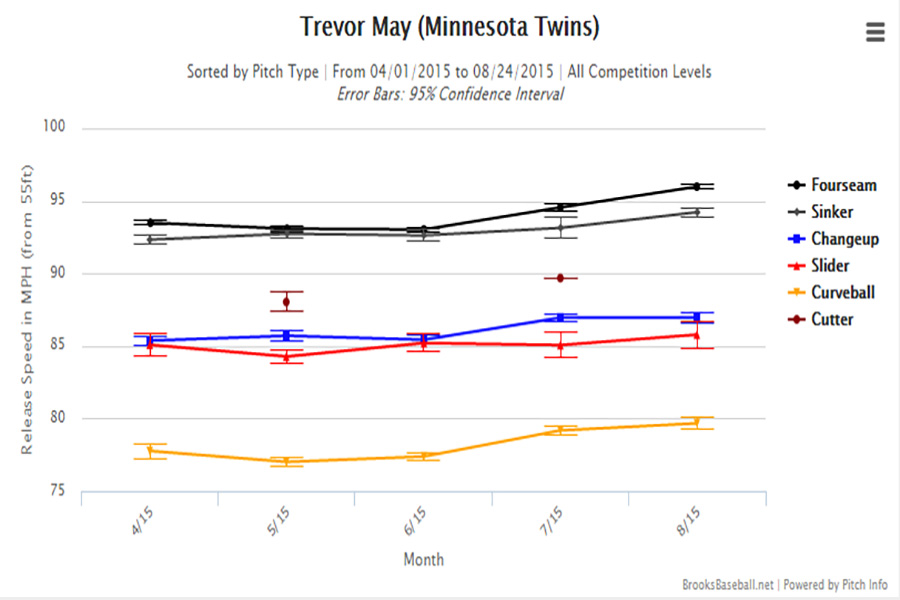 The above graph from Brooks Baseball provides a visualization of May's pitch velocities over the course of the 2015 season. You can see that since the 25-year-old switched gigs upon Ervin Santana's early-July return to the rotation, he's added substantial heat to each of his offerings – most notably the fastball, which has recently been sizzling in at more than 95 MPH. The increased gas has unsurprisingly coincided with heightened effectiveness for all of May's pitches, and that has been reflected in his results. Over the past calendar month, he has made 12 relief appearances and hasn't allowed a single run. The only damage that's been dealt against the righty during that span was in a spot start against Cleveland, when he gave up a couple runs in three innings. Every time May trots out to the mound in the late innings, he looks more and more comfortable. His numbers are growing increasingly dominant as he acclimates to his new duties. Here in August, he has faced 33 batters as a reliever and allowed only five hits, with 13 strikeouts and one walk. It's becoming quite clear that May is one of those starting pitchers that uncovers a new level of performance pitching in shorter stints. Such players are not all that rare. Kansas City's Wade Davis is a familiar example. But of course, Davis had exhausted his opportunities as a starter, delivering 64 starts worth of mediocrity in Tampa before the Rays finally decided to try him in the pen. That hasn't been the case for May. Most would agree that his demotion was undeserved, and you can make a pretty good argument that he's pitched better as a starter this year than anyone currently in the rotation. And so the Twins face an interesting conundrum going forward. Right-handed relief will probably still be a prioritized need in the offseason as they gear up for true contention efforts in 2016, and May is looking like their best bet. He has the makings of a lights-out setup guy in front of Glen Perkins. Meanwhile, the rotation is already shaping up to be a bit crowded with Ervin Santana, Phil Hughes, Ricky Nolasco, Kyle Gibson, Jose Berrios, Tyler Duffey and maybe Tommy Milone all in play. As is always the case, May can be a far more valuable player as a quality starter than as an excellent reliever. It seems ridiculous to give up on his arm in a role where it can make a far greater impact, and it also seems quite unfair to him. He'd prefer to start and has done nothing to forfeit that chance other than pitching his ass off in relief. But with all things considered, one can see the appeal of committing to him as a late-inning weapon and dramatically lessening some of the club's ongoing bullpen concerns. What say you?
 -
Article: Are The Twins Drowning In Bad Contracts?
Nick Nelson replied to Nick Nelson's topic in Twins Daily Front Page News
Theoretically you guys are right and I doubt many here would disagree with you. But in reality... You have to know that's how it's going to be, right? Few teams would simply bail on these kinds of investments and the Twins almost certainly aren't one of them.- 72 replies
-
- 1
-
-
- phil hughes
- ervin santana
- (and 1 more)
-
Article: Are The Twins Drowning In Bad Contracts?
Nick Nelson replied to Nick Nelson's topic in Twins Daily Front Page News
Definitely agree on Nolasco. With Santana, I don't think the question is whether TR overpaid, but whether it was a smart/necessary contract in the first place. If they planned on extending Hughes in the same offseason, it meant locking into three of those "#3 type" veteran starters long-term, and that diminishes a flexibility. It'd be one thing if at least one of those guys was a true top-of-the-rotation starter, but as we're seeing, they're not.- 72 replies
-
- 5
-
-
- phil hughes
- ervin santana
- (and 1 more)
-
In his second season with the Twins, and his first since signing a five-year, $58 million extension during the offseason, Phil Hughes has taken a major step backward. He has allowed the most hits and homers in the league. His fastball velocity has dipped while his K-rate has bottomed out. There's been talk of dead arm, and now he's on the shelf with a bad back after his worst start in a Twins uniform. Not exactly the signs you like to see from a 29-year-old with four more guaranteed years left on his deal. But sadly, Hughes' contract isn't the ugliest one the Twins are presently shackled to. Far from it.As we all know, there's been plenty of lamentation surrounding Joe Mauer's contract, and the gripes carry more legitimacy now that the former MVP has gone from undeserving whipping boy to actual liability. But Mauer is at least in the lineup everyday, typically batting third and producing enough to stay afloat. While he is undoubtedly overpaid at this point, Mauer has been providing some modicum of value to the team and has an elite track record to fall back on. That's more than can be said of the pitchers signed to the two largest free agent contracts in franchise history over the past two offseasons – contracts that have up to this point turned out so disastrously that it almost defies belief. Ricky Nolasco inked a four-year, $49 million deal in November of 2013. Since then, he has given the Twins 191 innings with a 5.40 ERA and 1.54 WHIP. This year he has been limited to seven starts and it appears that he won't return due to a nagging ankle injury. The prized free agent signing of the past offseason, Ervin Santana, has overshadowed Nolasco in terms of money and misfortune. His four-year, $55 million pact eclipsed Nolasco's as the most lucrative ever for the Twins, and his has gotten off to an even worse start. While the injuries for Nolasco have been frustrating, it's hard to fault a guy for getting hurt; meanwhile, the trouble that kept Santana off the field was self-induced, as he missed the first 80 games this year due to a steroid suspension. Since returning, Santana has delivered one of the worst stretches of performance in his career. He has given up nine homers in eight starts and his substandard 13.8 percent strikeout rate is radically out of line with his norm. The hope was that his return in early July would further stabilize a rotation that had been surprisingly effective in the first half, but instead, Santana's lousy output has coincided with a complete meltdown for the unit as a whole. The Twins are tied to Nolasco, Santana and Hughes through 2017 for a total of almost $75 million, with the latter two deals running even longer. The monetary aspect is less bothersome than the lengthy commitments, because having these three vets entrenched limits the club's flexibility to plug in youngsters or seek out other options. In general, the Twins are mired in questionable contracts. Of their six highest-paid players – Mauer, Santana, Nolasco, Torii Hunter, Hughes and Kurt Suzuki – not one has even been an average performer this year. All but Hunter are locked in to return next year and at this point there's not a whole lot of reason to believe any will be above average then, either. Granted, this is a snapshot being taken at a time that is hopefully the low point for this collective group. It's hard to imagine that Santana and Hughes will continue to struggle to this degree, although the potential injury implications of their plummeting strikeout rates are concerning. Either way, there's no denying that Terry Ryan's forays into free agency now that he finally has the financial freedom that was never available to him in his past tenure have been roundly brutal. Even the instances of success, namely the original contracts for Suzuki and Hughes, have been tainted by doubling down after strong (and unprecedented) first impressions, which unsurprisingly have not turned out to signal transformative career turnarounds. Certainly there's been a lot of bad luck at play, but to what extent are Ryan and the front office culpable for all these repeatedly floundering contracts? While the salaries shouldn't be all that disturbing to the standard fan – it's not our money – the long-term commitments to what's looking like a whole lot of veteran mediocrity, for a young rebuilding team, could be very damaging from a competitive standpoint. That's a problem. Click here to view the article
- 72 replies
-
- 2
-
-
- phil hughes
- ervin santana
- (and 1 more)
-
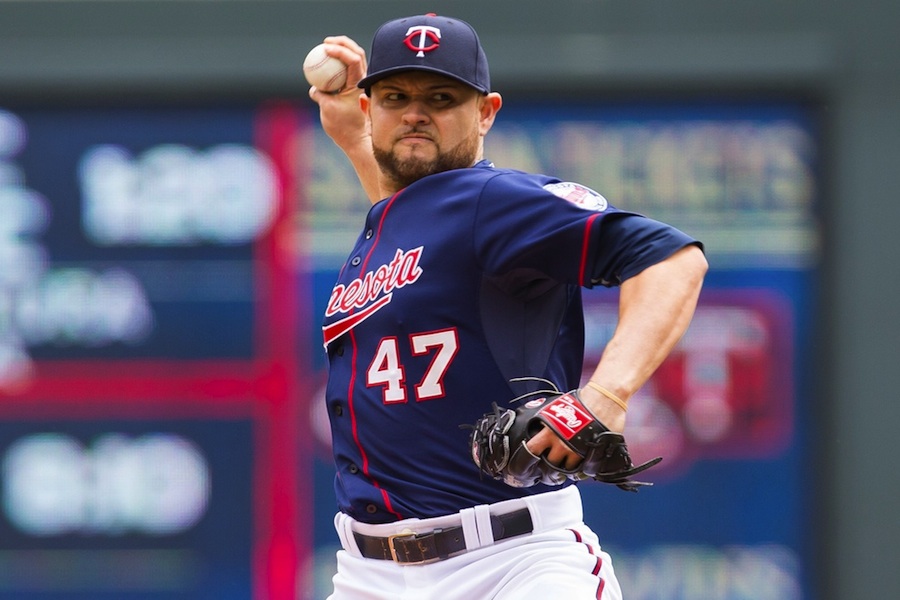 As we all know, there's been plenty of lamentation surrounding Joe Mauer's contract, and the gripes carry more legitimacy now that the former MVP has gone from undeserving whipping boy to actual liability. But Mauer is at least in the lineup everyday, typically batting third and producing enough to stay afloat. While he is undoubtedly overpaid at this point, Mauer has been providing some modicum of value to the team and has an elite track record to fall back on. That's more than can be said of the pitchers signed to the two largest free agent contracts in franchise history over the past two offseasons – contracts that have up to this point turned out so disastrously that it almost defies belief. Ricky Nolasco inked a four-year, $49 million deal in November of 2013. Since then, he has given the Twins 191 innings with a 5.40 ERA and 1.54 WHIP. This year he has been limited to seven starts and it appears that he won't return due to a nagging ankle injury. The prized free agent signing of the past offseason, Ervin Santana, has overshadowed Nolasco in terms of money and misfortune. His four-year, $55 million pact eclipsed Nolasco's as the most lucrative ever for the Twins, and his has gotten off to an even worse start. While the injuries for Nolasco have been frustrating, it's hard to fault a guy for getting hurt; meanwhile, the trouble that kept Santana off the field was self-induced, as he missed the first 80 games this year due to a steroid suspension. Since returning, Santana has delivered one of the worst stretches of performance in his career. He has given up nine homers in eight starts and his substandard 13.8 percent strikeout rate is radically out of line with his norm. The hope was that his return in early July would further stabilize a rotation that had been surprisingly effective in the first half, but instead, Santana's lousy output has coincided with a complete meltdown for the unit as a whole. The Twins are tied to Nolasco, Santana and Hughes through 2017 for a total of almost $75 million, with the latter two deals running even longer. The monetary aspect is less bothersome than the lengthy commitments, because having these three vets entrenched limits the club's flexibility to plug in youngsters or seek out other options. In general, the Twins are mired in questionable contracts. Of their six highest-paid players – Mauer, Santana, Nolasco, Torii Hunter, Hughes and Kurt Suzuki – not one has even been an average performer this year. All but Hunter are locked in to return next year and at this point there's not a whole lot of reason to believe any will be above average then, either. Granted, this is a snapshot being taken at a time that is hopefully the low point for this collective group. It's hard to imagine that Santana and Hughes will continue to struggle to this degree, although the potential injury implications of their plummeting strikeout rates are concerning. Either way, there's no denying that Terry Ryan's forays into free agency now that he finally has the financial freedom that was never available to him in his past tenure have been roundly brutal. Even the instances of success, namely the original contracts for Suzuki and Hughes, have been tainted by doubling down after strong (and unprecedented) first impressions, which unsurprisingly have not turned out to signal transformative career turnarounds. Certainly there's been a lot of bad luck at play, but to what extent are Ryan and the front office culpable for all these repeatedly floundering contracts? While the salaries shouldn't be all that disturbing to the standard fan – it's not our money – the long-term commitments to what's looking like a whole lot of veteran mediocrity, for a young rebuilding team, could be very damaging from a competitive standpoint. That's a problem.
