


Twins Video
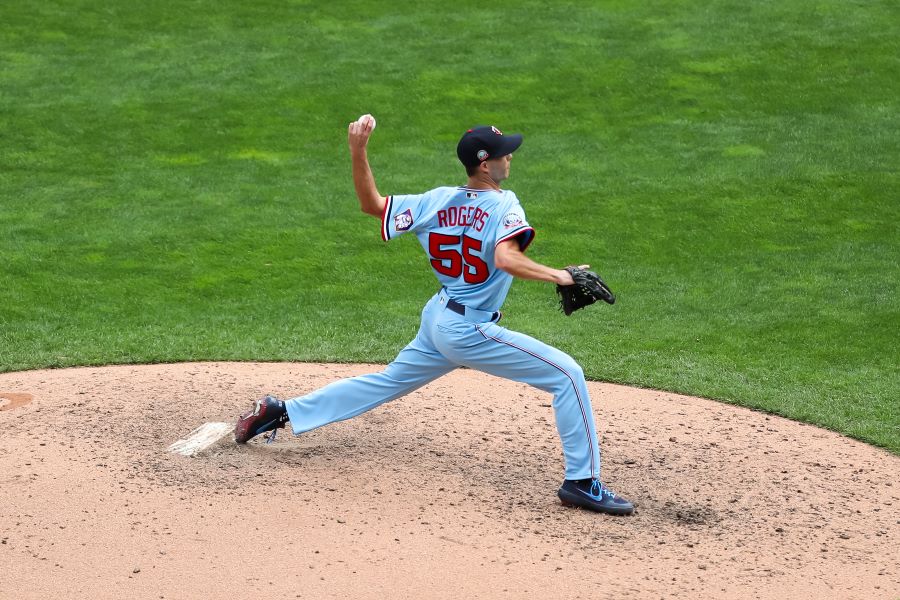
Last season was a rough one for the Twins’ erstwhile relief ace. He turned a corner in mid-2018, as he slowly added a slider to his sinker- and curveball-centric repertoire, becoming one of the game’s elite relief pitchers over the ensuing year and a half. In 2020, though, he lost the feel that allowed him to separate that slider from his curveball. As Rogers told Dan Hayes in September 2018, he grips the two pitches the same way, which can make differentiating them difficult at times. Like other pitchers throughout baseball, he clearly struggled with that very thing throughout the strange and shortened first pandemic season.
The problem is most easily illustrated by looking at Rogers’s average velocities on his two breaking balls. From the moment when he first unleashed the slider, it was a significantly firmer pitch than the curve. In 2020, he lost the extra velocity that gave the pitch such biting action, especially against righties.

In fact, he ran into some of the same problem in late 2019, but then, it predominantly took the form of his curve coming in too firm, with the shape and in the same velocity band as the slider. In 2020, he had the curve tuned to its usual pitch (no pun intended), but the slider took on the curve’s shape, as well as dropping to its speed range.

The results showed up in a slightly decreased whiff rate on the pitch, but much more so in the forms of more damage on both the curveball and the sinker. Without the hard, laterally-moving slider, the sinker was easier to spot and attack. The curve created less of a sinking feeling in the hitter’s stomach. The slider is more than just a whipsaw pitch in its own right, helping the hurler rack up strikeouts: it’s also supposed to keep hitters on the defensive. Rogers couldn’t do that last year.
When he took the mound Sunday in Fort Myers, though, Rogers had the nasty version of the slider back. Last season, Rogers didn’t average more than 83.0 miles per hour on the soldier in any individual appearance. For the year, he sat at 81.7 miles per hour with it. On Sunday, his five sliders averaged 84.7 miles per hour. He got in on right-handed hitters Connor Wong and Bobby Dalbec with it, drawing three swings and two whiffs. Unlike last season, when he often left the pitch over the middle, Rogers was able to steer the pitch where he wanted it to go.
This is no guarantee of success, of course, and Rogers could suffer further inconsistency as he moves through the month of preparation left before the season starts. Commanding two distinct breaking balls, especially for a pitcher who repeats their release point as robotically as Rogers does, can be very hard. The fact that he uses the same grip on each pitch only further complicates the process. For one game, however, he put on display precisely the pitch that went missing for him throughout a disappointing 2020.
MORE FROM MATTHEW
- Which Pitch Should Kenta Maeda Add in 2021?
- Alex Kirilloff, and the Truth About Scott Boras and Contract Extensions
- A Good Comp for Jhoan Duran and His Splinker
- How Well Could the Twins Hide Luis Arraez in the Field?
- The Biggest Red Flag for Byron Buxton's Bat




Recommended Comments
Create an account or sign in to comment
You need to be a member in order to leave a comment
Create an account
Sign up for a new account in our community. It's easy!
Register a new accountSign in
Already have an account? Sign in here.
Sign In Now