


Twins Video
The Twins don't have many holes, and even their worst-case scenarios look relatively rosy. However, spring training is the time of year during which smart contenders consider ways in which they might shore up their minor weaknesses and raise their floor ever further. To that end, Minnesota should explore the possibility of a trade for Cubs outfielder Albert Almora, Jr.
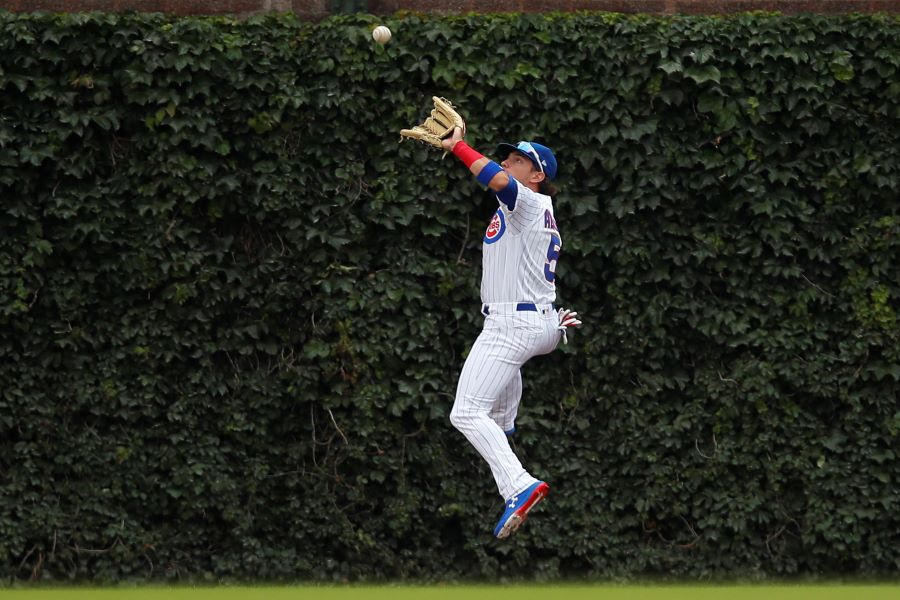
Before you ask, no, Almora isn't someone the Cubs are desperately trying to move, and no, he wouldn't be a notable improvement over Jake Cave or LaMont Wade as a regular fourth outfielder. However, the Cubs are infamously weak in an area (young pitching) in which the Twins are famously strong, and Almora would provide something the Twins do still need: a reliable, viable backup to Byron Buxton, capable of stepping in as an everyday center fielder if Buxton gets hurt and keeping the outfield defense intact. He has three years of team control remaining, including 2020.
Almora, who will turn 26 in April, went to the Cubs just four picks after the Twins took Buxton in the 2012 draft. If Buxton's path to establishing himself in the majors felt circuitous and frustrating, though, it was nothing to that of Almora, who battled hand and wrist injuries, was blocked for most of a season during which he seemed ready for the majors, and has been given only inconsistent opportunities over the last three seasons. That said, he's not wholly a victim of circumstance: He's yet to post a season in which he was even a league-average hitter, according to Baseball Prospectus's DRC+, and he's failed to rein in his plate discipline as the Cubs hoped he would.
Buxton and Almora are very different, in terms of style and profile, but similar in the shape of their overall value. Almora lacks Buxton's power potential and game-breaking speed, but has far superior feel for contact, and makes up for his lack of wheels in center field with terrific instincts. When right, he's well above-average defensively, and a line-drive hitter who can be a headache for left-handed pitchers.
Alas, for much of 2019, Almora wasn't right. He had a career-worst 72 DRC+, as he continued to hack away too often at pitches outside the zone. He put the ball on the ground far too often. Last spring, he benefited when the Cubs sent Ian Happ to Triple-A Iowa to open the season. By mid-summer, however, Almora had lost his starting job in center to Jason Heyward, and Happ came back up to push him into a true platoon role.
For the Twins to take interest in this particular target, they would need to believe they can do with Almora what they've done with so many other young hitters over the last two seasons. That would be a bet against the Cubs' player development, but bets against that particular element of the Chicago operation lately have tended to be wise ones. Almora showed up this spring talking about an overhauled swing, and there is certainly a real change. With his altered mechanics, he's already generated some impressive hard contact this spring, including a double and a home run, and he's more balanced, giving him a longer look at the incoming pitch and a better chance of laying off it if he doesn't like what he sees.
If those changes hold, or if the Cubs (or Twins) build upon them, it's easy to see Almora blossoming into a similar hitter to Buxton, albeit with less impactful defense and baserunning. PECOTA projects an unimpressive .249/.287/.384 batting line for Almora this year, which isn't exciting, but the system only forecasts Buxton to hit .230/.288/.437. When (more than if) Buxton goes down with an injury, Almora could provide a facsimile of his value on both offense and defense.
At the moment, the plan for any extended Buxton absence would seem to be to slide Max Kepler back to center field, with Marwin González becoming an everyday corner man and the roles of both Cave and Wade expanding considerably. Almora would change that. His presence would allow the team to keep Kepler in right field, where he's a Gold Glove-caliber defender. He'd also be a right-handed bat, helping maintain the balance at the bottom and turn of the batting order.
Over the last few years, as teams have reached Peak Bullpen and the squeeze on position players has gotten tighter, the priority for any team in building a bench has been flexibility. Any player slated for a backup role needed to do things someone else on the roster didn't do. Complementary skills were valued much more highly than redundancies.
With the addition of a 26th man and rules in place to prevent teams from further expanding their pitching staffs, that can start to change. The Twins could carry Almora as a late-game defensive replacement for Eddie Rosario, allow him to soak up the pinch-hit opportunities against lefties that would otherwise go (as his roster spot would) to Willians Astudillo, and have him handy as a high-upside replacement for Buxton when injury strikes. They'd still have room on the bench for Alex Avila, González, and Ehire Adrianza. Astudillo, Cave, and Wade, who all have minor-league options remaining, would remain available whenever need arose. For that matter, Almora can be optioned, too.
The Cubs would want a fairly solid young arm in exchange for Almora. The fifth spot in their rotation is a toss-up between veteran Tyler Chatwood and young hurlers Alec Mills and Adbert Alzolay, but the system is considerably more bullish on Randy Dobnak and Lewis Thorpe than on Alzolay or Chatwood, and even its pessimistic take on Devin Smeltzer puts him on even footing with Chatwood. With Jhoulys Chacín in camp, the Twins could part with one of those three in exchange for Almora, but even if they were unwilling to, they might tempt the Cubs with either Cody Stashak or Zack Littell, because Chicago's bullpen lacks the controllable, flexible arms with which Minnesota's corps is replete.
Moves that contain even a kernel of risk, as an Almora trade certainly would, are unappealing to teams in strong positions like the Twins' in February and March. If they're smart, though, Minnesota will keep their ears open and their thumbs limber, listening on offers and texting with executives throughout the spring. The worst-case scenario for this team isn't Buxton getting hurt, but rather, Buxton getting hurt at a time when any other player is also out, leaving them unable to shift their phalanx to cover their holes neatly. It's Buxton getting hurt while they don't have a solid defensive center fielder to keep their team defense together in his absence. It's having to go make a trade like the one outlined above, but in June or July, with the eyes of the baseball world on them and a whole lot less leverage than they have now.
Proactive teams can avoid major overpays during the height of trade season, the kind that cost valuable prospects who go on to be stars elsewhere, and still be ready for a long season and deep playoff run. The Twins can enjoy that kind of benefit by acting now to fill what might be their only important hole.
MORE FROM TWINS DAILY
— Latest Twins coverage from our writers
— Recent Twins discussion in our forums
— Follow Twins Daily via Twitter, Facebook or email




Recommended Comments
Create an account or sign in to comment
You need to be a member in order to leave a comment
Create an account
Sign up for a new account in our community. It's easy!
Register a new accountSign in
Already have an account? Sign in here.
Sign In Now