

Jump to content
Twins Daily
  • Create Account
  • Twins News & Analysis

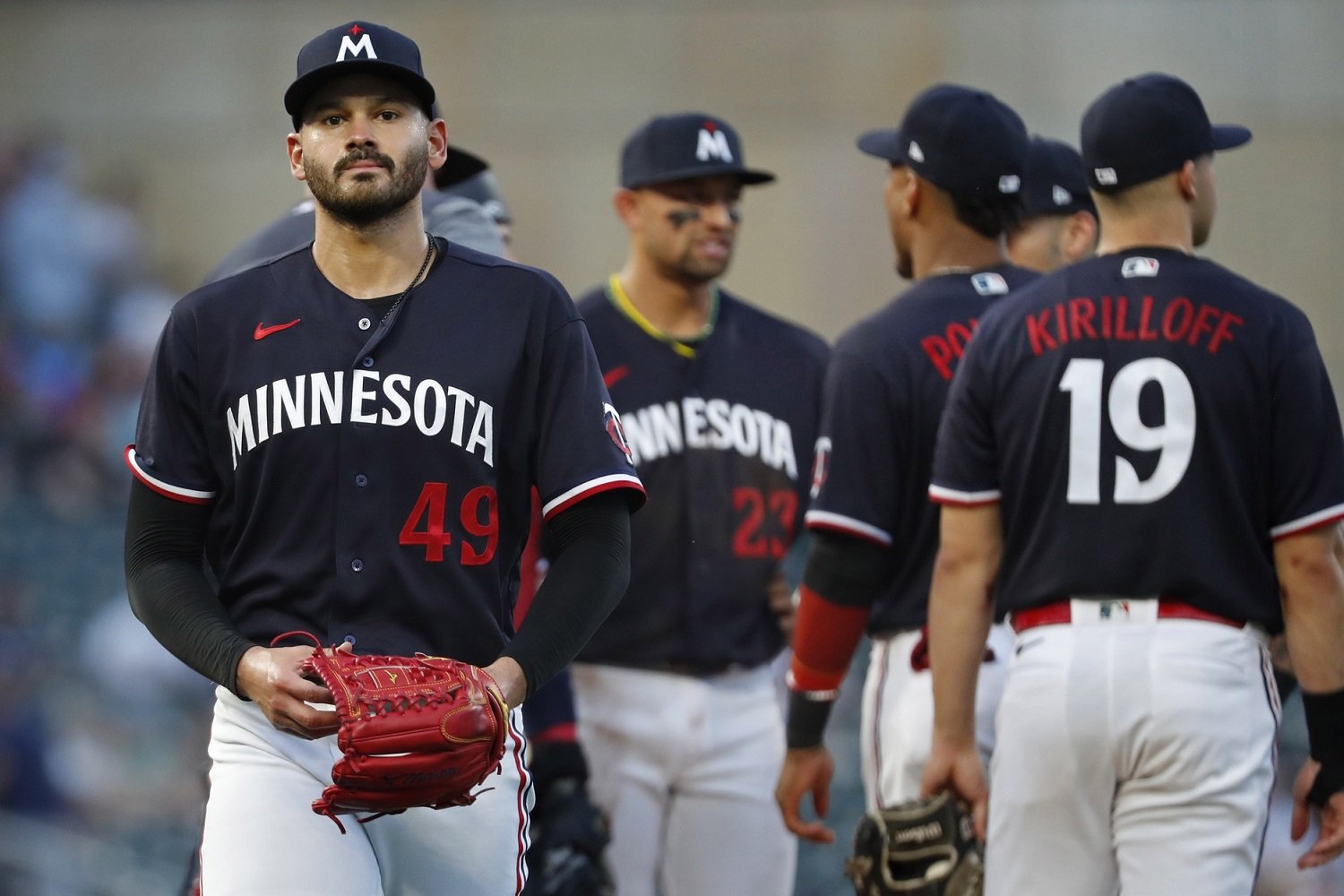
    Pablo Lopez is Better than His ERA


    Ted Wiedmann

    A 4.41 ERA may seem disappointing on the surface, but diving a little deeper into Pablo Lopez’s numbers show he’s pitched quite a bit better than that.

    Image courtesy of © Bruce Kluckhohn-USA TODAY Sports

    Twins Video

    Through Pablo Lopez’s first three starts as a Minnesota Twin, he looked to be the next Venezuelan sensation to come through this organization. However, a 4.25 ERA in May and a 5.04 ERA so far in June seem to tell a different story for the Twins’ starter. But what if we look past that big earned runs average stat? 

    The most significant change in Pablo Lopez’s game this year has been his ability to generate swings and misses. Lopez’s 30.1% K% ranks fifth in all of baseball among qualified starting pitchers, and his 23.3% K-BB% ranks third in the same qualifier. Lopez is also experiencing career highs in chase% at 36.2% and swing and miss% at 29.9%, compared to the league average at 28.4% and 24.8%, respectively. Pablo also has career bests in zone contact% 77.4% and chase contact% 55.1%, compared to the league average of 82.0% and 58.1%. 

    Why is this important? Striking hitters out is the most valuable skill a pitcher can possess. Infield bleeders and pop-up jam shots don’t exist on strikeouts. Neither does hard contact or home runs. I don’t believe it is a coincidence that of the top 30 pitchers in fWAR, only eight have a below-average strikeout rate. 
     
    Obviously, the counterpoint to all of this is that strikeouts are great, but the objective is not to give up runs, and Lopez has roughly a league average runs per game allowed. Well, that doesn’t all have to be attributed to Lopez. 

    For this, I’ll refer to Carlos Correa’s favorite stat on Baseball Savant, xwOBA. xwOBA, or expected weighted on-base average, measures the culmination of expected outcomes based on the quality of contact, in this case, given up by a pitcher. When you remove defense from the equation, Lopez’s .280 xwOBA is the 83rd percentile among qualified starters in baseball, with the league average being .316, meaning he doesn’t allow much hard contact. 

    Taking this one step further, we can measure his entire performance by adding his strikeout, walk, and hit-by-pitch results to his xwOBA into a single stat, expected ERA (xERA). Pablo Lopez’s xERA is currently 3.15, a much better mark than his 4.41 ERA. Out of pitchers allowing 200 balls in play, Lopez’s +1.26 difference in ERA vs. xERA is the seventh highest in MLB, just ahead of Yu Darvish and Sandy Alcantara.  

    Defense removed statistics apply particularly to Twins’ pitchers because the Twins’ infield ranks 29th in outs above average (OAA) with -15, and their outfield ranks 22nd in OAA at -3. Most notably, the Twins’ -17 OAA to left-handed hitters ranks 30th, with the 29th team having only -7 OAA to LHH, implying the right side of the infield is a huge issue. Being a pitching and defense team without playing defense is pretty challenging. 

    The last point I want to make is that Lopez seems on the wrong side of variance. In 2023 Pablo Lopez’s LOB% is 67.9%, well short of his career average of 72.0% and well below the 2023 league average of 71.9%. LOB% tends to be a highly volatile statistic, and given both his career LOB% and the metrics presented earlier, I would bet on this number settling around league average by the end of the season. 

    Pablo Lopez is producing similarly to the elite pitchers in baseball in many categories, and most importantly, ones that tend to be more predictive than ERA. It’s easy to see a big four in front of his ERA and assume Lopez pitched poorly this season, but if looked deeper, the Twins have gotten everything out of Pablo they could’ve hoped for this year. 

    Follow Twins Daily For Minnesota Twins News & Analysis

    Recent Twins Articles

    Recent Twins Videos

    Twins Top Prospects

    Marek Houston

    Cedar Rapids Kernels - A+, SS
    The 22-year-old went 2-for-5 on Friday night, his fourth straight multi-hit game. Heading into the week, he was hitting .246/.328/.404 (.732). Four games later, he is hitting .303/.361/.447 (.808).

    User Feedback

    Recommended Comments


    Featured Comments

    17 hours ago, Ted Wiedmann said:

    Forgive me if I misunderstand you, 

    But I think you answered your own question. If the ERA were high and there is lots of hard contact being allowed, that would make sense. However, Lopez is both striking out lots of hitters and also not allowing much hard contact but still holds a high ERA. The conclusion is then Lopez must be allowing runs on soft contact, which is not a sustainable way to score runs offensively. Therefore if Lopez continues to disallow hard contact, the amount of runs he allows decreases. 

    To your Buxton example, if he were to have half the hard contact rate he does but still a high batting average, I would say unless he starts hitting the ball harder it is likely his batting average decreases. 

    Have no fear; I am misunderstood every day.  It is what has made me so eloquent.  😌

    As for a Buxton, hard contact really means nothing if the metrics tells the opposition where to play the hitter.  You can knock the stuffing out of the ball if they are playing where you hit it.  If you play the whole field, and use the speed you have (if any) you can get by with virtually any contact and it will fall or roll where someone isn't enough of the time to succeed.  Yes, that will not give you the power stats you might want, but it is better than what we are seeing out of some of these guys.

    As for pitching, the same could be said.  Why does a pitcher try so hard for strike outs?  Because when the ball is put in play it may be put where there isn't someone there to catch it.  Or they will flub it.  Or throw it away, etc.  Contact, hard or soft, is a possible hit, or at least base runner.  Now, if the defense is playing the batters correctly, contact should also be right at them, or close enough.  So contact, in and of itself, is not bad; it is only bad in the pitcher's mind.  

    The speed off of the bat means absolutely nothing to me.  Using the whole field, and making the defense work harder than striking out a third of the time is the most important aspect of hitting.  And pitchers should embrace contact.  If they put the pitch where they want it, the batter will more than likely hit it where they want it.  And someone will be there, or close enough.  Strike outs pile on pitch counts, and when teams are married to pitch counts it limits the innings a starter can go, and taxes the bullpens.  I hope any of that made sense.  🥴

    19 hours ago, Ted Wiedmann said:

    What would you consider underlying metrics and what is invalid about them? 

    What would you call it when the “expected outcomes” continuously fail to materialize?  What metrics?  Whatever metrics that are predicting these mythical “expected outcomes “. 

    2 hours ago, Reptevia said:

    What would you call it when the “expected outcomes” continuously fail to materialize?  What metrics?  Whatever metrics that are predicting these mythical “expected outcomes “. 

    By definition expected outcomes that fail to materialize are outliers. While sporadic, they do happen from time to time. 

    You're also calling math and physics mythical in this statement. 

    4 hours ago, Mark G said:

    Have no fear; I am misunderstood every day.  It is what has made me so eloquent.  😌

    As for a Buxton, hard contact really means nothing if the metrics tells the opposition where to play the hitter.  You can knock the stuffing out of the ball if they are playing where you hit it.  If you play the whole field, and use the speed you have (if any) you can get by with virtually any contact and it will fall or roll where someone isn't enough of the time to succeed.  Yes, that will not give you the power stats you might want, but it is better than what we are seeing out of some of these guys.

    As for pitching, the same could be said.  Why does a pitcher try so hard for strike outs?  Because when the ball is put in play it may be put where there isn't someone there to catch it.  Or they will flub it.  Or throw it away, etc.  Contact, hard or soft, is a possible hit, or at least base runner.  Now, if the defense is playing the batters correctly, contact should also be right at them, or close enough.  So contact, in and of itself, is not bad; it is only bad in the pitcher's mind.  

    The speed off of the bat means absolutely nothing to me.  Using the whole field, and making the defense work harder than striking out a third of the time is the most important aspect of hitting.  And pitchers should embrace contact.  If they put the pitch where they want it, the batter will more than likely hit it where they want it.  And someone will be there, or close enough.  Strike outs pile on pitch counts, and when teams are married to pitch counts it limits the innings a starter can go, and taxes the bullpens.  I hope any of that made sense.  🥴

    I think I get what you're saying, and if I do then we found our point of disagreement.

    I don't think many hitters have control over the direction of a batted ball, just making contact is difficult enough as it is.  There are a select few in history that had/have the ability, but I believe for the most part it is random. I also think this has also gotten more difficult with the continuing development of pitching. If batted ball direction is random, then hit the snot out of it and hope for the best.

    On the flip side, I believe for a pitcher a strikeout is the best possible outcome for an at-bat, therefore pitchers should maximize their best possible outcomes. With each out being so precious, I think pitchers should be uncomfortable leaving outs up to chance. 

    Two different ways of thinking. 

    1 hour ago, Ted Wiedmann said:

    I think I get what you're saying, and if I do then we found our point of disagreement.

    I don't think many hitters have control over the direction of a batted ball, just making contact is difficult enough as it is.  There are a select few in history that had/have the ability, but I believe for the most part it is random. I also think this has also gotten more difficult with the continuing development of pitching. If batted ball direction is random, then hit the snot out of it and hope for the best.

    On the flip side, I believe for a pitcher a strikeout is the best possible outcome for an at-bat, therefore pitchers should maximize their best possible outcomes. With each out being so precious, I think pitchers should be uncomfortable leaving outs up to chance. 

    Two different ways of thinking. 

    That's all anyone can ask for.  Thanks.  

    19 hours ago, Ted Wiedmann said:

    By definition expected outcomes that fail to materialize are outliers. While sporadic, they do happen from time to time. 

    You're also calling math and physics mythical in this statement. 

    Um, no. I’m calling the underlying metrics suspect. When you say, “Successful players have this, this and this in common”, but then when other players share those traits and aren’t successful, it begs the question as to whether the original hypothesis is valid. The last three years are not a small sample size. Hardly small enough to be labeled an “outlier”. 

    26 minutes ago, Reptevia said:

    Um, no. I’m calling the underlying metrics suspect. When you say, “Successful players have this, this and this in common”, but then when other players share those traits and aren’t successful, it begs the question as to whether the original hypothesis is valid. The last three years are not a small sample size. Hardly small enough to be labeled an “outlier”. 

    If your're referring to players I'm not really sure what your're referring to either. Outside of Max Kepler, who has the largest wOBA/xwOBA difference over the last three years and that can still be explained fairly easily, who has underperformed based on batted ball and plate discipline data?

    On the pitching side I think the misses in the recent years have not been due to incorrect data, I would attribute them mostly to emphasizing the wrong characteristics in pitchers. But the data shows that their process of thinking was wrong. 

    I think the team coming to the wrong conclusion based on the data is different than the data being invalid, and I think that might be what your're saying. I could be misinterpreting. 

    11 hours ago, Ted Wiedmann said:

    If your're referring to players I'm not really sure what your're referring to either. Outside of Max Kepler, who has the largest wOBA/xwOBA difference over the last three years and that can still be explained fairly easily, who has underperformed based on batted ball and plate discipline data?

    On the pitching side I think the misses in the recent years have not been due to incorrect data, I would attribute them mostly to emphasizing the wrong characteristics in pitchers. But the data shows that their process of thinking was wrong. 

    I think the team coming to the wrong conclusion based on the data is different than the data being invalid, and I think that might be what your're saying. I could be misinterpreting. 

    Fair point. I may be giving them too much credit. It is true that I assumed that the  wunderkids were interpreting the data correctly.   I do not know for a fact that they were. I assumed when they batted Kepler cleanup 56 times last year that they were following some metric that informed them it was a good idea. Maybe not?  I also assumed that when they instruct the entire lineup to stand at the plate and swing like Stevie Wonder with a light saber that some metric was informing that instruction. Maybe not?

    López has provided a lot of innings and that alone has value. His underlying metrics are as good or better than his previous seasons and yet his ERA and runs allowed are up. It would make sense for things to normalize, but sometimes they don't over the course of a year.

    Some guys constantly underperform their metrics (ex-Twin Ricky Nolasco comes to mind), but usually things do normalize. As long as Pablo stays healthy, I would expect his W-L and ERA to improve.


    Create an account or sign in to comment

    You need to be a member in order to leave a comment

    Create an account

    Sign up for a new account in our community. It's easy!

    Register a new account

    Sign in

    Already have an account? Sign in here.

    Sign In Now

×
×
  • Create New...


