


Twins Video
“You are always trying to adjust. And if you want to be successful you have to adjust ahead of the curve and not behind it. That’s in the back of my mind.”
When he thinks about it, Perkins believes that the knee surgery he had in the offseason prior to 2014 may have played a role in his velocity decline last year. At the same time, as a consumer of baseball analytics and advanced research, the Twins closer is also acutely aware of the realities of getting older.
“I felt like I was playing catch-up a little bit all last year,” Perkins said. “I felt I was out of my comfort zone, kind of the whole season. I’m probably around the same [velocity] this year than I was last year so maybe it has got something to do with being 32 instead of 28.”
Research has found that starting around the age-30 season, a pitcher’s velocity tends to make a southward turn. No one stays young forever. Save for a catastrophic arm injury, it typically is a gradual decline, but a decline nonetheless. A reduction in velocity does not necessarily doom a closer, either. For instance, former Twin Joe Nathan saw his velocity begin to slip after 2007 and followed that in 2008 with just as successful a season if not better. He continued to produce at high levels even after having Tommy John surgery and with a slower fastball.
Whereas Nathan remained primarily fastball-slider pitcher, Perkins entertains the idea of adding to his pitch selection, even if not in the near future. The change-up has become the pitch du jour and Perkins toys with it when playing catch with guys like Brian Duensing just to ensure he can pull it out when necessary.
“I play catch with it, I work on it, but I don’t throw it until I have to,” said Perkins. “I’ve already started to work on that because it was a good pitch when I was a starter and became a bad pitch when I was a reliever. It’s something that I don’t all of a sudden want to be like ‘oh crap, I can’t throw a fastball by anybody I need to throw a change-up, how do I throw a change-up?’”
The new change-up revolution in the Twins clubhouse intrigues Perkins, to say the least, and pitching coach Neil Allen’s theories have grabbed his attention.
“I don’t want to give away all his secrets. I know that he’s a little bit analytical but not really but the stuff that he tells me that I see from an analytical side and it’s stuff that makes a lot of sense. I talk to hitters when we are playing cards after the game or standing in the dugout or whatever and the kinda things they are thinking, so he’s thinking from a hitter’s perspective on it.”
Perkins does not feel like he needs to a third pitch at this point in his career. He will cross that bridge when he gets to it. More importantly, he needs to stay healthy.
“Last year, for five months, whatever my velocity was I was probably having my best season as a reliever up until August.”
From April until the end of June the closer was striking out 32 percent of all opponents faced while walking 4 percent. Those figures put him among the American League’s elite relievers. Even with a slightly slower fastball he was in the middle of what was shaping up to be a career year. However Perkins said his forearm started to respond differently after outings, bullpen sessions and throwing in general.
Perkins described the injury and the effect on his pitching as the sensation of after maxing out on arm curls. His forearm would be exhausted and numb. It was difficult to engage the muscles and resulted in an overall lack of connection with the ball. For pitchers, this is a significant problem.
“You can’t finish a pitch,” he said. “I would try to throw a slider I just couldn’t get the last little bit of the whip. You don’t have the spin. So you lose movement, you lose the life. The life and movement is the spin. Guy with late life spins the ball faster than a guy without late life.”
The lack of that “last little bit of whip” on his slider played particularly poorly in the second-half of the season. While it had been the premier pitch in his arsenal in the first-half, racking up a swing-and-miss rate of 43 percent and a .118 opponent average, it became a considerable liability in the season’s back-end. The swing-and-miss rate dropped to 21 percent and hitters managed to levy a .282 average off of it.


You do not have to be a baseball expert to see the contrast between his slider location as the season progressed. Without the slider diving down, his ability to induce swinging strikes suffered.
Like most baseball players who thrive on competitiveness and pride, Perkins continued to try to take the ball whenever summoned. He went out to pitch “five or six times” while trying to get additional treatment and a few extra days of rest. Each time he would hope to rebound and that the muscle inflammation would go away and he would return to being the team’s shutdown closer. It was then when he started to consider the alternatives.
“You try to tell [the staff] how you feel and it’s not getting better, it’s getting worse and you are hoping that they say ‘you know what? let’s shut it down’ and then it’s not me doing it. Even though that’s what I wanted, that's what I needed to do.”
On September 16 Perkins was called on to hold a 2-0 lead against Detroit. After allowing several base-runners, Perkins was close to escaping the inning when he surrendered a three-run home run off the bat of JD Martinez. It was a 92 mile per hour fastball that didn’t come out of his hand well, like others before that one. That was the moment he knew he had gone from shutdown closer to shut it down, closer.
“I had no business being out there. I knew I had no business getting major league hitters out.”
Tests revealed that he had a combination of muscle and nerve irritation and inflammation in his forearm. One was getting inflamed and irritating the other. The consequence was a disconnect when finishing his pitches.
“It wasn’t a hurt, it wasn’t a pain,” he said trying to make sense of the ailment. “It was a lack of any pain or feeling. Pitchers talk about feel and there wasn’t any of that. There was no feel for pitches, no feel for getting out front, no feel for being able to finish a pitch.”
That, Perkins says, is no longer an issue at this point.
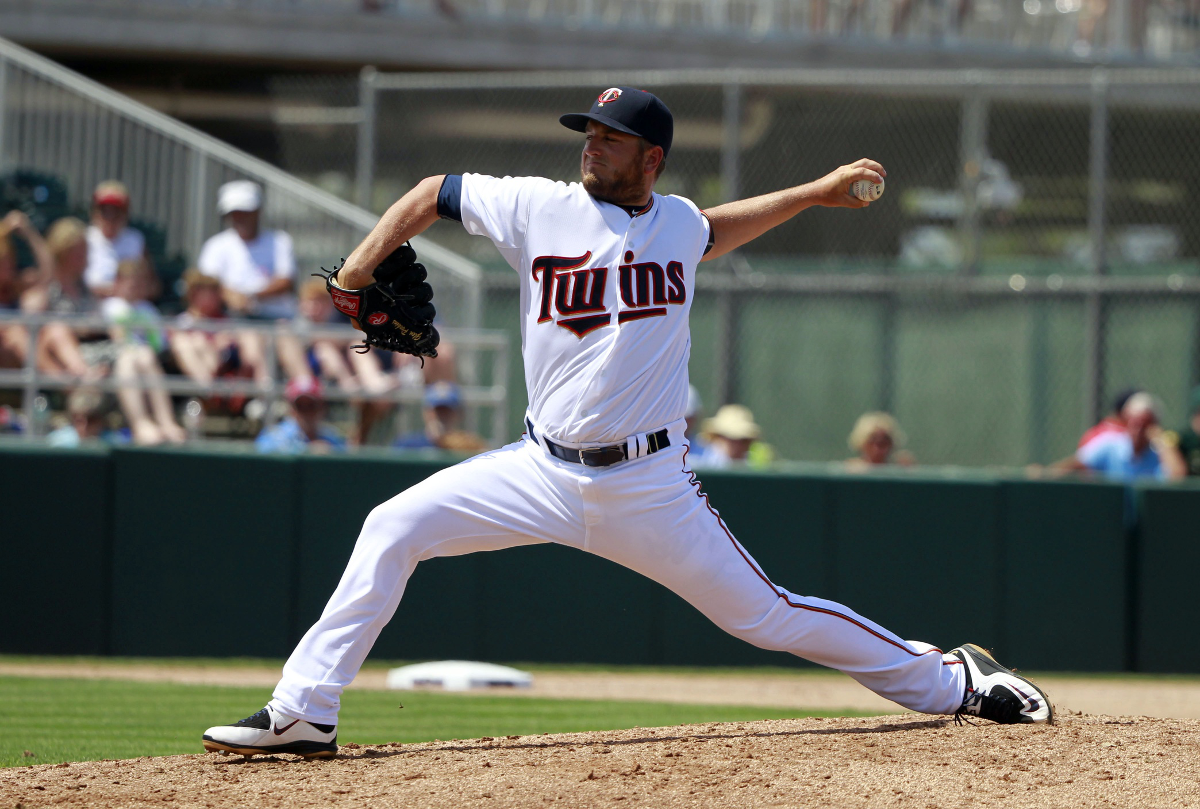
In his outing on Wednesday, throwing in consecutive games for the first time in the spring season, Perkins was hitting 91 to 92 with his fastball. Down but not entirely unexpected for this time of year. An oblique strain slowed his spring this year and limited his appearances. He’s aware that he has been behind but is catching up quickly. Even with time off, Perkins feels that he is in a much better place now than at this time last year. Manager Paul Molitor agrees that his closer is starting to return to form.
“It seems with each outing he’s been a little crisper,” Molitor observed after the game. “His breaking ball was a little better today that’s one pitch that I think has been a little slow for him to come around with.”
At least on paper the Twins bullpen appears shaky, From his perspective Glen Perkins feels that he is more than ready to provide the same high-quality pitching he did prior to the second-half of 2014.
“I feel a lot better," Perkins says reflected on how he felt this year compared to a year ago. "I always felt like I was a week behind and my arm wasn’t catching up. As far as this spring from last spring, I feel a lot better. I just don’t want to have this forearm thing to crop up. If I can avoid that, I’ll be just fine.”





Recommended Comments
Create an account or sign in to comment
You need to be a member in order to leave a comment
Create an account
Sign up for a new account in our community. It's easy!
Register a new accountSign in
Already have an account? Sign in here.
Sign In Now