


Twins Video
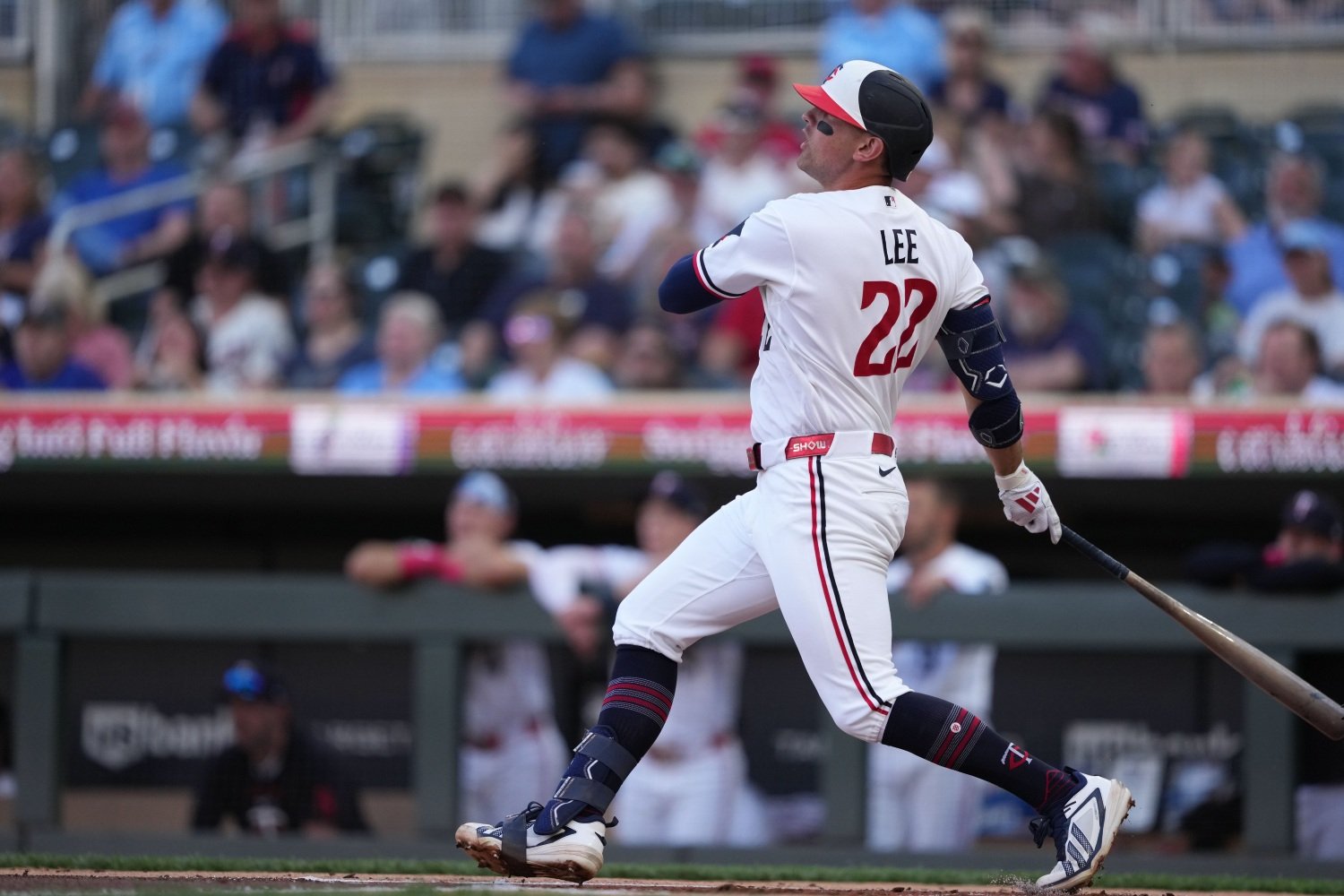
Brooks Lee is currently having the best season of his major-league career. Entering Tuesday night's game, the Twins infielder is hitting .238 with a .293 on-base percentage. On the surface, those numbers don't exactly jump off the page. If you looked at the stat line without any additional context, you probably wouldn't think much of it. But there's more to Lee's season than his batting average. The biggest difference has been the power.
Lee already has 12 home runs this season and is on pace to finish the year with a career-high 25. His slugging average has jumped more than 50 points from where it sat a season ago, and for the first time since arriving in the big leagues, it feels like he's beginning to establish himself as a legitimate major-league hitter.
That doesn't mean everything is perfect. There are still parts of Lee's offensive profile that could be improved, adjusted, or refined moving forward. One of those adjustments, in my opinion, should be abandoning switch-hitting and becoming a full-time left-handed hitter.
Now, before you immediately disagree and close the tab, hear me out. Switch-hitting works for a lot of players. There are plenty of hitters throughout baseball history who have built successful careers by hitting from both sides of the plate. If you think Lee should continue switch-hitting, that's completely fair. But I think there's at least a conversation to be had.
The first thing worth acknowledging is that the historical data doesn't necessarily support my argument. Over the course of his major-league career, Lee has actually been a better hitter from the right side of the plate. As a right-handed hitter, he's posted a .249 batting average. As a left-handed hitter, that number drops to .228. His career on-base percentage is also 11 points higher from the right side. So yes, if we're looking strictly at career batting average and OBP, I'm not exactly building a great case.
But the 2026 version of Lee has looked very different. This season, the numbers have essentially flipped. Lee has been a better hitter from the left side of the plate, and it hasn't been particularly close. His batting average is 36 points higher as a left-handed hitter, and his OPS is 119 points higher. He's also striking out less from the left side, which is something that's been true throughout his major-league career.
When Lee bats left-handed this season, he owns a 107 wRC+, meaning he's been comfortably above league average offensively. From the right side, however, he owns an 80 wRC+. That's a pretty substantial difference. Of course, there’s a reasonable counterargument here: we're talking about roughly three months of data. That's not nothing, but it also isn't enough to completely ignore everything we've seen previously. There's a very real possibility that I'm overreacting to a relatively small sample that happens to run contrary to his historical production. But perhaps it's also possible that we're seeing something more meaningful.
Even when you zoom out and look at Lee's entire major-league career, there are signs that his left-handed swing might be the more impactful version. Despite having a higher batting average and on-base percentage from the right side, Lee's career OPS is actually higher as a left-handed hitter. He hits for considerably more power from the left side of the plate, but as I mentioned earlier, he strikes out less as a left-handed hitter, too. I'd also argue he's been a bit unlucky. As a right-handed hitter, Lee owns a career .286 BABIP. That's a perfectly normal number. It doesn't scream bad luck, nor does it suggest he's been unusually fortunate.
As a left-handed hitter, however, his BABIP sits at just .238. While BABIP isn't perfect, it can give you a pretty good idea about whether a hitter's results accurately reflect the quality of contact he's producing. A .238 BABIP would suggest Lee has likely been on the wrong side of some batted-ball luck as a left-handed hitter, meaning there's a good chance his production should look even better than it already does.
We're finally seeing the first legitimate offensive breakthrough of Lee's major-league career, and much of that success has come from one side of the plate. Matt Trueblood wrote about this earlier today, in a way, when he noted that Lee has made two different adjustments this year: one to become a more competent actual hitter, and one merely to wait out more at-bats and draw some walks. Guess which side's adjustment is which.
Again, this isn't meant to be an indictment of switch-hitting in general. For players who can effectively do it, switch-hitting provides a significant advantage. Being able to maintain the platoon edge almost every time you step into the batter's box is a valuable skill.
But not every hitter benefits equally from it. Some players ultimately find more success by focusing on one swing, rather than maintaining two. A recent example is Cedric Mullins. Mullins entered professional baseball as a switch-hitter but decided to become a full-time left-handed hitter before the 2021 season. That year, he broke out massively, hitting .291 while becoming an All-Star and one of the few players in baseball to produce a 30-homer, 30-steal season. Giving up switch-hitting isn't all that uncommon. Tucker Barnhart did it recently, too. A couple big-leaguers elect to stop switch-hitting every decade.
Now, to be clear, I'm not suggesting Lee is suddenly going to become a 30-30 player if he gives up switch-hitting, and I certainly wouldn't recommend looking too closely at how Mullins's career has unfolded since then. But his story does illustrate an important point: some hitters benefit from simplifying things. Sometimes one swing is better than two. Whether Lee ultimately makes that change is another question entirely. It's not something that the Twins would seriously consider until the offseason, but as Lee continues to take steps forward offensively, I think it's a discussion worth having.
The historical numbers may not fully support it yet, and the sample size may still be relatively small. But between the power production, the improved strikeout rates, the stronger underlying results, and what appears to be some poor luck from the left side, there's enough evidence to at least wonder. If Lee's offensive breakout is just beginning, perhaps the next step is committing to the side of the plate that appears to bring out the best version of his bat.





Recommended Comments
Create an account or sign in to comment
You need to be a member in order to leave a comment
Create an account
Sign up for a new account in our community. It's easy!
Register a new accountSign in
Already have an account? Sign in here.
Sign In Now