Jump to content
Twins Daily
  • Create Account
  • Twins News & Analysis

    Chasing An Ace


    Nick Nelson

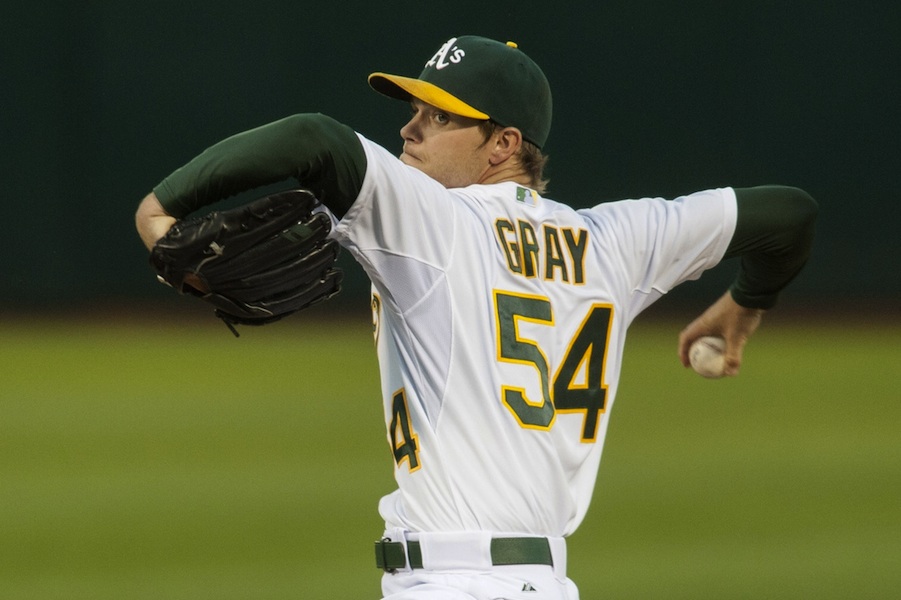
    Last week, on Twitter and in the Twins Daily forum, I posed a hypothetical question: If you were the Twins GM, and you had the chance to trade Jose Berrios and Max Kepler for Oakland's Sonny Gray, would you do it?

    The responses varied widely – everywhere from "Yes, in a split-second" to "Not in a million years." But the uncomfortable proposition of parting with both the organization's reigning minor-league pitcher and hitter of the year highlights a dreary and relevant reality: Acquiring an "ace" pitcher is really, really difficult.

    Image courtesy of Ed Szczepansk, USA Today

    Twins Video

    Outlook for the 2016 Rotation

    The Twins had plenty of solid depth in their starting corps this season, with five different starters making 15-plus starts and posting an ERA that was close to or slightly above average.

    What was lacking, however, was a true standout No. 1. Kyle Gibson earned that billing by default, as he led the way in innings and ERA, but his ERA ranked 48th among big-league starters and his K-rate ranked 60th. A match-up between Gibson and someone like David Price, Cole Hamels or Dallas Keuchel in a Game 1 postseason tilt would have been tragically lopsided.

    So as the Twins try to solidify themselves as true contenders this offseason, the search for that top-tier arm to lead the rotation is a primary consideration, and one that we cover extensively in the upcoming Offseason Handbook (now available for preorder!).

    Before we dig into the topic here, let's ask ourselves a question:

    Does An Ace Really Matter That Much?

    It seems inherently obvious. Many teams have ridden their horse to October glory, with last year's Giants and Madison Bumgarner serving as a prime example.

    But having that premier starter at the front of your rotation doesn't come close to guaranteeing anything. This year, we saw the Royals ship out some great young talent to acquire Johnny Cueto from the Reds at the deadline, only to watch the righty post a 5.27 ERA in 16 starts between the regular season and postseason.

    Cueto was pretty much the definition of an ace starter when Kansas City acquired him. He'd been Cincinnati's No. 1 for years, had pitched in big postseason games, and had the second-lowest ERA among all MLB starters since 2011, trailing only the inimitable Clayton Kershaw. Yet, as the Royals learned, and as the Twins have learned on a smaller scale with Ervin Santana and Ricky Nolasco, you don't always know what you're getting.

    Even when a top starter does pitch up to his ability, it's not some magical elixir that assures postseason success. The Twins went to the playoffs four times from 2002 through 2006, and the only time they won a series was when Johan Santana was NOT in the rotation.

    Paying The Price

    In any case, clearly, having a high-end starter fronting the rotation makes a team better, both in the regular season and playoffs. So what would it cost for the Twins to reel in an elite pitching talent?

    The top name on the free agent market is David Price, who could land a record-setting deal coming off a Cy Young caliber season in which he had an enormous impact for the Blue Jays following a deadline trade. It seems safe to assume that the Twins won't go north of $200 million on any contract.

    Next in line are names like Zack Greinke, Cueto and Jordan Zimmermann, but each is likely to ink a nine-figure contract. That's probably too steep. In fact, almost any lucrative long-term deal for a starter is difficult to fathom when the Twins have committed a total of $170 to Santana, Nolasco and Phil Hughes over the past two offseasons.

    Those big commitments to middling veterans are really limiting the Twins' flexibility to make a meaningful plunge into the pitching market. It'd be nice if they could take all those deals back and put that combined sum toward one elite arm, but alas.

    Outside of free agency, the avenue for acquiring a big-name starter would be a trade. As the Berrios/Kepler-for-Gray scenario illustrates, going this route would require a painful exodus of high-caliber young talent. Still, it might be worth it. Gray has established himself at a level Berrios can only hope to reach, and will be controlled at a reasonable price for many years. He's only one example, but he's certainly the type of player that Terry Ryan should be targeting if he's willing to pony up with some of his top prospects.

    Searching Within

    The alternative to all this, of course, is to stand pat and hope that someone emerges from within to provide the Twins with a legitimate No. 1 starter. I see three paths to this outcome that aren't completely unrealistic:

    1) Ervin Santana pitches like he did in September for most the season.

    When the Twins signed Santana to a franchise-record free agent deal last winter, they were hoping he could become that No. 1 guy for them. He certainly looked the part at times. In his first four starts and last seven starts, he combined to go 7-1 with a 1.97 ERA and 1.00 WHIP. That's ace type stuff, for sure. Of course, the problem was that in between those stretches he endured a miserable slump. That's always been the story for Santana: flashes of brilliance amidst consistent inconsistency. There's a reason he has only twice posted an ERA+ higher than 111. It's tough to believe he'll pull it together for a full year, especially as he ages into his mid-30s and surpasses 2,000 innings in career workload.

    2) Phil Hughes reverts to 2014 form.

    It gets overlooked a bit since the Twins lost 92 games, but Hughes really was an ace-caliber starter in his first season with Minnesota. He set an MLB record for K/BB ratio, his 2.65 FIP was sixth-best in baseball, and he was "quality" in 20 of his 32 starts. This year, Hughes' HR-rate spiked while his strikeouts plummeted, but decreased fastball velocity (attributable to back problems?) appeared to be the main culprit. He did maintain his elite control, proving that 2014 was no fluke in that regard, so if he can regain the zip on his heater and start missing more bats he has a chance to get back to that level. Hughes doesn't turn 30 until next June.

    3) Jose Berrios fulfills his promise.

    Since he lacks the prototypical frame of a front-end workhorse starter, Berrios' ability to develop into the pitcher that his spectacular minor-league numbers foretell has always been in question. Yet, the kid just continues to dominate older and more experienced competition at every stop. And he's the one pitcher in the mix for the Twins who, in terms of pure stuff, can match up to the top dogs on contending clubs.

    Personally, I think the chances of at least one of the three possibilities mentioned above coming to fruition are good enough that I'd forego taking the drastic steps necessary to acquire an established No. 1 starter externally.

    How about you?
    Follow Twins Daily For Minnesota Twins News & Analysis

    Recent Twins Articles

    Recent Twins Videos


    User Feedback

    Recommended Comments


    Featured Comments

    It's time to really get serious about converting some of these minor league starters into relievers. I mean this ranges from Pat Dean to Taylor Rogers, too. Rogers has multiple pitches and hits 92-93 with regularity. That could jump to Trevor May velocity in the bullpen. As a lefty.


    Duffey *might* end up there too.

    If a team has the money, you gamble. This last season, the Twins put a lot of money into their rotation. They lost, but the team did better than recent years. Go figure. You always run the risk of a bad investment (that is what you have analytics and scouts for, right). You have to be willing eat a certain amount of salary every season. They did it with Joe Mays, to a lesser extent Nick Blackburn, once for Joe Nathan. It happens. Be prepared to not have your "superstars" on the field. It is the longterm eating of a contract that literally sucks. 


    Do you trade prospects? Same issue. How many prospects in the Top 20 make it to the majors. How many actually play in the majors for any extended amount of time. A quick look at the past decade of Twin draftees shows that you are lucky if 5-6 guys make the majors, and not necessarily with your own team. And here is another area that you are spending good money and not getting the results that you may want.


    Ultimately, my definition of a top of the order sarter, or an Ace, is someone who consistently year-after-year gives you starts and innings (preferably 200 these days) and keeps you in the game. I have never totally embraced the idea of having your "ace" start against another team's ace, especially in, say, the playoffs or World Series. One of these "aces" has to lose. You might do better having your next guy pitch against their ace and have your ace come back against a lesser pitcher. A year long battle of aces could have one guy with a 20-10 record and a 2.98 ERA and the other with a 10-20 record and a 2.99 ERA, 


    How much is that worth? 


    I have also been a firm believer that you do develop your own talent and when that talent produces for you, you reward them with contracts and salary for what they are doing and have done. When you pay out outrageous monies based on what someone ahs done with another team (different home park, different offense, different bullpen) you are paying for soemthing that will go bust more often than not. At least when that homegrown talent busts, you can tell yourself you were underpaying them in early years.


    Looking at the Twins in 2015, what would it have been like to have David Price on the mound with the team? Would he been equally successful? Are a pitchers numbers like Grienke skewed because he faces a pitcher as a batter in the National League?  Would we rather have three $15 million dollar pitchers and have one go down than one $25 million pitcher who goes down (and, yes, we had three that did partial work last season, I know). 


    In the game of baseball, someone wins, someone loses. Your best and their best still results in someone not winning.


    Oh?  You have some evidence of that?


    I see plenty of variation.  There are plenty of aces that struggle and lots of the Ryan Vogelsongs of the world.  If you have some sort of mass study on it I'd love to see it.  Otherwise it's easy to see just from pulling up this playoff year (and it's true for most you look at) that being the "ace" of your staff doesn't mean you won't be outperformed badly by dudes like Marco Estrada.  Every postseason is littered with dud performances by aces and surprising #3 guys that carry their team.


    And it shouldn't be a surprise.  The playoffs are just a grandiose small sample themselves.

    You really don't think that better pitchers outperform average pitchers if you use several years of playoff data (to get enough sample size)?


    Using your argument the Twins should not bother to look for great hitters because Plouffe or Rosario will go on a Daniel Murphy tear and be better than a Miguel Cabrera level hitter.  Of course there will be 10 game stretches where Plouffe is a better hitter than MCab but if you combine 20 Plouffe level hitters over 10 game stretches then you will find that the elite hitters were decidedly better.


    The playoffs are a small sample size but that doesn't mean that you can expect a Marco Estrada level pitcher to outperform a Price level pitcher going forward.


    You really don't think that better pitchers outperform average pitchers if you use several years of playoff data (to get enough sample size)?


    Using your argument the Twins should not bother to look for great hitters because Plouffe or Rosario will go on a Daniel Murphy tear and be better than a Miguel Cabrera level hitter.  Of course there will be 10 game stretches where Plouffe is a better hitter than MCab but if you combine 20 Plouffe level hitters over 10 game stretches then you will find that the elite hitters were decidedly better.


    The playoffs are a small sample size but that doesn't mean that you can expect a Marco Estrada level pitcher to outperform a Price level pitcher going forward.


    Well, that wasn't my argument at all.  My argument (and it was stated pretty clearly) was that the best thing you can do is upgrade your 25 man roster and you should do that however the availability of talent allows you to do that.  Don't fall over yourself for one position, but do what adds the most for the money you have.  So no, that entire middle paragraph is a strawman.


    And I don't "think" this is true.  The stats say it's true.  Pull up the playoff stats for pitchers and see for yourself.  Here are the three best starters from the last few years:


    2015 - Estrda, Kuechel, Kershaw   (Worst: Hammel, Cueto, Price)

    2014 - Bumgarner, Lynn, Ventura  (Worst: Shields, Kershaw, Peavy)

    2013 - Lester, Lackey, Verlander (Worst: Buchholz, Lynn, Peavy)

    2012 - Vogelsong, Fister, Sanchez (Worst: Bumgarner, Wainwright, Gonzalez)

    2011 - Carpenter, Colby Lewis, Gallardo (Worst: Grienke, Verlander, Scherzer)

    2010 - Lewis, Bumgarner, Lincecum (Worst: Sabathia, Hunter, Sanchez)


    It's all over the map. (Approximations) Guys go back and forth, in and out, every year.  Colby Lewis twice kicked the crap out of the playoffs.  Ryan Vogelsong pretty much won a World Series himself.  Guys who are good often suck terribly.  Sometimes they're as great as advertised, sometimes not.  The same goes with hitters for that matter.


    The point is that there is no silver bullet.  The best thing you can do is field the best 25 man roster you can and not worry about how many aces you have.  Spend what you have available to make as robust a team as you can, you never know who is going to step up and be the hero if you have enough capable dudes on your team.

    For what it's worth, the only players I am interested (and who have value) in trading in the org are:


    Trevor Plouffe, Kurt Suzuki, Tommy Milone, Josmil Pinto, Kennys Vargas, Casey Fien, Kohl Stewart, Travis Harrison, Levi Michael, and Danny Ortiz.


    Catcher, setup man, and top 10% starting pitcher are the only real MLB positions I would be interested in getting, anyone else being prospects.


    Catcher, setup man, and top 10% starting pitcher are the only real MLB positions I would be interested in getting, anyone else being prospects.


    Top 10% SP is a very tall order.  Here is the math:  30 teams, lets say 7 SP each = 210 SP in the majors.  Top 10% means up to number 21.    Here are the SPs ranked by xFIP in the majors in 2015 (100 IP + so you take care of the 6th and 7th pitchers of each team.  And need a rate measurement like xFIP and not  a cumulative one like WAR.)


    Greinke, Price and Harvey are ranked 19th-21st, so they round up that 10%.  (Highest ranked Twins' pitcher was Gibson at 66 FWIW.)   SIERA is probably a bit better measurement and the results you get are pretty similar.  

    Where it gets interesting is that even with the 100 IP, the total list is 133 pitchers, which is much less that 6 or 7 by each team.  (so the cuttoff for top 10% is 13...  Tough list.)  To get a bit more realistic sample size, you have to drop all the way to 50 IP where you get 186 SP and the top 10% is 19.  


    Still very tough list that top 10% :)  (but the Mets have 3, which tells you a lot for the reasons they are there.)


    (highest Twins in that latest exercise are Tyler Duffey at 53 and Trevor May at 57.  More like top 30%  Gibson Drops at 93 (50th percentile) and Hughes and Santana are in the 65th-75th percentile.


      Here are the SPs ranked by xFIP in the majors in 2015

    Ay caramba. None of these guys have much of a chance of being pried away. Even going further down the list into the 30s and it's tough to imagine... until I come to the name Sonny Gray. Shades of another TD thread. :)


    Ay caramba. None of these guys have much of a chance of being pried away. Even going further down the list into the 30s and it's tough to imagine... until I come to the name Sonny Gray. Shades of another TD thread. :)


    To me the most interesting name in that list is Pineda.  His ERA and W-L was mediocre, and really did not produce in NY.  Wonder if someone like Dozier might be interesting to them as a bait enough to center a trade around those 2...

    It helps the odds to add better players, that's for sure.  The problem is that people believe that having an ace is a prerequisite for even being considered a contender.   The Twins need a better 25 man roster and there are many ways to skin that cat.


    Personally, right now, I don't think all in on an ace is the way to go.  Ride the excellent fielding outfield, pay up for Chris Davis, and find a way to upgrade the catching spot.  Let the kids play.

    I really like this post!


    My one concern with moving Plouffe is the high potential but tenuous OF situation for 2016. Like Leviathan, I believe Buxton should be in CF. Great defense, tremendous tools and potential...he can learn a bit on the fly. (I believe his 2015 experience and talent will allow him to do so) Rosario is obviously in left. And until Kepler is ready, Hicks, or possibly Hicks/Arcia can man RF. I still wouldn't mind a veteran LH bat for a bench role, but that's a rather small piece vs a larger discussion here.


    But if the Twins are truly intent in their belief of placing Buxton in Rochester to begin the year, and Plouffe IS traded, then DH and RF becomes a whole lot more tenuous. A Davis signing provides another high quality hitter for the DH spot, improves and deepens the lineup, and you mow don't miss Plouffe. (Or Hunter's 22 HR for that matter)


    Add a reliever from both sides of the mound, and this team looks really good to me for 2016 with some very talented milb depth in the wings.


    Create an account or sign in to comment

    You need to be a member in order to leave a comment

    Create an account

    Sign up for a new account in our community. It's easy!

    Register a new account

    Sign in

    Already have an account? Sign in here.

    Sign In Now

×
×
  • Create New...