Jump to content
Twins Daily
  • Create Account
  • Twins News & Analysis

    Can Aaron Hicks Be Fixed?


    Parker Hageman

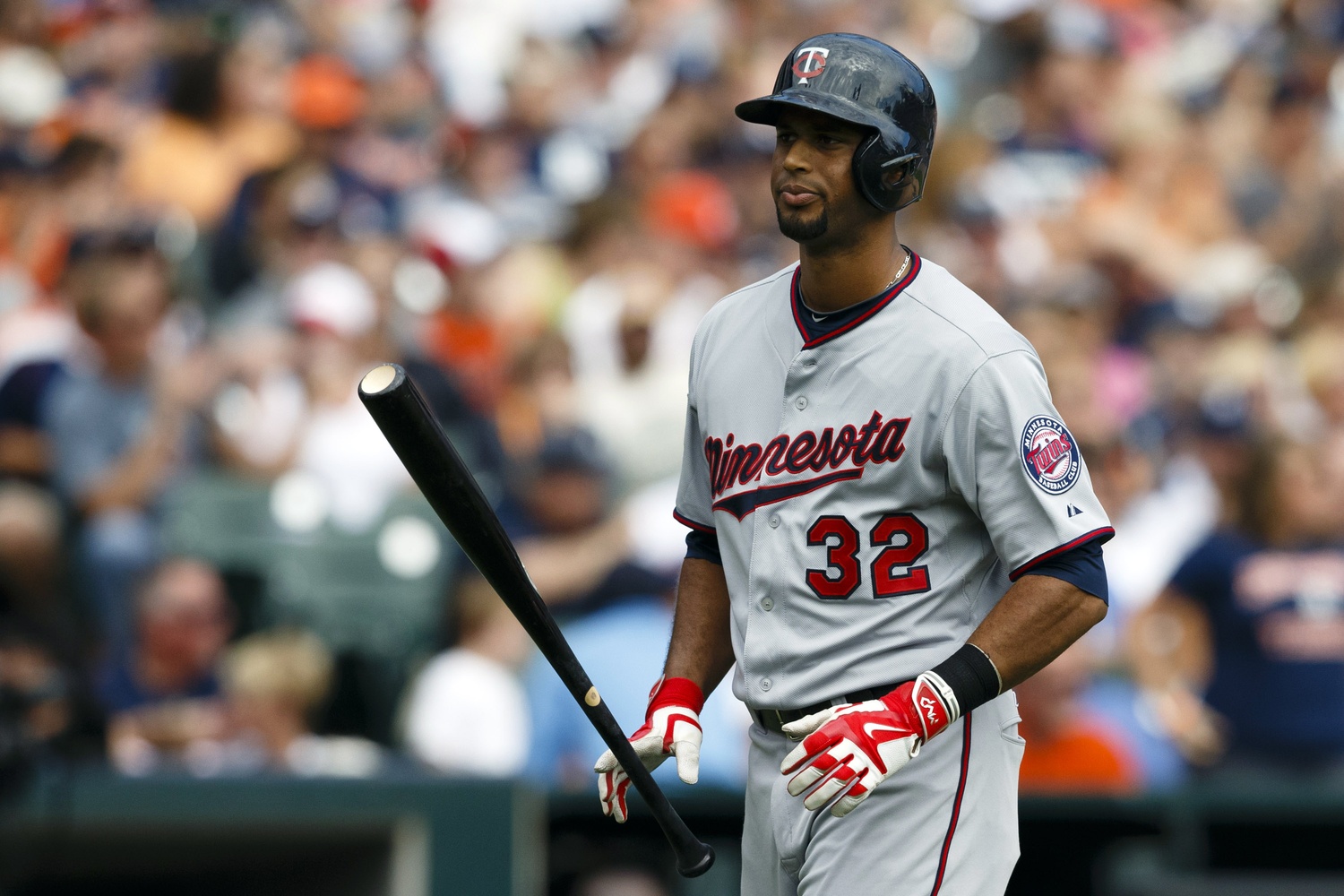
    One of the more critical openings the Minnesota Twins will have this year is in center field. If all goes well, that job will be Aaron Hicks’ to borrow. What are the odds that he meets expectations in 2015?

    Twins Video

    The offseason did not start off well for Hicks: In November he was released from his Venezuelan winter ball team after hitting just .220/.381/.280 in 16 games. The explanation from his team was that he was released because of the poor production but there were rumblings from local media that the Venezuelan team was also upset with his attitude. Whatever the case might be between him and Bravos de Margarita, earlier in the offseason general manager Terry Ryan was emphatic that the Twins organization had no concerns over Hicks’ drive and makeup.

    Meanwhile, during his introductory conference call with season ticket holders manager Paul Molitor reiterated his hopes that Hicks will be able to hold the center field job. That, of course, will depend on how much he can do with the stick. Since coming up to the Twins in 2013, Hicks has posted an OPS+ of 69 (heh) which is 79 out of 89 hitters who have played at least 25 games in center. Ahead of him? Sam Fuld (76), Jordan Schafer (82), Alex Presley (83) and Danny Santana (130). With the exception of Santana those other three players were readily available, making Hicks the epitome of a player below replacement-level.

    It is a shame considering Hicks has the requisite tools necessary to be a solid contributor. All that is, except hitting. If the baseball saying goes " Hit and we’ll find a position for you" is true, the opposite is certainly valid for those who cannot hit.

    There does not seem to be any reason to blame bad luck for the low offensive numbers, either. According to ESPN/TruMedia’s database, since 2013 Hicks’ hard-hit average has been at .115 -- well below the average of .155, and qualifies as 31 of 36 center fielders with 400 plate appearances. Because of this, it is easy to see why he wound up with the second lowest batting average on balls in play in that pool.

    Part of what makes him so volatile at the plate is being a switch-hitter who has not found comfort at either side of the plate -- particularly from the left-hand side where he will find the bulk of his plate appearances. Ted Simmons, the former switch-hitting catcher who eventually became the San Diego Padres bench coach, offered this up to ESPN’s Tim Kurkjian about hitting from both sides: It’s difficult.

    "Six percent of all players is a very small sample,'' Simmons told ESPN regarding having success when hitting from both sides. "And how many of that 6 percent are even capable of hitting .300? Now that 6 percent goes down to maybe 2 percent. So now we're talking about a very, very, very small sample. I also have yet to find a person that completely, totally, unequivocally has bilateral symmetry. One side is always dominant. People can't write right-handed and left-handed with the same physicality.”

    Hicks shares Simmons’ sentiments on switch-hitting as well. Even before his decision to drop the left-handed swing in 2014, he knew the sinister swing was his weaker side.

    “I play golf right-handed. I do everything right-handed,” Hicks told Alan Maimon and Chuck Myron in their book Hits and Misses in the Baseball Draft before the start of the 2012 season. “I think one of the main reasons I’m good at hitting baseball right-handed is because of the eye-hand coordination I developed playing golf. I never felt the same confidence hitting left-handed. And neither did my coaches. In high school, they’d say, ‘Hey, we’ve got the bases loaded. Can Aaron please hit right-handed, so we can win this game?’ [before the 2012 season], I fooled around with playing left-handed golf. I think it helped my left-handed baseball swing come along.”

    Beyond the strains of switch-hitting, what is happening in his swing that is hindering his ability to make quality contact? In 2012 Hicks said to the Star Tribune’s Phil Miller in a Baseball America article that he had been tinkering too much with his swing the previous season.

    “I never got any consistency last year because I was just tweaking my swing too much,” the Hicks said. “I tried my hands high, then tried them low. I tried holding my bat still, then I tried letting my hands move more freely. I was constantly changing it up.”

    Despite trying multiple swings along the way, it appears that the bulk of the modifications were focused on his hands. Judging from recent video, the problem could be a few feet lower.

    Watch his swing up to the point of contact from the left-hand side.

    http://i.imgur.com/JHhf3Jt.gif

    At the end of the clip, keep an eye on his front foot as it begins to turn and roll. For the majority of hitters, the process of turning over their front foot begins after contact, not before (with Jason Heyward being one of those outlying exceptions). While there are almost unlimited examples to compare to, below is a comparison of Hicks to teammate Joe Mauer before contact.

    AH_LHB.jpg

    JM_LHB.jpg

    When this was presented to hitting instruction Bobby Tewksbary, who has worked with Jason Donaldson and Chris Colabello, Tewksbary said he believes this to be the symptom of a larger issue with his swing. This is an indicator that his front side is pulling out. In the video clip above, it is clear that his front side is drifting well below the point of contact.

    The planted front foot ensures a strong leverage point and keeps the hips from opening up too soon. If the front side opens up, the swing as a tendency to lag through the zone and the outer-half of the plate becomes a safe haven for pitchers. This is why pitchers likely targeted Hicks in that location:

    strike-zone (6).png

    Perhaps even more disheartening is that pitchers threw plenty of pitches over the heart of the plate with which Hicks has been unable to produce.

    Hicks’ practice of turning over on his foot before contact happens from the right-side as well. As he stated before, he is a much more natural hitter from the right so he demonstrates better contact and more power. That said, he still drifts:

    AH_RHB.jpg

    AJ_RHB.jpg

    ****

    Twins hitting coach Tom Brunansky has been credited with working wonders on a handful of his players. Hicks, on the other hand, has been a complete mystery. Gifted with the tools to succeed at the highest level, the ability to hit consistently has eluded him. To this point, Brunansky and the rest of the organization’s coaches have not been able to figure out that problem either.

    If the Twins have spotted this and have tried to get him to stop turning off his front side, then it would seem that he has not been unable to replicate the work in the cages into the game. It is also possible that he was working on it in Venezuela, hence the low yield at the plate. If they have not, it could pay dividends to attempt to have Hicks try to work on keeping his front foot firm up to the point of contact. Either way, progress needs to be made.

    As much as Hicks could use a good season at the plate, the Twins could really benefit from having a strong contributor at a key position.

    Follow Twins Daily For Minnesota Twins News & Analysis

    Recent Twins Articles

    Recent Twins Videos


    User Feedback

    Recommended Comments


    Featured Comments

    It may be his last chance to be a regular CF, but he has demonstrated skills that can help a major league team.


    He can hit left handed pitching. He would be an above average defender on a corner. He is adequate in CF. Some team will give him a role platooning in RF with a guy that doesn't hit left handed pitching well and is limited defensively.


    His skills play well on a bench. Defensive replacement, pinch hitter against a LOOGY, pinch running and a platoon option on a corner.


    I would give him two more months to see if he can hit righties well enough to be a regular CF. Meanwhile Rosario is the AAA CF and Buxton is the AA CF. On June 1 if either is dominating while Hicks is struggling, they come up and take over and Hicks slides into a bench role and start him on a corner against lefties.


    That is the plan I would go with.  If he is hitting .220 with no power by June, call a duck a duck and make him a good bench option.

    I think this is Aaron Hicks last chance to prove that he can play at the MLB level. I'm of the belief that Torii Hunter was offered considerably way more money to sign here rather than Texas and Hicks is the reason why. If I'm right Hicks is out of options, isn't even the future center or right fielder, and is on his last leg in the organization with his attitude.  If Torii cannot get him turned around, Hicks is done.  Plenty of other options remain for a future left fielder including Rosario, Kepler, Walker II, or even Travis Harrison.  Aaron, it's time to ^&*$ or get off the toilet dude.

    Hicks does have one more option I believe.


    Hicks does have one more option I believe.

     For goodness sakes, that option should be used. Turning a first round choice into a right handed Sam Fuld is not really a positive. Let the kid master AAA and come up when he's ready. If Rosario or Buxton is ready first, so be it.


     For goodness sakes, that option should be used. Turning a first round choice into a right handed Sam Fuld is not really a positive. Let the kid master AAA and come up when he's ready. If Rosario or Buxton is ready first, so be it.


    I agree with you. That should have been the plan. But the Twins took the let spend $10.5M on Torii to motivate him path.  No way HIcks starts in AAA.

    I agree with you. That should have been the plan. But the Twins took the let spend $10.5M on Torii to motivate him path.  No way HIcks starts in AAA.

    IMHO, if that is the case, they are throwing good money after bad. I've said many times that I still consider Hicks a prospect, but even if he becomes a mid-range outfielder, I don't see much future for him with the Twins. Buxton will start in AA, and other players have made that jump. Buxton is a prospect in a different galaxy than Hicks ever was, so at best Hicks a) builds a little trade value or :cool: slides over to a corner where his bat will have to make another quantum leap to be league average.


    I don't believe Torii Hunter was signed to specifically mentor Aaron Hicks. He may have been acquired to provide an example for young players, but in the end Hicks will have to stand or fall on his own.

    IMHO, if that is the case, they are throwing good money after bad. I've said many times that I still consider Hicks a prospect, but even if he becomes a mid-range outfielder, I don't see much future for him with the Twins. Buxton will start in AA, and other players have made that jump. Buxton is a prospect in a different galaxy than Hicks ever was, so at best Hicks a) builds a little trade value or :cool: slides over to a corner where his bat will have to make another quantum leap to be league average.


    I don't believe Torii Hunter was signed to specifically mentor Aaron Hicks. He may have been acquired to provide an example for young players, but in the end Hicks will have to stand or fall on his own.


    Yeah, I can't argue with any of this.  I don't think that Torii will have much sway in whether or not Buxton, Rosario, or Hicks become good MLB players. But I do believe he is here for these guys and without Hicks, probably would not be here at all.


    As far as what will happen, the Twins will win more games next year than they have in any of the last four (low bar, I know). But regardless, Torii will get an outsized share of that credit. From the players, media, and coaches alike.

    Edited by tobi0040

    Two years ago coming out of ST it seemed like Hicks had good power but once people figured him out he had trouble making contact.  Seemed like that first year he actually put balls out of the park and was hitting solid line drives, (when he hit the ball), last year it didn't look like he could hit the ball out of the infield.  Looking at him pulling away from the pitch in that video of his swing he looks really confused.  Hopefully he can figure it out and put some wood on the ball.  I don't think anyone would question his fielding as much if he hit around .250 with some doubles power and an occasional Hr.  It is pretty much all about his hitting and it seems as though he has been reluctant to accept coaching, at least from the Gardy regime, but Bruno was part of that regime also.  So I hope he comes through and grows out of his funk, but I'm not holding my breath.  I hope he is desperate enough to go and seek out help to better his hitting, but that would mean that he has matured and that is really probably the main question with Hicks.  Maturity.

    I don't believe Torii Hunter was signed to specifically mentor Aaron Hicks. He may have been acquired to provide an example for young players, but in the end Hicks will have to stand or fall on his own.


    My hope is that Torii has an impact on more than just Hicks.  Arcia springs to mind.  Also, I would hope that Hicks, Rosario and Buxton all audition for the CF job this spring, and the best one sticks.  Make Hunter part of that decision making process if that helps justify the money.  If the Twins are going to pay him to be a mentor, I'd hate to see it spent on Hicks just because he's the eldest of the three prospects.

    We can only guess as to what makes Hicks less responsive to instruction than most of his MLB peers, but I'd bet this trait has haunted him since his childhood and we're just being introduced to it. My guess is that he's overcome it through sheer talent throughout his athletic career. Now that he's at the most elite level and no longer exceptional, it's up to him to change, IMO. There's still hope. I keep thinking about a pampered kid in my son's class-smart, great eye-hand coordination, etc., but he just couldn't be coached and kept out of trouble otherwise. I guess it took a drill sergeant to get through to him, and now he's an elite sniper in our U.S. Marine Corps.  


    Not really a fitting analogy, but still...


    Create an account or sign in to comment

    You need to be a member in order to leave a comment

    Create an account

    Sign up for a new account in our community. It's easy!

    Register a new account

    Sign in

    Already have an account? Sign in here.

    Sign In Now

×
×
  • Create New...