


Twins Video
It seems likely that the coronavirus will define the calendar year of 2020, in all facets of life throughout the world, let alone the United States. In several years, the mention of 2020 is likely to be connected to almost nothing else, because of the sheer enormity of the situation we continue to face. In such a context, lost baseball games are obviously trivial. Still, those lost games are a tiny kind of tragedy, one that becomes and remains important to fans of the game long afterward. This piece is aimed at contemporaneously observing and documenting the Twins’ share of that space, by discussing in real time what the team and certain of its players are losing.
Yesterday, Nick Nelson wrote an article here at Twins Daily that I heartily recommend, if you haven’t already read it. Within, he made the case that the 2020 season should be considered something wholly separate from a traditional season of record, if any baseball happens at all. It’s a painful truth, but I share Nick’s assessment.
That said, the cancellation of a full season would be a disaster for the Twins, and today, we’ll examine three players whose individual predicaments make that especially clear. In the future, we might undertake a similar exercise with every player on the roster, but for now, we can begin with these three. (For today, we’ll leave aside the cases of Nelson Cruz, Trevor May, and Jake Odorizzi, who would be free agents before playing another game for the Twins if this took place. That’s a whole different can of worms.)
Byron Buxton: The developmental clock is ticking more loudly on Buxton than on any other Twin, both because of his skill set and because of his service time stage. Remember, an agreement between the league and the MLB Players Association last month made clear that if the season is canceled, players will be granted exactly the same amount of service time they received in 2019, so a non-season would still push Buxton one year closer to free agency.
More importantly, Buxton is 26. Given his profile, there’s no reason to expect him to be better in any future season than he projects to be in this one. He’s had extra time to recuperate from his season-ending shoulder injury from last year, but now, further lost time threatens to waste the youth in his elite legs. Moreover, his offensive approach (and especially his swing, which has undergone so many tweaks and reversions over the last several seasons) figures to be hurt more by the time off than most players’ will be.
Buxton has had to fight to find consistency throughout his big-league career. Now, he’s in danger of losing what should be a prime season, and the Twins are in danger of losing a crucial season in the evaluation and instruction both of the player and of his health prospects.
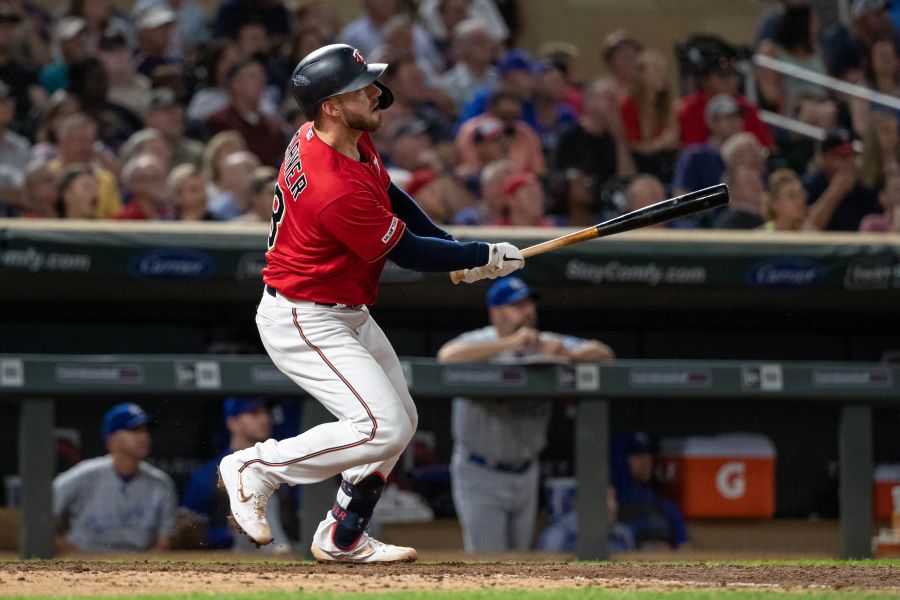
Mitch Garver: If Trevor Plouffe and Brian Dozier didn’t drive home the point hard enough, Twins fans could get another lesson in the cruel truths of aging curves from Garver. Here’s the thing: blooming late doesn’t earn one good karma, and thereby guarantee a long, graceful prime that lasts into one’s mid-30s. Plouffe and Dozier each became average-plus players only in their late 20s, but both then declined sharply as they entered their 30s.
This is why good, proactive, fast-acting player development is so important, from the player’s perspective: becoming a star at 23 or 24 is wildly profitable, compared to doing the same at 28, as Garver just did. It also tends to lead to a kinder overall assessment of a player; guys who have just a great season or two before fading back to the fringe tend to be unfairly viewed as lucky or insubstantial.
Garver is already 29. He’s four years from free agency, and (as a catcher) very unlikely to find friendly bidding if and when he does get there, even if he gets full credit for 2020 and reaches the open market at 33. More to the point, for Twins fans, it was never likely that Garver would replicate his rate-stat production of 2020 in any future season, but the prospective loss of his age-29 season makes it harder to envision that he could even retain his place as one of the AL’s best catchers.
All of Garver’s improvements, at the plate and a few feet behind it, were real. That doesn’t mean they’ll survive his body getting a year older, even without a year of being beaten up behind the plate, given where he is on the aging curve and how his career has progressed to date.
Michael Pineda: What a fragmented, bizarre, pockmarked career Pineda has had. His season as a rookie sensation in Seattle was nine years ago; it feels like 15. Now 31, Pineda still faces another 39 games worth of PED suspension, whenever baseball resumes. (If you think it will be wiped out, I invite you to consider more closely the attitudes of both the league and the union toward all PED suspensions and the men who incur them.)
Pineda’s stuff has declined, shifted, been adjusted, and then been honed to work for him in the best way his command will allow. He’s found ways to stay healthy, after years and years of persistent injuries, but that hasn’t stopped him from struggling with inconsistency. Now, the Twins could lose Year One of a two-year deal in which year One was certainly the one on which they were betting more heavily.
A year off might do Pineda’s arm some good, but often, his injury problems haven’t been confined to his arm, and his performance problems haven’t been tied to insufficient arm strength. If he doesn’t ever have another healthy, average-or-better season in the big leagues again, it will come as little surprise. For the Twins, that would be an important and painful disappointment, because he represents a key part of the bridge to their upcoming wave of young pitching.
MORE FROM TWINS DAILY
— Latest Twins coverage from our writers
— Recent Twins discussion in our forums
— Follow Twins Daily via Twitter, Facebook or email





Recommended Comments
Create an account or sign in to comment
You need to be a member in order to leave a comment
Create an account
Sign up for a new account in our community. It's easy!
Register a new accountSign in
Already have an account? Sign in here.
Sign In Now