



Matthew Trueblood
-
Posts
1,026 -
Joined
-
Last visited
Content Type
Profiles
News
Minnesota Twins Videos
2026 Minnesota Twins Top Prospects Ranking
2022 Minnesota Twins Draft Picks
Minnesota Twins Free Agent & Trade Rumors, Notes, & Tidbits
Guides & Resources
2023 Minnesota Twins Draft Picks
The Minnesota Twins Players Project
2024 Minnesota Twins Draft Picks
2025 Minnesota Twins Draft Pick Tracker
2026 Minnesota Twins Draft Tracker: Picks & Bonuses
Forums
Blogs
Events
Store
Downloads
Gallery
Everything posted by Matthew Trueblood
-
Just work with me here. If this happened, how different would it make things? And who'd benefit?This is an article breaking down the four players I view as legitimate candidates to be the Twins’ best player if the bases were 81 feet apart. If the bases were 10 percent closer to one another, and their distance thus better fit baseball’s fervent devotion to multiples of three (three strikes, three outs, nine innings, and now, 81-foot basepaths), which Twin would best help the team hang on to its primacy in the AL Central? A former editor of mine, Sam Miller, was a genius. When he wrote an article at Baseball Prospectus about where to put a pit on a baseball field, if there was to be a pit, he knew better than to engage on the question of whether there should be a pit. Too messy. Right up front, he made it clear: the article was about where to put a pit, if there was a pit, operating under the assumption that that was just the way it was going to be. Same here: we’re not debating whether the distance between all bases should be shortened to 81 feet. That’s a given, until you depart this page. The question is: Which Twin would be the most valuable, if the bases were 81 feet apart? Obviously, it wouldn’t be a pitcher. There might be pitchers who would be the most valuable player on their team if the bases were 81 feet apart, like Max Scherzer or Jacob deGrom, but no Twins hurler combines strikeouts, a low walk rate, and the ability to induce weak contact well enough to be a candidate. A game with 81-foot basepaths is a game focused on speed, contact, and defense, not on that weird little bump in the back half of the infield. Among the position players, there are four guys with legitimate cases: Byron Buxton, Luis Arráez, Max Kepler, and Josh Donaldson. Back in the old days, when the basepaths were long and the game was slower, there were cases to be made that Miguel Sanó, Nelson Cruz, Mitch Garver, and Jorge Polanco were as valuable as this quartet, but now, forget about it. Sanó’s trouble making contact is a more costly disadvantage than ever, and he has no positional or defensive value. Cruz is just a hitter, and his power is a smaller relative edge now, thanks to all the hits and extra bases to be found all over the diamond even without elite pop. Garver’s framing is great, but he runs poorly, and his below-average throwing arm is a bigger deal. Great throwing catchers will take advantage of a throw 13 feet shorter than their former one, despite their fielders needing to range further to cover the bag on steal attempts, but Garver isn’t going to be able to do it. Besides, robot umpires can’t be far off, and then framing becomes a dead issue. Polanco simply doesn’t play the kind of defense now required of a shortstop, even as the league takes shifting to a new level. He doesn’t have the range or the arm to get batters out when they have just 81 feet to cover between home plate and first base. On, then, to the real contenders: Buxton Strengths: Absolutely every ground ball he hits is now a likely hit. It takes a perfect play on a ball hit right at a shallowly-positioned infielder to get him, and even then, it has to be a strong-armed infielder. Remember, each base is 81 feet from the next, so he’s also going to start racking up hustle doubles, line-drive triples, and more inside-the-park home runs than a Dead Ball shortstop facing Little Leaguers. In addition to all of that, it’s never been more important to have a defensive whiz in center field, and Buxton’s strong arm will come into play often, too. Weaknesses: Strikeouts still hurt, and through every iteration of Buxton’s maturation, he’s been vulnerable to them. Pitchers are going to be pitching for the strikeout in practically every plate appearance, especially with Buxton up there, and he’s exploitable. Arráez Strengths: Even using the old-fashioned dimensions, Arráez was a tough hitter to defend. Now, he’s virtually unstoppable. The reliable outs are harmless fly balls, ground outs hit to predictable places, and strikeouts, and hardly any of Arráez’s plate appearances end with any of those outcomes. He’ll frustrate strikeout-hungry opponents to no end with his ability to spoil pitches. He’s also on the right side of the infield, where the impact of weak defense is slightly lower. Weaknesses: He still isn’t a great fielder, and it’s still a problem to have anything short of a brilliant infield defense with these dimensions in place. Arráez also doesn’t run well, making him a dreaded baseclogger atop the lineup. Kepler Strengths: Kepler is such a good right fielder that, as five-man infields become more common, he and Buxton allow the Twins to feel comfortable going with two-man outfields from time to time. He’s not just fast on the bases, but quick in his changes of direction, allowing him to take the extra base, and that’s a bigger part of the game than ever. More than that, though, Kepler’s balanced offensive skill set is so appealing. He’s a left-handed batter with speed, so putting the ball in play is a good mathematical move in itself, and he’s sustained a well below-average strikeout rate for the last two years, while also demonstrating above-average power and plate discipline. Weaknesses: Kepler did show some vulnerability, some new holes in his swing, during the season half of last season. He’s also become a dead pull hitter, and teams will force him to change that habit by populating as much of the right side as possible until he starts consistently driving the ball to left field again. Donaldson Strengths: A great athlete with a rocket arm, Donaldson is the kind of third baseman who can still turn batted balls to the left side into outs. He’s always shown a special penchant for charging bunts and throwing with oomph on the run, which should help the Twins control the opponents’ bunting game. He also has the plate discipline to get on base very consistently, and under these new dimensions, having a runner on base puts more pressure on the defense than it did before. Of course, he’s also an excellent power hitter, and pitchers don’t figure to suddenly find a way to shut down that aspect of his game. Weaknesses: Slow-footed and aging, Donaldson can’t take advantage of the basepaths. He’s also swung and missed within the zone at a fairly high rate in recent years, and as pitchers hunt for strikeouts, he might see his own whiff rate rise to a troubling extent. The Verdict The pitchers are still 60 feet, six inches away. They still have nasty sliders, and changeups, and fastballs with such extraordinary spin that they hop over bats. Buxton will still strike out too much, and though he’ll take extra bases on hits and outs with awesome, hilarious frequency, he won’t be able to steal more, because the catchers will get bigger advantages in those isolated cases than runners will. Arráez won’t help the team prevent runs, and won’t develop power any time soon. That leaves the two more balanced options, and of them, Kepler seems to have the edge. His impact will be more two-sided; the outfield is really the place where teams’ fates will be decided. His ability to make contact so often without sacrificing power is also more valuable than ever, now that the bases are only 81 feet apart. This change should bring balance and action back to baseball, and it should make Max Kepler a superstar. MORE FROM TWINS DAILY — Latest Twins coverage from our writers — Recent Twins discussion in our forums — Follow Twins Daily via Twitter, Facebook or email Click here to view the article
-
Who Would Be the Best Twin if the Bases Were 81 Feet Apart?
Matthew Trueblood posted an article in Twins
 This is an article breaking down the four players I view as legitimate candidates to be the Twins’ best player if the bases were 81 feet apart. If the bases were 10 percent closer to one another, and their distance thus better fit baseball’s fervent devotion to multiples of three (three strikes, three outs, nine innings, and now, 81-foot basepaths), which Twin would best help the team hang on to its primacy in the AL Central? A former editor of mine, Sam Miller, was a genius. When he wrote an article at Baseball Prospectus about where to put a pit on a baseball field, if there was to be a pit, he knew better than to engage on the question of whether there should be a pit. Too messy. Right up front, he made it clear: the article was about where to put a pit, if there was a pit, operating under the assumption that that was just the way it was going to be. Same here: we’re not debating whether the distance between all bases should be shortened to 81 feet. That’s a given, until you depart this page. The question is: Which Twin would be the most valuable, if the bases were 81 feet apart? Obviously, it wouldn’t be a pitcher. There might be pitchers who would be the most valuable player on their team if the bases were 81 feet apart, like Max Scherzer or Jacob deGrom, but no Twins hurler combines strikeouts, a low walk rate, and the ability to induce weak contact well enough to be a candidate. A game with 81-foot basepaths is a game focused on speed, contact, and defense, not on that weird little bump in the back half of the infield. Among the position players, there are four guys with legitimate cases: Byron Buxton, Luis Arráez, Max Kepler, and Josh Donaldson. Back in the old days, when the basepaths were long and the game was slower, there were cases to be made that Miguel Sanó, Nelson Cruz, Mitch Garver, and Jorge Polanco were as valuable as this quartet, but now, forget about it. Sanó’s trouble making contact is a more costly disadvantage than ever, and he has no positional or defensive value. Cruz is just a hitter, and his power is a smaller relative edge now, thanks to all the hits and extra bases to be found all over the diamond even without elite pop. Garver’s framing is great, but he runs poorly, and his below-average throwing arm is a bigger deal. Great throwing catchers will take advantage of a throw 13 feet shorter than their former one, despite their fielders needing to range further to cover the bag on steal attempts, but Garver isn’t going to be able to do it. Besides, robot umpires can’t be far off, and then framing becomes a dead issue. Polanco simply doesn’t play the kind of defense now required of a shortstop, even as the league takes shifting to a new level. He doesn’t have the range or the arm to get batters out when they have just 81 feet to cover between home plate and first base. On, then, to the real contenders: Buxton Strengths: Absolutely every ground ball he hits is now a likely hit. It takes a perfect play on a ball hit right at a shallowly-positioned infielder to get him, and even then, it has to be a strong-armed infielder. Remember, each base is 81 feet from the next, so he’s also going to start racking up hustle doubles, line-drive triples, and more inside-the-park home runs than a Dead Ball shortstop facing Little Leaguers. In addition to all of that, it’s never been more important to have a defensive whiz in center field, and Buxton’s strong arm will come into play often, too. Weaknesses: Strikeouts still hurt, and through every iteration of Buxton’s maturation, he’s been vulnerable to them. Pitchers are going to be pitching for the strikeout in practically every plate appearance, especially with Buxton up there, and he’s exploitable. Arráez Strengths: Even using the old-fashioned dimensions, Arráez was a tough hitter to defend. Now, he’s virtually unstoppable. The reliable outs are harmless fly balls, ground outs hit to predictable places, and strikeouts, and hardly any of Arráez’s plate appearances end with any of those outcomes. He’ll frustrate strikeout-hungry opponents to no end with his ability to spoil pitches. He’s also on the right side of the infield, where the impact of weak defense is slightly lower. Weaknesses: He still isn’t a great fielder, and it’s still a problem to have anything short of a brilliant infield defense with these dimensions in place. Arráez also doesn’t run well, making him a dreaded baseclogger atop the lineup. Kepler Strengths: Kepler is such a good right fielder that, as five-man infields become more common, he and Buxton allow the Twins to feel comfortable going with two-man outfields from time to time. He’s not just fast on the bases, but quick in his changes of direction, allowing him to take the extra base, and that’s a bigger part of the game than ever. More than that, though, Kepler’s balanced offensive skill set is so appealing. He’s a left-handed batter with speed, so putting the ball in play is a good mathematical move in itself, and he’s sustained a well below-average strikeout rate for the last two years, while also demonstrating above-average power and plate discipline. Weaknesses: Kepler did show some vulnerability, some new holes in his swing, during the season half of last season. He’s also become a dead pull hitter, and teams will force him to change that habit by populating as much of the right side as possible until he starts consistently driving the ball to left field again. Donaldson Strengths: A great athlete with a rocket arm, Donaldson is the kind of third baseman who can still turn batted balls to the left side into outs. He’s always shown a special penchant for charging bunts and throwing with oomph on the run, which should help the Twins control the opponents’ bunting game. He also has the plate discipline to get on base very consistently, and under these new dimensions, having a runner on base puts more pressure on the defense than it did before. Of course, he’s also an excellent power hitter, and pitchers don’t figure to suddenly find a way to shut down that aspect of his game. Weaknesses: Slow-footed and aging, Donaldson can’t take advantage of the basepaths. He’s also swung and missed within the zone at a fairly high rate in recent years, and as pitchers hunt for strikeouts, he might see his own whiff rate rise to a troubling extent. The Verdict The pitchers are still 60 feet, six inches away. They still have nasty sliders, and changeups, and fastballs with such extraordinary spin that they hop over bats. Buxton will still strike out too much, and though he’ll take extra bases on hits and outs with awesome, hilarious frequency, he won’t be able to steal more, because the catchers will get bigger advantages in those isolated cases than runners will. Arráez won’t help the team prevent runs, and won’t develop power any time soon. That leaves the two more balanced options, and of them, Kepler seems to have the edge. His impact will be more two-sided; the outfield is really the place where teams’ fates will be decided. His ability to make contact so often without sacrificing power is also more valuable than ever, now that the bases are only 81 feet apart. This change should bring balance and action back to baseball, and it should make Max Kepler a superstar. MORE FROM TWINS DAILY — Latest Twins coverage from our writers — Recent Twins discussion in our forums — Follow Twins Daily via Twitter, Facebook or email
 -
The question hits like a line drive to the shin, but if baseball won't be back this year, it's an important and legitimate one.The persistent uncertainty over when (or if) MLB will have a season in 2020 continues to invite questions about the futures of almost every player, in various ways. One of the most serious and potentially painful forms these questions take pertains to longtime veterans in their late 30s. In the case of Twins reliever Sergio Romo, it’s a reasonable (though cruel) question: will he ever pitch in the big leagues again? At first blush, that might seem a foolish question. Romo had a terrific second half with the Twins last year, and signed a contract for 2020 that includes a team option for 2021, at an affordable $5 million. Under the surface, though, there are signs that Romo, one of the best relievers of his generation, is headed for troubled water, even if and when baseball resumes. Among hurlers with at least 500 innings pitched since 1950, Romo has the 20th-best career DRA-, according to Baseball Prospectus. He’s in virtual lockstep with Max Scherzer. Obviously, Scherzer’s role as a workhorse starter makes him much, much more valuable than Romo, a one-inning reliever, but the fact remains that Romo has been a dominant pitcher (perhaps more so than most people even realized) for over a decade. He does it in a few ways, and the details shift with each passing year, reflecting the right-hander’s savvy and willingness to evolve as he ages. For one thing, while his four-seam fastball sat at just 86.5 miles per hour in 2019, he spun it at over 2,300 revolutions per minute. His low arm slot and the way he releases the pitch preclude him from getting the rising action pitchers look for when spinning their fastball so efficiently, but the spin isn’t wasted: both his four-seamer and his sinker have exceptional run to the arm side. Romo threw his changeup more often last season than ever, helping him extend a trend of neutralizing left-handed batters better late in his career. He hardly ever throws the pitch against righties, but to lefties, it’s become a steady part of the diet, a pitch he throws fully 30 percent of the time. It has enough velocity separation from his sinker to fool batters, despite strikingly similar movement, and crucially, he adjusted his targets after joining the Twins. He began hitting the bottom of the zone with his sinker, and absolutely burying his changeup, as never before. Batters were slow to adjust, and he got plentiful whiffs from the pitch down the stretch. Then, of course, there’s that slider. Romo unabashedly drops down and gets around the pitch, which drops less than his sinker and only slightly more than his four-seamer on the way to the plate. Its spin effectively mirrors that of his sinker, though, and the 20-inch difference in their horizontal movement makes misreads by opposing hitters costly mistakes. Great lateral movement, but minimal vertical separation, tends to beget weak contact rather than swings and misses, and while Romo’s strikeout rate has sagged recently, he was one of the best hurlers in baseball at avoiding hard contact in 2019. Why, then, do we say there are signs of trouble? For one thing, Romo’s become an extreme flyball pitcher. For another, he’s avoiding barrels by nibbling on the edges of the strike zone. His command and control remain solid; he just doesn’t have the sheer stuff to attack within the zone anymore. When hitters do swing, despite getting less desirable pitches to hit, they are making contact more and more often. Even with good command, the willingness to throw his slider over 60 percent of the time, and improved depth on his change, Romo is becoming a more comfortable at-bat, because he utterly lacks the ability to overpower big-league hitters. Even with his sterling showing for the Twins mixed in, Romo had his worst season in 2019. For the first time ever, he registered a DRA- above 78—and it was 95, meaning he was just five percent better than an average pitcher. His cFIP, a more skill-centric and predictive measurement of a pitcher’s performance, was 101, meaning he was (if anything) worse than average. Meanwhile, as teams develop increasingly advanced player development tools, the importance of lost games for minor leaguers still on the way up the chain is diminishing. Whenever baseball resumes, top prospects with big stuff are going to be much less affected by the layoff than those of old veteran hurlers, even though those hurlers, like Romo, will benefit marginally from not bearing a year of wear and tear. Romo’s competitive advantage over young arms was already shrinking rapidly; it might disappear entirely before 2021 begins. MORE FROM TWINS DAILY — Latest Twins coverage from our writers — Recent Twins discussion in our forums — Follow Twins Daily via Twitter, Facebook or email Click here to view the article
-
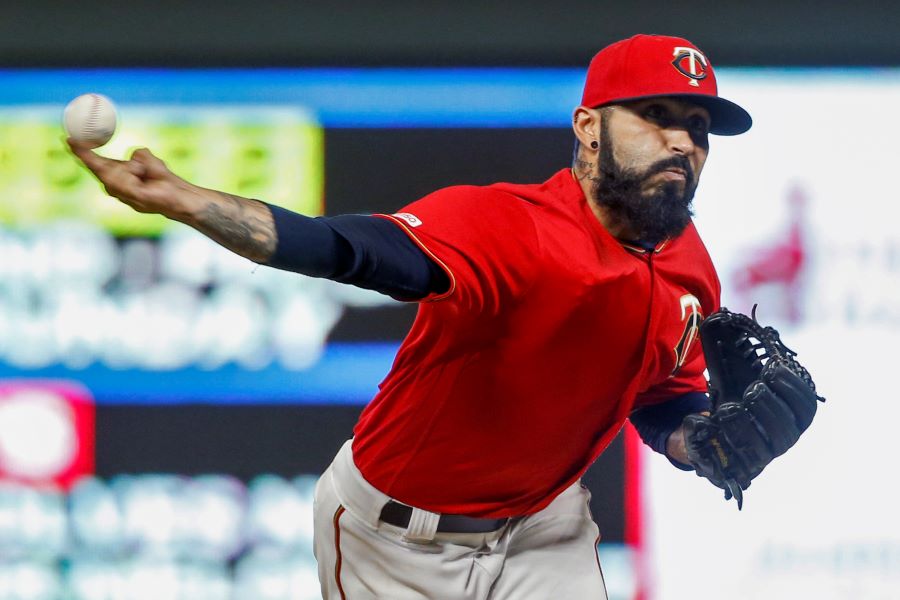 The persistent uncertainty over when (or if) MLB will have a season in 2020 continues to invite questions about the futures of almost every player, in various ways. One of the most serious and potentially painful forms these questions take pertains to longtime veterans in their late 30s. In the case of Twins reliever Sergio Romo, it’s a reasonable (though cruel) question: will he ever pitch in the big leagues again? At first blush, that might seem a foolish question. Romo had a terrific second half with the Twins last year, and signed a contract for 2020 that includes a team option for 2021, at an affordable $5 million. Under the surface, though, there are signs that Romo, one of the best relievers of his generation, is headed for troubled water, even if and when baseball resumes. Among hurlers with at least 500 innings pitched since 1950, Romo has the 20th-best career DRA-, according to Baseball Prospectus. He’s in virtual lockstep with Max Scherzer. Obviously, Scherzer’s role as a workhorse starter makes him much, much more valuable than Romo, a one-inning reliever, but the fact remains that Romo has been a dominant pitcher (perhaps more so than most people even realized) for over a decade. He does it in a few ways, and the details shift with each passing year, reflecting the right-hander’s savvy and willingness to evolve as he ages. For one thing, while his four-seam fastball sat at just 86.5 miles per hour in 2019, he spun it at over 2,300 revolutions per minute. His low arm slot and the way he releases the pitch preclude him from getting the rising action pitchers look for when spinning their fastball so efficiently, but the spin isn’t wasted: both his four-seamer and his sinker have exceptional run to the arm side. Romo threw his changeup more often last season than ever, helping him extend a trend of neutralizing left-handed batters better late in his career. He hardly ever throws the pitch against righties, but to lefties, it’s become a steady part of the diet, a pitch he throws fully 30 percent of the time. It has enough velocity separation from his sinker to fool batters, despite strikingly similar movement, and crucially, he adjusted his targets after joining the Twins. He began hitting the bottom of the zone with his sinker, and absolutely burying his changeup, as never before. Batters were slow to adjust, and he got plentiful whiffs from the pitch down the stretch. Then, of course, there’s that slider. Romo unabashedly drops down and gets around the pitch, which drops less than his sinker and only slightly more than his four-seamer on the way to the plate. Its spin effectively mirrors that of his sinker, though, and the 20-inch difference in their horizontal movement makes misreads by opposing hitters costly mistakes. Great lateral movement, but minimal vertical separation, tends to beget weak contact rather than swings and misses, and while Romo’s strikeout rate has sagged recently, he was one of the best hurlers in baseball at avoiding hard contact in 2019. Why, then, do we say there are signs of trouble? For one thing, Romo’s become an extreme flyball pitcher. For another, he’s avoiding barrels by nibbling on the edges of the strike zone. His command and control remain solid; he just doesn’t have the sheer stuff to attack within the zone anymore. When hitters do swing, despite getting less desirable pitches to hit, they are making contact more and more often. Even with good command, the willingness to throw his slider over 60 percent of the time, and improved depth on his change, Romo is becoming a more comfortable at-bat, because he utterly lacks the ability to overpower big-league hitters. Even with his sterling showing for the Twins mixed in, Romo had his worst season in 2019. For the first time ever, he registered a DRA- above 78—and it was 95, meaning he was just five percent better than an average pitcher. His cFIP, a more skill-centric and predictive measurement of a pitcher’s performance, was 101, meaning he was (if anything) worse than average. Meanwhile, as teams develop increasingly advanced player development tools, the importance of lost games for minor leaguers still on the way up the chain is diminishing. Whenever baseball resumes, top prospects with big stuff are going to be much less affected by the layoff than those of old veteran hurlers, even though those hurlers, like Romo, will benefit marginally from not bearing a year of wear and tear. Romo’s competitive advantage over young arms was already shrinking rapidly; it might disappear entirely before 2021 begins. MORE FROM TWINS DAILY — Latest Twins coverage from our writers — Recent Twins discussion in our forums — Follow Twins Daily via Twitter, Facebook or email
 -
After a promising rookie showing, Stashak looks likely to be part of the Twins' bullpen in the near term. But he could be more than 'likely' with a successful tweak or two.Cody Stashak had an impressive 2019, rising from fringy prospect status as a Double-A reliever to an occasionally high-leverage arm in the bullpen for the Twins. Across three levels, he faced 321 batters (not counting the ALDS against the Yankees), struck out 99 of them, and walked just 10. He’s already proved he can be a good relief pitcher. However, there are mechanical and mental changes he could make to take another step forward, whenever baseball finally resumes. Stashak made five appearances in the Grapefruit League, prior to it being shuttered due to the outbreak of the coronavirus. In them, he pitched seven scoreless innings. He faced 23 batters, struck out nine of them, and issued no walks. Batters managed just three hits against him. Even when the ball was put in play, it tended not to be well-struck. Between that showing and the team’s decision to trade Brusdar Graterol at the beginning of spring training, Stashak had positioned himself well to open the season in the Minnesota bullpen. Obviously, it’s an open (and difficult) question whether baseball will or should be played at all in 2020, and if the season happens, the Twins will have a deep pitching staff. Stashak isn’t guaranteed to be on the roster at all times, let alone to have an important role in the club’s relief corps. Since Stashak is still a young and fresh arm, though, there’s room to dream on him as an important long-term piece of that puzzle, including and especially as a potential replacement for impending free agent Trevor May. First, a quick reintroduction to Stashak’s background and skill set. He’s a former 13th-round pick, though he signed for a bonus that indicated the team believed in him more than that. For the first two and a half seasons of his professional career, he was a starter, and a fairly effective one. The Twins elected to move him to a relief role in 2018, not as a response to failure, but as a proactive effort to get the most possible out of him. Neither a hard thrower nor one with an especially deep repertoire, Stashak immediately benefited from the switch. His high arm slot gives his fastball some natural rising action, and his slider can be a wipeout pitch, as evidenced by batters’ 47.3-percent whiff rate on swings against it when he reached the big leagues last season. He only gets his fastball above 92 miles per hour when really reaching back for something extra, though, and his changeup (right now) lacks sufficient movement or velocity separation. Becoming a reliever also helped paper over one of Stashak’s remaining weaknesses as a pitcher: he doesn’t have great command. Because he has considerable spine tilt during the latter phase of his delivery, he doesn’t show a consistent ability to hit his catcher’s target. His misses tend strongly to be up or down, rather than lateral, which helps him avoid walks exceptionally well. However, missing vertically so often makes him highly vulnerable to hard contact. In 2019, 10 of the 77 batted balls against Stashak were what Statcast classifies as Barrels—the most valuable bucket into which the system places hits. Batters had a .351 BABIP and slugged .475 against him, and the patterns were similar in the minor leagues. That’s why, despite his tremendous strikeout and walk numbers, he had an ERA of 3.22 for the entire season, and 3.24 in the big leagues, marking him as good, but not great at actually preventing runs. Part of the problem might be that Stashak still has certain remnants of his effort to be a starter baked into the way he pitches. For one thing, he sets up on the first-base edge of the rubber. That’s somewhat common for a right-handed starter, because they tend to have pitches that run to their arm side, as well as ones that move to the glove side, and because that can sometimes create tough angles for opposing left-handed batters. Now that he works in relief, though, Stashak should consider sliding over on the rubber. Despite his high slot and largely vertical movement profile, his slider has a natural sweep to the glove side, so moving to the middle or the third-base side of the rubber might allow him to more aggressively use the slider—especially against left-handers. He threw the slider almost exactly half the time against fellow righties in MLB last season, but against lefties, his slider usage was under 23 percent. In the modern game, even a reliever needs the conviction to throw a breaking ball to opposite-handed batters, and to do it relatively often. Stashak, without an overpowering fastball or pinpoint command, needs to do so especially acutely. Moving on the rubber could help with that, and because Stashak’s fastball lacks much run to the arm side anyway, it wouldn’t much harm his ability to attack hitters with that pitch. More importantly, though, Stashak needs to quiet down some of the spine tilt he shows at release, in order to harness his stuff better and avoid hard contact. Some of that tilt comes from his stride pattern, one that keeps him closed and allows him to maximize torque, but some of it is the result of insufficient functional strength. He showed signs of having improved his posture during delivery during the spring, contributing to better command, so he might already be on the way to achieving that. If Stashak does improve his posture and enjoy better command, he might lose some of the rise on his fastball, as his release angle will drop slightly even if his arm slot remains the same. The arm might move more freely, though, in which case he could make up the loss of movement in one dimension with some armside run or even extra spin. He’d be far from the first hurler to see an uptick in spin or velocity after improving the same mechanical flaw. He might also get better movement (and thus, better results) with his changeup from that altered release point, especially because the pitch would be better able to work toward or past the outside corner against left-handed batters. This point of caution always deserves mention: Stashak has had an improbably successful pro career. He might not be inclined to make a significant change, lest he lose whatever magic (deception, perhaps, or effective wildness born of the sheer unpredictability of his misses) has carried him so far. If he embraces data-driven adjustments, though, he could blossom into an even better reliever, and thereby transform from a competent big-leaguer forever on the shuttle to the International League into a borderline relief ace, with a chance to reach free agency and leave the game a decade from now, his family set for life. MORE FROM TWINS DAILY — Latest Twins coverage from our writers — Recent Twins discussion in our forums — Follow Twins Daily via Twitter, Facebook or email Click here to view the article
-
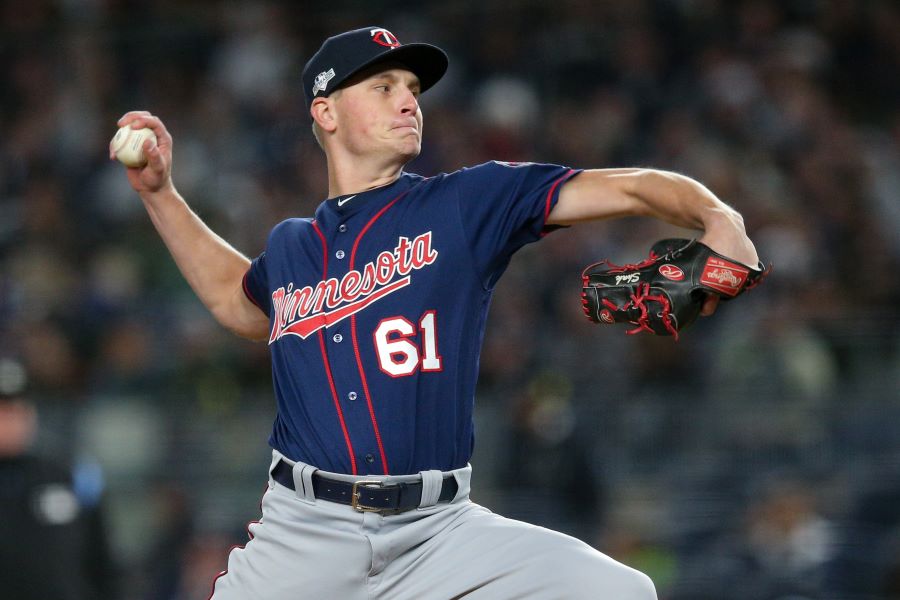 Cody Stashak had an impressive 2019, rising from fringy prospect status as a Double-A reliever to an occasionally high-leverage arm in the bullpen for the Twins. Across three levels, he faced 321 batters (not counting the ALDS against the Yankees), struck out 99 of them, and walked just 10. He’s already proved he can be a good relief pitcher. However, there are mechanical and mental changes he could make to take another step forward, whenever baseball finally resumes. Stashak made five appearances in the Grapefruit League, prior to it being shuttered due to the outbreak of the coronavirus. In them, he pitched seven scoreless innings. He faced 23 batters, struck out nine of them, and issued no walks. Batters managed just three hits against him. Even when the ball was put in play, it tended not to be well-struck. Between that showing and the team’s decision to trade Brusdar Graterol at the beginning of spring training, Stashak had positioned himself well to open the season in the Minnesota bullpen. Obviously, it’s an open (and difficult) question whether baseball will or should be played at all in 2020, and if the season happens, the Twins will have a deep pitching staff. Stashak isn’t guaranteed to be on the roster at all times, let alone to have an important role in the club’s relief corps. Since Stashak is still a young and fresh arm, though, there’s room to dream on him as an important long-term piece of that puzzle, including and especially as a potential replacement for impending free agent Trevor May. First, a quick reintroduction to Stashak’s background and skill set. He’s a former 13th-round pick, though he signed for a bonus that indicated the team believed in him more than that. For the first two and a half seasons of his professional career, he was a starter, and a fairly effective one. The Twins elected to move him to a relief role in 2018, not as a response to failure, but as a proactive effort to get the most possible out of him. Neither a hard thrower nor one with an especially deep repertoire, Stashak immediately benefited from the switch. His high arm slot gives his fastball some natural rising action, and his slider can be a wipeout pitch, as evidenced by batters’ 47.3-percent whiff rate on swings against it when he reached the big leagues last season. He only gets his fastball above 92 miles per hour when really reaching back for something extra, though, and his changeup (right now) lacks sufficient movement or velocity separation. Becoming a reliever also helped paper over one of Stashak’s remaining weaknesses as a pitcher: he doesn’t have great command. Because he has considerable spine tilt during the latter phase of his delivery, he doesn’t show a consistent ability to hit his catcher’s target. His misses tend strongly to be up or down, rather than lateral, which helps him avoid walks exceptionally well. However, missing vertically so often makes him highly vulnerable to hard contact. In 2019, 10 of the 77 batted balls against Stashak were what Statcast classifies as Barrels—the most valuable bucket into which the system places hits. Batters had a .351 BABIP and slugged .475 against him, and the patterns were similar in the minor leagues. That’s why, despite his tremendous strikeout and walk numbers, he had an ERA of 3.22 for the entire season, and 3.24 in the big leagues, marking him as good, but not great at actually preventing runs. Part of the problem might be that Stashak still has certain remnants of his effort to be a starter baked into the way he pitches. For one thing, he sets up on the first-base edge of the rubber. That’s somewhat common for a right-handed starter, because they tend to have pitches that run to their arm side, as well as ones that move to the glove side, and because that can sometimes create tough angles for opposing left-handed batters. Now that he works in relief, though, Stashak should consider sliding over on the rubber. Despite his high slot and largely vertical movement profile, his slider has a natural sweep to the glove side, so moving to the middle or the third-base side of the rubber might allow him to more aggressively use the slider—especially against left-handers. He threw the slider almost exactly half the time against fellow righties in MLB last season, but against lefties, his slider usage was under 23 percent. In the modern game, even a reliever needs the conviction to throw a breaking ball to opposite-handed batters, and to do it relatively often. Stashak, without an overpowering fastball or pinpoint command, needs to do so especially acutely. Moving on the rubber could help with that, and because Stashak’s fastball lacks much run to the arm side anyway, it wouldn’t much harm his ability to attack hitters with that pitch. More importantly, though, Stashak needs to quiet down some of the spine tilt he shows at release, in order to harness his stuff better and avoid hard contact. Some of that tilt comes from his stride pattern, one that keeps him closed and allows him to maximize torque, but some of it is the result of insufficient functional strength. He showed signs of having improved his posture during delivery during the spring, contributing to better command, so he might already be on the way to achieving that. If Stashak does improve his posture and enjoy better command, he might lose some of the rise on his fastball, as his release angle will drop slightly even if his arm slot remains the same. The arm might move more freely, though, in which case he could make up the loss of movement in one dimension with some armside run or even extra spin. He’d be far from the first hurler to see an uptick in spin or velocity after improving the same mechanical flaw. He might also get better movement (and thus, better results) with his changeup from that altered release point, especially because the pitch would be better able to work toward or past the outside corner against left-handed batters. This point of caution always deserves mention: Stashak has had an improbably successful pro career. He might not be inclined to make a significant change, lest he lose whatever magic (deception, perhaps, or effective wildness born of the sheer unpredictability of his misses) has carried him so far. If he embraces data-driven adjustments, though, he could blossom into an even better reliever, and thereby transform from a competent big-leaguer forever on the shuttle to the International League into a borderline relief ace, with a chance to reach free agency and leave the game a decade from now, his family set for life. MORE FROM TWINS DAILY — Latest Twins coverage from our writers — Recent Twins discussion in our forums — Follow Twins Daily via Twitter, Facebook or email
 -
The Twins are in a particularly rough spot if the season is canceled. These three players help illustrate why.It seems likely that the coronavirus will define the calendar year of 2020, in all facets of life throughout the world, let alone the United States. In several years, the mention of 2020 is likely to be connected to almost nothing else, because of the sheer enormity of the situation we continue to face. In such a context, lost baseball games are obviously trivial. Still, those lost games are a tiny kind of tragedy, one that becomes and remains important to fans of the game long afterward. This piece is aimed at contemporaneously observing and documenting the Twins’ share of that space, by discussing in real time what the team and certain of its players are losing. Yesterday, Nick Nelson wrote an article here at Twins Daily that I heartily recommend, if you haven’t already read it. Within, he made the case that the 2020 season should be considered something wholly separate from a traditional season of record, if any baseball happens at all. It’s a painful truth, but I share Nick’s assessment. That said, the cancellation of a full season would be a disaster for the Twins, and today, we’ll examine three players whose individual predicaments make that especially clear. In the future, we might undertake a similar exercise with every player on the roster, but for now, we can begin with these three. (For today, we’ll leave aside the cases of Nelson Cruz, Trevor May, and Jake Odorizzi, who would be free agents before playing another game for the Twins if this took place. That’s a whole different can of worms.) Byron Buxton: The developmental clock is ticking more loudly on Buxton than on any other Twin, both because of his skill set and because of his service time stage. Remember, an agreement between the league and the MLB Players Association last month made clear that if the season is canceled, players will be granted exactly the same amount of service time they received in 2019, so a non-season would still push Buxton one year closer to free agency. More importantly, Buxton is 26. Given his profile, there’s no reason to expect him to be better in any future season than he projects to be in this one. He’s had extra time to recuperate from his season-ending shoulder injury from last year, but now, further lost time threatens to waste the youth in his elite legs. Moreover, his offensive approach (and especially his swing, which has undergone so many tweaks and reversions over the last several seasons) figures to be hurt more by the time off than most players’ will be. Buxton has had to fight to find consistency throughout his big-league career. Now, he’s in danger of losing what should be a prime season, and the Twins are in danger of losing a crucial season in the evaluation and instruction both of the player and of his health prospects. Mitch Garver: If Trevor Plouffe and Brian Dozier didn’t drive home the point hard enough, Twins fans could get another lesson in the cruel truths of aging curves from Garver. Here’s the thing: blooming late doesn’t earn one good karma, and thereby guarantee a long, graceful prime that lasts into one’s mid-30s. Plouffe and Dozier each became average-plus players only in their late 20s, but both then declined sharply as they entered their 30s. This is why good, proactive, fast-acting player development is so important, from the player’s perspective: becoming a star at 23 or 24 is wildly profitable, compared to doing the same at 28, as Garver just did. It also tends to lead to a kinder overall assessment of a player; guys who have just a great season or two before fading back to the fringe tend to be unfairly viewed as lucky or insubstantial. Garver is already 29. He’s four years from free agency, and (as a catcher) very unlikely to find friendly bidding if and when he does get there, even if he gets full credit for 2020 and reaches the open market at 33. More to the point, for Twins fans, it was never likely that Garver would replicate his rate-stat production of 2020 in any future season, but the prospective loss of his age-29 season makes it harder to envision that he could even retain his place as one of the AL’s best catchers. All of Garver’s improvements, at the plate and a few feet behind it, were real. That doesn’t mean they’ll survive his body getting a year older, even without a year of being beaten up behind the plate, given where he is on the aging curve and how his career has progressed to date. Michael Pineda: What a fragmented, bizarre, pockmarked career Pineda has had. His season as a rookie sensation in Seattle was nine years ago; it feels like 15. Now 31, Pineda still faces another 39 games worth of PED suspension, whenever baseball resumes. (If you think it will be wiped out, I invite you to consider more closely the attitudes of both the league and the union toward all PED suspensions and the men who incur them.) Pineda’s stuff has declined, shifted, been adjusted, and then been honed to work for him in the best way his command will allow. He’s found ways to stay healthy, after years and years of persistent injuries, but that hasn’t stopped him from struggling with inconsistency. Now, the Twins could lose Year One of a two-year deal in which year One was certainly the one on which they were betting more heavily. A year off might do Pineda’s arm some good, but often, his injury problems haven’t been confined to his arm, and his performance problems haven’t been tied to insufficient arm strength. If he doesn’t ever have another healthy, average-or-better season in the big leagues again, it will come as little surprise. For the Twins, that would be an important and painful disappointment, because he represents a key part of the bridge to their upcoming wave of young pitching. MORE FROM TWINS DAILY — Latest Twins coverage from our writers — Recent Twins discussion in our forums — Follow Twins Daily via Twitter, Facebook or email Click here to view the article
-
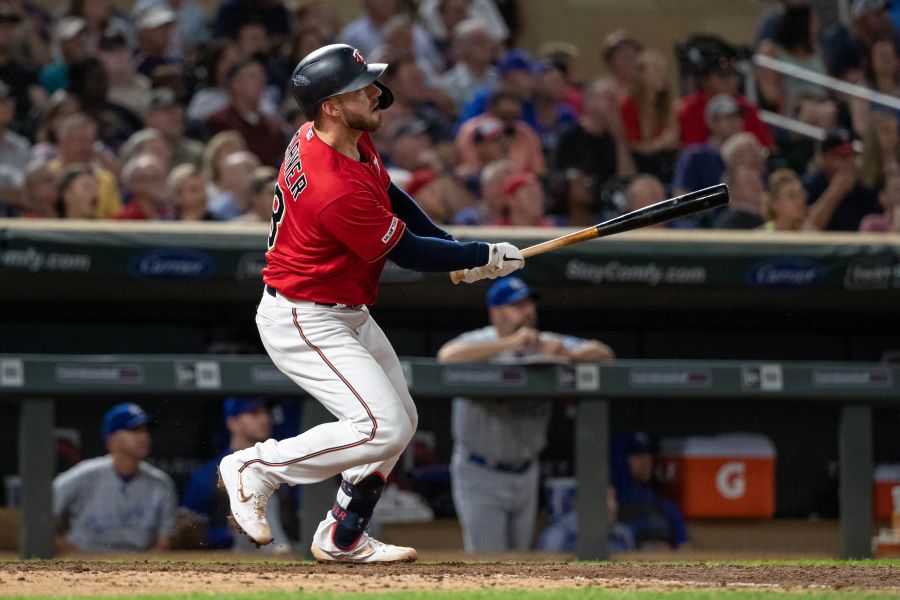 It seems likely that the coronavirus will define the calendar year of 2020, in all facets of life throughout the world, let alone the United States. In several years, the mention of 2020 is likely to be connected to almost nothing else, because of the sheer enormity of the situation we continue to face. In such a context, lost baseball games are obviously trivial. Still, those lost games are a tiny kind of tragedy, one that becomes and remains important to fans of the game long afterward. This piece is aimed at contemporaneously observing and documenting the Twins’ share of that space, by discussing in real time what the team and certain of its players are losing. Yesterday, Nick Nelson wrote an article here at Twins Daily that I heartily recommend, if you haven’t already read it. Within, he made the case that the 2020 season should be considered something wholly separate from a traditional season of record, if any baseball happens at all. It’s a painful truth, but I share Nick’s assessment. That said, the cancellation of a full season would be a disaster for the Twins, and today, we’ll examine three players whose individual predicaments make that especially clear. In the future, we might undertake a similar exercise with every player on the roster, but for now, we can begin with these three. (For today, we’ll leave aside the cases of Nelson Cruz, Trevor May, and Jake Odorizzi, who would be free agents before playing another game for the Twins if this took place. That’s a whole different can of worms.) Byron Buxton: The developmental clock is ticking more loudly on Buxton than on any other Twin, both because of his skill set and because of his service time stage. Remember, an agreement between the league and the MLB Players Association last month made clear that if the season is canceled, players will be granted exactly the same amount of service time they received in 2019, so a non-season would still push Buxton one year closer to free agency. More importantly, Buxton is 26. Given his profile, there’s no reason to expect him to be better in any future season than he projects to be in this one. He’s had extra time to recuperate from his season-ending shoulder injury from last year, but now, further lost time threatens to waste the youth in his elite legs. Moreover, his offensive approach (and especially his swing, which has undergone so many tweaks and reversions over the last several seasons) figures to be hurt more by the time off than most players’ will be. Buxton has had to fight to find consistency throughout his big-league career. Now, he’s in danger of losing what should be a prime season, and the Twins are in danger of losing a crucial season in the evaluation and instruction both of the player and of his health prospects. Mitch Garver: If Trevor Plouffe and Brian Dozier didn’t drive home the point hard enough, Twins fans could get another lesson in the cruel truths of aging curves from Garver. Here’s the thing: blooming late doesn’t earn one good karma, and thereby guarantee a long, graceful prime that lasts into one’s mid-30s. Plouffe and Dozier each became average-plus players only in their late 20s, but both then declined sharply as they entered their 30s. This is why good, proactive, fast-acting player development is so important, from the player’s perspective: becoming a star at 23 or 24 is wildly profitable, compared to doing the same at 28, as Garver just did. It also tends to lead to a kinder overall assessment of a player; guys who have just a great season or two before fading back to the fringe tend to be unfairly viewed as lucky or insubstantial. Garver is already 29. He’s four years from free agency, and (as a catcher) very unlikely to find friendly bidding if and when he does get there, even if he gets full credit for 2020 and reaches the open market at 33. More to the point, for Twins fans, it was never likely that Garver would replicate his rate-stat production of 2020 in any future season, but the prospective loss of his age-29 season makes it harder to envision that he could even retain his place as one of the AL’s best catchers. All of Garver’s improvements, at the plate and a few feet behind it, were real. That doesn’t mean they’ll survive his body getting a year older, even without a year of being beaten up behind the plate, given where he is on the aging curve and how his career has progressed to date. Michael Pineda: What a fragmented, bizarre, pockmarked career Pineda has had. His season as a rookie sensation in Seattle was nine years ago; it feels like 15. Now 31, Pineda still faces another 39 games worth of PED suspension, whenever baseball resumes. (If you think it will be wiped out, I invite you to consider more closely the attitudes of both the league and the union toward all PED suspensions and the men who incur them.) Pineda’s stuff has declined, shifted, been adjusted, and then been honed to work for him in the best way his command will allow. He’s found ways to stay healthy, after years and years of persistent injuries, but that hasn’t stopped him from struggling with inconsistency. Now, the Twins could lose Year One of a two-year deal in which year One was certainly the one on which they were betting more heavily. A year off might do Pineda’s arm some good, but often, his injury problems haven’t been confined to his arm, and his performance problems haven’t been tied to insufficient arm strength. If he doesn’t ever have another healthy, average-or-better season in the big leagues again, it will come as little surprise. For the Twins, that would be an important and painful disappointment, because he represents a key part of the bridge to their upcoming wave of young pitching. MORE FROM TWINS DAILY — Latest Twins coverage from our writers — Recent Twins discussion in our forums — Follow Twins Daily via Twitter, Facebook or email
 -
In 2019, Kepler appeared to be having a monster breakout, before an injury marred his final several weeks. However, there might be more to that regression than sheer health problems.If the Twins expected anything more than they got from Max Kepler in 2019, they did so unfairly. He was a star, not only playing his usual, laudable right field, and not only filling in admirably in center field for Byron Buxton, but bashing his way to 36 home runs and a 126 DRC+, according to Baseball Prospectus. Down the stretch, however, Kepler struggled, and it might not just have been because of the nagging injury to his left shoulder. Start chopping up Kepler’s exemplary seasonal stats, and some surprising things emerge. For one, he had a better season (in a small sample, of course) against left-handed pitchers than against righties. He lit up fellow lefties, hitting .293/.356/.524 against them. His BABIP with southpaws on the mound was a sturdy .296. Against righties, he was a solid-but-unspectacular .236/.328/.517 hitter, with an ugly .223 BABIP. Yet, throughout the first half, Kepler hit righties hard, too. At the All-Star break, Kepler stood at .263/.348/.543 against right-handers, despite an unimpressive .254 BABIP. Thereafter, however, he would hit righties at a meager .193/.295/.476 clip. In 166 plate appearances, he had a .168 second-half BABIP against righties. Some of the compromised contact, of course, likely stemmed from the weakness and limitations of his shoulder during the final several weeks. Still, he had low ground-ball and pop-up rates, pulled the ball consistently, and had a very high Hard contact rate, according to FanGraphs, north of 41 percent. The rest of the gap, then, might more easily be explained by a change in the way right-handed hurlers pitched Kepler—and that change, in turn, might be viewed as a reaction to adjustments Kepler made in 2019, which unlocked his full power potential but left him vulnerable in certain areas of the zone. After a series of important and valuable adjustments in 2018, Kepler came back in 2019 with even more exaggerated versions of those swing and approach changes in place. He stood more upright in the batter’s box, started his hands a hair higher, and lengthened his stride, creating more torque and generating a steeper bat path as he entered the strike zone. That’s how he had the highest average launch angle of his career, and how he so easily accessed his full power. It also opened up some holes in Kepler’s swing. He struggled with pitches at the top of the zone, and even with pitches in the lower, inner segment of the zone. By becoming selective enough to look for pitches on which he could extend his increasingly violent swing and slam the ball out of the park, Kepler made himself vulnerable on high and inside stuff. Here’s where righties pitched Kepler in the first half of 2019: Download attachment: Kepler.gif After the break, here’s the breakdown: Download attachment: Kepler 2.gif In addition to becoming much more careful in the areas of the zone where Kepler was most capable of doing damage, and thereby throwing more junk below the zone and off the plate away, right-handers began to look for opportunities to attack the top of the zone, and even to work down and in on Kepler. That’s a counterintuitive place for a righty to pitch to a lefty, and it undoubtedly led to some of the mistakes Kepler crushed for his 11 second-half homers against righties, but on balance, it paid off. If a 2020 season happens, it’s hard to predict whether Kepler will have worked to close this hole, or whether his fully healthy left shoulder will have allowed him to close it without a significant adjustment. There’s undeniable value in the approach he took last season, one lefties will continue to struggle to exploit, and one that allows him to have success even while vulnerable in certain ways. Still, it’s interesting to track the cat-and-mouse game between a good hitter like Kepler and the pitchers trying to gameplan against him. There will be opportunities, whether in 2020 or in 2021, for the league to target the weaknesses he showed late in 2019 even more acutely, and it might be up to Kepler to find a new movement pattern in the box that allows him response flexibility even as he maintains his damage-focused, highly successful work from 2019. MORE FROM TWINS DAILY — Latest Twins coverage from our writers — Recent Twins discussion in our forums — Follow Twins Daily via Twitter, Facebook or email Click here to view the article
-
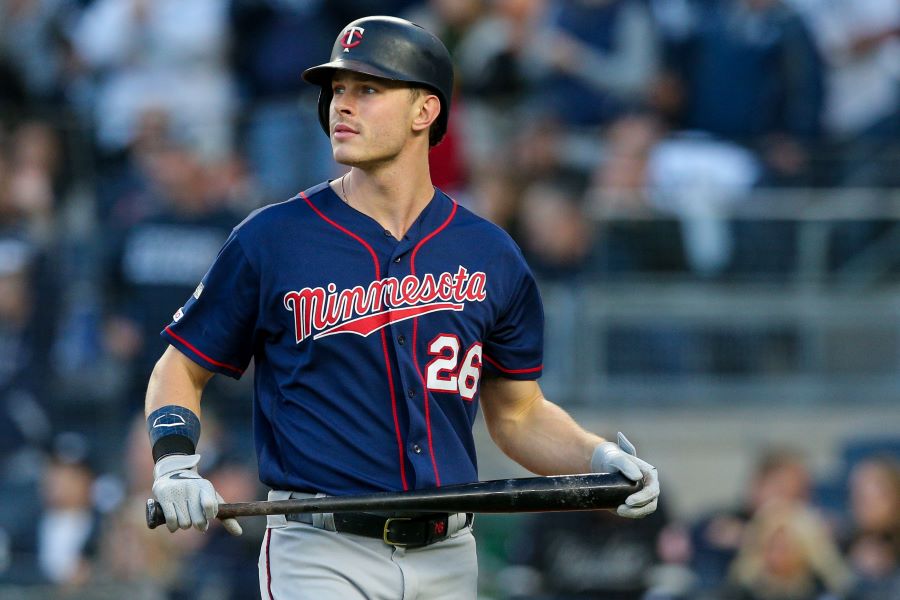 If the Twins expected anything more than they got from Max Kepler in 2019, they did so unfairly. He was a star, not only playing his usual, laudable right field, and not only filling in admirably in center field for Byron Buxton, but bashing his way to 36 home runs and a 126 DRC+, according to Baseball Prospectus. Down the stretch, however, Kepler struggled, and it might not just have been because of the nagging injury to his left shoulder. Start chopping up Kepler’s exemplary seasonal stats, and some surprising things emerge. For one, he had a better season (in a small sample, of course) against left-handed pitchers than against righties. He lit up fellow lefties, hitting .293/.356/.524 against them. His BABIP with southpaws on the mound was a sturdy .296. Against righties, he was a solid-but-unspectacular .236/.328/.517 hitter, with an ugly .223 BABIP. Yet, throughout the first half, Kepler hit righties hard, too. At the All-Star break, Kepler stood at .263/.348/.543 against right-handers, despite an unimpressive .254 BABIP. Thereafter, however, he would hit righties at a meager .193/.295/.476 clip. In 166 plate appearances, he had a .168 second-half BABIP against righties. Some of the compromised contact, of course, likely stemmed from the weakness and limitations of his shoulder during the final several weeks. Still, he had low ground-ball and pop-up rates, pulled the ball consistently, and had a very high Hard contact rate, according to FanGraphs, north of 41 percent. The rest of the gap, then, might more easily be explained by a change in the way right-handed hurlers pitched Kepler—and that change, in turn, might be viewed as a reaction to adjustments Kepler made in 2019, which unlocked his full power potential but left him vulnerable in certain areas of the zone. After a series of important and valuable adjustments in 2018, Kepler came back in 2019 with even more exaggerated versions of those swing and approach changes in place. He stood more upright in the batter’s box, started his hands a hair higher, and lengthened his stride, creating more torque and generating a steeper bat path as he entered the strike zone. That’s how he had the highest average launch angle of his career, and how he so easily accessed his full power. It also opened up some holes in Kepler’s swing. He struggled with pitches at the top of the zone, and even with pitches in the lower, inner segment of the zone. By becoming selective enough to look for pitches on which he could extend his increasingly violent swing and slam the ball out of the park, Kepler made himself vulnerable on high and inside stuff. Here’s where righties pitched Kepler in the first half of 2019: After the break, here’s the breakdown: In addition to becoming much more careful in the areas of the zone where Kepler was most capable of doing damage, and thereby throwing more junk below the zone and off the plate away, right-handers began to look for opportunities to attack the top of the zone, and even to work down and in on Kepler. That’s a counterintuitive place for a righty to pitch to a lefty, and it undoubtedly led to some of the mistakes Kepler crushed for his 11 second-half homers against righties, but on balance, it paid off. If a 2020 season happens, it’s hard to predict whether Kepler will have worked to close this hole, or whether his fully healthy left shoulder will have allowed him to close it without a significant adjustment. There’s undeniable value in the approach he took last season, one lefties will continue to struggle to exploit, and one that allows him to have success even while vulnerable in certain ways. Still, it’s interesting to track the cat-and-mouse game between a good hitter like Kepler and the pitchers trying to gameplan against him. There will be opportunities, whether in 2020 or in 2021, for the league to target the weaknesses he showed late in 2019 even more acutely, and it might be up to Kepler to find a new movement pattern in the box that allows him response flexibility even as he maintains his damage-focused, highly successful work from 2019. MORE FROM TWINS DAILY — Latest Twins coverage from our writers — Recent Twins discussion in our forums — Follow Twins Daily via Twitter, Facebook or email
 -
Anytime you’re asked whether a sports record will ever fall, it’s a good idea to bet that it will. In this case, though, it’s a lot more complicated than that.In 1969, Harmon Killebrew tied his career best with 49 home runs. He also topped 700 plate appearances, for the only time in his career. For most of the season, he batted cleanup, although Billy Martin flipped Killebrew and Tony Oliva when the Twins faced left-handed pitchers. All told, Killebrew drove in 140 runs, which was not only a career high, but the Senators-cum-Twins’ record. Forty years later, that record stands, and only Justin Morneau has gotten within 10 of it. Will anyone ever break Killebrew’s record? The short answer, as Betteridge’s law of headlines would suggest, is a simple one: no. Some sequence of major changes to the game could result in that record becoming vulnerable, but based on the current composition of the game and its players, it’s well out of reach. More interesting than the simple answer, though, is a more nuanced one. Let’s take the time to offer that answer—to wrestle not just with whether a player is likely to drive in 140 or more in some season to come, but with the questions of what changes have made that so unlikely, and of what would have to happen in order for that condition to change. Since 2000, there have only been three seasons in which any player in MLB drove in 150 or more runs. Sammy Sosa drove in 160 in 2001, in his best season. Miguel Tejada pushed across 150 in 2006, and Alex Rodríguez pummeled his way to 156 RBI in 2007, when he won the MVP with the Yankees and opted out of his famous 10-year deal, eventually winning an even more lucrative one from the team. Eighteen player-seasons have eclipsed 140 RBI over the same span, but every one of those came before the 2010 campaign. In the decade that just ended, Miguel Cabrera’s Triple Crown-winning 2012 total of 139 RBI was the top number. Since offense bottomed out, and then began to rebound, the highest individual total in any season was the 133 runs driven home by Rockies slugger Nolan Arenado, in 2016. In the first four seasons after the last expansion, beginning in 1998, there were 70 individual seasons of 120 or more RBI, and 34 of at least 130. Over the last four seasons, there have been just 13 and four such seasons, respectively. There are two key reasons for this: the changing structure of the modern lineup, and the changing offensive profile of non-elite big-leaguers. As stat-savvy fans are well aware, sabermetric explorations have found that the ideal place for a lineup’s best hitter is not third or fourth, but second. Since about 2015, teams have embraced that fact, and the nature of the top segments of the batting order have transformed. Teams put their best hitters at the top of the order, even if those hitters have ample power—and they usually do. Rank every season since 1904 by the league’s aggregate slugging average from the top two places in the order, and the leaderboard begins: 2019, 2017, 2018, 2016. The .460 slugging average from the top two slots in 2019, easily the highest ever, tells the story in concise fashion. Where tablesetters once batted, there are now big eaters. More to the point, though, every hitter in baseball is becoming more run producer than table setter. As teams have become more sophisticated in their evaluations of hitters, they’ve stopped giving any real time to players without power—and in some cases, have even helped players who would never previously have been trained to slug to do just that. The player with a .360 or better on-base percentage, but little power, is nearly extinct, for a number of complementary reasons. For the first time since the first expansion of the league in 1961, we’ve now gone more than two decades without any expansion at all. That’s eliminated a key driver of gaudy offensive numbers of all kinds: there just aren’t enough bad pitchers in baseball to facilitate them. That, far more than performance-enhancing drugs or even the fluctuating liveliness of the baseball, accounts for the fact that no one has seriously threatened a home-run record in over a decade. There aren’t easy marks against whom great hitters can rack up huge home-run totals, and there aren’t wild hurlers against whom non-dangerous hitters can rack up walks. Nor, with the ever-increasing average athleticism of players and the even more rapidly evolving intelligence of defensive alignments, are there places for such hitters to deposit singles. Teams select for power, because a hitter bereft of power has never had less chance to be successful in the majors. As they cull the talent pool that way, and retrain certain players to hit more long balls, they reduce the number of baserunners any player is likely to have on when they bat, because their lesser teammates are more likely to have driven themselves or others in. As the league drags its feet on potential expansion (navigating their way toward the best balance of demand in a new market and the ability to manipulate current cities when existing teams need new ballparks or tax breaks), great pitching also makes it harder for batters to run up huge individual numbers. It doesn’t help that these trends have also pushed strikeout rates higher, depressing batting average potential; great RBI seasons almost always involve a player batting at least .300, a wildly rare occurrence in the modern game. All of that could change, someday. The ball could stay as lively as we saw it be in 2019, and two new teams could be added, and rule changes could force teams to reconceptualize their offenses and make it a plan, once again, to maximize OBP at the top of the order and save their sluggers for its heart. If that all happens while Luis Arráez is batting atop the Twins order, some Minnesota slugger could eclipse Killebrew. For now, however, his record seems very safe. MORE FROM TWINS DAILY — Latest Twins coverage from our writers — Recent Twins discussion in our forums — Follow Twins Daily via Twitter, Facebook or email Click here to view the article
-
Will the Twins' Single-Season RBI Record Ever Be Broken?
Matthew Trueblood posted an article in Twins
 In 1969, Harmon Killebrew tied his career best with 49 home runs. He also topped 700 plate appearances, for the only time in his career. For most of the season, he batted cleanup, although Billy Martin flipped Killebrew and Tony Oliva when the Twins faced left-handed pitchers. All told, Killebrew drove in 140 runs, which was not only a career high, but the Senators-cum-Twins’ record. Forty years later, that record stands, and only Justin Morneau has gotten within 10 of it. Will anyone ever break Killebrew’s record? The short answer, as Betteridge’s law of headlines would suggest, is a simple one: no. Some sequence of major changes to the game could result in that record becoming vulnerable, but based on the current composition of the game and its players, it’s well out of reach. More interesting than the simple answer, though, is a more nuanced one. Let’s take the time to offer that answer—to wrestle not just with whether a player is likely to drive in 140 or more in some season to come, but with the questions of what changes have made that so unlikely, and of what would have to happen in order for that condition to change. Since 2000, there have only been three seasons in which any player in MLB drove in 150 or more runs. Sammy Sosa drove in 160 in 2001, in his best season. Miguel Tejada pushed across 150 in 2006, and Alex Rodríguez pummeled his way to 156 RBI in 2007, when he won the MVP with the Yankees and opted out of his famous 10-year deal, eventually winning an even more lucrative one from the team. Eighteen player-seasons have eclipsed 140 RBI over the same span, but every one of those came before the 2010 campaign. In the decade that just ended, Miguel Cabrera’s Triple Crown-winning 2012 total of 139 RBI was the top number. Since offense bottomed out, and then began to rebound, the highest individual total in any season was the 133 runs driven home by Rockies slugger Nolan Arenado, in 2016. In the first four seasons after the last expansion, beginning in 1998, there were 70 individual seasons of 120 or more RBI, and 34 of at least 130. Over the last four seasons, there have been just 13 and four such seasons, respectively. There are two key reasons for this: the changing structure of the modern lineup, and the changing offensive profile of non-elite big-leaguers. As stat-savvy fans are well aware, sabermetric explorations have found that the ideal place for a lineup’s best hitter is not third or fourth, but second. Since about 2015, teams have embraced that fact, and the nature of the top segments of the batting order have transformed. Teams put their best hitters at the top of the order, even if those hitters have ample power—and they usually do. Rank every season since 1904 by the league’s aggregate slugging average from the top two places in the order, and the leaderboard begins: 2019, 2017, 2018, 2016. The .460 slugging average from the top two slots in 2019, easily the highest ever, tells the story in concise fashion. Where tablesetters once batted, there are now big eaters. More to the point, though, every hitter in baseball is becoming more run producer than table setter. As teams have become more sophisticated in their evaluations of hitters, they’ve stopped giving any real time to players without power—and in some cases, have even helped players who would never previously have been trained to slug to do just that. The player with a .360 or better on-base percentage, but little power, is nearly extinct, for a number of complementary reasons. For the first time since the first expansion of the league in 1961, we’ve now gone more than two decades without any expansion at all. That’s eliminated a key driver of gaudy offensive numbers of all kinds: there just aren’t enough bad pitchers in baseball to facilitate them. That, far more than performance-enhancing drugs or even the fluctuating liveliness of the baseball, accounts for the fact that no one has seriously threatened a home-run record in over a decade. There aren’t easy marks against whom great hitters can rack up huge home-run totals, and there aren’t wild hurlers against whom non-dangerous hitters can rack up walks. Nor, with the ever-increasing average athleticism of players and the even more rapidly evolving intelligence of defensive alignments, are there places for such hitters to deposit singles. Teams select for power, because a hitter bereft of power has never had less chance to be successful in the majors. As they cull the talent pool that way, and retrain certain players to hit more long balls, they reduce the number of baserunners any player is likely to have on when they bat, because their lesser teammates are more likely to have driven themselves or others in. As the league drags its feet on potential expansion (navigating their way toward the best balance of demand in a new market and the ability to manipulate current cities when existing teams need new ballparks or tax breaks), great pitching also makes it harder for batters to run up huge individual numbers. It doesn’t help that these trends have also pushed strikeout rates higher, depressing batting average potential; great RBI seasons almost always involve a player batting at least .300, a wildly rare occurrence in the modern game. All of that could change, someday. The ball could stay as lively as we saw it be in 2019, and two new teams could be added, and rule changes could force teams to reconceptualize their offenses and make it a plan, once again, to maximize OBP at the top of the order and save their sluggers for its heart. If that all happens while Luis Arráez is batting atop the Twins order, some Minnesota slugger could eclipse Killebrew. For now, however, his record seems very safe. MORE FROM TWINS DAILY — Latest Twins coverage from our writers — Recent Twins discussion in our forums — Follow Twins Daily via Twitter, Facebook or email
 -
As a new book illustrates, the Twins' failure to get anything out of Chris Colabello had much to do with the organization's broader shortcomings. Josh Donaldson's arrival speaks to their evolution since.Josh Donaldson has a lot in common with the Twins. He’s as dedicated to hitting the ball hard in the air to his pull field as they are, and thus, he’s a perfect philosophical fit for the team. Several years ago, however, the team muffed its chance to get the best out of Chris Colabello, the first player ever to thrive under the tutelage of the hitting coach who would similarly help Donaldson. A new book on the baseball industry’s changing understanding of the swing makes clear that, while Colabello could never have become the player Donaldson is, it’s not a coincidence that he broke out only in the season after he departed Minnesota and joined Donaldson on the Blue Jays. Out Tuesday, “Swing Kings” is a book by Jared Diamond, the Wall Street Journal baseball writer. It chronicles the influential roles of several independent hitting coaches who, from outside the structure of organized baseball, changed the way the game is played at the MLB level by bringing a new offensive philosophy to the fore. Among those coaches is Bobby Tewksbary, a former player who topped out in the independent Canadian-American Association. He was a teammate of Colabello, there, and the two are the same age. They became friends, and when (after giving up on playing himself) Tewksbary discovered some counterintuitive and highly valuable things about the nature of the swing, he made Colabello his first guinea pig. Colabello began smashing the Can-Am Association to bits, finally drawing the Twins’ interest. As the book explains, however, neither Colabello nor Tewksbary considered the team a perfect fit for Colabello’s newfound, power-centric swing and approach. Tewksbary called the team, then run by the old guard that surrounded Terry Ryan and the rest of his front office, “anti-progressive.” No sooner was Colabello brought into the ranks of affiliated ball, than the Twins’ minor-league coaches were trying to change him. One number helps tell the story of Colabello’s frustrating failure with the Twins, and his subsequent success in Toronto. With Minnesota in 2013 and 2014, Colabello swung at the first pitch just 28.6 percent of the time. With his overall contact rate (just over 65 percent of his swings resulted in contact during his Twins tenure), being that selective early in the count spelled disaster. He struck out 30.9 percent of the time while he was a Twin, which torpedoed his overall performance. In 2015, when Colabello hit .321/.367/.520 for the Blue Jays, he swung at the first pitch in 43.5 percent of his plate appearances. That early aggressiveness not only allowed him to avoid strikeouts better, but removed the danger that he might let the most hittable pitch he would see go by. He pushed his ground-ball rate down and consistently drove the ball for the first (and last) time during his big-league career, because the Blue Jays allowed him to take the aggressive approach that suited his swing. At the time, the Twins were not only behind the analytical curve, but strikingly rigid in their approach to advising players and building in-game strategies. They were wrong about how to best approach big-league pitching, but more damningly, they were highly confident that they were right, and they allowed no quarter to players who wanted to do things a different way. All of that has changed. Tellingly, the Twins not only sit on the cutting edge of the industry’s advancements in understanding all phases and facets of the game, but treat every player as a unique case. They permit, and even encourage, different approaches from different players, rather than applying any single principle with a broad brush. Donaldson’s arrival is the payoff for that evolution. Another, unheralded Tewksbary client (who initially heard about him because of Colabello) introduced Donaldson to Tewksbary prior to 2013, and Tewksbary so helped Donaldson emerge as an MVP-caliber slugger that, in 2015, Donaldson brought Tewksbary along as his pitcher when he competed in the Home Run Derby. A player of Donaldson’s personality, with his drive and his confidence in the way he does things, would not have signed with the Ryan-era Twins, even if they had made him the most substantial offer. He’d have seen their unreceptive attitude toward unusual approaches, their inflexibility, and their lack of imagination as disqualifying. Diamond’s book stands as a reminder that the Twins have moved from the back of the pack to the front, or very nearly so, where analytical savvy is concerned, but also that they paid a price for taking so long to get here. MORE FROM TWINS DAILY — Latest Twins coverage from our writers — Recent Twins discussion in our forums — Follow Twins Daily via Twitter, Facebook or email Click here to view the article
-
 Josh Donaldson has a lot in common with the Twins. He’s as dedicated to hitting the ball hard in the air to his pull field as they are, and thus, he’s a perfect philosophical fit for the team. Several years ago, however, the team muffed its chance to get the best out of Chris Colabello, the first player ever to thrive under the tutelage of the hitting coach who would similarly help Donaldson. A new book on the baseball industry’s changing understanding of the swing makes clear that, while Colabello could never have become the player Donaldson is, it’s not a coincidence that he broke out only in the season after he departed Minnesota and joined Donaldson on the Blue Jays. Out Tuesday, “Swing Kings” is a book by Jared Diamond, the Wall Street Journal baseball writer. It chronicles the influential roles of several independent hitting coaches who, from outside the structure of organized baseball, changed the way the game is played at the MLB level by bringing a new offensive philosophy to the fore. Among those coaches is Bobby Tewksbary, a former player who topped out in the independent Canadian-American Association. He was a teammate of Colabello, there, and the two are the same age. They became friends, and when (after giving up on playing himself) Tewksbary discovered some counterintuitive and highly valuable things about the nature of the swing, he made Colabello his first guinea pig. Colabello began smashing the Can-Am Association to bits, finally drawing the Twins’ interest. As the book explains, however, neither Colabello nor Tewksbary considered the team a perfect fit for Colabello’s newfound, power-centric swing and approach. Tewksbary called the team, then run by the old guard that surrounded Terry Ryan and the rest of his front office, “anti-progressive.” No sooner was Colabello brought into the ranks of affiliated ball, than the Twins’ minor-league coaches were trying to change him. One number helps tell the story of Colabello’s frustrating failure with the Twins, and his subsequent success in Toronto. With Minnesota in 2013 and 2014, Colabello swung at the first pitch just 28.6 percent of the time. With his overall contact rate (just over 65 percent of his swings resulted in contact during his Twins tenure), being that selective early in the count spelled disaster. He struck out 30.9 percent of the time while he was a Twin, which torpedoed his overall performance. In 2015, when Colabello hit .321/.367/.520 for the Blue Jays, he swung at the first pitch in 43.5 percent of his plate appearances. That early aggressiveness not only allowed him to avoid strikeouts better, but removed the danger that he might let the most hittable pitch he would see go by. He pushed his ground-ball rate down and consistently drove the ball for the first (and last) time during his big-league career, because the Blue Jays allowed him to take the aggressive approach that suited his swing. At the time, the Twins were not only behind the analytical curve, but strikingly rigid in their approach to advising players and building in-game strategies. They were wrong about how to best approach big-league pitching, but more damningly, they were highly confident that they were right, and they allowed no quarter to players who wanted to do things a different way. All of that has changed. Tellingly, the Twins not only sit on the cutting edge of the industry’s advancements in understanding all phases and facets of the game, but treat every player as a unique case. They permit, and even encourage, different approaches from different players, rather than applying any single principle with a broad brush. Donaldson’s arrival is the payoff for that evolution. Another, unheralded Tewksbary client (who initially heard about him because of Colabello) introduced Donaldson to Tewksbary prior to 2013, and Tewksbary so helped Donaldson emerge as an MVP-caliber slugger that, in 2015, Donaldson brought Tewksbary along as his pitcher when he competed in the Home Run Derby. A player of Donaldson’s personality, with his drive and his confidence in the way he does things, would not have signed with the Ryan-era Twins, even if they had made him the most substantial offer. He’d have seen their unreceptive attitude toward unusual approaches, their inflexibility, and their lack of imagination as disqualifying. Diamond’s book stands as a reminder that the Twins have moved from the back of the pack to the front, or very nearly so, where analytical savvy is concerned, but also that they paid a price for taking so long to get here. MORE FROM TWINS DAILY — Latest Twins coverage from our writers — Recent Twins discussion in our forums — Follow Twins Daily via Twitter, Facebook or email
 -
This week, with the help of Out of the Park, we’ve simulated the 91/19 World Series, a seven-game battle between the 1991 Twins and the 2019 Twins. __________________ Tom Kelly’s strategy in this World Series is becoming clear: he intends to zig wherever Rocco Baldelli’s club expects a zag. In a 7-3 Game 3 victory that puts Kelly’s 1991 team ahead 2-1 in the best-of-seven, every unexpected maneuver paid off—especially the controversial choice to tab rookie Denny Neagle as the starting pitcher.Neagle worked into the seventh inning, holding the hosts scoreless. He demonstrated extraordinary pitch efficiency, and fearlessly faced down the gauntlet of right-handed sluggers slotted into the middle of Baldelli’s batting order. Whether 20-game winner Scott Erickson will recover smoothly from the affront of having a pitcher without a big-league win slotted into the rotation ahead of him remains to be seen, but for one night, Kelly’s decision to avoid Erickson’s contact-heavy profile against the record-setting 2019 offense worked. In the first game of the set played at chilly Target Field, Baldelli called upon Michael Pineda, looking to sustain the momentum the team won when José Berríos led them to a Game 2 victory. No sooner had Pineda taken the mound, though, than Kelly’s ambush lineup went to its work. Leading off again, Chuck Knoblauch caught the 2019 Twins napping with a drag bunt toward third base, taking advantage of Miguel Sanó playing too deep and of Pineda’s tendency to fall off the mound toward first base at the end of his delivery. Pineda got to the ball, but had no chance to throw out Knoblauch at first base. It’s hard to blame Sanó or Pineda for being ill-prepared; Knoblauch didn’t manage a single bunt hit during the 1991 regular season. Still, the tactic seemed to fluster Pineda, and because of Kelly’s new lineup construction, he had no time to recover. On a 1-0 pitch, Kent Hrbek blasted his third home run of the series, into the planters just above the right-field wall. A batter later, Shane Mack fell behind 0-2 to Pineda, but spoiled a pitch, worked his way back to a full count, and then launched a home run into the bullpen beyond left-center field. In a blink, it was 3-0 in favor of Kelly’s agents of chaos, and those who had raised an eyebrow at Kelly’s unusual sequence of pregame decisions were left to semantic arguments. Mack is just maturing into a full-time player, rather than the potent but platoon-protected bench bat he’d been in the past, and in the vast majority of his starts in 1991, he batted either sixth or seventh. He only started twice in the cleanup slot during the regular campaign. Kelly has already written Mack into that spot three times in this series, all against right-handed starters, and it’s paid off, thanks in large part to the trickle-up effects of moving Knoblauch and Hrbek to the top of the order. Mack’s thump has rendered Dan Gladden’s absence almost an afterthought, and as the series shifted to the smaller left field of Target Field, it became a less nervous swap for Kelly and his staff. Pineda’s slider was erratic, and his fastball command was loose. As tends to happen on his bad nights, he was largely in the zone with his heat, but unable to locate to the quadrants for which he was aiming. The 1991 Twins ignored the slider, teed off on fastballs, and squared him up repeatedly. In the second, only a pair of stellar plays by Byron Buxton in center field—cutting off a Mike Pagliarulo line drive toward the gap in right-center field to hold him to a two-out single, then making a diving play on a similar liner from Knoblauch to retire the side—kept the visitors from extending their 3-0 lead even further. In the fourth, right fielder Gene Larkin led off with a double, and two batters later, Knoblauch brought him home with a single up the middle, a sharp grounder that squeezed between the shifted Jorge Polanco and Luis Arráez. Meanwhile, Neagle cruised. The rookie defused the vaunted Bomba Squad like a seasoned special agent, a dour expression masking any jitters about pitching on such a grand stage in the same city where he pitched collegiate ball. Even when C.J. Cron dented the chain link of the fence in left-center with a leadoff double in the third inning, Neagle kept his jaw set and took care of business. He got a lazy fly ball from Eddie Rosario, a breaking ball worming its way to the end of his bat, and then struck out Buxton after a tough at-bat. A fastball on the hands of Polanco induced a pop-up to Knoblauch, and the 2019 club’s rally died without so much as advancing Cron. Baldelli hasn’t managed with tremendous urgency to this point in the series, and that became particularly pronounced in the middle innings of Game 3. He lifted Pineda in favor of Ryne Harper, who delivered a clean inning as a good matchup for the right-handed Kirby Puckett and Mack. The next pitcher out of the bullpen, however, was Matt Magill, and Baldelli would leave his fringy pensman in to throw 47 pitches over 2 ⅔ innings. Baldelli also slotted Arráez into the second place in the order against the left-handed Neagle, a gamble that briefly seemed poised to pay big dividends. In the bottom of the sixth, after Neagle had retired 11 in a row, he came back to the top of the order for a third trip through. Polanco drew a two-out walk, and then Arráez doubled over the shallowly-positioned Mack and Puckett, to the gap in left-center field. Polanco held at third on the play, and Neagle then walked Nelson Cruz. Brian Harper and pitching coach Dick Such visited the mound, but Kelly elected to give his young starter a chance to work out of the jam again. That brought up Mitch Garver, who worked a 2-2 count, then crushed a ball on a high arc toward the left-field bleachers. Lady Luck didn’t attend the poke in its flight, however, as Mack hauled the ball in with his back to the wall in straight-away left field. A would-be game-tying grand slam became the final out of the inning, and the game seemed to slip out of the 2019 club’s reach for good. It took just two batters for Kelly’s band of assassins to stomp on the throats of their wounded opponents. Magill’s second inning of work began with a Hrbek single past Arráez, despite the shift that had Arráez positioned about 210 feet from home plate in straight-away right field. Then, Puckett swatted a fly ball to the same spot as Garver, with an identical exit velocity of 99.4 miles per hour off the bat, but landed it in the second row of the bleachers, just beyond Rosario’s best Spider-Man impression at the left-field wall. Each side kept their best bullpen powder dry, thanks to Kelly’s profound faith in Neagle, and thanks to the hole in which Pineda put the 2019 team early. Baldelli seems unable to keep up with Kelly’ uncharacteristic, counterintuitive, highly modern tactics, and the power of the 1991 team has caught its more famous slugging counterpart off-guard. It will be interesting to see whether Baldelli turns back to Jake Odorizzi, on short rest, in order to avoid falling behind 3-1 in Game 4. In the meantime, fans of the 1991 Twins will savor the feeling of having dodged a bullet on Garver’s drive, and of having outsmarted the notorious innovators of the 2019 team in order to put two quick runs on the board in a key game. You can find the boxscore and pitch-by-pitch results for Game One attached below. If you would like to learn more about Out of the Park 21, please click on this link. If you would like to try it, you can also download it for 10% off the regular price using the code TWINSDAILY. Finally, be sure to go back and see the recaps for: Game 1 Game 2 Download attachment: Mnnesota 2019 Twins @ Minnesota 1991 Twins Game Log Game 3.pdf Download attachment: MLB Box Score, Minnesota 2019 Twins at Minnesota 1991 Twins Game 3.pdf Click here to view the article
-
91/19 World Series Game 3: Kelly's Bold Moves Pay Off in Pivotal Win
Matthew Trueblood posted an article in Twins
 Neagle worked into the seventh inning, holding the hosts scoreless. He demonstrated extraordinary pitch efficiency, and fearlessly faced down the gauntlet of right-handed sluggers slotted into the middle of Baldelli’s batting order. Whether 20-game winner Scott Erickson will recover smoothly from the affront of having a pitcher without a big-league win slotted into the rotation ahead of him remains to be seen, but for one night, Kelly’s decision to avoid Erickson’s contact-heavy profile against the record-setting 2019 offense worked. In the first game of the set played at chilly Target Field, Baldelli called upon Michael Pineda, looking to sustain the momentum the team won when José Berríos led them to a Game 2 victory. No sooner had Pineda taken the mound, though, than Kelly’s ambush lineup went to its work. Leading off again, Chuck Knoblauch caught the 2019 Twins napping with a drag bunt toward third base, taking advantage of Miguel Sanó playing too deep and of Pineda’s tendency to fall off the mound toward first base at the end of his delivery. Pineda got to the ball, but had no chance to throw out Knoblauch at first base. It’s hard to blame Sanó or Pineda for being ill-prepared; Knoblauch didn’t manage a single bunt hit during the 1991 regular season. Still, the tactic seemed to fluster Pineda, and because of Kelly’s new lineup construction, he had no time to recover. On a 1-0 pitch, Kent Hrbek blasted his third home run of the series, into the planters just above the right-field wall. A batter later, Shane Mack fell behind 0-2 to Pineda, but spoiled a pitch, worked his way back to a full count, and then launched a home run into the bullpen beyond left-center field. In a blink, it was 3-0 in favor of Kelly’s agents of chaos, and those who had raised an eyebrow at Kelly’s unusual sequence of pregame decisions were left to semantic arguments. Mack is just maturing into a full-time player, rather than the potent but platoon-protected bench bat he’d been in the past, and in the vast majority of his starts in 1991, he batted either sixth or seventh. He only started twice in the cleanup slot during the regular campaign. Kelly has already written Mack into that spot three times in this series, all against right-handed starters, and it’s paid off, thanks in large part to the trickle-up effects of moving Knoblauch and Hrbek to the top of the order. Mack’s thump has rendered Dan Gladden’s absence almost an afterthought, and as the series shifted to the smaller left field of Target Field, it became a less nervous swap for Kelly and his staff. Pineda’s slider was erratic, and his fastball command was loose. As tends to happen on his bad nights, he was largely in the zone with his heat, but unable to locate to the quadrants for which he was aiming. The 1991 Twins ignored the slider, teed off on fastballs, and squared him up repeatedly. In the second, only a pair of stellar plays by Byron Buxton in center field—cutting off a Mike Pagliarulo line drive toward the gap in right-center field to hold him to a two-out single, then making a diving play on a similar liner from Knoblauch to retire the side—kept the visitors from extending their 3-0 lead even further. In the fourth, right fielder Gene Larkin led off with a double, and two batters later, Knoblauch brought him home with a single up the middle, a sharp grounder that squeezed between the shifted Jorge Polanco and Luis Arráez. Meanwhile, Neagle cruised. The rookie defused the vaunted Bomba Squad like a seasoned special agent, a dour expression masking any jitters about pitching on such a grand stage in the same city where he pitched collegiate ball. Even when C.J. Cron dented the chain link of the fence in left-center with a leadoff double in the third inning, Neagle kept his jaw set and took care of business. He got a lazy fly ball from Eddie Rosario, a breaking ball worming its way to the end of his bat, and then struck out Buxton after a tough at-bat. A fastball on the hands of Polanco induced a pop-up to Knoblauch, and the 2019 club’s rally died without so much as advancing Cron. Baldelli hasn’t managed with tremendous urgency to this point in the series, and that became particularly pronounced in the middle innings of Game 3. He lifted Pineda in favor of Ryne Harper, who delivered a clean inning as a good matchup for the right-handed Kirby Puckett and Mack. The next pitcher out of the bullpen, however, was Matt Magill, and Baldelli would leave his fringy pensman in to throw 47 pitches over 2 ⅔ innings. Baldelli also slotted Arráez into the second place in the order against the left-handed Neagle, a gamble that briefly seemed poised to pay big dividends. In the bottom of the sixth, after Neagle had retired 11 in a row, he came back to the top of the order for a third trip through. Polanco drew a two-out walk, and then Arráez doubled over the shallowly-positioned Mack and Puckett, to the gap in left-center field. Polanco held at third on the play, and Neagle then walked Nelson Cruz. Brian Harper and pitching coach Dick Such visited the mound, but Kelly elected to give his young starter a chance to work out of the jam again. That brought up Mitch Garver, who worked a 2-2 count, then crushed a ball on a high arc toward the left-field bleachers. Lady Luck didn’t attend the poke in its flight, however, as Mack hauled the ball in with his back to the wall in straight-away left field. A would-be game-tying grand slam became the final out of the inning, and the game seemed to slip out of the 2019 club’s reach for good. It took just two batters for Kelly’s band of assassins to stomp on the throats of their wounded opponents. Magill’s second inning of work began with a Hrbek single past Arráez, despite the shift that had Arráez positioned about 210 feet from home plate in straight-away right field. Then, Puckett swatted a fly ball to the same spot as Garver, with an identical exit velocity of 99.4 miles per hour off the bat, but landed it in the second row of the bleachers, just beyond Rosario’s best Spider-Man impression at the left-field wall. Each side kept their best bullpen powder dry, thanks to Kelly’s profound faith in Neagle, and thanks to the hole in which Pineda put the 2019 team early. Baldelli seems unable to keep up with Kelly’ uncharacteristic, counterintuitive, highly modern tactics, and the power of the 1991 team has caught its more famous slugging counterpart off-guard. It will be interesting to see whether Baldelli turns back to Jake Odorizzi, on short rest, in order to avoid falling behind 3-1 in Game 4. In the meantime, fans of the 1991 Twins will savor the feeling of having dodged a bullet on Garver’s drive, and of having outsmarted the notorious innovators of the 2019 team in order to put two quick runs on the board in a key game. You can find the boxscore and pitch-by-pitch results for Game One attached below. If you would like to learn more about Out of the Park 21, please click on this link. If you would like to try it, you can also download it for 10% off the regular price using the code TWINSDAILY. Finally, be sure to go back and see the recaps for: Game 1 Game 2 Mnnesota 2019 Twins @ Minnesota 1991 Twins Game Log Game 3.pdf MLB Box Score, Minnesota 2019 Twins at Minnesota 1991 Twins Game 3.pdf
 -
What's Left for Homer Bailey to Fix?
Matthew Trueblood posted a topic in Twins Daily Front Page News
Homer Bailey made huge strides after a mid-July trade in 2019. To be as good in 2020, he needs to lock in a few adjustments, and make one or two more.The additions of Josh Donaldson and Kenta Maeda defined the Twins’ offseason, but if the season eventually goes forward, they might benefit as much from the earlier work they did to bolster their rotation. Homer Bailey is an under-the-radar addition to the pitching staff, but not an unimportant one. Under the tutelage of Wes Johnson, he could build upon his 2019 success in ways that go far beyond his increasingly famous splitter. Read about Bailey’s bounceback campaign last year, and you’ll be inundated with talk of his splitter. It was the pitch that saved his career, and using it more often—including finding the courage to do so even against right-handed batters—certainly put him on the path toward the success that earned him a guaranteed deal this winter. However, in paying close attention to the remarks made by Twins brass when they signed Bailey, it becomes clear that it’s not just the splitter that intrigues them. They specifically took interest in Bailey’s adjustments in the second half, and his increased splitter usage began long before he was traded from the Royals to the Athletics, in mid-July. One obvious adjustment Bailey made, beyond any tinkering with his pitch mix, was to slide over on the rubber. He went from being a slightly crossfire righty setting up on the third-base edge of the pitching rubber to using the middle of that rubber, changing the angles his pitches created for hitters and allowing him to take a more direct mechanical line to home plate. In so doing, he added heat to his fastball. His average velocity on the heater ticked up by about 0.3 miles per hour after the trade, according to Statcast, and so did his average perceived velocity—he lost no extension at release by making the mechanical tweak. His average spin rate rose, too, from 2,071 revolutions per minute (RPM) to 2,117. None of those changes are large, but they matter. The biggest (apparent) change the A’s asked of him wasn’t to move over on the rubber, but to take that more direct line to the plate, and to raise his arm slot to match. Bailey did it, and the result was that everything he threw achieved more vertical plane. His curveball lost about an inch of lateral sweep, but no vertical depth, and since his fastball rose slightly more, the curve came to tunnel better off of the heater than it previously had. More importantly, as he leaned ever more heavily on the four-seamer and splitter, those two pitches could stay on the same plane for longer, with the fastball nipping the bottom of the strike zone, and the splitter diving out of it. Download attachment: Brooksbaseball-Chart (5).jpeg By starting that splitter at a higher point, Bailey allowed it to tumble freely, but end up slightly less far below the zone, tempting more hitters. He induced swings on 52 percent of his splitters before the trade to Oakland, and on 58.6 percent of them afterward. He was both throwing more strikes and getting hitters to chase more when he threw non-strikes. He also stayed out of danger zones more consistently. His fastball spin is below-average, so when he elevates the pitch, it tends to flatten out—and get hammered. In Kansas City, 25.7 percent of his heaters sailed to or above the top of the zone. In Oakland, that figure dropped to 20.6 percent. The slide on the rubber and the change of arm angle are good signs that what Bailey did for the A’s down the stretch is partially sustainable. However, after running a very slight reverse platoon split in Kansas City, Bailey fell victim to a severe and scary one in Oakland: With Oakland, v. LHB: 156 PA, 37 K, 7 BB, 4 HR, .197/.237/.327 opponent batting lineWith Oakland, v. RHB: 151 PA, 31 K, 8 BB, 5 HR, .314/.353/.471 opponent batting lineWe mustn’t draw overly confident conclusions from such small samples, but those results point to a fact of Bailey’s new fastball-splitter approach: that pitch pairing works best against opposite-handed batters. Bailey’s fastball has above-average armside run, which is why it mirrors the spin of the splitter and creates such a neat vertical tunnel with it, but as he raised his arm angle and changed the alignment of his delivery, he lost the ability to consistently move the ball horizontally, away from same-handed batters. There’s good news here, too, though: the Twins have the personnel to help Bailey adjust again. One way in which the Twins (who are otherwise in lockstep with the industry leaders in advancing and modernizing pitching) still seem to hew toward the old school is their use of the sinker. Rather than cratering last year, as Johnson replaced Garvin Alston, the team’s sinker usage merely dipped, and they still threw them more often than all but six other teams. Bailey junked his sinker in 2019, but after moving over on the rubber and changing his mechanics, he’s now a good candidate to add the pitch back into his arsenal. A good sinker, running in on the hands of right-handed batters, could help him manage contact better, and he has more room to create that running action, thanks to the realignment. The other thing a sinker might help do, against right-handers, is to set up a breaking ball. Neither of Bailey’s are especially good at this point in time, but his whiff rate on the slider spiked impressively in September. Here’s where, inevitably, we enter into something of a guessing game. In watching video of Bailey’s slider, from early in the season and from September, the only especially obvious changes are to his arm angle and delivery, about which we already know. He used the same grip early on as he did later, slightly flexing the index finger, laying the middle finger more flatly across the seams, and extending his thumb underneath the ball. Using the publicly available video, I can’t say for sure, but there appears to be one small (but potentially important) change, despite the apparent sameness. In September, it appears that Bailey had altered the way the pitch comes out of his hand, very slightly. Instead of coming off the middle finger and index finger simultaneously, he seems to hold contact with the tip of his index finger for a millisecond longer, helping create more consistent action, down and away from a right-handed batter. The numbers show he achieved slightly more average movement in both dimensions in September, but the adjustment (if it exists) wasn’t Earth-shattering. Nonetheless, something he did with his slider near the end of the season worked, and worked well. The Twins have access to better information than we do. There’s high-speed video of Bailey’s slider somewhere in their database, and if he did change the way he released the pitch, they know it. That could be the final thing the Twins believe they know about Bailey, and which we don’t know, and can’t know, except by asking. For what it’s worth, it’s also true that the Royals lag behind the industry in embracing the value of high-speed video, whereas the A’s use it more expansively, so they might well have helped Bailey in a way Kansas City could not. If that change is real, then it’s likely that Johnson will find a way to bring it along even further. Bailey closely mirrors another right-handed starter the Twins acquired two years ago, who had a good four-seam fastball and a nasty splitter, but struggled with every other pitch in his arsenal. Jake Odorizzi became more mechanically efficient prior to his 2019 breakout, which improved both his velocity and his command. Johnson helped him along from there, tinkering with the action of his cutter and slider, and aiding him in developing the sinker into a weapon against fellow righties. While Odorizzi’s seemingly intrinsic feel for spin is far superior to Bailey’s, there’s no reason to doubt that Bailey can be similarly effective given his track record, his veteran mindset, his demonstrated willingness to tinker, and the team’s proficiency in the skills on which he still needs to improve. If he can stay healthy, and if the season even takes place, Bailey could be a much better hurler than most Twins fans are expecting. MORE FROM TWINS DAILY — Latest Twins coverage from our writers — Recent Twins discussion in our forums — Follow Twins Daily via Twitter, Facebook or email Click here to view the article -
 The additions of Josh Donaldson and Kenta Maeda defined the Twins’ offseason, but if the season eventually goes forward, they might benefit as much from the earlier work they did to bolster their rotation. Homer Bailey is an under-the-radar addition to the pitching staff, but not an unimportant one. Under the tutelage of Wes Johnson, he could build upon his 2019 success in ways that go far beyond his increasingly famous splitter. Read about Bailey’s bounceback campaign last year, and you’ll be inundated with talk of his splitter. It was the pitch that saved his career, and using it more often—including finding the courage to do so even against right-handed batters—certainly put him on the path toward the success that earned him a guaranteed deal this winter. However, in paying close attention to the remarks made by Twins brass when they signed Bailey, it becomes clear that it’s not just the splitter that intrigues them. They specifically took interest in Bailey’s adjustments in the second half, and his increased splitter usage began long before he was traded from the Royals to the Athletics, in mid-July. One obvious adjustment Bailey made, beyond any tinkering with his pitch mix, was to slide over on the rubber. He went from being a slightly crossfire righty setting up on the third-base edge of the pitching rubber to using the middle of that rubber, changing the angles his pitches created for hitters and allowing him to take a more direct mechanical line to home plate. In so doing, he added heat to his fastball. His average velocity on the heater ticked up by about 0.3 miles per hour after the trade, according to Statcast, and so did his average perceived velocity—he lost no extension at release by making the mechanical tweak. His average spin rate rose, too, from 2,071 revolutions per minute (RPM) to 2,117. None of those changes are large, but they matter. The biggest (apparent) change the A’s asked of him wasn’t to move over on the rubber, but to take that more direct line to the plate, and to raise his arm slot to match. Bailey did it, and the result was that everything he threw achieved more vertical plane. His curveball lost about an inch of lateral sweep, but no vertical depth, and since his fastball rose slightly more, the curve came to tunnel better off of the heater than it previously had. More importantly, as he leaned ever more heavily on the four-seamer and splitter, those two pitches could stay on the same plane for longer, with the fastball nipping the bottom of the strike zone, and the splitter diving out of it. By starting that splitter at a higher point, Bailey allowed it to tumble freely, but end up slightly less far below the zone, tempting more hitters. He induced swings on 52 percent of his splitters before the trade to Oakland, and on 58.6 percent of them afterward. He was both throwing more strikes and getting hitters to chase more when he threw non-strikes. He also stayed out of danger zones more consistently. His fastball spin is below-average, so when he elevates the pitch, it tends to flatten out—and get hammered. In Kansas City, 25.7 percent of his heaters sailed to or above the top of the zone. In Oakland, that figure dropped to 20.6 percent. The slide on the rubber and the change of arm angle are good signs that what Bailey did for the A’s down the stretch is partially sustainable. However, after running a very slight reverse platoon split in Kansas City, Bailey fell victim to a severe and scary one in Oakland: With Oakland, v. LHB: 156 PA, 37 K, 7 BB, 4 HR, .197/.237/.327 opponent batting line With Oakland, v. RHB: 151 PA, 31 K, 8 BB, 5 HR, .314/.353/.471 opponent batting line We mustn’t draw overly confident conclusions from such small samples, but those results point to a fact of Bailey’s new fastball-splitter approach: that pitch pairing works best against opposite-handed batters. Bailey’s fastball has above-average armside run, which is why it mirrors the spin of the splitter and creates such a neat vertical tunnel with it, but as he raised his arm angle and changed the alignment of his delivery, he lost the ability to consistently move the ball horizontally, away from same-handed batters. There’s good news here, too, though: the Twins have the personnel to help Bailey adjust again. One way in which the Twins (who are otherwise in lockstep with the industry leaders in advancing and modernizing pitching) still seem to hew toward the old school is their use of the sinker. Rather than cratering last year, as Johnson replaced Garvin Alston, the team’s sinker usage merely dipped, and they still threw them more often than all but six other teams. Bailey junked his sinker in 2019, but after moving over on the rubber and changing his mechanics, he’s now a good candidate to add the pitch back into his arsenal. A good sinker, running in on the hands of right-handed batters, could help him manage contact better, and he has more room to create that running action, thanks to the realignment. The other thing a sinker might help do, against right-handers, is to set up a breaking ball. Neither of Bailey’s are especially good at this point in time, but his whiff rate on the slider spiked impressively in September. Here’s where, inevitably, we enter into something of a guessing game. In watching video of Bailey’s slider, from early in the season and from September, the only especially obvious changes are to his arm angle and delivery, about which we already know. He used the same grip early on as he did later, slightly flexing the index finger, laying the middle finger more flatly across the seams, and extending his thumb underneath the ball. Using the publicly available video, I can’t say for sure, but there appears to be one small (but potentially important) change, despite the apparent sameness. In September, it appears that Bailey had altered the way the pitch comes out of his hand, very slightly. Instead of coming off the middle finger and index finger simultaneously, he seems to hold contact with the tip of his index finger for a millisecond longer, helping create more consistent action, down and away from a right-handed batter. The numbers show he achieved slightly more average movement in both dimensions in September, but the adjustment (if it exists) wasn’t Earth-shattering. Nonetheless, something he did with his slider near the end of the season worked, and worked well. The Twins have access to better information than we do. There’s high-speed video of Bailey’s slider somewhere in their database, and if he did change the way he released the pitch, they know it. That could be the final thing the Twins believe they know about Bailey, and which we don’t know, and can’t know, except by asking. For what it’s worth, it’s also true that the Royals lag behind the industry in embracing the value of high-speed video, whereas the A’s use it more expansively, so they might well have helped Bailey in a way Kansas City could not. If that change is real, then it’s likely that Johnson will find a way to bring it along even further. Bailey closely mirrors another right-handed starter the Twins acquired two years ago, who had a good four-seam fastball and a nasty splitter, but struggled with every other pitch in his arsenal. Jake Odorizzi became more mechanically efficient prior to his 2019 breakout, which improved both his velocity and his command. Johnson helped him along from there, tinkering with the action of his cutter and slider, and aiding him in developing the sinker into a weapon against fellow righties. While Odorizzi’s seemingly intrinsic feel for spin is far superior to Bailey’s, there’s no reason to doubt that Bailey can be similarly effective given his track record, his veteran mindset, his demonstrated willingness to tinker, and the team’s proficiency in the skills on which he still needs to improve. If he can stay healthy, and if the season even takes place, Bailey could be a much better hurler than most Twins fans are expecting. MORE FROM TWINS DAILY — Latest Twins coverage from our writers — Recent Twins discussion in our forums — Follow Twins Daily via Twitter, Facebook or email
 -
One of the hallmarks of the Twins' record-setting offense in 2019 was the way they pounced on pitchers early. Doing that consistently in 2020, without getting swing-happy, will be a new challenge.Last season, big-league teams had the highest aggregate OPS on record, in plate appearances in which they swung at the first pitch. The league also swung at the first pitch more often, on average, than it had in any season since 2001. The Twins rode that rising tide, and even helped steer it: no American League club swung as often on the first pitch as did Minnesota. They also had an impressive .520 collective slugging percentage in those plate appearances, because the team’s excellent power paired perfectly with the aeroball. Now, they face the challenge of remaining on the attack in 2020, without becoming overly anxious. It hasn’t been the Twins’ custom to swing at the first pitch at anything like their 2019 rate. Until the end of 2018, of course, the team’s offensive identity could best be embodied by Joe Mauer, whose patience (and especially, whose reluctance to ambush the first pitch) was his defining characteristic. That didn’t always mean that the rest of the team took Mauer’s mentality into the box with them, but he was the heartbeat of the offense for well over a decade, and thus, the team came to resemble him in certain key tendencies. It wasn’t until 2013 that the Twins, having experienced two nightmarish seasons at the tail end of their run of AL Central success in the 2000s, started to hold hitter back from hacking at the first pitch, but once they did so, they did it firmly. I wrote about their apparently hard take signals on first pitches for Baseball Prospectus in 2015. They were embracing the OBP-focused mindset of the Moneyball Athletics, but they were a decade too late to the party. Because it would take them another several years to modernize their front office, however, and because they similarly lagged in progressive thinking in the dugout, and because of Mauer’s veteran influence, the team remained one of the least aggressive on the first pitch even after the rest of the league started to attack more often. Sometimes, taking too long to make one change means having to pivot more quickly than others when the trend lines reverse themselves, and it creates a snowball effect. With Rocco Baldelli on the top step and Mauer in retirement, the 2019 Twins became a team past whom you couldn’t hope to sneak an early strike. While hitters have been slow in making the adjustment to swing more early in counts, pitchers have been even slower to stop throwing predictable fastballs on the first pitch, and that means it’s still a good idea to be more aggressive on the first pitch than most hitters are. Even hitters who are otherwise disciplined are learning to hunt hittable strikes where they’re most abundant, at the front ends of plate appearances. Max Kepler swung at 40.5 percent of first pitches last year, against a league average still hovering just south of 29 percent. Still, much of the Twins’ first-pitch damage came from hitters who will be either wearing other uniforms or playing reduced roles whenever the 2020 season begins. Jonathan Schoop and Eddie Rosario paced the team. Mitch Garver and Luis Arráez each took the first pitch over 80 percent of the time, making them two of the most selective early-count hitters in the league. Every hitter’s approach needs to be neatly tailored to their skill set, and Kepler, Arráez, and Garver nicely demonstrate the flexibility of the Twins’ individual plans for their hitters these days. They don’t need to make major adjustments in the way they approach the first pitch. At a team level, though, as they get more disciplined and patient hitters, the Twins will need to remain opportunistic, forcing pitchers to handle them carefully from the moment they enter the batter’s box. That responsibility falls mostly to Baldelli, along with Edgar Varela and Rudy Hernández. It’s not an easy balance to strike, but the team demonstrated its ability to find it last year. MORE FROM TWINS DAILY — Latest Twins coverage from our writers — Recent Twins discussion in our forums — Follow Twins Daily via Twitter, Facebook or email Click here to view the article
-
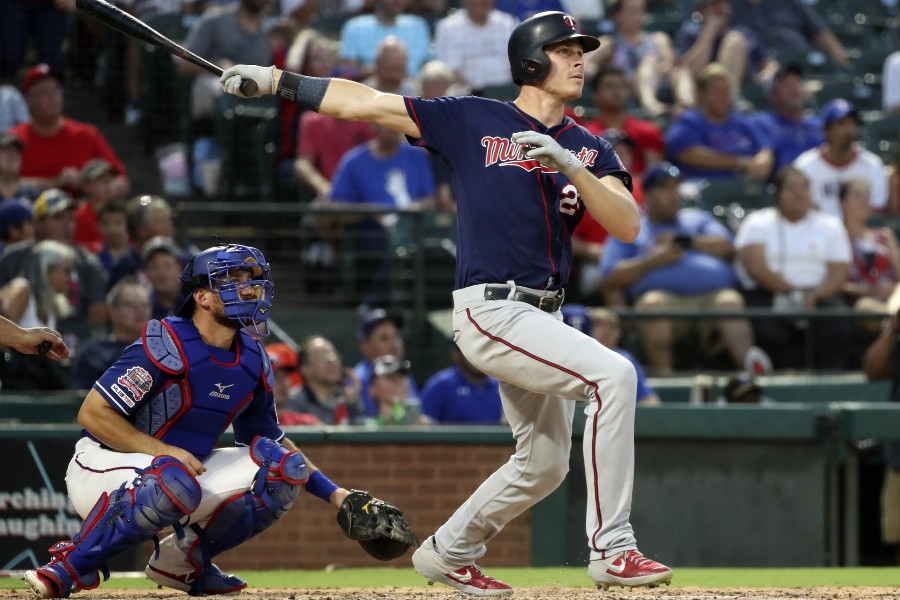 Last season, big-league teams had the highest aggregate OPS on record, in plate appearances in which they swung at the first pitch. The league also swung at the first pitch more often, on average, than it had in any season since 2001. The Twins rode that rising tide, and even helped steer it: no American League club swung as often on the first pitch as did Minnesota. They also had an impressive .520 collective slugging percentage in those plate appearances, because the team’s excellent power paired perfectly with the aeroball. Now, they face the challenge of remaining on the attack in 2020, without becoming overly anxious. It hasn’t been the Twins’ custom to swing at the first pitch at anything like their 2019 rate. Until the end of 2018, of course, the team’s offensive identity could best be embodied by Joe Mauer, whose patience (and especially, whose reluctance to ambush the first pitch) was his defining characteristic. That didn’t always mean that the rest of the team took Mauer’s mentality into the box with them, but he was the heartbeat of the offense for well over a decade, and thus, the team came to resemble him in certain key tendencies. It wasn’t until 2013 that the Twins, having experienced two nightmarish seasons at the tail end of their run of AL Central success in the 2000s, started to hold hitter back from hacking at the first pitch, but once they did so, they did it firmly. I wrote about their apparently hard take signals on first pitches for Baseball Prospectus in 2015. They were embracing the OBP-focused mindset of the Moneyball Athletics, but they were a decade too late to the party. Because it would take them another several years to modernize their front office, however, and because they similarly lagged in progressive thinking in the dugout, and because of Mauer’s veteran influence, the team remained one of the least aggressive on the first pitch even after the rest of the league started to attack more often. Sometimes, taking too long to make one change means having to pivot more quickly than others when the trend lines reverse themselves, and it creates a snowball effect. With Rocco Baldelli on the top step and Mauer in retirement, the 2019 Twins became a team past whom you couldn’t hope to sneak an early strike. While hitters have been slow in making the adjustment to swing more early in counts, pitchers have been even slower to stop throwing predictable fastballs on the first pitch, and that means it’s still a good idea to be more aggressive on the first pitch than most hitters are. Even hitters who are otherwise disciplined are learning to hunt hittable strikes where they’re most abundant, at the front ends of plate appearances. Max Kepler swung at 40.5 percent of first pitches last year, against a league average still hovering just south of 29 percent. Still, much of the Twins’ first-pitch damage came from hitters who will be either wearing other uniforms or playing reduced roles whenever the 2020 season begins. Jonathan Schoop and Eddie Rosario paced the team. Mitch Garver and Luis Arráez each took the first pitch over 80 percent of the time, making them two of the most selective early-count hitters in the league. Every hitter’s approach needs to be neatly tailored to their skill set, and Kepler, Arráez, and Garver nicely demonstrate the flexibility of the Twins’ individual plans for their hitters these days. They don’t need to make major adjustments in the way they approach the first pitch. At a team level, though, as they get more disciplined and patient hitters, the Twins will need to remain opportunistic, forcing pitchers to handle them carefully from the moment they enter the batter’s box. That responsibility falls mostly to Baldelli, along with Edgar Varela and Rudy Hernández. It’s not an easy balance to strike, but the team demonstrated its ability to find it last year. MORE FROM TWINS DAILY — Latest Twins coverage from our writers — Recent Twins discussion in our forums — Follow Twins Daily via Twitter, Facebook or email
 -
The Twins' second baseman is profoundly difficult to gameplan against. Then again, we've got some unexpected free time in which to try it. It’s nice to have a knack for making contact, and especially nice to be elite in that regard. Twins second baseman Luis Arráez isn’t the projected American League batting champion, though, simply because he projects to strike out less than 10 percent of the time, in a league that could whiff in 24 percent of all plate appearances.Plenty of batters who make frequent contact do so on the ground, or towards predictable and easily defended areas of the diamond. In his stellar rookie season, Arráez avoided those traps. He showed an almost Joe Mauer-like ability to smack medium-strength line drives into the areas just beyond infielders and in front of outfielders, especially on the left side of the diamond. He’s excruciatingly hard to defend. Even Mauer, however, eventually saw opponents begin to realign their defense, swinging their outfielders well toward left field in an effort to foil his opposite-field approach. Let’s ask ourselves, then, how teams might adjust to Arráez, too. Since he’s both slow-footed and lacking in power, there are certain ways they can do so, but it will take something we’d normally regard as radical and irrational, and it might well be that Arráez could counteradjust and foil those defensive strategies. Above is Arráez’s spray chart, color-coded by batted-ball trajectory, for 2019. It is extraordinary. The sheer number of line drives, which are hard to defend even for a well-positioned team, is impressive, and the way he both peppered the shallow outfield area with liners and drove the ball to the alleys with relative consistency makes for headaches for any outfield coordinator. Arráez even sprays his grounders a bit more than most left-handed hitters do, deterring would-be defensive shifts. One strategy teams frequently used against Mauer, however, could also allow them to pose problems for Arráez. Because Mauer didn’t run well, aggressive teams would move their second basemen a handful of steps out into right field, despite keeping both their third basemen and shortstops in standard positioning on the left side. Since Arráez doesn’t hit many balls hard, a second baseman could play him quite deep, widening his lateral range, and still have plenty of time to both reach the ball and throw out the plodding youngster. Meanwhile, whereas Mauer was capable of pulling the ball hard down the first-base line at times, Arráez did little of that last season. Thus, the first baseman could plausibly play well off the line, further cutting down the space into which Arráez might fit a hit on the right side. On the other side, teams have a chance to get even more radical. Again, Arráez doesn’t exactly scorch the ball most of the time, especially when going the other way with a pitch on the outer part of the plate. That could allow the third baseman to play drastically shallow, cutting off many grounders that would otherwise become hits. In turn, that would permit the shortstop to play much deeper than normal, handling hot shots to the left side of the infield and in position to go back on and snag some of the lofted line drives Arráez turned into singles last year. Both middle infielders, in fact, would essentially be playing rover roles, taking hits that fell between the infield and outfield last year and turning them into outs. That leaves the outfielders. The right fielder would, in all likelihood, do well to play Arráez more or less straight-away. Like Mauer, Arráez tends to drill the ball when he does turn on it and elevate, so the only high-percentage play to that field is to play it straight and be ready to catch those line drives when they’re close enough. The center fielder’s job is harder. Arráez puts pressure on them by hitting to both gaps, and by occasionally lofting a ball to dead center field that requires them to go back to the wall. So many more of his batting balls are lower-trajectory hits to the middle of the diamond, though, that center fielders should still play quite shallowly against him. Given his lack of top-end speed, a good center fielder should be able to hold him to a double even if he gets the ball over his head, and those types of hits off Arráez’s bat are much less common than ones that drop in front of a center fielder in standard position. In left field, Arráez varies from Mauer. He doesn’t hit the ball hard down the line often. He’s more prone to drive it toward the gap. As a result, the left fielder needs to stay off the line, resulting in a pinched alignment, but he can’t play too shallowly. In this scenario, he’d be able to afford to play at average depth, ready to go back and collect well-struck would-be doubles to the gap, because the shortstop would help cover shallow flies and liners. Download attachment: InkedJake Odorizzi_LI.jpg It’s interesting to imagine how Tony Gwynn would have handled defensive shifts. He had an extraordinary ability to punch the ball through the gap on the left side of the infield; he surpassed 3,000 hits by honing that skill. Had teams positioned themselves as flexibly and proactively during his playing days as they do now, however, Gwynn would have had to come up with a new way to find hits, retaining that touch when the hole was left open but able to scorch the ball through the right side when teams overcompensated. Of course, were he playing now, he’d also have to contend with much more strikeout-focused, high-velocity pitching than he saw in the 1980s and 1990s. Arráez shares a number of key traits with Gwynn, even if the comparison seems unfair. It’s fun to imagine how a team might try to torture and negate his skill set, but it’s also important to remembr that Arráez has shown a balanced skill set at the plate. If forced to, he might well make a major adjustment and become an equally dangerous (though fundamentally different) hitter. MORE FROM TWINS DAILY — Latest Twins coverage from our writers — Recent Twins discussion in our forums — Follow Twins Daily via Twitter, Facebook or email Click here to view the article
-
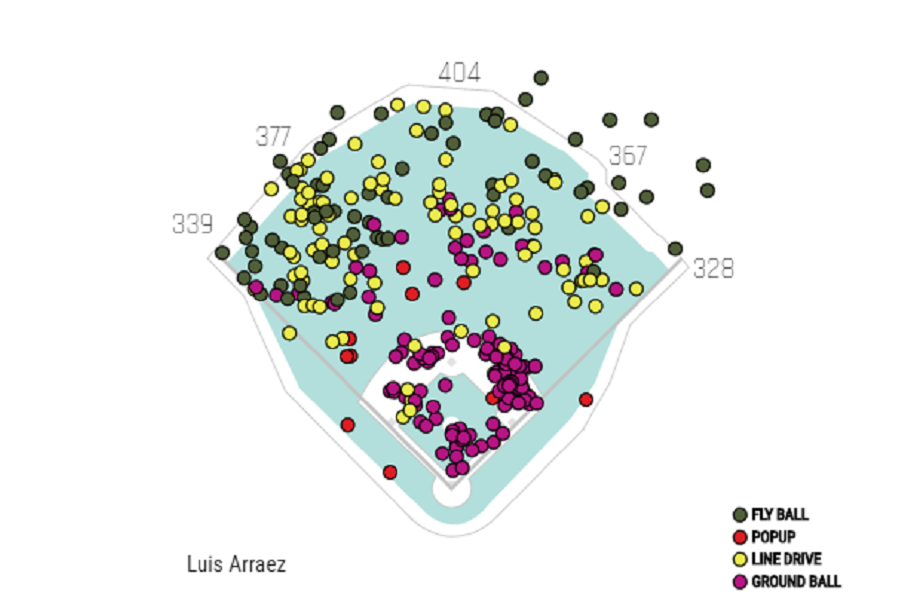 Plenty of batters who make frequent contact do so on the ground, or towards predictable and easily defended areas of the diamond. In his stellar rookie season, Arráez avoided those traps. He showed an almost Joe Mauer-like ability to smack medium-strength line drives into the areas just beyond infielders and in front of outfielders, especially on the left side of the diamond. He’s excruciatingly hard to defend. Even Mauer, however, eventually saw opponents begin to realign their defense, swinging their outfielders well toward left field in an effort to foil his opposite-field approach. Let’s ask ourselves, then, how teams might adjust to Arráez, too. Since he’s both slow-footed and lacking in power, there are certain ways they can do so, but it will take something we’d normally regard as radical and irrational, and it might well be that Arráez could counteradjust and foil those defensive strategies. Above is Arráez’s spray chart, color-coded by batted-ball trajectory, for 2019. It is extraordinary. The sheer number of line drives, which are hard to defend even for a well-positioned team, is impressive, and the way he both peppered the shallow outfield area with liners and drove the ball to the alleys with relative consistency makes for headaches for any outfield coordinator. Arráez even sprays his grounders a bit more than most left-handed hitters do, deterring would-be defensive shifts. One strategy teams frequently used against Mauer, however, could also allow them to pose problems for Arráez. Because Mauer didn’t run well, aggressive teams would move their second basemen a handful of steps out into right field, despite keeping both their third basemen and shortstops in standard positioning on the left side. Since Arráez doesn’t hit many balls hard, a second baseman could play him quite deep, widening his lateral range, and still have plenty of time to both reach the ball and throw out the plodding youngster. Meanwhile, whereas Mauer was capable of pulling the ball hard down the first-base line at times, Arráez did little of that last season. Thus, the first baseman could plausibly play well off the line, further cutting down the space into which Arráez might fit a hit on the right side. On the other side, teams have a chance to get even more radical. Again, Arráez doesn’t exactly scorch the ball most of the time, especially when going the other way with a pitch on the outer part of the plate. That could allow the third baseman to play drastically shallow, cutting off many grounders that would otherwise become hits. In turn, that would permit the shortstop to play much deeper than normal, handling hot shots to the left side of the infield and in position to go back on and snag some of the lofted line drives Arráez turned into singles last year. Both middle infielders, in fact, would essentially be playing rover roles, taking hits that fell between the infield and outfield last year and turning them into outs. That leaves the outfielders. The right fielder would, in all likelihood, do well to play Arráez more or less straight-away. Like Mauer, Arráez tends to drill the ball when he does turn on it and elevate, so the only high-percentage play to that field is to play it straight and be ready to catch those line drives when they’re close enough. The center fielder’s job is harder. Arráez puts pressure on them by hitting to both gaps, and by occasionally lofting a ball to dead center field that requires them to go back to the wall. So many more of his batting balls are lower-trajectory hits to the middle of the diamond, though, that center fielders should still play quite shallowly against him. Given his lack of top-end speed, a good center fielder should be able to hold him to a double even if he gets the ball over his head, and those types of hits off Arráez’s bat are much less common than ones that drop in front of a center fielder in standard position. In left field, Arráez varies from Mauer. He doesn’t hit the ball hard down the line often. He’s more prone to drive it toward the gap. As a result, the left fielder needs to stay off the line, resulting in a pinched alignment, but he can’t play too shallowly. In this scenario, he’d be able to afford to play at average depth, ready to go back and collect well-struck would-be doubles to the gap, because the shortstop would help cover shallow flies and liners. It’s interesting to imagine how Tony Gwynn would have handled defensive shifts. He had an extraordinary ability to punch the ball through the gap on the left side of the infield; he surpassed 3,000 hits by honing that skill. Had teams positioned themselves as flexibly and proactively during his playing days as they do now, however, Gwynn would have had to come up with a new way to find hits, retaining that touch when the hole was left open but able to scorch the ball through the right side when teams overcompensated. Of course, were he playing now, he’d also have to contend with much more strikeout-focused, high-velocity pitching than he saw in the 1980s and 1990s. Arráez shares a number of key traits with Gwynn, even if the comparison seems unfair. It’s fun to imagine how a team might try to torture and negate his skill set, but it’s also important to remembr that Arráez has shown a balanced skill set at the plate. If forced to, he might well make a major adjustment and become an equally dangerous (though fundamentally different) hitter. MORE FROM TWINS DAILY — Latest Twins coverage from our writers — Recent Twins discussion in our forums — Follow Twins Daily via Twitter, Facebook or email
 -
Here are five players for whom certain aspects of the advanced system's projection could be wildly wrong, and for which the system doesn't allow flexibility.Yesterday, I broke down the way projection systems can fail to capture the real variance of a forthcoming baseball season, using the Twins’ PECOTA projections as an example. Here, now, are five key projections that, while fixed in all PECOTA simulations, seem highly uncertain, and which would have a huge impact on the Twins if they swung widely in either direction: Byron Buxton’s Playing Time We already discussed this one, but it’s worth touching on again. If Buxton gets just half the number of plate appearances for which he’s projected, he not only forces the team to cover his absence and install a (likely) lesser hitter into the lineup, but also loses the chance to have the overwhelming defensive impact he has when he’s positioned in center field. Josh Donaldson’s Defense PECOTA pegs Donaldson for -3 Fielding Runs Above Average (FRAA). That seems crazy, and it’s probably flat-out wrong. In the past, other defensive metrics have consistently rated Donaldson much more highly than FRAA, and the eye test says those metrics are right. However, defensive statistics remain muddier and harder to assess than offensive ones. If it were to turn out that Donaldson has little defensive impact on the Minnesota infield, the team would have a weakness the public has generally overlooked. If he does save them a bunch of runs with his glove, despite his age and FRAA’s pessimism, then you can mentally tack an extra win or two onto each of the decile projections for the team above. Mitch Garver’s Defense Before he transformed himself under the guidance of catching coordinator Tanner Swanson prior to 2019, Garver had a poor reputation as a pitch framer, and BP’s stats on that skill matches the scouting report. As a result, and even after the stats reflected his growth into an average-plus framer in 2019, PECOTA forecasts -8 FRAA from the Twins’ catcher for 2020. It’s worth noting that other catchers have had good seasons of framing after years of struggle, only to go backward. However, PECOTA is probably wrong again, here, because we know that Garver has made substantial and (presumably) sustainable changes to both the physical and the mental way he receives the ball. This speaks to something else that is worth noting, because Garver also isn’t a darling of PECOTA on the offensive side. Player development has become a much more real, tangible, and replicable practice over the last several years. Projection systems, as currently constructed, have very limited ability to bake that in. Even a perfectly tuned system will miss on players who have undergone a large, fundamental transformation over a short period of time, because one of the primary responsibilities of a projection system is to avoid being fooled by small samples and random fluctuation. Eventually, and particularly in light of the availability of such granular data (exit velocities, launch angles and directions, pitch velocity and movement, spin rate, sprint speed, defensive positioning, and so on), the industry could and should look to move to a first-principles projection system—one founded on everything a player does, from their tendency to chase pitches outside the zone to their hard-hit rate and clustering of launch angles, rather than on every outcome a player produces. In the meantime, however, systems have to contend with the risk that a player who appears to have undergone a legitimate breakout could have done so with smoke and mirrors. As humans who know the humans who build these systems, we can sometimes allow ourselves to acknowledge that the system’s limitations are greater than our own. Jake Odorizzi’s Innings Total In the past, Odorizzi has often had trouble pitching deep into games, and he’s sometimes had trouble staying healthy. For a mixture of the two reasons, the architects of BP’s depth charts have him listed for just 149 innings in 2020. Because the depth charts fix innings pitched, and not batters faced, Odorizzi remains a low-mileage starter even when checking his higher-percentile outcomes. That’s a fair way for the system to solve the complex problem of projecting both performance and health risks, but in practice, Odorizzi has pitched at least 159 innings in five of the last six seasons. That 159 was his total last year, and was held down, in part, by the team’s careful usage of him in September, to ensure he was ready to pitch in the postseason. Given the changes Odorizzi has made to his approach, pitch mix, and mechanics, and given that he’s starting the season with a clean slate, it’s easy to imagine a scenario in which he throws 25 more innings than he’s projected for in 2020. It’s also possible he could pitch 50 fewer, and while the Twins have above-average pitching depth, that would be a major blow. Neither risk is captured by the decile projections. Trevor Larnach’s and Alex Kirilloff’s Playing Time While PECOTA produces projections for thousands of players, only the ones who are listed on Baseball Prospectus’s depth charts go into team record projections. That means that Kirilloff and Larnach, both of whom are off those depth charts entirely, are ignored by the system. From a downside perspective, that doesn’t matter much, because the system also doesn’t reflect the risk of a more serious Buxton injury, or that of a prolonged absence for Eddie Rosario or Nelson Cruz. However, it misses some upside, because both Larnach and Kirilloff are high-level hitters who have succeeded at the upper levels of the minors and have impressed observers this spring. The system likes both hitters, too. Their median projections are for a 102 (Kirilloff) and 103 (Larnach) DRC+, making them above-average hitters. If either were to reach the big leagues and perform at their 80th-percentile level (a 116 and 117 DRC+, respectively), they’d be solid contributors, providing more value even than Marwin González or Rosario are likely to. Projection systems are still more accurate and more interesting than pundits and opinion polls. However, if you really want to see a full picture of the season ahead, you have to look hard at them, and ask yourself what those systems are missing. When you do so, you realize that baseball is even less predictable than we tend to believe. Click here to view the article
-
How PECOTA Projections Could Miss on the Twins (Part Two)
Matthew Trueblood posted an article in Twins
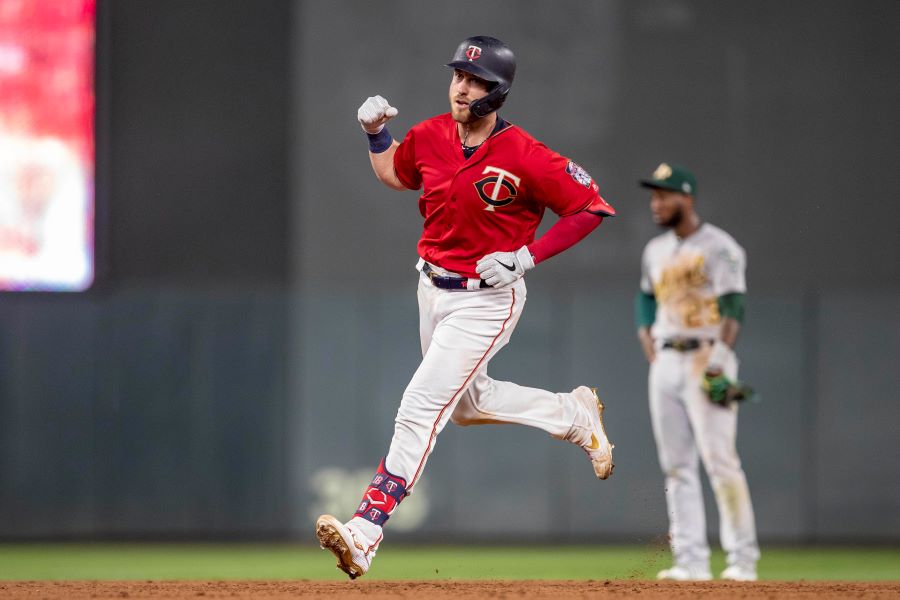 Yesterday, I broke down the way projection systems can fail to capture the real variance of a forthcoming baseball season, using the Twins’ PECOTA projections as an example. Here, now, are five key projections that, while fixed in all PECOTA simulations, seem highly uncertain, and which would have a huge impact on the Twins if they swung widely in either direction: Byron Buxton’s Playing Time We already discussed this one, but it’s worth touching on again. If Buxton gets just half the number of plate appearances for which he’s projected, he not only forces the team to cover his absence and install a (likely) lesser hitter into the lineup, but also loses the chance to have the overwhelming defensive impact he has when he’s positioned in center field. Josh Donaldson’s Defense PECOTA pegs Donaldson for -3 Fielding Runs Above Average (FRAA). That seems crazy, and it’s probably flat-out wrong. In the past, other defensive metrics have consistently rated Donaldson much more highly than FRAA, and the eye test says those metrics are right. However, defensive statistics remain muddier and harder to assess than offensive ones. If it were to turn out that Donaldson has little defensive impact on the Minnesota infield, the team would have a weakness the public has generally overlooked. If he does save them a bunch of runs with his glove, despite his age and FRAA’s pessimism, then you can mentally tack an extra win or two onto each of the decile projections for the team above. Mitch Garver’s Defense Before he transformed himself under the guidance of catching coordinator Tanner Swanson prior to 2019, Garver had a poor reputation as a pitch framer, and BP’s stats on that skill matches the scouting report. As a result, and even after the stats reflected his growth into an average-plus framer in 2019, PECOTA forecasts -8 FRAA from the Twins’ catcher for 2020. It’s worth noting that other catchers have had good seasons of framing after years of struggle, only to go backward. However, PECOTA is probably wrong again, here, because we know that Garver has made substantial and (presumably) sustainable changes to both the physical and the mental way he receives the ball. This speaks to something else that is worth noting, because Garver also isn’t a darling of PECOTA on the offensive side. Player development has become a much more real, tangible, and replicable practice over the last several years. Projection systems, as currently constructed, have very limited ability to bake that in. Even a perfectly tuned system will miss on players who have undergone a large, fundamental transformation over a short period of time, because one of the primary responsibilities of a projection system is to avoid being fooled by small samples and random fluctuation. Eventually, and particularly in light of the availability of such granular data (exit velocities, launch angles and directions, pitch velocity and movement, spin rate, sprint speed, defensive positioning, and so on), the industry could and should look to move to a first-principles projection system—one founded on everything a player does, from their tendency to chase pitches outside the zone to their hard-hit rate and clustering of launch angles, rather than on every outcome a player produces. In the meantime, however, systems have to contend with the risk that a player who appears to have undergone a legitimate breakout could have done so with smoke and mirrors. As humans who know the humans who build these systems, we can sometimes allow ourselves to acknowledge that the system’s limitations are greater than our own. Jake Odorizzi’s Innings Total In the past, Odorizzi has often had trouble pitching deep into games, and he’s sometimes had trouble staying healthy. For a mixture of the two reasons, the architects of BP’s depth charts have him listed for just 149 innings in 2020. Because the depth charts fix innings pitched, and not batters faced, Odorizzi remains a low-mileage starter even when checking his higher-percentile outcomes. That’s a fair way for the system to solve the complex problem of projecting both performance and health risks, but in practice, Odorizzi has pitched at least 159 innings in five of the last six seasons. That 159 was his total last year, and was held down, in part, by the team’s careful usage of him in September, to ensure he was ready to pitch in the postseason. Given the changes Odorizzi has made to his approach, pitch mix, and mechanics, and given that he’s starting the season with a clean slate, it’s easy to imagine a scenario in which he throws 25 more innings than he’s projected for in 2020. It’s also possible he could pitch 50 fewer, and while the Twins have above-average pitching depth, that would be a major blow. Neither risk is captured by the decile projections. Trevor Larnach’s and Alex Kirilloff’s Playing Time While PECOTA produces projections for thousands of players, only the ones who are listed on Baseball Prospectus’s depth charts go into team record projections. That means that Kirilloff and Larnach, both of whom are off those depth charts entirely, are ignored by the system. From a downside perspective, that doesn’t matter much, because the system also doesn’t reflect the risk of a more serious Buxton injury, or that of a prolonged absence for Eddie Rosario or Nelson Cruz. However, it misses some upside, because both Larnach and Kirilloff are high-level hitters who have succeeded at the upper levels of the minors and have impressed observers this spring. The system likes both hitters, too. Their median projections are for a 102 (Kirilloff) and 103 (Larnach) DRC+, making them above-average hitters. If either were to reach the big leagues and perform at their 80th-percentile level (a 116 and 117 DRC+, respectively), they’d be solid contributors, providing more value even than Marwin González or Rosario are likely to. Projection systems are still more accurate and more interesting than pundits and opinion polls. However, if you really want to see a full picture of the season ahead, you have to look hard at them, and ask yourself what those systems are missing. When you do so, you realize that baseball is even less predictable than we tend to believe.
 -
Projection systems are more robust than ever... but there are still whole swaths of baseball's unpredictability for which they cannot account.According to Baseball Prospectus’s PECOTA system, the Twins have a 76.6-percent chance of winning the AL Central in 2020. FanGraphs pegs them just a bit lower, at 55.0 percent to win the division. FanGraphs gives them a 68.3-percent chance to make the playoffs in any form; BP has them at a gaudy 87.5 percent. Both systems project them for over 90 wins, though fewer than 95. However, as I was preparing the Twins’ team preview for Prospectus last week, I found myself noting ways in which PECOTA (and all projection systems, in fact) is unable to properly capture the risk and the upside of a team like Minnesota. First, consider injury risk. At Baseball Prospectus, the only way in which those risks are accounted for is through the manual process of building team depth charts. Because Byron Buxton strongly tends to get hurt and miss portions of each season, he’s not projected for as full a share of the playing time in center field as he’ll enjoy whenever he’s healthy. However, the playing time he is projected to receive (75 percent of center field innings, and 490 total plate appearances) isn’t treated as a variable by the system. The format for team previews at Prospectus this spring involves building out and breaking down the decile projections for each team—that is, the record each club would have given a 90th-percentile outcome, an 80th-percentile outcome, and so on, down to 10th. The idea is to sketch out how PECOTA captures the variance possible at a team level, based on the vagaries of individual performances. The decile projections are created using the individual decile projections PECOTA generates, with each team projection representing the outcome of 500 simulations wherein each team’s players all perform at that decile and the rest of the league is kept at their median projection. Here are the Twins’ decile projections for 2020, as of last week: 90th percentile: 109-5380th percentile: 104-5870th percentile: 100-6260th percentile: 98-6450th percentile: 94-6840th percentile: 90-7230th percentile: 86-7620th percentile: 81-8110th percentile: 74-88That seems, at first blush, like a fair depiction of the real possibility spectrum for this team. The Twins are likely to be very good, and the only way they won’t at least be a respectable Wild Card contender is if the wheels truly come off. However, in all nine of those amalgamated projections, and in all 4,500 simulations that underpin them, Byron Buxton goes to the plate 490 times, and is the Twins’ center fielder for 75 percent of their defensive innings. In all of the simulations, José Berríos pitches 184 innings, Michael Pineda pitches 100, and Rich Hill pitches 52. The system is only capturing variance created by players performing in unexpected ways; it doesn’t see injury risk. For that matter, the system also only reflects variance in offensive performance. In all those simulations, Buxton (with his fixed playing time) is worth 20 runs as a defender in center field. In all of them, Miguel Sanó (whom BP has pegged for 65 percent of the playing time at first base, five percent at third base, and five percent at DH, reflecting some of his own injury history) is worth eight runs as a defender at first base, because typically, third baseman who make the transition to first base while still in their prime tend to be good fielders there. PECOTA has no engine for systematically scaling defensive production upward or downward, and even if it had one, it would be hard to decide how to use it. Would a player having a bad season at the plate be expected to struggle to the same extent in the field? Would a guy who turned out to be a better-than-expected defender lose something at bat because of his focus on defense and the wear and tear of playing harder in the field? PECOTA isn’t alone in not being able to answer these questions, and BP isn’t alone in being unwilling to attempt to calibrate all of that manually. Playoff odds and other team-level projections, like the atomic player projections of which they consist, are fraught with oversimplifications and unexamined axes of upside and downside. This is part one of a two-part exploration of the ways projection systems miss certain elements of the Twins' risk and upside. Check back tomorrow for five specific examples drawn from the Twins' individual projections. Click here to view the article


