



John Bonnes
-
Posts
6,784 -
Joined
-
Last visited
-
Days Won
4
Content Type
Profiles
News
Minnesota Twins Videos
2026 Minnesota Twins Top Prospects Ranking
2022 Minnesota Twins Draft Picks
Minnesota Twins Free Agent & Trade Rumors, Notes, & Tidbits
Guides & Resources
2023 Minnesota Twins Draft Picks
The Minnesota Twins Players Project
2024 Minnesota Twins Draft Picks
2025 Minnesota Twins Draft Pick Tracker
2026 Minnesota Twins Draft Tracker: Picks & Bonuses
Forums
Blogs
Events
Store
Downloads
Gallery
Everything posted by John Bonnes
-
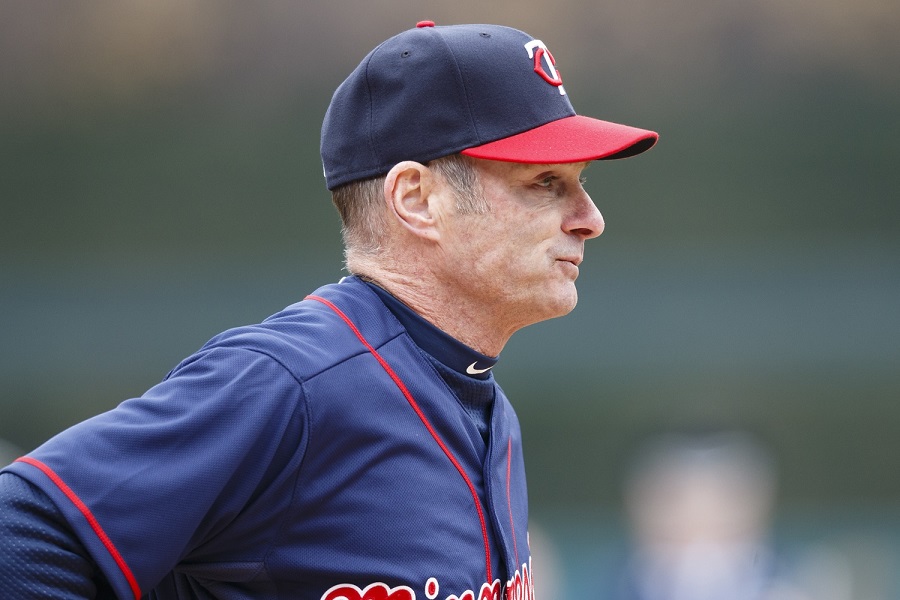
Aaron and John talk about Paul Molitor winning Manager of the Year, targeting right-handed hitters for an outfield role, giving up a draft pick to sign a free agent, voiding Jelfrey Marte's contract, the odds signing Shohei Otani, playing poker in Vegas with Lou Piniella, and doing your holiday shopping with our sponsors. You can listen by downloading us from iTunes, Stitcher or find it at GleemanAndTheGeek.com. Or just click this link. Click here to view the article
-
 http://traffic.libsyn.com/gleemangeek/Episode_344_MOY.mp3
 -
 This year's Twins Daily Offseason Handbook included profiles of 22(!) free agent starting pitchers that the Twins could pursue. Below are a few examples. You can still download your own Offseason Handbook AND name your own price right here. Acquiring starting pitchers through free agency is a fickle endeavor. Sometimes it goes right (Ervin Santana). Sometimes it goes wrong (Ricky Nolasco). Sometimes it goes very right, and then very wrong (Phil Hughes). Assessing these arms and how they’ll progress over the life of a contract will forever be an inexact science. But aiming higher typically yields better results.The Twins already have a number of credible starters in the mix, but if they are setting their sights on a postseason run, they could use a stud to slot in alongside Santana and Jose Berrios. This year’s class features some very noteworthy names. Jake Arrieta, RHP Age: 32 | Previous Team: Cubs 2017 Stats: 168.1 IP, 14-10, 3.53 ERA, 1.22 WHIP Arrieta had one of the best pitching seasons in recent memory when he won the Cy Young in 2015, and he won 18 games in 2016. He didn’t look like himself in the first half this year, but pulled things together in the second half, posting a 2.28 ERA after the break. He turns 32 in March and his fastball velocity was at a career low (92.1 MPH), so there might be some hesitation in his market, but the Scott Boras client will get paid. Estimated Contract: 6 years, $168 million Lance Lynn, RHP Age: 30 | Previous Team: Cardinals 2017 Stats: 186.1 IP, 11-8, 3.43 ERA, 1.23 WHIP After missing 2016 due to Tommy John surgery, Lynn came back strong in 2017, starting every fifth day and getting better as the season progressed. His velocity trended upward throughout the summer and in the second half he mostly looked like a rotation-fronter. Lynn has a 3.38 career ERA and has been extremely reliable in St. Louis. He’s also two years younger than Arrieta. Estimated Contract: 6 years, $150 million Yu Darvish, RHP Age: 31 | Previous Team: Dodgers 2017 Stats: 186.2 IP, 10-12, 3.86 ERA, 1.16 WHIP He is one of the game’s premier strikeout pitchers, with an 11.0 K/9 rate that ranks first among active starters since coming over from Japan in 2012. The results haven’t always lined up with the spectacular stuff, and this year in particular Darvish had his battles, especially with the long ball. He posted the highest ERA and lowest strikeout rate of his career in 2017, so there’s some risk here, but Darvish certainly has the ability to slot as an ace. Estimated Contract: 5 years, $135 million Other Options: Alex Cobb, RHP (30): Cobb’s market will be interesting to see. He hasn’t been quite the same since returning from Tommy John surgery but was still quite effective this year (3.66 ERA, 1.22 WHIP) and set a career high for innings. Jaime Garcia, LHP (31): The left-hander enjoyed a lengthy and illustrious career with the Twins, making one start in July as the Twins flipped from buyers to sellers. On the right terms he’d be a fine addition, but his upside is limited. Francisco Liriano, LHP (34): Reunion time? All these years later, Liriano is still struggling to find himself. He pitched out of the bullpen exclusively after a deadline trade to Houston, and might be more interesting in that capacity if he could just throw some dang strikes. Michael Pineda, RHP (29): He’s one of the game’s better strikeout pitchers and a former young phenom, but Pineda has already gone through a bunch of shoulder issues and he underwent Tommy John in June. Do you ink him on a two-year contract, hoping he can help down the stretch in 2018 but more with an eye on scoring big value in 2019? CC Sabathia, LHP (37): As a member of the Indians and Yankees, he’s been a thorn in Minnesota’s side for almost two decades. His performance in the past two seasons suggests he’s not done getting results. Plus, if he joins up, he’ll never need to face the Twins’ bunt-happy offense. There are 62 pages of Twins-focused offseason goodness just waiting for you to obsess over. Just name your own price and you can immediately download theTwins Daily Offseason Handbook. Click here to view the article
 -
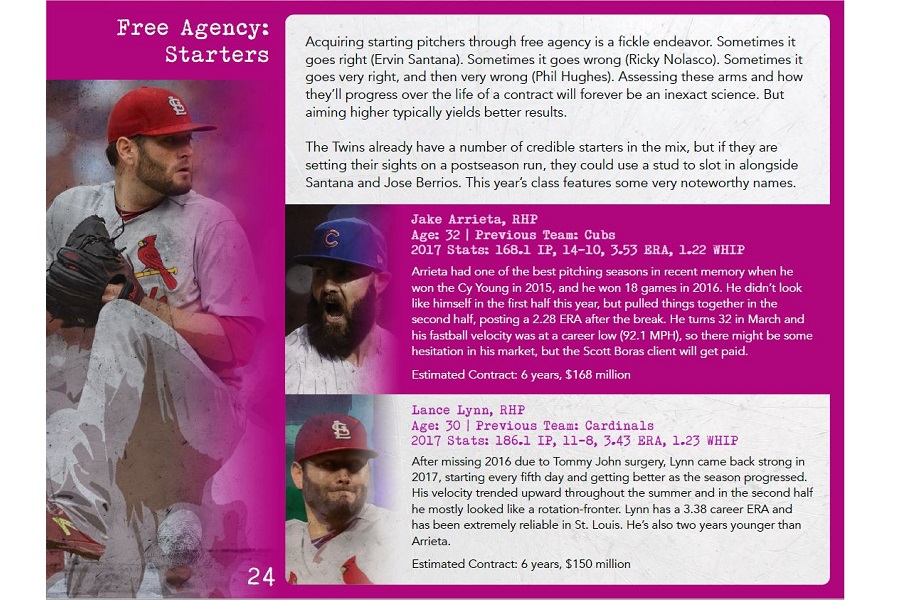 The Twins already have a number of credible starters in the mix, but if they are setting their sights on a postseason run, they could use a stud to slot in alongside Santana and Jose Berrios. This year’s class features some very noteworthy names. Jake Arrieta, RHP Age: 32 | Previous Team: Cubs 2017 Stats: 168.1 IP, 14-10, 3.53 ERA, 1.22 WHIP Arrieta had one of the best pitching seasons in recent memory when he won the Cy Young in 2015, and he won 18 games in 2016. He didn’t look like himself in the first half this year, but pulled things together in the second half, posting a 2.28 ERA after the break. He turns 32 in March and his fastball velocity was at a career low (92.1 MPH), so there might be some hesitation in his market, but the Scott Boras client will get paid. Estimated Contract: 6 years, $168 million Lance Lynn, RHP Age: 30 | Previous Team: Cardinals 2017 Stats: 186.1 IP, 11-8, 3.43 ERA, 1.23 WHIP After missing 2016 due to Tommy John surgery, Lynn came back strong in 2017, starting every fifth day and getting better as the season progressed. His velocity trended upward throughout the summer and in the second half he mostly looked like a rotation-fronter. Lynn has a 3.38 career ERA and has been extremely reliable in St. Louis. He’s also two years younger than Arrieta. Estimated Contract: 6 years, $150 million Yu Darvish, RHP Age: 31 | Previous Team: Dodgers 2017 Stats: 186.2 IP, 10-12, 3.86 ERA, 1.16 WHIP He is one of the game’s premier strikeout pitchers, with an 11.0 K/9 rate that ranks first among active starters since coming over from Japan in 2012. The results haven’t always lined up with the spectacular stuff, and this year in particular Darvish had his battles, especially with the long ball. He posted the highest ERA and lowest strikeout rate of his career in 2017, so there’s some risk here, but Darvish certainly has the ability to slot as an ace. Estimated Contract: 5 years, $135 million Other Options: Alex Cobb, RHP (30): Cobb’s market will be interesting to see. He hasn’t been quite the same since returning from Tommy John surgery but was still quite effective this year (3.66 ERA, 1.22 WHIP) and set a career high for innings. Jaime Garcia, LHP (31): The left-hander enjoyed a lengthy and illustrious career with the Twins, making one start in July as the Twins flipped from buyers to sellers. On the right terms he’d be a fine addition, but his upside is limited. Francisco Liriano, LHP (34): Reunion time? All these years later, Liriano is still struggling to find himself. He pitched out of the bullpen exclusively after a deadline trade to Houston, and might be more interesting in that capacity if he could just throw some dang strikes. Michael Pineda, RHP (29): He’s one of the game’s better strikeout pitchers and a former young phenom, but Pineda has already gone through a bunch of shoulder issues and he underwent Tommy John in June. Do you ink him on a two-year contract, hoping he can help down the stretch in 2018 but more with an eye on scoring big value in 2019? CC Sabathia, LHP (37): As a member of the Indians and Yankees, he’s been a thorn in Minnesota’s side for almost two decades. His performance in the past two seasons suggests he’s not done getting results. Plus, if he joins up, he’ll never need to face the Twins’ bunt-happy offense. There are 62 pages of Twins-focused offseason goodness just waiting for you to obsess over. Just name your own price and you can immediately download the Twins Daily Offseason Handbook.
 -
Article: Offseason Blueprint: Chasing Opportunities
John Bonnes replied to John Bonnes's topic in Twins Daily Front Page News
That's one million more than I projected for next year; I don't know which is more accurate. But if it is, what do you think would be more fair? Like this? • 2018 as a 24-year-old, $1 million • 2019 as a 25-year-old, $4 million • 2020 as a 26-year-old, $8 million • 2021 as a 27-year-old, $11 million • 2022 as a 28-year-old, $14 million • 2023 as a 29-year-old, team option of $16 million That's $38M guaranteed and the Twins keep him for two years of free agency. That seems a little heavy to me, but I'd be happy enough with something in between the two proposals. (I'd trade away the higher salaries for the second team option year.) -
Article: Offseason Blueprint: Chasing Opportunities
John Bonnes replied to John Bonnes's topic in Twins Daily Front Page News
Finally, regarding Dozier, I'll publish a longer version of my blueprint for that section below. (It's also not a bad reminder that a writer, when revisiting a first draft, can ax quite a bit out of it and still get the point across. Just compare it to the first section.) Thanks again for the comments. Keep 'em coming. I'll check in later with more replies. ------------------------------------------------ 2. Shop Brian Dozier The verb is “shop” not “trade.” But he’s far from untouchable and unless he is willing to take a very team-friendly contract (without a no-trade clause) the Twins should definitely not extend him. Dozier is very good, but he’s not irreplaceable. He’s also 30 years old and his next contract will likely last until he’s 35 years old. He’s also going to be expensive, probably costing whoever signs him in free agency upwards of $15M/year. And for the Twins, there are other options on the roster. Moving him allows the Twins to move Jorge Polanco to second base, which could upgrade the Twins defensively at both shortstop and at second base, where Dozier has been slightly below average for the last couple of years. Ehire Adrianza could play shortstop for the year, with Nick Gordon waiting in the wings. I won’t deny it hurts the team a little for 2018, but the defensive upgrade helps, and I’m looking at impacts beyond 2018. Plus, he could command quite a bit in return. Despite conventional wisdom, Dozier is not worth less this year than he was last offseason. The return the Twins can demand is dependent on how many teams want him, not how many years those teams can squeeze out of him before free agency. Last year, they had one team interested, and therefore he wasn’t worth anything more than a questionable prospect. There is one more advantage this year: the Twins don’t solely need to be interested in soon-to-the-majors, high-upside pitching prospects. They already have those: Stephen Gonsalves and Fernando Romero. That was one of the problems with last year’s trade market; the Twins were only interested in getting pitching in return. This year, they can trade him for prospects or high-upside relievers or international money or whatever. Again, I’m not saying “trade Dozier.” I’m saying don’t be afraid to trade Dozier. The time to shop a player is when you don’t need to shop them. Also, when they are about to get old. Also, when they’re about to get expensive. And finally, the best time is just before they become a free agent. Our attachment to Dozier might blind us from these objective truths, but now is the time to explore trading him. -
Article: Offseason Blueprint: Chasing Opportunities
John Bonnes replied to John Bonnes's topic in Twins Daily Front Page News
First, on moving the dial: I'm not trying to move the dial for 2018. I'm hoping the continued development of the young players in the lineup plus that in the rotation (Berrios, Mejia, Gonsalves, Romero) provides they take an incremental step forward this year. I'm trying to prepare them for a big leap in the future. I was hoping that leap would come from placing Tanaka atop the rotation, but if that is not to be, then I'll settle for keeping my powder dry. BTW, if you're interested in learning about the possibilities and challenges of signing a big name starting pitcher, I highly recommend this week's Gleeman and the Geek podcast. -
Article: Offseason Blueprint: Chasing Opportunities
John Bonnes replied to John Bonnes's topic in Twins Daily Front Page News
Are you saying it isn't enough money? I'll lay it out: Provided Byron Buxton continues to progress, here is a rough estimate of what he (and Twins fans) can expect over the next five years: • 2018 as a 24-year-old, $550,000 • 2019 as a 25-year-old, $4 million • 2020 as a 26-year-old, $8 million • 2021 as a 27-year-old, $12 million • 2022 as a 28-year-old, signs for a gazillion dollars as a free agent with the Yankees. If they do nothing, the Twins hang on to him for four years and pay him $24.5 million. Alternately, the Twins could offer a guaranteed contract that looks like this: • 2018 as a 24-year-old, $1 million • 2019 as a 25-year-old, $3 million • 2020 as a 26-year-old, $6.5 million • 2021 as a 27-year-old, $10 million • 2022 as a 28-year-old, $12 million • 2023 as a 29-year-old, team option of $15 million with a $2 million buyout • 2024 as a 30-year-old, team option of $17 million • 2025 as a 31-year-old, signs for a gazillion dollars as a free agent with the Yankees. This way, the Twins get seven years of Buxton, the last two of which is under their prerogative. Buxton gets $32.5 million guaranteed, plus he still is a free agent while he’s only 31 years old. -
Article: Offseason Blueprint: Chasing Opportunities
John Bonnes replied to John Bonnes's topic in Twins Daily Front Page News
I'll respond to the Dozier comment in another comment. Yes, signing those three (and I should've included Kepler, who will be a Super 2) requires two sides to agree. But it's common that happens. I'd say the chances for each of them is 75/25. It's just plan hard to turn down a $20-30M guaranteed contract. But mostly what I'm saying is that trying to do so should be a huge priority this offseason. #1, really. -
Article: Offseason Blueprint: Chasing Opportunities
John Bonnes replied to John Bonnes's topic in Twins Daily Front Page News
I fought with the same "nimble" issue on mine, which is why I tried to make it about priorities. My top priority, my biggest splash, are the long-term deals. As far as what happens with Step 2, I think I kind of laid it out: 1. If I get back SP, that fits in well. 2. If I get back RP, then switch to chasing a veteran fill-in, like Sabathia, for Step 3. 3. If I get an offer back for a different fit, like a prospect I think can be a difference-maker in the future, then stay the course. Thanks for commenting. Keep 'em comimg. -
Article: Offseason Blueprint: Chasing Opportunities
John Bonnes replied to John Bonnes's topic in Twins Daily Front Page News
GREAT comments, per usual from the TD community. I'll start quoting and replying as I have some time.... -
One of the best parts of getting the Twins Daily Offseason Handbook is building your own Twins offseason blueprint. John Bonnes provides his below. You can do the same; just order the Handbook. The Twins were a good team in 2017, but they weren’t great. To truly contend, they need to make a couple of large leaps, and those leaps aren’t going to come from tightening up the bullpen, adding a middle-of-the-rotation starter or extending a veteran. They need to think bigger and they need to think beyond 2018.So with future greatness as the goal and a couple of unique opportunities available right now, here are the major moves I would like to see the Twins make this offseason. 1. Sign Byron Buxton, Miguel Sano and Eddie Rosario to long-term deals with team options on the back-end. The first opportunity comes along only once in every player’s career – the offseason when a player has between two and three years of service time. For each one of these players, they’re guaranteed only around $550,000 next year, which isn’t “lifetime security” money. If the club waits even one more year, the player has millions guaranteed, and the Twins have far less leverage, costing them the chance to secure free agent years. For instance, the Twins can propose a $32.5 million, five-year deal for Buxton, with team options in years six and seven. The Twins get seven years of Buxton (instead of four), and Buxton gets paid, plus he is still a free agent while he’s only 31 years old. Similar deals could be made for Sano and Rosario. This is a rare chance to sign three offensive cornerstones and extend the Twins championship window several extra years. 2. Shop Brian Dozier I’m not saying “trade Dozier.” I’m saying the time to shop a player is when you don’t need to shop them. Also, when they are about to get old. Also, when they’re about to get expensive. And finally, the best time is just before they become a free agent. Our attachment to Dozier might blind us from these objective truths, but now is the time to explore trading him. Dozier is very good, but he’s not irreplaceable. He’s also 30 years. He’s going to be expensive, probably costing whoever signs him in free agency upwards of $15M/year. It would be a mistake to extend him, especially because there are other options. Jorge Polanco can move to second base, which upgrades the Twins defensively at both shortstop and at second base. Ehire Adrianza can play shortstop for the year, with Nick Gordon waiting in the wings. And unlike last year, the Twins don’t need to receive soon-to-the-majors, high-upside pitching prospects in a trade. This year, they can trade him for prospects or high-upside relievers or international money. The return could be significant. And if it isn’t, then hang on to him. 3. Sign Masahiro Tanaka to six-year, $136 million contract with a 3-year opt out. This was the original plan, but Tanaka decided on Friday NOT to opt out of his deal with the Yankees, which is a damn shame. So I’ll leave the original plan here and replace #3 with #3B below, since I now have a lot of money to spend…. Yu Darvish and Jake Arrieta are at the top of the free agency class and are both 31 years old. However, there is another ace-caliber pitcher who is only 28: Mashiro Tanaka, who appears likely to opt-out of a guaranteed 3-year deal with the Yankees for $67M. Tanaka has had health issues and may not be considered an “ace” yet, though his career ERA at this point last year was 3.12. His 4.74 ERA in 2018 might depress some interest in him, but he still struck out 9.8 batters per nine and walked only 2.1. His problem has been that he’s given up too many home runs. Well, yeah. He pitches at Yankee Stadium. Try Target Field on for size, Masahiro. If you dream of a Twins postseason team with an ace (in his prime) atop the rotation, this is your best chance of that for the next five years. Signing Tanaka raises payroll to $120 million and I didn’t do anything with the bullpen. Those incremental improvements will need to wait. Instead, I’m focusing on the opportunities that are here today. We can work out the smaller stuff next year. #3B. Sign relievers Juan Nicasio($21M/3 years) and Mike Minor($28M/4 years) Without Tanaka available, I don’t see a golden opportunity among the free agent pitchers, so instead I focus on either trying to fill a spot in the bullpen by signing CC Sabathia or stabilizing the bullpen. I like Sabathia because I liked the veteran presence that Bartolo Colon brought and Sabathia seems like he could play a similar role. But I chose the idea of bolstering the bullpen with a 1-2 punch from the left (Minor) and right (Nicasio). That move give manager Paul Molitor a core he can trust and allows the rest of the bullpen to settle in with internal arms that are developing. Maybe Hildenberger continues his breakout season. Maybe some guys get healthy, like Tyler Jay or JT Chargois. Maybe the new pitching coach helps Ryan Pressly or Tyler Duffey take their next steps. Minor and Nicasio provide a little buffer while the rest gets sorted out. Click here to view the article
-
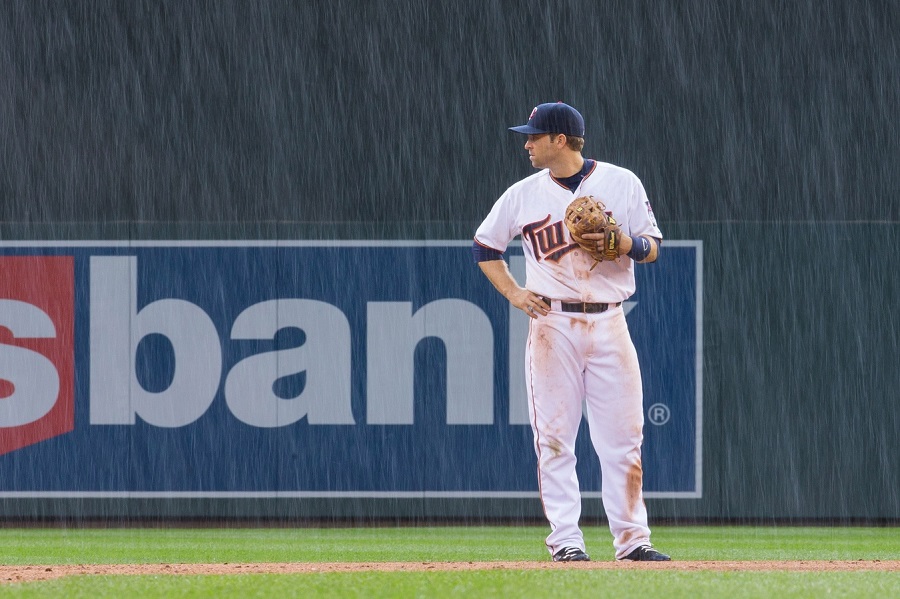 So with future greatness as the goal and a couple of unique opportunities available right now, here are the major moves I would like to see the Twins make this offseason. 1. Sign Byron Buxton, Miguel Sano and Eddie Rosario to long-term deals with team options on the back-end. The first opportunity comes along only once in every player’s career – the offseason when a player has between two and three years of service time. For each one of these players, they’re guaranteed only around $550,000 next year, which isn’t “lifetime security” money. If the club waits even one more year, the player has millions guaranteed, and the Twins have far less leverage, costing them the chance to secure free agent years. For instance, the Twins can propose a $32.5 million, five-year deal for Buxton, with team options in years six and seven. The Twins get seven years of Buxton (instead of four), and Buxton gets paid, plus he is still a free agent while he’s only 31 years old. Similar deals could be made for Sano and Rosario. This is a rare chance to sign three offensive cornerstones and extend the Twins championship window several extra years. 2. Shop Brian Dozier I’m not saying “trade Dozier.” I’m saying the time to shop a player is when you don’t need to shop them. Also, when they are about to get old. Also, when they’re about to get expensive. And finally, the best time is just before they become a free agent. Our attachment to Dozier might blind us from these objective truths, but now is the time to explore trading him. Dozier is very good, but he’s not irreplaceable. He’s also 30 years. He’s going to be expensive, probably costing whoever signs him in free agency upwards of $15M/year. It would be a mistake to extend him, especially because there are other options. Jorge Polanco can move to second base, which upgrades the Twins defensively at both shortstop and at second base. Ehire Adrianza can play shortstop for the year, with Nick Gordon waiting in the wings. And unlike last year, the Twins don’t need to receive soon-to-the-majors, high-upside pitching prospects in a trade. This year, they can trade him for prospects or high-upside relievers or international money. The return could be significant. And if it isn’t, then hang on to him. 3. Sign Masahiro Tanaka to six-year, $136 million contract with a 3-year opt out. This was the original plan, but Tanaka decided on Friday NOT to opt out of his deal with the Yankees, which is a damn shame. So I’ll leave the original plan here and replace #3 with #3B below, since I now have a lot of money to spend…. Yu Darvish and Jake Arrieta are at the top of the free agency class and are both 31 years old. However, there is another ace-caliber pitcher who is only 28: Mashiro Tanaka, who appears likely to opt-out of a guaranteed 3-year deal with the Yankees for $67M. Tanaka has had health issues and may not be considered an “ace” yet, though his career ERA at this point last year was 3.12. His 4.74 ERA in 2018 might depress some interest in him, but he still struck out 9.8 batters per nine and walked only 2.1. His problem has been that he’s given up too many home runs. Well, yeah. He pitches at Yankee Stadium. Try Target Field on for size, Masahiro. If you dream of a Twins postseason team with an ace (in his prime) atop the rotation, this is your best chance of that for the next five years. Signing Tanaka raises payroll to $120 million and I didn’t do anything with the bullpen. Those incremental improvements will need to wait. Instead, I’m focusing on the opportunities that are here today. We can work out the smaller stuff next year. #3B. Sign relievers Juan Nicasio($21M/3 years) and Mike Minor($28M/4 years) Without Tanaka available, I don’t see a golden opportunity among the free agent pitchers, so instead I focus on either trying to fill a spot in the bullpen by signing CC Sabathia or stabilizing the bullpen. I like Sabathia because I liked the veteran presence that Bartolo Colon brought and Sabathia seems like he could play a similar role. But I chose the idea of bolstering the bullpen with a 1-2 punch from the left (Minor) and right (Nicasio). That move give manager Paul Molitor a core he can trust and allows the rest of the bullpen to settle in with internal arms that are developing. Maybe Hildenberger continues his breakout season. Maybe some guys get healthy, like Tyler Jay or JT Chargois. Maybe the new pitching coach helps Ryan Pressly or Tyler Duffey take their next steps. Minor and Nicasio provide a little buffer while the rest gets sorted out.
 -
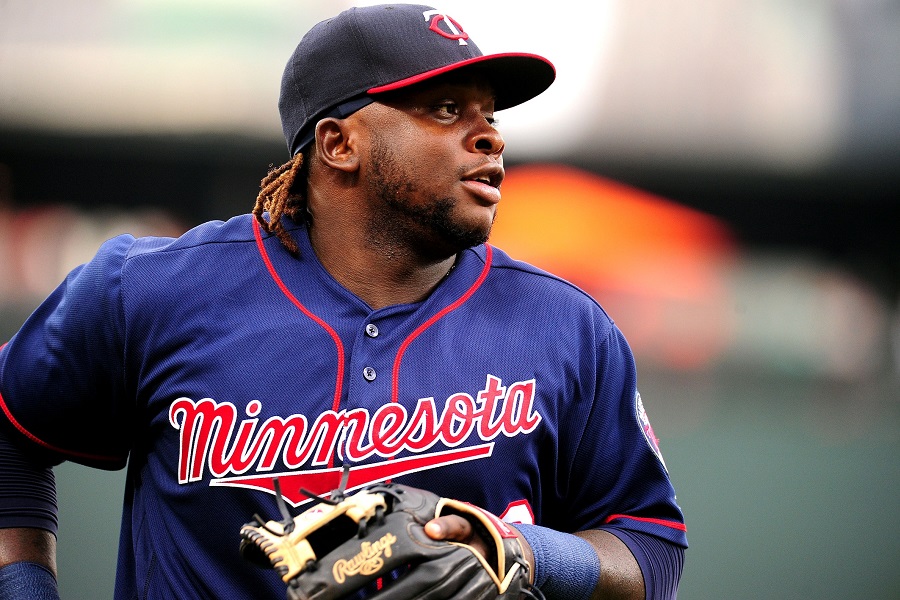
Aaron and John talk about the Twins' offseason needs, limited free agent starting pitching options, Miguel Sano's surgery to insert a titanium rod into his leg, Twins Daily's Offseason Handbook, losing Daniel Palka and Randy Rosario on waivers, Rick Anderson joining Ron Gardenhire in Detroit, Duck Duck Gray Duck, Francisco Liriano winning a World Series, and reviewing the preseason AL Central over/under picks. You can listen by downloading us from iTunes, Stitcher or find it at GleemanAndTheGeek.com. Or just click this link.http://traffic.libsy...3?dest-id=74590 Click here to view the article
-
 [media]http://traffic.libsyn.com/gleemangeek/Ep_342.mp3?dest-id=74590[/media]
 -
Happy Offseason! At Twins Daily, we let Honus Wagner stare out the window and wait for spring. We dig in, with Twins talk every crazy day and we kick it off with our Offseason Handbook. It’s yours to download for whatever price you think is fair and has everything you’ll need to plan out your own offseason plan for your favorite baseball team. It includes: An analysis of the Twins payroll and how much they are likely to spend on free agents.A summary of free agent starting pitchers, relievers and right-handed hitters that would be prime targets for the Twins.A complete review of the organization’s depth, position-by-position, from the majors down to the rookie leagues.A summary of the arbitration decisions the Twins must make and their likely choices.Analysis of the top trade targets on the Twins.Essays by Twins Daily writers on special topics looking back at the season and at the upcoming offseason.A sample blueprint on a path the Twins could take in building for 2018 and beyond.We encourage you to check it out, make your own blueprint, and then follow along on Twins Daily as we track the Twins, their rumors, their news and the rest of the American League. C'mon - you’ve got some time this afternoon, so order it now and you’ll be able to download it immediately. Thank you for checking it out and for stopping by Twins Daily for your Twins fix. Click here to view the article
-
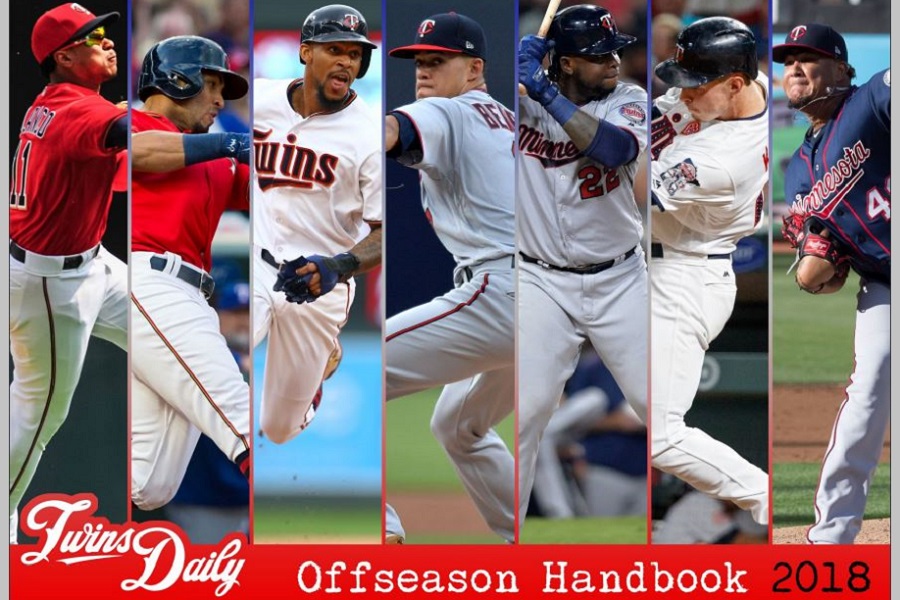 An analysis of the Twins payroll and how much they are likely to spend on free agents. A summary of free agent starting pitchers, relievers and right-handed hitters that would be prime targets for the Twins. A complete review of the organization’s depth, position-by-position, from the majors down to the rookie leagues. A summary of the arbitration decisions the Twins must make and their likely choices. Analysis of the top trade targets on the Twins. Essays by Twins Daily writers on special topics looking back at the season and at the upcoming offseason. A sample blueprint on a path the Twins could take in building for 2018 and beyond. We encourage you to check it out, make your own blueprint, and then follow along on Twins Daily as we track the Twins, their rumors, their news and the rest of the American League. C'mon - you’ve got some time this afternoon, so order it now and you’ll be able to download it immediately. Thank you for checking it out and for stopping by Twins Daily for your Twins fix.
 -
It’s almost here… the Twins Daily Offseason Handbook will be sent out at the last out of the World Series, but those folks who have preordered received Nick Nelson’s essay examining the trade market for Jorge Polanco. You can too - just pre-order it. As soon as you do (at whatever price you think is fair) you’ll be able to download Nick’s essay AND you’ll get the Handbook the moment it is released.If you even visit this site occasionally, you're going to love the Offseason Handbook. It lays out the whole offseason as if you were the Twins General Manager: the free agents, the trade options, the payroll limitations, and a complete organizational depth chart featuring all your minor league players. At the end, we share Nick Nelson's blueprint for what he would do if he was the GM, and this week other Twins Daily writers will share theirs. We invite you to share yours too, in the Forums. It makes a long cold offseason a whole lot more fun and we want everyone to have a chance to play with it, so you choose how much to pay. Again, pre-order it now, so you can get Nick's essay early! Click here to view the article
-
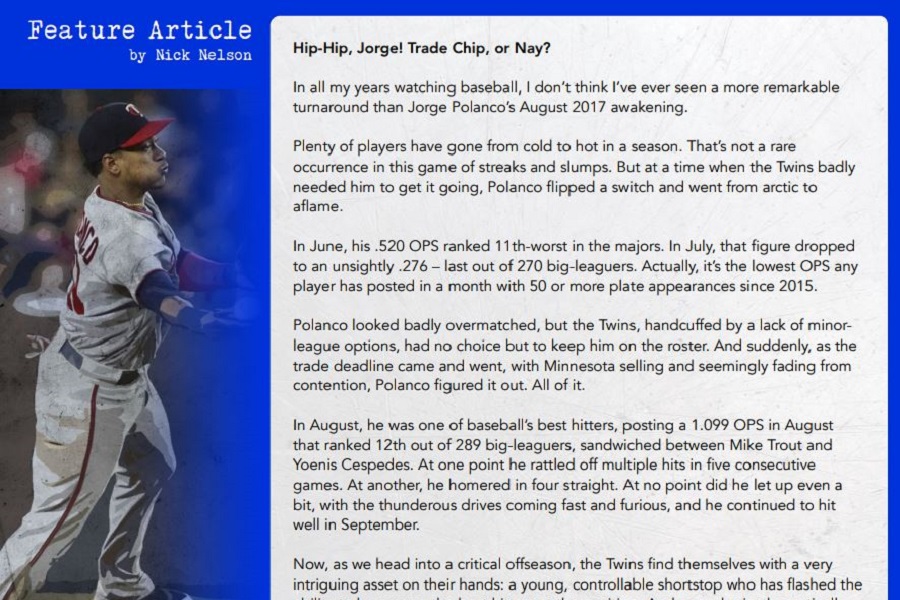 If you even visit this site occasionally, you're going to love the Offseason Handbook. It lays out the whole offseason as if you were the Twins General Manager: the free agents, the trade options, the payroll limitations, and a complete organizational depth chart featuring all your minor league players. At the end, we share Nick Nelson's blueprint for what he would do if he was the GM, and this week other Twins Daily writers will share theirs. We invite you to share yours too, in the Forums. It makes a long cold offseason a whole lot more fun and we want everyone to have a chance to play with it, so you choose how much to pay. Again, pre-order it now, so you can get Nick's essay early!
 -
Aaron and John discuss new Twins pitching coach Garvin Alston, Glen Perkins career, John's attempt to run a half-marathon with the help of RxBars and their preseason picks in the AL East. You can listen by downloading us from iTunes, Stitcher or find it at GleemanAndTheGeek.com. Or just click this link. Click here to view the article
-
 http://traffic.libsyn.com/gleemangeek/Episode_341.mp3
 -
Tired or waiting for the Twins Daily Offseason Handbook? If you pre-ordered it, you got a sneak peek at it on Saturday night, when we sent out Parker's essay detailing how Byron Buxton's swing was rebuilt on the fly this season. And you can still get it! Just pre-order it. You'll not only immediately be able to download Parker's essay but you'll also get:1. Nick Nelson's essay on a prime trade target on the Twins and 2. The Twins Daily Offseason Handbook as soon as the offseason starts, when the last out of the World Series is recorded. If you even visit this site occasionally, you're going to love the Offseason Handbook. It lays out the whole offseason as if you were the Twins General Manager: the free agents, the trade options, the payroll limitations, and a complete organizational depth chart featuring all your minor league players. At the end, we share Nick Nelson's blueprint for what he would do if he was the GM, and this week other Twins Daily writers will share theirs. We invite you to share yours too, in the Forums. It makes a long cold offseason a whole lot more fun and we want everyone to have a chance to play with it, so you choose how much to pay. Again, pre-order it now, so you can get Parker's and Nick's essays early! Download attachment: CTA-Banner.jpg Click here to view the article
-
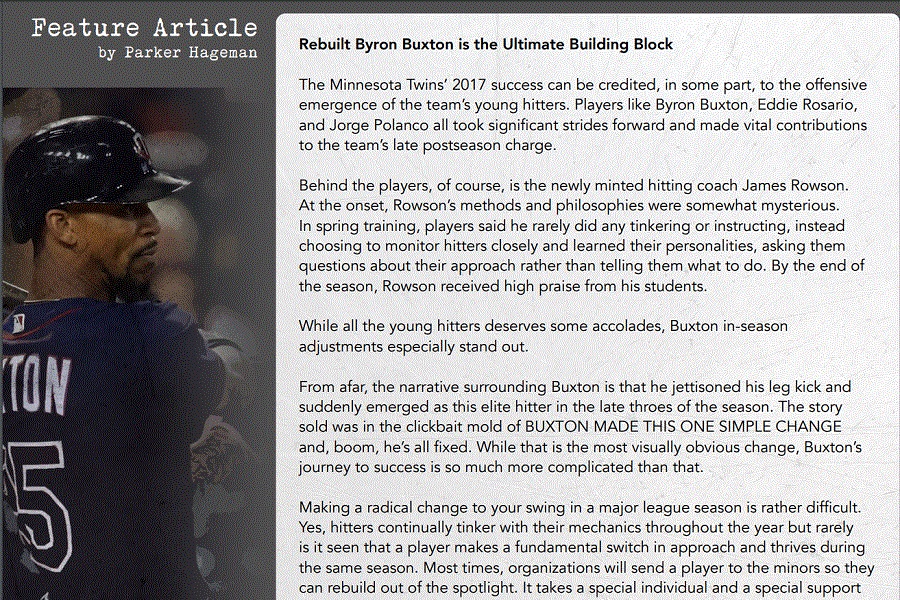 1. Nick Nelson's essay on a prime trade target on the Twins and 2. The Twins Daily Offseason Handbook as soon as the offseason starts, when the last out of the World Series is recorded. If you even visit this site occasionally, you're going to love the Offseason Handbook. It lays out the whole offseason as if you were the Twins General Manager: the free agents, the trade options, the payroll limitations, and a complete organizational depth chart featuring all your minor league players. At the end, we share Nick Nelson's blueprint for what he would do if he was the GM, and this week other Twins Daily writers will share theirs. We invite you to share yours too, in the Forums. It makes a long cold offseason a whole lot more fun and we want everyone to have a chance to play with it, so you choose how much to pay. Again, pre-order it now, so you can get Parker's and Nick's essays early!
 -
Aaron and John talk about Ron Gardenhire's return to the AL Central with the Tigers, the Twins' pitching coach search, their Friday night activities, Baseball America editor-in-chief John Manuel joining the Twins' scouting department, betting on Nick Blackburn, plugging books and handbooks, Delmon Young's clean slate in Australia, and the results of the preseason AL West over/under picks. You can listen by downloading us from iTunes, Stitcher or find it at GleemanAndTheGeek.com. Or just click this link.http://traffic.libsy...3?dest-id=74590 If you would like to check out the Twins Daily Offseason Handbook which we talk about on this podcast, click on this: Download attachment: CTA-Banner.jpg Click here to view the article
-
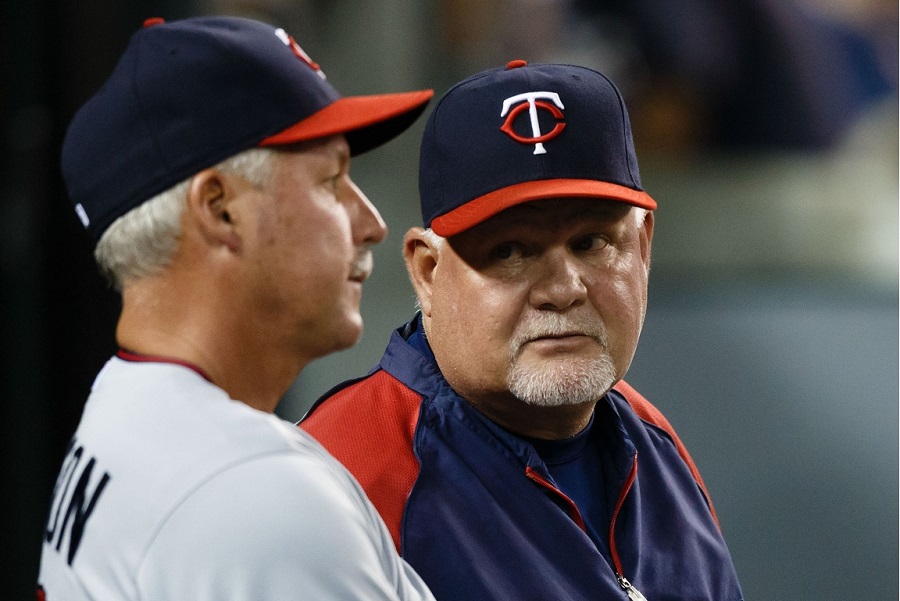 http://traffic.libsyn.com/gleemangeek/Episode_340The_Return_of_Gardy.mp3?dest-id=74590 If you would like to check out the Twins Daily Offseason Handbook which we talk about on this podcast, click on this:

