



twinsfan34
-
Posts
840 -
Joined
-
Last visited
Content Type
Profiles
Minnesota Twins News, Rumors & Analysis
Minnesota Twins Videos
2026 Minnesota Twins Top Prospect Rankings
2022 Minnesota Twins Draft Picks & Signing Bonuses
Minnesota Twins Trade & Free Agent Rumors
Minnesota Twins Fan Guides & Resources
2023 Minnesota Twins Draft Picks & Signing Bonuses
The Minnesota Twins Players Project
2024 Minnesota Twins Draft Picks & Signing Bonuses
2025 Minnesota Twins Draft Picks & Signing Bonuses
2026 Minnesota Twins Draft Picks & Signing Bonuses
Forums
Blogs
Events
Store
Downloads
Gallery
Everything posted by twinsfan34
-
How did they do it? What were the changes? How does a team 'unload' most of it's talent and not really seem to acquire much more, yet, come out on top as it seems the Red Sox have done. The 1991 Minnesota Twins went from 'worst to first'...as did the Atlanta Braves that year. The 2012 Red Sox had: Carl Crawford ($102.5M over the next 5 yrs) Adrian Gonzalez ($127M over the next 6 yrs, Red Sox pay $3.9M/yr thru '15) Marlon Byrd Josh Beckett ($31.5M over the next 2 yrs) Kevin Youkilis ($12M) Aaron Cook Saisuke Matsuzaka ($10M) Cody Ross ($26M over next 3 yrs) Mike Aviles ($6 over next 2 yrs) Cook and Matsuzaka stunk. So they wouldn't have been back either way. James Loney, acquired in the Dodgers trade, was let go. They only have one prospect (BA's #71 for 2013) in P Allen Webster to show for that trade. The 2013 Red Sox acquired: Stephen Drew (FA, 1yr/$9M, 3.1 WAR) Johnny Gomes (FA, 2y/$10M, 1.2 WAR) Mike Napoli (FA, 1y/$13M, 4.1 WAR) Shane Victorino (FA, 3yr/$39M, 6.1 WAR) Ryan Dempster (FA, 2yr/$26.5M, -1.7 WAR) Koji Uehara (FA, 2yr/$9.25M, 3.6 WAR) Mike Carp (Trade, 1yr/508K, 1.3 WAR) Late season trade: Jake Peavy (2yr/$29M, 0.6 WAR, 10g played) The players who moved WAR contributions: Adrian Gonzalez - 2012 ~ 3.5 WAR, 2013 ~ 3.9 WAR Carl Crawford - 2012 ~ 0.5 WAR, 2013 ~ 1.7 WAR Kevin Youkilis - 2012 ~ 1.6 WAR, 2013 ~ -0.2 WAR Cody Ross - 2012 ~ 1.9 WAR, 2013 ~ 2.5 WAR Mike Aviles - 2012 ~ 2.3 WAR, 2013 ~ 0.6 WAR Josh Beckett - 2012 ~ 1.1 WAR, 2013 ~ -0.8 WAR And they're in pretty good shape for 2014 with a lot of salary flexiblity in that Napoli, Drew, Ellsbury, Saltamacchia, Hanrahan, and Matt Thornton are all coming off the books. I'm sure they'll try to sign, in order, Ellsbury, Napoli, and Saltamacchia. That's $49.5M to still arrive at their $154M number for 2014. Jackie Bradley should provide some value as a 2nd year MLB prospect, who knows, maybe he'd have to replace Ellsbury if they don't sign him. Bogaerts should add value to 3B, if not win ROY as well. The only thing better they could have done was keep Byrd or Ross instead of signing Johnny Gomes. And not sign Ryan Dempster. But is it just me, or was that off-season not all that impressive? If anything, it would seem like they would have had another losing season as it seemed more talent went out the door than what came in the door. What, if at all, would this look like in action on the Minnesota Twins?
-

Sickels: Top 20 Twins prospects for 2014
twinsfan34 replied to cmb0252's topic in Twins Minor League Talk
And he's walking half a batter per inning. -
White Sox Sign Jose Abreu: Donkey Kong Part II
twinsfan34 commented on twinsfan34's blog entry in Blog twinsfan34
Question: Which would have given most of the Twins fans on here the bigger jolt. The signing of Abreu or Mike Napoli? -
White Sox Sign Jose Abreu: Donkey Kong Part II
twinsfan34 commented on twinsfan34's blog entry in Blog twinsfan34
-
If you check out the Podcasts (#2 specifically), Jeff Smith, Manager of the Desert Dogs and Twins Organizational guy talks about Rosario playing some 2B as well as the corner OF positions. He also mentions Max Kepler at 1B and is impressed with both of them. He says that the Arizona Fall League is comparable to a 'high' AA type of competition.
-
I'm on board with this. Sign (risk?) a 1-2 yr $4-6M deal on Josh Joshson. Maybe an incentive laden deal that pushes it over $10M annually, with a team option. MN guy comes home would be a great story. He still struck out over 9 per 9 IP. Seems like a command issue on top of the health issue than lack of 'stuff' still left. I'd be comfortable going as high as $7-8M for Lincecum 2 year deal. Qualifying offer extended - not worth it. That means $13M+ salary and loss of 2nd RD pick.
-
Shane, You got a hunch or an inside scoop?
-
-
I love this signing for the Twins. This means Adam Dunn OR this guy is playing 1B/LF. That's 'greener' pastures for the Twins. Very slow and liabilities in the field. Adam Dunn's D-WAR is -2.4. Can't wait to see him or Abreu in the field for the White Sox. According to Buster Olney, "most" (whatever that means) industry experts feel he's a very risky acquisition and weary on his guy's ability to transition to MLB. It's not even assumed he'll start with the big club next year. If he cost 'only' $11M/per, why didn't the Yankees put 2 pennies together and get him? Lyle Overbay, Mark Reynolds, Kevin Youkilis, Travis Hafner, & Curtis Granderson were responsible for most of the DH at-bats and they represent $37.5M coming off the books. Why wouldn't they sign him...if he was only $11M/yr to sign? How about Boston? Mike Napoli is a FA after the season. He cost $13M. They must not think Abreu could hit .259 AVG 23 HR 92 RBI in 579 at-bats (Napoli's numbers)...and for a cheaper price to boot.
-
I was born in 1981. I had similar experiences. To this day, two favorite MLB teams, The Twins, and a distant second, the St. Louis Cardinals. Loved Ozzie Smith and my dad talked a lot about Stan Musial and I got to read a bit on him. I grew up on a farm near a town of 316. My 'birthday' gift each year (usually in May) was two Twins games. I usually picked the Oakland A's in hopes of catching a baseball and it was the best matchup in the late 80's and early 90's. Good times.
-
Arizona Fall League is Underway - Kepler is the Twins Star of the AFL So Far
twinsfan34 commented on twinsfan34's blog entry in Blog twinsfan34
Note. Kepler, in all 4 games, has played 1B. -
Not that I thought his 40-man roster spot was ever in doubt. But he's the best performing Twin so far in the ARZ Fall League, which started on Oct 8. Here's a story on Kepler and his performance in his last game. Here's the Twins stats - they're on the Glendale Desert Dogs.
-
Great observation. One would think this would open up teams from being more aggressive in that 'middle tier' free agency area (under the compensatory loss of pick price range). This is a great Question: And under the new CBA, will they still continue to do it? It appears the Devil Rays are looking to deal David Price or at least highly entertaining the idea.
-
Yep. Instead of losing your 1st RD draft pick to the other team. You just forfeit it altogether. Exceptions Teams that were protected in the top 15 are now only the top 10 protected. Free Agents are also no longer tiered. Has to do with if they've been offered average salary of top 125 player money (early indications of $14.1M for 2014). So the Twins for example, 5th worst team (top 10 protected), would instead lose a 2nd RD pick for say, signing Robbie Cano (sure to be offered compensatory money). And yea, you're probably right. They probably won't go after a $14M+a yr player, primarily for the salary implications, but also because this administration would likely not prefer to lose their 2nd RD draft pick in this upcoming draft.
-
I can see your view point on Anibal Sanchez. As the reason he's with the Tigers in 2013 is because he was a free agent and signed a contract. However, if that's the line of thinking, eventually 100% of players will be free agent acquisitions - because they have to sign a non-rookie contract at some point. There's a few caveats, but any player generally needs at least 6 years of MLB service time to be an unrestricted FA. So any player with 6 years or more on a team is a free agent. Maholm is with the Braves - whether or not he signed with Chicago isn't really relevant to how he's playing with the Braves. How would you then deal with the fact he came to the majors by the Draft. That is, he was drafted by the Pirates in 2003, so would you not then have to consider him a Draft Pick? As he was a draft pick before he was a free agent. The other factor, is I'd struggle with how MLB classifies Maholm. At no point could Maholm have decided (free agency) not to be a Brave after being traded from the Cubs. Well - Adam Wainwright would have been a Cardinal in 2013 regardless - as his contract extension doesn't come into play until 2014. But, lets play out the scenario I think you're referring to. That is, assuming the Cardinals make the playoffs in 2014. I still would find it hard to classify Adam Wainwright as a Free Agent - as at no point in his career could the Twins (or any other ballclub) have signed him. He "avoided" free agency as claims, in the MLB terms, he has to file for free agency and be granted it. He would at no point been able to classify or call himself a free agent by Major League Baseball. Even so, I just can't classify a guy who's never been a free agent, as a free agent.
-
It doesn't necessarily preclude them from doing so. It can have a negative affect on your minor leagues. Example, after the 2011 season the Angels signed Albert Pujols. The Cardinals got their 1st RD pick (Michael Wacha) as compensation for signing away Pujols. The Cardinals also got another 1st RD as a supplemental selection (Stephen Piscotty). Two years later, Wacha almost throws a no-hitter in the post-season and Piscotty is in AA already with a great BB/SO and contact ratio. The Angels also signed CJ Wilson so they lost their 2nd RD choice in that draft as well. The Twins had a tremendous draft in 2012, but, they also lost their 2nd RD pick (#2 overall in that round) for signing Josh Willingham. Willingham had a great year in 2012. What will that pick ultimately end up being or what value will Josh Willingham's 2012 (and whatever he does this year, did nothing in 2013) and any other years weigh against that signing. Who knows... So it's not 'free' to sign any free agent. For top free agents, you'll also lose your draft pick in the 1st RD for the upcoming draft.
-
I admit, I don't know what to think about the fact that most of the upper management for the Twins has been in place for 20+ years. A little scared as they might not be caught in their ways. But, maybe they're good delegators and good at finding capable people? Winning seasons, playoff appearances, World Series Championships, All-Stars (above the automatic one per year), MVP's, Cy Young's, etc. I wonder how they'd fare. Here's a rundown of the Twins Organization over the years: Bill Smith,1986-2011. 26 years. Rob Antony, 1996-Present. 18 years. Mike Radcliffe, 1994-Present. 20 years. Terry Ryan, 1987-Present. 27 years. Jim Rantz, 1986-Present. 28 years. Tom Kelly, 1986-Present. 28 years. The guy I'd like to know more about is Jack Goin. He was hired in 2012. He's the Director of Baseball Research.
-
He was only Director of Scouting from 1987 to 1991 per Baseball America. However, he was GM starting in 1995 until 2007. Can't really say he wasn't 'responsible' while in that position versus being Director of Scouting. And I wonder how much 'pull' certain scouts get or how they get graded. They likely all are pulling for 'their guys' to get drafted. Was an interesting read to read about the scout for the Angels who had to fight and plea for the Angels to even take Trout with the 2nd pick of the 1st round that year. Mike Radcliffe was Scouting Director from 1994-2007. A list of Minnesota Twins Scouting Directors over the years.
-
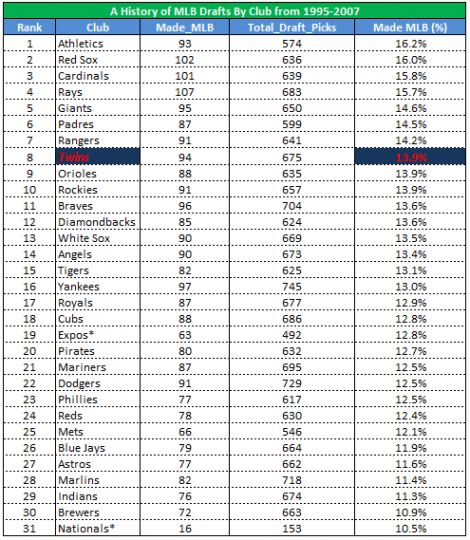
To support your point, and to name those 7 teams. I did a query of teams during Terry Ryan's tenure of drafting players, 1995-2007 for those of you keeping track at home. Anyone wanna guess which team had the most players drafted to make at least an appearance in the Major Leagues during that time? Table: Note: I didn't include WAR as a lot of times WAR is accumulated with other teams or in cases where team drafts the same player twice (Andre Ethier, Athletics) or he's drafted by two different teams (Jason Varitek,Twins & Mariners) or a team drafts him, he doesn't do anything, and becomes a stud somewhere else (Josh Hamilton, Tampa Bay -> Rangers). Thus, it was only based on a team picking a player and that guy made it to the bigs. I also choose from 1995 to 2007 for two reasons. One, Terry Ryan, and two, because most drafts from 2009 and more recent aren't enough time for the 'average' player to develop into a MLB player. College players usually take 2-4 years, while HS players usually take 4-5 years.
-
Yes, you are 100% correct, Chris Archer was acquired via trade. But he was brought to the Rays through the Farm system versus he was traded for and brought immediate value to the ML club. So yes, you are right, but for my classification, I was saying 'farm' as he didn't provide any value to the Rays as a AA player nor to their ability to win that particular season he was acquired much like a Free Agent or a Trade (typically) will. He was acquired in 2011 and spent a little over 2 years in the minors before becoming a starter a little while into the 2013 season. I should have been more clear.
-
I think you're right. If drafting and other areas don't work out the tendency is to jump more fully into Free Agency. I think that's a healthy correlation. The other one - that may or may not be there - is the success or lack of success of teams that try to primarily 'win' with free agency. And for how long. The latest collective bargaining agreement affected free agency a lot. Not so much in the contracts offered value wise, but in the compensation. It used to be you could trade for a Matt Garza, in a contract year, and then if you didn't resign him, you got a 1st RD draft pick by the type of Free Agent he is. If it was a team outside of the protected top 15 picks (15 worst teams) you also received their 1st RD pick. So in affect, they would give up the prospects Garza, but then you'd get two 1st round picks for him. Now a player must be offered a 'qualifying offer', last year it was $13.3M, this year it appears to be $14.1M. That is, unless Ervin Santana (Royals) is offered at least $14.1M for 1 season (or more) a team who signs him won't lose their 1st RD pick to the player's former team, the pick is just forfeited altogether. The team losing that player, if they offered at least a qualifying offer, would get a compensatory pick at the end of the 1st round. What do you think that will do for free agency? The team losing the FA, now doesn't get as much compensation, that is they don't receive the pick from the signing team - will the team with the pending free agent then try harder to keep that player? What it does for the Twins, who are in the top 10 picks, is we won't lose our 1st RD pick if we sign a 'top' (received a qualifying offer) free agent. But we would forfeit a 2nd rounder. So it's still the cost of signing the player as well as losing a high draft pick. So 'signing away' also hurts your farm system. So did MLB do this in hopes of teams keeping their players? And did they do that knowing a player typically performs better for his home grown team versus signing for another? (assuming not a cast off) The study wasn't so much, not caring. But that signing Free Agent starting pitching often didn't pay off. That is, it didn't result in wins for the team. Another guy did a WAR (wins above replacement) study and very few pitchers offered a WAR even above 2. So you pay $12M for 2 more wins than the next guy? The past 4 years there were 42 starting pitchers signed via Free Agency. Only 16 even posted a winning record. The rest were awful. Look at the top salary guys from this past year. $13M this past year would have gotten you Dan Haren, Edwin Jackson, or Ryan Dempster. That is 10-14 W-L 4.67 ERA, 8-18 W-L 4.98 ERA, and 8-9 W-L 4.57 ERA. We could have been WORSE as a team to sign those 3 guys and could have spent $40M in doing so. They're just not affective if you have to start reaching for Free Agent Pitching. Now, if you're talking about free agent hitting - that's a whole other matter and that can be and is successful. But winning pitching rotations are built primarily through the draft, secondarily through trades, and lastly, as often a final piece, through free agency - and often - they are not high salary guys. I'm all for spending in Free Agency, but pitching is rare to return on it's value. It's why you have to pay $25M for a 34 year old Cliff Lee. Or $13M a piece for those studs (Dempster, Jackson, Haren) this past FA period. Paying $13M to get Matt Garza isn't going to make us a winner.
-
Article: The Righty Reliever Pipeline
twinsfan34 replied to Nick Nelson's topic in Twins Daily Front Page News
Got a few questions, of which I'll preface once I set up. 1. Do you feel that relievers are easier to get to the bigs? I ask as from what I read on scouting of builds, the number of "plus" grade pitches a reliever requires to make it in MLB, and other factors. It's much less limiting. For instance, a lot of scouting notes will always talk about the build of a pitcher. Downward plane, able to endure lots of pitches, etc. Then for the pitches themselves, to be a good starter in MLB, you need at least 3 pitches that are "plus", or an offspeed and fastball that are "plus-plus" and complement each other. To be a reliever, you need maybe 2 pitches, and only one of them has to be "plus-plus" I believe former Twin Grant Balfour is a great example of such a candidate. He had a "plus" to "plus-plus" fastball (FA). That is it was generally clocked between 94-97 mph. While he was with the Twins, he only had the "plus fastball" and secondary pitches, slider and change-up, were quite ordinary. His development of his slider (SL) to a "plus" pitch has gotten him from 'average reliever' to closer. That's merely from developing another pitch. Put him as a starter and by the 2nd or 3rd AB that game Major League hitters will start to put them in the seats. Grant Balfour pitches by percentage chart: You can see the effectiveness (thrown more) and with better ERA (better success) in 2012 and 2013, which coincidentally is when he's become the A's closer. The other part about relievers is you can be a 'niche' guy. You only have to pitch to weaknesses of various hitters. The Jesse Orosco's (former Twin Draft Pick by the way), Dan Plesac, and John Candelaria's of the world were able to pitch into their 40's due to this. That said, when it comes to playoff teams. These guys are vital. And playoff teams are often willing to pay for that reliever in a pinch, as it's often that missing factor to expose match-ups in the playoffs. That said, the Twins could sorta produce a 'pipeline' to get more draft picks and other AA prospects by developing failed starters as relievers. This is another reason I'm against drafting "control" type pitchers, al a Kyle Gibson, Pat Dean, etc as you can't develop them as relievers if starting fails for them. 95% of the time you start with a guy who has a "plus" or "plus-plus" fastball and work on command of that while adding a 2nd pitch. Curious, your thoughts, and others, on which pitchers could fit this profile in the Twins Organization. And two, if you think the Twins would ever entertain the idea. Also, Glen Perkins is a great example of a 'failed' (moderate success) as starter, but is an All-Star as a reliever.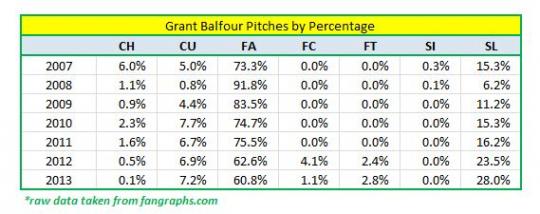
-
For some reason the chart wasn't coming through in the other comment... Maybe this will work:

-
Great Question Nickssaviking, I ran a quick run through of teams starting from the bottom, the Houston Astros. It's quite different from the successful teams - the 'farm' still wins, but only by 1 player out of the bottom 11 teams. If you pull the Mets from there (a healthy David Wright, et al) you would find the main method of putting together a starting rotation by the worst teams in MLB is by Free Agency (reaching perhaps?). I have a question: Is it possible that Free Agency Starting Pitching is the Running Backs of the NFL. That is, find someone young, when he's getting expensive, and arguably not as good or likely to be successful, get trade him or let him walk for a 1st RD compensatory pick (a second 1st RD pick from the signing team if not a bottom 10 team and you offered him top 125 player money). Here's a breakdown of the pitching staffs: Houston Astros (51-111) Dallas Keuchel - $503K– Farm Lucas Harrell – $501K – Waivers Erik Bedard – $1.15M - Free Agent Jordan Lyles - $500K – Farm Brad Peacock - $490K – Trade Miami Marlins – 62-100 Jose Fernandez – Farm Tom Koehler – Farm Jacob Turner – Trade Nathan Eovaldi – Trade Henderson Alvarez - Trade Chicago White Sox (63-99) Chris Sale - $850K - Farm Jose Quintana - $505K – Minor League FA Hector Santiago - $505K - Farm John Danks - $14.25M – Trade Dylan Axelrod - $493K - Farm Chicago Cubs (66-96) Jeff Samardzija – Farm Travis Wood - $528K – Trade Edwin Jackson - $13M – Free Agent Scott Feldman - $7M – Free Agent Carlos Villanueva - $5M – Free Agent Minnesota Twins (66-96) Kevin Correia – Free Agent Mike Pelfrey – Free Agent Scott Diamond – Farm (Rule 5, AAA, 1.5 yr in system) Sam Deduno – Free Agent Vance Worley – Free Agent Seattle Mariners (71-91) Felix Hernandez – Farm Hisashi Iwakuma – Free Agent Joe Saunders – Free Agent Aaron Harang – Trade Brandon Maurer - Farm Philadelphia Phillies (73-89) Cliff Lee – Free Agent Cole Hamels – Farm Kyle Hendrick – Farm Roy Halladay – Free Agent John Lannan – Free Agent Blue Jays (74-88) R.A. Dickey - Trade Mark Buehrle – Trade J.A. Happ – Trade Josh Johnson – Trade Esmil Rogers – Trade New York Mets (74-88) Matt Harvey - Farm Dillon Gee - Farm Jonathan Niese - Farm Shawn Marcum – Free Agent Zack Wheeler – Trade (but AA prospect, 2 yrs in Mets system) Milwaukee Brewers (74-88) Kyle Lohse – Free Agent Wily Peralta - Farm Yovani Gallardo - Farm Marco Estrada - Waivers Tom Gorzelanny – Free Agent San Diego Padres (76-86) Eric Stultz – Waivers Andrew Cashner – Trade Edinson Volquez – Trade Jason Marquis – Free Agent Tyson Ross – Trade


-
You can view the page at http://twinsdaily.com/content.php?r=2396-Pitching-and-Playoffs-Through-the-Farm-System-Free-Agency-or-Trades


