



twinsfan34
-
Posts
840 -
Joined
-
Last visited
Content Type
Profiles
Minnesota Twins News, Rumors & Analysis
Minnesota Twins Videos
2026 Minnesota Twins Top Prospect Rankings
2022 Minnesota Twins Draft Picks & Signing Bonuses
Minnesota Twins Trade & Free Agent Rumors
Minnesota Twins Fan Guides & Resources
2023 Minnesota Twins Draft Picks & Signing Bonuses
The Minnesota Twins Players Project
2024 Minnesota Twins Draft Picks & Signing Bonuses
2025 Minnesota Twins Draft Picks & Signing Bonuses
2026 Minnesota Twins Draft Picks & Signing Bonuses
Forums
Blogs
Events
Store
Downloads
Gallery
Everything posted by twinsfan34
-
Terry Ryan was signed on November 7, 2011. Thus: He did not sign any players for the 2011 season. He did not participate in the 2011 MLB June Draft. The World Series had completed. So that puts him in charge of 2012 and 2013. I believe total comes to two seasons, not three where he resides over the FA, Draft, and in-season activities. All three of which he missed for the 2011 season.
-
3rd year? Use numbers...like 2011...2012...etc
-
Changing the FO and field management personnel. 1. I think the "field management personnel" can affect a team - 5-10 wins. 2. The FO has little to nothing to do with the team put on the field the first 3 years with the team. Most of the players on the 25 man roster will be from the previous GM's activities. Around year 4 (this will be Terry Ryan's 3rd year at the controls - signed late 2011, in charge of 2012 and 2013 activities) you see the team (more than half it's players) as directly there by actions of the FO.
-
OR...to get a higher Draft pick. And that can, at times, mean you miss out on a Ken Griffey Jr, Alex Rodriguez, Joe Mauer, Stephen Strasburg, Bryce Harper, et al. It also means if you sign a FA outside of the top protected picks (was top 15, now in 2014 it's a top 10) you would forfeit your 1st RD draft pick, thus sorta 'handcuffing' your future for the present going from 66 wins to 72 wins. So if you sign 'top' end FA's ~ for 2013 that was $13M and up ~ you better be prepared to mortgage your future 1st RD draft pick.
-
Free Agency definitely doesn't have a very good return on investment. Finding good talent and drafting it, Michael Wacha, who has "Ace" type stuff for the Cardinals was drafted by the Cardinals #19th in the 1st RD of 2012. He's already in the majors and a stud.
-
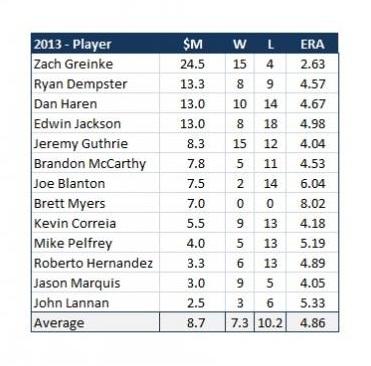
If the Twins can get Tanaka for similar to Yu Darvish (6yr $56M +$4M in possible roster bonuses + $51.7M for negotiating rights) money, he would probably be a better deal than most of the pitching signed this past off-season. Darvish ultimately will 'cost' an average of $18.6M per year. Here's a rundown of 2012 FA class (begin 2013 with their new teams) production and salary for 2013: The question is, how would he then compare to the top pitching Free Agent Starting pitching for next year? A quick gander at the crop of top FA starting pitchers for the 2014 season can be had at MLB Trade Rumors. If anyone saw my breakdown of starting pitching in the playoffs - most of the starting pitching that led to playoff teams was built on the farm, rather than through Free Agency.
-
Great first post.
-
How did the most successful teams of 2013 make it to the playoffs? Was it through the Farm System/Draft, Free Agency, or Trades? Any guesses which was the most expensive of the 3 areas? And which was the most successful (regardless of salary)? Below are the 2013 rotations which are ordered by post-season rotation order and then secondarily, for the #4 & #5 starters, by their contributions during the regular season. [PRBREAK][/PRBREAK] Boston Red Sox Jon Lester – Farm system – $11.625M – 15-8 W-L 3.75 ERA 213.1 IP 177 SO John Lackey – FA - $16.5M – 10-13 W-L 3.52 ERA 189.1 IP 161 SO Clay Buchholz – Farm system – $5.5M – 12-1 W-L 1.74 ERA 108.1 IP 96 SO Felix Doubront – Farm system – $519K – 11-6 W-L 4.32 ERA 162.1 IP 139 SO Ryan Dempster – FA – $13.25M – 8-9 W-L 4.57 ERA 171.1 IP 157 SO Detroit Tigers Justin Verlander – Farm System - $20M 13-12 W-L 3.46 ERA 218.1 IP 217 SO Max Scherzer – Trade - $6.7M – 21-3 W-L 2.90 ERA 214.1 IP 240 SO Anibal Sanchez – Trade - $8.8M – 14-8 W-L 2.57 ERA 182 IP 202 SO Doug Fister – Trade - $4M – 14-9 W-L 3.67 ERA 208.2 IP 159 SO Rick Porcello – Farm System - $5.1M 13-8 W-L 4.32 ERA 177 IP 142 SO Oakland Athletics Bartolo Colon – FA - $3M – 18-6 W-L 2.65 ERA 190.1 IP 117 Sonny Gray – Farm system - $490K – 5-3 W-L 2.67 ERA 64 IP 67 SO Jarrod Parker – Farm System (trade w/ ARZ as Class AA, #26 Overall Prospect) - $495K - 12-8 W-L 3.97 ERA 197 IP 134 SO AJ Griffin – Farm System - $493K – 14-10 W-L 3.83 ERA 200 IP 171 SO Dan Straily – Farm System - $493K – 10-8 W-L 3.96 ERA 152.1 IP 124 SO Tampa Bay Rays David Price – Farm System – $10.1m – 10-8 W-L 3.33 ERA 186.2 IP 151 SO Matt Moore – Farm System – $1M – 17-4 W-L 3.29 ERA 150.1 IP 143 SO Alex Cobb – Farm System – $502K – 11-3 W-L 2.76 143.1 IP 134 SO Jeremy Hellickson – Farm System – $503K – 12-10 W-L 5.17 ERA 174 IP 135 SO Chris Archer – Farm System - $500K – 9-7 W-L 3.22 ERA 128.2 IP 101 SO Atlanta Braves Kris Medlen – Farm System - $505K – 13-9 W-L 3.21 ERA 204.2 IP 181 SO Mike Minor – Farm System - $2.6M – 15-12 W-L 3.11 ERA 197 IP 157 SO Julio Teheran – Farm System - $490K – 14-8 W-L 3.20 ERA 185.2 IP 170 SO Paul Maholm – Trade - $6.5M – 10-11 W-L 4.41 ERA 153 IP 105 SO Tim Hudson – Trade - $9M – 8-7 W-L 3.97 ERA 131.1 IP 95 SO Los Angeles Dodgers Clayton Kershaw – Farm System - $11M – 16-9 W-L 1.83 ERA 236 IP 232 SO Zack Greinke – FA - $19M – 15-4 W-L 2.63 ERA 177.2 IP 148 SO Hyun-jin Ryu FA - $6M – 14-8 W-L 3.00 ERA 192 IP 154 SO Ricky Nolasco – Trade - $11.5M – 13-11 W-L 3.70 ERA 199.1 IP 165 SO Chris Capuano – FA - $6M – 4-7 W-L 4.26 ERA 105.2 IP 81 SO Pittsburgh Pirates Francisco Liriano – FA - $1M – 16-8 W-L 3.02 ERA 161 IP 163 SO AJ Burnett – FA - $16.5M – 10-11 W-L 3.30 ERA 191 IP 209 SO Gerrit Cole – Farm System - $490K 10-7 W-L 3.22 ERA 117.1 IP 100 SO Jeff Locke – Farm System (Trade w/ Braves when in Class A) - $498K – 10-7 W-L 3.52 ERA 166.1 IP 125 SO Charlie Morton – Trade - $2M – 7-4 W-L 3.26 ERA 116 IP 85 SO St. Louis Cardinals Adam Wainwright – Farm System (trade w/ Braves as Class AA, #18 Overall Prospect) - $12M - 19-9 W-L 2.94 ERA 241.2 IP 219 SO Shelby Miller – Farm System - $490K 15-9 W-L 3.06 ERA 173.1 IP 169 SO Michael Wacha – Farm System - $490K 4-1 W-L 2.78 ERA 64.2 IP 65 SO Joe Kelly – Farm System $493K – 10-5 W-L 2.69 ERA 124 IP 79 SO Lance Lynn – Farm System - $513K – 15-10 W-L 3.97 ERA 201.2 IP 198 SO So if you were tallying, you would get this breakdown of the rotations by team: All but two had their ace come through their farm system. Bartolo Colon and Francisco Liarino have proved to be one-year wonders. And at $3M and $1M respectively, they were steals, but hardly predictable contributors. Apart from those two free agent finds, six free agents combined for a 61-52 W-L record, while having a combined price tag of $77.25M. Add Liriano and Colon back to the mix and it's 95-66. Here's a look over the past 4 years of FA starting pitcher to back up the post-season numbers from this year. One could run a little optimization application to figure out the optimal price to pay for Free Agent Pitching. (I'll run this later) Lesson: Don't overpay for Free Agents. Only in 2011 did the highest paid free agent starting pitcher, Cliff Lee, have the most wins. So what's the best method for teams, including the Twins, in 2014 (and beyond) to develop a pitching staff? Farm System Cheap FA flyers Continue to add more power arms via 2014 MLB Draft Trades that yield prospects Maybe, just maybe, Terry Ryan doesn't sound like such a stooge anymore.
-

A Look At The Numbers: Yu Darvish vs. Masahiro Tanaka
twinsfan34 posted a blog entry in Blog twinsfan34
-
Pitching and Playoffs: Through the Farm System, Free Agency, or Trades?
twinsfan34 commented on twinsfan34's blog entry in Blog twinsfan34
The Wise One, I'm sorry about not disclosing the classification distinction I had made . I thought I had a disclaimer in there that I counted guys who despite being involved in a trade, if they were in the minors, AA or below I considered them to be "from the Farm"...as they would have to do half of their development in that system (arguably the most important) half at that, in actually getting that prospect to the Big Leagues. -
Pitching and Playoffs: Through the Farm System, Free Agency, or Trades?
twinsfan34 commented on twinsfan34's blog entry in Blog twinsfan34
duplicate... -
Pitching and Playoffs: Through the Farm System, Free Agency, or Trades?
twinsfan34 commented on twinsfan34's blog entry in Blog twinsfan34
Ah good Call!! No, let's get it right. So one less FA, but rather in a Trade. [strengthens the case of staying away from FA as a way to acquire pitching ] Burnett was traded from the Yankees. February 19, 2012: Traded by the New York Yankees with cash to the Pittsburgh Pirates for Diego Moreno (minors) and Exicardo Cayones (minors). Archer was indeed traded, however, he was still a minor leaguer. So I put him in the development stage as he came to the big league club on a minor league contract and had to advance up two levels (AA & AAA, 2 years total) before he made it to the major leagues. So I don't count that as a 'trade' as it was not a 'sure thing' and development was the major factor. January 8, 2011: Traded by the Chicago Cubs with Hak-Ju Lee (minors), Robinson Chirinos, Sam Fuld and Brandon Guyer to the Tampa Bay Rays for Matt Garza, Fernando Perez and Zach Rosscup. Cobb was drafted by the Rays... Drafted by the Tampa Bay Devil Rays in the 4th round of the 2006 amateur draft. (All Transactions) -
Is there really this much interest in David Price? He'd have to be traded this Fall to get two "cheap" ($11M-$15M) seasons, before he asks for $25M a season for 5-8 years at age 30. I don't see that as a smart move for m(any) teams.
-
This is great. Yours? 1. Agree. Bat is way more project-able for value. 2. I see how the Tampa Bay Rays basically fleeced the Royals. The Royals had top arms in in AA and AAA. Shields is solid. But Wade Davis? And you give the Rays 2 top pitching prospects (Mike Montgomery #31 ovr, Jake Odorizzi, #45 ovr) and Wil Myers (#4 prospect ovr)!!? Welp, they are what we thought they were. They are, in fact, the Royals.
-
Pitching and Playoffs: Through the Farm System, Free Agency, or Trades?
twinsfan34 posted a blog entry in Blog twinsfan34
-
so 15 guys...at $70k. $850k. Assuming we sign no one for anything other than the MLB minimum after that. 19 guys at $500k gives us $9.5M...so $10.35M assuming we sign only minimum salary contracts. $57 million....bare minimum.
-
Thanks for explaining that iastfan112 - sorry I wasn't more clear earlier.
-
You're right. It's not $68M yet. It's $46M for 6 players so far. We will have to 34 players to fill out the 40-Man roster and other subsequent minor league contracts purchased who might exceed that 40 man roster. The major league minimum salary for 2014 is $500,000. So 34 players will cost an additional $17M at a minimum. Puts us at $63M. Sorry, I'm not sure why I said $68M. But if we sign anybody over the minimum, it'll add to that $63M number.
-
Even if we could land 2 Clayton Kershaw's for whatever combination of prospects, if our offense didn't improve, we'd still be just under .500 as a team. Trading Draft picks isn't going to bring back value that actually changes the team much. If you want attendance to get better, they won't come to see "middle tier" Free Agents. I don't think signing Jacoby Ellsbury would bring up the attendance either. It will take a big overall team turnaround. Getting impatient to try to 'compete' and turn attendance around in 2014 is only setting us up for long term failure. High school prospects typically take 4-6 years to develop. Stewart, Berrios, et al. But they actually have higher payoff than college prospects as a whole. Also, most teams won't give away a 'significant' player for an A-level prospect. .500 record or better in 2015 is a real possibility if their prospects develop. Our 2014 salary is already $68M. Irony is, we'll lose some salary by 2015 and probably be more talented (Buxton, Rosario, Sano, Meyer, May, Baxendale, Tomkin, Vargas, Hicks, Arcia, Berrios, Gonslaves, Stewart, et al). The other hope is Willingham and a few other guys provide value at the trade deadline and bring back a AA prospect or higher. The Tampa Bay Rays were built on the draft, it took about 6-8 years to make it happen though. 2014 will be year 4 of the Terry Ryan regime, and he got a gift from Bill Smith in his signing of Miguel Sano. Year 4 is when a GM's influence begins to take influence. As you start to see players he's acquired account for about 20% of the roster. By year 5 (2015), should be around 50%. Baseball is unlike any other sport, you need time. Football and basketball can see franchises turned around in one pick. In baseball you don't see a LeBron James or David Robinson or Tim Duncan or Andrew Luck or RG III type of affect. But I love the game.
-
I wouldn't hold Ryan accountable for the 96 and 96. At least not wholly. Just like Billy Beane was not responsible for those Oakland A's teams that experience a great deal of success from 1999 to 2004. Jason Giambi, Eric Chavez, Ramon Hernandez, Tim Hudson, Miguel Tejada, Matt Stairs, Ben Grieve, et al were already there and locked into contracts. His only contributions during that time were Mark Mulder and Barry Zito. A solid FA signing in 1999 of John Jaha. So that to say, not much of the 2012 roster is Terry Ryan's doing. You'd have to go back to 2007 (draft, signings, etc) to find who's on the roster as his doing. 2011 and 2012 were very solid drafts. He didn't sign much of anyone, but our payroll was over $100M...and we all know that had to be reduced.
-
Ask Baseball America - The Rule 5 Draft and Max Kepler
twinsfan34 replied to Steve Lein's topic in Twins Minor League Talk
I agree with Seth. I'd be shocked if they didn't put Santana and Kepler on the 40-man roster for 2014. If Clete Thomas can get 250+ ABs on our team, we have room for Kepler. He doesn't have to be in the bigs. Just means there's the 3 year window. Leave Thomas, Mastrioanni, Parmalee, Ramirez, and Presley off the 40-man. They've already proven they can't contribute much at the major league level. And btw, Santana was already on the 40-man for 2013. 40-Man Roster | twinsbaseball.com: Team -
Agree. Most dismal in memory of 32 years... Clete Thomas...absolutely, I was baffled he was even in the majors. I'd a rather had anyone at Rochester, Antoan Richardson et al.
-
I plan on writing an article, er, I mean blog on Billy Beane. I will break down his success as a GM. Trades, through the Draft, Salary cap management (through trading arbitration eligible players vs talent payback), and the team's success with players he was directly responsible for. I have a feeling y'all will be very surprised when the facts are put out there. I will say, this guy is a trader jack, and that has made connecting the strings a lot more work. I also plan on putting forth a very compelling Byron Buxton article that I have yet to find in circulation. Just takes a lot of statistical analysis. As always, love the discussions you guys bring.
-
I was befundled how poor those drafts were. We went for a lot of college prospects who were "tapped out". Pitchers who were control pitchers and position players who were solid defenders. Perhaps this is due to the fact we were a perennial playoff team and so we wanted players that were 1-3 years away to keep the ship running versus taking higher talent yet undeveloped higher ceiling players that would take 3-5 years time in fear of the quality of the major league club not being able to have people fill in the spots as players went for those higher contracts as mentioned above. 1st Round Draft History
-
Article: Can Ron Gardenhire Develop Young Players?
twinsfan34 replied to John Bonnes's topic in Twins Daily Front Page News
Well said. Great that you're around this to 'see' whereas some of us (myself, perhaps others) is more from a 3rd point of view or based on analyzing decisions, interviews, etc. Thanks.

