



Boone
-
Posts
155 -
Joined
-
Last visited
Content Type
Profiles
News
Minnesota Twins Videos
2026 Minnesota Twins Top Prospects Ranking
2022 Minnesota Twins Draft Picks
Minnesota Twins Free Agent & Trade Rumors, Notes, & Tidbits
Guides & Resources
2023 Minnesota Twins Draft Picks
The Minnesota Twins Players Project
2024 Minnesota Twins Draft Picks
2025 Minnesota Twins Draft Pick Tracker
2026 Minnesota Twins Draft Tracker: Picks & Bonuses
Forums
Blogs
Events
Store
Downloads
Gallery
Everything posted by Boone
-
Solidifying The Twins Up The Middle
Boone commented on Ted Schwerzler 's blog entry in Off The Baggy
The decision between Polanco and Dozier is an easy one, at least for me. The core of the Twins future--Sano, Buxton, Berrios--are all 22 (and Kepler is 23). If we assume that the prime years of this core (ages 25-30) will be the best years for the Twins, then the Twins should be focusing 3-8 years down the road. Now, onto Polanco and Dozier. Polanco is also 22, whereas Dozier is 29. 3 years from now, Polanco will be 25, entering his prime. Dozier will be 32, certainly post-prime. 8 years from now, Polanco will be 30, at the end of his prime. Dozier will be 37, probably out of the league. Quite simply, Polanco's career timeline lines up much better than Dozier's. There's no guarantee that Polanco's career peak will be quite as good as Dozier's, but he is 22, hitting well in AAA, and has hit well at every level of the minors. So we should expect him to be a productive major leaguer. And if he does, he will be much better than Dozier during the prime years of Minnesota's core. Add in the fact that Dozier probably has more trade value today and Polanco is near MLB-ready and it seems like a no-brainer. Trade Dozier. Insert Polanco as second baseman of the future. -
Finding 2016's Twins Breakout Prospect
Boone replied to Cody Christie's topic in Twins Daily Front Page News
First of all, I have a hard time considering a guy like Gordon (who was a top draft pick and impressed in his rookie year) a breakout prospect. Same goes for someone like Gonsalves or Walker--it's easy to argue that they've already had their "breakout" year. Someone like Kohl Stewart, on the other hand, could be considered a breakout candidate because he has struggled to date as a professional. I have a couple guys in mind. For older players, Travis Harrison and Levi Michael. I expected Harrison to breakout last year after a strong end to the 2014 season. While he struggled in 2015, his plate discipline improved markedly in the 2nd half (he walked more, struck out less, and saw his BB:K ratio increase from .50 to .87). I'm hoping that he builds off that success and the raw power he displayed in high school finally appears. Levi Michael has fallen off most people's lists due to early struggles and an inability to stay healthy. However, the last few years he's played quite well, albeit in small sample sizes: he posted a 124 wRC+ in A+ in 2014 and a 131 wRC+ in AA in 2015. Plus, he's quietly become a pretty good basestealer: 55 steals in 339 games at an 83% success rate in his career (that's 26 SB per 162 games). If he can stay healthy this season, his performance in AA and AAA could merit an Opening Day gig in 2017 (although he would most likely be blocked by Polanco and Dozier). For younger players, I have my eyes on Lachlan Wells and Engelb Vielma. Wells was pretty dominant in the GCL in 2015 (9.3 K/9, 2.1 BB/9, and 2.09 ERA). 2016 might be a bit premature for his breakout year, as he might not taste full season ball. But I expect him to put up great numbers again and make most top prospect lists following the season. I've written about Vielma before: he showed great improvements in the 2nd half of 2015 and has become an excellent basestealer. If he can carry that success over to 2016 and be a league average hitter in AA as a 22 year old, he should be a top 10 organizational prospect. -
2016 Twins Roster Projections: The Catchers
Boone replied to Seth Stohs's topic in Twins Daily Front Page News
I'm pretty high on Turner. He's always displayed good plate discipline and made significant improvements in the 2nd half of 2015 (BB:K ratio increased from .55 to .77 and his OPS increased from .550 to .704, compared to the 1st half). My hope for him is to be in AAA within a few months and to be challenging for the starting position by mid-season 2017.- 16 replies
-
- 1
-

-
- kurt suzuki
- john ryan murphy
- (and 3 more)
-
The State Of The Lefty Reliever Market
Boone replied to Nick Nelson's topic in Twins Daily Front Page News
Couldn't agree more. O'Rourke wasn't great last year, but he struck out 39% of the lefties he faced. Combine that with the fact that he's only 28, cheap, and has been utterly dominant in the upper levels of the minors and I think he deserves a shot as a LOOGY. Same goes for Rogers, who struck out 28% of lefties he faced last year with an 11:1 K:BB ratio. Yes, if we sign a LHP as a free agent it will be someone with a proven track record. Furthermore, they might be better against righties than either O'Rourke or Rogers. But O'Rourke and Rogers offer plenty of upside, both for this year and in the future, at a fraction of the cost. -
Seth's Preliminary Top 50 Twins Prospects: Part 4 (21-25)
Boone replied to Seth Stohs's topic in Twins Daily Front Page News
This is definitely a little worrisome. That being said, he walked in 15.6% of PA's in 2014 and 8.5% of PA's in the GCL in 2015, so he has displayed that he can be a patient hitter. It would be nice for him to reestablish that patience before advancing to A-ball. He's so young at this point that holding him back for a few months is acceptable. -
Seth's Preliminary Top 50 Twins Prospects: Part 3 (26-30)
Boone replied to Seth Stohs's topic in Twins Daily Front Page News
I would think Harrison should be a little higher: he has posted a wRC+ noticeably above average in each of his 3 full-season leagues: 124 in A (2013), 112 in A+ (2014), and 111 in AA (2015). I will admit that he has some definite question marks: I doubt he'll ever be more than an average defensive LF and the raw power he was known for when drafted has yet to manifest itself in game action. However, in my opinion a guy who will be 23 all next season who has already posted above average offensive seasons at A, A+, and AA should be higher than 28, even in Minnesota's stacked system.- 18 replies
-
- 2
-
-
- aaron slegers
- yorman landa
- (and 3 more)
-
Baseball America's Top 20 GCL Prospects
Boone replied to Seth Stohs's topic in Twins Minor League Talk
I would have liked to have seen Lachlan Wells make this list. Of the 85 pitchers who threw over 30 innings, Wells had the 7th highest strikeout rate (26.5%) and his of 4.45 was the 13th best (FYI his BB rate was 6.0%). Plus, at 18, he's super young (13th youngest of those 85 with at least 30 IP). Yes, I know he's only 5 foot 8 (although he might not be done growing). But between his numbers and youth, he seems to have a bright future, even if it's out of the bullpen. -
To some extent, you are accurate. However, I would like to point out that Vielma's plate discipline has improved significantly. When you strike out less and walk more, your average and OBP will increase (all else being equal). So an increased BABIP is only part of the story here. Secondly, to your point about his ISO being "stagnant". While the .006 increase from the 1st split to the 3rd appears small, it’s actually fairly sizeable when considered as a percentage (16% to be exact). That's the same as someone with an ISO of .100 increasing to .116, or an ISO of .200 increasing to .232—certainly enough to make you wonder if harder contact is being made. We should do the same with Vielma. Regardless, at this point I think it's safe to say that his .794 OPS the last 2.5 months as well as his .568 OPS during the first 3 are probably inaccurate representations of his ability. What we have seen is that Vielma is capable of making adjustments in the middle of a season, an important ability. So even if his true self is the .650 OPS he posted in the middle split (which is also his year-long number), that is just about average for a FSL shortstop (based on wRC+). Combined this with his youth, defense, baserunning/bastealing, and the aforementioned ability to make midseason adjustments, I think this makes Vielma a legitimate prospect.
-
About a month ago I made a post arguing that it was time for the Twins to promote Kepler to AAA (http://twinsdaily.com/topic/19339-time-to-promote-kepler/). Clearly this hasn't happened. I don't have Kepler's numbers since that date (too much work), but he's been brilliant in August: .333/.424/.630 (1054 OPS) with 9BB:10K in 54 AB's; his plate discipline has remained stellar, he's hitting for more power than any other month (.297 ISO is the highest of the season). In 14 games, he has 6 2B, 2 3B, 2 HR, and 3 SB, which amounts to these stats over 154 games: 66 2B, 22 3B, 22 HR, and 33 SB. Basically, he's been stupid good in August. At this point, however, the Twins have probably missed the boat promoting Kepler to AAA. He would only be there for only 3 weeks, so expect him to stay in AA and try to bring a Southern League championship to Chattanooga. But the real question is: what do the Twins do with Max Kepler next season? The outfield is deep, with Buxton, Rosario, and Hicks all deserving of being everyday starters. Kepler has experience playing 1B, but that is a waste of his athleticism and is currently occupied by our $184 million man, Joe Mauer. As a result, Kepler will most likely begin the season in AAA, but that is only a short-term solution to a long-term problem (or if we're looking at the glass half-full, this long-term opportunity). The handling of Max Kepler will be one of a number of difficult personnel choices the Twins must make this offseason, and is one I will be watching closely.
-
It’s time people start paying attention to Engelb Vielma. Having turned 21 a month ago, Vielma has been the starting shortstop for the Miracle this season. Always known as a top flight defensive prospect, the diminutive Vielma has done little to discourage that perception in his first two seasons of professional ball. Image courtesy of Linwood Ferguson It’s time people start paying attention to Engelb Vielma. Having turned 21 a month ago, Vielma has been the starting shortstop for the Miracle this season. Always known as a top flight defensive prospect, the diminutive Vielma has done little to discourage that perception in his first two seasons of professional ball. in the Midwest League in 2014, Vielma posted a .636 OPS (a wRC+ of 84) and so far in 2015 his OPS sits at .648 (wRC+ of 99). Certainly, this represents a modest improvement, but it is nothing to get excited about. However, taking a closer look at Vielma’s monthly splits, it becomes clear that he has made some significant in-season improvements as a hitter. The first thing that sticks out is how dreadful Vielma was in April and May—combined his OPS was .463—and how solid he has been since, posting an OPS of over .770 for three straight months. But overall, looking at five straight months of data like this has some flaws: for one, the sample sizes are relatively small; and two, it’s a little more difficult to pick up on trends' patterns. My solution to this is to create three, 3-month splits (April-June, May-July, June-August), similar to rolling periods used in the financial industry. Let’s take a look: As you can see here, Vielma has made some pretty tremendous strides. This is especially true when looking at his plate discipline: his BB% has increased over each of these splits and his K% has fallen, leading to a consistent improvement in his BB/K ratio. Furthermore, while Vielma only improved modestly in these three categories from the 1sfirst split to the second, he has seen a dramatic improvement from the second split to the third split. And while Vielma’s isolated power has improved less consistently, his OPS has also improved by leaps and bounds. Overall, Vielma’s numbers have improved—albeit rather modestly—from a year ago. Once again, he is walking more (6.1% to 6.3%) and striking out less (15.5% to 14.6%), which has certainly contributed to the modest increase in OPS (.636 to .649). And while this increase is small (and his power has decreased), it has been done in the context of a much difficult environment for hitters. Clearly, Vielma has made terrific in-season improvements as a hitter. Combined with his modest overall improvement from a year ago, this suggests that he should be ready to begin 2016 in AA, despite rather mediocre season-long numbers. Another important development for Vielma has been his base-stealing. As a player who has very limited power—and has shown no signs of developing any more—being able to create extra runs on the base paths will be necessary for Vielma to establish himself as a valuable offensive player. While I don’t have any statistics regarding Vielma’s ability to take an extra base after a hit, he has shown dramatic improvements as a base-stealer this year. In 2014, Vielma stole 10 bases on 16 attempts in 112 games. So far in 103 games this year, he has stolen 29 bases in 39 attempts. Not only has he stolen nearly 3 times as many bases as last season, Vielma has also greatly improved his success rate from a dreadful 62.5% (well below the 2014 Midwest League average of 68%) to a respectable 74% (well above the 2015 Florida State League average of 67%). With Nick Gordon on his heels and Jorge Polanco ahead of him (not to mention Brian Dozier), Engelb Vielma will have a hard time becoming a starter for the Twins. But as a player who is stellar defensively, emerging as a base-stealer, and improving as a hitter, he has firmly established himself as a legitimate prospect worth watching. View full article
-
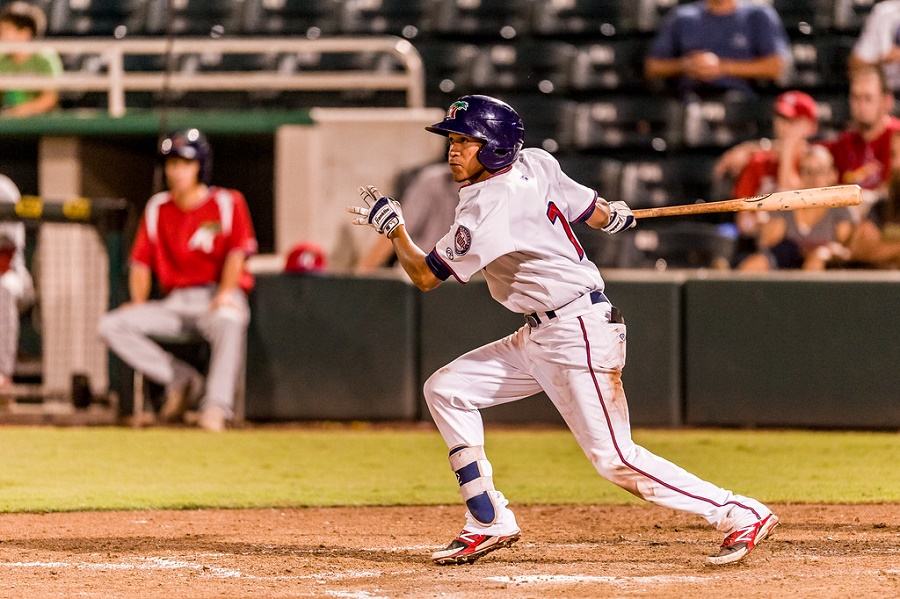 in the Midwest League in 2014, Vielma posted a .636 OPS (a wRC+ of 84) and so far in 2015 his OPS sits at .648 (wRC+ of 99). Certainly, this represents a modest improvement, but it is nothing to get excited about. However, taking a closer look at Vielma’s monthly splits, it becomes clear that he has made some significant in-season improvements as a hitter. The first thing that sticks out is how dreadful Vielma was in April and May—combined his OPS was .463—and how solid he has been since, posting an OPS of over .770 for three straight months. But overall, looking at five straight months of data like this has some flaws: for one, the sample sizes are relatively small; and two, it’s a little more difficult to pick up on trends' patterns. My solution to this is to create three, 3-month splits (April-June, May-July, June-August), similar to rolling periods used in the financial industry. Let’s take a look: As you can see here, Vielma has made some pretty tremendous strides. This is especially true when looking at his plate discipline: his BB% has increased over each of these splits and his K% has fallen, leading to a consistent improvement in his BB/K ratio. Furthermore, while Vielma only improved modestly in these three categories from the 1sfirst split to the second, he has seen a dramatic improvement from the second split to the third split. And while Vielma’s isolated power has improved less consistently, his OPS has also improved by leaps and bounds. Overall, Vielma’s numbers have improved—albeit rather modestly—from a year ago. Once again, he is walking more (6.1% to 6.3%) and striking out less (15.5% to 14.6%), which has certainly contributed to the modest increase in OPS (.636 to .649). And while this increase is small (and his power has decreased), it has been done in the context of a much difficult environment for hitters. Clearly, Vielma has made terrific in-season improvements as a hitter. Combined with his modest overall improvement from a year ago, this suggests that he should be ready to begin 2016 in AA, despite rather mediocre season-long numbers. Another important development for Vielma has been his base-stealing. As a player who has very limited power—and has shown no signs of developing any more—being able to create extra runs on the base paths will be necessary for Vielma to establish himself as a valuable offensive player. While I don’t have any statistics regarding Vielma’s ability to take an extra base after a hit, he has shown dramatic improvements as a base-stealer this year. In 2014, Vielma stole 10 bases on 16 attempts in 112 games. So far in 103 games this year, he has stolen 29 bases in 39 attempts. Not only has he stolen nearly 3 times as many bases as last season, Vielma has also greatly improved his success rate from a dreadful 62.5% (well below the 2014 Midwest League average of 68%) to a respectable 74% (well above the 2015 Florida State League average of 67%). With Nick Gordon on his heels and Jorge Polanco ahead of him (not to mention Brian Dozier), Engelb Vielma will have a hard time becoming a starter for the Twins. But as a player who is stellar defensively, emerging as a base-stealer, and improving as a hitter, he has firmly established himself as a legitimate prospect worth watching.
-
It’s time people start paying attention to Engelb Vielma. Vielma, who turned 21 a month ago, has been the starting shortstop for the Miracle this season. Always known as a top flight defensive prospect, the diminutive Vielma has done little to discourage that perception in his first 2 seasons of professional ball: in the Midwest League in 2014, Vielma posted a .636 OPS (a wRC+ of 84) and so far in 2015 his OPS sits at .648 (wRC+ of 99). Certainly, this represents a modest improvement, but it is nothing to get excited about. However, taking a closer look at Vielma’s monthly splits, it becomes clear that he has made some significant in-season improvements as a hitter. The first thing that sticks out is how dreadful Vielma was in April and May—combined his OPS was .463—and how solid he has been since, posting an OPS of over .770 for 3 straight months. But overall, looking at 5 straight months of data like this has some flaws: for one, the sample sizes are relatively small; and two, it’s a little more difficult to pick up on trends patterns. My solution to this is to create 3, 3-month splits (April-June, May-July, June-August), similar to rolling periods used in the financial industry. Let’s take a look: As you can see here, Vielma has made some pretty tremendous strides. This is especially true when looking at his plate discipline: his BB% has increased over each of these splits and his K% has fallen, leading to a consistent improvement in his BB/K ratio. Furthermore, while Vielma only improved modestly in these 3 categories from the 1st split to the 2nd split, he has seen a dramatic improvement from the 2nd split to the 3rd split. And while Vielma’s isolated power has improved less consistently, his OPS has also improved by leaps and bounds. Overall, Vielma’s numbers have improved—albeit rather modestly—from a year ago. Once again, he is walking more (6.1% to 6.3%) and striking out less (15.5% to 14.6%), which has certainly contributed to the modest increase in OPS (.636 to .649). And while this increase is small (and his power has decreased), it has been done in the context of a much difficult environment for hitters. Clearly, Vielma has made terrific in-season improvements as a hitter. Combined with his modest overall improvement from a year ago, this suggests that he should be ready to begin 2016 in AA, despite rather mediocre season-long number. Another important development for Vielma has been his basestealing. As a player who has very limited power—and has shown no signs of developing any more—being able to create extra runs on the basepaths will be necessary for Vielma to establish himself as a valuable offensive player. While I don’t have any statistics regarding Vielma’s ability to take an extra base after a hit, he has shown dramatic improvements as a basestealer this year. In 2014, Vielma stole 10 bases on 16 attempts in 112 games. So far in 103 games this year, he has stolen 29 bases in 39 attempts. Not only has he stolen nearly 3 times as many bases as last season, Vielma has also greatly improved his success rate from a dreadful 62.5% (well below the 2014 Midwest League average of 68%) to a respectable 74% (well above the 2015 Florida State League average of 67%). With Nick Gordon on his heels and Jorge Polanco ahead of him (not to mention Brian Dozier), Engelb Vielma will have a hard time becoming a starter for the Twins. But as a player who is stellar defensively, emerging as a basestealer, and improving as a hitter, he has firmly established himself as a legitimate prospect worth watching.
-
Palacios displayed a lot of potential last season in the DSL: 15.6% BB, 16.1% K (.95 BB/K), .802 OPS, and 14/17 on stolen bases in 49 games. This makes me think his performance this year is no fluke. His plate discipline translated to the GCL this year--8.5% BB, 10.4% K (.82 BB/K)--and he has displayed much improved power: after 17 XBH last season in 49 games, he has already posted 17 XBH this year in just 34 games. Palacios and Blankenhorn should be two worth watching the rest of the way in Elizabethton.
-
Max Kepler is ready for AAA. He is currently dominating AA pitching, to the tune of a .332/.413/.517 triple-slash line. How good is that? If he had enough AB's to qualify, his OPS (.930 OPS) would be the only in the Eastern League north of .900. Despite an unsustainably high BABIP (.381), Kepler's spectacular plate-discipline suggest that he should be able to maintain this run of success: he has drawn a walk in 11.9% of plate appearances and struck out in just 13.2%, good for a BB/K ratio of .90. In fact, since 6/1, Kepler's BB/K ratio is an even 1.0 All of this screams that Kepler is ready for AAA pitching. Some might argue by claiming that, with just 73 games at AA, he simply needs more experience. However, don't forget that Kepler has now spent 2 offseasons in the Arizona Fall League, logging a combined 36 games. Nor did Kepler dominate in the Florida State League a season ago. While that is true, he did display good plate discipline (8.4% BB: 15.2% K) and his lack of power and low BABIP could be attributed--at least partially--to nagging injuries. A month in AAA now could help put Kepler on track for an early-mid season call-up next year. I've always felt that Kepler has been underrated: the great plate discipline he has shown throughout his career, especially considering his lack of baseball experience relative to his appears, has made me extremely confident in his hit tool. Regardless of whether or not Kepler spends the rest of the season in AA, he should shoot up prospect rankings this offseason. He has appeared on Fangraph.com's weekly "Fringe 5" prospect articles 4 times since mid-June. Take a look: http://www.fangraphs.com/statss.aspx?playerid=sa549507&position=OF.
-
The Twins Most Overlooked Cornerstone
Boone replied to Ted Schwerzler 's topic in Twins Daily Front Page News
Trevor Plouffe has certainly become one of the better--and most underrated--3rd basemen in the league. Great to see that the Twins' patience paid off. However, despite Plouffe's current importance, I have to wonder how he fits into our long-term plans: hopefully Sano will be ready to take over at 3rd base next season, with Arcia or Vargas replacing him at DH. If the above scenario plays out, then Plouffe would have to move to outfield--where the Twins have tons of young talent--or to 1st base, where we have an unmovable asset in Joe Mauer. While Plouffe has been a great Twin for several years, the youth movement could make him expendable as early as this offseason. Therefore, we must ask ourselves this question: should we shop Trevor Plouffe before the deadline? Trading him for longterm assets would certainly rankle many fans--including maybe myself--but could be the smart decision. Or the Twins could work themselves in on a 3 team trade, receiving a shortstop or catcher in return. -
At this point, it seems clear that option 2 is the solution. In my opinion, there are two steps: 1. Trade for one, quality arm to be a set-up man. Trevor May has certainly done enough to earn a spot in the Twins rotation for next year, if not the stretch run. With 6 legitimate starters, the Twins should work themselves into a 3-team trade (giving up either Pelfrey or Milone) to acquire a quality bullpen arm. Hopefully, this could give them a legitimate set-up man to shore up the 8th inning. 2. Bring up an arm, or two, from AAA. O'Rourke has shown--thus far--that this is a legitimate option. Tonkin has struggled in the majors, but he has a 1.52 ERA and a 34:4 K:BB ratio in 23.2 IP at Rochester this year. Those are spectacular numbers. I think with an extended run at the ML level he would be fine. Achter and Oliveros are also intriguing numbers. The Twins could also shut-down Duffey or Berrios as starters early to be 1-inning arms for the stretch-run. This course of action should be able to add 2 quality arms to the bullpen. Combined with Perkins and 2 great LOOGY options, this would be a solid bullpen for the Twins during the stretch-run.
-
Stewart is still displaying good control (7.5% BB rate), although it is a slight regression from last year (6.7% BB rate). He is also a ground ball machine, as displayed by his 2.08 GO/FO ratio, even better than last year's 1.8 GO/FO. However, Stewart is really struggling to strike hitters out: he has struck out just 10.8% of opposing hitters, far worse than his mediocre rate 17.2% last year. To put this in perspective, his strikeout rate is the 3rd worst in the Florida State League among qualified starters. For an elite prospect who was billed as having power stuff coming out of high school, this is a little worrisome. Was his stuff never as good as advertised? Is there a lingering injury that we don't know about? How concerned should we be about his future?
-
Where do Jay and Cody fit in team rankings?
Boone replied to gunnarthor's topic in Twins Minor League Talk
I have a hard time putting Cody over Rogers and Duffey. Yes, he probably has more upside. But their track record in AA (and to a lesser extent, AAA) puts them above Cody, in my mind. At least for now. -
This is the first part in what I envision being a three part examination of the Twins bullpen. In Part I, I will look at the 2015 Twins bullpen as a whole, and compare it to the other bullpens in MLB. In Parts II and III, I will look at the performance of the individual members of the Twins bullpen and then at several players in the upper levels of the Twins minor league system who could be viable replacement options. Image courtesy of Credit: Charles LeClaire-USA TODAY Sports This is the first part in what I envision being a three part examination of the Twins bullpen. In Part I, I will look at the 2015 Twins bullpen as a whole, and compare it to the other bullpens in MLB. In Parts II and III, I will look at the performance of the individual members of the Twins bullpen and then at several players in the upper levels of the Twins minor league system who could be viable replacement options. There are two main features of the Twins’ bullpen so far in 2015: it’s bad, and it’s old. Let’s start off with the bad. Here is a rundown of how the pen is performing in a number of key categories: ERA: 4.01 (21st in MLB) FIP: 4.19 (25th in MLB) WAR: .4 (23) These numbers make it pretty clear that the Twins bullpen is in the bottom third of the league. Why has the bullpen performed so poorly? The answer is a combination of a lack of strikeouts and an inability to generate ground balls, which is leading to a high number of home runs. Look for yourself: K%: 15.6% (30) BB%: 6.6% (2) K/BB: 2.34 (22) GB/FB: 1.09 (27) HR/9: 1.0 (22) Poor performance in these categories—the three “true outcomes”—makes it pretty difficult to find sustainable success. Therefore, unless the Twins make a dramatic improvement in these peripheral numbers, don’t expect their overall performance to improve. Now, on to the age issue. In case you weren’t aware, the Twins have a pretty old bullpen. The average age of the members of the Twins bullpen, weighted for innings pitched1, is 30.0 years old. I don’t have numbers for the average age of other bullpens in MLB, but I would be willing to bet that the Twins have one of the oldest bullpens in all of baseball. To summarize: in case you hadn’t noticed, the Twins bullpen consists of (1) old pitchers who (2) don’t strikeout many batters and (3) fail to generate many ground balls. The result is one of the worst bullpens in all of baseball. Yes, we have a stud closer, but outside of Perkins, it wouldn’t surprise me if the Twins have the worst bullpen in all of baseball. So why do we care? Obviously, a good bullpen is an important part of a team’s success. But beyond that, having an old bullpen means it’s less likely that our relief pitchers will make significant improvements in their individual performances over the course of the rest of the season. Furthermore, if the Twins do fall out of contention, it would be beneficial, long-term, for the club to give some younger players some experience at the big league level. 1: The sum, for all relievers, of each pitcher's age multiplied by the percentage of the bullpen's IP that they have accounted for. View full article
-
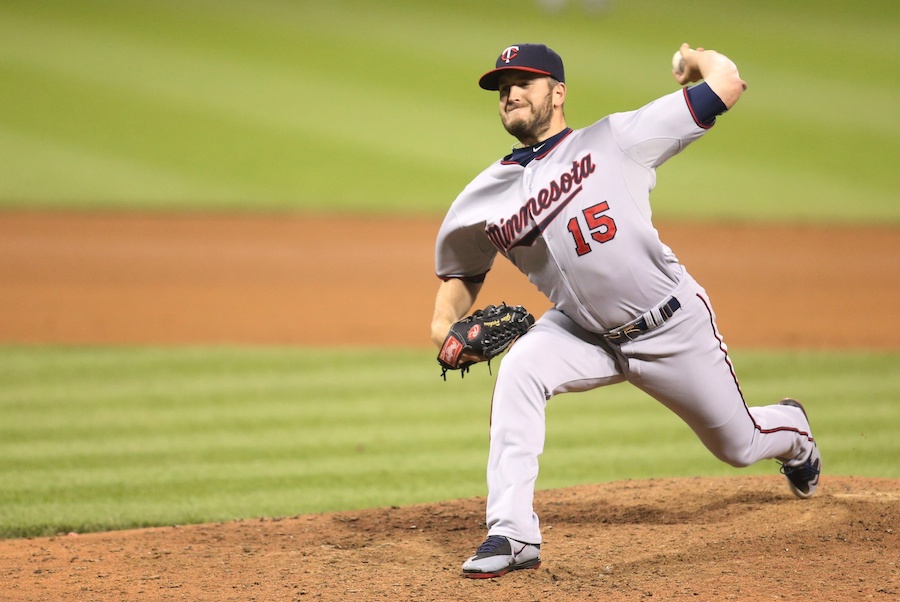 There are two main features of the Twins’ bullpen so far in 2015: it’s bad, and it’s old. Let’s start off with the bad. Here is a rundown of how the pen is performing in a number of key categories: ERA: 4.01 (21st in MLB) FIP: 4.19 (25th in MLB) WAR: .4 (23) These numbers make it pretty clear that the Twins bullpen is in the bottom third of the league. Why has the bullpen performed so poorly? The answer is a combination of a lack of strikeouts and an inability to generate ground balls, which is leading to a high number of home runs. Look for yourself: K%: 15.6% (30) BB%: 6.6% (2) K/BB: 2.34 (22) GB/FB: 1.09 (27) HR/9: 1.0 (22) Poor performance in these categories—the three “true outcomes”—makes it pretty difficult to find sustainable success. Therefore, unless the Twins make a dramatic improvement in these peripheral numbers, don’t expect their overall performance to improve. Now, on to the age issue. In case you weren’t aware, the Twins have a pretty old bullpen. The average age of the members of the Twins bullpen, weighted for innings pitched1, is 30.0 years old. I don’t have numbers for the average age of other bullpens in MLB, but I would be willing to bet that the Twins have one of the oldest bullpens in all of baseball. To summarize: in case you hadn’t noticed, the Twins bullpen consists of (1) old pitchers who (2) don’t strikeout many batters and (3) fail to generate many ground balls. The result is one of the worst bullpens in all of baseball. Yes, we have a stud closer, but outside of Perkins, it wouldn’t surprise me if the Twins have the worst bullpen in all of baseball. So why do we care? Obviously, a good bullpen is an important part of a team’s success. But beyond that, having an old bullpen means it’s less likely that our relief pitchers will make significant improvements in their individual performances over the course of the rest of the season. Furthermore, if the Twins do fall out of contention, it would be beneficial, long-term, for the club to give some younger players some experience at the big league level. 1: The sum, for all relievers, of each pitcher's age multiplied by the percentage of the bullpen's IP that they have accounted for.
-
Introduction Over the past few weeks there have been a number of articles focusing on the Twins early season success, and asking one, simple question: can the Twins keep on winning? These articles have focused on two main points: the Twins potent offense (they rank 9th in MLB) despite a mediocre OPS (18th in MLB) and their stellar record (4th best win percentage in MLB) despite a much less impressive run differential (8th best in MLB). Their conclusion has tended to be that the Twins performance is unsustainable. Other articles have told you the Twins offense has been lucky because we are scoring more runs than we should have based on our current OPS. But this good luck good be balanced out by an unluckily low OPS. So my goal is to determine if our OPS is artificially high or low. If it is artificially low, then we shouldn’t have to worry too much about our inflated run-scoring ability: while we might start scoring fewer runs per point of OPS, our OPS should improve, meaning our run production shouldn’t drop too much. But if our OPS is artificially high…Well that would be bad news. Analysis My process will be as follows: OPS = OBP + SLG. OBP is composed of getting hits (AVG) and drawing walks (BB%). SLG is a result of total bases, which is determined by how many hits you get (AVG) and how many extra bases you get (ISO). So in short, we’ve now broken OPS down into three component parts: AVG, BB%, and ISO. One further step: your batting average is determined by how many balls you put in play (K%) and how frequently those balls in play drop for hits (BABIP and, to a lesser extent, HR%). So we now have broken OPS down into four parts: K%, BABIP, BB%, and ISO. Let’s see how the Twins perform in these four statistics, and we’ll have a better idea of what our OPS should be, given how we’ve played so far. K%: 21.0% (22nd in MLB) BB%: 6.7% (25th) Let’s combine these two statistics together into BB/K ratio: BB/K: .32 (25). BABIP: .309 (8) ISO: .132 (24) OPS: .700 (18) As you can see, the Twins strike out at one of the highest rates in baseball. They also draw walks at one of the lowest rates in baseball. The result, should be one of the worst OBP in baseball. Turns out, it is: the Twins OBP of .311 ranks 21st in MLB. This is in spite of one of the highest BABIP in all of baseball. The Twins also lack power, evidenced by their ISO of .132 (24th in baseball). As a result, our low slugging percentage (.389, 18th in baseball), shouldn’t come as a surprise. When you put together an inability to get on base with a lack of power, you should get a low OPS. Which is exactly what the Twins have: their OPS of .700 ranks 18th in baseball. In case you’re wondering, this is their triple-slash line, and how it ranks in baseball: .257(11)/.311(21)/.389(18). So our OPS doesn’t seem to be unnaturally low. After all, the Twins rank 22nd or lower in 3 of the 4 components I identified. The only area where the Twins are performing well is in terms of BABIP, which is why our team batting average ranks 11th in baseball: the Twins currently sport a BABIP of .309, the 8th highest in baseball. BABIP is somewhat of an infamous statistic. It has a wide variance that leads to dramatic differences in the AVG (and thus OBP, SLG, and OPS) for a given player or team). But let’s take a closer look at the Twins batted ball profile and determine if our BABIP is artificially low (which would be good) or artificially high (which would be bad). Here is a rundown of how the Twins perform in a number of batted ball statistics: LD%: 21.7% (12th highest) GB/FB: 1.36 (14th highest) Hard hit: 25.6% (27th highest) IFFB%: 11.3% (6th highest) Because line drives lead to more hits than grounders and fly balls, the higher your LD% the higher the expected BABIP should be. Same goes for GB/FB ratio (ground balls yield a higher BABIP than fly balls) and hard hit percentage. Conversely, infield fly balls are automatic outs, so a low IFFB% should yield a higher BABIP. Look at the rankings: the Twins fail to rank in the top 8 in any category where more is better nor in the bottom 8 of IFFB% (where less is better). In fact, the Twins don’t rank in the top/bottom 11 of any of these categories. This isn’t the most scientific approach, but to me this indicates that the Twins should not, at this point, have the 8th highest BABIP in MLB. High K-rate, low BB-rate, little power, and an unnaturally high BABIP means our play as hitters deserves a low OPS. Conclusion The Twins don’t have good underlying statistics as hitters: the Twins rank 22nd or lower in 3 of the 4 components I identified. The only area where we are performing well is BABIP which is the 8th highest in baseball. Unfortunately, this mark seems to be unnaturally high. As a result, I feel confident in saying that the Twins current OPS is not a result of bad luck. In fact, it might even be a result of good luck. Quick caveat: all I did was look and see if, based on underlying numbers, what our OPS should be. What I didn’t look at was if those underlying numbers are artificially good/bad: Are our players striking out more than in past years? Are they hitting fewer line drives? I don’t know. So I don’t know if our performance in these underlying metrics will get better as the season goes on. Any number of articles can tell you that the Twins offense has scored more runs than they should have so far (based on OPS). What I’m telling you is that our OPS should be low (maybe even lower). This is further confirmation that our offense has scored more runs than it should have so far. In other words, if our ability to score runs at a high rate given our OPS slows down (and we should expect it too), we should not expect our OPS to increase to balance this out…Unless we start performing better across these underlying statistics. Will we? I don’t know. But let’s hope so.
-
Don't know why everyone thinks Vargas, Rosario, and Polanco are MLB-ready offensively. They're not: Vargas A+ (2013): 20.2% K, 9.6% BB, .48 BB/K, .813 OPS (125 games) AA (2014): 16.8% K, 10.6% BB, .63 BB/K, .832 OPS (97 games) MLB (2014-15): 26.9% K, 5.5% BB, .20 BB/K, .734 OPS (82 games) AAA (2015): 24.2% K, 9.1% BB, .38 BB/K, 1.158 OPS (8 games) Notice how much worse his plate discipline numbers were in the majors compared to his last two seasons in the minors, especially his strikeout-rate. Clearly, he wasn't MLB ready. Also, notice how his plate discipline numbers are worse in AAA than they were in his last two seasons in the minors. This is evidence that he needs a little more time in Rochester. Big point: we might think of Vargas as a "home run or strikeout" kind of hitter because that's what he has seemed like for the Twins, but he was much more of a pure hitter in A+ and AA. If we want that kind of player--and we do--he could use more time in the minors. Yes, I'm aware of Vargas's silly OPS so far in AAA. But in just an 8 game sample, that number is incredibly volatile--much more so than his plate discipline numbers. Vargas's numbers in AAA are being boosted by a completely unsustainable .421 BABIP. Rosario A (2012): 16.1% K, 7.2% BB, .45 BB/K, .835 OPS (95 games) A+ (2013): 12.6% K, 7.4% BB, .59 BB/K, .903 OPS (52 games) AA (2013-2014): 20.8% K, 5.9% BB, .28 BB/K, .706 OPS (149 games) AAA (2015): 17.0% K, 5.0% BB, .29 BB/K, .659 OPS (23 games) MLB (2015): 30.2% K, 1.9% BB, .06 BB/K, .708 OPS (16 games) Rosario was a stud hitter in A and A+, but since then his strikeout rate has increased and his walk rate has decreased. While both of these were marginal changes, together they've led to a pretty significant drop in his BB/K ratio in both AA and AAA; this is a large reason why his OPS numbers have been so poor the last two seasons. This development has been taken to an extreme so far with the Twins, as Rosario is striking out almost twice as frequently as in his minor league career and almost never drawing a walk. For a guy who really struggled in AA a year ago, and was not great (by his standards) in 23 games in AAA, it seems clear to me that Rosario could use some time in AAA. Also, just for the sake of comparison, Aaron HIcks has struck out in 29.2% of his at bats so far in his ML career. Rosario has struck out in 32% of his at bats. Yes, it's early. But still not what you want to see. Polanco A (2013): 11.3% K, 8.0% BB, .71 BB/K, .813 OPS (115 games) A+ (2014): 13.9% K, 10.6% BB, .77 BB/K, .780 OPS (94 games) AA (2014-15): 16.3% K, 5.5% BB, .34 BB/K, .730 OPS (79 games) Once again, Polanco's plate discipline numbers are significantly worse in AA than they were in A and A+. While his strikeout rate is still quite good--albeit higher than in A or A+--his walk rate is significantly worse. As a result, he's drawing fewer than half as many walks per strikeout. His OPS is struggling as a result. In short, it doesn't seem like Polanco has really mastered AA pitching quite yet. What makes us think that he's ready for MLB pitchers? One last thing: what do Aaron Hicks, Oswaldo Arcia, and Kennys Vargas all have in common? Answer: they all tore up AA pitching, skipped AAA, and then struggled in the majors to the point where they had to be demoted to AAA. To a lesser extent, this is happening to Eddie Rosario. Do we want to keep on having our top hitting prospects skip AAA?
- 77 replies
-
- 1
-
-
- left field
- shortstop
- (and 2 more)
-
Twins Draft Preview: Andrew Benintendi
Boone replied to Jeremy Nygaard's topic in Twins Daily Front Page News
Got to love his plate discipline: strikes out in 9% of his at bats as a freshman and a 6/5 BB/K ratio and strikes out in 14% of his at bats as a sophomore with a 4/3 BB/K ratio. Combine that with his speed, and it seems like he should have a very good chance of being a successful top of the order guy. The real question comes down to defense and power. If he can stick in CF, he has the potential to be a solid starter. But if his power plays (even just 20 HRs), he has star potential. -
This is the first part in one I envision being a three part examination of the Twins bullpen. In Part I, I will look at the 2015 Twins bullpen as a whole, and compare it to the other bullpens in MLB. In Parts II and III, I will look at the performance of the individual members of the Twins bullpen and then at several players in the upper levels of the Twins minor league system who could be viable replacement options. There are two main features of the Twins’ bullpen so far in 2015: it’s bad, and it’s old. Let’s start off with the bad. Here is a rundown of how our pen is performing in a number of key categories: ERA: 4.01 (21st in MLB) FIP: 4.19 (25th in MLB) WAR: .4 (23) These numbers make it pretty clear that our bullpen is in the bottom third of the league. Why has our bullpen performed so poorly? The answer, in my opinion, is a combination of a lack of strikeouts and an inability to generate ground balls, which is leading to a high number of home runs. Look for yourself: K%: 15.6% (30) BB%: 6.6% (2) K/BB: 2.34 (22) GB/FB: 1.09 (27) HR/9: 1.0 (22) Poor performance in these categories—the three “true outcomes”—makes it pretty difficult to find sustainable success. Therefore, unless the Twins make a dramatic improvement in these peripheral numbers, don’t expect their overall performance to improve. Now, onto the age. In case you weren’t aware, the Twins have a pretty old bullpen, too. The average age of the members of the Twins bullpen, weighted for innings pitched1, is 30.0 years old. I don’t have numbers for the average age of other bullpens in MLB, but I would be willing to bet that the Twins have one of the oldest bullpens in all of baseball. To summarize: in case you hadn’t noticed, the Twins bullpen consists of (1) old pitchers who (2) don’t strikeout many batters and (3) fail to generate many ground balls. The result is one of the worst bullpens in all of baseball. Yes, we have a stud closer, but outside of Perkins, it wouldn’t surprise me if the Twins have the worst bullpen in all of baseball. So why do we care? Obviously, a good bullpen is an important part of a team’s success. But beyond that, having an old bullpen means it’s less likely that our relief pitchers will make significant improvements in their individual performance over the course of the rest of the season. Furthermore, if the Twins do fall out of contention, it would be beneficial, long-term, for the club to give some younger players some experience at the big league level. 1: The sum of (each pitcher's age multiplied by the percentage of the bullpen's IP that they have accounted for)
-
Jorge Polanco has been a favorite prospect of mine for several years and at this point he has certainly established himself as one of the best prospects in the Twins system. His discipline at the plate and positional flexibility make him seem like a relatively safe bet as far as prospects go. However, Polanco’s lack of power and speed have prevented him from being viewed as a dynamic prospect; you won’t see him on any top 100 prospect lists. But after 3 steals in four games, is it time to reevaluate Polanco’s base stealing ability? Here is a quick look at Polanco’s performance in terms of stealing bases the last several years: Year SB SB% SB/162G 2012 6 67% 19 51 2013 4 50% 6 115 2014 17 61% 21 131 2015 3 100% 162 4 As you can see, Polanco actually stole bases at a solid rate in 2012 and 2014; the outlier in this data set is 2013, when he stole just 4 bases in 115 games. In other words, Polanco might be a better base then commonly believed. However, Polanco’s biggest problem in all of these seasons hasn’t been his raw number of stole bases, but rather his success rate: he has never succeeded in more than 2/3 of his attempts, and even that occurred in a short-season league. But if we look a little bit deeper, we can identify a little bit more of a trend. Through July of last season, Polanco had stolen 11 bases in 18 attempts. But in August and September, he stole 6 bases in 8 attempts. If we combine 2012, 2013, and the first 4 months of 2014 into one group, and the final 2 months of 2014 with the start of this season into a second group, this is what we see: SB SB% SB/162G 21 57% 13 9 82% 44 This shows a much different story: not only is Polanco stealing bases lots of bases but he is also succeeding at a very good rate; in short, he looks like a very legitimate base-stealer. Admittedly, there are a few problems with this argument. The first is that 34 games is a small sample size. The second is that I “cherry-picked” the sample: if I had included one more or one less month in the second group, Polanco’s performance would appear quite different. However, there are a few indicators that make me confident that Polanco’s newfound basestealing ability is here to stay. The first is that this trend has been duplicated in his winter league play. Polanco has played for Leones del Escogido of the Dominican Winter League each of the last 2 winters, and he performed as a basestealer the winter following the 2014 season than the winter preceding it: 3-3 in 23 games (21 per 162, 100% success rate) vs. 4-6 in 49 games (13 per 162, 67% success rate). In other words, Polanco’s increased success at the end of 2014 carried over through the winter and now into the spring. Secondly, , even early on in 2014, Polanco was attempting to steal bases at a career high rate: he attempted 29 steals per 162 games in 2012, 11 in 2013, and 35 in 2014. So it seems possible that the there was a concerted effort in 2014 to have Polanco run more, which might reflect optimism on behalf of the Twins organization. Perhaps even more important, is that this trend manifested itself soon after arriving in AA: Polanco stole 7 bases in 10 attempts in 37 total games for the Rock Cats last season. Maybe he picked up a key bit of coaching advice that played a key role in his success. We’ll have to wait and see if Polanco’s improved basestealing is here to stay. I, for one, think it is. If Polanco can contribute 30 steals at a 75% success rate—which I think is fairly manageable—he will be a much more dynamic prospect and could shoot up rankings next winter. The next question, of course, is how valuable these steals are. But that’s a question for another day.
