



mikelink45
-
Posts
10,496 -
Joined
-
Last visited
-
Days Won
27
Content Type
Profiles
News
Minnesota Twins Videos
2026 Minnesota Twins Top Prospects Ranking
2022 Minnesota Twins Draft Picks
Minnesota Twins Free Agent & Trade Rumors, Notes, & Tidbits
Guides & Resources
2023 Minnesota Twins Draft Picks
The Minnesota Twins Players Project
2024 Minnesota Twins Draft Picks
2025 Minnesota Twins Draft Pick Tracker
2026 Minnesota Twins Draft Tracker: Picks & Bonuses
Forums
Blogs
Events
Store
Downloads
Gallery
Everything posted by mikelink45
-
Article: 1961: Welcome to the Big Leagues
mikelink45 replied to mikelink45's topic in Twins Daily Front Page News
I sure do. We had some big crowds and those ramps were almost disasters. At an angle that really moved people around - a fall and there was a pile up. But the thing that stood out to me was how the big erector set vibrated when the crowd started to stamp their feet in unison. I was nervous working third deck as a usher. -
Article: 1961: Welcome to the Big Leagues
mikelink45 replied to mikelink45's topic in Twins Daily Front Page News
As well loved as Harmon became, it is amazing how people dumped on him. Today if Sano had his K rate we would think he had great plate discipline. But just like people getting on Mauer for DPs, they did not like the DPs that Killebrew had. Yet no one ever got more ovations or louder ovations that Killebrew did. He was Minnesota Nice - here is a good article that catches his personality. https://pressprosmagazine.com/a-personal-story-about-harmon-killebrew/ -
Article: 1961: Welcome to the Big Leagues
mikelink45 replied to mikelink45's topic in Twins Daily Front Page News
I was born in WI, given the Packers as a birthright, loved them - we were starting and they were the best. I rooted for the Vikings and drove my dad nuts, but even today, I am still a Vikings/Packer fan. Of course I started as a Braves fan, but never got caught up with the Brewers. When Atlanta stole the Braves the Twins became my only team and when they beat the Atlanta Braves in 1991 I was ecstatic. I have never had a happier walk than I did leaving the Humphrey! -
Article: The Twins Almanac for February 4–10
mikelink45 replied to Matt Johnson's topic in Twins Daily Front Page News
I really enjoy these notes and stories. -
Adalberto Mejia: High Floor or More?
mikelink45 commented on Jamie Cameron's blog entry in Curveball Blog
It means that he should not stand in the way of our prospects. I want our two young starters to get a good opportunity. Santana, Berrios, Gibson should be as good as the 1987 Viola, Blyleven, Straker combination. If we can pull up the last two with our young arms and Berrios continues to improve we should match 1991 Morris, Tapani, Erickson, Anderson, West. With the bullpen support I think we are in better shape that has been projected. -
In 1961, Minnesota joined the ranks of Major League Baseball and the National Football League. It might be hard to believe today, but before that there were no Twins and Vikings in the state history, unless you buy the story of the Rune Stone in Alexandria and those Vikings might have tossed rocks, but not footballs. There has never been another year like this in Minnesota sports history and happily I can say I was there – both as a high school sophomore at Central High School in Minneapolis and as an usher in Met Stadium.I loved the Met, the big erector set in the distant community of Bloomington. This was the big leagues for both football and baseball (shortly after we added the soccer team – the Kicks) and it was in this rural suburb that we planted the seeds for this part of our community lore. Of course, they were not called the Bloomington Twins or the Bloomington Vikings. It might have been appropriate, but then Wold Chamberlain – our massive international airport (just joking) was also located nearby and no one thought to call it the Bloomington airport. Of course, we had a sports history before this. In 1960, the Minnesota Gophers were named the No. 1 college football team in the country – yup, Alabama did not get that one. Playing under Murray Warmath with players like Sandy Stevens at QB (he then played in Canadian Football League), we were at the top of big time college football. Then we went to the big game – the Rose Bowl, where we set the precedent for the soon to arrive Minnesota Vikings – but lost the biggest game of the year to Washington 17-7. In the year of the Vikings and Twins, the Gophers ranked sixth in the nation and corrected their previous loss by winning the Rose Bowl against UCLA 21-3. There was no NHL team in the cities (that still amazes me), but that did not mean that there were no sports memories to be had. When I asked a friend, John Helland, who retired from working at the state capitol about his impressions of that time he wrote: “Hey, Mike, here's what I remember: Gopher baseball was great, winning the NCAA championship in 1960 over Southern Cal. Jim Rantz, longtime Twin's farm club director, and Tom Moe, also a good football player and much later Athletic Director, were on that team. They also won four years later. Some Gopher hockey players, including Herb Brooks, almost made the U.S. hockey team (he was the last player cut). The Saints vs. Millers was a great rivalry then, but don't remember names of good players. Jim Beattie was starting his pro boxing career as an up and coming heavyweight. This is going back almost 60 years now, so just a kid. The 1960 U.S. Olympic team featured Minnesotan’s John Mayasich, Jack McCarten, the goalie, and Warroad's Christian brothers who later developed iconic hockey sticks.” We were excited about our sports legacy and we still had a professional team, the Minneapolis Lakers, in 1960. But Mikan retired – he was so good they changed the court, enlarging the lane so that he would not get every rebound. And we were champions – five times in six years with a roster of NBA Hall of Famers. In the 1958/59 season we drafted Elgin Baylor and the future looked bright. Sitting in the Minneapolis Armory where many games were played, there were no bad seats. Unlike the Timberwolves stadium where you need binoculars in the upper deck to watch seven-foot players, at the Armory the players towered over us and it was almost like being on the court. It was great, but attendance was not – how many can you get in the Armory? So in 1960, just as we were getting excited about our new teams, the Lakers were moved – to the West Coast, to Los Angeles, to a city that does not even know what a lake is! We would have been depressed, but the Twins were coming. There were minor league teams still playing – the Minneapolis Millers were in Nicollet Stadium, just six blocks from where I lived, until 1956 when they moved to Metropolitan Stadium (who came up with that name for a stadium in the middle of a field in Bloomington?) where they played until 1960. In St Paul, the Saints were the farm team of the Dodgers, who were about to move to the West Coast. Who knew then that the Giants would be enticed to move with them? But 1960 would be the last year of this franchise until Mike Veeck and others created the new Saints in independent ball who would play at the same stadium – Midway – that the original Saints used in their final season. In 1958, future Twins manager Gene Mauch was the skipper of the Millers – now a farm team for the Red Sox, having been associated with the Giants for years. Mauch led us to the championship and then we lost the Minor League World Series. We knew that major league baseball was coming, and Horace Stoneham of the Giants played us for country bumpkins, promising to move here and using the leverage to get to San Francisco. Our final year was pretty glorious – Carl Yastrzemski was here, as was future Twin Al Worthington. This left an opening for a team which we had no association with – the Washington Senators, and their owner/GM – Calvin Griffith. But who cared? This team, so famous for the saying: "Washington DC, first in war, first in peace, last in the American League," was coming. Time to learn who they were. From Senators to Twins – what a transition. Some bonus player named Harmon Killebrew showed up and so did some Latin players like Camilo Pascual and Pedro Ramos. The Pirates were the reigning champions – they were FAMILY – we were in baseball heaven. In the meantime, something else was brewing – the NFL was going to put a team in the state the same year and the same stadium. It was Viking time. And we would be playing outside like real Vikings. Norm Van Brocklin would be our coach, we would have a rookie QB named Frank Tarkington and no one expected him to do anything. As an expansion team, we were expected to be the tackling dummies for the rest of the league. The champions were from Philadelphia – a team called the Eagles, but we knew we would get even with them someday (we hope). April 11, 1961 the Twins played the very first major league game in Minnesota. There were 39,615 fans, a sellout, and I was an usher. We were so new to this that we still did not know who those players were, but they were ours, so we cheered. Metropolitan stadium with its three decks had never felt the feet of so many people and when they got their coordination together, they would stomp their feet and rock, or should I say – sway, the stadium. Unaccustomed to the rules of the major leagues I remember being booed by thousands of people when I would go to make sure someone was not hurt by a foul ball. They were sure I was there to take the ball back! We loved the fresh air, the breeze coming in from right field, the uniforms and excitement of the game, even if we had no idea who manager Cookie Lavagetto was. We had Billy Martin, a future manager at 2B, Harmon Killebrew, a future HOF player, at 1B, Zoilo Versalles at SS and Bob Allison in the OF. With Pascual and Ramos were Jack Kralick and Jim Kaat in the rotation. This was so heady we hardly noticed that one of our own – Roger Maris – was hitting the baseball out of the park more than anyone in history. Actually, we knew but it was not as important as the fact that we won 61 games! Of course, we also lost 100, but who cared? This was the majors and our guy Harmon hit 46 home runs. When the season was over, the Twins had drawn 1,256,723 fans, the third highest total in MLB and we were in seventh place, not last (10th). Now it was Viking time! The Senators were an established team that moved, but the Vikings were an expansion team and they were not supposed to win. After opening with an exhibition in Sioux Falls, SD the team came home to a rousing welcome. Like good Minnesotans, the fans were all on time, the parking lot was full and the ushers helped people find their seats quickly. It was an excited crowd, but everyone knew we would lose, that is, everyone but Fran Tarkington who had not read that script. He came off the bench to replace the wily old vet, George Shaw, and beat the mighty bears 37-13 on opening day! For a week we had a perfect record in the NFL. True, we had the Minneapolis Marines and Duluth had the Eskimos, but that ancient history hardly makes a dent in our professional football story. Even if the Eskimos had Ernie Nevers, the first superstar. We got a franchise in the American Football League, but never played a game. The fact that we got awarded this new team meant the NFL (which was not merged with the upstarts) decided to put a team in Minnesota if we gave up that first AFL franchise, which subsequently became the Oakland Raiders. The new owners included Ole Haugsrud, who had given up the original Duluth team to the league with a provision that he would be allowed ownership in any future NFL team. It took forty years. Playing outside, the Viking fans became the new version of the Packers – standing in the cold, breath frozen in the air, a unique sound of clapping gloves and a rabid excitement that would continue right up today’s softer indoor fans. The opening win shocked everyone, and the roar was similar to the playoff games of the future, but the shock wore off with seven straight losses and a final 3-11 record. Being in the stadium at the end of the season, no one minded that we were packed in tightly. It just made us warmer. Thermos’ went from coffee to slightly stronger beverages and the sounds of the stadium faithful echoed across the frozen prairies of Bloomington. An average of 34,586 people attended the games, many of them lopsided contests. Norm Van Brocklin, the ex-quarterback of the Philadelphia Eagles, was the grumpy head coach because the quiet man of the north – Bud Grant – would not cancel his contract with the Blue Bombers in the Canadian Football League. Eventually we would get him. I only ushered for one year, but that was enough to create a love for sports that continues today. Only baseball remains with as much passion, but that dates back to my childhood when the only vacation my parents would take was a trip to County Stadium in Milwaukee to watch the Milwaukee Braves in their championship seasons. My career would take me in many directions, including one-year writing for the short-lived Midwest Spectator, a Twin Cities sports publication, and finally into my career in the Outdoor/Environmental Education. Like many people, I was moved by the events that I witnessed when I was young. Even though I attended all the 1991 World Series games at home, nothing will be as lasting as that first night when the sun was setting, and the stadium lights came on, when the green of the stadium grass seemed to turn luminescent and the players uniforms sparkled in the light. There was the smell of the concessions, the sound of the bat and the collective anticipation that something good was going to happen – something good that would continue for the next 57 years and who knows how long into the future. Click here to view the article
-
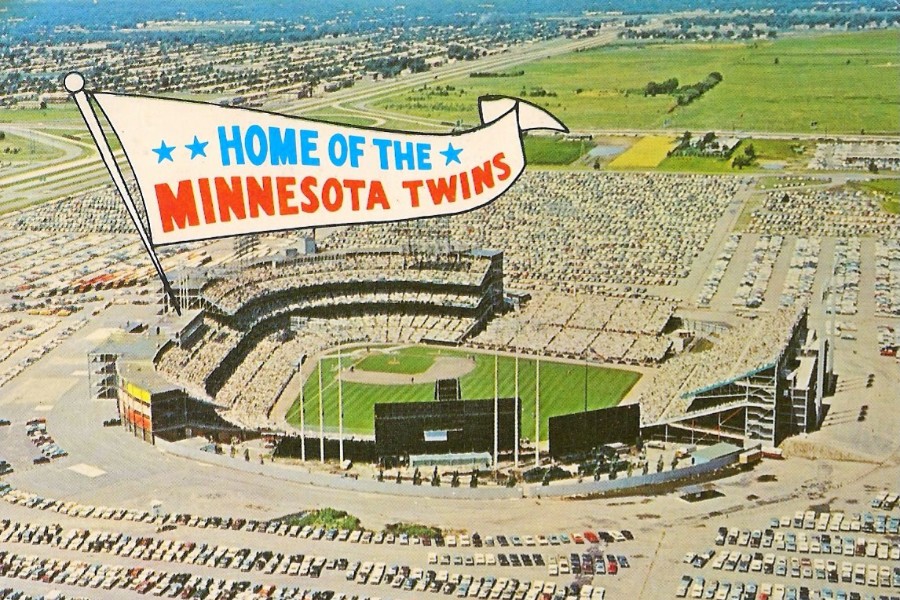 I loved the Met, the big erector set in the distant community of Bloomington. This was the big leagues for both football and baseball (shortly after we added the soccer team – the Kicks) and it was in this rural suburb that we planted the seeds for this part of our community lore. Of course, they were not called the Bloomington Twins or the Bloomington Vikings. It might have been appropriate, but then Wold Chamberlain – our massive international airport (just joking) was also located nearby and no one thought to call it the Bloomington airport. Of course, we had a sports history before this. In 1960, the Minnesota Gophers were named the No. 1 college football team in the country – yup, Alabama did not get that one. Playing under Murray Warmath with players like Sandy Stevens at QB (he then played in Canadian Football League), we were at the top of big time college football. Then we went to the big game – the Rose Bowl, where we set the precedent for the soon to arrive Minnesota Vikings – but lost the biggest game of the year to Washington 17-7. In the year of the Vikings and Twins, the Gophers ranked sixth in the nation and corrected their previous loss by winning the Rose Bowl against UCLA 21-3. There was no NHL team in the cities (that still amazes me), but that did not mean that there were no sports memories to be had. When I asked a friend, John Helland, who retired from working at the state capitol about his impressions of that time he wrote: “Hey, Mike, here's what I remember: Gopher baseball was great, winning the NCAA championship in 1960 over Southern Cal. Jim Rantz, longtime Twin's farm club director, and Tom Moe, also a good football player and much later Athletic Director, were on that team. They also won four years later. Some Gopher hockey players, including Herb Brooks, almost made the U.S. hockey team (he was the last player cut). The Saints vs. Millers was a great rivalry then, but don't remember names of good players. Jim Beattie was starting his pro boxing career as an up and coming heavyweight. This is going back almost 60 years now, so just a kid. The 1960 U.S. Olympic team featured Minnesotan’s John Mayasich, Jack McCarten, the goalie, and Warroad's Christian brothers who later developed iconic hockey sticks.” We were excited about our sports legacy and we still had a professional team, the Minneapolis Lakers, in 1960. But Mikan retired – he was so good they changed the court, enlarging the lane so that he would not get every rebound. And we were champions – five times in six years with a roster of NBA Hall of Famers. In the 1958/59 season we drafted Elgin Baylor and the future looked bright. Sitting in the Minneapolis Armory where many games were played, there were no bad seats. Unlike the Timberwolves stadium where you need binoculars in the upper deck to watch seven-foot players, at the Armory the players towered over us and it was almost like being on the court. It was great, but attendance was not – how many can you get in the Armory? So in 1960, just as we were getting excited about our new teams, the Lakers were moved – to the West Coast, to Los Angeles, to a city that does not even know what a lake is! We would have been depressed, but the Twins were coming. There were minor league teams still playing – the Minneapolis Millers were in Nicollet Stadium, just six blocks from where I lived, until 1956 when they moved to Metropolitan Stadium (who came up with that name for a stadium in the middle of a field in Bloomington?) where they played until 1960. In St Paul, the Saints were the farm team of the Dodgers, who were about to move to the West Coast. Who knew then that the Giants would be enticed to move with them? But 1960 would be the last year of this franchise until Mike Veeck and others created the new Saints in independent ball who would play at the same stadium – Midway – that the original Saints used in their final season. In 1958, future Twins manager Gene Mauch was the skipper of the Millers – now a farm team for the Red Sox, having been associated with the Giants for years. Mauch led us to the championship and then we lost the Minor League World Series. We knew that major league baseball was coming, and Horace Stoneham of the Giants played us for country bumpkins, promising to move here and using the leverage to get to San Francisco. Our final year was pretty glorious – Carl Yastrzemski was here, as was future Twin Al Worthington. This left an opening for a team which we had no association with – the Washington Senators, and their owner/GM – Calvin Griffith. But who cared? This team, so famous for the saying: "Washington DC, first in war, first in peace, last in the American League," was coming. Time to learn who they were. From Senators to Twins – what a transition. Some bonus player named Harmon Killebrew showed up and so did some Latin players like Camilo Pascual and Pedro Ramos. The Pirates were the reigning champions – they were FAMILY – we were in baseball heaven. In the meantime, something else was brewing – the NFL was going to put a team in the state the same year and the same stadium. It was Viking time. And we would be playing outside like real Vikings. Norm Van Brocklin would be our coach, we would have a rookie QB named Frank Tarkington and no one expected him to do anything. As an expansion team, we were expected to be the tackling dummies for the rest of the league. The champions were from Philadelphia – a team called the Eagles, but we knew we would get even with them someday (we hope). April 11, 1961 the Twins played the very first major league game in Minnesota. There were 39,615 fans, a sellout, and I was an usher. We were so new to this that we still did not know who those players were, but they were ours, so we cheered. Metropolitan stadium with its three decks had never felt the feet of so many people and when they got their coordination together, they would stomp their feet and rock, or should I say – sway, the stadium. Unaccustomed to the rules of the major leagues I remember being booed by thousands of people when I would go to make sure someone was not hurt by a foul ball. They were sure I was there to take the ball back! We loved the fresh air, the breeze coming in from right field, the uniforms and excitement of the game, even if we had no idea who manager Cookie Lavagetto was. We had Billy Martin, a future manager at 2B, Harmon Killebrew, a future HOF player, at 1B, Zoilo Versalles at SS and Bob Allison in the OF. With Pascual and Ramos were Jack Kralick and Jim Kaat in the rotation. This was so heady we hardly noticed that one of our own – Roger Maris – was hitting the baseball out of the park more than anyone in history. Actually, we knew but it was not as important as the fact that we won 61 games! Of course, we also lost 100, but who cared? This was the majors and our guy Harmon hit 46 home runs. When the season was over, the Twins had drawn 1,256,723 fans, the third highest total in MLB and we were in seventh place, not last (10th). Now it was Viking time! The Senators were an established team that moved, but the Vikings were an expansion team and they were not supposed to win. After opening with an exhibition in Sioux Falls, SD the team came home to a rousing welcome. Like good Minnesotans, the fans were all on time, the parking lot was full and the ushers helped people find their seats quickly. It was an excited crowd, but everyone knew we would lose, that is, everyone but Fran Tarkington who had not read that script. He came off the bench to replace the wily old vet, George Shaw, and beat the mighty bears 37-13 on opening day! For a week we had a perfect record in the NFL. True, we had the Minneapolis Marines and Duluth had the Eskimos, but that ancient history hardly makes a dent in our professional football story. Even if the Eskimos had Ernie Nevers, the first superstar. We got a franchise in the American Football League, but never played a game. The fact that we got awarded this new team meant the NFL (which was not merged with the upstarts) decided to put a team in Minnesota if we gave up that first AFL franchise, which subsequently became the Oakland Raiders. The new owners included Ole Haugsrud, who had given up the original Duluth team to the league with a provision that he would be allowed ownership in any future NFL team. It took forty years. Playing outside, the Viking fans became the new version of the Packers – standing in the cold, breath frozen in the air, a unique sound of clapping gloves and a rabid excitement that would continue right up today’s softer indoor fans. The opening win shocked everyone, and the roar was similar to the playoff games of the future, but the shock wore off with seven straight losses and a final 3-11 record. Being in the stadium at the end of the season, no one minded that we were packed in tightly. It just made us warmer. Thermos’ went from coffee to slightly stronger beverages and the sounds of the stadium faithful echoed across the frozen prairies of Bloomington. An average of 34,586 people attended the games, many of them lopsided contests. Norm Van Brocklin, the ex-quarterback of the Philadelphia Eagles, was the grumpy head coach because the quiet man of the north – Bud Grant – would not cancel his contract with the Blue Bombers in the Canadian Football League. Eventually we would get him. I only ushered for one year, but that was enough to create a love for sports that continues today. Only baseball remains with as much passion, but that dates back to my childhood when the only vacation my parents would take was a trip to County Stadium in Milwaukee to watch the Milwaukee Braves in their championship seasons. My career would take me in many directions, including one-year writing for the short-lived Midwest Spectator, a Twin Cities sports publication, and finally into my career in the Outdoor/Environmental Education. Like many people, I was moved by the events that I witnessed when I was young. Even though I attended all the 1991 World Series games at home, nothing will be as lasting as that first night when the sun was setting, and the stadium lights came on, when the green of the stadium grass seemed to turn luminescent and the players uniforms sparkled in the light. There was the smell of the concessions, the sound of the bat and the collective anticipation that something good was going to happen – something good that would continue for the next 57 years and who knows how long into the future.
 -
Article: A Central Of Historic Proportions
mikelink45 replied to Ted Schwerzler 's topic in Twins Daily Front Page News
I was reading Fangraphs today and thought this article was pertinent to this Article - https://www.fangraphs.com/blogs/here-are-the-complete-five-year-win-forecasts/ "The Royals are tied for seventh in baseball in wins over the past five years, but, over the next five years, they’re ranked 28th, between the Orioles and Tigers." -
Article: MLB Shift Driving Market Realities
mikelink45 replied to Ted Schwerzler 's topic in Twins Daily Front Page News
I would call this year a market correction like we are seeing on Wall Street right now. That does not mean that the egos of the owners will not overwhelm common sense in the end, but I agree with the comment that this is an overall weak group. Darvish is the ace, but as Schoenfield writes on ESPN - "Buyer beware: Darvish will be paid like an ace, but he’s more of a six-inning starter these days. His wOBA (weighted on-base average) allowed was .289 through pitch 50 but .334 from pitches 51 to 100, and he lasted fewer than six innings in 11 of his 32 starts." I do not want the owners to pocket all the profit, but I also do not want teams to throw money around and hurt their future. I think that Pujols and other long term contracts are starting to add up to make a point with owners. Next year has great value, but will have another economic factor - supply and demand! Will there be enough big spenders for all the values that are out there. It is an interesting time, but the fact that the players want big contracts and their agents want huge contracts is not enough to make these contracts worthwhile for the teams. We have had corrections before and I look forward to seeing it happen again. If I were able to spend the extra owner money I would prefer to add another player or two to the active roster. With the shift to mega-bullpens we could use another roster spot.- 83 replies
-
- 1
-

-
- major league baseball
- yu darvish
- (and 3 more)
-
Article: 2018 Twins Super (Bowl) Predictions
mikelink45 replied to Seth Stohs's topic in Twins Daily Front Page News
In 1960, the year before the Twins came to town Philadelphia (10-2) won the championship in a wonderful game with the Green Bay Packers (8-4). The QB for the Philadelphia team was HOF Norm Van Brocklin, who in 1961 would be the first coach of the brand new Minnesota Vikings. The Eagles won 17 - 13 (it would exciting to see that score repeated). It was a great game with Bart Starr, Hornung, Taylor, Nitschke and other future HOF players on the Packers and the last two way player - Chuck Bednarik joining Norm on the Eagles. In the Vikings first year - 1961 - the Packers began an amazing streak winning five straight NFL championships (the Super bowl started with the last two of those wins). The comparison might be between Lombardi and Belichek - two of the greatest coaches of all time. Brady and Starr - both HOF quarterbacks. It was the beginning of a dynasty for the Packers, maybe this will be the end of a dynasty for the Patriots, but I would not put any money on it. Just like the Packers and Lombardi's famous adage that they know what's coming, its up to them to stop it (the famous Hornung and Taylor sweep) so it is with the Pats - they have a psychological edge that plays with the opponents minds. I just hope its a good game.- 16 replies
-
- 1
-
-
- denard span
- latroy hawkins
- (and 3 more)
-
I only like the development of our young pitchers as a option. I would sign Darvish to 3 years, but he would not take it. I would offer Cobb and/or Lynn 2 years. Vargas was not really good before last year and ended up badly. I love the one year Arrieta - is it just wishful thinking? Cahill and Tillman are not options in my mind. They do not improve the rotation. And Jaimie Garcia???? What does he bring? He is a filler, not a rotation guy. I would want Gibson more than Garcia and Mejia should build on what he did last year. So lets hope Gonsalves, Romero and some surprise pitcher pushes there way into the rotation. I think we will be okay.
-
Article: A Central Of Historic Proportions
mikelink45 replied to Ted Schwerzler 's topic in Twins Daily Front Page News
Good speculation, but too early. I think we can safely put Detroit in the doldrums, after all they hired a manager who specializes in big loss teams, but Chicago could surprise and maybe KC will do something yet. 130 FA unsigned, spring training ahead, rookies can still surprise, injuries can upset plans, and trades can reset teams. I agree that we look really good right now and I do think that Cleveland is substantially injured by the events so far, but, as fun as it is, I cannot project anything yet. -
Article: Top 15 Minnesota Twins Players
mikelink45 replied to Seth Stohs's topic in Twins Daily Front Page News
Both men played 12 years with the Twins/Senators, but I am fine with this choice - I just find that Goslin tends to be underrated even if he is in the HOF. Most people only know the HOF choices that played in their lifetime and maybe for just a few years after getting voted in. That is why I say that Clemens and Bonds have gotten more publicity for not being in - just like Rose and Shoeless Joe -
Article: Top 15 Minnesota Twins Players
mikelink45 replied to Seth Stohs's topic in Twins Daily Front Page News
You missed a big one - Goose Goslin is underestimated and mostly unknown, but he deserves to be on this list (66.1 WAR) Thanks for Camilo Pascual!- 30 replies
-
- 1
-
-
- harmon killebrew
- rod carew
- (and 3 more)
-
Article: Top 15 Minnesota Twins Players
mikelink45 replied to Seth Stohs's topic in Twins Daily Front Page News
I would argue for Perry too. Knoblauch and Nathan had only 7 years with the Twins - only one more than Camilo and for that transition time I have to take into consideration the Senators.- 30 replies
-
- 1
-
-
- harmon killebrew
- rod carew
- (and 3 more)
-
Article: Top 15 Minnesota Twins Players
mikelink45 replied to Seth Stohs's topic in Twins Daily Front Page News
Thanks Seth - I enjoyed this. It is sometimes hard to rank players across history. Most are forgotten. Somehow I feel like we need a list of the most obscure or forgotten. For example I have thought about Bernie Allen - not sure why - who is seldom mentioned in Twins history, but he was our starting second baseman for 5 years starting in 1962 after being a Quarterback at Purdue or Rich Reese who played for us for ten years and tied for the lead in pinch hits - 13 in 1967 and still holds the record with three grand slams. Or Rich Rollins who played 3B for us for 8 years starting in 1961. In fact Don Mincher our 1B slugger from 1961 - 1966 accumulated 23 WAR and in 2000 became part of the New Orleans Saints front office. Of course there are more who are obscure than this, but it will take more research to bring them back to my old memory. My argument with your list is that you left off our first ace - Camilo Pascual. I watched him pitch. He had a curveball that makes Tyler Duffey's look flat and he also had a fastball that could put players away. Ted Williams said it was the most devasting pitch in baseball. In 1962 Pascual went 20-11 and led the league in complete games, shutouts and strikeouts to help notch his first 20-win season. 41.3 WAR, 174 wins for mostly last place teams in Washington and then Minnesota. Over his career, he compiled 174 wins, 2,167 strikeouts, and a 3.63 earned run average. The following is a wiki quote - "The period from 1959 to 1964 would see Pascual's peak years. He would win at least 12 games every season while leading the league in complete games, shutouts, and strikeouts three times each and racking up all five of his All-Star games appearances. In 1962 Pascual went 20-11 and led the league in complete games, shutouts and strikeouts to help notch his first 20-win season. In 1963 he had arguably his best season with a 21-9 win lost record, a 2.46 ERA, leading the league in complete games and strikeouts. 1965 would see the Twins/Washington franchise return to the World Series for the first time since Washington lost the 1933 series to the New York Giants. However, after starting the season 8–2, injuries limited Pascual to nine relatively ineffective second-half starts and he lost his World Series matchup with Claude Osteen in Game 3. Pascual would continue to have arm problems in 1966 and would pitch only 103 innings in 21 games, both career lows." Camilo (nickname the little potato by some) 1885 K to 909 walks in his MN years. He was a career .205 hitter with some years in the 250 range and a grand slam too. I put him in the top 5, I also put Oliva at #3. We would all create different lists - I am just glad you starting me thinking.- 30 replies
-
- 2
-
-
- harmon killebrew
- rod carew
- (and 3 more)
-
Article: Top Ten Twins Players Under 25 (1-5)
mikelink45 replied to Cody Christie's topic in Twins Daily Front Page News
I posted on my blog - he needs to have a Rickey Henderson approach. I am serious, speed, defense and some power. He needs to focus his inner Rickey and he is HOF -
It's important to have one contrarian on the site
- 54 replies
-
- 2
-
-
- trevor hildenberger
- alan busenitz
- (and 3 more)
-
I expect that I will be taking an unpopular position - again - but I think that baseball has allowed the bullpen to own the game and I do not like it. I like the old days when starting pitchers when as long as they had to and relief pitchers were not pampered with ninth inning only appearances. My choice is to have the team designate 3 relief pitchers per game. Use them as they want. But make them pitch. Being old I am not as much of a Loogy, Roogy or what ever the hell else there is. My love of baseball was not based on trips to the mound, or one pitch relief appearances. I liked complete games. I love Warren Spahn, Lew Burdette... I liked Don McMahon https://www.baseball-reference.com/players/m/mcmahdo02.shtml coming in and pitching until the other team was done. I liked Hoyt Wilhelm throwing into the wee hours - https://www.baseball-reference.com/players/w/wilheho01.shtml that was baseball and the games lasted 2 - 2.5 hours. So designate three pitchers a game. Make the damn manager sweat. Make the game move on. Strategy, but not boredom. I know many of you love to see the pitching coach come out, then the catcher, then the manager. Wow is that fun. But not me.
-
I wish. But remember I have been around to see the Yankees pilfer Maris. They do not just sign free agents - they trade too - http://www.nydailynews.com/sports/baseball/yankees/wheeling-dealing-9-biggest-trades-yankees-history-article-1.3688394 And of course they are not too bad with Free Agents, but more selective than people might think - http://bleacherreport.com/articles/2309283-new-york-yankees-5-best-offseason-signings-of-the-last-decade
-
I loved the excitement. Vic Power was the person who most impressed me - great glove, great smile.
-
I have learned to never underestimate the Yankees - getting Stanton was over the top, reminds me of 1961 - the year the Twins and Vikings came in to being. We celebrated the new teams - they had Mantle and Maris.
-
The long winter is particularly difficult as a baseball fan when the Hot Stove does not get stoked. Normally I would just put on my cross country skis and roam the woods, but this year I chose to get a knee replacement, so no skiing, no sleeping, and I depend on Twins Daily to keep me connected to the sport. I chose two ways of adding to this entertainment, one was to write a blog for TD that emphasized the Eclectic aspects of baseball, the stories that surround the game as a whole and not the day to day specifics and second to take an unpopular position on Yu Darvish so I could look forward to daily arguments and postings Thank goodness for TD - it really helps with winter enjoyment. The only thing I have to add Is that living up north in a State Forest I still do not have enough wood for the stove to keep the window open!
-
Right now the swooping is around Darvish - Brewer's, Cubs, Yankees. I would move on the lower level while all the discussion is on Yu.
-
That is why we changed the leadership.
