



Parker Hageman
-
Posts
4,152 -
Joined
-
Last visited
-
Days Won
6
Content Type
Profiles
News
Minnesota Twins Videos
2026 Minnesota Twins Top Prospects Ranking
2022 Minnesota Twins Draft Picks
Minnesota Twins Free Agent & Trade Rumors, Notes, & Tidbits
Guides & Resources
2023 Minnesota Twins Draft Picks
The Minnesota Twins Players Project
2024 Minnesota Twins Draft Picks
2025 Minnesota Twins Draft Pick Tracker
2026 Minnesota Twins Draft Tracker: Picks & Bonuses
Forums
Blogs
Events
Store
Downloads
Gallery
Everything posted by Parker Hageman
-
In 1986 the Minnesota Twins' Kirby Puckett jumped from four home runs to 31 in a single-season. How did he do it?In baseball history there are a handful of players who have transformed from a mediocre player into a power threat overnight. Toronto’s Jose Bautista is an example of that -- someone who had hit home runs in the low double-digits and was suddenly jacking 30-plus home runs each season. Like Minnesota’s Kirby Puckett, Bautista had the prerequisite tools which can equate to that type of power (quick hands, strong lower-half and powerful hips). The trick was putting it all together. For Puckett the tipping point would come in his third season with the Twins. In his first two season in the majors Puckett posted an impressive .292 average but hit just only four home runs in over 1,300 trips to the plate. That style of hitting according to Rachel A. Koestler-Grack in her book “Kirby Puckett (Baseball Superstars)” was based on the teachings from one of the organization’s roving minor league hitting instructors and legendary hitter, Tony Oliva. Together, Oliva and Puckett honed his inside-out swing that delivered base hit after base hit offered little in the way of power. However some in the organization sensed that beneath the singles exterior was long ball potential. Puckett would just need a push. The push may have come in the form of peer pressure. Puckett told Sports Illustrated in 1986 that Reggie Jackson had found Puckett in the outfield before a game in Anaheim two years prior. Jackson approached the then-rookie center fielder. Looking him up and down, Jackson asked "You hit the long ball?" "Nope", Puckett replied, "I’m a base-hit hitter." "Then what am I doing here," Jackson said mockingly, "Why am I talking to this Punch and Judy hitter?" Opponents weren't the only ones who would poke fun at Puckett’s single-minded approach at the plate. His own teammates would razz him for the lack of power. When he finally hit a home run in 1985, the rest of the Twins gave him the silent treatment in the dugout which Puckett felt was a dig. According to Chuck Carlson in his book “Puck!” the Twins’ regular lead-off hitter released his frustration in batting practice, at one point clearing the fence on 10 swings in a row. Puckett made the decision that he wanted to add the long ball to his repertoire. Even though he believed he could be a power hitter, Puckett was apprehensive about altering his swing from the base hit mode. “It scared me because being a home run hitter brings a lot more pressure. I didn’t know whether I wanted that,” Puckett said. It would be Oliva, who had moved on to being the major league hitting coach, who would help convince him that it would be beneficial beyond just the home runs, it would led to more base hits as well. Puckett’s opposite field approach had allowed teams to shift their outfield around on him to prevent him from driving the ball into empty space in right (not unlike the inverse alignment that Joe Mauer faced on occasion in 2014). Pulling the ball more, Oliva convinced Puckett, would open up the field for more hits to fall as outfielders would have to play back more to respect his bat. In addition to the approach adjustment Puckett also hit the weights hard during the offseason -- or perhaps the buffet, depending on who you asked. When he reported to spring training in 1986 Puckett tipped the scales at 212 pounds. That kind of weight on his five-foot-eight frame caused some concern among the coaching staff. He had gained 17 pounds over the winter. “What else can you do in Minnesota during the winter except eat?" Puckett jokingly said after he showed up to camp. Twins manager Ray Miller was not convinced this was necessarily a positive move. When the Twins entered a late-May series in New York, Miller implored his outfielder not attempt to drive anything out of the vast Yankee Stadium. After sending two long outs into the spacious outfield the previous night against the Yankees’ Ron Guidry, Miller reportedly told Puckett “this park’s too big for you” on the way back to the hotel. The next day, in his second at-bat Puckett drove a Joe Niekro offering 450+ feet over the center field wall. When Puckett returned to the dugout he told Miller “Too big for me, huh? There’s your ‘too big’” and refused to shake Miller’s hand in jest. Kirby Puckett had officially arrived. As the 1986 season progressed, Puckett was a one-man wrecking crew. His eight home runs in the month of April were the best in baseball. He added seven more in May. No longer was he a turf hitter, expected to drive the ball down or to right field. This out-pour of offense earned him a trip to his first All-Star Game in Houston. Here we can see the difference in Puckett’s swing from 1985 to 1986. While the ball in play results are nearly identical in both clips, the process is significantly different. The first clip is from August 1985. This is Puckett's pre-power swing that has a shorter leg kick and much more movement from his feet after his swing (diving at the pitch rather than keeping his weight back): http://i.imgur.com/03w4GVY.gif Compare that to his 1986 midsummer classic swing. Puckett displays his new swing complete with the iconic higher leg kick driving his weight to his back leg before firing forward: http://i.imgur.com/UHYFy3d.gif Former pitcher and All Star Game broadcast Jim Palmer summarized the changes. “They made a change. They moved him up on the plate, you can see him on top of the plate,” he said during Puckett’s 1986 All-Star Game at-bat. “He came up as basically a contact hitter, just trying to hit it down on the turf in Minnesota. This year Oliva did change him and if you look at his build you can see he can hit the ball a long way.” During the at bat Palmer mentioned that pitchers started to adjust to the new Puckett by busting him inside. Pitchers had started to throw inside on him to move him off the plate. On a road trip in Seattle, twice the Mariners’ hurlers threw at Puckett’s head to get him to move his feet. The message pitches didn’t phase him. “Pitchers have been knocking him down, and he has been knocking them back,'' Ray Miller told reporters. ''He hit one off a pitcher's leg in Seattle after the guy threw one behind his ear.'' Beginning in 1986 Puckett's new swing would result in 20-plus home runs in each of the next three seasons.The trademark Puckett swing would become a household brand when the Twins reached the World Series in 1987: http://i.imgur.com/MWUh9CI.gif And even more iconic in 1991: http://i.imgur.com/xCB11GG.gif There are plenty of theories of how Kirby Puckett became one of the first players to go from so little to so much power so quickly. Because it is baseball and steroids have permeated the game for so long, these trends invite accusations. Even Bill James lobbed some at Puckett in 2008. Is it possible that Kirby Puckett used steroids and make changes to his swing to get these results? Potentially, but there is nothing more than hearsay and unsubstantiated rumors. What we do know is that Kirby Puckett had the raw natural tools and physical stature to orchestrate that power production. He just needed the right coaching and the right mindset. In a way Puckett's story is not unlike Brian Dozier who was a few adjustments go from a single-season high of 12 home runs in the minors to 42 in 2016. Puckett's career trajectory is of a player who went from a turf burner to a power threat. Without that conversion, it's possible that the Twins don't win two World Series in five years. Click here to view the article
-
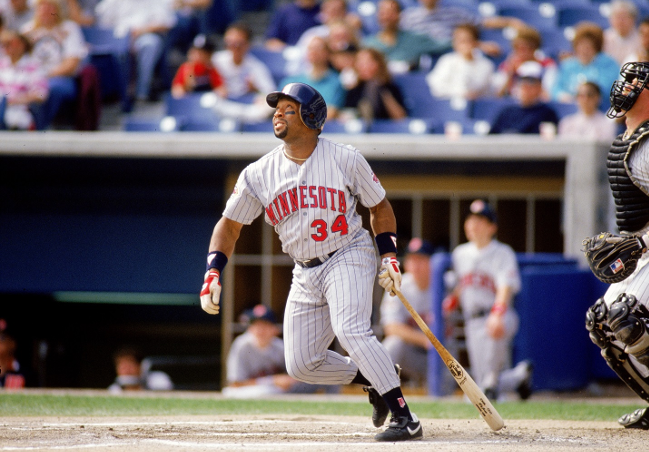 In baseball history there are a handful of players who have transformed from a mediocre player into a power threat overnight. Toronto’s Jose Bautista is an example of that -- someone who had hit home runs in the low double-digits and was suddenly jacking 30-plus home runs each season. Like Minnesota’s Kirby Puckett, Bautista had the prerequisite tools which can equate to that type of power (quick hands, strong lower-half and powerful hips). The trick was putting it all together. For Puckett the tipping point would come in his third season with the Twins. In his first two season in the majors Puckett posted an impressive .292 average but hit just only four home runs in over 1,300 trips to the plate. That style of hitting according to Rachel A. Koestler-Grack in her book “Kirby Puckett (Baseball Superstars)” was based on the teachings from one of the organization’s roving minor league hitting instructors and legendary hitter, Tony Oliva. Together, Oliva and Puckett honed his inside-out swing that delivered base hit after base hit offered little in the way of power. However some in the organization sensed that beneath the singles exterior was long ball potential. Puckett would just need a push. The push may have come in the form of peer pressure. Puckett told Sports Illustrated in 1986 that Reggie Jackson had found Puckett in the outfield before a game in Anaheim two years prior. Jackson approached the then-rookie center fielder. Looking him up and down, Jackson asked "You hit the long ball?" "Nope", Puckett replied, "I’m a base-hit hitter." "Then what am I doing here," Jackson said mockingly, "Why am I talking to this Punch and Judy hitter?" Opponents weren't the only ones who would poke fun at Puckett’s single-minded approach at the plate. His own teammates would razz him for the lack of power. When he finally hit a home run in 1985, the rest of the Twins gave him the silent treatment in the dugout which Puckett felt was a dig. According to Chuck Carlson in his book “Puck!” the Twins’ regular lead-off hitter released his frustration in batting practice, at one point clearing the fence on 10 swings in a row. Puckett made the decision that he wanted to add the long ball to his repertoire. Even though he believed he could be a power hitter, Puckett was apprehensive about altering his swing from the base hit mode. “It scared me because being a home run hitter brings a lot more pressure. I didn’t know whether I wanted that,” Puckett said. It would be Oliva, who had moved on to being the major league hitting coach, who would help convince him that it would be beneficial beyond just the home runs, it would led to more base hits as well. Puckett’s opposite field approach had allowed teams to shift their outfield around on him to prevent him from driving the ball into empty space in right (not unlike the inverse alignment that Joe Mauer faced on occasion in 2014). Pulling the ball more, Oliva convinced Puckett, would open up the field for more hits to fall as outfielders would have to play back more to respect his bat. In addition to the approach adjustment Puckett also hit the weights hard during the offseason -- or perhaps the buffet, depending on who you asked. When he reported to spring training in 1986 Puckett tipped the scales at 212 pounds. That kind of weight on his five-foot-eight frame caused some concern among the coaching staff. He had gained 17 pounds over the winter. “What else can you do in Minnesota during the winter except eat?" Puckett jokingly said after he showed up to camp. Twins manager Ray Miller was not convinced this was necessarily a positive move. When the Twins entered a late-May series in New York, Miller implored his outfielder not attempt to drive anything out of the vast Yankee Stadium. After sending two long outs into the spacious outfield the previous night against the Yankees’ Ron Guidry, Miller reportedly told Puckett “this park’s too big for you” on the way back to the hotel. The next day, in his second at-bat Puckett drove a Joe Niekro offering 450+ feet over the center field wall. When Puckett returned to the dugout he told Miller “Too big for me, huh? There’s your ‘too big’” and refused to shake Miller’s hand in jest. Kirby Puckett had officially arrived. As the 1986 season progressed, Puckett was a one-man wrecking crew. His eight home runs in the month of April were the best in baseball. He added seven more in May. No longer was he a turf hitter, expected to drive the ball down or to right field. This out-pour of offense earned him a trip to his first All-Star Game in Houston. Here we can see the difference in Puckett’s swing from 1985 to 1986. While the ball in play results are nearly identical in both clips, the process is significantly different. The first clip is from August 1985. This is Puckett's pre-power swing that has a shorter leg kick and much more movement from his feet after his swing (diving at the pitch rather than keeping his weight back): http://i.imgur.com/03w4GVY.gif Compare that to his 1986 midsummer classic swing. Puckett displays his new swing complete with the iconic higher leg kick driving his weight to his back leg before firing forward: http://i.imgur.com/UHYFy3d.gif Former pitcher and All Star Game broadcast Jim Palmer summarized the changes. “They made a change. They moved him up on the plate, you can see him on top of the plate,” he said during Puckett’s 1986 All-Star Game at-bat. “He came up as basically a contact hitter, just trying to hit it down on the turf in Minnesota. This year Oliva did change him and if you look at his build you can see he can hit the ball a long way.” During the at bat Palmer mentioned that pitchers started to adjust to the new Puckett by busting him inside. Pitchers had started to throw inside on him to move him off the plate. On a road trip in Seattle, twice the Mariners’ hurlers threw at Puckett’s head to get him to move his feet. The message pitches didn’t phase him. “Pitchers have been knocking him down, and he has been knocking them back,'' Ray Miller told reporters. ''He hit one off a pitcher's leg in Seattle after the guy threw one behind his ear.'' Beginning in 1986 Puckett's new swing would result in 20-plus home runs in each of the next three seasons.The trademark Puckett swing would become a household brand when the Twins reached the World Series in 1987: http://i.imgur.com/MWUh9CI.gif And even more iconic in 1991: http://i.imgur.com/xCB11GG.gif There are plenty of theories of how Kirby Puckett became one of the first players to go from so little to so much power so quickly. Because it is baseball and steroids have permeated the game for so long, these trends invite accusations. Even Bill James lobbed some at Puckett in 2008. Is it possible that Kirby Puckett used steroids and make changes to his swing to get these results? Potentially, but there is nothing more than hearsay and unsubstantiated rumors. What we do know is that Kirby Puckett had the raw natural tools and physical stature to orchestrate that power production. He just needed the right coaching and the right mindset. In a way Puckett's story is not unlike Brian Dozier who was a few adjustments go from a single-season high of 12 home runs in the minors to 42 in 2016. Puckett's career trajectory is of a player who went from a turf burner to a power threat. Without that conversion, it's possible that the Twins don't win two World Series in five years.
 -
 Who will be the Twins' fifth starter? What about center field? What will the clubhouse be like with Paul Molitor in charge? Where should I get a beer in Fort Myers? On this week's No Juice Podcast -- recorded at JL Beers in Northeast Minneapolis -- Dan Anderson and Parker Hageman are joined by MLB.com's Twins beat writer, Rhett Bollinger, to answer these questions and more. Click to listen.Other topics include cheating in Little League, Charles Barkley's anti-analytics rant and Phil Cuzzi's promotion. Mike Evans from JL Beers joins the show to talk about their mobile app and upcoming events, including the addition of the delicious and limited Bell's HopSlam to the taps on February 25th. He also shares how you can get $10 Burger Bucks for free which you can put towards that pint of beer. Listen below, on iTunes or on Stitcher: NO JUICE PODCAST, EPISODE #43: SPRING TRAINING PREVIEW WITH RHETT BOLLINGER Click here to view the article
 -
No Juice Podcast #43: Spring Training Preview with Rhett Bollinger
Parker Hageman posted an article in Twins
 Other topics include cheating in Little League, Charles Barkley's anti-analytics rant and Phil Cuzzi's promotion. Mike Evans from JL Beers joins the show to talk about their mobile app and upcoming events, including the addition of the delicious and limited Bell's HopSlam to the taps on February 25th. He also shares how you can get $10 Burger Bucks for free which you can put towards that pint of beer. Listen below, on iTunes or on Stitcher: NO JUICE PODCAST, EPISODE #43: SPRING TRAINING PREVIEW WITH RHETT BOLLINGER
 -
Article: TD Top Prospects: #6 Nick Gordon
Parker Hageman replied to Parker Hageman's topic in Twins Daily Front Page News
In his first full season as a starter, Dee was a 3.1 WAR player. In terms of his E-Town performance? M'eh, I wouldn't focus on that. As opposed to Sano, Polanco and Buxton, Gordon was not afforded the luxury of getting his feet wet at a development level in the GCL. And trying to compare performances in those leagues across time is difficult. For instance, the offensive environment in the Appy League in 2011 was far superior to that of 2014. That could be a case of a better class of pitching or inferior offensive players but it goes to show comparing sheer OPS numbers is not telling of the entire story. Definitely correct in that he still needs to prove that his tools can result in success. His second season should be something to watch. -
Article: TD Top Prospects: #6 Nick Gordon
Parker Hageman replied to Parker Hageman's topic in Twins Daily Front Page News
Yes, this was pointed out a lot in George Will's Men At Work during his Cal Ripken section. If a player can put stank on the ball -- with a quick release, mind you -- this increases the likelihood of covering the 5.5 hole between short and third and can help compensate for players like Hardy and Ripken that did not have blinding quickness. -
Over the past 10 years, the Minnesota Twins have had some of the lowest production from the shortstop position among all MLB teams but the future may offer stability in the form of Nick Gordon. Selected with the fourth overall pick in 2014, Gordon entered the Twins’ system with lofty expectations. Certainly the Twins have used first-round picks on shortstops in the past -- such as Levi Michael (2011), Trevor Plouffe (2004) and Michael Cuddyer (1997) -- but eventually all were relocated to another spot in the field. Will Gordon suffer the same fate or can he develop into the two-way shortstop the organization has lacked for years?Age: 19 (DOB: 10/24/1995) 2014 Stats (Elizabethton): .294/.333/.366 (.699) with 6-2B, 4-3B, 1-HR ETA: 2018 2014 Ranking: N/A What’s To Like Baseball America anointed Gordon the Appalachian League’s number two prospect, citing his natural instincts, first-step quickness, soft hands in the field, and lightning quick hands at the plate leading to a contact-oriented approach. At short, he has displayed the tendencies of an elite defender with a rocket arm (he hit 94 mph with his fastball during a Perfect Game showcase in high school) which increases his range potential. The trick has been instilling in Gordon the idea that he can take his time, avoiding rushing his throws across the diamond -- which reportedly happened on several occasions this season -- but truly a lesson all shortstops must learn as they adapt to the faster game. Considering it was his first year of professional baseball where he was two years younger than the league’s average, his .294/.333/.366 slash line in 255 plate appearances was solid. In all, he was fourth in hits (69), second in runs scored (46), tied for third in triples (4), and tenth in stolen bases (11). Gordon’s season ended with the E-Twins in the playoffs and his left hand in a cast after suffering a broken finger against the Johnson City Cardinals in the postseason. Despite ending the year sidelined, the Twins are excited about his future. “With the maturity and skill level we saw from him in high school, we thought he’d be able to compete at that level and handle any adversity,” Twins Minor League Director Brad Steil told Twins Daily’s Seth Stohs on the decision to place Gordon in the advanced rookie league, “He was probably more prepared for pro ball than most high school players, having been around it most of his life because of his dad and brother.” With major league bloodlines -- an All-Star brother, Dee, who currently plays second for the Miami Marlins and father, Tom, who pitched for 21 years in the majors as a three-time All-Star -- the Twins know that he has the genetics to complement his personal drive to reach and excel at the major league level. “You value the gene,” said Mike Radcliff, the Twins’ Vice President of Player Personnel, last July. “When you come from a major league gene, that’s what it is all about. There’s a great value at the beginning of their careers and a feeling that they won’t be overmatched.” What’s Left To Work On Like any raw but talented prospect, Gordon has areas of his game that need improvement. Despite having all of the natural talent to play shortstop, Radcliff pointed out that as he ascends in the system the Twins want to see Gordon smooth out his footwork and pivot at second base, necessary components of middle infield success . Offensively, while he demonstrated an excellent ability to garner hits, Gordon’s plate discipline was lacking. He struck out in 18% of his plate appearances -- a decent rate compared to the league’s average -- but walked in just 4%, making him one of the league’s least frequent walkers. Improvement in that area would help buoy his on-base percentage and put him on the bases more in order to take advantage of his speed. While his pre-draft profile suggested he would provide power, ultimately the left-handed hitting Gordon’s swing stays inside the ball more which has made his spray chart look strikingly similar to that of Joe Mauer: ground balls to second and balls in the air to left. This distribution is not an optimal way to generate power. Admittedly Gordon is not exactly built like a brick blankhouse but adding weight has been a goal for him this offseason. The Twins stressed that they want to see him add to his “man muscles” which, in theory, should help him generate more power. For his part, Gordon has spent the offseason attempting to hasten that process. “I’ve just been working out, trying to put on some weight, and stay fast,” Gordon told Stohs in January. “Stay to my game. I’m loving the process.” What's Next Nick Gordon is gifted in ways that should make normal players envious but he still needs seasoning. It is hard not to be enamored of his work in the field. Dinged for eight errors -- a faulty stat on many levels -- his E-6 totals pale in comparison to seasons of past Elizabethton shortstops like Brian Dozier (14), James Beresford (23) or Trevor Plouffe (16). Will his patience at the plate increase? If you listen to Oakland’s GM Billy Beane, probably not wholesale. “It can be taught, but we’d have to take guys in diapers to do it,” the A’s general manager remarked in Michael Lewis’ book Moneyball. And Gordon acknowledges his aggressive approach which has led to a near .300 batting average. And what about his power numbers? Radcliff believes the extra bases will come as he matures and continues to fill out his frame. The Twins will likely move him to Class-A Cedar Rapids where he can hone his defensive skills and make adjustments at the plate. If he is able to damage that league both with his glove and bat, a stop in Fort Myers is likely not out of the question. TD Top Prospect #10: Nick Burdi TD Top Prospect #9: Trevor May TD Top Prospect #8: Eddie Rosario TD Top Prospect #7: Jorge Polanco TD Top Prospect #6: Nick Gordon TD Top Prospect #5: TD Top Prospect #4: TD Top Prospect #3: TD Top Prospect #2: TD Top Prospect #1: Click here to view the article
-
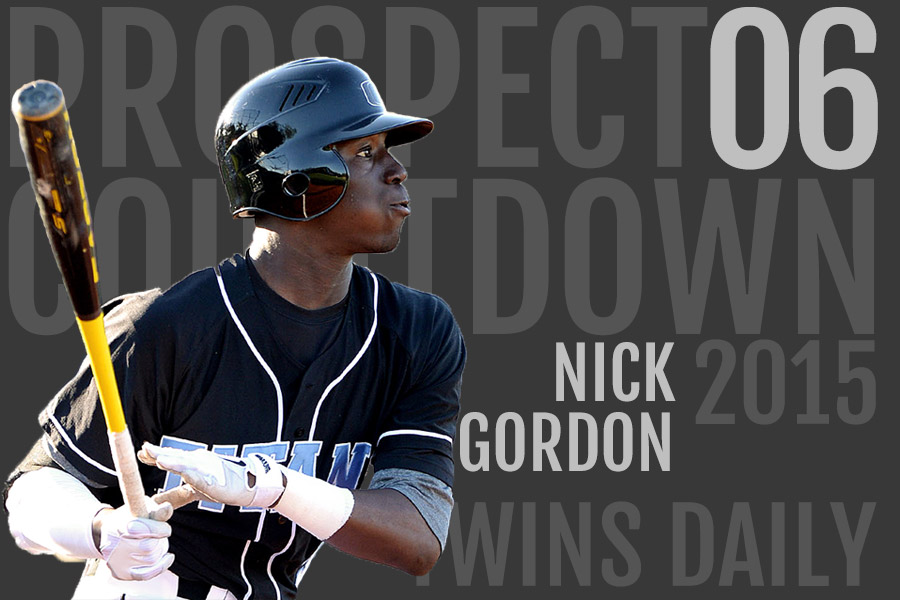 Age: 19 (DOB: 10/24/1995) 2014 Stats (Elizabethton): .294/.333/.366 (.699) with 6-2B, 4-3B, 1-HR ETA: 2018 2014 Ranking: N/A What’s To Like Baseball America anointed Gordon the Appalachian League’s number two prospect, citing his natural instincts, first-step quickness, soft hands in the field, and lightning quick hands at the plate leading to a contact-oriented approach. At short, he has displayed the tendencies of an elite defender with a rocket arm (he hit 94 mph with his fastball during a Perfect Game showcase in high school) which increases his range potential. The trick has been instilling in Gordon the idea that he can take his time, avoiding rushing his throws across the diamond -- which reportedly happened on several occasions this season -- but truly a lesson all shortstops must learn as they adapt to the faster game. Considering it was his first year of professional baseball where he was two years younger than the league’s average, his .294/.333/.366 slash line in 255 plate appearances was solid. In all, he was fourth in hits (69), second in runs scored (46), tied for third in triples (4), and tenth in stolen bases (11). Gordon’s season ended with the E-Twins in the playoffs and his left hand in a cast after suffering a broken finger against the Johnson City Cardinals in the postseason. Despite ending the year sidelined, the Twins are excited about his future. “With the maturity and skill level we saw from him in high school, we thought he’d be able to compete at that level and handle any adversity,” Twins Minor League Director Brad Steil told Twins Daily’s Seth Stohs on the decision to place Gordon in the advanced rookie league, “He was probably more prepared for pro ball than most high school players, having been around it most of his life because of his dad and brother.” With major league bloodlines -- an All-Star brother, Dee, who currently plays second for the Miami Marlins and father, Tom, who pitched for 21 years in the majors as a three-time All-Star -- the Twins know that he has the genetics to complement his personal drive to reach and excel at the major league level. “You value the gene,” said Mike Radcliff, the Twins’ Vice President of Player Personnel, last July. “When you come from a major league gene, that’s what it is all about. There’s a great value at the beginning of their careers and a feeling that they won’t be overmatched.” What’s Left To Work On Like any raw but talented prospect, Gordon has areas of his game that need improvement. Despite having all of the natural talent to play shortstop, Radcliff pointed out that as he ascends in the system the Twins want to see Gordon smooth out his footwork and pivot at second base, necessary components of middle infield success . Offensively, while he demonstrated an excellent ability to garner hits, Gordon’s plate discipline was lacking. He struck out in 18% of his plate appearances -- a decent rate compared to the league’s average -- but walked in just 4%, making him one of the league’s least frequent walkers. Improvement in that area would help buoy his on-base percentage and put him on the bases more in order to take advantage of his speed. While his pre-draft profile suggested he would provide power, ultimately the left-handed hitting Gordon’s swing stays inside the ball more which has made his spray chart look strikingly similar to that of Joe Mauer: ground balls to second and balls in the air to left. This distribution is not an optimal way to generate power. Admittedly Gordon is not exactly built like a brick blankhouse but adding weight has been a goal for him this offseason. The Twins stressed that they want to see him add to his “man muscles” which, in theory, should help him generate more power. For his part, Gordon has spent the offseason attempting to hasten that process. “I’ve just been working out, trying to put on some weight, and stay fast,” Gordon told Stohs in January. “Stay to my game. I’m loving the process.” What's Next Nick Gordon is gifted in ways that should make normal players envious but he still needs seasoning. It is hard not to be enamored of his work in the field. Dinged for eight errors -- a faulty stat on many levels -- his E-6 totals pale in comparison to seasons of past Elizabethton shortstops like Brian Dozier (14), James Beresford (23) or Trevor Plouffe (16). Will his patience at the plate increase? If you listen to Oakland’s GM Billy Beane, probably not wholesale. “It can be taught, but we’d have to take guys in diapers to do it,” the A’s general manager remarked in Michael Lewis’ book Moneyball. And Gordon acknowledges his aggressive approach which has led to a near .300 batting average. And what about his power numbers? Radcliff believes the extra bases will come as he matures and continues to fill out his frame. The Twins will likely move him to Class-A Cedar Rapids where he can hone his defensive skills and make adjustments at the plate. If he is able to damage that league both with his glove and bat, a stop in Fort Myers is likely not out of the question. TD Top Prospect #10: Nick Burdi TD Top Prospect #9: Trevor May TD Top Prospect #8: Eddie Rosario TD Top Prospect #7: Jorge Polanco TD Top Prospect #6: Nick Gordon TD Top Prospect #5: TD Top Prospect #4: TD Top Prospect #3: TD Top Prospect #2: TD Top Prospect #1:
 -
Article: TD Top Prospects: #9 Trevor May
Parker Hageman replied to Jeremy Nygaard's topic in Twins Daily Front Page News
Great stuff overall, Jeremy. I'm hoping we see a lot more of Trevor May soon. The one thing I would like May to improve on -- besides the numbers -- is pitching from the stretch. It is in those situations that have weighed on his performance. -
What is going on in Fort Myers? What happened to Joe Mauer? Did Oswaldo Arcia really change things up in Venezuela? Is Kent Hrbek a must-follow on Twitter? What's child birth like? On this week's No Juice Podcast Dan Anderson and Parker Hageman answer these questions and more. Click to listen.Other topics include Al Michaels' contention that the Twins pumped fake crowd noise into the Dome during the 1987 World Series, when the appropriate time to bring a child to their first baseball game is, and how to properly plan for Valentine's Day. Listen below, on iTunes or on Stitcher: NO JUICE PODCAST, EPISODE #42: "I GOT SOMETHIN AL CAN PUMP" Click here to view the article
-
 Other topics include Al Michaels' contention that the Twins pumped fake crowd noise into the Dome during the 1987 World Series, when the appropriate time to bring a child to their first baseball game is, and how to properly plan for Valentine's Day. Listen below, on iTunes or on Stitcher: NO JUICE PODCAST, EPISODE #42: "I GOT SOMETHIN AL CAN PUMP"
 -
Article: What Happened To Joe Mauer?
Parker Hageman replied to Parker Hageman's topic in Twins Daily Front Page News
Interesting notion, Seth. Went to check those numbers against Morneau and Span following their concussion seasons to see if there may be something to it. Check out their BA performances in those changing speed scenarios: Obviously this was just a rough-and-tough view of the data -- and batting average and the sample size is extremely volatile -- but considering the rapid drop the season after their concussions (aside from Span's jump in performances against changeups following fastballs), it is not entirely implausible to think that the brain injury is effecting the ability to track that kind of speed decline. If I were a baseball team, I would probably want to research that further and more in-depth.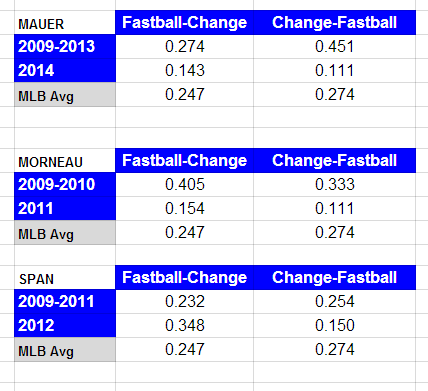
-
Article: What Happened To Joe Mauer?
Parker Hageman replied to Parker Hageman's topic in Twins Daily Front Page News
According to ESPN/TruMedia's data, Mauer finished the with the seventh lowest BA in 0-2 counts at .068 (44 PAs). Jason Heyward at .053 finished with the worst in the game. One interesting note is that during those 0-2 situations, the most frequent pitch was a fastball up in the zone. This differed from the other seasons. This might be a trend in baseball or something opponents have targeted. Either way, Mauer was not successful against those pitches. -
Article: What Happened To Joe Mauer?
Parker Hageman replied to Parker Hageman's topic in Twins Daily Front Page News
No, he was working out leading up to the Winter Caravan when he said he his offseason was "very productive". From ESPN.com last November: -
Article: What Happened To Joe Mauer?
Parker Hageman replied to Parker Hageman's topic in Twins Daily Front Page News
He did increase his tendency to swing at the first pitch over the past few years: 2014 - 12% 2013 - 8% 2012 - 8% 2011 - 6% 2010 - 9% And, like you said, he did have success when swinging at those. In terms of Mauer hitting behind in the count, he didn't hit behind anymore than he did in the last six years. He did so more in 2012 and 2010 when he had very good years. This season, he's just performed poorly in those circumstances. Like I mentioned above, there appears to be a slight timing issue in his mechanics compared to his early model. That analysis is forthcoming. This would cause the swing-and-miss issues, the increased foul balls and decline in hard-hit contact. -
Article: What Happened To Joe Mauer?
Parker Hageman replied to Parker Hageman's topic in Twins Daily Front Page News
Did he try? Maybe. That might account for some of the strikeouts but in terms of putting the ball into play, his pull rate in 2014 was 23%, lowest in the six-year span. 2014 - 23% 2013 - 33% 2012 - 35% 2011 - 29% 2010 - 27% 2009 - 34% Going back to the sequencing point, Mauer also was pulling more pitches on the outer-half away than before. There appears to be a timing issue in his swing that is different from the 2009 version that may be causing him to roll over on softer pitches away and wind up late on some fastballs up. -
Article: What Happened To Joe Mauer?
Parker Hageman replied to Parker Hageman's topic in Twins Daily Front Page News
To me, it was the least influential of the issues. The OF shift did steal some hits away and may have altered his approach for a while but statistically it was not as significant as the increase in strikeouts or weaker contact. -
If the 2015 Minnesota Twins have any hope of contending in the AL Central it requires Joe Mauer's level of offensive productivity to return to his career norm. Certainly a gross oversimplification considering he can’t pitch or cover the outfield but the lineup functions much better when he is healthy and hitting. Fortunately, just last month Mauer told KSTP that “this is the most productive offseason I've had in a long time.” MOST. PRODUCTIVE. OFFSEASON. EVER*. You hear that pitchers? Print the World Series tickets now. Plan the parade route. Chisel Mauer’s bust on the MVP trophy. Start the...hold on. Apparently last year Mauer told the Pioneer Press that that winter “has been a very productive offseason” and that offseason’s labor resulted in one of his worst offensive years in his career (outside of his injured 2011). So, wait, are words just meaningless? The accusation here is not that Mauer did not work out and prepare to his fullest ability heading into 2014, but rather something was off which led to the low offensive output relative to his lofty standards. Reviewing his season, there are several notable factors that chipped away at his usually pristine BABIP and eroded his on-base percentage. The Outfield Shift The first was that other teams were positioning themselves to account for Mauer’s opposite field tendencies. Over the last three years his batting average on balls in the air had never dropped below .400 when going the other way and wound up at .330. Still very good overall but that is several fewer hits nonetheless. Download attachment: Mauer_BABIP OF.png No Hits To The Right Second, Mauer’s ability to get hits when pulling the ball completely fell apart. Again, part of this goes back to the defensive alignment because -- as you can glean from the chart below -- a limited numbers of balls actually got out to the right field area and this allowed the right fielder to shift around. On the other hand, Mauer’s ground ball tendencies when pulling makes for some very busy infielders. From 2009 to 2013, he held a respectable .279 batting average on balls in play on anything he yanked but that dropped to .207 in 2014. The average left-handed hitter was about to post a .289 BABIP when pulling. Download attachment: hit-chart.png The Whiff The last is his increased strikeout rate. Since 2009 the percent of plate appearances in which he has struck out has gone from 10% to 9% to 11% to 14% to 18% to, finally, 19%. One reason for those increasing rates is a growing number of strikeouts looking. From 2009 through 2011, he struck out looking 27 times total but from 2012 through 2014, he has watched strike three go by 63 times. On the rising figures, Mauer told Pioneer Press’s Charley Walters this year that he attributes it to the umpire’s expanding zone and he’s not wrong. According to Jon Roegele’s research at HardballTimes.com the zone has been fattening up the past six years, particularly in the lower regions of the zone. In spite of having always been in the zone, suddenly pitches that were called balls in 2011 for Mauer are considered strikes in 2014. Of course, that doesn’t explain the rise in strikeouts swinging -- or maybe it does to some degree. Mauer has always been one of the game’s most calibrated individuals and the shifting strike zone may be messing with that aspect. It is possible that Mauer's transition away from catcher has affected his zone calibration as the umpires began to call lower and lower strikes. Adding and Subtracting Speed Here is another data nugget that could be influencing the outcomes mentioned above. Looking at pitch sequencing, an interesting trend for Mauer stands out: When pitchers added and subtracted speed, he struggled mightily last year. This is not a new wrinkle opponents are challenging him with, but now the results are significantly different. For example, from 2009 to 2013, when pitchers followed a fastball with a change-up, Mauer hit .274/.318/.377 on that pitch. Meanwhile in 2014, he turned in a .143/.172/.179 line. On the other hand, if a pitcher tried to go with a fastball after a change Mauer hit .451/.521/.697 from 2009 to 2013. Last year Mauer went just .111/.200/.111. Download attachment: Mauer_Sequencing.png Naturally this is presented with the small sample size caveat. However, this is an unusual trend for Mauer over the course of the last six years of data. In no other cases did he have any issues in sequencing. It is as if pitchers have figured out a way to throw him off-balance. **** To be fair, Mauer’s offensive numbers were better than the average but deviated from his typical norm. His on-base percentage was still in the top 20 in the league and his OPS+ remained above the league’s average too. Sometimes being critical of Mauer’s performance feels like saying a girl is too pretty. Overall, his contact has been inferior this past year as well. His hard-hit average (.182) hit a six-year low as did his fly ball/line drive distance rate (275 feet), while his foul ball rate hit a high in that time. His in-play percentage was also a new low. In short, he did not make the same high quality contact as he had made in previous years. Part of that may be because he was trying to adjust to the defense or the expanding strike zone while trying to time the pitchers’ offerings. Beyond these elements, Mauer may have been hindered by injuries, age or other things that we cannot know (like perhaps the fumes from his new first baseman’s mitt causes dizziness). We know a lot about what went wrong in 2014 for Joe Mauer. What is unknown is whether this decline is a growing trend or a passing phase. *“in a long time.” Click here to view the article
-
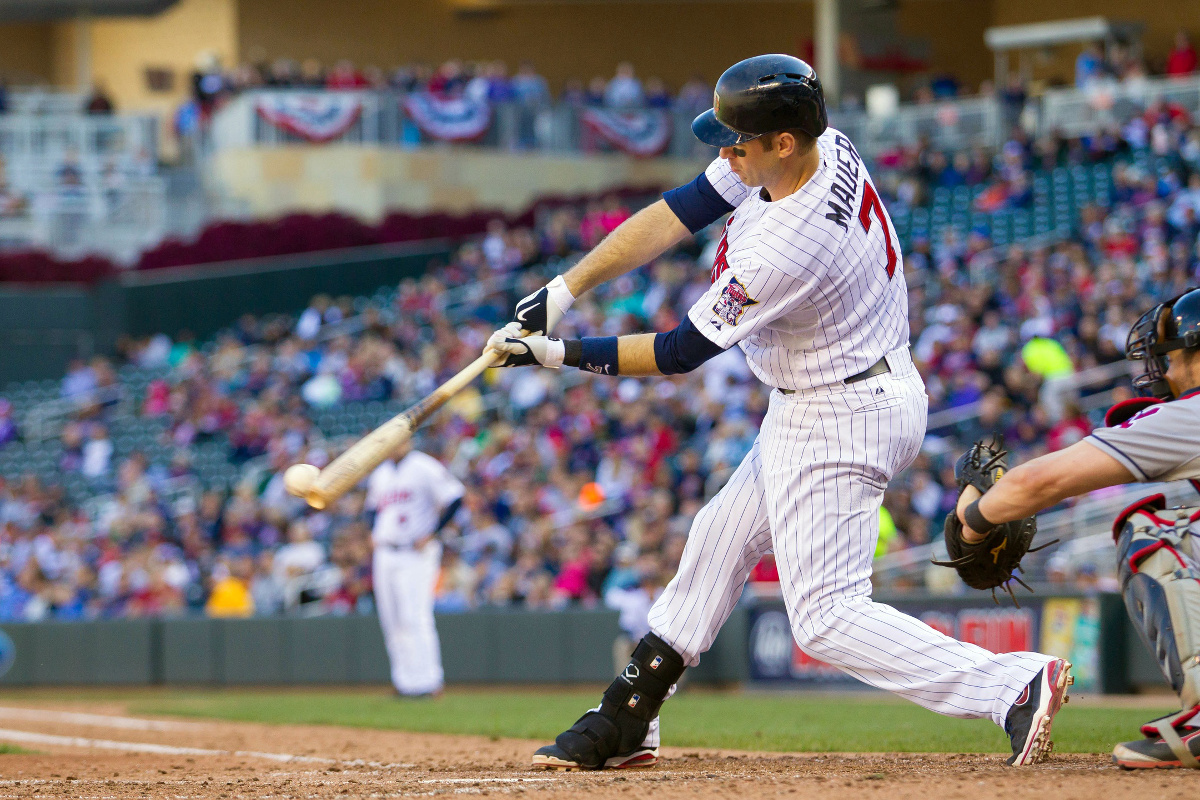 MOST. PRODUCTIVE. OFFSEASON. EVER*. You hear that pitchers? Print the World Series tickets now. Plan the parade route. Chisel Mauer’s bust on the MVP trophy. Start the...hold on. Apparently last year Mauer told the Pioneer Press that that winter “has been a very productive offseason” and that offseason’s labor resulted in one of his worst offensive years in his career (outside of his injured 2011). So, wait, are words just meaningless? The accusation here is not that Mauer did not work out and prepare to his fullest ability heading into 2014, but rather something was off which led to the low offensive output relative to his lofty standards. Reviewing his season, there are several notable factors that chipped away at his usually pristine BABIP and eroded his on-base percentage. The Outfield Shift The first was that other teams were positioning themselves to account for Mauer’s opposite field tendencies. Over the last three years his batting average on balls in the air had never dropped below .400 when going the other way and wound up at .330. Still very good overall but that is several fewer hits nonetheless. No Hits To The Right Second, Mauer’s ability to get hits when pulling the ball completely fell apart. Again, part of this goes back to the defensive alignment because -- as you can glean from the chart below -- a limited numbers of balls actually got out to the right field area and this allowed the right fielder to shift around. On the other hand, Mauer’s ground ball tendencies when pulling makes for some very busy infielders. From 2009 to 2013, he held a respectable .279 batting average on balls in play on anything he yanked but that dropped to .207 in 2014. The average left-handed hitter was about to post a .289 BABIP when pulling. The Whiff The last is his increased strikeout rate. Since 2009 the percent of plate appearances in which he has struck out has gone from 10% to 9% to 11% to 14% to 18% to, finally, 19%. One reason for those increasing rates is a growing number of strikeouts looking. From 2009 through 2011, he struck out looking 27 times total but from 2012 through 2014, he has watched strike three go by 63 times. On the rising figures, Mauer told Pioneer Press’s Charley Walters this year that he attributes it to the umpire’s expanding zone and he’s not wrong. According to Jon Roegele’s research at HardballTimes.com the zone has been fattening up the past six years, particularly in the lower regions of the zone. In spite of having always been in the zone, suddenly pitches that were called balls in 2011 for Mauer are considered strikes in 2014. Of course, that doesn’t explain the rise in strikeouts swinging -- or maybe it does to some degree. Mauer has always been one of the game’s most calibrated individuals and the shifting strike zone may be messing with that aspect. It is possible that Mauer's transition away from catcher has affected his zone calibration as the umpires began to call lower and lower strikes. Adding and Subtracting Speed Here is another data nugget that could be influencing the outcomes mentioned above. Looking at pitch sequencing, an interesting trend for Mauer stands out: When pitchers added and subtracted speed, he struggled mightily last year. This is not a new wrinkle opponents are challenging him with, but now the results are significantly different. For example, from 2009 to 2013, when pitchers followed a fastball with a change-up, Mauer hit .274/.318/.377 on that pitch. Meanwhile in 2014, he turned in a .143/.172/.179 line. On the other hand, if a pitcher tried to go with a fastball after a change Mauer hit .451/.521/.697 from 2009 to 2013. Last year Mauer went just .111/.200/.111. Naturally this is presented with the small sample size caveat. However, this is an unusual trend for Mauer over the course of the last six years of data. In no other cases did he have any issues in sequencing. It is as if pitchers have figured out a way to throw him off-balance. **** To be fair, Mauer’s offensive numbers were better than the average but deviated from his typical norm. His on-base percentage was still in the top 20 in the league and his OPS+ remained above the league’s average too. Sometimes being critical of Mauer’s performance feels like saying a girl is too pretty. Overall, his contact has been inferior this past year as well. His hard-hit average (.182) hit a six-year low as did his fly ball/line drive distance rate (275 feet), while his foul ball rate hit a high in that time. His in-play percentage was also a new low. In short, he did not make the same high quality contact as he had made in previous years. Part of that may be because he was trying to adjust to the defense or the expanding strike zone while trying to time the pitchers’ offerings. Beyond these elements, Mauer may have been hindered by injuries, age or other things that we cannot know (like perhaps the fumes from his new first baseman’s mitt causes dizziness). We know a lot about what went wrong in 2014 for Joe Mauer. What is unknown is whether this decline is a growing trend or a passing phase. *“in a long time.”
 -
On this week's No Juice Podcast -- recorded from JL Beers in Northeast Minneapolis -- Dan Anderson and Parker Hageman discuss the Minnesota Twins' struggles with their first round draft picks, the possibility of Joe Mauer never bouncing back and more. Click to listen.Other topics include super hot Super Bowl Media Day takes, revisited the Manziel vs Bridgewater scenario, talked Twins first round draft struggles and the Timberwolves trolling Kevin Love. Mike Evans from JL Beers joins the show to introduce the outstanding burger and beer bar in Northeast Minneapolis to the listeners. He also shares how you can get $10 Burger Bucks for free. Be sure to download their mobile app to help decide what to spend that on. Listen below, on iTunes or on Stitcher: NO JUICE PODCAST, EPISODE #41: SUNDAY AT JL BEERS Click here to view the article
-
 Other topics include super hot Super Bowl Media Day takes, revisited the Manziel vs Bridgewater scenario, talked Twins first round draft struggles and the Timberwolves trolling Kevin Love. Mike Evans from JL Beers joins the show to introduce the outstanding burger and beer bar in Northeast Minneapolis to the listeners. He also shares how you can get $10 Burger Bucks for free. Be sure to download their mobile app to help decide what to spend that on. Listen below, on iTunes or on Stitcher: NO JUICE PODCAST, EPISODE #41: SUNDAY AT JL BEERS
 -
Comparing First Round Draft Pick Performance
Parker Hageman commented on jay's blog entry in Blog jay
Man. Would you look at all this sub-commenting... -
Article: Dozier's Expected Extension
Parker Hageman replied to Cody Christie's topic in Twins Daily Front Page News
That's the picture you guys use? Really? -
Article: First Round Busts?
Parker Hageman replied to Parker Hageman's topic in Twins Daily Front Page News
Technically, the Twins could have taken anyone in the draft. You could argue that the Twins COULD HAVE drafted Wil Myers in the first round in 2009 or COULD HAVE drafted Tyson Ross in 2008. I understand what you are driving at but there are a lot of roads to travel if you are conducting your study in this manner. Right. Obviously if we were trying to gauge each pick you would take the position and see what the WAR value is on average, you could then see what each individual pick did in terms of under, over or simply achieve. No question. For a straightline analysis against other teams in that time, the Twins median selection was at 28. 12 teams drafted at a lower median position from them at that time and nine of those teams had higher WAR totals from those picks. The Cardinals are probably the most apt comparison in that time -- selecting at comparable slots in that time. They managed to milk 23.7 WAR out of there picks. On the other hand, Boston -- a well thought of analytical team who similarly drafted near the Twins but had more picks overall -- only got 3.4 WAR out of their picks. I wrote this in the article and I will reiterate it now: Draft position factors in quite a lot as to what level of talent is available, but having a high pick does not guarantee success either. Having a low pick does not preclude a team from not succeeding in the draft either. I'll say this one more time: The conclusion presented in the post isn't that "the Twins didn't draft well". The conclusion is that the first round picks have failed to perform. -
Article: First Round Busts?
Parker Hageman replied to Parker Hageman's topic in Twins Daily Front Page News
Look, I don't know what you are thinking you have read and/or getting out of the original post but let me reiterate one final time before ending this conversation so you can continue to do research on this matter until you find a conclusion and methodology that are strong like bull: (1) Using WAR, how did the Twins fare with their first round picks compared to other teams between 2006 and 2011? (2) Conclusion. Poorly. Those of us who followed the team in that time recognize that the conclusion was already there. These numbers are just highlighting to what extent using WAR. There are teams that have drafted at higher positions who have fared better and there are teams with lower draft slots who did worse in that time. If you care to re-read the post, you will find that there is no definitive statement suggesting the team is doing anything wrong. Also, there is a statement saying that this study is complete considering there are still players who could make the major league level and provide more positive value. This was not intended to be an inch wide and a mile deep. If you felt misled, I'm sorry. That was not the intent. Again, it was a simple question and simple conclusion. The Twins have had one of the lowest success rates of first round picks based on WAR from 2006 to 2011 at this point. True story. If you care to continue to further your research in perfecting the methodology and conclusion to demonstrate to what extent the Twins underachieved, overachieved or just achieved, then I recommend contacting TD member Jay in assisting him in his blog post. Otherwise, I think this conversation has run its course. http://24.media.tumblr.com/55b2b8063859b27c9d04eaf739772082/tumblr_meqar76mwj1rmmshbo1_250.gif

