RpR
-
Posts
9,946 -
Joined
-
Last visited
Content Type
Profiles
News
Minnesota Twins Videos
2026 Minnesota Twins Top Prospects Ranking
2022 Minnesota Twins Draft Picks
Minnesota Twins Free Agent & Trade Rumors, Notes, & Tidbits
Guides & Resources
2023 Minnesota Twins Draft Picks
The Minnesota Twins Players Project
2024 Minnesota Twins Draft Picks
2025 Minnesota Twins Draft Pick Tracker
2026 Minnesota Twins Draft Tracker: Picks & Bonuses
Forums
Blogs
Events
Store
Downloads
Gallery
Everything posted by RpR
-
Spring training game thread: week of Feb 21
RpR replied to mrtwinsfan's topic in Minnesota Twins Talk
He went up to the broadcast booth and talked about his new hitting stance, did not mention any problems. -
Spring training game thread: week of Feb 21
RpR replied to mrtwinsfan's topic in Minnesota Twins Talk
-
Spring training game thread: week of Feb 21
RpR replied to mrtwinsfan's topic in Minnesota Twins Talk
-
Spring training game thread: week of Feb 21
RpR replied to mrtwinsfan's topic in Minnesota Twins Talk
-
Joe Ryan to Yankees: Who says no? The Yankees.
-
How Kaelen Culpepper Can Keep Forcing the Issue in 2026
RpR replied to Cody Christie's topic in Twins Minor League Talk
In modern baseball, data from Statcast confirms that infield throwing velocity is a critical metric for defensive success, particularly on "bang-bang" plays at first base. Data supporting the importance of throw speed from second to first includes: 1. Positional Averages and Impact Second Basemen (2B): Average throw speeds range from 75 to 85 mph. While lower than shortstops (85–95 mph), 2B velocity is prioritized for quick releases and accuracy during double plays. Arm Strength Leaderboard: Statcast tracks the average of a player’s top 5% of throws for 2B/SS/3B positions. This specialized tracking highlights how maximum effort throws are a distinct, measurable skill. 2. Defensive Urgency Data The speed of a throw "counts" because it directly competes with a runner's time to first base: Runner Speed: The average MLB batter reaches first base in 4.31 to 4.35 seconds. Elite runners like Trea Turner reach it in approximately 4.13 to 4.22 seconds (2025 data). The "Bang-Bang" Window: Infielders often have only fractions of a second to complete a play. A difference of 0.2 seconds can be the deciding factor between a runner being safe or out. 3. Notable Statcast Records (Infield Assists) Masyn Winn: Set a record for the fastest throw by an MLB infielder at 101.2 mph in May 2024. Elly De La Cruz: Recorded a 99.8 mph infield assist in 2023. Oneil Cruz: Previously held records with infield throws reaching 97.8 mph. 4. Statistical Significance Range and Versatility: Higher velocity allows an infielder to field balls deeper "in the hole" or further up the middle and still beat a runner to first. Runner Intimidation: High throwing velocities can influence base runner behavior, discouraging them from taking extra bases or attempting to advance. For detailed player rankings, you can view the official Statcast Arm Strength Leaderboard on Baseball Savant. -
How Kaelen Culpepper Can Keep Forcing the Issue in 2026
RpR replied to Cody Christie's topic in Twins Minor League Talk
The article said it, I just copied the article. If you have a beef take it to them. -
How Kaelen Culpepper Can Keep Forcing the Issue in 2026
RpR replied to Cody Christie's topic in Twins Minor League Talk
The typical straw man argument creates the illusion of having refuted or defeated an opponent's proposition through the covert replacement of it with a different proposition -
How Kaelen Culpepper Can Keep Forcing the Issue in 2026
RpR replied to Cody Christie's topic in Twins Minor League Talk
It says , you gave your opinion, and that is all it is. -
How Kaelen Culpepper Can Keep Forcing the Issue in 2026
RpR replied to Cody Christie's topic in Twins Minor League Talk
If you say so. -
Because they are members of a team, not self-centered snot faced brats.
-
How Kaelen Culpepper Can Keep Forcing the Issue in 2026
RpR replied to Cody Christie's topic in Twins Minor League Talk
I quoted a statement as accurate as any on this site; The speed of a throw from second (or any infield position) to first makes a significant difference directly reducing the runner's time to reach the base, with faster throws shaving off crucial fractions of a second that can determine an out, though accuracy and quick release are often prioritized over pure velocity for second basemen. While a slower, more accurate throw might work, a faster release with good velocity is often best, as even slight speed differences (like 10%) create a noticeable half-step advantage for the defense. Impact of Throwing Speed Reduced Reaction Time: Faster throws give runners less time to react and reach first base safely. Game-Changing Margins: Baseball is a game of inches; a faster throw can be the difference between safe and out, especially on close plays. Trade-off with Accuracy: Second basemen focus on quick, accurate throws for double plays, but higher velocity still helps beat the runner. Key Factors for Infield Throws Velocity: The faster the ball, the less time the runner has. Quick Release: A faster release is often more impactful than just pure arm strength, as it minimizes the time the ball spends in the infielder's hand. Accuracy: Essential for getting the out, especially on double plays where the throw goes to first base after a pivot. Example A 90 mph throw (around 132 ft/sec) from 90 feet (typical infield distance) takes about 0.68 seconds, while a slower 80 mph throw takes around 0.76 seconds, a significant difference for a runner trying to beat the play. (Calculations based on 90 ft distance) In essence, while second basemen value accuracy and quickness for double plays, increasing velocity on throws to first is a major advantage, as it directly cuts down the runner's time to get to the bag, potentially turning a close play into an out -
How Kaelen Culpepper Can Keep Forcing the Issue in 2026
RpR replied to Cody Christie's topic in Twins Minor League Talk
If you say so. -
How Kaelen Culpepper Can Keep Forcing the Issue in 2026
RpR replied to Cody Christie's topic in Twins Minor League Talk
The speed of a throw from second (or any infield position) to first makes a significant difference directly reducing the runner's time to reach the base, with faster throws shaving off crucial fractions of a second that can determine an out, though accuracy and quick release are often prioritized over pure velocity for second basemen. While a slower, more accurate throw might work, a faster release with good velocity is often best, as even slight speed differences (like 10%) create a noticeable half-step advantage for the defense. Only if you ignore what you do not agree with. -
How Kaelen Culpepper Can Keep Forcing the Issue in 2026
RpR replied to Cody Christie's topic in Twins Minor League Talk
The speed of a throw from second (or any infield position) to first makes a significant difference directly reducing the runner's time to reach the base, with faster throws shaving off crucial fractions of a second that can determine an out, though accuracy and quick release are often prioritized over pure velocity for second basemen. While a slower, more accurate throw might work, a faster release with good velocity is often best, as even slight speed differences (like 10%) create a noticeable half-step advantage for the defense. Impact of Throwing Speed Reduced Reaction Time: Faster throws give runners less time to react and reach first base safely. Game-Changing Margins: Baseball is a game of inches; a faster throw can be the difference between safe and out, especially on close plays. Trade-off with Accuracy: Second basemen focus on quick, accurate throws for double plays, but higher velocity still helps beat the runner. Key Factors for Infield Throws Velocity: The faster the ball, the less time the runner has. Quick Release: A faster release is often more impactful than just pure arm strength, as it minimizes the time the ball spends in the infielder's hand. Accuracy: Essential for getting the out, especially on double plays where the throw goes to first base after a pivot. Example A 90 mph throw (around 132 ft/sec) from 90 feet (typical infield distance) takes about 0.68 seconds, while a slower 80 mph throw takes around 0.76 seconds, a significant difference for a runner trying to beat the play. (Calculations based on 90 ft distance) In essence, while second basemen value accuracy and quickness for double plays, increasing velocity on throws to first is a major advantage, as it directly cuts down the runner's time to get to the bag, potentially turning a close play into an out -
How Kaelen Culpepper Can Keep Forcing the Issue in 2026
RpR replied to Cody Christie's topic in Twins Minor League Talk
First yes, but turning a double play as second it makes a Huge difference. -
How Kaelen Culpepper Can Keep Forcing the Issue in 2026
RpR replied to Cody Christie's topic in Twins Minor League Talk
The Twins do not need average in the infield; Correa was not average and it made a difference. IF, if Keaschall can get his outfield mojo back, that is where he should be. -
Why Did the Minnesota Twins Sign Victor Caratini?
RpR replied to Greggory Masterson's topic in Twins Daily Front Page News
It was NOT for his glove, maybe his amazing bat skills.👨🦲😂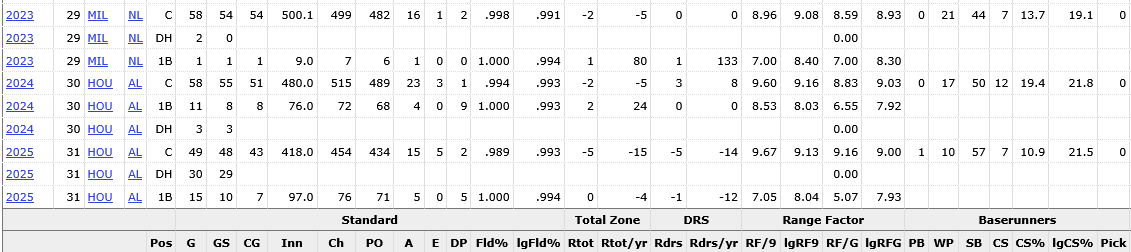
-
I have paid little attention to college football for a long time and totally quit with the new bs play-system, BUT, I hope Indiana wins the big one. The Minn. Gopher have not won a truly big game since they won the Championship in 1962 and the still LOST, the Rose Bowl that year; I do see the Rose Bowl as the only important college game. I really quit caring much when the Gophers lead Michigan 28-7 in the fourth quarter and still lost the game in 2003. GO HOOSIERS!!!
-
Beyond grammer, this is an interesting article. https://www.mlb.com/news/twins-2026-roster-outlook-catcher
-
Byron Buxton to Play for Team USA in the 2026 World Baseball Classic
RpR commented on NJM's blog entry in Miscellaneous Twins News
IF -- if he is going to get hurt, and it is an absolute item that will happen, which team he is on is pointless. Or if he gets hurt early , he may not miss as much time regular season. -
LOL - his range, since he left the Twins has improved . especially last year but at that, SS was where he was lacking. Second Base is where he was and is still pretty good. His bat is not too good any more.
-
Former Twins OF Max Kepler Receives 80-Game PED Suspension
RpR replied to Seth Stohs's topic in Minnesota Twins Talk
Other people can got what Col. Klink told them to do , their problem not his. -
Former Twins OF Max Kepler Receives 80-Game PED Suspension
RpR replied to Seth Stohs's topic in Minnesota Twins Talk
He paid his money and took his chances, but he lost. Not related to the Virus bs.