



Thrylos
-
Posts
11,094 -
Joined
-
Last visited
-
Days Won
9
Content Type
Profiles
News
Minnesota Twins Videos
2026 Minnesota Twins Top Prospects Ranking
2022 Minnesota Twins Draft Picks
Minnesota Twins Free Agent & Trade Rumors, Notes, & Tidbits
Guides & Resources
2023 Minnesota Twins Draft Picks
The Minnesota Twins Players Project
2024 Minnesota Twins Draft Picks
2025 Minnesota Twins Draft Pick Tracker
2026 Minnesota Twins Draft Tracker: Picks & Bonuses
Forums
Blogs
Events
Store
Downloads
Gallery
Everything posted by Thrylos
-
Article: How Secure Is Suzuki's Starting Job?
Thrylos replied to Nick Nelson's topic in Twins Daily Front Page News
I'd rather see Pinto get a chance to be the starter because he as more potential than Suzuki and to improve as an MLB catcher you have to (well...) catch MLB pitchers. And he and Suzuki are not that far away with the glove (and Pinto has a better bat.) Mike Piaza and Brian Harper were not even close to being gold glove catchers, but they were cornerstones for their teams. That said, Suzuki has been in the league a long time, but is not that old. He is a year younger than Mauer... -
Article: The Best 25 GMs in History: #23 John Hart
Thrylos replied to Daniel R Levitt's topic in Twins Daily Front Page News
The ultimate measure of a great GM is the number of World Series his team won. With that respect, both Jon Hart (zero, zip, nada) and John Quinn (1) should be ranked below Andy MacPhail. That is the goal of a GM: To win it all. And if that is not his goal, then something is wrong. -
Article: A Look Back: The 2012 Draft
Thrylos replied to Seth Stohs's topic in Twins Daily Front Page News
Fernandez, even though played both C/OF in school he has played almost exclusively at C (and a bit at first base) and he has been a quality receiver as well. I think that he will be the real thing and have him ranked 19th overall in my Twins prospects' list and second-best C prospect after Mitch Garver. Definitely the sleeper in this group (Larson potentially also) One comment: 2-3 seasons is not that much post-mortem to evaluate a draft. Give it a good 10 seasons We should really be talking about the 2005 draft right now instead, when you know how things turned out (and that was not a bad draft, just the Twins traded or did not sign the best players they drafted...)- 45 replies
-
- 1
-

-
- byron buxton
- jose berrios
- (and 3 more)
-
HRs are not everything. Polanco's floor as far as power goes, is Wade Boggs. I think that Boggs or Tony Gwynn and I think that these guys did ok. Line drive hitters like the 2 hall of famers mentioned and Polanco are more of doubles and triples vs home run power. That is the type of his game. I suspect that he will develop Mauer-like power.
-
Indeed. Rookie Leauges are short season and he was in extended spring training
-
Article: The Best 25 GMs In History: #25 Andy MacPhail
Thrylos replied to Kevin's topic in Twins Daily Front Page News
Don't forget the in-season changes to really build a good post-season team: Carlton, Niekro, Baylor, Schatzeder, and the father of Drew (well he was a late off-season signing) -
Article: The Best 25 GMs In History: #25 Andy MacPhail
Thrylos replied to Kevin's topic in Twins Daily Front Page News
That was not an issue in that era the Twins were on the top 5 of payroll early and often in the MacPhail era. As a matter of fact MacPhaile singed the highest annual value pitcher (Morris) and position player (Puckett.) That "small market" talk happened after the strike... Note re: Scott Erickson, who was the Twins' best pitcher in 1991. He was drafted in 1989. Chuck Knoblauch, who was the catalyst in the 1991 team was also drafted in 1989. 2 years from draft to the majors. This is a lesson that current GMs should learn...- 12 replies
-
- 3
-
-
- andy macphail
- general managers
- (and 1 more)
-
Article: A New Metric for Shortstop Fielding
Thrylos replied to Thrylos's topic in Twins Daily Front Page News
That work has been done and it is the "zone" ratings. These days are the Revised Zone Rating (or RZR) and the Ultimate Zone Rating (or UZR). The latter chops the field in 75 pieces and assigns each one to a particular fielder. And it looks at what happened to balls hit in any of those pieces. Fun. But nothing simple. Nothing intuitive and nothing that one can calculate with a cell phone. And we have no data whatsoever about that in minor league play. (Bill James invented the much maligned "Range Factor" and then improved it with plus/minus in his fielding bible. RF is something fairly easily calculated, too...) -
Article: A New Metric for Shortstop Fielding
Thrylos replied to Thrylos's topic in Twins Daily Front Page News
That's what the normalization does. As FIP assumes that the pitcher has a league average defense behind him, this assumes that the ss has league average fielding partners...- 18 replies
-
- 1
-
-
- jorge polanco
- engelb vielma
- (and 1 more)
-
Article: A New Metric for Shortstop Fielding
Thrylos replied to Thrylos's topic in Twins Daily Front Page News
Typo. I am using league totals, so it is 162 times 15 I am all ears regarding alternative normalizations- 18 replies
-
- 1
-
-
- jorge polanco
- engelb vielma
- (and 1 more)
-
Article: A New Metric for Shortstop Fielding
Thrylos replied to Thrylos's topic in Twins Daily Front Page News
This is accounted a couple of times: in the normalization process, the same way of accounting for a ground ball pitcher, for example, and in the denominator, using all shortstop chances (i.e. by broadening the container.) I am actually looking at the second (and third) basemen data with a derivative measure. Would be interesting to see how much correlation there is. Definitely a standard deviation & sample size issue (a better infield.)- 18 replies
-
- 1
-
-
- jorge polanco
- engelb vielma
- (and 1 more)
-
Article: A New Metric for Shortstop Fielding
Thrylos replied to Thrylos's topic in Twins Daily Front Page News
Thanks. About those questions: As I indicated, I need to further look into more data historically to see how that metric looks from year to year and even more importantly, how the league average Percent Chances that are turned into double plays looks year to year (and league to league.) Is there portability? Is that number fairly constant? How does it look in the minors? (Alas, we do not have very good league total chance data for the minors and it is a pain in the neck to assemble) And I do suspect that individuals will change from season to season in both ways. I'd love to look at Jeter or Smith or someone else for example. Regarding the double plays: a. The normalization against the league average Percent Chances that are turned into double plays takes care of the ground ball pitcher/man on base factor. It assumes that the probability for a shortstop to encounter a chance for a double play is the same at any PA across the league. To give you an analogy (and we are talking about 1500 innings.) Let's imagine someone has exactly162 days to bike from NYC to LA. This is 2776 miles, which averages out to 17.1 miles a day. Of course, because of external factors (not much different than groundball pitcher/man on base) during some days someone might do 40 miles, some days someone might rest and some days might hit 17.1 exactly. The mathematical problem with these assumptions is that, while you are able to see the big picture and say that someone's rate of > 17.1 miles a day is better than the average, if you a measuring just a part of that (like from Chicago to Des Moines) you do not know whether it is significant. I am not sure what sample is big enough for this to discuss with some certainty, but I think that a third of a season (500 innings) or even a quarter (350) might be fines. Still need to do the math... b. About the double plays and why double plays. I am using them as the numerator, but I am measuring baseball skills that turned into results. It is a bit of an abstract concept, but if you are looking at batting average (Hits/ABs) you are using hits as a numerator, but you are measuring the ability of a hitter to make productive contact utilizing his contact skill. So the assumptions are: turning more double plays than another player requires better fielding (a combination of range, arm, instinct, accuracy, whatever -cannot differentiate) skills. So if someone turns more double plays than another, he must be a better fielder somehow. Because, if you cannot turn the double play, you'd likely have a hard time making a diving catch on a line drive. Also the metric is further refined by accounting for errors in routine situations. Does that make any sense? I am really counting double plays, but I am measuring fielding skills, and the ability to turn double plays are a way to measure those skills. As I indicated, I just wanted a simple objective (read one that is based on data) measure that will give me a bit of confidence about someone's fielding and it is easily calculated (good luck getting pluses or minuses or UZRs or RZRs for minor leaguers) with the data we have. I think that we rely too much on scouts (who are great btw, but they too have a SSS since they watch someone for about 5 games on average) for fielding evaluation... Perfect? No by any means, just another factor in evaluating someone.- 18 replies
-
- 1
-
-
- jorge polanco
- engelb vielma
- (and 1 more)
-
Recently when I was looking for an objective way to numerically describe how good Engelb Vielma's glove for my Minnesota Twins' top 40 prospect list, which is fairly easily understood as a concept, I came up with a simple metric: The percentage of putouts that resulted in a double play.--- This is an edit to clarify a few points that were made previously that may have been confusing. I did a bit of research to see whether it will pass the stink test, and so looked at Omar Visquel's Gold Glove seasons (1994-2001). Visquel's percentage of putouts that occurred during double plays (DP/PO) was 40%, so I concluded that Vielma's 39.6% was indeed encouraging. Furthermore, I used this metric as supportive of what I have seen with my eyes this season to suggest that Jose Polanco, with a 52.3% DP/PO rate, despite the rumors, is a very good fielding shortstop. This resulted in a major upset on the top 10of my Twins prospect list, and a hearty discussion of the metric, among other things, here. Conceptually it is very simple metric: An effective shortstop will turn more batted balls into outs than a less effective shortstop. It is affected by many things like range and arm, but it is not perfect. It misses the number of chances for double plays as a normalization, and it does not help describe how the shortstop was with the glove when there were no putouts. So I did three things : a. When I first thought of this, I thought that putouts were the way to go, because for some reason it helped tell more about a shortstop than assists. After a bit of discussion and noodling, this is not really valid. I was wrong to use putouts for the denominator. I think that total chances (TC) are a better denominator, so that is it. Instead of percent of putouts that were DPs, I am using percent of total chances that resulted in double plays (%CDP, from the DP/TC formula) b. To add something into the measurement that describes a shortstop in a non-double play situation, I went back to an old (and tired) friend and gave it new life by marrying it with %CDP. This is fielding percentage (FP), which by itself is inadequate to wholly describe fielding, but is a very simple conceptual metric: Errors over chances. So this compound measurement is simply: The percent of total chances that resulted in double plays multiplied by fielding percentage, or FP. Because that is a mouthful, I am calling it shortstop fielding effectiveness, or SSFE. (The name is similar to the other metric I devised to simplify pitching effectiveness: Pitching Effectiveness.) For the equation-inclined: DP/TC x FP=SSFE. c. To normalize for the chances of a double play, or what percentage of total chances were with a man on base, I normalized against the league for a full season, assuming that the chances for a double play are pretty much the same for all teams over the course of 2280 games (152 times 15). A league normalization would be good enough. So I calculated the average SSFE (which was 13.5) and divided each player's SSFE by that average, resulting to a normalized value, which I call nSSFE. A nSSFE of 1 is average, everything above 1 is above average and everything below 1 is below average. To make it look numerically a bit more familiar (think ERA+ and OPS+,) I multiplied by 100, making the average 100, like those other two metrics, creating what I call nSSFE+ (still a mouthful). 139 players played shortstop in the bigs in 2014. Does it pass the stink test? Here is the nSSFE+ for all MLB shortstops in 2014 with more that 200 innings at short. In blue are the above average shortstops (nSSFE+ 110 or more) and in red are the below average (nSSFE+ 90 or less.) Since this is a Twins-focused blog, the Twins' players are in bold. I think that it does pass the stink test if you look who are in the blue categories (JJ Hardy, S. Drew, et al) and who are in the red (Derek Jeter, Jimmy Rollins et al.) Is it a perfect metric? No; because there is no such a thing. But I think that it is easily understood and can be valuable. And it is better than the "eye" alone. The two together may be awesome. Could it be translated to other positions? I will try to play around, but feel free to play and tell me I will eventually look to see how the average moves with history, and potentially refine it, but this is the first attempt. Originally published at The Tenth Inning Stretch Click here to view the article
- 18 replies
-
- 2
-
-
- jorge polanco
- engelb vielma
- (and 1 more)
-
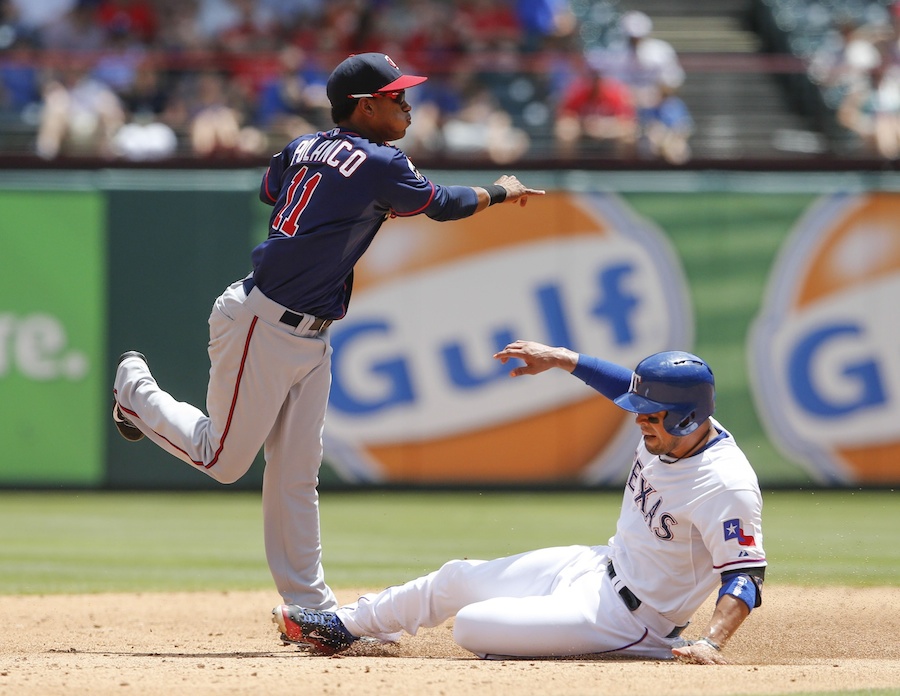 --- This is an edit to clarify a few points that were made previously that may have been confusing. I did a bit of research to see whether it will pass the stink test, and so looked at Omar Visquel's Gold Glove seasons (1994-2001). Visquel's percentage of putouts that occurred during double plays (DP/PO) was 40%, so I concluded that Vielma's 39.6% was indeed encouraging. Furthermore, I used this metric as supportive of what I have seen with my eyes this season to suggest that Jose Polanco, with a 52.3% DP/PO rate, despite the rumors, is a very good fielding shortstop. This resulted in a major upset on the top 10 of my Twins prospect list, and a hearty discussion of the metric, among other things, here. Conceptually it is very simple metric: An effective shortstop will turn more batted balls into outs than a less effective shortstop. It is affected by many things like range and arm, but it is not perfect. It misses the number of chances for double plays as a normalization, and it does not help describe how the shortstop was with the glove when there were no putouts. So I did three things : a. When I first thought of this, I thought that putouts were the way to go, because for some reason it helped tell more about a shortstop than assists. After a bit of discussion and noodling, this is not really valid. I was wrong to use putouts for the denominator. I think that total chances (TC) are a better denominator, so that is it. Instead of percent of putouts that were DPs, I am using percent of total chances that resulted in double plays (%CDP, from the DP/TC formula) b. To add something into the measurement that describes a shortstop in a non-double play situation, I went back to an old (and tired) friend and gave it new life by marrying it with %CDP. This is fielding percentage (FP), which by itself is inadequate to wholly describe fielding, but is a very simple conceptual metric: Errors over chances. So this compound measurement is simply: The percent of total chances that resulted in double plays multiplied by fielding percentage, or FP. Because that is a mouthful, I am calling it shortstop fielding effectiveness, or SSFE. (The name is similar to the other metric I devised to simplify pitching effectiveness: Pitching Effectiveness.) For the equation-inclined: DP/TC x FP=SSFE. c. To normalize for the chances of a double play, or what percentage of total chances were with a man on base, I normalized against the league for a full season, assuming that the chances for a double play are pretty much the same for all teams over the course of 2280 games (152 times 15). A league normalization would be good enough. So I calculated the average SSFE (which was 13.5) and divided each player's SSFE by that average, resulting to a normalized value, which I call nSSFE. A nSSFE of 1 is average, everything above 1 is above average and everything below 1 is below average. To make it look numerically a bit more familiar (think ERA+ and OPS+,) I multiplied by 100, making the average 100, like those other two metrics, creating what I call nSSFE+ (still a mouthful). 139 players played shortstop in the bigs in 2014. Does it pass the stink test? Here is the nSSFE+ for all MLB shortstops in 2014 with more that 200 innings at short. In blue are the above average shortstops (nSSFE+ 110 or more) and in red are the below average (nSSFE+ 90 or less.) Since this is a Twins-focused blog, the Twins' players are in bold. I think that it does pass the stink test if you look who are in the blue categories (JJ Hardy, S. Drew, et al) and who are in the red (Derek Jeter, Jimmy Rollins et al.) Is it a perfect metric? No; because there is no such a thing. But I think that it is easily understood and can be valuable. And it is better than the "eye" alone. The two together may be awesome. Could it be translated to other positions? I will try to play around, but feel free to play and tell me I will eventually look to see how the average moves with history, and potentially refine it, but this is the first attempt. Originally published at The Tenth Inning Stretch
 -
2015 Twins offseason top 40 prospects list: 1-5
Thrylos commented on Thrylos's blog entry in Thrylos' Blog - select Tenth Inning Stretch posts
I think that Willinghamer was talking about Sano Re: Buxton. I think that his ceiling is Rickey Henderson-like. Yeah, better than Crawford. His floor is what concerns me... -
A new metric for evaluating shortstop fielding
Thrylos commented on Thrylos's blog entry in Thrylos' Blog - select Tenth Inning Stretch posts
I think that both Drew and Zorbrist have good reputation with the glove. It is the stick that is holding their contract $ down (look at Florimon up there btw) and last season Drew could have made $13M had he accepted that QO. -
Thanks! As far as Burdi goes, I said that he is the best RHRP in the Twins organization right now. I should have said that he is the best reliever in the Twins' organization; period. He is better than Perkins, IMO. He was MLB-ready when they drafted him. I think though that the 9 players ranked before him have superstar potential, plus the value of a reliever is really lower than a position player or a top of the rotation starting pitcher. That's why at 10... As far as 18 and 19 year old players go, people have zero objections on ranking 18 and 19 year old (Rule 4) draft picks really high in those lists. If 18 year old Gordon and 18 year old Stewart (Last season) make the list right after the draft, I see no reason that 18 year old Minier or 17 year old Diaz should not make a top 10 list because of age, other than people not knowing them
-
2015 Twins offseason top 40 prospects list: 1-5
Thrylos commented on Thrylos's blog entry in Thrylos' Blog - select Tenth Inning Stretch posts
Good stuff. For some silly reason I thought that a better denominator would be POs. I changed my mind, and I think that Chances, is a better denominator now. Also, to ashburyjohn's comment ("And it does not include any information about opportunity. How often did his fielding chances come with a man on first and fewer than two outs? Without that additional information for comparison, we are in about the same situation as awarding the batting title to whomever gets the most base hits - that might be the right thing to do, or it might deprive the honor from someone who had fewer plate appearances or many more walks") I took account of that by normalizing against the league, assuming that the rate of chances for a double play (i.e. a shortstop having a chance with at least a man on base) are the same in a course of a season. Further took in account whether someone boots the ball when he should not, and refined it. Overall refinement here. Thank you guys, that was great input. -
Originally published at The Tenth Inning Stretch --- (this is an edit to clarify a few points that were confusing previously) Recently when I was looking for an objective way to numerically describe how good Engelb Vielma's glove for my Minnesota Twins' top 40 prospect list, which is fairly easily understood as a concept, I came up with a simple metric: The percentage of putouts that resulted in a double play. I did a bit of research to see whether it will pass the stink test, and looked at Omar Visquel's (who is indisputably a good glove shortstop and pretty recent) gold glove seasons (1994-2001). Visquel percentage of putouts that were double plays was 40%, so I concluded that Vielma's 39.6 was indeed encouraging. Furthermore I used this metric (as supportive to what I have seen with my eyes this season) to suggest that Jose Polanco, whose 52.3% of Put Outs were Double Plays, despite the rumors, is a very good shortstop with the glove. This resulted in a major upset on the top 10 of my Twins' prospect list, and a hearty discussion of the metric, among other things, here. Conceptually it is very simple metric: An effective shortstop will turn as many outs as possible when he has a chance. It is affected by many things like range and arm, but it is not perfect. It misses the number of chances for double play as a normalization, and something to describe how the shortstop was with the glove when there were no putouts. So I did three things : a. When I first thought of this, I thought that putouts were the way to go, because for some reason helped tell more for a shortstop than assists. After a bit of discussion and noodling, this is not really valid. I was wrong to use putouts for the denomination. I think that Total Chances are a better denominator, so that is it. Instead of percent of Put Outs that were Double Plays, I am using percent of Chances that resulted in Double Plays (%CDP) b. To add something in the measurement that describes a shortstop in a non-double play situation, I went back to an old (and tired) friend and gave it new life my marrying it with %CDP: Good old Fielding Percentage, which by itself is inadequate to whole describe fielding, but a very simple conceptual metric: Errors over chances. So this compound measurement is simply: The percent of Chances that resulted in Double Plays multiplied by Fielding Percentage. Because that is a mouthful, I am calling it Shortstop Fielding Effectiveness (SSFE, and the name is similar to the other metric I device to simply evaluate pitching, the Pitching Effectiveness.) c. To normalize for the chances of double play (i.e. how many of total chances were with a man on base,) I normalized against the league for a full season, assuming that the chances for a double play are pretty much the same for all teams in the course of 2280 games (152 times 15) and a league normalization, would be good enough. So I calculated the average SSFE (which was 13.5) and divided each player's with that average, resulting to a normalized value, which I call nSSFE. nSSFE of 1 is average, everything above 1 is above average and everything below 1 is below average. To make it look numerically a bit more familiar (think ERA+ and OPS+,) I multiplied by 100 (making the average 100, like those other 2 metrics) creating what I call nSSFE+ (still a mouthful). 139 players played Shortstop in the bigs in 2014 contributing to those numbers. Does it pass the stink test? Here is the nSSFE+ are all MLB shortstops in 2014 with more that 200 innings at shortstop. In blue are the above average shortstops (nSSFE+ 110 or more) and in red are the below average (nSSFE+ 90 or less.) Since this is a Twins-focused blog, the Twins' players are in bold. I think that it does pass the stink test if you look who is in the blue categories (JJ Hardy, S. Drew, et al) and who is in the red (Derek Jeter, Jimmy Rollins et al.) Is it a perfect metric? No; because there is no such a thing. But I think that it is easily understood as a concept and can be valuable. And it is better than the "eye" alone. The two together may be awesome. Could it be translated to other positions? I will try to play around, but feel free to play and tell me I will eventually look to see how the average moves with history, and potentially refine it, but this is the first attempt...
-
2015 Twins offseason top 40 prospects list: 1-5
Thrylos commented on Thrylos's blog entry in Thrylos' Blog - select Tenth Inning Stretch posts
I made it up, because I was looking for some objective metric. Heck, it is not complete, and it does not stand alone, but I think it is easily understood, whereas Range Factor, RZR, UZR, and even plus/minus are not... I will probably work to refine it at some point... EDIT: And here is the refinement if anyone cares. -
Shane, I think of the inclusion of players who signed as international free agents as "balance" not "love". I have a hard time understanding, for example, why top 2-3 round draft picks usually appear on those lists, whereas top IFAs do not... It is likely because people do not know them
-
2015 Twins offseason top 40 prospects list: 1-5
Thrylos commented on Thrylos's blog entry in Thrylos' Blog - select Tenth Inning Stretch posts
Well, I do read what people say, but I make up my own mind about prospects. My lists and prospect discussion in general are not derivative by any means... Not many people had Vargas ranked 7th and 6th in this system, like I did in my lists (and I think that I am validated.) And, since about 3 years ago, I have been talking about Josmil Pinto as a prospect, when for most, Pinto was a model of a car. I don't buy in hype. That simple. And, also, I am not afraid to change my mind based on evidence. See: Baxendale, DJ -
2015 Twins offseason top 40 prospects list: 1-5
Thrylos commented on Thrylos's blog entry in Thrylos' Blog - select Tenth Inning Stretch posts
As I said, these guys are close in my book (but Sano is ahead of both). Position is a big thing. Buxton will likely be a better baseball player than Polanco. But if Polanco at SS does 80% of what Buxton does at CF, he will be more valuable than Buxton... This is taken into consideration. -
Originally published at The Tenth Inning Stretch ---- I have been counting down the Twins top 40 prospects with descriptions and scouting reports of the players, their potential, their likely destinations for 2015, and in some cases the reasons why they were ranked where they were. You can find all installments here in reverse chronological order. Here are the detailed rankings: 36-40, 31-35 , 26-30 , 21-25 , 16-20 , 11-15 , 6-10 and 1-5. You can find the 2014 off-season summary list here In these listings in parenthesis, I am including their ranking in the last prospect list, which was the 2014 mid-season list, with "--" if not ranked. You can find that list here. First of all the following players graduated: Graduated: Trevor May (4), Kennys Vargas (5), AJ Achter (25) and these, ranked in the mid-season list, did not make this list: Nico Goodrum IF (22), Matthew Koch C (28), Zach Jones RHP (31), Sean Gilmartin LHP (32); and not only because he is not part of the organization any longer, Brian Gilbert RHP (33), Argenis Silva RHP (34), Sam Clay LHP (35), DJ Baxendale (37). Here are my top 40 Twins' Prospects for 2014, in one single post: 1. Miguel Sano 3B (1) 2. Jorge Polanco SS (6) 3. Byron Buxton OF (2) 4. Alex Meyer RHP (3) 5. Jose Berrios RHP (9) 6. Amaurys Minier 1B/3B/OF (11) 7. Kohl Stewart RHP (7) 8. Eddie Rosario OF (10) 9. Lewin Diaz 1B (24) 10. Nick Burdi RHP (14) 11. Lewis Thorpe LHP (15) 12 Nick Gordon SS (8) 13. Stephen Gonsalves LHP (20) 14. Travis Harrison OF/3B (16) 15. Max Kepler OF/1B (12) 16. Jake Reed RHP (--) 17. Mitch Garver C (17) 18. Chih-Wei Hu RHP (--) 19. Jorge Fernandez C (--) 20. Engelb Vielma ss (21) 21. Adam Walker OF (13) 22. Levi Michael 2B (38) 23. Mike Cederoth RHP (18) 24. Rainis Silva C (--) 25. Alexis Tapia RHP (30) 26. Max Murphy OF (--) 27. Brandon Peterson RHP (36) 28. Stuart Turner C (--) 29. Felix Jorge RHP (23) 30. Ryan Eades RHP (19) 31. Aaron Slegers RHP (26) 32. Jose Abreu RHP (27) 33. Zach Larson OF (29) 34. Todd Van Steensen RHP (--) 35. Mat Batts LHP (--) 36. Jermaine Palacios IF (--) 37. Fernardo Romero RHP (39) 38. Tyler Kuresa 1B (--) 39. Moises Gomez RHP (--) 40. Luis Arraez IF (--) http://farm6.staticflickr.com/5152/7098789651_02fb66b359_z.jpg
-
I am a Twins' fan. I have zero interest in attending any east coast (or other in general) teams' events, unless they involve the Twins some way, but those are usually minor league games. Now, if there were something in DC about the history of the Twins' franchise in its time there and I was at the area, I might give it some thought.
