



Brock Beauchamp
-
Posts
32,660 -
Joined
-
Last visited
-
Days Won
328
Content Type
Profiles
Minnesota Twins News, Rumors & Analysis
Minnesota Twins Videos
2026 Minnesota Twins Top Prospect Rankings
2022 Minnesota Twins Draft Picks & Signing Bonuses
Minnesota Twins Trade & Free Agent Rumors
Minnesota Twins Fan Guides & Resources
2023 Minnesota Twins Draft Picks & Signing Bonuses
The Minnesota Twins Players Project
2024 Minnesota Twins Draft Picks & Signing Bonuses
2025 Minnesota Twins Draft Picks & Signing Bonuses
2026 Minnesota Twins Draft Picks & Signing Bonuses
Forums
Blogs
Events
Store
Downloads
Gallery
Everything posted by Brock Beauchamp
-
You are grasping at straws with that statement. Silva posted a 4.0/4.1 K/9 with Seattle (as opposed to a ~3.6 number with the Twins) and then moved to the NL, where his K rate jumped to over 6. Funny how the NL tends to do that for everybody.
-

Why Isn't Tony Oliva in the HOF?
Brock Beauchamp replied to YourHouseIsMyHouse's topic in Minnesota Twins Talk
Because it's, uh, un-American or something. -
Rand: The Mauer versus Puckett comparison
Brock Beauchamp replied to Parker Hageman's topic in Minnesota Twins Talk
Totally valid points but I disagree with the Lofton/steroid era bit. Kenny was hurt pretty badly by the steroid era (assuming he was not a steroid user himself). Singles hitters who focused on getting on base and then stealing them were not treated well in the era where guys were routinely hitting 60+ homeruns. The entire era ballooned slugging percentages and even the adjusted metrics (WAR, rC, OPS+, etc) ding players who weren't mashers because the "net average" MLB hitter was raised by all those guys using PEDs. Of course, Kirby would have been somewhat affected by that as well, just not quite as much. I admitted that WAR could have been brutal to players in the dome, which is why I implied that Kirby's WAR could be lower than it should be. On the other hand, before defensive metrics came to popularity, Derek Jeter was considered a premiere defensive shortstop. We all know how that turned out after people started digging more deeply into defensive statistics past errors. Personally, I think Kirby was a very good defensive outfielder but honestly, I have no idea if I'm correct in that assumption or not. I watched Kirby play as a kid and my eye wasn't exactly trained to differentiate hype from actual performance. -
Obama looked far more presidential in that speech than Romney did in his last week. I actually thought Romney's speech was decent but Obama's was better.
-
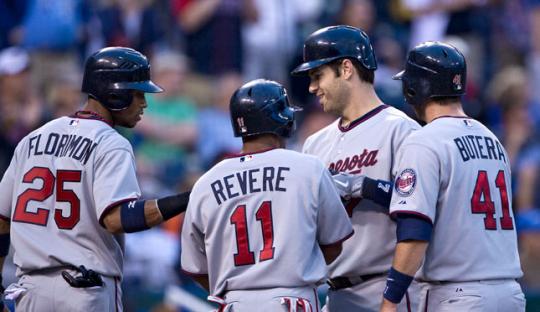
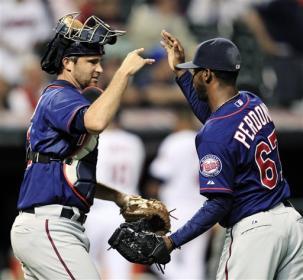
You know the drill. Quote image, add caption.
-
Nothing more than dumb luck. It won't happen again.
-
If only Torre hadn't ruined Mariano Rivera's arm during his time as Yankees' skipper. I may be going out on a limb here but I think that Rivera guy could have really been something had he stayed healthy.
-
Trade Revere, Not Span
Brock Beauchamp replied to YourHouseIsMyHouse's topic in Minnesota Twins Talk
I'm not against trading him for a B prospect if the team also pulls in a raw guy with good upside in the low minors. It all depends on the package. If it's only a B prospect, no thanks. I'd pass. The team doesn't need to trade Denard but it is a good idea considering the dearth of pitching in the system. -
An interesting analysis but it's a little disingenuous to compare the Twins' past two years to the league average. The Twins' staffs in 2011/2012 have been downright awful. Everyone knows that. No matter what you preach to your staff, if they have no talent they will have very limited success. The Twins weren't harping on Liriano when he was throwing strikes in 2010. They may have asked him to get a few more pitches over the plate in hopes that he'd be a 7-8 inning pitcher instead of a 5-6 inning pitcher but almost any team would ask that from the guy. Finding ways to build on success is natural. On the other hand, we only heard about the team preaching PTC to Francisco after he turned into an awful pitcher that couldn't throw strikes and was walking 80% more batters and throwing 5% less strikes (and therefore, 5% more balls). While you say they should have worked on his mechanics, do we have any kind of assurance that they didn't do just that? I think you're getting hung up on the terminology here, not factoring in what the team was actually trying to say and instead of paying so much attention to the word "contact". They were trying to get Liriano to throw more strikes, which makes him a better pitcher because his slider is more lethal with a located fastball preceding it. The Twins weren't trying to get him to stop striking guys out. Strikeouts happen naturally if you get the ball over the plate and have good movement on your pitches. It should also be noted that in the course of his career, Scott Baker has gradually increased his K/9 with the Twins (and posted a 8.2 k/9 to Liriano's 7.5 just last season). The team hasn't done anything to stop this progression. Why? Because Scott has never had issues with his command and therefore, there was nothing to be concerned about. This team isn't against strikeouts, it's against guys who don't throw strikes.
-
No, I think it means that Joe wants to see what a pitcher has in his arsenal before deciding to swing. Nothing wrong with that. Guys take different approaches to get to the same point. Some are Vlad or Kirby, others are Mauer or Williams.
-
Rand: The Mauer versus Puckett comparison
Brock Beauchamp replied to Parker Hageman's topic in Minnesota Twins Talk
The HoF factors in a lot more than just play on the field and I don't have any issues with that. Puckett easily got through the voting process because of his personality, his rings, and his career-shortening glaucoma. But if we're comparing only what was done on the field (which is generally the point of player comparisons), guys like Lofton and Murphy aren't terribly different than Puckett as overall players. -
Rand: The Mauer versus Puckett comparison
Brock Beauchamp replied to Parker Hageman's topic in Minnesota Twins Talk
Again, nowhere in this thread have I questioned Puckett's HoF-worthiness. I believe he deserves to be there... I'm just pointing out that he's not the greatest player since Mantle. I flipped the homers. That was a screwup on my part. On the other hand, Lofton played in ~20% more games than Puckett while Kenny's career WAR is ~35% higher than Kirby. Lofton was a great defender for longer, was better at getting on base, and was a terror on the basepaths. Kirby had the advantage in BA and slugging. Interestingly enough, WAR isn't kind to Kirby's defense. An oversight on the part of WAR in the early days of the Metrodome or a misjudging of Puckett's defense capabilities? Either could be the case. And by the way, hits are in no way comparable to touchdowns. I downplay hits because they're only a part of what a player does at the plate and on the basepaths. Hits are an overblown statistic because a single is not a double is not a triple is not a homer, yet they are all counted for the same in that metric. It's like comparing Plaxico Burress and LaDainian Tomlinson and concluding that they're the same player because they have approximately the same number of receptions, ignoring that Plaxico had twice as many yards per catch than Tomlinson and four times as many receiving touchdowns while also ignoring Tomlinson's running abilities. It's a non-sensical comparison in a vacuum because the information is nearly useless. -
Pitch for the Durham Bulls.
-
Rand: The Mauer versus Puckett comparison
Brock Beauchamp replied to Parker Hageman's topic in Minnesota Twins Talk
Al Newman has two rings as well. Newmie >> Mauersie Al Newman > Ted Williams -
Rand: The Mauer versus Puckett comparison
Brock Beauchamp replied to Parker Hageman's topic in Minnesota Twins Talk
On the left, you see Kirby Puckett in his age 35 season. On the right, you see Paul Molitor in his age 35 season. It's not hard to see why one doesn't believe that Puckett was going to age gracefully into his age 40 season and why Molitor did just that. Oh, and Puckett wasn't a better hitter than Molitor. Their career OPS+ are 122 and 124. They were basically the same hitter (though as an overall player, Molitor was far more valuable over the course of his career than Puckett, sporting a WAR of 72.5 to Puckett's 48.5).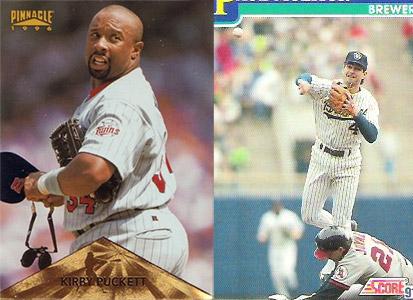
-
Rand: The Mauer versus Puckett comparison
Brock Beauchamp replied to Parker Hageman's topic in Minnesota Twins Talk
You're going to use hits as the sole indicator of a player's worth? I think it's pretty apparent I was comparing the entire player, not just his hitting style. Lofton had 70 more HR, 450 more BB, 20 less 2B, 500 (!) more stolen bases, and 50 more 3B than Puckett. The comp isn't 100% accurate but they were both centerfielders who were well above average during the peak of their careers (and had overlapping careers). Lofton just lasted a little longer than Puckett. Kenny spent the bulk of his career posting an OPS+ of around 10-15 points lower than Puckett and ended his career with an OPS+ 20 points lower, while Lofton posted a career 64.9 WAR against Puckett's 48.2. They're not as different as you'd like to think. I believe Puckett was the better player (but not by much) and someone could make a damned good case that Kenny was the better overall player. I wouldn't buy it but the argument could easily be made. -
Trade Revere, Not Span
Brock Beauchamp replied to YourHouseIsMyHouse's topic in Minnesota Twins Talk
Aaron Hicks. -
Rand: The Mauer versus Puckett comparison
Brock Beauchamp replied to Parker Hageman's topic in Minnesota Twins Talk
To be clear, I'm not against Puckett being in the HoF. I loved the guy as much as anyone. His 87 and 91 championships, his personality, his talent, and his untimely exit all contributed to his HoF career. I don't have a problem with that. But from purely the numbers he put up on the field, he was not what I'd consider a "baseball great". James may have listed him as the 7th best CF ever but it's a pretty massive drop-off after Mays, Mantle, Cobb, Griffey, and DiMaggio. Puckett isn't even close to any of those guys (personally, I don't think he was even all that close to guys like Snider). Puckett's best comp might be Kenny Lofton. That doesn't exactly light the world on fire. -
Butera rotting on the bench as a third catcher who starts 20-25 games in a season doesn't bother me much. Butera starting 50 or more games as a part-time catcher is just about the worst idea in the world. The guy is one of the worst hitters in MLB history.
-
Rand: The Mauer versus Puckett comparison
Brock Beauchamp replied to Parker Hageman's topic in Minnesota Twins Talk
Puckett would have had to play into his age 40 season at the same level as his age 33-35 seasons to get to 3,000 hits. If you're old enough to remember Puckett so vividly, you should also remember what he looked like as a 35 year old corner outfielder and realize just how unlikely that was to happen. 3,000 hits wasn't out of the question for the guy but it was a bit of a longshot. He certainly wouldn't have "easily" reached the mark. -
Post of the week.
-
Why Isn't Tony Oliva in the HOF?
Brock Beauchamp replied to YourHouseIsMyHouse's topic in Minnesota Twins Talk
Injuries and a lack of respect for the DH in the early days of the position. If he could have eeked out even two more above average seasons, I think he'd be in the HoF right now. -
Rand: The Mauer versus Puckett comparison
Brock Beauchamp replied to Parker Hageman's topic in Minnesota Twins Talk
You shouldn't get ripped for that. We all love Puck but those of us who try to avoid looking through the baseball annals with rose-colored glasses generally think that Puckett was a little overrated. Great hitter, fantastic personality, Very Good Baseball Player. He had great moments but he was not a baseball great. He was basically Dale Murphy or Kenny Lofton with fewer ABs and a better PR agent. You don't exactly see people pounding down doors in Cooperstown to let those guys into the Hall of Fame. -
Rand: The Mauer versus Puckett comparison
Brock Beauchamp replied to Parker Hageman's topic in Minnesota Twins Talk
That comments section made me despair for the human race. -
Sometimes you'll hear of a pitcher that he "never gives in to the batter", which I take to mean that the guy would rather throw a quality pitch on 3-1 even at the risk of walking the batter rather than lay it in for a high chance of a double or worse; extrapolating, he might also be less likely to throw a strike on 2-1, and even on 1-1 he's not afraid to let the count go to 2-1 in order to make his pitch. Is that on the same spectrum, at the other end, from PTC? (Steve Carlton is the guy I think I heard this said of first.) Yes and no. I view PTC as something that happens early in the count more than later. The point isn't to avoid all walks, it's to avoid pitching behind in the count to most of your batters. Give them something to hit. If they hit it, don't worry, just try again with the next guy. If they miss, great, you're now up on the batter 0-1 or 1-2. To me, the purpose of PTC is to make the batter beat you and your defense early in the count instead of issuing free passes or getting behind guys too often, running up your pitch count. It's not about lobbing it over the middle of the plate and crossing your fingers, it's about using your first 1-2 pitches to get ahead of the batter so that you can set him up with your breaking ball or off speed stuff to keep the batter off balance. Anyway, that's how I've always viewed it. I think "Pitch to Contact" is being read too literally by some posters on this forum. John and I were talking about it at lunch today and he mentioned that it should be referred to as "Challenging the Hitter" or something like that. It's not about putting every ball into play, it's about getting ahead of batters and making them beat you early in the count instead of having to serve up a meatball in a 3-2 or 3-1 count.


