


Twins Video
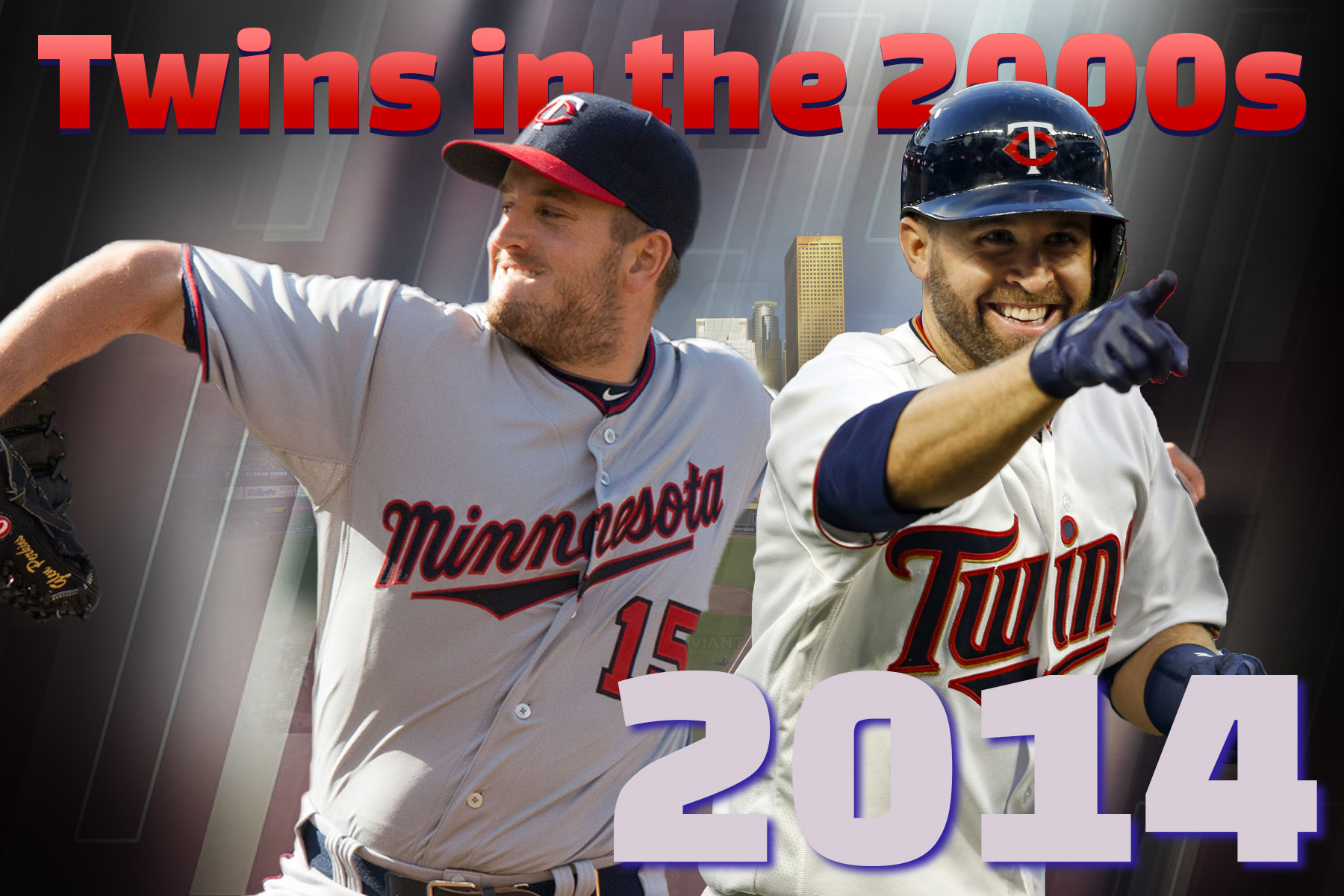
We're running a 20-part series in which we look back at each Minnesota Twins season of the 2000s. A rotation of different writers will highlight key moments, unearth forgotten details, and share nostalgic tales from the past two decades leading up to the present. This installment covers the 2014 season.
Team Record: 70-92
Finish: 5th Place in AL Central
All-Stars: Glen Perkins (RP), Kurt Suzuki ( C )
Awards: N/A
Playoffs: N/A
Season Overview
After a scary concussion ended his 2013 season, Joe Mauer and the Twins made the tough decision to hang up his catcher's gear. In 2014, with first base opened up by the absence of longtime tenant (and M&M counterpart) Justin Morneau, Mauer settled in at his new home.
Taking over at catcher was free agent Kurt Suzuki, who joined Mauer and a newly solidifying core on Opening Day: Brian Dozier at second base, Trevor Plouffe at third, Aaron Hicks in center field, Oswaldo Arcia in right.
Sure, there were some leaky plugs, like shortstop Pedro Florimón and a DH spot being held down by longshot Chris Colabello. There were also some very strained efforts by Terry Ryan at recapturing nostalgia, with non-roster signings Jason Bartlett and Jason Kubel inexplicably making the bench out of camp. (Both predictably struggled, and then were done as big-leaguers. Bartlett actually announced his retirement in April.)
But it was easy enough to see Ryan's vision for this team as he laid groundwork for the arrival of top prospects Byron Buxton and Miguel Sanó, ranked ahead of the season by Baseball America as the No. 1 and No. 6 prospects in the game.
Unfortunately, things would not go as planned for either of these premier young talents in 2014. Sanó tore his UCL in spring training and required Tommy John surgery, forcing him to miss the season. Buxton was struck by a barrage of injuries – including a scary outfield collision in August that left him momentarily unconscious – and played only 31 games total.
As their rising cornerstones stalled out, so too did the Twins in a rebuild largely framed around them. The team managed to hang around .500 through much for the first half, but started to slide as June transitioned to July, and by the break they were 10 1/2 games out of first. A picture-perfect All-Star Game at Target Field, featuring Suzuki and Glen Perkins, was a moment for Twins fans to savor, but there wouldn't be many afterward as Minnesota went 26-42 in the second half, completely fading from relevance.
The offense, mostly, did its part. This required some tinkering and rejiggering from its initial state, and not every experiment took (the midseason signing of veteran free agent DH Kendrys Morales serving as one failed gamble), but others did. For instance:
- After Hicks struggled out of the gates in center (again), he was replaced by rookie Danny Santana, a natural shortstop who took well to the defensive relocation and slashed .319/.353/.472 in 101 games.
- Once the Twins finally grew tired of Florimón's totally inadequate bat, they turned to Eduardo Escobar as their regular shortstop in the second half and the light-hitting utilityman responded with a breakthrough offensive season, posting a .721 OPS with 35 doubles.
- On August 1st, slugger Kennys Vargas made his MLB debut, starting at first base and batting sixth. He doubled and drove in two. Over the final two months, Vargas would take over as primary DH, hitting .274/.316/.456 with nine home runs and 38 RBIs in 58 games.
Even with Mauer becoming a mere shadow of his former self (.277/.361/.371), he was still reasonably effective. And the strength of this offense was in its balance – 11 different players made 100-plus plate appearances and posted an OPS+ of 100 or better. This was a stark contrast from one year earlier, when they had only three such players.
Thanks to these varied contributions, the 2014 Twins finished fifth among AL teams in both runs scored and OPS. A big departure from 2013 (13th in runs, 12th in OPS) and 2012 (10th in both).
The pitching staff wasn't such a departure from the status quo, ranking last in ERA and strikeout rate while allowing the most hits of any team in baseball for a third time in four years (they allowed the second-most in 2012). The internal pitching pipeline was providing very little, as evidenced by a season-opening rotation that featured four free agents (Ricky Nolasco and Phil Hughes from the latest offseason; Kevin Correia and Mike Pelfrey from the one prior) alongside Kyle Gibson.
Hughes proved to be a phenomenal find, delivering an historic first season as a Twin, and Gibson was decent in his first full campaign. But that was the extent of positives for the rotation. Nolasco's first season was a disaster as he went 6-12 with a 5.38 ERA. Correia was bad before the Twins unloaded him to the Dodgers in August. Pelfrey battled injuries and made five starts, with a 7.99 ERA. Yohan Pino, Trevor May, Logan Darnell, Tommy Milone all got crushed in their rotation opportunities.
In the bullpen, Perkins had another great year generally, but it was marred by a brutal September in which he allowed eight earned runs in 5 1/3 innings with one strikeout before being shut down with forearm soreness, inflating his final ERA to 3.65. Injuries were beginning to impact Minnesota's All-Star closer, who was already nearing the end of a brief-but-brilliant peak.
As Perkins cratered down the stretch, so too did the Twins, stumbling to another last-place finish. This was enough for Ron Gardenhire to run out his leash. The second-longest tenured manager in the major leagues (behind Mike Scoscia of the Angels) was fired after the season ended. His endurance of this brutal stretch is a testament to the organization's unparalleled loyalty: Gardenhire became the fourth manager in MLB history to preside over four consecutive 90-loss seasons with the same team.
One of the others was his predecessor, Tom Kelly. The other two examples are old enough that the teams managed were the Philadelphia Athletics and the St. Louis Browns.
Team MVP: Phil Hughes (SP)
Other Contenders: Brian Dozier (2B), Danny Santana (CF), Trevor Plouffe (3B), Kyle Gibson (SP)
On the one hand, it's tough to award team MVP to a pitcher on a staff that was clearly the club's downfall. Dozier, Santana, Plouffe and others were all big factors in a lineup that was this team's only saving grace. On the other hand, none of those players were truly extraordinary. Hughes transcended in 2014, and he was basically the only thing preventing this rotation from all-out ruin.
In a career-high 209 2/3 innings, he struck out 186 batters and walked only 16. His 0.7 BB/9 rate was the best in the majors, and his 11.63 K/BB ratio was the best in major-league history, topping Bret Saberhagen's record from 30 years prior.
Hughes went 16-10 with a 3.52 ERA, 2.65 FIP, and 1.13 WHIP. His 6.3 fWAR led the team with ease, and represents the highest valuation FanGraphs has assigned a Twins pitcher since Johan Santana's Cy Young season in 2006.
3 Most Pivotal Games
May 15th: Won vs. Boston Red Sox, 4-3
This game was notable for a few reasons. First and foremost, it was a walk-off win that clinched a series against a formidable foe, and part of a 7-2 stretch that pushed the Twins above .500 in late May.
They won behind their newfound ace Hughes, who struck out eight and walked none over six innings of one-run ball, and a walk-off single from the embattled Hicks, who began to find himself at the plate a bit after this big moment.
June 18th: Lost @ Boston Red Sox, 2-1
A month earlier, the Twins had won two walk-offs at home against Boston (including the one above) as they seemingly asserted their viability in the American League. Their rematch against the Red Sox at Fenway in mid-June, capped by this sweep-clinching walk-off loss, reflected how much things had changed. The Twins managed to score just two runs in three games, including a sleepy four-hit effort in the finale that wasted Gibson's seven shutout innings. Most painfully, the Twins took a 1-0 lead on Chris Parmelee's home run in the 10th, only to have David Ortiz and Mike Napoli tie and win it on back-to-back solo homers in the bottom half.
By now Minnesota was six games below .500, and right in the middle of a 10-game road losing streak. By July 4th they'd be 11 games out of first.
August 26th: Lost @ Kansas City Royals, 2-1
The Twins were hopelessly out of contention and spiraling toward the finish line. They went through five different four-game losing streaks in August and September, and were amidst one of them when Kansas City delivered this morale-crusher on August 26th.
Nolasco provided a rare good start, firing seven shutout innings, before handing it off to Burton for a scoreless eighth. In came Perkins to protect a one-run lead. Alcides Escobar led off with a single, and Alex Gordon followed with a walk-off homer. Ballgame. It was the first sign of an unraveling to come for Perkins, who posted an 11.37 ERA the rest of the way, striking out two of his final 30 hitters before being shut down.
Unforgettable Highlights
Jorge Polanco Debuts
Five years earlier, Bill Smith had signed a class of international talents that would eventually become transformative. In 2014, Jorge Polanco beat out Sanó and Max Kepler to a big-league debut, appearing mostly out of logistical necessity when the Twins needed an extra man for stretches in late June and July. He appeared for Minnesota only five times – four coming as a late-game replacement – and went 2-for-6 at the plate.
Polanco didn't make much impact in 2014, but he became the second-youngest Twins player to debut in the 2000s (behind only Mauer, who was four days younger on Opening Day 2004). His impact would be plentiful down the line.
Perkins and Suzuki Close Out All-Star Game
In a storybook moment, Perkins was set up for a two-run save in the ninth inning of the All-Star Game at Target Field on July 15th. The hometown success story got a chance to throw to Minnesota's other 2014 All-Star, the catcher Suzuki, and together these Twins worked a 1-2-3 inning to close out the win.
Dozier Joins 20/20 Club
By notching his 20th stolen base on August 20th, to go along with his 20 home runs, Dozier became the fifth Twin to reach the 20/20 club. Torii Hunter did it twice (2002 and 2004), while Corey Koskie (2001), Marty Cordova (1995), Kirby Puckett (1986) and Larry Hisle (1977) are the other members.
Hughes Gets His Phil of Strikeouts
That headline might've made you groan, but I bet not as much as this fact: When Hughes struck out 11 White Sox in his September 13th start, it was the first time in 380 games that a Twins starter reached double-digit Ks.
In a related note, longtime pitching coach Rick Anderson was ousted after the season alongside his main man Gardenhire.
One Detail You Probably Forgot
In the first decade of the 2000s, Matt Guerrier enjoyed the best years of his career, and was frequently an essential bullpen fixture. He led the AL in appearances in two consecutive seasons, 2008 and 2009, and was a top-notch setup man more often than not.
By 2014, at age 35, he was nearing the end. He signed a minor-league deal with the Twins, was called up in May, and posted a 12-to-10 K/BB ratio in 28 innings through late July before the team moved on. Like fellow throwback signings Kubel and Bartlett, Guerrier walked off into the sunset after a final ride with the team – and manager – that brought him into the big leagues.
In retrospect I suppose there's a poetic beauty to it, although I gotta say, at the time it was infuriating because these guys were clearly cooked.
Fun Fact
Per his contract, Hughes was in line for a $500,000 bonus if he reached 210 innings pitched in 2014 – no small sum for a guy earning $8 million in salary. Seemingly on a mission to reach it, he threw seven-plus innings in nine straight starts to end the year. In his last outing Hughes was through eight frames of one-run ball before a rain delay forced him out, with his season total sitting at 209 2/3 innings. Gardenhire offered him a chance to pinch once more in the final weekend and earn the bonus, but Hughes declined.
~~~
Previous Installments:
- The 2000 Season
- The 2001 Season
- The 2002 Season
- The 2003 Season
- The 2004 Season
- The 2005 Season
- The 2006 Season
- The 2007 Season
- The 2008 Season
- The 2009 Season
- The 2010 Season
- The 2011 Season
- The 2012 Season
- The 2013 Season





Recommended Comments
Create an account or sign in to comment
You need to be a member in order to leave a comment
Create an account
Sign up for a new account in our community. It's easy!
Register a new accountSign in
Already have an account? Sign in here.
Sign In Now