

Jump to content
Twins Daily
  • Create Account
  • Twins News & Analysis

    On The Twins' Cheapness And Showing Your Work


    William Parker

    I want to talk about the Twins and payroll, and how we talk about the Twins’ payroll.

    It’s been about a month since Jack Moore wrote the excellent and scathing The Minnesota Small-Market Con over at Baseball Prospectus Milwaukee. The points it makes are numerous and wide-ranging -- the most important, I think, is “if the billionaire Pohlads had been willing to take a short-term loss, they could have made their way out of the Metrodome years earlier without taking the public for such a ride" -- but being published as it was in the latter part of an offseason in which fans have watched the team take very few substantial visible steps toward getting better, most seemed to take it as a chance to complain about the team's unwillingness in recent years to spend on free agents.

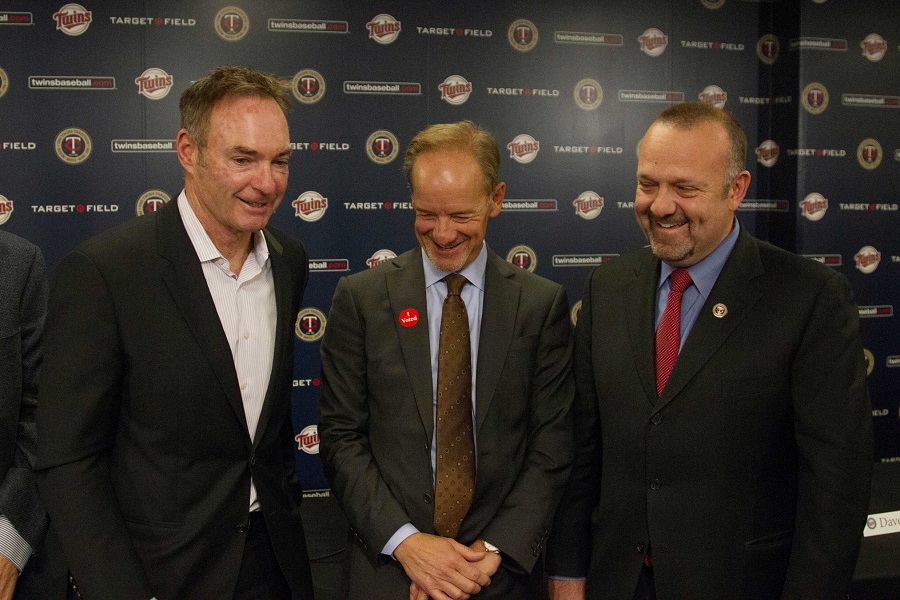
    Image courtesy of Brad Rempel, USA Today

    Twins Video

    And I get it. Having taken the public for said ride and secured a stadium that is maybe the most appealing in baseball, the Twins (per Cot’s Contracts) ended their first two seasons in Target Field with top-ten payrolls, but then fell back to 13th in 2012, and haven’t been out of the 20s since. While attendance predictably declined from 2011 to 2015, it seems a safe bet that they could generally have spent more money than they did in those years and still turned a nice profit.

    The problem I’ve always had, though, is that this (at the most) is generally where the fan’s analysis stops. They could have spent more money, but they didn’t, and they should have. The obvious next questions that gets left on the table, though, are “on what?” and “why?”: what could that money have gotten them, and what makes it a good idea? The 2011 Twins had a $115 million payroll and were coming off a 94-win, first-place year, but with injuries to almost literally everyone -- only Danny Valencia and Michael Cuddyer would play as many as 120 games for the Twins in 2011 -- they lost 99, finishing a whopping 28 games out of a wildcard spot, and it was pretty clear their window had slammed shut. They lost 96 in both 2012 and 2013 (22 and 26 games out of the playoffs, respectively), and 92 (18 out) in 2014. Their season-ending payroll declined, meanwhile, from 9th in 2011, to 13th, to 24th.

    But, again, what could and should they have spent more money on, and what could we have expected it to bring them? In a league in which the very best player might be worth about nine wins and four is a typical All-Star, the Twins would’ve had to add the equivalent of four or five All-Stars, two Mike Trouts, or some combination thereof (assuming each of them takes the place of true replacement-level players, to boot) in order to have had any chance at a postseason berth in any of those years. That’s not the kind of thing that’s ever happened via free agency--teams have tried, typically with disastrous consequences (check out the turn-of-the-century Devil Rays sometime).

    But what if the postseason isn’t the goal? What about just putting a marginally more entertaining product on the field? I question whether that’s a thing, personally--it’s the competing that draws the crowds, the Timberwolves are as entertaining as a bad basketball team can get right now and not drawing substantially more than their terribly depressing squads of the last couple years did--but I get that, too. It’s not as though a team puts those savings in an interest-bearing account and adds them to the pot for next year. They would, in a perfect world, but they don’t; those savings go to the owners, and the next year’s budget is its own thing. So to the extent you’re concerned only about this season, yes, you as a fan should want the team to spend as much money as they can possibly get away with, because that money’s gone for your purposes after the season either way.

    The problem with that is that the one-year deal for a good (or even just “entertaining”) player exists in baseball only when that player comes with huge risks. Most free agents worth signing as anything more than filler in this game demand commitments of three years, or four or five or more. Most free agents are also in their 30s, which means almost without exception that they’re likely to get worse over those three to five years, not better. What that means is that most of the free agents the Twins could’ve signed to make them marginally better or more fun in 2013 or 2014 would still be getting paid as Twins in 2016, and would be less good or fun now than they were then (but probably making at least as much money). When you don’t expect to win, you probably shouldn’t (and can’t, to field a team that avoids challenging the ‘62 Mets) stop spending entirely. But your focus in spending, way ahead of getting better for the now, has to be to avoid hamstringing the team in future seasons, when -- if your prospects pan out and you’re not too bogged down by aging players’ contracts -- you might be positioned to spend to fill more immediate needs and make a run at it.

    In that light, I tended to think the Twins’ spending from 2012 through 2014 was just about perfect--a weird thing for me to say, as I’ve never been one to go easy on the front office (Tony Batista and Ruben Sierra? Seriously?). In 2012, there was just a long, black-dark road ahead, and nothing to do but fill a couple of the gaps to try to be interesting and wait it out. And that’s exactly what they did, bringing in Josh Willingham (who worked) and Ryan Doumit (who didn’t) to fill in for the departing Michael Cuddyer and Jason Kubel, and otherwise just stayed put and take their lumps. Heading into 2014, with Byron Buxton, Miguel Sano and others now on their way, it made sense to take a look at some relatively low-risk, 30-or-younger free agents who could reasonably be expected to be contributing at about the same level a couple years down the line, and they did that, bringing in Phil Hughes (who I’d argue worked) and Ricky Nolasco (who thus far clearly hasn’t), along with more stopgaps like Mike Pelfrey and Kurt Suzuki. For whatever else the Twins have done right or wrong, this is exactly how a non-contending team should spend its money. Should they have spent more of it? Perhaps--but it’s on the one arguing they should to identify where they should’ve spent it and why. Whining that they’re cheap and run by billionaires just doesn’t cut it; they’re losing ninety-plus either way. Show your work.

    I’ve left out 2015 so far, of course, and that’s a tough one because we know how it ends: the Twins win 83 games, surprising everyone, and miss the wildcard play-in game by just three wins. They entered the last week with a real shot, and as it turns out, even one modest upgrade in the offseason could have gotten them there. That’s cheating, though: the Twins didn’t know how it would end, and I really think they were looking at 2016 or 2017 as their next legitimate chance, and so they stayed the course, bringing in 32-year-old Ervin Santana to add to their stable of average starters who seem likely to still be about average by the next time they thought they’d be competitive. Were there moves that not only could have put them over the top as things turned out, but that they should have made in December or January 2014-15, knowing and believing what they reasonably did then? Maybe! But I’d like to know what those specifically were. (Note also that a first half from Santana might itself ultimately have put them in the playoffs.)

    So that gets us to today. I’ve been as frustrated as anyone with the lack of activity: Byung-Ho Park is certainly interesting, but hardly fills a glaring need, and there’s not much else that’s even worth mentioning. It feels much like a team with two third basemen and three or four 1B/DH types, which seems to suggest moves to be made, and I would’ve loved to see them land, say, Darren O’Day, an elite reliever who signed a four-year deal to stay with the Orioles similar to the ones the Twins gave Santana and Nolasco. But: O’Day is 32 years old, and at his very best -- at any modern reliever’s best -- is worth about three wins. The Twins had a lot of luck last year, and while I’m looking forward to seeing what they can do in 2016, there’s good reason to believe they’re not quite there yet, with or without the upgraded bullpen. If, as Baseball Prospectus’ PECOTA expects, they go 79-83 and miss the playoffs by seven games, O’Day probably wouldn’t have made a difference, and neither would most anyone else. And then what about in 2018, when Buxton and Sano are MVP candidates, but O’Day is 35 and ineffective, while his $9 million salary helps prevent you from signing that year’s Darren O’Day, who could be the difference between an LDS loss and a world championship?

    I have no answers. I thought they should have done more this offseason, and I sure hope that they do well enough that there’s a worry it might come back to bite them. But too often, we collectively seem to want the team to spend more money without considering a.) the limits of what that spending can actually do, or b.) the risks down the road of imprudently committing money now. Fans can complain that the team is cheap all they want -- and why not, it’s just baseball, it’s all in fun, you do you -- but without an idea of how they should spend that extra money, why they should and what might happen if it goes bad, all it is is whining for whining’s sake. Seems to me it’s more fun, more instructive, and, at least in this case, harder to argue with the plan, if you show your work.

    Follow Twins Daily For Minnesota Twins News & Analysis

    Recent Twins Articles

    Recent Twins Videos

    Twins Top Prospects

    Marek Houston

    Cedar Rapids Kernels - A+, SS
    The 22-year-old went 2-for-5 on Friday night, his fourth straight multi-hit game. Heading into the week, he was hitting .246/.328/.404 (.732). Four games later, he is hitting .303/.361/.447 (.808).

    User Feedback

    Recommended Comments


    Featured Comments

    Good post bird.


    If I could add a perspective from the "spend!" side: something that also gets ignored, from the "don't tie up future payroll" side, is that money unspent today, is just as wasted tomorrow as money that's already spent.


    Not pending in 2014 is an opportunity that is gone, and we can be reasonably sure it won't be put in an account and spent in 2018.


    So there's cost to both methods. Either way, you're tieing someone's hands, sometime.


    Good post bird.

    If I could add a perspective from the "spend!" side: something that also gets ignored, from the "don't tie up future payroll" side, is that money unspent today, is just as wasted tomorrow as money that's already spent.

    Not pending in 2014 is an opportunity that is gone, and we can be reasonably sure it won't be put in an account and spent in 2018.

    So there's cost to both methods. Either way, you're tieing someone's hands, sometime.


    Yeah, good point. Sure would be sweet if they made a public commitment to have such an account, and I'd suggest it would be a helluva brilliant PR move. Therefore, because this org is allergic to good PR, it'll never happen.


    With a K/9 over 9?  I think you're underselling May a bit.  I'd put money on May being a better starter than Meyer at this point.  Radke was a good pitcher and in a different era, but you really undersell May on this one.

    When did May ever have a season with a k/9 over 9 besides the minors?

    Good post bird.


    If I could add a perspective from the "spend!" side: something that also gets ignored, from the "don't tie up future payroll" side, is that money unspent today, is just as wasted tomorrow as money that's already spent.


    Not pending in 2014 is an opportunity that is gone, and we can be reasonably sure it won't be put in an account and spent in 2018.


    So there's cost to both methods. Either way, you're tieing someone's hands, sometime.

    In my mind that money would have been better spent eating money on a trade, taking on a bad contract to acquire a better asset, popping the international spending limits on occasion or pumping money into one year flyers that could get flipped.


    While I personally don't think signing free agents at the level suggested is the answer, I hope that isn't seen as full agreement in what they did. In addition to not really pursuing the policies I suggested they probably still tied up too much money in middle of the road pitching.

    I think there is a decent argument that if you are going to have money tied to diminishing players, the best time is as the competitive window is opening up. The Twins maximum payroll flexibility should be the next three years, where the production-to-dollars ratio for Sano, Buxton, Berrios, Duffey, Rosario, Kepler, et al is a its absolute highest. Maybe Sanchez was a little too early for this window, but I'd definitely argue that going after Russell Martin a year ago certainly would not have been. And as my little exercise (surprisingly, at least to me) showed, the payroll situation right now between my moves and the status quo is practically zero. It is just as easy to clog payroll with multiple small moves as it is with a handful a big moves, and the small moves have the added downside of clogging the roster as well.

    My two quibbles here would be I don't think you can just plug in the free agent contracts signed, you have to add a year and some salary. Second, you are operating with perfect hindsight, would be impressive to pull it off similarly in real time.


    Except he wasn't.  

    Yup, that is why Duensing and Swarzak were in the bullpen and starts were given to Albers, Pedro Hernandez and the like were being given starts, Duensing and Swarzak were better pitchers than Correa. Pitchers that year that did not work out one  or two year contracts: Meyer, Marcum, Jurrgens, Lannan, Baker, Shawn Burnett, Roberto Hernandez, Blanton  and Haren.   Karstens had a half season and has not pitched since.  Correa  was signed to fill a slot, not carry the team. Pitch every 5 days

    In my mind that money would have been better spent eating money on a trade, taking on a bad contract to acquire a better asset, popping the international spending limits on occasion or pumping money into one year flyers that could get flipped.


    First of all, this plan was just a general outline of the biggest money moves to stay under a certain salary level. There is still plenty of room to do some of these things on the side if you want -- note that the author didn't address Correia, Capos, etc. Feldman, Kazmir, etc. would all still be options in his scenario, just as much as in more of a rebuilding scenario (actually some guys even more so -- guys like Madson may have been more inclined to sign here if we already had a record near .500).


    As for the bigger financial commitments you mention, any specific examples from the past few years? Feel free to use hindsight. While in theory the alternatives sound nice, in practice I think you might see they are not actually clearly better than Sanchez.

    My two quibbles here would be I don't think you can just plug in the free agent contracts signed, you have to add a year and some salary. Second, you are operating with perfect hindsight, would be impressive to pull it off similarly in real time.

    At least with Sanchez, I know the author added $5 mil and perhaps removed the Tigers backloading, although maybe it wasn't intentional. Generally I agree with you, and when the plan gets to Martin, I consider that a bit of a stretch, although Hunter and Buehrle may have signed for a comptetive offer here without much cajoling.


    By the time Martin comes around, you could substitute Montero as a worthy investment anyway.

    Edited by spycake


    My two quibbles here would be I don't think you can just plug in the free agent contracts signed, you have to add a year and some salary. Second, you are operating with perfect hindsight, would be impressive to pull it off similarly in real time.

    These are valid quibbles, especially the first one. I totally agree that it wasn't completely fair to just claim that free agent X would have signed here for the exact same amount as they ended up signing for somewhere else. I just didn't have a good handle on what the proper adjustment should be, though your "add 10% and an extra year" is a solid suggestion, and if I had saved my spreadsheet from yesterday I would try to rerun the scenario with that factored in. However, another factor that prevent me from making any adjustments is that the numbers just worked really well given the parameters I was working under, and frankly I was too lazy to go into the weeds and start making secondary moves like "In order to keep the Sanchez signing under budget, they couldn't sign Correia or Pelfrey" in order to keep everything under budget. But without going through the work (again, I'm lazy), my gut feeling is that there is enough slack with the Correia/Pelfrey/etc signings that a bump up in free agent prices is still manageable. 


    To your second quibble, I wouldn't say it was "perfect" hindsight. To pull back the curtain a little bit, I was intrigued by the challenge put out, and I decided to start out with a framework built around 5 moves that I wanted at the time: keeping Hardy, signing Sanchez and Martin, not signing Santana and not extending Hughes. Those 5 were my starting point, and I was definitely surprised by how much payroll was still available (from the $125M limit), especially if I dumped Nolasco. Then I looked through the 2012-2014 teams to identify major weaknesses, and decided that I really needed another starter and a corner outfield/DH bat. From there it was pretty easy to cherry-pick the Beurhle and Hunter contracts. So yes, there was definitely some benefit from hindsight, but a good chunk of these moves were picked "in real time".

    First of all, this plan was just a general outline of the biggest money moves to stay under a certain salary level. There is still plenty of room to do some of these things on the side if you want -- note that the author didn't address Correia, Capos, etc. Feldman, Kazmir, etc. would all still be options in his scenario, just as much as in more of a rebuilding scenario (actually some guys even more so -- guys like Madson may have been more inclined to sign here if we already had a record near .500).


    As for the bigger financial commitments you mention, any specific examples from the past few years? Feel free to use hindsight. While in theory the alternatives sound nice, in practice I think you might see they are not actually clearly better than Sanchez.

    I'm not exactly sure what you're asking in the second paragraph.


    I'm not exactly sure what you're asking in the second paragraph.

    Just specific examples from that time frame to support the following statement you made: "In my mind that money would have been better spent eating money on a trade, taking on a bad contract to acquire a better asset"

    Just specific examples from that time frame to support the following statement you made: "In my mind that money would have been better spent eating money on a trade, taking on a bad contract to acquire a better asset"

    That I won't be able to produce without more work than I'm able to do.


    But certainly a fair point, it is possible those opportunities didn't exist.


    That I won't be able to produce without more work than I'm able to do.

    But certainly a fair point, it is possible those opportunities didn't exist.

    That's my feeling.  Well, I am sure opportunities existed and I too would have entertained them, but in most cases, I'm guessing the net benefits weren't necessarily greater than those of the Sanchez contract, and/or those other opportunities weren't necessarily mutually exclusive from an investment in Sanchez (i.e. most flyer contracts).


    I'm mostly just thinking outloud here, so don't think that I'm against rebuilding. I have, at times, definitely been a strong advocate of the total rebuild like you suggest, so don't hold it against me if I argue for rebuilding in a different thread at a later date. :) I just feel like the last year changed my perspective as a fan a little bit. Maybe it has been all the losing, but it was shockingly fun to actually care about the results of the team for the entire season. It has definitely made me reconsider the value of just muddling along as a .500 team. Though I'm sure that would get old after a while, too!

    Yeah, I think "muddling along as a .500 team" gets under-rated.  The Twins have finished around .500 in 2001, 2005, 2007, and 2015, and those were fun, interesting years.  I would be very cautious about any plan that would deliberately sacrifice that for 3+ seasons.


    It's easy to look back at the White Sox recent years and say, they haven't made the playoffs, they would have been better off blowing things up for 3-4-5 years. But that feels like more of an abuse of hindsight than your exercise (which actually doesn't require much hindsight at all, the core moves of Hardy, Buehrle, Hunter, etc. were easily justifiable in real-time).


    The White Sox lost big one year (and got Rodon from it), otherwise they've been in the mix most years with a couple spikes to 85-88 wins.  They didn't get enough luck and/or didn't make the right moves to put them over the top in any of those years, but they'd probably still face the same luck/judgment issues after tanking for 3-4-5 years too.


    A deliberate long-term rebuild/tank job should probably be limited to fairly extreme circumstances, like having a more thoroughly awful MLB roster AND farm system (in which case you probably don't have to do anything "deliberate" to lose :) ).


    In my mind that money would have been better spent eating money on a trade, taking on a bad contract to acquire a better asset, popping the international spending limits on occasion or pumping money into one year flyers that could get flipped.

    While I personally don't think signing free agents at the level suggested is the answer, I hope that isn't seen as full agreement in what they did. In addition to not really pursuing the policies I suggested they probably still tied up too much money in middle of the road pitching.


    Agreed on all of this.


    Also, with the 2nd wild card, muddling along at 81-84 wins has REAL value now.......and with luck, you have a chance to be a playoff team and continue your luck.

    I wonder if we're seeing the effects of that in the standings too.  Since the second wild card was added in 2012, it has taken fewer and fewer wins to earn it: 93, 92, 88, and last year 86.


    In the AL anyway.  I guess the NL skews differently (the 88 win Cardinals snuck in for 2012, and of course the Pirates and Cubs both won 97 games last year).

    Edited by spycake

    You've been asking for bullpen upgrades all off season, how were Stauffer's 2013-14 numbers really much different than the guys you wanted this year?


    Stauffer wasn't any good last year, that happens all the time with free agent relievers, more so than any other position.

    Well, I am not sure one year is a great guide, especially for a reliever.


    I do know that Steve Cishek's career ERA plus is 139. Stauffer is at 92.

    I wonder if we're seeing the effects of that in the standings too. Since the second wild card was added in 2012, it has taken fewer and fewer wins to earn it: 93, 92, 88, and last year 86.


    In the AL anyway. I guess the NL skews differently (the 88 win Cardinals snuck in for 2012, and of course the Pirates and Cubs both won 97 games last year).

    Yeah, I think that's a byproduct of one league scrapping it out with several good-to-mediocre teams while the other has a large gulf between good and bad.


    Create an account or sign in to comment

    You need to be a member in order to leave a comment

    Create an account

    Sign up for a new account in our community. It's easy!

    Register a new account

    Sign in

    Already have an account? Sign in here.

    Sign In Now

×
×
  • Create New...
