Jump to content
Twins Daily
  • Create Account
  • Twins News & Analysis

    MIN 4, BOS 1: For Grossman and Kepler, The Price Was Right


    Andrew Thares

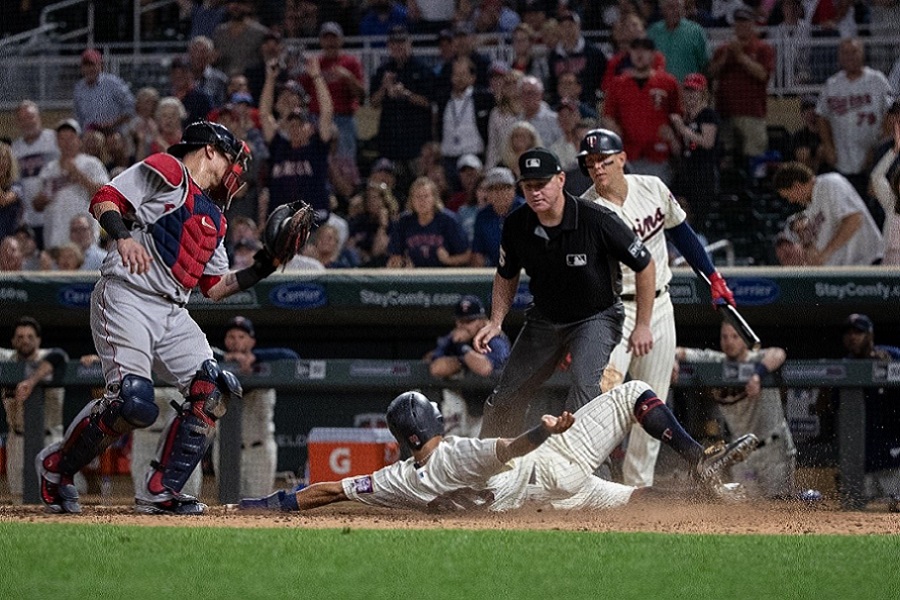
    The Twins have played two of their best games of the season to open this series against the Boston Red Sox. Last night it was the Eduardo Escobar show, tonight the Twins were led by excellent performances by both Max Kepler and from the bullpen. The Twins have clinched the series win and will go for what could be their first sweep of a three or four game series all season Thursday afternoon.

    Image courtesy of © Jordan Johnson-USA TODAY Sports

    Twins Video

    Snapshot (chart via FanGraphs)

    Lance Lynn: 53 Game Score, 5.0 IP, 3 H, 1 R, 0 ER, 2 K, 5 BB, 51.5% strikes

    Bullpen: 4.0 IP, 0 ER, 1 H, 3 K, 0 BB

    Lineup: 1-for-6 w/RISP, 5 LOB

    Top three per WPA: Lynn .186, Kepler .167, Hildenberger .080

    ccs-10590-0-94377500-1529553624_thumb.png

    Joe Mauer got the night off against a tough lefty in David Price, but Robbie Grossman stepped in nicely for him in the leadoff spot, belting a home run to get the Twins on the board after their first batter of the game. It was just Grossman’s third home run of the season and his first as a right-handed hitter.

    https://twitter.com/Twins/status/1009601105540603904

    The Twins base running woes continued tonight as Eddie Rosario was picked off first base with one out in the first. In case you were wondering, here is a little update on how many times the Twins have made outs on the bases this year.

    https://twitter.com/MNBrianHall/status/1009594749358047233

    After giving up a run in the second, the Twins regained the lead in the fourth when Max Kepler blasted a two-out, two-run home run of David Price. This continued Kepler’s improvement against left-handed pitchers this year as Kepler has now doubled his total of extra-base hits against them from a season ago, going from 6 to 12.

    https://twitter.com/fsnorth/status/1009612355787878401

    Kepler then backed that up with a tremendous diving catch, on a fly ball with a 4 percent catch probability, to rob J.D. Martinez of a hit in the eighth inning. The catch was originally ruled a hit but was quickly overturned after going to instant replay.

    https://twitter.com/fsnorth/status/1009632809026142208

    The Twins picked up an insurance run in the eighth when Brian Dozier lined a double off the left-field wall and Eddie Rosario scored from first with some excellent base running. Dozier finished the night going 2-for-4 with two doubles.

    Lance Lynn was the definition of effectively wild in his start tonight. Lynn needed to work around five more walks but wound up surrendering just one unearned run over five innings. In each of the five innings the Red Sox had a runner in scoring position, but in each instance, they failed to get a hit once someone got there.

    The only reason the Red Sox ended up scoring against Lynn was because of a botched exchange between Logan Morrison and Lynn after Morrison made a great diving play to nearly get the Twins out of the inning.

    While Lynn may have had to work to keep the Red Sox off the board, that wasn’t the same story for the Twins bullpen which allowed just one base runner over four innings of work.

    Taylor Rogers had perhaps his best outing of the season in the sixth, then Addison Reed came in for the seventh and had a get-back-on-track inning. Then it was more of the same from Trevor Hildenberger and Fernando Rodney who each worked a 1-2-3 inning in the eighth and ninth respectively.

    Postgame with Paul Molitor

    https://twitter.com/fsnorth/status/1009647744166711296

    Bullpen Usage

    Here’s a quick look at the number of pitches thrown by the bullpen over the past five days:

    ccs-10590-0-00673400-1529553609_thumb.png

    AL Central Standings

    CLE 40-33

    DET 36-39 (5 GB)

    MIN 33-37 (5.5 GB)

    CHW 24-49 (15 GB)

    KC 22-52 (18.5 GB)

    Next Three Games

    Thu at BOS, 12:10 pm CT – Rick Porcello vs. Kyle Gibson

    Fri vs. TEX, 7:10 pm CT – Mike Minor vs. Fernando Romero

    Sat vs. TEX, 1:10 pm CT – Yovani Gallardo vs. Jake Odorizzi

    Last Three Games

    MIN 6, BOS 2: Bats Get to Boston Bullpen

    CLE 4, MIN 1: Lots of Traffic, Just One Run

    MIN 9, CLE 3: That’s Our Eddie

    Follow Twins Daily For Minnesota Twins News & Analysis

    Recent Twins Articles

    Recent Twins Videos

    Twins Top Prospects

    Marek Houston

    Cedar Rapids Kernels - A+, SS
    Friday night, Marek Houston's first homer came in a 6-run 7th inning. His second home run gave his team an 8-2 lead an inning later. He's 3-for-5, 2 HR (5) and a stolen base, his 15th.

    User Feedback

    Recommended Comments


    Featured Comments

    To your point about it being lucky the other team can't get a hit with men on base, does that mean the Twins had been unlucky the entire first third of the season?

    Yes, there was definitely bad luck in some of their losses. Luck plays a much bigger role in sports than many like to acknowledge.


    Your scenario works when you're only talking about one game and assuming no other impacts from other players. Over the course of a season, avoiding making outs is a more important individual skill for scoring runs than hitting for power.


    The same thinking applies to the cliche of "a walk is as good as a hit". In isolation, that's true: both have avoided spending an out. But a hit, even a single, is more valuable than a walk because of all the other things that can happen because of it (driving in a run, creating the possibility of a fielding error, creating the possibility of a throwing error, advancing a runner an extra base, etc).

    Concur with paragraph two, although even in isolation, a walk isn't as good as a hit.


    It's really nice to look at the starting pitching assignments for the Twins.  Each day the starter gives us hope, expectation of a good game.  Unlike past years where one or two starters were good, the rest gave us dread of impending loss.  Go Twins!

    Just curious.... Did you know Eddie Mathews? I saw the Tigers play in 1968 but Eddie only came to the plate 50-some times that season, so never saw him take any swings.


    A player doesn't always need to use the bat to be productive at the plate. You should give this a watch, it is pretty interesting.


    https://www.sbnation.com/2017/4/11/15264034/barry-bonds-2004-stats-chart-party

    Barry Bonds actually proves the point that, within the context of real actual games...with real actual win/loss scenarios...that SLG can be way more important than OBP.  He was intentionally given a base 688 times, and pitched around many, many more times than that...all to avoid his SLG...the manager deciding, correctly, that OBP would not hurt him as much as SLG would in those scenarios.


    Again, within the context of a game, you need both to win consistently.  Dexter Fowler 362/421 career OBP/SLG for a 783 OPS.  Bo Jackson 309/474 for 783, or Dave Kingman 302/478 for 780.  Are there more instances where I'd rather see Fowler come to the plate than Jackson or Kingman.  Probably.  Are there almost as many at-bats where I'd rather have Jackson or Kingman come to the plate.  Yes.


    This actually gets to sequencing and batting orders, which is a whole 'nuther discussion :)


    Barry Bonds actually proves the point that, within the context of real actual games...with real actual win/loss scenarios...that SLG can be way more important than OBP.  He was intentionally given a base 688 times, and pitched around many, many more times than that...all to avoid his SLG...the manager deciding, correctly, that OBP would not hurt him as much as SLG would in those scenarios.


    I don't think you understand. No one has said slugging is not a very important part of baseball.  Your Barry Bonds example proves exactly nothing, except that Barry Bonds was really frickin' good and lots of times managers would prefer him on 1st than rounding the bases. No one is denying a HR is more important than a walk in an isolated at bat


    Bonds was .582/.799/ 1.381 in 2002. It is a proven fact that line is more important to a team than if someone was .400/.981/1.381

    Edited by alarp33


    No one is denying a HR is more important than a walk in an isolated at bat

    You're right.  I don't understand.  I would have thought home runs are more important than walks in about 99.99 at-bats.  I guess I'm really having trouble staying with these advanced metrics.

    Not to weigh in particularly on either side, but a confounding factor in discussing OBP versus SLG is that they aren't on the same scale. By definition, the maximum OBP is 1.000 while for SLG it's 4.000.


    While batters routinely reach a larger fraction of the maximum of OBP than for SLG, it's still the case that the league leader in OBP will be ahead of the league average by fewer points than the leader of SLG is. This year Mike Trout leads the majors in OBP with .152 more than MLB average, while for SLG it's Trout (again) by .282 more than the average. You can't just compare the two stats directly.


    It's a bit like comparing Celsius and Fahrenheit, except that those two scales are measuring the same actual thing.


    For me it means that .010 of additional OBP is more valuable than .010 more SLG. If someone's regression study doesn't attempt to correct for scale, then the conclusion will be that getting on base is more important than hitting for power. And I'm not sure that it's answering the actual question, done that way.


    This difference of scale has always been one of the prime criticisms of OPS. You're adding a pound of apples to a dozen oranges.


    As an aside, by sheer coincidence, yesterday I ran across a reference to a precursor to OPS, in which OBP plus SLG plus BA were added together. The guy called it ''combined triple average." I kind of like it. It over-weights batting average, but that means the criticism of OPS that it gives too much weight to walks is mitigated, likewise the outsize effect of a few extra wallops over the fence. If it overweights base hits, well, that's IMO the single most valuable skill in the sport, so it's not a major sin - but like OPS the combined triple average is better than BA alone.


    http://archive.boston.com/news/globe/living/articles/2005/06/23/his_numbers_are_in_the_ballpark/


    Not to weigh in particularly on either side, but a confounding factor in discussing OBP versus SLG is that they aren't on the same scale. By definition, the maximum OBP is 1.000 while for SLG it's 4.000.


    While batters routinely reach a larger fraction of the maximum of OBP than for SLG, it's still the case that the league leader in OBP will be ahead of the league average by fewer points than the leader of SLG is. This year Mike Trout leads the majors in OBP with .152 more than MLB average, while for SLG it's Trout (again) by .282 more than the average. You can't just compare the two stats directly.


    It's a bit like comparing Celsius and Fahrenheit, except that those two scales are measuring the same actual thing.


    For me it means that .010 of additional OBP is more valuable than .010 more SLG. If someone's regression study doesn't attempt to correct for scale, then the conclusion will that getting on base is more important than hitting for power. And I'm not sure that it's answering the actual question, done that way.


    This difference of scale has always been one of the prime criticisms of OPS. You're adding a pound of apples to a dozen oranges.


    As an aside, by sheer coincidence, yesterday I ran across a reference to a precursor to OPS, in which OBP plus SLG plus BA were added together. The guy called it ''combined triple average." I kind of like it. It over-weights batting average, but that means the criticism of OPS that it gives too much weight to walks is mitigated, likewise the outsize effect of a few extra wallops over the fence. If it overweights base hits, well, that's IMO the single most valuable skill in the sport, so it's not a major sin.


    http://archive.boston.com/news/globe/living/articles/2005/06/23/his_numbers_are_in_the_ballpark/

    But doesn't mean that OBP is twice as valuable as SLG.


    Not to weigh in particularly on either side, but a confounding factor in discussing OBP versus SLG is that they aren't on the same scale. By definition, the maximum OBP is 1.000 while for SLG it's 4.000.


    While batters routinely reach a larger fraction of the maximum of OBP than for SLG, it's still the case that the league leader in OBP will be ahead of the league average by fewer points than the leader of SLG is. This year Mike Trout leads the majors in OBP with .152 more than MLB average, while for SLG it's Trout (again) by .282 more than the average. You can't just compare the two stats directly.


    It's a bit like comparing Celsius and Fahrenheit, except that those two scales are measuring the same actual thing.


    For me it means that .010 of additional OBP is more valuable than .010 more SLG. If someone's regression study doesn't attempt to correct for scale, then the conclusion will that getting on base is more important than hitting for power. And I'm not sure that it's answering the actual question, done that way.


    This difference of scale has always been one of the prime criticisms of OPS. You're adding a pound of apples to a dozen oranges.


    As an aside, by sheer coincidence, yesterday I ran across a reference to a precursor to OPS, in which OBP plus SLG plus BA were added together. The guy called it ''combined triple average." I kind of like it. It over-weights batting average, but that means the criticism of OPS that it gives too much weight to walks is mitigated, likewise the outsize effect of a few extra wallops over the fence. If it overweights base hits, well, that's IMO the single most valuable skill in the sport, so it's not a major sin - but like OPS the combined triple average is better than BA alone.


    http://archive.boston.com/news/globe/living/articles/2005/06/23/his_numbers_are_in_the_ballpark/


    Good summary.  Also worth pointing out, OBP and SLG don't even use the same denominator.  OBP uses plate appearances and SLG uses at bats. 

    But doesn't mean that OBP is twice as valuable as SLG.

    Yeah, I don't know what the multiplier should be. As I stated, the 4X difference in maximums is obviously too high to use. While 1X is too low. "Twice as valuable" is getting closer, but is still probably too high. I think I've seen values around 1.6, which would be in the ballpark of my very simplistic example with Trout. There have been careful studies, probably the some of the ones mentioned in this thread, that give a useful answer - I don't have one at hand to recommend at the moment, and I'm just cautioning against being careless when comparing two very different kinds of number.

    Barry Bonds actually proves the point that, within the context of real actual games...with real actual win/loss scenarios...that SLG can be way more important than OBP.  He was intentionally given a base 688 times, and pitched around many, many more times than that...all to avoid his SLG...the manager deciding, correctly, that OBP would not hurt him as much as SLG would in those scenarios.


    Again, within the context of a game, you need both to win consistently.  Dexter Fowler 362/421 career OBP/SLG for a 783 OPS.  Bo Jackson 309/474 for 783, or Dave Kingman 302/478 for 780.  Are there more instances where I'd rather see Fowler come to the plate than Jackson or Kingman.  Probably.  Are there almost as many at-bats where I'd rather have Jackson or Kingman come to the plate.  Yes.


    This actually gets to sequencing and batting orders, which is a whole 'nuther discussion :)


    If OBP was most important, they would teach bunting instead of launch angle to beat the shifts. But that isn't happening anytime soon.


    Create an account or sign in to comment

    You need to be a member in order to leave a comment

    Create an account

    Sign up for a new account in our community. It's easy!

    Register a new account

    Sign in

    Already have an account? Sign in here.

    Sign In Now

×
×
  • Create New...