



Major League Ready
-
Posts
7,926 -
Joined
-
Last visited
-
Days Won
26
Content Type
Profiles
News
Minnesota Twins Videos
2026 Minnesota Twins Top Prospects Ranking
2022 Minnesota Twins Draft Picks
Minnesota Twins Free Agent & Trade Rumors, Notes, & Tidbits
Guides & Resources
2023 Minnesota Twins Draft Picks
The Minnesota Twins Players Project
2024 Minnesota Twins Draft Picks
2025 Minnesota Twins Draft Pick Tracker
2026 Minnesota Twins Draft Tracker: Picks & Bonuses
Forums
Blogs
Events
Store
Downloads
Gallery
Everything posted by Major League Ready
-
This one is interesting. He has 4/81 left and he is already 33. He was very good the last half of 2019. I am not sure why the Cubs would have to reduce payroll. They were the 2nd most profitable team in the league in 2018 according to Forbes with over $90M in net profit so I wonder if this report is true.
-
2019 estimates are not out yet but they were 25th in profit in 2018. They did elect to be aggressive with spending just 2 years ago.
-
Again, asking workers who aren't billionaires to give up wages is very different than asking owners to take less profit. And, I'm a fan asking owners to do this, not an owner asking employees to do something. And, in the NFL, there are instances of players taking less money so other players can be signed.... So it does actually happen. But that's a decision an individual gets to make, just as the owner can decide to make more or less profit. I've never once said the owners shouldn't make money. .. You keep banging this drum because you think it's reasonable. Did Chris Davis or Jacoby Ellsbury or any of the long list of players who tanked after signing a big contract offer to give back some of their pay when they produced so poorly? Business owners don't accept less profit because they are already wealthy. If they were willing, I agree with Birdwatcher that hopefully they would contribute to something more meaningful than a couple extra wins. You keep pressing this presumption that owners accepting less would somehow enable teams to acquire more talent and that premise is fundamentally flawed. The Twins relative financial capacity does not change in a world where owners give up profits even if they only did it in years they hope to contend. There are probably 25 of the 30 teams that are hopeful of competing this year. The only net difference would be that players would get payed even more. I have pointed this out to you twice in the past but you elect to ignore the facts that don't sync with your annual focus that all would be well if the Twins would just sign a giant contract. This debate between you and I started way back when you insisted signing Ellsbury was a great idea.
-
I am going to keep asking the same question until someone answers ... If Cole is so "doable" why is there only one instance where a pitcher of this status was signed by a team with equal or less revenue and that team just happened to sign a billion dollar TV deal. Opinions here are not consistent with history. BTW ... we should also note the Dbacks were 1 game above 500 for the 4 years with Greinke. There is literally not an example of a team in the bottom half of revenue building a dominant team with this strategy in the past 30 years.
-
I looked through all of the old profit projections I am guessing are the same reports you used to estimate operating cost and came up with the same rough estimate as you.
-
Have you accounted for payroll taxes in this calculation? I read somewhere it's around 11.5% for MLB teams.
-
How high would you go for Cole?
Major League Ready replied to goulik's topic in Minnesota Twins Talk
That would be about 28% of the highest payroll the team has ever had. Has this ever happened before with any MLB team? -
Chasing Madison Bumgarner Thread
Major League Ready replied to John Bonnes's topic in Minnesota Twins Talk
The added about 42M AAV but they also shed about 50M from last year. Of course, they have arbitration increases as well but I would guess their projected payroll is about the same as last year which was under $120M. Their revenue was $75M more than the Twins in 2018 so I suspect they have the capacity to add to payroll. -
Passan: Twins to Sign Catcher Alex Avila
Major League Ready replied to Tom Froemming's topic in Twins Daily Front Page News
I was wondering the same thing. Just glad they got one of the two as I thought they were the best fit here. -
So, in other words, you refuse to answer the question I asked. Would the players sacrifice any substantive salary to help build a winner? I am sure you will find another way to avoid answering the question to which we all know the answer.
-
You have changed the scenario. I have often said players are going to go where they want to play. The financial sacrifice is very modest for them to do so. The premise being promoted here is that the team take a substantial bottom line hit in order to sign a desirable player. I am asking if players would take even a fraction of that hit in order to contribute to winning. We all know players would not take any substantive reduction.
-
I thought 140M or perhaps a little more is reasonable given the increase in revenue last year. The roster below is missing a SP, a replacement for Cron and 2 RPs. I show 98.5M.. Bumgarner, 2 RPs and a replacement for Cron fit within that 140-145M plan. Maybe even Strasburg. I just don't see strasburg wanting to come here.
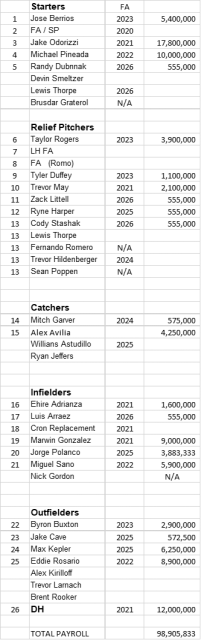
-
I noticed you avoided answering my scenario which was quite specific. Would players be willing to take a much smaller hit (on a percentage basis) if the team was willing to forgo profits in order to spend more on players? Will anyone have the guts to say ... their might be a player or even two but in general every player is going to want every last dime coming to them.
-
I don't disagree. If lowering profits resulted in a dominant team, it might actually improve the brand and therefore eventually the evaluation. My response was specific to the premise Mike promotes every year which is that people should not spend money on tickets if the team isn't willing to operate at a minimal profit. If you look back, I was advocating a payroll of a little over $140M. I advocated the signing of free agents. However, I also understand the absolute necessity of production per/dollar spent, especially when so many teams can outspend us. Their reluctance to pay what it would have required was not a product of cheapness. I think it's a fair assumption that they felt they could make a better investment. This is not a difficult concept. Wolves fans have been lamenting signing to a max contract. It's not because they are worried about Glen Taylor's bank account. They understand that there is a max the team can spend and investing this much in Wiggins would likely prevent the team from putting together an elite team. There are those who will respond that there is no salary cap in baseball. None of us have a formal cap on our spending either but we recognize we can't spend more than we take in. Can we agree there is a stark contrast to the way NHL or NBA fans view investment in player salaries? Those fans understand the necessity of production per dollar spent, Would you agree?
-
The 50-52% is a soundbite. It's a player's association demand. I don't doubt someone in the organization made the comment that 50-52% was a targeted range. However, how is their spending relative to income and relative to other teams in terms of profitability inconsequential? The premise being argued here is the relative greed or cheapness of the Pohlads. How do we measure their relative greed if not against the other teams? If their relative willingness to invest in players is the same as other teams, we can say all of the owners are greedy but we can say the Pohlads are particularly greedy. Player salaries have trended down the last few years. Could it be because teams are spending more money on analytics, development programs, facilities, etc because teams are recognizing this investments nets the most productivity on the field per dollar spent. BTW ... I would love it if the Pohlads were willing to run the team at break even but I certainly have no expectation they do, just as I expect players to get every dollar they can in free agency or arbitration. I expect they are as aggressive as the other teams on average.
-
You are correct. I should have taken more time to make this point. Mike insists that people should not spend money on the team if they are not willing to spend at a rate which would result in less profit. Given an incremental five or even 10 million is going to have little impact, we can assume we are talking about cutting profitability in half (at least). If fans followed Mike’s position, and the team needed to operate at a minimum profit in order to attract fans, the valuation of the team would be considerable less. What if the team said … we are willing to forgo 80% of our normal profit for the next 3 years if our players are willing to match our contribution? In other words. The players collectively would contribute roughly 24M or roughly 20% of their income. How many fans here think they would do this or should contribute? After all, they make literally 100 times that of the average working American for playing a game.
-
You apparently don't understand that the primary determinant in valuation is profitability. If they can't compete while remaining profitable, the franchise has no value.
-
OK, I could have used Disney or any other company in the entertainment business. Your premise that they should not care about profit because they are in the entertainment business is incredibly naive IMO. If you don't like that side of the argument, why is it that players should treat this business like a business but owners should not? If you worked for twins and they came to you and said we want everyone to contribute 25% of their wages and we will match in order to spend more on players, would you accept that sacrifice. After all, shouldn't you care more about winning since you chose to work for a MLB team? Funny how it's easy to say others should sacrifice.
-
I am pretty sure you have stated here that players should never be expected to take less than the max they can get no matter what. Owners should abide by a different standard. The Twins average a little under $30M/year in net profit if my memory is correct. I doubt $10M has a meaningful impact so what you are suggesting they would require they cut profits in half or more but players should never be expected to take anything less than max. Sounds like a very biased position to me. Should Ford take less profit so that I can get more options for the same price.
-
I agree with the acquisition and development of pitchers but that's on the old regime. Is there really a point in belaboring what happened under the previous regime. Where relative spending is concerned... In years past I could find Forbes earning projections going back several years. Apparently they delete that content now. Statistica has these estimates but I no longer have a Statistica account. I looked through several years of Forbes data about three years ago. Part of my interest was to get a handle on operating expenses so that I had a sense of what they could spend on players. I never compiled that information but I can tell you the Twins organization has probably been slightly under average in terms of net profit as a percentage of sales and in the bottom third on average in terms of profit dollars. You may have noticed that none of the people who proclaim the problem to be that the Pohlad’s are cheap ever back-up their accusation with facts or even estimates from credible sources.
-
How do all of us determine our spending. By income, right. Why is it so hard for people to figure out that's what drives / enables the spending of major league teams? In 2018, the Twins were 22nd in revenue and 20th in spending. Revenue was up somewhat in 2019 so it is reasonable to expect an uptick in spending.
-
Every Team Wants Zack Wheeler
Major League Ready replied to Cody Christie's topic in Twins Daily Front Page News
You can't possible believe this is logical. It amazes me that some people refuse to accept something so common as the notion of allocating their own money to things they think are a good value. The concept that a team with average or less than average revenue has to get more production per dollar of payroll is slightly more complex but far from difficult to understand. -
Every Team Wants Zack Wheeler
Major League Ready replied to Cody Christie's topic in Twins Daily Front Page News
If you can't find the point, me explaining will not help. -
Every Team Wants Zack Wheeler
Major League Ready replied to Cody Christie's topic in Twins Daily Front Page News
Thanks for sharing some rational thinking. If US Bank acquired another bank, they would assess the value of that business and set a maximum value they would be willing to pay and walk if it could not be acquired at the price they determined. That’s called good management. For some reason many here think the Minnesota Twins should not operate under the same basic principles as any other business. Let’s put it in more personal terms. If an individual goes to buy a home valued at $360K and there are multiple offers that somehow escalated the price to 472K, is it a good decision to pay $472K because you really want it. What if the seller says … I really want to sell to these other people so matching is not adequate? You will need to pay $500K. How many people here would just go for it? BTW …. I used the same ratios present in the Wheeler deal to produce these figures. The expectation the Twins should ignore their valuation and just throw around a hundred million like it is chump change is exceptionally naïve. It never happens. It’s just not that easy for any team and much harder for a mid revenue or less team. I keep asking for those who say they should just do regardless of cost to show me examples of another ML team with the Twins revenue or less who has “just gone for it” and it worked out. Some of you elect to ignore the facts. I welcome anyone who rebuts this notion to prove me wrong with facts. Two teams of similar or less revenue have ever signed such deals. Grienke when the Diamonds landed a billion dollar TV contract. They went nowhere and finally traded him. The other is Mike Hampton. Colorado went nowhere with him. They had 73 wins in each of the first 2 years of his 8 year deal and they traded him. He produced less than 3 WAR over his 8 year contract. Are all of the GMs of similar teams just incompetent that they can’t see paying whatever it takes to get a front of the rotation FA or do fans just not understand why it’s not a good practice to pay whatever it takes?- 213 replies
-
- 5
-

-
- zack wheeler
- jose berrios
- (and 1 more)
-
Every Team Wants Zack Wheeler
Major League Ready replied to Cody Christie's topic in Twins Daily Front Page News
You are not alone. Many fans subscribe to the push all in theory and there were more GMs in the past who subscribed albeit to a lesser degree. The new breed of baseball executive has a background that precludes this type of immediate term decision making. They are paid to sustain success. We don't expect players to accept less pay when the team is bad so we should not expect teams to manage in a manner that will lead to bad teams in the future.- 213 replies
-
- 3
-
-
- zack wheeler
- jose berrios
- (and 1 more)
