



Parker Hageman
-
Posts
4,152 -
Joined
-
Last visited
-
Days Won
6
Content Type
Profiles
News
Minnesota Twins Videos
2026 Minnesota Twins Top Prospects Ranking
2022 Minnesota Twins Draft Picks
Minnesota Twins Free Agent & Trade Rumors, Notes, & Tidbits
Guides & Resources
2023 Minnesota Twins Draft Picks
The Minnesota Twins Players Project
2024 Minnesota Twins Draft Picks
2025 Minnesota Twins Draft Pick Tracker
2026 Minnesota Twins Draft Tracker: Picks & Bonuses
Forums
Blogs
Events
Store
Downloads
Gallery
Everything posted by Parker Hageman
-
 His expected performance indicator, xFIP, is almost one full run higher than last year, jiving with his ERA, which is also one run higher this season than it was a year ago. The catalyst has been a decline in strikeouts and a sharp climb in the number of home runs allowed. On the surface, Hughes is not doing much different than he did the previous season -- constantly in the zone, throwing first pitch strikes like his life depends on it, etc -- but a deeper review of PitchF/X data shows that there is a slight contrast between his first season with the Twins and this one. One of those small changes is that he has started to use a two-seam fastball more in lieu of the four-seam variety. “I have thrown a lot more [two-seamers] probably because I am trying to find something else to go to until I get my fastball back to where it needs to be,” Hughes acknowledged. “I'm trying to make some adjustments on the fly.” “It seems like I haven't been able to go in with my four-seamer to lefties as effectively so I figure the best alternative to that is my two-seamer down and away and I've gotten quite a few ground balls with it,” Hughes explained as the impetus for the heater swap. “As the season picks up and my arm strength gets a little better and I find my four-seam fastball a little bit more hopefully that will be something I can go to more.” Hughes said that he found when he turned to the four-seamer this year to hit the glove-side of the zone, the ball has drifted back over the plate. http://i.imgur.com/GNmXJm1.gif “I don't think the velocity has been all that different but just trying to get that late ride that I get, being able to command it in and keep it in to lefties as opposed to where it is running back over the plate a little bit more.” Velocity certainly has not been the problem. Sure it is down a tick according to Fangraphs.com’s PitchF/X date but the increase in two-seamers would account for the slight downturn for Hughes, which are typically thrown with less velocity than the four-seamer. And control has not been the problem either as evident by the few walks issued. His real enemy has been command -- getting the pitch do what he wants it to do once it is out of his hand. He can hit a strike zone, it is hitting the small sections within the zone that matters. While Hughes maintains a miniscule walk rate and has a lower batting average on balls that don’t leave the playing surface, it is the long ball which has been been his detriment. After allowing 16 in 209.2 innings in 2014 he’s surrendered 12 in 64.2 innings this year. He is outpacing all of his other seasons for home runs allowed, a considerable surprise after he left the hitter’s haven in New York for the more balanced play of Target Field. It’s not just the fastball that has been a factor in the inflated home run totals, his cutter has not been up to the same grade as it was last year. Hughes developed the cutter in 2014 as another pitch after using a big slider and changeup in New York. The cutter acts like a fastball but has late movement down and glove-side run which resulted in 79 strikeouts, many of which were looking. Hitters see what appears to be a fastball that is heading off the plate but darts back over at the last second. “It comes out like a fastball,” said catcher Kurt Suzuki on what made Hughes’ cutter such a good pitch. “I don't know if he does anything different but from my side is that it just looks like a fastball and it just has that late cut. That’s what makes pitchers so tough is when pitches come out looking just like a fastball and just moves at the last second.” http://i.imgur.com/iTWOCC4.gif When on, it has been a plus-plus pitch for Hughes. “It’s more being able to locate it exactly where I want to,” Hughes said about his cutter this year. “It kind of comes and goes in spurts. I know in Seattle, it was automatic for me to go out there with it. And it other games I've been constantly missing a tiny bit. The more I try to go away, I'll try to make the adjustment and it will run back over the plate a little bit more.” Missing a little bit, like he did to Dustin Pedroia in his most recent start, has resulted in some long flights. http://i.imgur.com/ikw7QlI.gif Another element of his game, his plus-curveball, has not been the same either. In 2014 hitters missed on a quarter of their swings. This season, however, hitters are missing on less than 10 percent. Hughes says splitting his nail has played a role early in the season. In the handful of starts in which his nail actually split, it was “extremely painful” to continue to try to throw his knuckle-curve but has since had that nail heal. “I feel like I can throw my curveball confidently and it has been something I needed to incorporate more but for whatever reason I haven't done it,” Hughes said. “So hopefully the curveball is something that makes its way into my pitch sequences more often because I feel like I can really use that pitch to get guys off my fastball.” True to his word, Hughes has been spinning more curves in his arsenal since the beginning of May. In his five April starts he mixed it in 6% of the time but has increased that to 20% in his five May outings. His biggest reasoning for adding in more was to keep hitters from attacking his first-pitch fastball. “I've tried to throw some first-pitch curveballs to get guys into a count where I can dictate the at-bat instead of guys trying to sell out for the first-pitch fastball,” Hughes said as he noticed hitters swinging out of their cleats and realized something needed to change. “I think it was [Rays outfielder Kevin] Kiermaier the other day swung at the first pitch of the game and it was above his head. Guys are really selling out for first-pitch fastballs. And good for them -- that's a good game plan especially for a guy who throws a lot of fastballs, usually the best you are going to see is the first in the count. I've just got to stay one pitch ahead.” So if hitters are just swinging out of their shoes, why not just start the at-bat with a fastball well out of the strike zone occasionally to keep them honest? “That's not something you necessarily want to do unless a guy is just absolutely selling out for a fastball they usually see the ball coming out of your hand before they make a decision at whether they want to swing at it. I can't just throw an intentional ball and hope they swing, it's more about throwing the quality pitch where I'm on the corners I'll take my chances. When I've gotten burned, it's been on pitches that guys have sold out for and they haven't been good location pitches. That's something I have to be better with.” Fewer missed bats in general has been an issue for Hughes as well. After posting on of his best swinging strikes seasons, he now is one of the bottom 10 qualified pitchers when it comes to making hitters whiff. On two-strike counts, he has turned to his fastball more over his curveball or cutter which he favored in that situation heavily last year. Hughes relied on a four-seamer from hell last year. It lived up in the zone and feasted on hitters’ souls. Four-seam fastballs, while not able to rise because of the laws of physics, stay on the same plane and can battle gravity to give hitters the perception that they are rising. When located up in the zone with the type of velocity that Hughes can generate, it can led to empty swings or foul balls. On the other hand two-seamers by nature are sinking fastballs. They reside down in the zone and are geared towards contact; where it is located depends on how damaging that contact can be. The high fastball also expanded the zone a hitter needed to cover with his swing. With a two-seamer, cutter and curveball all heading toward the lower third of the zone, it helps remove some of the guess work. Hughes said he understands that and is working toward getting back to that part of his game. “Obviously with my two-seamer I want to be down in the zone but I feel like I haven't been able to effectively live up in the zone with my four-seamer as much as I have been in the past,” Hughes said of his body of work during strikeout situations. “Again, small sample size and I feel like I'm not really in a groove right now but hopefully when I start getting on a roll, you will start to see more riding four-seamers up in the zone and then getting some two-seamers down if I have to but my bread-and-butter is living up and that something I've always done but right now I've gotten burned a few times on pitches that I've tried to go up on the corners that I've just left over the plate. As my confidence with my four-seamer starts to pick up, you'll see more of those up in the zone.” Staying ahead of the competition is what makes good pitchers great, Hughes understands this. He never intended to rest on his laurels which was one of the reasons he explored using changeups more during spring training. While there is an emphasis placed on the change from the staff, Hughes said he feels the pitch is at a point where it is his fourth-best and doesn’t want to live and die by it, reserving it for low-risk situations. “It's an adjustment but that's what you do constantly in this game. Hitters are getting all these reports and info just like we are and obviously trying to exploit a weakness. I just gotta stay one step ahead of it.” It cannot be stressed enough that pitching -- and in the big picture, baseball as a whole -- is organic. There are adjustments and adaptations needed every season, every start, every inning, and even every pitch. With a few adjustments, Hughes believes he will finish the year closer to where he was a year ago.
 -

Article: How Is Mike Pelfrey Doing This?
Parker Hageman replied to Parker Hageman's topic in Twins Daily Front Page News
"Pelfrey has thrown a splitter for years - he used it with similar frequency way back in 2010. He throws it with less velocity now (despite his fastball velocity being the same), which may be helping it work better as a change-up." Yes. He threw a split-finger fastball with the Mets and on rare occasions with the Twins but this version has far less rotation, more movement and behaves differently. For all intents and purposes it is a new pitch. -
I warned everyone in April that this might be a real possibility. At that time, just several starts into the 2015 season, the analysis was smothered with caution sauce. Statistically, there were indicators abounding that things were going to go south quickly, however there seemed to be something different about this Mike Pelfrey. This Mike Pelfrey was peppering the zone, possessed improved velocity, induced weak contact, had improved his swing-and-miss capabilities, and added a second pitch.For various reasons Pelfrey’s ability to sustain this success was questioned. Despite the swinging strikes, he really didn’t strike anyone out. He put a ton of baserunners on but managed to wiggle out of jams by the skin of his teeth. Surely the wheels were ready to come off. And when the Detroit Tigers pounded him for 10 hits over four innings a few short weeks later, it felt as if the foreboding avalanche of regression would leave no survivors. But then something unexpected happened: He didn’t regress. Mike Pelfrey went back out and threw 13 innings of 10 hit, two-run ball over his next two starts. Instead, he concluded Tuesday night’s victory over the Boston Red Sox tied with Edinson Volquez with a 2.77 ERA -- the 10th best in the American League. It is especially crazy considering his expected performance figures peg him to be around 4.50. How has he continued to outperform performance indicators like xFIP? Nine starts is by no means an ample sample but the traits that Pelfrey demonstrated in April have rolled over into May. In addition to the ERA (which should not be used in gauging the quality of a pitcher’s performance so stop using it), Pelfrey has managed to keep opposing hitters away from hard contact. According to ESPN/trumedia, he maintains a well-hit average of .103 -- this time 12th best in all of baseball. BaseballSavant.com’s batted ball velocity more or less confirms this, saying Pelfrey’s batted ball velocity of 87 mph is 18th among all qualified pitchers. Tons of contact but the vast majority of it is weak. Pelfrey’s inclusion of the splitter has elevated his arsenal to a new level. It is lethal against left-handed hitters and has kept right-handers honest to some degree. Watch the movement it showed in his last start against Pittsburgh. This was a nasty pitch that incited a silly swing from the Pirates’ Pedro Alvarez: http://i.imgur.com/sRa4T8a.gif This season’s splitter has a lack of spin and that provides drag and drop. When thrown with similar arm speed as a fastball it can produce some head-shaking swings. Pelfrey’s current .202 batting average against lefties is 10th lowest in baseball by a right-hander -- company that includes pitching elite like Felix Hernandez, Matt Harvey and Sonny Gray -- and that development undoubted coincides with his use of the splitter. The other reason he has been able to achieve weak contact on a consistent basis is location and movement on his fastball. Over the previous two years with the Twins, Pelfrey’s low-90s fastball was mostly seen hovering over the middle of the plate. Now he is hitting the low corners of the zone with solid movement: http://i.imgur.com/iAVcMwX.gif Download attachment: Fastball Location.png The results have been his highest ground ball rate on the pitch since 2010 because hitters are unable to barrel it up. While this may feel like an Arrested Development’s Ann moment, Mike Pelfrey has been good this season (“Him?”) and if he continues to twirl pitches the way he has while receiving competent infield defense behind him, he just might maintain throughout this surprising season. At the same time Pelfrey has outpaced his strand rate, benefited from the lowest batting average on balls in play of his career all while posting the second-lowest strikeout rate of his career -- there is room for regression. Click here to view the article
-
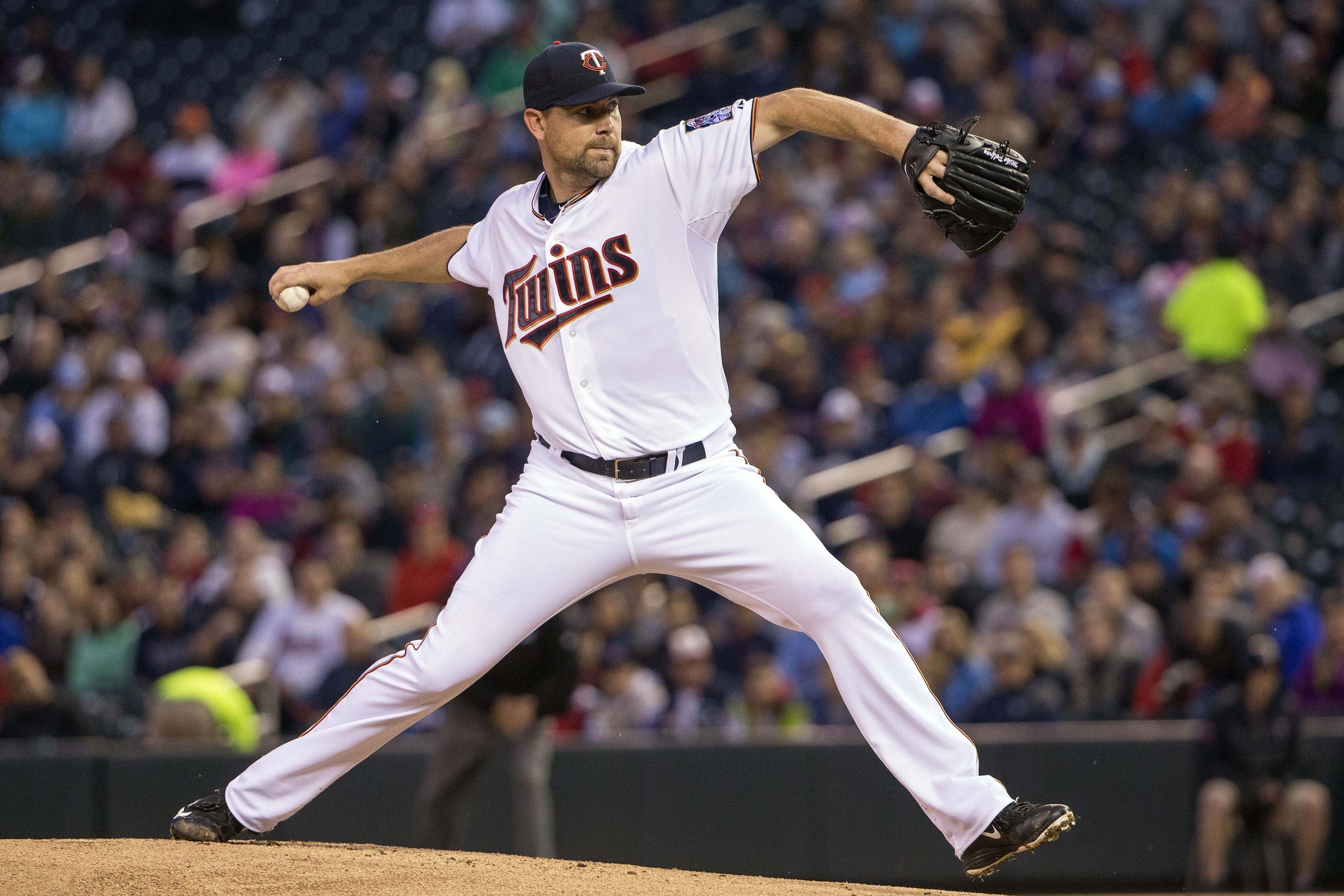 For various reasons Pelfrey’s ability to sustain this success was questioned. Despite the swinging strikes, he really didn’t strike anyone out. He put a ton of baserunners on but managed to wiggle out of jams by the skin of his teeth. Surely the wheels were ready to come off. And when the Detroit Tigers pounded him for 10 hits over four innings a few short weeks later, it felt as if the foreboding avalanche of regression would leave no survivors. But then something unexpected happened: He didn’t regress. Mike Pelfrey went back out and threw 13 innings of 10 hit, two-run ball over his next two starts. Instead, he concluded Tuesday night’s victory over the Boston Red Sox tied with Edinson Volquez with a 2.77 ERA -- the 10th best in the American League. It is especially crazy considering his expected performance figures peg him to be around 4.50. How has he continued to outperform performance indicators like xFIP? Nine starts is by no means an ample sample but the traits that Pelfrey demonstrated in April have rolled over into May. In addition to the ERA (which should not be used in gauging the quality of a pitcher’s performance so stop using it), Pelfrey has managed to keep opposing hitters away from hard contact. According to ESPN/trumedia, he maintains a well-hit average of .103 -- this time 12th best in all of baseball. BaseballSavant.com’s batted ball velocity more or less confirms this, saying Pelfrey’s batted ball velocity of 87 mph is 18th among all qualified pitchers. Tons of contact but the vast majority of it is weak. Pelfrey’s inclusion of the splitter has elevated his arsenal to a new level. It is lethal against left-handed hitters and has kept right-handers honest to some degree. Watch the movement it showed in his last start against Pittsburgh. This was a nasty pitch that incited a silly swing from the Pirates’ Pedro Alvarez: http://i.imgur.com/sRa4T8a.gif This season’s splitter has a lack of spin and that provides drag and drop. When thrown with similar arm speed as a fastball it can produce some head-shaking swings. Pelfrey’s current .202 batting average against lefties is 10th lowest in baseball by a right-hander -- company that includes pitching elite like Felix Hernandez, Matt Harvey and Sonny Gray -- and that development undoubted coincides with his use of the splitter. The other reason he has been able to achieve weak contact on a consistent basis is location and movement on his fastball. Over the previous two years with the Twins, Pelfrey’s low-90s fastball was mostly seen hovering over the middle of the plate. Now he is hitting the low corners of the zone with solid movement: http://i.imgur.com/iAVcMwX.gif The results have been his highest ground ball rate on the pitch since 2010 because hitters are unable to barrel it up. While this may feel like an Arrested Development’s Ann moment, Mike Pelfrey has been good this season (“Him?”) and if he continues to twirl pitches the way he has while receiving competent infield defense behind him, he just might maintain throughout this surprising season. At the same time Pelfrey has outpaced his strand rate, benefited from the lowest batting average on balls in play of his career all while posting the second-lowest strikeout rate of his career -- there is room for regression.
 -
Article: Twins Draft Preview: Walker Buehler
Parker Hageman replied to Parker Hageman's topic in Twins Daily Front Page News
That's the intriguing part of this year's draft class. By most accounts, it is a weaker class -- at least an in-between year from some strong classes. That said, Buehler probably isn't the best available in his rotation. -
Frankly, I'm kind of surprised teams haven't tried to track foul ball locations and whatnot and package tickets around it.
-
Article: Twins Draft Preview: Walker Buehler
Parker Hageman replied to Parker Hageman's topic in Twins Daily Front Page News
I believe that has been their strategy for a while. No reason to stop that practice now. -
Vanderbilt’s Walker Buehler doesn’t possess the prototypical pitcher's frame but he does have an above average four-pitch mix and an apprenticeship from what has become one of the NCAA’s biggest pitching factory. Would the Twins find themselves with a steal or is Buehler a massive reach?Who is this guy? At 6-foot-1 and 175 pounds, Vanderbilt’s right-handed wiry starter Walker Buehler doesn’t have the projectable frame of the elite pitcher but he comes equipped with a strong assortment of pitches and clean mechanics to allow for some dirty pitches. Buehler can reach 96 comfortably with his fastball but sits 90-94. When he enrolled in college he had above average command of a big slow curve (72-73) and fading changeup (82-84) but he since added a hard slider (82) to his repertoire to complement the curve. Buehler is said to be a strong athlete when it comes to fielding his position. His pick-off move is reputed to be one of the best and his ability to handle anything hit between the mound and the plate is above average. A cog in the pitching-rich tradition of Vanderbilt, this past summer Baseball America rated Buehler as the top prospect in the prestigious Cape Cod summer league where he took home co-MVP honors after flashing a fastball that caused hitters to churn through the Massachusetts turf. Prior to the NCAA season started, many had Buehler going high in the first round. MLB.com’s Jim Callis and Jonathan Mayo both projected him going sixth to the Twins. However, a sore elbow combined with average performances in key matchups have made his stock slip a little bit. Download attachment: USATSI_7966452_154617946_lowres.jpg Why the Twins will pick him Many evaluators believe that Buehler can be a fast mover in the system. Buehler who has an advanced repertoire, comes from Vanderbilt which has built quite the reputation for developing major league pitching. Since David Price’s selection, they have also produced Oakland’s Sonny Gray as well as other first- and second-round pitchers in Mike Minor (2009, 1st), Sam Selman (2012, 2nd), Kevin Ziomek (2013, 2nd) and Tyler Beede (2014, 1st) not to mention Carson Fulmer who will be another pick selected this year ahead of Buehler. Credit goes to the school’s pitching lab, developed by coach Tim Corbin and former assistant Derek Johnson (now a Cubs minor league assistant), which has enticed numerous high-end high school pitching talents to choose Vanderbilt to hone their craft rather than accepting major league money out of high school (Buehler is one of them who chose to play at Vanderbilt in lieu of accepting 14th round money from the Pittsburgh Pirates out of high school). Because of this, guys like Buehler enter an organization and are ready to contribute quickly. Why the Twins will not pick him Being undersized as a pitcher is always a concern for long-term projectability and Buehler’s elbow soreness may cause him to fall some more on draft day. While his mechanics and training can help him through the light workload of a college season, scouts have to be asking themselves if his body will be able to stand up to the rigors of a full professional season. In spite of the shutdown performance in the Cape Cod, Vanderbilt has used him mainly as a midweek and Sunday starter -- that’s college code for not the best pitcher on the staff. Friday nights are reserved for the team’s number one starter. Of course, it is not necessarily a bad thing when you have a pitcher like Fulmer who also projects as a high first-round pick competing ahead of you. With the sixth overall pick, if the Twins do select Buehler they likely are not acquiring the best available player at that time. Click here to view the article
-
 Who is this guy? At 6-foot-1 and 175 pounds, Vanderbilt’s right-handed wiry starter Walker Buehler doesn’t have the projectable frame of the elite pitcher but he comes equipped with a strong assortment of pitches and clean mechanics to allow for some dirty pitches. Buehler can reach 96 comfortably with his fastball but sits 90-94. When he enrolled in college he had above average command of a big slow curve (72-73) and fading changeup (82-84) but he since added a hard slider (82) to his repertoire to complement the curve. Buehler is said to be a strong athlete when it comes to fielding his position. His pick-off move is reputed to be one of the best and his ability to handle anything hit between the mound and the plate is above average. A cog in the pitching-rich tradition of Vanderbilt, this past summer Baseball America rated Buehler as the top prospect in the prestigious Cape Cod summer league where he took home co-MVP honors after flashing a fastball that caused hitters to churn through the Massachusetts turf. Prior to the NCAA season started, many had Buehler going high in the first round. MLB.com’s Jim Callis and Jonathan Mayo both projected him going sixth to the Twins. However, a sore elbow combined with average performances in key matchups have made his stock slip a little bit. Why the Twins will pick him Many evaluators believe that Buehler can be a fast mover in the system. Buehler who has an advanced repertoire, comes from Vanderbilt which has built quite the reputation for developing major league pitching. Since David Price’s selection, they have also produced Oakland’s Sonny Gray as well as other first- and second-round pitchers in Mike Minor (2009, 1st), Sam Selman (2012, 2nd), Kevin Ziomek (2013, 2nd) and Tyler Beede (2014, 1st) not to mention Carson Fulmer who will be another pick selected this year ahead of Buehler. Credit goes to the school’s pitching lab, developed by coach Tim Corbin and former assistant Derek Johnson (now a Cubs minor league assistant), which has enticed numerous high-end high school pitching talents to choose Vanderbilt to hone their craft rather than accepting major league money out of high school (Buehler is one of them who chose to play at Vanderbilt in lieu of accepting 14th round money from the Pittsburgh Pirates out of high school). Because of this, guys like Buehler enter an organization and are ready to contribute quickly. Why the Twins will not pick him Being undersized as a pitcher is always a concern for long-term projectability and Buehler’s elbow soreness may cause him to fall some more on draft day. While his mechanics and training can help him through the light workload of a college season, scouts have to be asking themselves if his body will be able to stand up to the rigors of a full professional season. In spite of the shutdown performance in the Cape Cod, Vanderbilt has used him mainly as a midweek and Sunday starter -- that’s college code for not the best pitcher on the staff. Friday nights are reserved for the team’s number one starter. Of course, it is not necessarily a bad thing when you have a pitcher like Fulmer who also projects as a high first-round pick competing ahead of you. With the sixth overall pick, if the Twins do select Buehler they likely are not acquiring the best available player at that time.
 -
Let’s say you have been to hundreds of baseball games in your life and you’ve never gotten a baseball. Or better yet, you are looking to give your kids that magical experience of landing a ball. Where would you sit? It goes without saying that getting a ball at the ballpark has very low odds but here are some seating tips to increase your chances during the upcoming Boston Red Sox series at Target Field.NABBING A HOME RUN BALL Since Target Field has opened, outside of Toronto’s Jose Bautista (11), no visiting player has hit more long balls downtown Minneapolis than than David Ortiz (9). Actually, both Miguel Cabrera and Carlos Santana have equaled that number but have done so over 47 and 43 games compared to Ortiz’s 14 games. In fact, Ortiz managed to blast four home runs a year ago spread out in back-to-back games. There is something also unique about Ortiz’s Target Field home runs: They almost all landed in the same spot each time. Download attachment: export (1).png Two of Ortiz’s home runs from 2014 were hit off of Twins pitcher Ricky Nolasco and both landed just a mere row or two away from each other. http://i.imgur.com/TEiGiNP.gif http://i.imgur.com/dJ4EPJ7.gif As odds would have it, Nolasco is scheduled to start Monday’s 1:10 PM game. If you want to come home with a Big Papi home run ball (in addition to your Twins BBQ Branding Iron -- play safe kids!), you are going to want to seek out tickets in the Pavillon, Section 134 for that game where Ticket King has several seats left. That section can provide quick access to share or a few steps away from the Twins Pub which sells local Surly and Fulton beers. Download attachment: TicketKing_Ortiz.png Word to the wise: If a Ortiz home run ball manages to come your way but lands a row or two short, don’t wrestle a kid for the ball. Also, don’t try to convince the kid to throw the ball back onto the field, like this guy did. http://i.imgur.com/IVZvPS4.gif NABBING A TWINS HOME RUN So having a Boston Red Sox home run ball doesn’t do anything for you. Your best bet for a Twins home run ball is getting tickets in the Left Field Bleachers for Tuesday night’s 7:10 game. If all goes according to plan, you should wind up with a Brian Dozier home run ball. Download attachment: Brian Dozier Dingers.png Dozier is a notorious high ball hitter -- 34 of his 54 home runs have come on pitches in the upper third of the strike zone. Additionally, almost all of the them with the exception of some lone wolf home runs, were pull shots. http://i.imgur.com/BhMRRtU.gif Tuesday’s scheduled starter for the Red Sox is Rick Porcello who absolutely loves pumping high fastballs this year. He has thrown almost half of his fastballs in the upper third (49%) which is well above the league norm. If he insists on doing the same to Dozier, there is an excellent chance fireworks will ensue. Download attachment: TicketKing_Dozier.png Failing that, Trevor Plouffe is the current active player with the most home runs at Target Field (40). Plouffe also enjoys the Left Field Bleachers and Home Run Porch as his favorite landing spots. Any Kind Of Ball Will Do If you want to be closer to the action and possibly pampered, the Dugout Boxes, Legends Club or Home Plate Box is your best bet in corralling a foul ball during Thursday’s getaway day game. http://i.imgur.com/BTqCfTd.gif The Legends Club seats that hug the home plate area seemingly receive the majority of the lofted foul balls, those that are gentle to catch with bare hands. If you are in the Home Plate Box area, sometimes those fouls ricochet back down from the exclusive seating area into the gen pop. Finally, if you want to catch the white whale of foul balls -- the screaming liner -- the Dugout Box is your spot. This is the section where hitters will rocket pitches they are fighting off to stay alive, so make sure you pay attention so you also stay alive. Good luck. Click here to view the article
-
 NABBING A HOME RUN BALL Since Target Field has opened, outside of Toronto’s Jose Bautista (11), no visiting player has hit more long balls downtown Minneapolis than than David Ortiz (9). Actually, both Miguel Cabrera and Carlos Santana have equaled that number but have done so over 47 and 43 games compared to Ortiz’s 14 games. In fact, Ortiz managed to blast four home runs a year ago spread out in back-to-back games. There is something also unique about Ortiz’s Target Field home runs: They almost all landed in the same spot each time. Two of Ortiz’s home runs from 2014 were hit off of Twins pitcher Ricky Nolasco and both landed just a mere row or two away from each other. http://i.imgur.com/TEiGiNP.gif http://i.imgur.com/dJ4EPJ7.gif As odds would have it, Nolasco is scheduled to start Monday’s 1:10 PM game. If you want to come home with a Big Papi home run ball (in addition to your Twins BBQ Branding Iron -- play safe kids!), you are going to want to seek out tickets in the Pavillon, Section 134 for that game where Ticket King has several seats left. That section can provide quick access to share or a few steps away from the Twins Pub which sells local Surly and Fulton beers. Word to the wise: If a Ortiz home run ball manages to come your way but lands a row or two short, don’t wrestle a kid for the ball. Also, don’t try to convince the kid to throw the ball back onto the field, like this guy did. http://i.imgur.com/IVZvPS4.gif NABBING A TWINS HOME RUN So having a Boston Red Sox home run ball doesn’t do anything for you. Your best bet for a Twins home run ball is getting tickets in the Left Field Bleachers for Tuesday night’s 7:10 game. If all goes according to plan, you should wind up with a Brian Dozier home run ball. Dozier is a notorious high ball hitter -- 34 of his 54 home runs have come on pitches in the upper third of the strike zone. Additionally, almost all of the them with the exception of some lone wolf home runs, were pull shots. http://i.imgur.com/BhMRRtU.gif Tuesday’s scheduled starter for the Red Sox is Rick Porcello who absolutely loves pumping high fastballs this year. He has thrown almost half of his fastballs in the upper third (49%) which is well above the league norm. If he insists on doing the same to Dozier, there is an excellent chance fireworks will ensue. Failing that, Trevor Plouffe is the current active player with the most home runs at Target Field (40). Plouffe also enjoys the Left Field Bleachers and Home Run Porch as his favorite landing spots. Any Kind Of Ball Will Do If you want to be closer to the action and possibly pampered, the Dugout Boxes, Legends Club or Home Plate Box is your best bet in corralling a foul ball during Thursday’s getaway day game. http://i.imgur.com/BTqCfTd.gif The Legends Club seats that hug the home plate area seemingly receive the majority of the lofted foul balls, those that are gentle to catch with bare hands. If you are in the Home Plate Box area, sometimes those fouls ricochet back down from the exclusive seating area into the gen pop. Finally, if you want to catch the white whale of foul balls -- the screaming liner -- the Dugout Box is your spot. This is the section where hitters will rocket pitches they are fighting off to stay alive, so make sure you pay attention so you also stay alive. Good luck.
 -
Additionally, early on Plouffe had developed a reputation for being a member of the "fun bunch" that people -- inside and outside the organization -- thought did not care to put the work in. Clearly he proved those people wrong.
-
Can you even imagine trying to explain advanced stats to Tom Bernard? The thing about the eye test is that while some people watch a high percentage of games and formulate an opinion based on those events, there are numerous people who cite an eye test based on things they watched from several years ago combined with whatever reputation the player developed over that time. Reputations happen for a reason. Consider that Terry Ryan, a very good evalutator of talent, questioned whether Plouffe would have made that play even a year ago. I question whether, defensively, the eye test can compete with data but at the same time whether data analysts can recognize changes in the data. /BallNerdOut
-
I would say it was improved -- fewer errors, looked more comfortable. Making a higher percentage of plays this season combined with a few standout ones has definitely made him look even better this year.
-
On this week's NO JUICE PODCAST, Dan Anderson and Parker Hageman discuss whether the Twins' fast start will eventually lead to a mid-season disappointment. Listen up.Other topics include bringing your infant to a Twins game, Mad Men and TV show finales in general, beer league baseball talk and fielding Twitter questions. Listen below, on iTunes or on Stitcher: NO JUICE PODCAST, EPISODE #56: DRIVING A BUS OFF A CLIFF Hup: Those MS Paint classes that Dan is taking is really starting to pay off. And thanks @wx_dave. You are this week's NJP Favorite Tweeder. Tweet at Parker, Dan or the No Juice Podcast twitter account to collect your $10 in JL Beers Burger Bucks. Click here to view the article
-
 Other topics include bringing your infant to a Twins game, Mad Men and TV show finales in general, beer league baseball talk and fielding Twitter questions. Listen below, on iTunes or on Stitcher: NO JUICE PODCAST, EPISODE #56: DRIVING A BUS OFF A CLIFF Swim is a good glove, high contact, no power catcher who is playing in a league in which he is two years above the average age. Our money is on PA because of his #OldManStrength. Knowing the Twins...extension. He's earned it too. They ARE fun. In fact, we discussed organizing a Sportive/No Juice #StearnsCountyPartyBus trip to a St Cloud Rox game. "Big Hipster Beer" should be the name of the next craft brewery. How has that not happened yet? We can't say what the next big one will be but we highly recommend trying Excelsior Brewing, 612 Brew and Bauhaus. Excelsior was kind enough to let us run amok in their taproom: [embed] [/embed] Man oh man Tommy Milone has been good in Rochester. Over his last three starts, he's thrown 23.1 innings while posting a ridiculous 33/2 strikeout-to-walk ratio. When will they let him back up? It may take an injury or a complete tank job by one of the current starts. It's a good problem to have, to be sure. The recent 90-loss seasons were littered with bodies like Yohan Pino, Kris Johnson and PJ Walters consuming too many starts. With Milone, they have depth. Hup: Those MS Paint classes that Dan is taking is really starting to pay off. And thanks @wx_dave. You are this week's NJP Favorite Tweeder. Tweet at Parker, Dan or the No Juice Podcast twitter account to collect your $10 in JL Beers Burger Bucks.
 -
In last Saturday’s afternoon contest the Twins maintained a 5-3 lead over the surging American League East Tampa Bay Rays heading into the top of the eighth inning. The Twins summoned Blaine Boyer to keep the score as is. The first batter of the inning, Steven Souza, turned on Boyer’s 0-2 slow curve, sending a well-struck grounder bounding down the third base line. With Trevor Plouffe playing three steps off the chalk, there was certainly room for the ball to scoot by for a base hit or extra bases. Instinctively, Plouffe made a cross step, gobbled the smash up with a backhand, and then from the furthest reaches of the infield he fired a bullet to Mauer at first to retire the speedy Souza.Plouffe executed the play like he had came out of the womb making backhanded, cross-diamond throws. The next day Twins general manager Terry Ryan reflected on Plouffe’s defensive performance and simply offered “I don’t know if he would have made that the previous year.” http://i.imgur.com/ZWIQKGO.gif Most Twins Daily readers would probably agree with Ryan’s assessment. Data confirms the eye test as the numbers revealed Plouffe had difficulties converting balls in play to his right into outs. Baseball Info Solution said he was -4 plays on average when going to his right. But even that was a relative improvement over his early days at third when he was a gross liability at -13 plays on average going to his right. At that point in his development, it was almost a given that a ball hit where Souza's did would allow him to reach base. “He’s starting to make plays,” said Ryan. “You know the accuracy is the only thing you worry about with him.” Plouffe’s abilities in the field have taken a significant step forwardsince his introduction to the hot corner. While trying to make that progress he felt like he could hear every groan after each misplay. “I think when I first started over there I was learning a new position right in front of everybody so everyone got to watch me fail which is always awesome,” Plouffe said. “But I worked hard at it. I had some coaches that really helped me out out there. I think the combination of those two things have helped me get a little better each day and I continue to work on it. I’m happy there is improvement.” Now in his fourth season as the regular third baseman, Ryan credits former manager Ron Gardenhire’s persistence with running Plouffe on the field despite some of the results. “Gardy had patience with Trevor. Gardy was always a fan of Trevor Plouffe. And kept putting him out there and putting him out there. We rotated him around the diamond some but he kept putting him out there. And ultimately this third base business might be his fit.” There has been observable (like the Souza play) and quantifiable improvement to his glove game. According to Revised Zone Ratings, Plouffe has converted 79.7% of all balls hit in his third base zone into outs. That is currently a career best and fourth highest among all third basemen this season. “At shortstop, where I played primarily, you gotta to go get the ball,” Plouffe explained. “At third base, if you are cutting your angles off that way, your range is going to be cut down dramatically. It was learning how to go laterally to the balls and learning the timing and a lot of things that go into it. I know it is fielding the ball and throwing over to first but that’s not how it is. There are a lot of different nuances you have to pick up and that took a little bit of time for me to figure out.” Download attachment: Plouffe Defense.png Another interesting statistic that really does not provide anything other than a sense of how comfortable he has gotten in the field is that he is leading all third basemen in plays from his knees. Of all the third base plays this season, only 12 outs have been made from the knees and Plouffe has recorded 4 of them. Like this... http://i.imgur.com/3zbO51E.gif ...and this… http://i.imgur.com/EepUmQZ.gif If that feels like an overkill stat, you are right, it is. But it speaks towards his ability to remain calm and not rush throws. Part of that is knowing the competition and part of that is knowing your own limitations. “He’s got good hands, there’s no reason for him not to do be able to that,” Ryan said of Plouffe’s playmaking abilities. “His hands are plenty good and they always have been. And his arm strength is plenty good to play third and always has been it’s just a matter of accuracy.” Plouffe is not an otherworldly defender at third. The excitement over his fielding is based on the fact that he has transitioned from a player actively hurting the team to average to slightly above average. But the Twins do not necessarily need a superman at third like Colorado’s Nolan Arenado who covers more infield than the stadium’s tarp. The Twins need a third baseman who can turn a high percentage of balls in his zone into outs. And so far Trevor Plouffe is proving he can do that in 2015. Click here to view the article
-
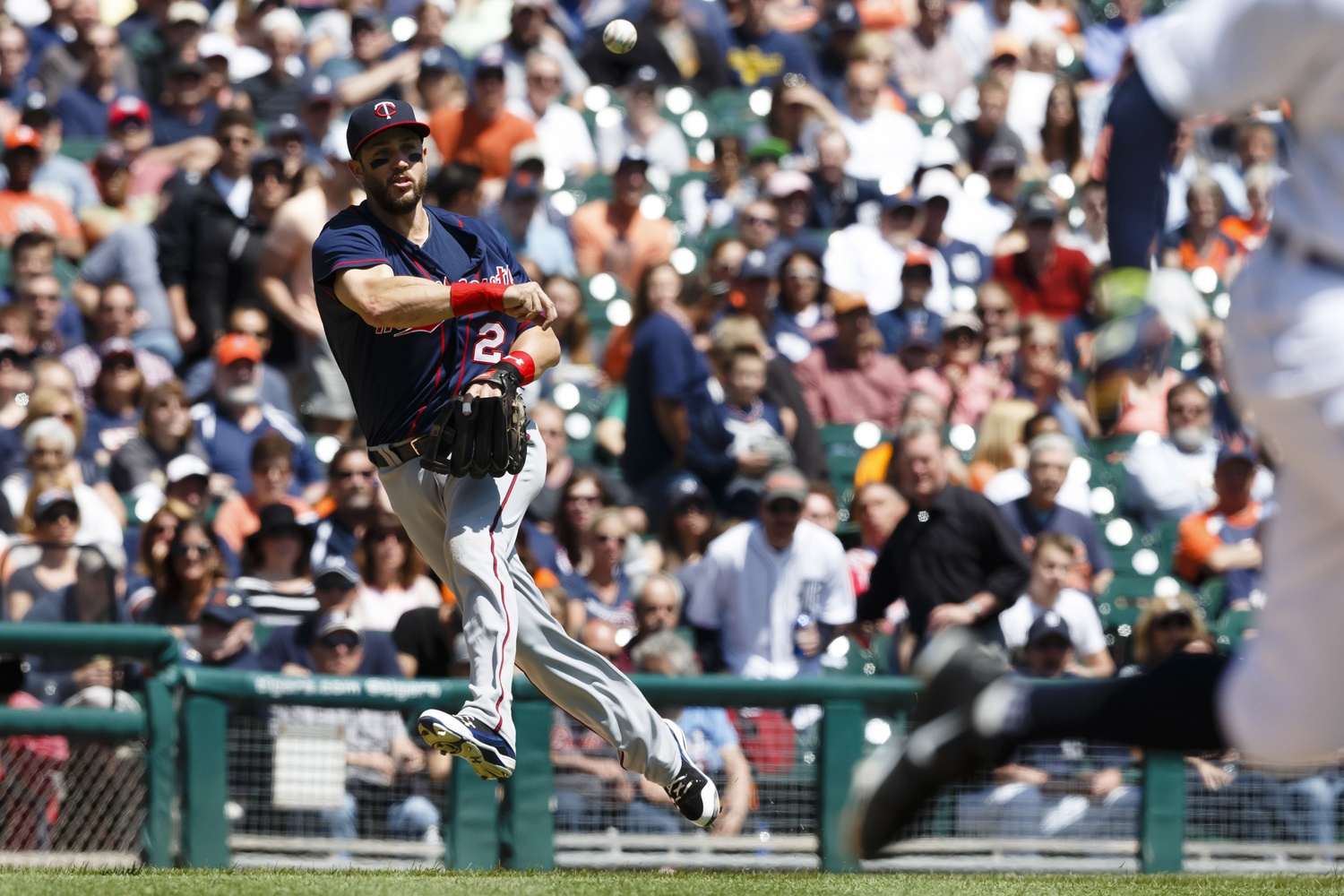 Plouffe executed the play like he had came out of the womb making backhanded, cross-diamond throws. The next day Twins general manager Terry Ryan reflected on Plouffe’s defensive performance and simply offered “I don’t know if he would have made that the previous year.” http://i.imgur.com/ZWIQKGO.gif Most Twins Daily readers would probably agree with Ryan’s assessment. Data confirms the eye test as the numbers revealed Plouffe had difficulties converting balls in play to his right into outs. Baseball Info Solution said he was -4 plays on average when going to his right. But even that was a relative improvement over his early days at third when he was a gross liability at -13 plays on average going to his right. At that point in his development, it was almost a given that a ball hit where Souza's did would allow him to reach base. “He’s starting to make plays,” said Ryan. “You know the accuracy is the only thing you worry about with him.” Plouffe’s abilities in the field have taken a significant step forward since his introduction to the hot corner. While trying to make that progress he felt like he could hear every groan after each misplay. “I think when I first started over there I was learning a new position right in front of everybody so everyone got to watch me fail which is always awesome,” Plouffe said. “But I worked hard at it. I had some coaches that really helped me out out there. I think the combination of those two things have helped me get a little better each day and I continue to work on it. I’m happy there is improvement.” Now in his fourth season as the regular third baseman, Ryan credits former manager Ron Gardenhire’s persistence with running Plouffe on the field despite some of the results. “Gardy had patience with Trevor. Gardy was always a fan of Trevor Plouffe. And kept putting him out there and putting him out there. We rotated him around the diamond some but he kept putting him out there. And ultimately this third base business might be his fit.” There has been observable (like the Souza play) and quantifiable improvement to his glove game. According to Revised Zone Ratings, Plouffe has converted 79.7% of all balls hit in his third base zone into outs. That is currently a career best and fourth highest among all third basemen this season. “At shortstop, where I played primarily, you gotta to go get the ball,” Plouffe explained. “At third base, if you are cutting your angles off that way, your range is going to be cut down dramatically. It was learning how to go laterally to the balls and learning the timing and a lot of things that go into it. I know it is fielding the ball and throwing over to first but that’s not how it is. There are a lot of different nuances you have to pick up and that took a little bit of time for me to figure out.” Another interesting statistic that really does not provide anything other than a sense of how comfortable he has gotten in the field is that he is leading all third basemen in plays from his knees. Of all the third base plays this season, only 12 outs have been made from the knees and Plouffe has recorded 4 of them. Like this... http://i.imgur.com/3zbO51E.gif ...and this… http://i.imgur.com/EepUmQZ.gif If that feels like an overkill stat, you are right, it is. But it speaks towards his ability to remain calm and not rush throws. Part of that is knowing the competition and part of that is knowing your own limitations. “He’s got good hands, there’s no reason for him not to do be able to that,” Ryan said of Plouffe’s playmaking abilities. “His hands are plenty good and they always have been. And his arm strength is plenty good to play third and always has been it’s just a matter of accuracy.” Plouffe is not an otherworldly defender at third. The excitement over his fielding is based on the fact that he has transitioned from a player actively hurting the team to average to slightly above average. But the Twins do not necessarily need a superman at third like Colorado’s Nolan Arenado who covers more infield than the stadium’s tarp. The Twins need a third baseman who can turn a high percentage of balls in his zone into outs. And so far Trevor Plouffe is proving he can do that in 2015.
 -
Grave mistake sounds too harsh. Like Ryan said, he needs work. I don't think there is any hurry to get him up at this point. As Seth mentioned, Plouffe is doing just fine at the position as is.
-
Nothing for public consumption. Some teams will either gather their own data or outsource to an Inside Edge-type company to gather info. Aside for that, some organizations like the Twins have added Trackman systems in their minor league ballparks and could use some of that data for evaluation. Beyond that, it is just the good old fashioned eye test.
-
Point with Plouffe is that the Twins do have patience for players to work through some shaky play. Look at Danny Santana right now as well. Sano's got a high error rate but it doesn't have to be a position-killer. Corey Koskie - Age-22 season (A): 36 errors in 109 games Miguel Sano - Age-20 season (A+-AA): 23 errors in 120 games Again, errors are dumb in defensive evaluation. As the clip shows above, Sano has decent athleticism. Hopefully he can improve the decision-making/concentration in order to keep from making the routine errors.
-
Trevor Plouffe made plenty of errors in his first season at third. Above that, he also had to work on his first step. Developed into a very decent third basemen. Sano could wind up doing the same.
-
Over the past week Twins prospect Miguel Sano has laid waste to his Southern League competition, going 11-for-29 (.379) with four doubles, a pair of home runs and 8 RBIs with a .438 on-base percentage to boot. Because of his performance, the Twins anointed him their Minor League Player of the Week. The Twins general manager had made a trip through Chattanooga to evaluate the club recently and when asked about his thoughts on where Sano is at in his development stage, Ryan gave his usual straightforward remarks.“He’s doing better,” Ryan said. “As you see, the progression is going in this direction and that’s good. He’s got work to do as does every guy down there at the Double-A level. But they’ve got a good club. There are guys that carried that team when Sano and Buxton were struggling. Neither one of them are struggling anymore.” Sano is certainly doing better. In the season’s first month he tagged four home runs but compiled a line of .159/.303/.381 while racking up strikeouts at a near 30% clip. When the calendar flipped to May, he turned it on. His line drive rate went from non-existent to lasers around the ballpark, helping him achieve a .321/.406/.625 line over his last 16 games. That is the progression the Twins are happy to see from Sano. Far too often, Sano’s swing results in towering flies to the middle of the park. Some of those flies turn into no-doubters but a high portion of them turn into long fly outs when hit to the middle of the park. Mixing in the screaming liners would ensure he reached safely on a few more of those plate appearances. http://i.imgur.com/7Tcw94c.gif There’s no doubt that Sano has the type of power that makes a pitcher hang his head and, for now, Sano’s bat is the focus but the underlying concern is whether his defense will be major league caliber. The on-going narrative for Sano is that the big man with the big swing will eventually be moved out of that position. Now with nine errors in 32 games, Ryan was asked if his defense was a concern for the organization to which he shrugged off. “No. Never has been a concern for me. I’ve never had a concern over his fielding, still don’t.” http://i.imgur.com/ypMNDFr.gif “Everybody makes errors in the minor league,” Ryan reminded the reporters. While errors are an antiquated measuring stick for defense, a high total still raises the question regarding a player’s skill set. Is his glove work in need of improvement? Is his throwing hindered by the recent Tommy John surgery? Is it decision-making? “They are both fine,” Ryan offered about Sano’s arm and hands. “He’s a kid who makes some unforced errors. Some of them he makes phenomenal plays but the next one is routine and he’ll botch it. Like a lot of youthful mistakes. All he needs is time. There’s nothing wrong with him.” Fielding aside, if Sano continues to swing the bat the way he currently is, he will likely find himself in a major league lineup in no time. Click here to view the article
-
Hot Bat Earns Miguel Sano Twins' Player Of The Week Honors
Parker Hageman posted an article in Twins
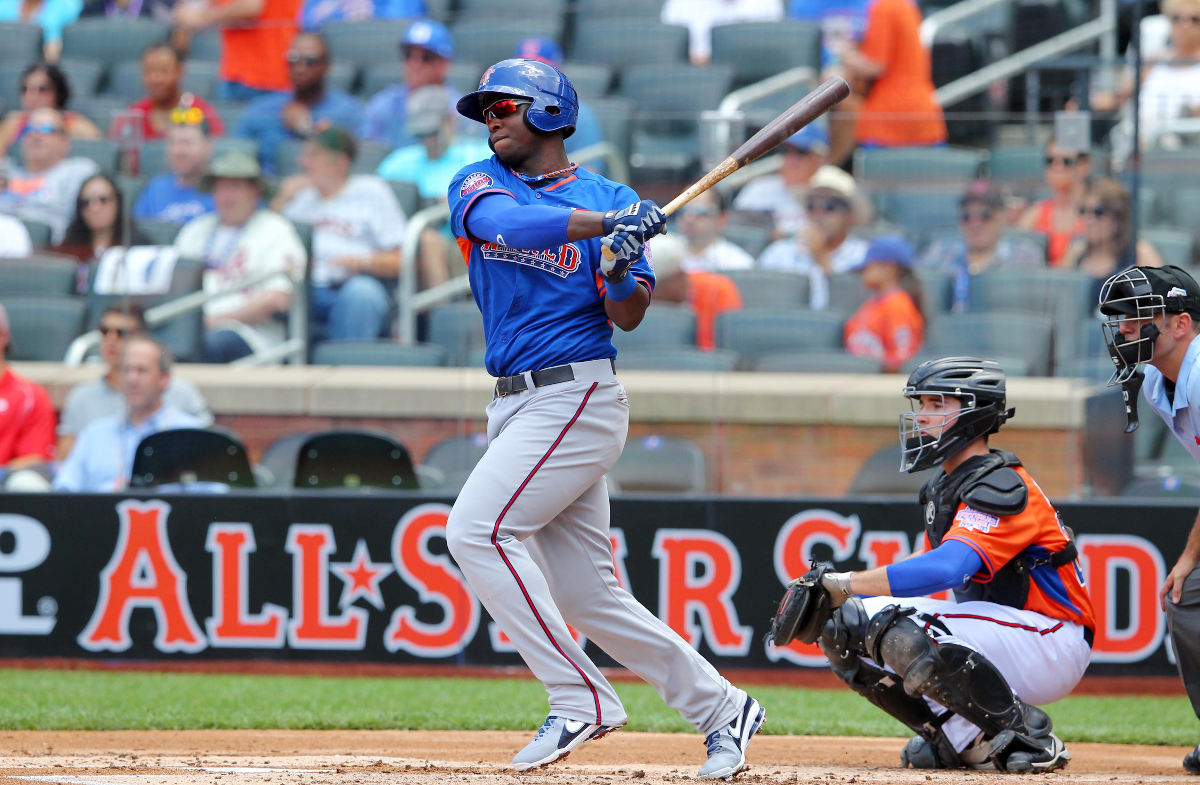 “He’s doing better,” Ryan said. “As you see, the progression is going in this direction and that’s good. He’s got work to do as does every guy down there at the Double-A level. But they’ve got a good club. There are guys that carried that team when Sano and Buxton were struggling. Neither one of them are struggling anymore.” Sano is certainly doing better. In the season’s first month he tagged four home runs but compiled a line of .159/.303/.381 while racking up strikeouts at a near 30% clip. When the calendar flipped to May, he turned it on. His line drive rate went from non-existent to lasers around the ballpark, helping him achieve a .321/.406/.625 line over his last 16 games. That is the progression the Twins are happy to see from Sano. Far too often, Sano’s swing results in towering flies to the middle of the park. Some of those flies turn into no-doubters but a high portion of them turn into long fly outs when hit to the middle of the park. Mixing in the screaming liners would ensure he reached safely on a few more of those plate appearances. http://i.imgur.com/7Tcw94c.gif There’s no doubt that Sano has the type of power that makes a pitcher hang his head and, for now, Sano’s bat is the focus but the underlying concern is whether his defense will be major league caliber. The on-going narrative for Sano is that the big man with the big swing will eventually be moved out of that position. Now with nine errors in 32 games, Ryan was asked if his defense was a concern for the organization to which he shrugged off. “No. Never has been a concern for me. I’ve never had a concern over his fielding, still don’t.” http://i.imgur.com/ypMNDFr.gif “Everybody makes errors in the minor league,” Ryan reminded the reporters. While errors are an antiquated measuring stick for defense, a high total still raises the question regarding a player’s skill set. Is his glove work in need of improvement? Is his throwing hindered by the recent Tommy John surgery? Is it decision-making? “They are both fine,” Ryan offered about Sano’s arm and hands. “He’s a kid who makes some unforced errors. Some of them he makes phenomenal plays but the next one is routine and he’ll botch it. Like a lot of youthful mistakes. All he needs is time. There’s nothing wrong with him.” Fielding aside, if Sano continues to swing the bat the way he currently is, he will likely find himself in a major league lineup in no time.
 -
Twins Notes: Hughes' Home Runs, Nolasco's Filth & Hunter's Pop
Parker Hageman posted an article in Twins
 http://i.imgur.com/j8leLbg.gif If you are a traditionalist -- someone who focuses on wins, losses and ERA to measure a pitcher’s performance -- you might judge Phil Hughes’ first seven starts harshly. If you are someone who looks at peripheral stats and FIP to better gauge his output, you might say he’s underperforming. What has characterized Hughes’ second season in a Twins uniform is his inability to locate his fastballs as well as he did the previous season. He has not been wild, he’s simply failed to get the pitch to the intended target, like in last Saturday’s start against the Indians. Catcher Kurt Suzuki calls for a fastball down and in on David Murphy but the pitch stays middle-middle and Murphy is able to get everything behind it. This isn’t the first time he’s struggled to hit that particular spot. Here’s the thing: Hughes’ bread-and-butter is fastballs up in the zone. Opponents are hitting ,229/.243/.356 over the last two years when he locates in the upper third of the zone. Meanwhile they are hitting .335/.342/.518 in the lower portions. If he wants to get hitters out, he should be attacking up but that’s counter to what he is actually doing this year. According to Pitch F/X, Hughes has increased the number of two-seam fastballs this season. Last year he threw it approximately 159 times total but has thrown around 171 two-seamers this season. This explains why his fastball locations have been middle of the plate instead of in the upper-third as they are frequently when he throws his four-seamer. Along the same lines, opponents have figured out how to hit his cutter. After batting just .218/.248/.326 off of it in 2014, they are posting a healthy .300/.317/.575 line so far this year. Hughes will get the ball in tonight’s start against the Rays. http://i.imgur.com/PfCKOF3.gif Brian Duensing hit the disabled list in mid-April with an intercostal strain and since his return, it has been an uphill battle. In now 3.1 innings of work, he has surrendered nine hits. (Add in another four walks and the lefty reliever has been littering the bases with runners.) The nine hits also includes that towering bomb by Miguel Cabrera on Thursday afternoon. To Duensing’s credit, despite all the hits allowed, the Cabrera home run was just the first he had allowed this season. What’s more is that the slider’s location wasn’t bad. Not too many people are able to launch a pitch that is out of the strike zone for a home run. Unfortunately, Cabrera is one of the few hitters who can do it: Since 2011 Cabrera has socked nine home runs on pitches in that location, the most in baseball. http://i.imgur.com/Q1AuCJv.gif Speaking of home runs, since the beginning of May, Torii Hunter has hit five home runs. Outside of the freakish Bryce Harper (7), Marlon Byrd (6...wait, what) and Joc Pederson (6), Hunter is tied with Nelson Cruz, Logan Morrison, Stephen Vogt, Anthony Rizzo and Todd Frazier with five on the month. Now with six on the year -- all pulled -- Hunter has shown he is locked in on pitches down-and-in. Not to mention, since moving to the second spot in the order on April 15, he is hitting .316/.370/.571 - a Top 25 OPS in that span. https://twitter.com/ParkerHageman/status/599070694752804864 If you thought Ricky Nolasco threw filth flarn filth in his most recent start against the Tigers, you would be correct. Nolasco relied on his slider/curveball combination to strike out a season-high seven Detroit hitters, including Miguel Cabrera, Victor Martinez and Ian Kinsler. Nolasco burned through pitches early by running the counts deep, walking three and ultimately exiting without completing his sixth inning of work. Still, the outing showed that the right-handed can make hitters look foolish with his secondary offerings. Opposing teams are hitting .366/.451/.488 off Nolasco’s fastball this year so a higher distribution of non-fastballs -- similar to Wednesday night’s outing at Comerica -- seems to be in order. http://i.imgur.com/U2vuNT1.gif There is a good reason this pitch was driven hard the other way: Trevor Plouffe was mentally well ahead of Detroit’s Kyle Lobstein. As discussed here last week, Plouffe has matured to the point where he knows that pitchers are trying to do. He said that he has found that pitchers will try to throw him hard inside then soft away. On cue, Lobstein tried to throw a soft slider down-and-away which Plouffe drove to the right center gap for a triple. http://i.imgur.com/w9lmSTt.gif After a really rough start to begin the season, reliever Blaine Boyer has strung together a series of nice outings. In fact, Boyer is one of just three relievers to not allow a run in their last ten innings or more. Boyer said in spring that he owed his time in Japan for helping him hone his command as he was forced to throw to a strike zone the size of a tennis ball. He has mid-90s heat which he claims is his two-seam fastball. While this seems to go against the science of pitching, Boyer swears that when he is hitting 94-95, it is the sinker that Cardinals’ pitching coach Dave Duncan taught him years ago. Without missing bats, Boyer’s success is likely limited but, for now, he has been able to help bridge the starters to Glen Perkins.

