



Seth Stohs
-
Posts
25,909 -
Joined
-
Last visited
-
Days Won
109
Content Type
Profiles
News
Minnesota Twins Videos
2026 Minnesota Twins Top Prospects Ranking
2022 Minnesota Twins Draft Picks
Minnesota Twins Free Agent & Trade Rumors, Notes, & Tidbits
Guides & Resources
2023 Minnesota Twins Draft Picks
The Minnesota Twins Players Project
2024 Minnesota Twins Draft Picks
2025 Minnesota Twins Draft Pick Tracker
2026 Minnesota Twins Draft Tracker: Picks & Bonuses
Forums
Blogs
Events
Store
Downloads
Gallery
Everything posted by Seth Stohs
-

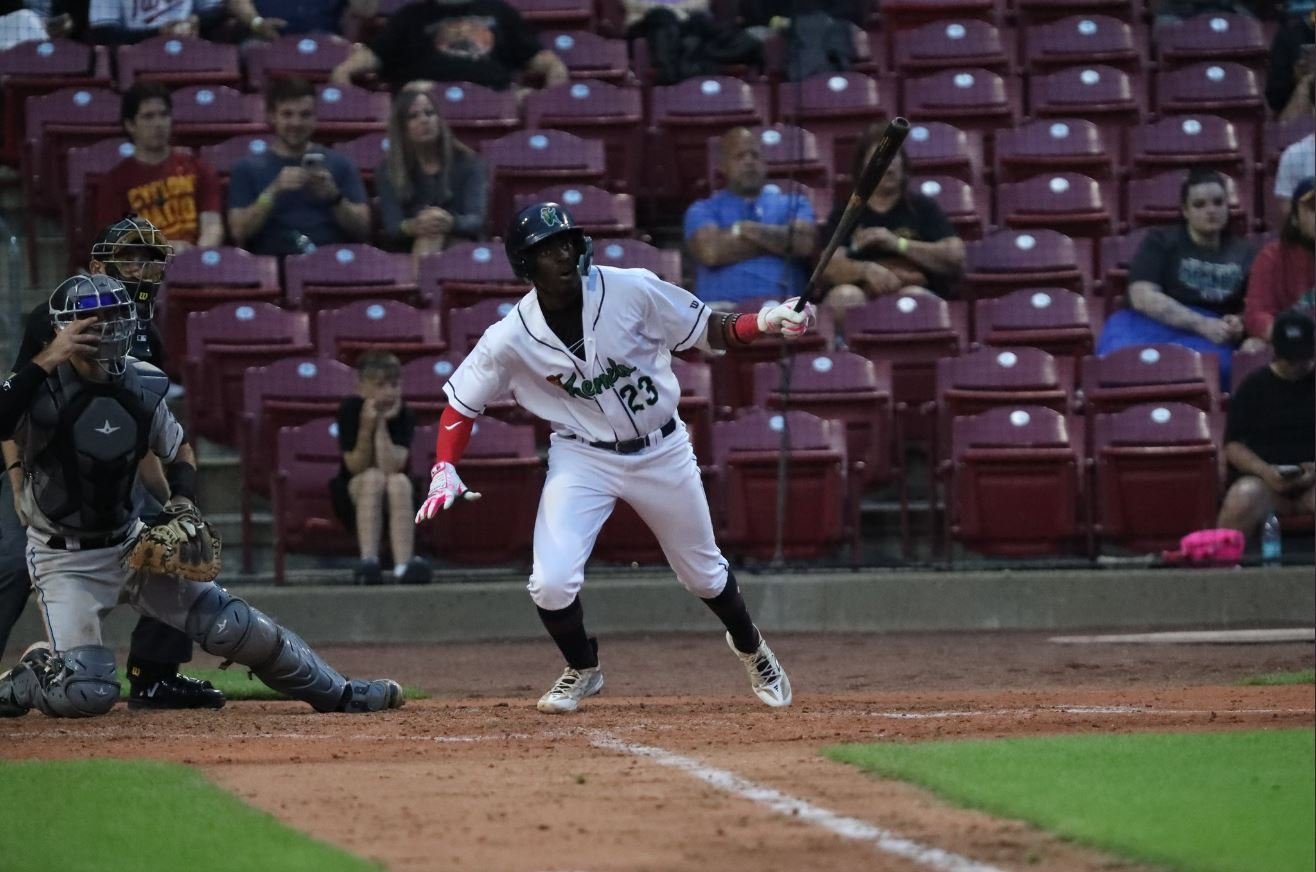 CURRENT W-L Records Minnesota Twins: 48-38 St. Paul Saints: 42-40 Wichita Wind Surge: 35-43 Cedar Rapids Kernels: 45-31 Fort Myers Mighty Mussels: 39-37 FCL Twins: 20-22 DSL Twins: 11-10 TRANSACTIONS As expected after he left last night’s game, Royce Lewis has been placed on the 10-Day Injured List by the Twins with an adductor strain. Taking his spot on the Twins active roster is infielder Brooks Lee who was also added to the Twins 40-man roster. He had been selected to play in the Futures Game this coming weekend, but I’m guessing he’s just fine with skipping that. To make room on the Twins 40-man roster, RHP Brock Stewart was placed on the 60-Day IL. LHP Aaron Rozek is heading back to St. Paul to join the Saints from Wichita. RHP Ricardo Velez has been promoted from Cedar Rapids to Wichita. Cedar Rapids shortstop Danny De Andrade was transferred from the 7-Day Injured List to the 60-Day Injured List. In addition, the Twins have signed free agent OF Tyler Dearden. The 25-year-old reached Triple-A with the Red Sox in 2023. Unsigned, he played 55 games for Twins legend Lew Ford and the Long Island Ducks in the independent Atlantic League. He was hitting .361/.410/.634 (1.044) with 19 doubles and 12 homers. SAINTS SENTINEL St. Paul 6, Gwinnett 21 Box Score On Wednesday afternoon, the Saints learned the great news that their shortstop, Brooks Lee, was going to the big leagues. The Saints celebrated with six runs on 13 hits, which normally is a pretty good outcome, but on this night, they lost by 15. But let me reiterate… Brooks Lee was called up. Then he started and went 2-for-4. He was able to record his first hit and his first RBI. Seven out of nine Saints batters had at least one hit. Seven out of the Stripers nine hitters had at least two hits (all nine had at least one). Veteran Eli White went 6-for-7 with two doubles, two home runs, and seven RBI. Maybe let’s stick to the Saints. Caleb Boushley was on the mound, and obviously he has been fantastic for the Saints this year. Coming into this game, he was 8-2 with a 3.48 ERA in 14 starts. In this game, he gave up nine runs on 13 hits and a walk over the first four innings. Scott Blewett gave up a run in the fifth frame. Ryan Jensen got four outs and gave up three runs. Austin Brice gave up two runs and recorded two outs. Hobie Harris gave up two runs in the eighth inning. Then infielder Diego A Castillo got to pitch the ninth; he gave up four runs on two hits and two walks. All four runs came on a grand slam. And just to think, Gwinnett left 12 runners on base and ‘only’ went 11-for-26 with runners in scoring position. Alright, let’s talk about the good stuff. Alex Isola led the offense with three hits in the game, including his eighth double. Chris Williams was 2-for-5 with his sixth homer. Patrick Winkel was 2-for-4 with his third home run. Matt Wallner had two doubles in four at-bats and now WIND SURGE WISDOM Wichita 2, Tulsa 3 (10 innings) Box Score It was Zebby Day in Wichita on Wednesday, and the right-hander provided another Quality Start. In six innings, he gave up two runs on four hits. Zebby Matthews had six strikeouts and, of course, no walks. Regi Grace continued his strong run of outings with two scoreless innings. Miguel Rodriguez pitched a perfect ninth with two strikeouts. Ricardo Velez was thrown right into the fire in his Surge debut. He came on for the 10th inning and gave up the Manfred Man to score to put the Surge down a run. They were unable to answer in the bottom of the inning. The Wind Surge managed just five hits in this contest. Carson McCusker went 2-for-4 with his 14th double which sent the game to… Overtime! Ben Ross was 2-for-4. Tanner Schobel had the lone extra base hit, his 12th double. https://x.com/WindSurgeICT/status/1808662238544224421 KERNELS NUGGETS Game 1: Cedar Rapids 4, Beloit 2 Box Score In the first game of the doubleheader, the Kernels jumped ahead only to see their lead disappear in the bottom of the seventh inning. The Kernels grabbed a 1-0 lead in the top of the first inning. Payton Eeles led off with a single and stole second. Ricardo Olivar lined a single to right field. Eeles scored on a sacrifice fly (to the second baseman, though running away from the plate in foul territory). Jeremy Lee started for the Kernels and put together his best start yet. He tossed five shutout innings. He gave up four hits, walked one, and struck out five batters. The score remained the same until the top of the sixth inning when Gonzalez welcomed Connor Fenlong with his second home run of the season. Gabriel Yanez came in and threw a 1-2-3 sixth inning. He came out for the bottom of the seventh and gave up a leadoff single. However, he got a strikeout and an infield pop out to put the Kernels one out from the win. Unfortunately, the next batter doubled so there were runners on second and third base. That was followed by a two-run single that tied the game. The batter advanced to second on a throwing error. Jared Dickey came to the plate and lined a single to right to drive in the game-winning (or game-losing) run. The Kernels managed just five hits in Game 1. Gonzalez went 1-for-2 and drove in both runs. Game 2: Cedar Rapids 5, Quad Cities 0 Box Score The Kernels again jumped out to a quick lead in Game 2. They scored all of their runs over the first two innings - on two big blasts - but this time they held on for the win, and the shutout. But let’s start with the pitch because, I mean, they tossed a shutout. It was a bit of a bullpen game for Cedar Rapids. Mike Paredes and Jarret Whorff, both who have made several starts in their careers, world the first six innings. Paredes gave up four hits and a walk over 3 1/3 innings. He had five strikeouts. Whorff gets the Win. He gave up just one hit over 2 2/3 scoreless innings. Juan Mendez came on for the seventh inning and was perfect, including one strikeouts. The first three games of this series have been played at the picturesque Modern Woodmen Park in Davenport. The next three games of the series will be played in front of the good folks of Cedar Rapids. Oh, you want to know who that hitting hero was and generally how the offense did? Let’s start in the first inning. Eeles again started things with a single in the top of the first. Rayne Doncon followed by launching his fourth homer since joining the Kernels. With two outs in the second inning, Dillon Tatum and Payton Eeles each singled. That brought Doncon back to the plate, and this time he put three runs on the scoreboard with his fifth homer. Eeles went 2-for-4 and his hitting .275 with an OPS of .898 since joining the Kernels. But Doncon was the story in this game, going 2-for-4 with two homers and five RBI. That’s a pretty solid day! MUSSEL MATTERS Fort Myers 5, Bradenton 10 Box Score The Mussels had 12 hits in this game, and they got off to a fast lead in the top of the first inning, but it just wasn’t enough on a rough day for the pitchers. In the top of the first, Walker Jenkins led off with a walk. Byron Chourio singled him to third, and then he stole second. After one out, Matthew Clayton doubled to drive in both runners. Nick Lucky followed with an RBI triple. Following a walk, Maddux Houghton drove in Lucky with a sacrifice fly to make it 4-0. That was about it for highlights for the Mussels. Ross Dunn started and gave up six runs on six hits (including two home runs) and two walks in 2 2/3 innings. He had three strikeouts. A rain delay slowed the momentum. Ben Ethridge came on and calmed things a bit. He gave up one run on four hits and two walks over the next three innings. Sam Perez gave up three runs on three hits and four walks in his 1 2/3 innings. He struck out two batters. Jack Noblegave up one hit, but he got the final two outs. The Mussel bats stayed quiet until the top of thgge ninth. After there were two outs, Angel Del Rosario singled, and Jenkins followed with a walk. Chourio drove in the team’s fifth and final run with a single to left. Nick Lucky went 3-for-4 with his first triple and his sixth and seventh steals. Byron Chourio was 3-for-5 and stole his 16th base. Matthew Clayton went 2-for-4 with his fourth double. Walker Jenkins had a single and two walks. TWINS DAILY MINOR LEAGUE PLAYERS OF THE DAY Pitcher of the Day – Jeremy Lee (Cedar Rapids) - 5.0 IP, 4 H, 0 R, 1 BB, 5 K; 74 pitches, 48 strikes (64.9%) Hitter of the Day – Rayne Doncon (Cedar Rapids) - 2-for-6, BB, 2-HR(5), 2 R, 5 RBI, K. PROSPECT SUMMARY Check out the Prospect Tracker for much more on the Twins Top 20 prospects after seeing how they did on Thursday. #1– Walker Jenkins (Fort Myers) – 1-for-3, 2 BB, K. #2 – Brooks Lee (Minnesota) – 2-for-4, RBI, K (MLB debut, batted 8th, played 3B) #4 – David Festa (Minnesota) – 5 IP, 9 H, 7 ER, 0 BB, 6 K, 81 pitches, 59 strikes (72.8%) #5 – Gabriel Gonzalez (Cedar Rapids) – Game 1: 1-for-2, HR(2), SF, R, 2 RBI ; Game 2: 1-for-3 #8 – Austin Martin (Minnesota) – 0-for-1 #9 – Luke Keaschall (Wichita) – 0-for-4, BB, K #13 – Tanner Schobel (Wichita) - 1-for-4, 2B(12), RBI, K #14 – Zebby Matthews (Wichita) – 6.0 IP, 4 H, 2 ER, 0 BB, 6 K, 92 pitches, 65 strikes (70.7%) #18 – Yunior Severino (St. Paul) – 2-for-5, 2B(7), R #20 – Ricardo Olivar (Cedar Rapids) – Game 1: 1-for-3, K (catcher) THURSDAY’S PROBABLE STARTERS St. Paul @ Iowa (6:07 PM CST) – RHP Louie Varland (2-5, 6.56 ERA) Wichita @ Tulsa (7:00 PM CST) – RHP Kyle Jones (first AA start) Quad Cities @ Cedar Rapids (6:35 PM CST) – RHP Ty Langenberg (2-0, 6.60 ERA) Bradenton @ Ft. Myers (6:05 APM CST) – RHP Spencer Bengard (5-1, 1.51 ERA) Please feel free to ask questions and discuss Wednesday’s games!
 -
Yeah, the photo was from last night. Not a regular Wind Surge jersey but one of their Tumba Vacas-themed jerseys... I can't explain it but here: https://www.milb.com/wichita/fans/copa
- 21 replies
-
- 2
-

-
- andrew morris
- brooks lee
- (and 3 more)
-
Twins Minor League Report (6/30): The Sevens Have It
Seth Stohs replied to Ted Schwerzler 's topic in Twins Minor League Talk
Yes. He's a catcher that can play some LF to keep his bat in the lineup.- 18 replies
-
- 2
-
-
- ricardo olivar
- adam plutko
- (and 4 more)
-
The Saints and Wind Surge got really good starting pitching on Saturday night. The Kernels powered their way to four home runs and a win. Rain was again the winner in Fort Myers. See what happened in the Twins minor leagues on Saturday. Image courtesy of Seth Stohs, Twins Daily CURRENT W-L Records Minnesota Twins: 44-36 (game in progress) St. Paul Saints: 41-38 Wichita Wind Surge: 32-42 Cedar Rapids Kernels: 43-29 Fort Myers Mighty Mussels: 36-36 FCL Twins: 18-22 DSL Twins: 10-10 TRANSACTIONS The Saints placed RHP Jay Jackson on the temporarily inactive list. Fort Myers activated C Wilfri Castro from the 7-Day IL. IF/OF Brandon Winokur was placed on the 7-Day IL SAINTS SENTINEL St. Paul 8, Iowa 2 Box Score In his previous start, Louie Varland was charged with 12 runs over 2 1/3 innings of work. To say he was much improved in this outing is a bit of an understatement. Of course, the wind in Des Moines wasn’t blowing out like it was a week ago in St. Paul. However, he was still blessed with plenty of run support. In the first inning, Brooks Lee doubled and scored on a single by Yunior Severino. In the second inning, Chris Williams hit a long home run to make it 2-0 Saints. The Saints put a “4” on the scoreboard in the fourth inning. Alex Isola reached on an error and advanced to second on a passed ball. Anthony Prato drove him in with a double. Edouard Julien followed with a single to center to score Prato. After the inning’s second out, Wallner singled to right. Julien advanced to third. Severino singled to drive in Julien. Varland completed five shutout innings. He gave up four hits, walked two and struck out seven batters. Josh Winder worked the next two innings. He gave up two runs on three hits. He walked one and struck out four batters. Ryan Jensen and Jeff Brigham each pitched a scoreless inning. Brigham struck out the side. DaShawn Keirsey went 3-for-4 with his 14th double and 18th stolen base. Julien went 2-for-5 with a walk. Severino went 2-for-5. Williams’ home run was his fifth of the year. WIND SURGE WISDOM Wichita 2, NW Arkansas 3 Box Score Travis Adams gave up two runs early, but he really settled on and had a high-quality start. He gave up a run in each of the first and second innings. However, he ended up going 6 2/3 innings and gave up just those two runs on six hits. He had nine strikeouts without issuing a walk. Miguel Rodriguez came in and got the final out of the seventh inning on a strikeout. Travis Floyd came on and pitched the eighth and ninth innings. He had four strikeouts, but he gave up one unearned run and took the loss. With one out in the third inning, Luke Keaschall walked. He stole second base. Jake Rucker walked. Then Jeferson Morales singled to drive in Keaschall with the team’s first run. In the fourth inning, Andrew Cossetti worked a one-out walk. He stole second, and with two outs, he scored on a Ben Ross double to tie the game at 2-2. Carson McCusker went 3-for-4 with his fifth stolen base. The rest of the Surge hitters combined for four more hits. KERNELS NUGGETS Cedar Rapids 4, Beloit 2 Box Score The Kernels powered their way to a nice, 4-2 win. In the first inning, Rayne Doncon’s third Kernels homer gave the Kernels a 1-0 lead. In the second frame, Misael Urbina hit his fourth homer of the year. With one out, Agustin Ruiz hit his fifth homer to make it 3-0. John Klein started and gave up two runs on six hits over five innings. He struck out eight batters and didn’t walk any. Both runs scored in the top of the third inning to make it 3-2. However, in the fifth inning, Ricardo Olivar knocked his 11th home of the season to make it 4-2. Sheldon Reed worked two scoreless innings. Ricardo Velez struck out three batters in a scoreless eighth frame. Gariel Yanez then pitched a scoreless ninth for his sixth save. The Kernels had just seven hit including the four home runs. In addition, Gabriel Gonzalez added a triple. Kevin Maitan had two walks. MUSSEL MATTERS Fort Myers 2, Tampa 0 (suspended in 2nd inning) Box Score Things started out quite well in Ft. Myers for the Mussels, well, after the game was delayed to start.. First,Jose Oliveres put a zero on the board. Then Walker Jenkins led off the bottom of the first by launching a 3-2 pitch over the wall in right field for his second homer of the season. Isaac Pena singled and then scored on a Poncho Ruiz double. Jose Olivares got two outs in the top of the second before the rains came again. That is where the game will continue when it restarts on Sunday morning. COMPLEX CHRONICLES FCL Twins 1, FCL Red Sox 6 Box Score Liam Rocha made the start for the Twins on Saturday. He gave up four runs on six hits (including two homers). He walked one and had five strikeouts. Eider Machuca came in and gave up two runs (1 earned) on one hit and two walks in the fifth inning. Ezequiel Ventural struck out three batters over two perfect innings. The Twins had just four hits in the game. Ricardo Pena went 1-for-2 with a walk and his seventh double. Yilber Herrera walked twice, including to lead off the third inning. He advanced to second on an Amilcar Vasquez single. However, he was out when Bryan Acuna lined out to the first baseman who threw behind Herrera to double him up. Yasser Mercedes followed with a single. Vasquez scored the lone Twins run on a wild pitch. DOMINICAN DAILIES DSL Twins 3, DSL Mets Orange 4 Box Score It was a back and forth game in the Dominican on Saturday. Both teams scored a run in the second inning. The Mets took a one-run lead after three innings, but the Twins tied it up in the fifth. The Mets reclaimed the lead at 3-2 with a run in the bottom of the sixth. The Twins tied it up in the top of the seventh, but the Mets walked it off with two outs in the bottom of the seventh. The Twins got a one-out single from Victor Leal in the top of the second. He moved to second on a ground out and then scored on a single by Alver Medina. With two outs in the top of the fifth inning, Murphy Hernandez singled. He then stole second base on a wild pitch which allowed him to go to third, but a throwing error by the catcher allowed him to score and tie the game. With two outs in the top of the seventh, Nestor Urbina reached on a force out. He stole second and scored on an error. That tied the game at 3-3. Santiago Rojas started this game. He went four innings and gave up two runs (1 earned) on four hits and a walk. He struck out four batters. Anderson Ramos came in to start the fifth frame. In 2 2/3 innings, he gave up two runs on four hits. He walked one and struck out two batters. Merphy Hernandez went 2-for-2 with a walk. He also stole three more bases, giving him 16 total for the season. Leal went 2-for-3 and stole his third base. TWINS DAILY MINOR LEAGUE PLAYERS OF THE DAY Pitcher of the Day – Travis Adams (Wichita) - 6.2 IP, 6 H, 2 R, 0 BB, 9 K; 91 pitches, 70 strikes (77.0%) Hitter of the Day – DaShawn Keirsey, Jr. (St. Paul) - 3-for-4, BB, 2B(14), R, RBI, K, SB(18). PROSPECT SUMMARY Check out the Prospect Tracker for much more on the Twins Top 20 prospects after seeing how they did on Thursday. #1– Walker Jenkins (Fort Myers) – Game Suspended (1-for-1, HR) #2 – Brooks Lee (St. Paul) – 1-for-5, 2B(5), R, K #5 – Gabriel Gonzalez (Cedar Rapids) – 1-for-4, 3B(2), K #8 – Austin Martin (Minnesota) – in lineup #9 – Luke Keaschall (Wichita) – 1-for-3, BB, R, K, SB(4) #18 – Yunior Severino (St. Paul) – 2-for-5, 2 RBI, K #20 – Ricardo Olivar (Cedar Rapids) – 2-for-4, HR(11), R, RBI, 2K SUNDAY’S PROBABLE STARTERS St. Paul @ Iowa (1:08 PM CST) – RHP Adam Plutko (2-1, 4.79 ERA) NW Arkansas @ Wichita (1:05 PM CST) – RHP Cory Lewis (0-1, 3.86 ERA) Beloit @ Cedar Rapids (1:05 PM CST) – LHP Christian MacLeod (1-1, 2.70 ERA) Tampa @ Ft. Myers (DH @ 11:05 AM CST) – LHP Cesar Lares (2-2, 3.30 ERA) Please feel free to ask questions and discuss Saturday’s games! View full article
- 14 replies
-
- 1
-
-
- louis varland
- dashawn keirsey jr
- (and 5 more)
-
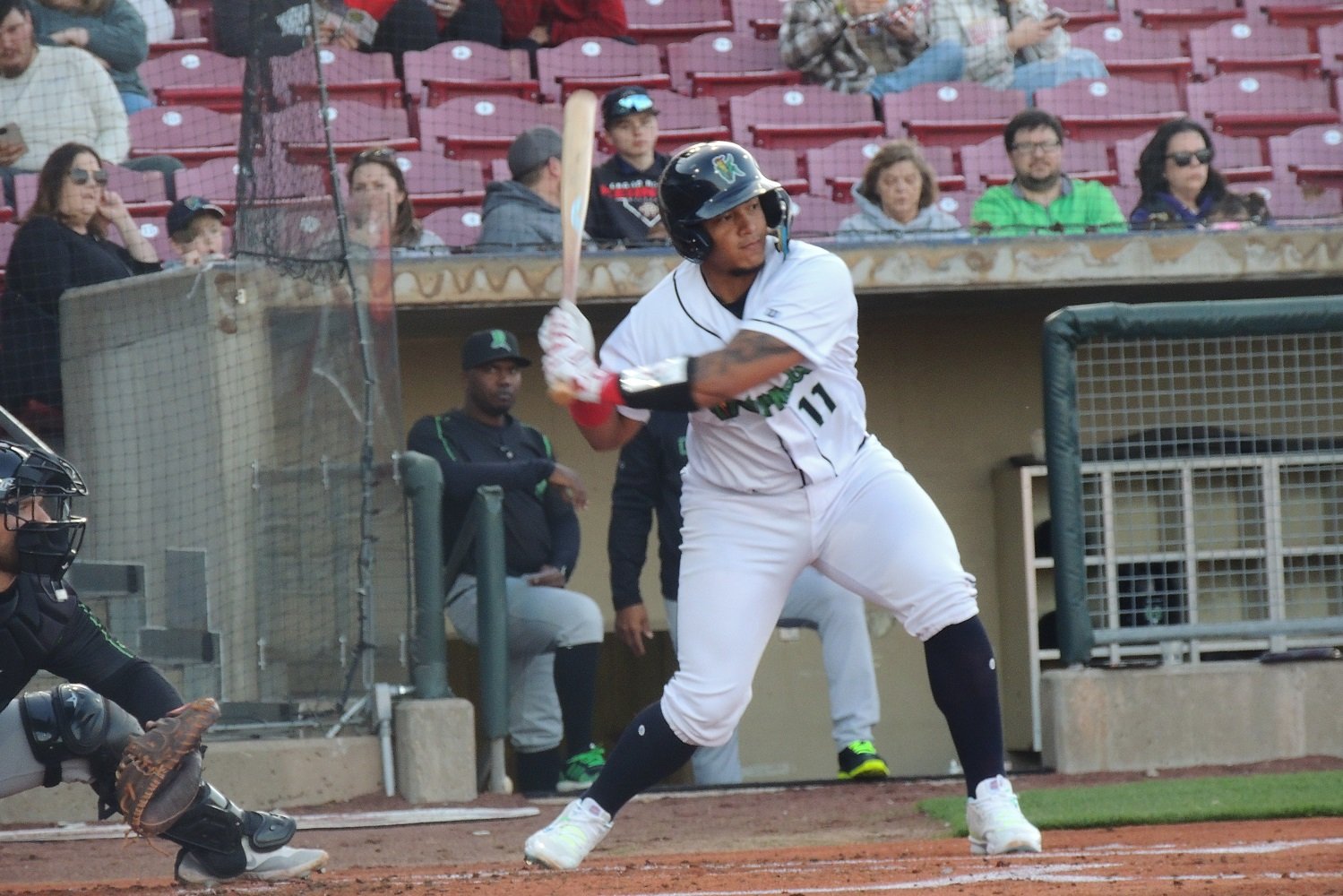 CURRENT W-L Records Minnesota Twins: 44-36 (game in progress) St. Paul Saints: 41-38 Wichita Wind Surge: 32-42 Cedar Rapids Kernels: 43-29 Fort Myers Mighty Mussels: 36-36 FCL Twins: 18-22 DSL Twins: 10-10 TRANSACTIONS The Saints placed RHP Jay Jackson on the temporarily inactive list. Fort Myers activated C Wilfri Castro from the 7-Day IL. IF/OF Brandon Winokur was placed on the 7-Day IL SAINTS SENTINEL St. Paul 8, Iowa 2 Box Score In his previous start, Louie Varland was charged with 12 runs over 2 1/3 innings of work. To say he was much improved in this outing is a bit of an understatement. Of course, the wind in Des Moines wasn’t blowing out like it was a week ago in St. Paul. However, he was still blessed with plenty of run support. In the first inning, Brooks Lee doubled and scored on a single by Yunior Severino. In the second inning, Chris Williams hit a long home run to make it 2-0 Saints. The Saints put a “4” on the scoreboard in the fourth inning. Alex Isola reached on an error and advanced to second on a passed ball. Anthony Prato drove him in with a double. Edouard Julien followed with a single to center to score Prato. After the inning’s second out, Wallner singled to right. Julien advanced to third. Severino singled to drive in Julien. Varland completed five shutout innings. He gave up four hits, walked two and struck out seven batters. Josh Winder worked the next two innings. He gave up two runs on three hits. He walked one and struck out four batters. Ryan Jensen and Jeff Brigham each pitched a scoreless inning. Brigham struck out the side. DaShawn Keirsey went 3-for-4 with his 14th double and 18th stolen base. Julien went 2-for-5 with a walk. Severino went 2-for-5. Williams’ home run was his fifth of the year. WIND SURGE WISDOM Wichita 2, NW Arkansas 3 Box Score Travis Adams gave up two runs early, but he really settled on and had a high-quality start. He gave up a run in each of the first and second innings. However, he ended up going 6 2/3 innings and gave up just those two runs on six hits. He had nine strikeouts without issuing a walk. Miguel Rodriguez came in and got the final out of the seventh inning on a strikeout. Travis Floyd came on and pitched the eighth and ninth innings. He had four strikeouts, but he gave up one unearned run and took the loss. With one out in the third inning, Luke Keaschall walked. He stole second base. Jake Rucker walked. Then Jeferson Morales singled to drive in Keaschall with the team’s first run. In the fourth inning, Andrew Cossetti worked a one-out walk. He stole second, and with two outs, he scored on a Ben Ross double to tie the game at 2-2. Carson McCusker went 3-for-4 with his fifth stolen base. The rest of the Surge hitters combined for four more hits. KERNELS NUGGETS Cedar Rapids 4, Beloit 2 Box Score The Kernels powered their way to a nice, 4-2 win. In the first inning, Rayne Doncon’s third Kernels homer gave the Kernels a 1-0 lead. In the second frame, Misael Urbina hit his fourth homer of the year. With one out, Agustin Ruiz hit his fifth homer to make it 3-0. John Klein started and gave up two runs on six hits over five innings. He struck out eight batters and didn’t walk any. Both runs scored in the top of the third inning to make it 3-2. However, in the fifth inning, Ricardo Olivar knocked his 11th home of the season to make it 4-2. Sheldon Reed worked two scoreless innings. Ricardo Velez struck out three batters in a scoreless eighth frame. Gariel Yanez then pitched a scoreless ninth for his sixth save. The Kernels had just seven hit including the four home runs. In addition, Gabriel Gonzalez added a triple. Kevin Maitan had two walks. MUSSEL MATTERS Fort Myers 2, Tampa 0 (suspended in 2nd inning) Box Score Things started out quite well in Ft. Myers for the Mussels, well, after the game was delayed to start.. First,Jose Oliveres put a zero on the board. Then Walker Jenkins led off the bottom of the first by launching a 3-2 pitch over the wall in right field for his second homer of the season. Isaac Pena singled and then scored on a Poncho Ruiz double. Jose Olivares got two outs in the top of the second before the rains came again. That is where the game will continue when it restarts on Sunday morning. COMPLEX CHRONICLES FCL Twins 1, FCL Red Sox 6 Box Score Liam Rocha made the start for the Twins on Saturday. He gave up four runs on six hits (including two homers). He walked one and had five strikeouts. Eider Machuca came in and gave up two runs (1 earned) on one hit and two walks in the fifth inning. Ezequiel Ventural struck out three batters over two perfect innings. The Twins had just four hits in the game. Ricardo Pena went 1-for-2 with a walk and his seventh double. Yilber Herrera walked twice, including to lead off the third inning. He advanced to second on an Amilcar Vasquez single. However, he was out when Bryan Acuna lined out to the first baseman who threw behind Herrera to double him up. Yasser Mercedes followed with a single. Vasquez scored the lone Twins run on a wild pitch. DOMINICAN DAILIES DSL Twins 3, DSL Mets Orange 4 Box Score It was a back and forth game in the Dominican on Saturday. Both teams scored a run in the second inning. The Mets took a one-run lead after three innings, but the Twins tied it up in the fifth. The Mets reclaimed the lead at 3-2 with a run in the bottom of the sixth. The Twins tied it up in the top of the seventh, but the Mets walked it off with two outs in the bottom of the seventh. The Twins got a one-out single from Victor Leal in the top of the second. He moved to second on a ground out and then scored on a single by Alver Medina. With two outs in the top of the fifth inning, Murphy Hernandez singled. He then stole second base on a wild pitch which allowed him to go to third, but a throwing error by the catcher allowed him to score and tie the game. With two outs in the top of the seventh, Nestor Urbina reached on a force out. He stole second and scored on an error. That tied the game at 3-3. Santiago Rojas started this game. He went four innings and gave up two runs (1 earned) on four hits and a walk. He struck out four batters. Anderson Ramos came in to start the fifth frame. In 2 2/3 innings, he gave up two runs on four hits. He walked one and struck out two batters. Merphy Hernandez went 2-for-2 with a walk. He also stole three more bases, giving him 16 total for the season. Leal went 2-for-3 and stole his third base. TWINS DAILY MINOR LEAGUE PLAYERS OF THE DAY Pitcher of the Day – Travis Adams (Wichita) - 6.2 IP, 6 H, 2 R, 0 BB, 9 K; 91 pitches, 70 strikes (77.0%) Hitter of the Day – DaShawn Keirsey, Jr. (St. Paul) - 3-for-4, BB, 2B(14), R, RBI, K, SB(18). PROSPECT SUMMARY Check out the Prospect Tracker for much more on the Twins Top 20 prospects after seeing how they did on Thursday. #1– Walker Jenkins (Fort Myers) – Game Suspended (1-for-1, HR) #2 – Brooks Lee (St. Paul) – 1-for-5, 2B(5), R, K #5 – Gabriel Gonzalez (Cedar Rapids) – 1-for-4, 3B(2), K #8 – Austin Martin (Minnesota) – in lineup #9 – Luke Keaschall (Wichita) – 1-for-3, BB, R, K, SB(4) #18 – Yunior Severino (St. Paul) – 2-for-5, 2 RBI, K #20 – Ricardo Olivar (Cedar Rapids) – 2-for-4, HR(11), R, RBI, 2K SUNDAY’S PROBABLE STARTERS St. Paul @ Iowa (1:08 PM CST) – RHP Adam Plutko (2-1, 4.79 ERA) NW Arkansas @ Wichita (1:05 PM CST) – RHP Cory Lewis (0-1, 3.86 ERA) Beloit @ Cedar Rapids (1:05 PM CST) – LHP Christian MacLeod (1-1, 2.70 ERA) Tampa @ Ft. Myers (DH @ 11:05 AM CST) – LHP Cesar Lares (2-2, 3.30 ERA) Please feel free to ask questions and discuss Saturday’s games!
- 14 comments
-
- 5
-
-

-
- louis varland
- dashawn keirsey jr
- (and 5 more)
-
David Festa made his much-anticipated MLB debut on Thursday afternoon, and he had his offense behind him, giving him plenty of run support. The Twins finished a series win in Phoenix! Image courtesy of Rob Schumacher/The Republic / USA TODAY NETWORK Box Score SP: David Festa - 5 IP, 7 H, 5 ER, 1 BB, 2 K (78 pitches, 53 strikes (67.9%), 6 whiffs) Home Runs: Byron Buxton (7) Top 3 WPA: Carlos Correa (.109), Willi Castro (.101), Royce Lewis (.080) Win Probability Chart (via FanGraphs) Happy Festa-val Day!! Everyone’s using the Festavus meme, but we’re going with Festa-val Day! Turns out, he had a Jack Morris game, to some degree. Jack Morris was known, when he got into the Hall of Fame, as having the highest ERA of all Hall of Fame pitchers. Morris would say he didn’t care about his ERA, just that his team got the win. He would pitch to the scoreboard instead of just trying to limit runs. Well, certainly in a big-league debut, David Festa was not trying to pitch to the scoreboard, but his overall line is not really all that indicative of what he did. In fact, all of the Diamondback damage off of him happened in that fourth inning. Ketel Marte homered, but then Festa recorded the first two strikeouts of his career. That was followed by five straight hits which almost put Festa’s day at an early end. Because they had the big lead, they could be more patient. Most important, Festa was throwing strikes and not hurting himself with walks. He managed to get through the fourth inning and then the fifth inning which allowed him to earn his first MLB Win. I know the Win statistic for individuals has lost its luster in the analytical age… but I guarantee a player’s first MLB win is pretty meaningful. By the numbers Of Festa's 78 pitches, he threw 33 four-seam fastballs (42%), 26 sliders (33%), and 19 changeups (24%). His fastball averaged 95.8 mph with a max of 96.9 mph. His slider averaged 87.1 mph with a max of 88.3 mph. The changeup was thrown at an average of 88.9 mph with a max of 90.6 mph. I was actually impressed that at no point did Festa look like he was overthrowing. He has touched 100 mph in the minor leagues and frequently hits 98. Clearly with the lead and run support, he prioritized throwing strikes. We know that his stuff can be better. His Triple-A numbers tell us that he will have much more swing-and-miss stuff. Of his 78 pitches, he had just six whiffs. Also, pitching in a more "normal" game would likely help. Yes, every pitcher will tell his offense to just keep scoring, but the Twins had three straight very long innings, and I don't know that Festa sat down even once in that time. Getting through the first big-league start is a big deal. Once he is able to relax a little and throw more freely, I believe we'll see even more velocity and more sharpness on the slider. Offense Remains Red Hot in the Desert! After a scoreless first inning, the Twins put a six-spot on the board in the second inning. They showed really good patience, laying off the Jordan Montgomery pitches below the zone. They didn't hit everything real hard, but they found the holes. Correa reached on catcher's interference. Royce Lewis reached on a fielder's choice and error which scored two runs. Jose Miranda hit a sacrifice fly. Carlos Santana crushed a double. Montgomery came out to start the third inning too. Byron Buxton reached on a ground ball to shortstop. Then he scored on a Willi Castro triple. Margot had another sacrifice fly to make it 8-0. Montgomery's day was over with 74 pitches and just eight outs. In the fourth inning, Byron Buxton had a lengthy at-bat. He got a fastball on the outer half of the plate and crushed it, 471 feet, to center field. The three-run homer gave the Twins an 11-0 lead. After the D-Backs scored four in the fourth, the Twins took two back. Royce Lewis doubled to left and Miranda hit another sacrifice fly. Buxton had three hits and three RBI. Willi Castro had two hits including his fifth triple. Santana 's double was his 14th. Margot went 2-for-5. Margot Continues to Rake While a lot of Twins fans watched Manuel Margot struggle early, Rocco Baldelli stood by him. He continued to play against lefties. He pinch hit against lefties. Eventually, it started paying off. Over his past 25 games, Margot is hitting .306/.389/.452 (.841). Santana Streak Continues While a lot of Twins fans watched Carlos Santana struggle early, Rocco Baldelli stood by him. For the most part, he played everyday at first base. He has more than proven himself defensively and should receive strong consideration for a Gold Glove. In his past 31 games, Santana is hitting .337/.427/.574 (1.001) with nine doubles and five homers. He also has 15 walks to go with 11 strikeouts. The 37-year-old has been remarkable. Taking Full Advantage of His Shot Since May 15th, Jose Miranda has played in 37 games. He has hit .315/.362/.548 (.910) with nine doubles, a triple, and six home runs. On June 3rd, many assumed Miranda would be the one sent to Rochester when Royce Lewis returned to the roster. Instead, the Twins sent down Edouard Julien because he had been struggling. In 20 games since then, Miranda is hitting .328/.397/.552 (.949) with seven doubles and two homers. Remember when Byron Buxton was Struggling? Since June 6th, Buxton is hitting .355/.397/.645 (1.042) with four doubles, a triple, and four home runs. Really Willi? And Willi Castro has just been so good defensively wherever he's played. However, he has earned his shot near the top of the lineup. In his last 20 games, he is hitting .338/.433/.597 (1.030) with nine doubles, a triple, and three home runs. But Then… Carlos Correa has been absolutely on fire for over a month. And now we, as Twins fans, can only hope that we get to see him hit again sometime in the next month. He began the day going 1-for-1 with two walks, but in his fourth plate appearance, a Bryce Jarvis, tailing fastball ran in on him and drilled him in the wrist region. Correa stepped out of the batter’s box, raised his arm and didn’t even try to shake it. Instead, he looked into his dugout and shook his head. Certainly we will learn more about the extent of the Correa injury in the coming hours and days. There is no question that if he is lost for any significant time, it would not be good for the Twins. Correa not only has been playing well, hitting well and fielding well, but he is the clear leader on this team. The initial in-game report from the Twins was that Correa has a right wrist contusion. X-Rays on his wrist were negative, which of course is positive. Certainly more testing will be done, but if they can avoid an IL stint, but it would be wonderful. Over 50 games since May 1, Correa has hit .319/.380/.521 (.901) with 13 doubles, two triples, and seven home runs. Of course, some may want to jump to point out that if the Twins do need to put Correa on the Injured List for an extended period of time, it would likely mean that Brooks Lee would get the call to the big leagues. We can be excited about that later. For now, I think we can all hope that Correa isn’t hurt as bad as it looked like it could have been. What’s Next? The Twins leave the desert and head to the oft-rainy northwest to take on the Seattle Mariners in a three game series. Fri 8:40 pm: RHP Bailey Ober (7-4, 4.50 ERA) vs RHP Logan Gilbert (5-4, 2.71 ERA) Sat 9:10 pm: RHP Pablo Lopez (7-6, 3.05 ERA) vs RHP Bryce Miller (6-6, 3.90 ERA) Sun 3:10 pm: RHP Joe Ryan (5-5, 3.31 ERA) vs TBD (7-3, 3.42 ERA) The Twins will get a day off on Monday before coming back to Target Field. Postgame Interviews Bullpen Usage Spreadsheet SUN MON TUE WED THU TOT Funderburk 0 0 0 0 34 34 Alcalá 0 0 19 0 0 19 Okert 0 0 0 19 0 19 Thielbar 0 0 0 0 19 19 Sands 0 0 9 0 9 18 Jax 15 0 0 0 0 15 Staumont 0 0 0 5 0 5 Durán 0 0 0 3 0 3 View full article
- 57 replies
-
- 1
-
-
- david festa
- byron buxton
- (and 5 more)
-
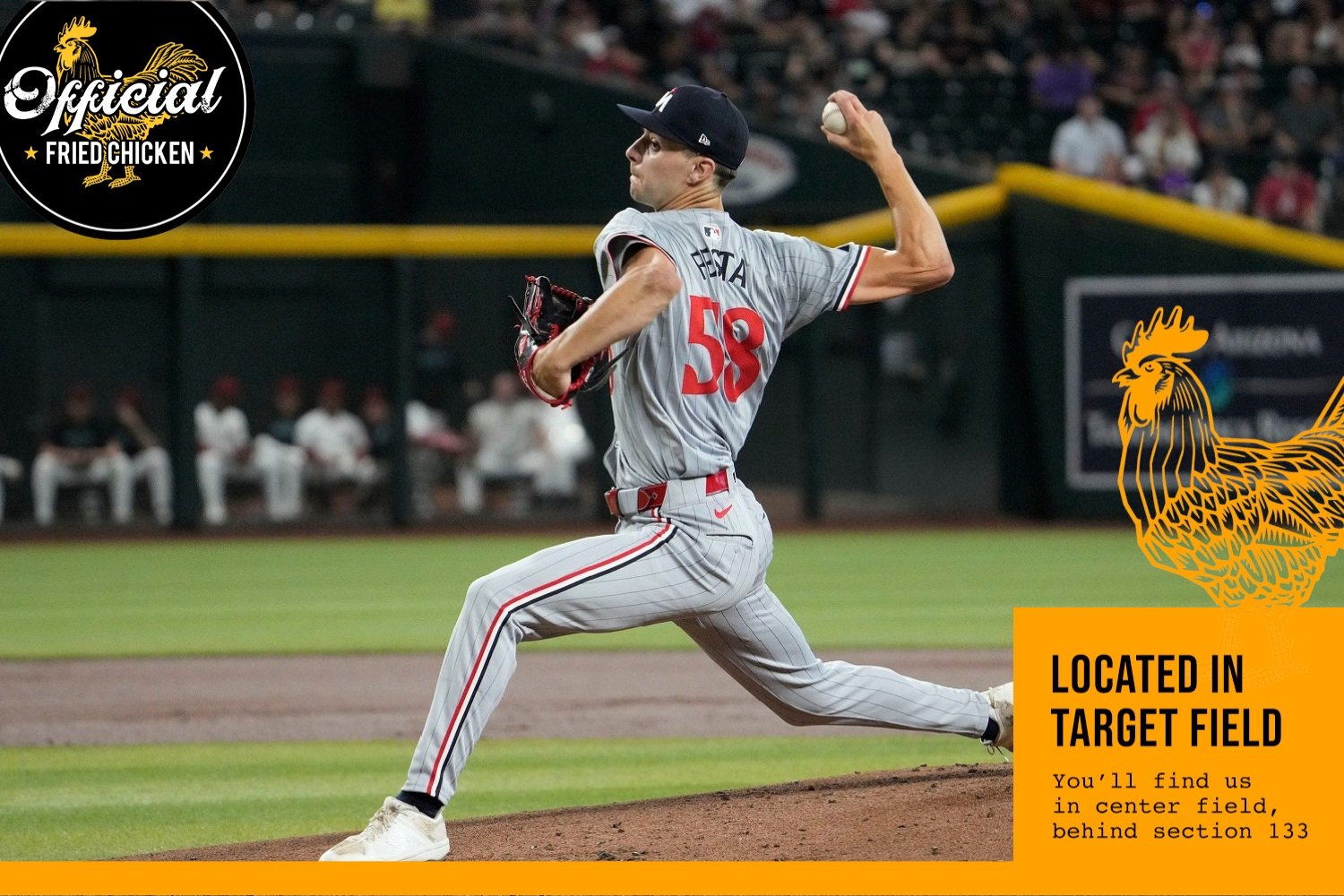 Box Score SP: David Festa - 5 IP, 7 H, 5 ER, 1 BB, 2 K (78 pitches, 53 strikes (67.9%), 6 whiffs) Home Runs: Byron Buxton (7) Top 3 WPA: Carlos Correa (.109), Willi Castro (.101), Royce Lewis (.080) Win Probability Chart (via FanGraphs) Happy Festa-val Day!! Everyone’s using the Festavus meme, but we’re going with Festa-val Day! Turns out, he had a Jack Morris game, to some degree. Jack Morris was known, when he got into the Hall of Fame, as having the highest ERA of all Hall of Fame pitchers. Morris would say he didn’t care about his ERA, just that his team got the win. He would pitch to the scoreboard instead of just trying to limit runs. Well, certainly in a big-league debut, David Festa was not trying to pitch to the scoreboard, but his overall line is not really all that indicative of what he did. In fact, all of the Diamondback damage off of him happened in that fourth inning. Ketel Marte homered, but then Festa recorded the first two strikeouts of his career. That was followed by five straight hits which almost put Festa’s day at an early end. Because they had the big lead, they could be more patient. Most important, Festa was throwing strikes and not hurting himself with walks. He managed to get through the fourth inning and then the fifth inning which allowed him to earn his first MLB Win. I know the Win statistic for individuals has lost its luster in the analytical age… but I guarantee a player’s first MLB win is pretty meaningful. By the numbers Of Festa's 78 pitches, he threw 33 four-seam fastballs (42%), 26 sliders (33%), and 19 changeups (24%). His fastball averaged 95.8 mph with a max of 96.9 mph. His slider averaged 87.1 mph with a max of 88.3 mph. The changeup was thrown at an average of 88.9 mph with a max of 90.6 mph. I was actually impressed that at no point did Festa look like he was overthrowing. He has touched 100 mph in the minor leagues and frequently hits 98. Clearly with the lead and run support, he prioritized throwing strikes. We know that his stuff can be better. His Triple-A numbers tell us that he will have much more swing-and-miss stuff. Of his 78 pitches, he had just six whiffs. Also, pitching in a more "normal" game would likely help. Yes, every pitcher will tell his offense to just keep scoring, but the Twins had three straight very long innings, and I don't know that Festa sat down even once in that time. Getting through the first big-league start is a big deal. Once he is able to relax a little and throw more freely, I believe we'll see even more velocity and more sharpness on the slider. Offense Remains Red Hot in the Desert! After a scoreless first inning, the Twins put a six-spot on the board in the second inning. They showed really good patience, laying off the Jordan Montgomery pitches below the zone. They didn't hit everything real hard, but they found the holes. Correa reached on catcher's interference. Royce Lewis reached on a fielder's choice and error which scored two runs. Jose Miranda hit a sacrifice fly. Carlos Santana crushed a double. Montgomery came out to start the third inning too. Byron Buxton reached on a ground ball to shortstop. Then he scored on a Willi Castro triple. Margot had another sacrifice fly to make it 8-0. Montgomery's day was over with 74 pitches and just eight outs. In the fourth inning, Byron Buxton had a lengthy at-bat. He got a fastball on the outer half of the plate and crushed it, 471 feet, to center field. The three-run homer gave the Twins an 11-0 lead. After the D-Backs scored four in the fourth, the Twins took two back. Royce Lewis doubled to left and Miranda hit another sacrifice fly. Buxton had three hits and three RBI. Willi Castro had two hits including his fifth triple. Santana 's double was his 14th. Margot went 2-for-5. Margot Continues to Rake While a lot of Twins fans watched Manuel Margot struggle early, Rocco Baldelli stood by him. He continued to play against lefties. He pinch hit against lefties. Eventually, it started paying off. Over his past 25 games, Margot is hitting .306/.389/.452 (.841). Santana Streak Continues While a lot of Twins fans watched Carlos Santana struggle early, Rocco Baldelli stood by him. For the most part, he played everyday at first base. He has more than proven himself defensively and should receive strong consideration for a Gold Glove. In his past 31 games, Santana is hitting .337/.427/.574 (1.001) with nine doubles and five homers. He also has 15 walks to go with 11 strikeouts. The 37-year-old has been remarkable. Taking Full Advantage of His Shot Since May 15th, Jose Miranda has played in 37 games. He has hit .315/.362/.548 (.910) with nine doubles, a triple, and six home runs. On June 3rd, many assumed Miranda would be the one sent to Rochester when Royce Lewis returned to the roster. Instead, the Twins sent down Edouard Julien because he had been struggling. In 20 games since then, Miranda is hitting .328/.397/.552 (.949) with seven doubles and two homers. Remember when Byron Buxton was Struggling? Since June 6th, Buxton is hitting .355/.397/.645 (1.042) with four doubles, a triple, and four home runs. Really Willi? And Willi Castro has just been so good defensively wherever he's played. However, he has earned his shot near the top of the lineup. In his last 20 games, he is hitting .338/.433/.597 (1.030) with nine doubles, a triple, and three home runs. But Then… Carlos Correa has been absolutely on fire for over a month. And now we, as Twins fans, can only hope that we get to see him hit again sometime in the next month. He began the day going 1-for-1 with two walks, but in his fourth plate appearance, a Bryce Jarvis, tailing fastball ran in on him and drilled him in the wrist region. Correa stepped out of the batter’s box, raised his arm and didn’t even try to shake it. Instead, he looked into his dugout and shook his head. Certainly we will learn more about the extent of the Correa injury in the coming hours and days. There is no question that if he is lost for any significant time, it would not be good for the Twins. Correa not only has been playing well, hitting well and fielding well, but he is the clear leader on this team. The initial in-game report from the Twins was that Correa has a right wrist contusion. X-Rays on his wrist were negative, which of course is positive. Certainly more testing will be done, but if they can avoid an IL stint, but it would be wonderful. Over 50 games since May 1, Correa has hit .319/.380/.521 (.901) with 13 doubles, two triples, and seven home runs. Of course, some may want to jump to point out that if the Twins do need to put Correa on the Injured List for an extended period of time, it would likely mean that Brooks Lee would get the call to the big leagues. We can be excited about that later. For now, I think we can all hope that Correa isn’t hurt as bad as it looked like it could have been. What’s Next? The Twins leave the desert and head to the oft-rainy northwest to take on the Seattle Mariners in a three game series. Fri 8:40 pm: RHP Bailey Ober (7-4, 4.50 ERA) vs RHP Logan Gilbert (5-4, 2.71 ERA) Sat 9:10 pm: RHP Pablo Lopez (7-6, 3.05 ERA) vs RHP Bryce Miller (6-6, 3.90 ERA) Sun 3:10 pm: RHP Joe Ryan (5-5, 3.31 ERA) vs TBD (7-3, 3.42 ERA) The Twins will get a day off on Monday before coming back to Target Field. Postgame Interviews Bullpen Usage Spreadsheet SUN MON TUE WED THU TOT Funderburk 0 0 0 0 34 34 Alcalá 0 0 19 0 0 19 Okert 0 0 0 19 0 19 Thielbar 0 0 0 0 19 19 Sands 0 0 9 0 9 18 Jax 15 0 0 0 0 15 Staumont 0 0 0 5 0 5 Durán 0 0 0 3 0 3
- 57 comments
-
- 6
-
-
- david festa
- byron buxton
- (and 5 more)
-
Sounds like a great situation for everyone with possibly one exception. It's great for the Twins to have two guys in the big leagues hitting like that and a guy at Triple-A seemingly figuring some things out.
- 15 replies
-
- 1
-
-
- andrew morris
- walker jenkins
- (and 5 more)
-
Twins Win! Saints Win! Wind Surge Win! Kernels Win! Mighty Mussels Win! DSL Twins Win! Image courtesy of Ed Bailey, Wichita Wind Surge CURRENT W-L Records Minnesota Twins: 44-36 St. Paul Saints: 40-36 Wichita Wind Surge: 32-39 Cedar Rapids Kernels: 40-29 Fort Myers Mighty Mussels: 35-35 FCL Twins: 18-18 DSL Twins: 8-9 TRANSACTIONS RHP Cory Lewis was activated from the Development List. SAINTS SENTINEL St. Paul 9, Iowa 7 Box Score Right-hander David Festa was scheduled to start this game for the Saints, but for some reason, he was removed from that start and the team went with a bullpen game. There are rumors that he took a flight to somewhere in the southwest part of the United States, but I have a feeling we will soon hear why Festa could not make this start. Former Cubs first-round pick Ryan Jensen made the start against many of his old teammates. He gave up one run on two hits over two innings. He had two strikes. Hobie Harris got the third inning, but he gave up three runs on five hits and a walk. Scott Blewett was able to eat some innings for the Saints. In 3 2/3 innings, he gave up three runs (1 earned) on five hits and a walk. He had four strikeouts. Josh Winder came in with two on and two outs in the bottom of the seventh inning. He allowed both inherited runners to score. However, his line looks great. In 2 1/3 innings, he gave up no runs on one hit and one walk. He struck out just one but recorded his third save of the season. The Saints offense continued to put up good numbers almost daily. In this game, seven of the nine hitters had at least one hit. Patrick Winkel didn’t have a hit, but he walked twice in key situations. Batting leadoff, Edouard Julien went 0-for-3 but had three walks. Yunior Severino went 3-for-4 with a walk and two RBI. Will Holland went 2-for-3 with a walk. He also stole his 13th base. Matt Wallner went 2-for-6 with his 11th double. DaShawn Keirsey hit his 12th double. And Brooks Lee hit his sixth home run since joining the Saints. WIND SURGE WISDOM Wichita 6, NW Arkansas 1 Box Score The Wind Surge combined a four-run fourth and yet another fantastic start from Andrew Morris to get an afternoon win on Wednesday. Morris improved his Double-A record to 3-1 while dropping his ERA to just 1.41. Morris worked 5 2/3 scoreless innings. He gave up four hits, walked none and had nine strikeouts. The nine strikeouts were the most he’s had with the Wind Surge and a number he reached twice earlier this season with Cedar Rapids. The bottom of the third inning started with a Kyler Fedko walk. Dalton Shuffield followed with a single. Then Jorel Ortego, the 9-Hole Hitter in this game, hit his fourth homer of the season, a three-run blast. Luke Keaschall followed by connecting on his second Wind Surge homer to make it 4-0. Regi Grace came on and got the final out of the sixth inning. He worked 2 1/3 scoreless, hitless innings. He issued just one walk and had one strikeout. Taylor Floyd worked the ninth inning. He gave up one run on three hits. He also hit a batter, but he had two strikeouts. Jake Rucker went 3-for-4. Jeferson Morales went 2-for-4 with two RBI. Keaschall was 2-for-4 with his ninth total homer of the season. KERNELS NUGGETS Cedar Rapids 8, Beloit 6 Box Score The Kernels scored three runs in the sixth and three more in the eighth to take the lead and hung on for their 40th win of the season. Like the Saints, the Kernels had a bit of a bullpen game on Wednesday afternoon. Mike Paredes started and gave up two runs on three hits over 3 1/3 innings. Jarret Whorff gave up one run on three hits and recorded five outs. AJ Labas went 1 2/3 innings and gave up two runs (1 earned) on two hits. Jacob Wosinski gave up two hits, but no runs. He recorded four outs, all on strikeouts. Gabriel Yanez gave up a run on three hits in the ninth but held on for his fifth save of the season. Combined, the Kernels pitchers didn’t hurt themselves. There was one hit batter, but no walks, and they recorded 10 strikeouts. Down 4-2 going to the bottom of the sixth, Nate Baez led off with a walk. Jay Harry followed with a single. After two strikeouts, Kyle Hess came to the plate. He ripped a triple to right field that drove in both runners. With a throwing error, Hess scored two and the Kernels had the 5-4 lead. The game was tied 5-5 going to the bottom of the eighth inning. It was again Baez that led off and got on base, this time after he was hit by a pitch. Harry followed with a walk. Misael Urbina successfully laid down a sacrifice bunt to advance the runners. Jose Salas followed with his second double of the game that scored only Baez, with Harry remaining at third base. After a second out, Payton Eeles singled to short which scored Harry, but a throwing error also allowed Salas to score. Salas went 2-for-4 with his sixth and seventh doubles. Ricardo Olivar walked three times. Hess’s triple was his first with the Kernels. Rayne Doncon hit his seventh double since joining the Kernels. It was his 20th overall this season. MUSSEL MATTERS Fort Myers 11, Tampa 9 Box Score The Mussels fell behind 6-0 after just one-half inning. Through three innings, the Mussels were behind 9-5. They kept clawing back and tied the game in the bottom of the seventh. Two more runs in the bottom of the eighth, and the Mussels completed the improbable comeback. Tanner Hall struggled early, but he also wasn’t helped by his defense. In 2 1/3 innings, he was charged with all nine runs. He gave up seven hits, walked four batters, and hit a batter. However, the Mussels had six errors and five of the runs allowed were unearned. However, the Mussels’ bullpen was absolutely fantastic in this game. Paulshawn Pasqualotto struck out four batters over 2 2/3 scoreless innings. He gave up just two hits. Julio Bonilla faced six batters over two perfect innings. He had four strikeouts. Nolan Santos faced seven batters over the final two innings. He gave up no hits, no walks, and no runs. He had three strikeouts. After falling behind 6-0, the Mussels responded with three runs in the bottom half of the first frame. Walker Jenkins started it with a walk. Byron Chourio singled. Then Brandon Winokur singled to load the bases. Jenkins scored on a Rixon Wingrove sacrifice fly. With two outs, Winokur stole a base. Carlos Aguiar drove in two runs with a single but was thrown out by the catcher trying to advance to second base. The team just kept picking away. In the second, Isaac Pena doubled and scored on a Maddux Houghton single. In the third inning, Wingrove scored from first on an Aguiar double. Down 9-5 going to the bottom of the fifth, the Mussels rallied again. It started out a little Little League-like. With one out, Isaac Pena reached on an error, stole second, and advanced to third base on a wild pitch. Yohander Martinez walked and stole second. Maddux Houghton was hit by a pitch. That loaded the bases and caused a pitching change. Walker Jenkins welcomed Jordy Luciano with a 102-mph, bases-clearing double to center that cut the Mussels’ deficit to 9-8. Then in the bottom of the seventh inning, Houghton led off with a single and somehow scored from first base on a single by Jenkins. How? Well, Jenkins hits the ball really hard (108.8 mph), and Houghton can absolutely fly! That tied the game at 9-9. Later that inning, Brandon Winokur was hit by a pitch. He left the game, hopefully more as a precaution, after missing last week after being hit by a pitch. Hopefully he can be back in the lineup soon. With two outs in the bottom of the eighth, Isaac Pena singled and stole second base. He also stole third base as Yohander Martinez walked. Martinez followed by stealing second. Pena scored on a wild pitch, and Martinez scored on a Houghton single to make it an 11-9 lead, a lead that they held onto. Isaac Pena went 3-for-5 with his fifth double. He also had three stolen bases, and because the team won, we won’t mention his three errors. Maddux Houghton went 3-for-4 with two RBI. Aguiar went 2-for-5 with his seventh double. Jenkins went 2-for-5 with a walk, his third double, and four RBI. The team had eight stolen bases and were hit by four pitches. COMPLEX CHRONICLES FCL Twins Box Score No Game on the schedule. DOMINICAN DAILIES DSL Twins 7, DSL Padres Brown 5 Box Score In a familiar story, the Twins fell behind early. It was 4-0 after the first inning. It was a tough one for Aaron Carranza. He recorded just one out and was charged with four runs (3 earned) on no hits and one walk. He hit the first two batters he faced. After a fly out, he hit another batter to load the bases. A fielding error allowed two runs on score. Then came the walk. And that was the end of his day. Nestor Cafe came in and gave up a two-run single, ending the line for Carranza. Cafe tossed 1 2/3 innings and gave up one hit. He walked two and struck out one. Yoel Roque came on and tossed 2 2/3 scoreless innings. He gave up two hits, walked three and hit another batter, but he had six strikeouts. Sebastian Pulido came on and went 1 1/3 innings. He gave up one run on one hit and one walk. Fabian Herrera came in and struck out two batters in a quiet seventh inning to record his second save. The Twins scored three in the top of the second inning. With two outs, Luis Fragoza singled. Carlos Silva doubled him to third. After a Nestor Urbina walk loaded the bases, Irvin Nunez singled to center to drive in two runs. Then the Twins pulled off a double-steal. Nunez stole second base, and Urbina stole home to make it a 4-3 deficit. Then in the third inning, Eduardo Beltre hit his second home run to tie the game. With two outs, Ramiro Dominguez singled and went to second on a balk. Fragoza doubled to put the Twins ahead 5-4. The Padres tied it in the bottom of the sixth inning. In the seventh frame, Eduardo Beltre singled. Murphy Hernandez pinch ran for him. He stole second and advanced to third on a wild pitch. Dominguez walked. Fragoza was hit by a pitch. Then Silva came through with a big, two-run single to give the team the 7-5 lead which became a 7-5 win. Silva was 2-for-4. The double was his third. Beltre was 2-for-4 with his second home run. Fragoza was 2-for-3, hit by a pitch, and hit his third double. TWINS DAILY MINOR LEAGUE PLAYERS OF THE DAY Pitcher of the Day – Andrew Morris (Wichita) - 5.2 IP, 4 H, 0 R, 0 BB, 9 K; 89 pitches, 57 strikes (64.0%) Hitter of the Day – Walker Jenkins (Fort Myers) - 2-for-5, BB, 2B(3), R, 4 RBI , K. PROSPECT SUMMARY Check out the Prospect Tracker for much more on the Twins Top 20 prospects after seeing how they did on Thursday. #1– Walker Jenkins (Fort Myers) – 2-for-5, BB, 2B(3), R, 4 RBI, K #2 – Brooks Lee (St. Paul) – 1-for-4, 2 BB, HR(6), 2 R, 2 RBI #9 – Luke Keaschall (Wichita) – 2-for-4, HR(2), 2 R, RBI, K. #10 – Brandon Winokur (Fort Myers) – 1-for-3, BB, R, SB(13) #11 – Simeon Woods Richardson (Minnesota) – 5.1 IP, 4 H, 3 ER, 2 BB, 4 K, 90 pitches, 57 strikes (63.3%) #13 – Tanner Schobel (Wichita) – 0-for-4, 2 K . #18 – Yunior Severino (St. Paul) – 3-for-4, BB, 2 RBI, K #20 – Ricardo Olivar (Cedar Rapids) – 0-for-2, 3 BB, 2 K THURSDAY’S PROBABLE STARTERS St. Paul @ Iowa (6:38 PM CST) – RHP Randy Dobnak (6-5, 4.35 ERA) NW Arkansas @ Wichita (7:05 PM CST) – RHP Zebby Matthews (2-1, 1.55 ERA) Beloit @ Cedar Rapids (6:35 PM CST) – RHP Jeremy Lee (0-3, 6.48 ERA) Tampa @ Ft. Myers (6:05 PM CST) – RHP Spencer Bengard (4-1, 1.23 ERA) FCL Twins @ FCL Braves (DH @ 9:00 AM CT) - TBD, TBD DSL Phillies Red @ DSL Twins (10:00 AM CST) - TBD Please feel free to ask questions and discuss Wednesday’s games! View full article
- 15 replies
-
- 1
-
-
- andrew morris
- walker jenkins
- (and 5 more)
-
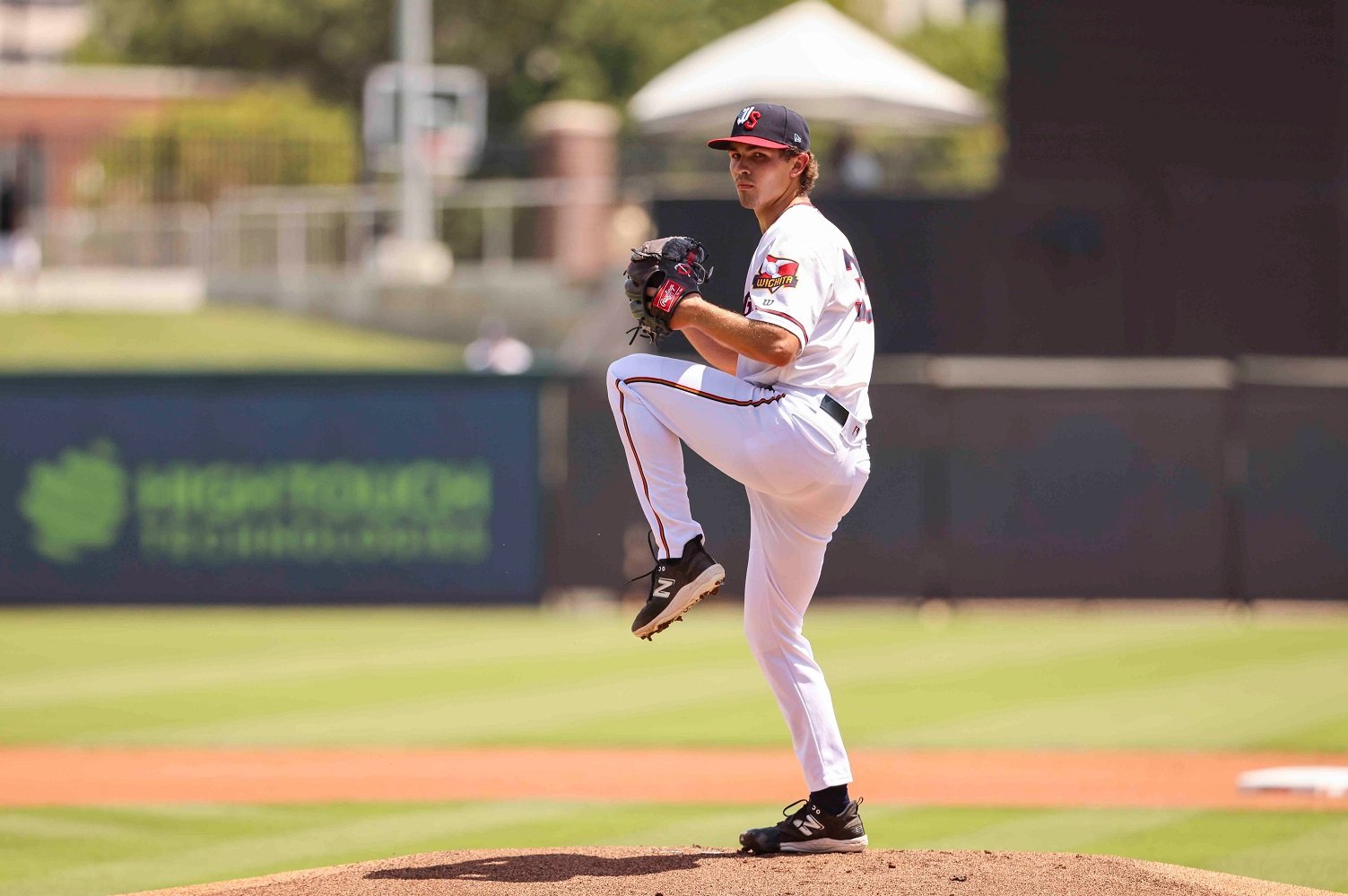 CURRENT W-L Records Minnesota Twins: 44-36 St. Paul Saints: 40-36 Wichita Wind Surge: 32-39 Cedar Rapids Kernels: 40-29 Fort Myers Mighty Mussels: 35-35 FCL Twins: 18-18 DSL Twins: 8-9 TRANSACTIONS RHP Cory Lewis was activated from the Development List. SAINTS SENTINEL St. Paul 9, Iowa 7 Box Score Right-hander David Festa was scheduled to start this game for the Saints, but for some reason, he was removed from that start and the team went with a bullpen game. There are rumors that he took a flight to somewhere in the southwest part of the United States, but I have a feeling we will soon hear why Festa could not make this start. Former Cubs first-round pick Ryan Jensen made the start against many of his old teammates. He gave up one run on two hits over two innings. He had two strikes. Hobie Harris got the third inning, but he gave up three runs on five hits and a walk. Scott Blewett was able to eat some innings for the Saints. In 3 2/3 innings, he gave up three runs (1 earned) on five hits and a walk. He had four strikeouts. Josh Winder came in with two on and two outs in the bottom of the seventh inning. He allowed both inherited runners to score. However, his line looks great. In 2 1/3 innings, he gave up no runs on one hit and one walk. He struck out just one but recorded his third save of the season. The Saints offense continued to put up good numbers almost daily. In this game, seven of the nine hitters had at least one hit. Patrick Winkel didn’t have a hit, but he walked twice in key situations. Batting leadoff, Edouard Julien went 0-for-3 but had three walks. Yunior Severino went 3-for-4 with a walk and two RBI. Will Holland went 2-for-3 with a walk. He also stole his 13th base. Matt Wallner went 2-for-6 with his 11th double. DaShawn Keirsey hit his 12th double. And Brooks Lee hit his sixth home run since joining the Saints. WIND SURGE WISDOM Wichita 6, NW Arkansas 1 Box Score The Wind Surge combined a four-run fourth and yet another fantastic start from Andrew Morris to get an afternoon win on Wednesday. Morris improved his Double-A record to 3-1 while dropping his ERA to just 1.41. Morris worked 5 2/3 scoreless innings. He gave up four hits, walked none and had nine strikeouts. The nine strikeouts were the most he’s had with the Wind Surge and a number he reached twice earlier this season with Cedar Rapids. The bottom of the third inning started with a Kyler Fedko walk. Dalton Shuffield followed with a single. Then Jorel Ortego, the 9-Hole Hitter in this game, hit his fourth homer of the season, a three-run blast. Luke Keaschall followed by connecting on his second Wind Surge homer to make it 4-0. Regi Grace came on and got the final out of the sixth inning. He worked 2 1/3 scoreless, hitless innings. He issued just one walk and had one strikeout. Taylor Floyd worked the ninth inning. He gave up one run on three hits. He also hit a batter, but he had two strikeouts. Jake Rucker went 3-for-4. Jeferson Morales went 2-for-4 with two RBI. Keaschall was 2-for-4 with his ninth total homer of the season. KERNELS NUGGETS Cedar Rapids 8, Beloit 6 Box Score The Kernels scored three runs in the sixth and three more in the eighth to take the lead and hung on for their 40th win of the season. Like the Saints, the Kernels had a bit of a bullpen game on Wednesday afternoon. Mike Paredes started and gave up two runs on three hits over 3 1/3 innings. Jarret Whorff gave up one run on three hits and recorded five outs. AJ Labas went 1 2/3 innings and gave up two runs (1 earned) on two hits. Jacob Wosinski gave up two hits, but no runs. He recorded four outs, all on strikeouts. Gabriel Yanez gave up a run on three hits in the ninth but held on for his fifth save of the season. Combined, the Kernels pitchers didn’t hurt themselves. There was one hit batter, but no walks, and they recorded 10 strikeouts. Down 4-2 going to the bottom of the sixth, Nate Baez led off with a walk. Jay Harry followed with a single. After two strikeouts, Kyle Hess came to the plate. He ripped a triple to right field that drove in both runners. With a throwing error, Hess scored two and the Kernels had the 5-4 lead. The game was tied 5-5 going to the bottom of the eighth inning. It was again Baez that led off and got on base, this time after he was hit by a pitch. Harry followed with a walk. Misael Urbina successfully laid down a sacrifice bunt to advance the runners. Jose Salas followed with his second double of the game that scored only Baez, with Harry remaining at third base. After a second out, Payton Eeles singled to short which scored Harry, but a throwing error also allowed Salas to score. Salas went 2-for-4 with his sixth and seventh doubles. Ricardo Olivar walked three times. Hess’s triple was his first with the Kernels. Rayne Doncon hit his seventh double since joining the Kernels. It was his 20th overall this season. MUSSEL MATTERS Fort Myers 11, Tampa 9 Box Score The Mussels fell behind 6-0 after just one-half inning. Through three innings, the Mussels were behind 9-5. They kept clawing back and tied the game in the bottom of the seventh. Two more runs in the bottom of the eighth, and the Mussels completed the improbable comeback. Tanner Hall struggled early, but he also wasn’t helped by his defense. In 2 1/3 innings, he was charged with all nine runs. He gave up seven hits, walked four batters, and hit a batter. However, the Mussels had six errors and five of the runs allowed were unearned. However, the Mussels’ bullpen was absolutely fantastic in this game. Paulshawn Pasqualotto struck out four batters over 2 2/3 scoreless innings. He gave up just two hits. Julio Bonilla faced six batters over two perfect innings. He had four strikeouts. Nolan Santos faced seven batters over the final two innings. He gave up no hits, no walks, and no runs. He had three strikeouts. After falling behind 6-0, the Mussels responded with three runs in the bottom half of the first frame. Walker Jenkins started it with a walk. Byron Chourio singled. Then Brandon Winokur singled to load the bases. Jenkins scored on a Rixon Wingrove sacrifice fly. With two outs, Winokur stole a base. Carlos Aguiar drove in two runs with a single but was thrown out by the catcher trying to advance to second base. The team just kept picking away. In the second, Isaac Pena doubled and scored on a Maddux Houghton single. In the third inning, Wingrove scored from first on an Aguiar double. Down 9-5 going to the bottom of the fifth, the Mussels rallied again. It started out a little Little League-like. With one out, Isaac Pena reached on an error, stole second, and advanced to third base on a wild pitch. Yohander Martinez walked and stole second. Maddux Houghton was hit by a pitch. That loaded the bases and caused a pitching change. Walker Jenkins welcomed Jordy Luciano with a 102-mph, bases-clearing double to center that cut the Mussels’ deficit to 9-8. Then in the bottom of the seventh inning, Houghton led off with a single and somehow scored from first base on a single by Jenkins. How? Well, Jenkins hits the ball really hard (108.8 mph), and Houghton can absolutely fly! That tied the game at 9-9. Later that inning, Brandon Winokur was hit by a pitch. He left the game, hopefully more as a precaution, after missing last week after being hit by a pitch. Hopefully he can be back in the lineup soon. With two outs in the bottom of the eighth, Isaac Pena singled and stole second base. He also stole third base as Yohander Martinez walked. Martinez followed by stealing second. Pena scored on a wild pitch, and Martinez scored on a Houghton single to make it an 11-9 lead, a lead that they held onto. Isaac Pena went 3-for-5 with his fifth double. He also had three stolen bases, and because the team won, we won’t mention his three errors. Maddux Houghton went 3-for-4 with two RBI. Aguiar went 2-for-5 with his seventh double. Jenkins went 2-for-5 with a walk, his third double, and four RBI. The team had eight stolen bases and were hit by four pitches. COMPLEX CHRONICLES FCL Twins Box Score No Game on the schedule. DOMINICAN DAILIES DSL Twins 7, DSL Padres Brown 5 Box Score In a familiar story, the Twins fell behind early. It was 4-0 after the first inning. It was a tough one for Aaron Carranza. He recorded just one out and was charged with four runs (3 earned) on no hits and one walk. He hit the first two batters he faced. After a fly out, he hit another batter to load the bases. A fielding error allowed two runs on score. Then came the walk. And that was the end of his day. Nestor Cafe came in and gave up a two-run single, ending the line for Carranza. Cafe tossed 1 2/3 innings and gave up one hit. He walked two and struck out one. Yoel Roque came on and tossed 2 2/3 scoreless innings. He gave up two hits, walked three and hit another batter, but he had six strikeouts. Sebastian Pulido came on and went 1 1/3 innings. He gave up one run on one hit and one walk. Fabian Herrera came in and struck out two batters in a quiet seventh inning to record his second save. The Twins scored three in the top of the second inning. With two outs, Luis Fragoza singled. Carlos Silva doubled him to third. After a Nestor Urbina walk loaded the bases, Irvin Nunez singled to center to drive in two runs. Then the Twins pulled off a double-steal. Nunez stole second base, and Urbina stole home to make it a 4-3 deficit. Then in the third inning, Eduardo Beltre hit his second home run to tie the game. With two outs, Ramiro Dominguez singled and went to second on a balk. Fragoza doubled to put the Twins ahead 5-4. The Padres tied it in the bottom of the sixth inning. In the seventh frame, Eduardo Beltre singled. Murphy Hernandez pinch ran for him. He stole second and advanced to third on a wild pitch. Dominguez walked. Fragoza was hit by a pitch. Then Silva came through with a big, two-run single to give the team the 7-5 lead which became a 7-5 win. Silva was 2-for-4. The double was his third. Beltre was 2-for-4 with his second home run. Fragoza was 2-for-3, hit by a pitch, and hit his third double. TWINS DAILY MINOR LEAGUE PLAYERS OF THE DAY Pitcher of the Day – Andrew Morris (Wichita) - 5.2 IP, 4 H, 0 R, 0 BB, 9 K; 89 pitches, 57 strikes (64.0%) Hitter of the Day – Walker Jenkins (Fort Myers) - 2-for-5, BB, 2B(3), R, 4 RBI , K. PROSPECT SUMMARY Check out the Prospect Tracker for much more on the Twins Top 20 prospects after seeing how they did on Thursday. #1– Walker Jenkins (Fort Myers) – 2-for-5, BB, 2B(3), R, 4 RBI, K #2 – Brooks Lee (St. Paul) – 1-for-4, 2 BB, HR(6), 2 R, 2 RBI #9 – Luke Keaschall (Wichita) – 2-for-4, HR(2), 2 R, RBI, K. #10 – Brandon Winokur (Fort Myers) – 1-for-3, BB, R, SB(13) #11 – Simeon Woods Richardson (Minnesota) – 5.1 IP, 4 H, 3 ER, 2 BB, 4 K, 90 pitches, 57 strikes (63.3%) #13 – Tanner Schobel (Wichita) – 0-for-4, 2 K . #18 – Yunior Severino (St. Paul) – 3-for-4, BB, 2 RBI, K #20 – Ricardo Olivar (Cedar Rapids) – 0-for-2, 3 BB, 2 K THURSDAY’S PROBABLE STARTERS St. Paul @ Iowa (6:38 PM CST) – RHP Randy Dobnak (6-5, 4.35 ERA) NW Arkansas @ Wichita (7:05 PM CST) – RHP Zebby Matthews (2-1, 1.55 ERA) Beloit @ Cedar Rapids (6:35 PM CST) – RHP Jeremy Lee (0-3, 6.48 ERA) Tampa @ Ft. Myers (6:05 PM CST) – RHP Spencer Bengard (4-1, 1.23 ERA) FCL Twins @ FCL Braves (DH @ 9:00 AM CT) - TBD, TBD DSL Phillies Red @ DSL Twins (10:00 AM CST) - TBD Please feel free to ask questions and discuss Wednesday’s games!
- 15 comments
-
- 3
-
-
-
- andrew morris
- walker jenkins
- (and 5 more)
-
Good to hear Festa is coming up and will start on Thursday. No rush to move Brooks Lee up. He's doing well, but he missed a ton of time. No problem letting him continue to hit in the very hitter friendly CHS Field. Castro obviously deserves to play most of the time .Larnach has been crushing the ball even when he doesn't get hits.
- 8 replies
-
- 3
-
-
- tony kemp
- brooks lee
- (and 4 more)
-
If you ever want or need a pick-me-up. If you need a reminder about how great baseball can be. If you enjoy listening to people who have a passion for baseball. If you want a fun story about a player overcoming the odds and getting to the big leagues, I really think you will enjoy this conversation with Outfielder Ian Miller, and you’ll want to bookmark the 9-Hole Podcast. We talk all the time about how prospect or player development is not linear. One of the other clichés around baseball is that it takes all types. Not everyone has to look like Aaron Judge. Not everyone has to have an arm like Jhoan Duran. Baseball players can succeed in all shapes and sizes. Ian Miller noted, “(The scouts) are looking for Tools. I’m not just going to just snap my fingers and magically figure out how to hit .400 with pop and drive the ball out of the yard. I think my junior year, I had three or four extra base hits in 50 games or something like that in Division I baseball. That’s very not good. So I needed to showcase the defense. I needed to showcase the range, the arm, and especially the stolen bases.” He’s from the northeast. Wagner is a small Division I up north. They don’t have a stadium on campus. They play where the Staten Island Yankees play, so they didn’t get very many fans to watch them. However, by his junior season, the scouts had found him. The Mariners drafted him in the 14th-round of the 2013 draft, just seven picks after the Twins selected Staten Island native and Seton Hall grad Zack Granite. “Man, I looked up to a dude like that, tried to be that guy. We were always kind of neck and neck, in terms of how we played the game, how we went about our business, our skill sets. I just always tried to be like that guy.” . In fact, Granite has been a two-time guest on the 9-Hole Podcast. Hungry Dogs Run Faster. A Masterclass in the Art of Small Ball. He was in Double-A within two years of being drafted. He got to Triple-A in 2017. He continued to bat in or near the 9-Hole, and he continued to play great defense and hit enough, get on base and steal bases. He played in just 136 combined games between two levels of rookie ball and two levels of Class A ball. He played 284 games at Double-A. He played a total of 383 Triple-A games. On August 10, 2019, Miller was traded to the Twins. Twins fans certainly remember the record-setting home run season for the Bomba Squad. Understandably, Derek Falvey wanted an element of speed for the bench late in the season and potentially in the playoffs. He spent about 20 days with the Rochester Red Wings. Manager Joel Skinner let him know that he was headed to the big leagues for September. He said that the team made him feel very comfortable when he got to the big-league clubhouse. Derek Falvey: “I gave him a hug when he called me up. I gave him a huge hug.” Nelson Cruz: “I spent a whole lot of time with Nelson Cruz over with the Mariners, so that was kind of my in. Nelson knew me. He gave me a big hug when I was there, like on the bus, and said, ‘ What’s up, bro? Good to see you. Finally you’re up here.’ One of the best guys ever!” He made his MLB debut at Fenway Park. It’s a hilarious story of being heckled, then fans learning about his debut, and then one of the funnier lines you’ll hear. His first hit came in his first start off of Jordan Zimmerman. The Twins had clinched a playoff spot the night before. Miller played in 12 games with the Twins. Mostly, he came off the bench to play defense. He wasn’t there to hit. He was there for his speed game, defense and arm. Following the season, the Twins allowed him to become a free agent. He signed with the Cubs. In the shortened-Covid season, he was with the team for a few games but only got to play in one game. He spent the 2021 season with the Iowa Cubs. That offseason, he got married, went on his honeymoon, and then went to play in Mexico. The team was good, but when the season was over, he knew it was probably the last time he would play. “My down time went from watching video, getting scouting reports on who’s pitching tonight. Watching swings from Mike Trout and Aaron Judge and trying to be in all-the-know of baseball. My time then was reading investment journals, reading about stocks. That’s the stuff that was interesting to me. I’d be up when the markets opened, listening to podcasts. Learned. That’s the stuff that was interesting to me.” He enjoyed watching Stuart Varney on Fox Business. He enjoyed the business and economic conversations, but he also just liked Varney’s voice. In fact, he contacted the British-American journalist and ended up working for a while. . If you think that hearing Ian Miller talk about baseball was passion-filled, you should hear him talk about his current business, Rellimnai Enterprises. He used his baseball knowledge and his story and his background in economics and investments to start his own business. It’s a coaching and consulting business, but he also started The 9-Hole podcast which has really taken off. Follow him on Instagram at @ianmiller14, Twitter at @8rellimnai, and TikTok at @the9holepodcast as well. “I’m just trying to lead, and inspire and show kids that are in the 9-Hole, like I was, from Little League to the big leagues, from the classroom to the business world. You can literally do anything you want regardless of if you’re leading off or in the 9-Hole.” It’s always fun to see what former players are up to after their playing careers. It’s really great to see former players giving back to the game, and to the next generations of players. It is especially fun to see when they are so passionate about it. Please check out Ian MIller’s webpages and podcast. View full article
-
Talkin’ Baseball (and Business) with … former Twins OF Ian Miller
Seth Stohs posted an article in Twins
 We talk all the time about how prospect or player development is not linear. One of the other clichés around baseball is that it takes all types. Not everyone has to look like Aaron Judge. Not everyone has to have an arm like Jhoan Duran. Baseball players can succeed in all shapes and sizes. Ian Miller noted, “(The scouts) are looking for Tools. I’m not just going to just snap my fingers and magically figure out how to hit .400 with pop and drive the ball out of the yard. I think my junior year, I had three or four extra base hits in 50 games or something like that in Division I baseball. That’s very not good. So I needed to showcase the defense. I needed to showcase the range, the arm, and especially the stolen bases.” He’s from the northeast. Wagner is a small Division I up north. They don’t have a stadium on campus. They play where the Staten Island Yankees play, so they didn’t get very many fans to watch them. However, by his junior season, the scouts had found him. The Mariners drafted him in the 14th-round of the 2013 draft, just seven picks after the Twins selected Staten Island native and Seton Hall grad Zack Granite. “Man, I looked up to a dude like that, tried to be that guy. We were always kind of neck and neck, in terms of how we played the game, how we went about our business, our skill sets. I just always tried to be like that guy.” . In fact, Granite has been a two-time guest on the 9-Hole Podcast. Hungry Dogs Run Faster. A Masterclass in the Art of Small Ball. He was in Double-A within two years of being drafted. He got to Triple-A in 2017. He continued to bat in or near the 9-Hole, and he continued to play great defense and hit enough, get on base and steal bases. He played in just 136 combined games between two levels of rookie ball and two levels of Class A ball. He played 284 games at Double-A. He played a total of 383 Triple-A games. On August 10, 2019, Miller was traded to the Twins. Twins fans certainly remember the record-setting home run season for the Bomba Squad. Understandably, Derek Falvey wanted an element of speed for the bench late in the season and potentially in the playoffs. He spent about 20 days with the Rochester Red Wings. Manager Joel Skinner let him know that he was headed to the big leagues for September. He said that the team made him feel very comfortable when he got to the big-league clubhouse. Derek Falvey: “I gave him a hug when he called me up. I gave him a huge hug.” Nelson Cruz: “I spent a whole lot of time with Nelson Cruz over with the Mariners, so that was kind of my in. Nelson knew me. He gave me a big hug when I was there, like on the bus, and said, ‘ What’s up, bro? Good to see you. Finally you’re up here.’ One of the best guys ever!” He made his MLB debut at Fenway Park. It’s a hilarious story of being heckled, then fans learning about his debut, and then one of the funnier lines you’ll hear. His first hit came in his first start off of Jordan Zimmerman. The Twins had clinched a playoff spot the night before. Miller played in 12 games with the Twins. Mostly, he came off the bench to play defense. He wasn’t there to hit. He was there for his speed game, defense and arm. Following the season, the Twins allowed him to become a free agent. He signed with the Cubs. In the shortened-Covid season, he was with the team for a few games but only got to play in one game. He spent the 2021 season with the Iowa Cubs. That offseason, he got married, went on his honeymoon, and then went to play in Mexico. The team was good, but when the season was over, he knew it was probably the last time he would play. “My down time went from watching video, getting scouting reports on who’s pitching tonight. Watching swings from Mike Trout and Aaron Judge and trying to be in all-the-know of baseball. My time then was reading investment journals, reading about stocks. That’s the stuff that was interesting to me. I’d be up when the markets opened, listening to podcasts. Learned. That’s the stuff that was interesting to me.” He enjoyed watching Stuart Varney on Fox Business. He enjoyed the business and economic conversations, but he also just liked Varney’s voice. In fact, he contacted the British-American journalist and ended up working for a while. . If you think that hearing Ian Miller talk about baseball was passion-filled, you should hear him talk about his current business, Rellimnai Enterprises. He used his baseball knowledge and his story and his background in economics and investments to start his own business. It’s a coaching and consulting business, but he also started The 9-Hole podcast which has really taken off. Follow him on Instagram at @ianmiller14, Twitter at @8rellimnai, and TikTok at @the9holepodcast as well. “I’m just trying to lead, and inspire and show kids that are in the 9-Hole, like I was, from Little League to the big leagues, from the classroom to the business world. You can literally do anything you want regardless of if you’re leading off or in the 9-Hole.” It’s always fun to see what former players are up to after their playing careers. It’s really great to see former players giving back to the game, and to the next generations of players. It is especially fun to see when they are so passionate about it. Please check out Ian MIller’s webpages and podcast.
-
- 1
-
-
- ian miller
- zack granite
- (and 1 more)
-
They've got quite the long line of Day 3 guys pushing through the minors. Festa. Ohl. Varland, Culpepper. Several Day 2 guys too, like Matthews, Lewis, Jones, etc.
- 19 replies
-
- 1
-
-
- spencer bengard
- zebby matthews
- (and 5 more)
-
There was a similar call for Elly de la Cruz to make it last year. When they announce the teams in a couple weeks, maybe Royce will earn a shot.
- 23 replies
-
- 1
-
-
- royce lewis
- all star game
- (and 5 more)
-
For the Saints, 10 Straight... That's great! For Wichita, it was a Marco Day and a Zebby Day. The Kernels won in a walkoff again. Fort Myers got some absolutely incredible pitching. Maybe we need t have a Bengard Day? The DSL got power from some youngsters to win. The lone loss in the Twins minor leagues was the FCL Twins, and that came in extra innings. And yes, Matt Wallner homered again! Image courtesy of William Parmeter CURRENT W-L Records Minnesota Twins: 41-35 St. Paul Saints: 37-35 Wichita Wind Surge: 29-38 Cedar Rapids Kernels: 38-27 Fort Myers Mighty Mussels: 32-34 FCL Twins: 16-17 DSL Twins: 6-8 TRANSACTIONS LHP Kody Funderburk was officially recalled from the Saints after RHP Jay Jackson was DFAd on Thursday. Infielder Angel Del Rosario was activated from the Fort Myers Injured List. SAINTS SENTINEL St. Paul 4, Toledo 2 Box Score The Saints have found a variety ways to post wins of late. A lot has been due to the offense and power, but on Friday night at CHS, it was the pitching that got the job done and pushed them to their 10th straight win. In a bend-but-don't-break way. Kind of. Randy Dobnak made the start. He went five innings and despite five walks and three hits, he gave up just one run. He had four strikeouts. Ryan Jensen came in and in 1 2/3 innings, he gave up one run on zero hits. He had four walks and two strikeouts. Hobie Harris got four outs, gave up no runs and no hits, but he walked two. Ronny Henriquez came on to protect the lead in the ninth inning and earned his third save with a scoreless frame. So, yes, the Saints pitchers gave up just two runs on four hits, but they issued 12 walks and were able to get away with it in this game. They came through when needed. Toledo went just 1-for-9 with runners in scoring position and left 12 on base. Frankly, the Saints weren’t a whole lot better in the clutch. In fact, they were just 1-for-12 with runners in scoring position and left 11 runners on base. They certainly had chances. Down 1-0 in the bottom of the second inning, Diego A. Castillo and Patrick Winkel walked. Then Will Holland reached on a bunt single to load the bases. Anthony Prato walked to tie the game at 1-1. The Saints had bases loaded, nobody out and the top of the lineup coming up. However, Edouard Julien and Brooks Lee struck out and Matt Wallner flew out to end the inning. The Saints got a big hit in the fifth. With one out, Lee singled and then Matt Wallner hit his 18th homer to make it 3-1 Saints. Toledo scored one to cut the lead to 3-2, but the Saints added a run in the bottom of the eighth when Will Holland scored on a stolen base with a throwing error to make it 4-2. Castillo went 2-for-3 with a walk and his 10th double. Lee was 2-for-5. Holland went 2-for-4 with his 12th stolen base. WIND SURGE WISDOM Wichita 3, Arkansas 2 Box Score It was a Zebby Day for the Surge, but not in his normal role. Marco Raya made the start for Wichita. As per usual, he went three innings. He gave up two runs on three hits and two walks. He had four strikeouts. Cody Laweryson pitched a perfect fourth inning with three strikeouts. All 11 of his pitches were strikes. Then it was Zebby Time! The right-hander was fantastic. In five innings, he gave up no runs and just one hit. He did walk a batter, but he had six strikes as well. He improved to 2-1 while dropping his Double-A ERA to just 1.55. He struck out two batters in the ninth inning. The final batter of the game was ejected for his excessive disagreement. The Saints are watching... The Surge fell behind 1-0 after two innings. Wichita tied it up in the top of the third. Ben Ross walked with one out and stole second base. With two outs, Luke Keaschall grounded to shortstop, but a throwing error allowed Keaschall to reach and Ross to score. The Travels reclaimed the lead with a single run in the bottom of the third. Then came a bunch of zeroes. In the top of the seventh, Carson McCusker singled with one out. He advanced to second on a Dalton Shuffield walk. Ben Ross then drove him in with a single to left field that tied the game at two. Jorel Ortega drove a single to left that scored Shuffield and put the Surge ahead. The Surge had seven hits and four walks. Tanner Schobel had the lone extra base hit, his 10th double of the season. Shuffield went 2-for-3 with a walk. KERNELS NUGGETS Cedar Rapids 6, Peoria 5 Box Score Down a run heading into the bottom of the ninth, who played hero to help the Kernels to another win? Jeremy Lee made the start for the Kernels. He was charged with two runs on seven hits and two walks. He had five strikeouts. Both runs scored in the first inning. The Kernels responded with single runs in the second, third and fourth innings. In the second frame, Kevin Maitan’s third home run put the team on the scoreboard. In the third, it was a Rayne Doncon single that drove in Ricaro Olivar. In the fourth inning, it was Jay Harry’s turn. He launched his sixth home run of the season to put the Kenres ahead 3-2. Left Jordan Carr gave up three runs (2 earned) on two hits and two walks. He left with two runners on base. AJ Labas came in and allowed one of the two runners to score. He worked a scoreless seventh inning, but when the 7th Inning Stretch signing took place, the Kernels found themselves down by a score of 5-4. Then came Payton Eeles, and the legend continues. He knocked his first High-A homer to cut the deficit in half in the bottom of the seventh inning. Ricardo Velez has been fantastic all season. He worked two perfect innings and struck out three batters to send the game to the bottom of the ninth. Olivar led off with a walk. After one out, Doncon walked. After a pitching change, Nate Baez pinch hit for Agustin Ruiz. He singled to load the bases. Jay Harry came up and drove in Olivar with a sacrifice fly to tie the game. One batter later, Maitan reached on an error that allowed Doncon to score the walk-off, winning run. Maitan went 2-for-3 wth a walk and his third homer of the season. Doncon went 1-for-3 with two walks. MUSSEL MATTERS Fort Myers 8, St. Lucie 0 Box Score The Mussels showed their muscle offensively on their way to eight runs on 13 hits. However, when you throw a shutout, you guarantee a win and that we will write about you first! Spencer Bengard was the Twins 15th round pick in 2023 out of California Baptist. The 6-4, 220 pound right-hander has been nothing short of impressive this season with Fort Myers. In this one, he gave up just two singles over six scoreless innings. He hit a batter but walked none and struck out seven batters. He improves to 4-1 with a 1.23 ERA on the season. Paulshawn Pasqualotto, the team’s 12th round pick in 2023 out of California (Berkeley), came on and recorded the three-inning save. He gave up just one hit over those three innings, walked none and struck out six batters. Bengard threw 75 pitches. 55 were strikes. That’s 73.3% Pasqualotto threw strikes on 29 of 37 pitches. That’s 78.4% In total, of the 112 pitches thrown, 84 of them were strikes. That is 75.0% That is remarkable! OK, now to the offense. The Mussels got on the board in the top of the third inning. With two outs, Walker Jenkins and Poncho Ruiz singled. Rixon Wingrove followed with a ground-rule double to drive in Jenkins. In the fourth, they used some extra base hits to add to their lead. Carlos Aguiar led off with a double. With one out, Yohander Martinez’s first home of the season. Later, Ryan McCarthy and Jenkins scored on a Ruiz double. Just off the IL, Angel Del Rosario had a Little League homer. OK, it was a triple, but a throwing error allowed Del Rosario to race home with the sixth run of the game. In the eighth inning, Del Rosario and Jenkins each had an RBI single to make it 8-0. Poncho Ruiz was 2-for-4 with a walk and his 14th double. Walker Jenkins was 2-for-4 with a walk. Rixon Wingrove was 2-for-5 with his fifth and sixth doubles. Carlos Aguiar was 2-for-5 with his fifth double. Del Rosario was 2-for-4 with his first triple. Ryan McCarthy went 1-for-2 with two walks and his second double. COMPLEX CHRONICLES FCL Twins 3, FCL Red Sox 4 (10 innings) Box Score The Twins needed a big play to send the game to extra innings but then lost the game in the 10th inning. The key story from this game is that RHP Kyle Jones continued his rehab and looked really good. Scheduled to go to Wichita when deemed ready, Jones retired all nine batters he faced to cover three perfect innings. He had four strikeouts. Miguel Cordero came on and was charged with three runs on four hits and a walk over three innings. Yency De Jesus gave up three hits but no runs over two innings. Ezequiel Ventura pitched a scoreless ninth inning but allowed the Manfred Man to score in the top of the 10th inning to take a loss. He gave up zero hits and walked none. Down 2-0 in the bottom of the fourth, Yasser Mercedes hit a one-out single. After the second out, Hendry Chivilli walks. Jayson Bass followed with a single to score Mercedes. After a pitching change, Chivilli scored on a Wild Pitch. Down 3-2 going to the bottom of the ninth inning, Bass singled to lead off the inning. Next, Ricardo Pena drove him in with a double to tie the score. After an intentional walk, a single loaded the bases. Unfortunately a short fly out and a double play ended the threat. DOMINICAN DAILIES DSL Twins 9, DSL Diamondbacks Black 6 Box Score The Twins scored five runs in the fourth inning and single runs in four other innings and held on for the win. The big blow in the big inning came off of the bat of Daiber De Los Santos whose third home run of the season drove in three runs. Ricardo Paez went 2-for-3 in the game with a walk. He notched both his first double and his first professional home run in this one. Luis Fragoza went 2-for-3 with his first triple. He was also hit by a pitch and stole a base. Ruben Velazquez was 2-for-3 with a walk and his first two doubles. Eduardo Beltre walked three times. Christian Hernandez started the game for the Twins with four no-hit innings. He was charged with two runs (1 earned) on four walks and four strikeouts. Ramiro Villanueva pitched the fifth inning. He gave up three runs on four hits. Nestor Cafe recorded just two outs. He gave up a run as he walked four and struck out one. Fabian Herrera got a strikeout for the final out to earn the save in this rain-shortened game. TWINS DAILY MINOR LEAGUE PLAYERS OF THE DAY Pitcher of the Day – Spencer Bengard (Fort Myers) - 6 IP, 2 H, 0 ER, 0 BB, 7 K; 75 pitches, 55 strikes (73.3%) Hitter of the Day – Ricardo Paez (DSL Twins) - 2-for-3, 2B(1), HR(1), 3 R, RBI. PROSPECT SUMMARY Check out the Prospect Tracker for much more on the Twins Top 20 prospects after seeing how they did on Thursday. #1– Walker Jenkins (Fort Myers) – 2-for-4, BB, 2R, RBI, K #2 – Brooks Lee (St. Paul) – 2-for-5, R, K #5 – Gabriel Gonzalez (Cedar Rapids) – 1-for-5, CS (rehab FCL, DH) #6 – Marco Raya (Wichita) – 3 IP, 3 H, 2 ER, 2 BB, 4 K; 58 pitches, 37 strikes (63.8%) #8 – Austin Martin (Minnesota) – 2-for-3, BB, R (played CF) #9 – Luke Keaschall (Wichita) – 1-for-4, BB, 2K #13 – Tanner Schobel (Wichita) – 1-for-5, 2B(10), K #14 – Zebby Matthews (Wichita) – 5 IP, 1 H, 0 R, 1 BB, 6 K; 69 pitches, 49 strikes (71.0%) #20 – Ricardo Olivar (Cedar Rapids) – 1-for-4, BB, 2B(10), 2 R, K SATURDAY’S PROBABLE STARTERS Toledo @ St. Paul (6:37 PM CST) – RHP Caleb Boushley (7-1, 3.90 ERA) Wichita @ Arkansas (6:05 PM CST) – LHP Jaylen Nowlin (4-3, 3.44 ERA) Peoria @ Cedar Rapids (6:35 PM CST) – RHP Ty Langenberg (1-0, 5.40 ERA) Fort Myers @ St. Lucie (5:10 PM CST) – RHP Charlee Soto (0-2, 6.68 ERA) FCL Twins @ FCL Red Sox (9:00 AM CT) - TBD DSL Phillies White @ DSL Twins (9:00 AM CST) - TBD Please feel free to ask questions and discuss Friday’s games! View full article
- 19 replies
-
- 1
-
-
- spencer bengard
- zebby matthews
- (and 5 more)
-
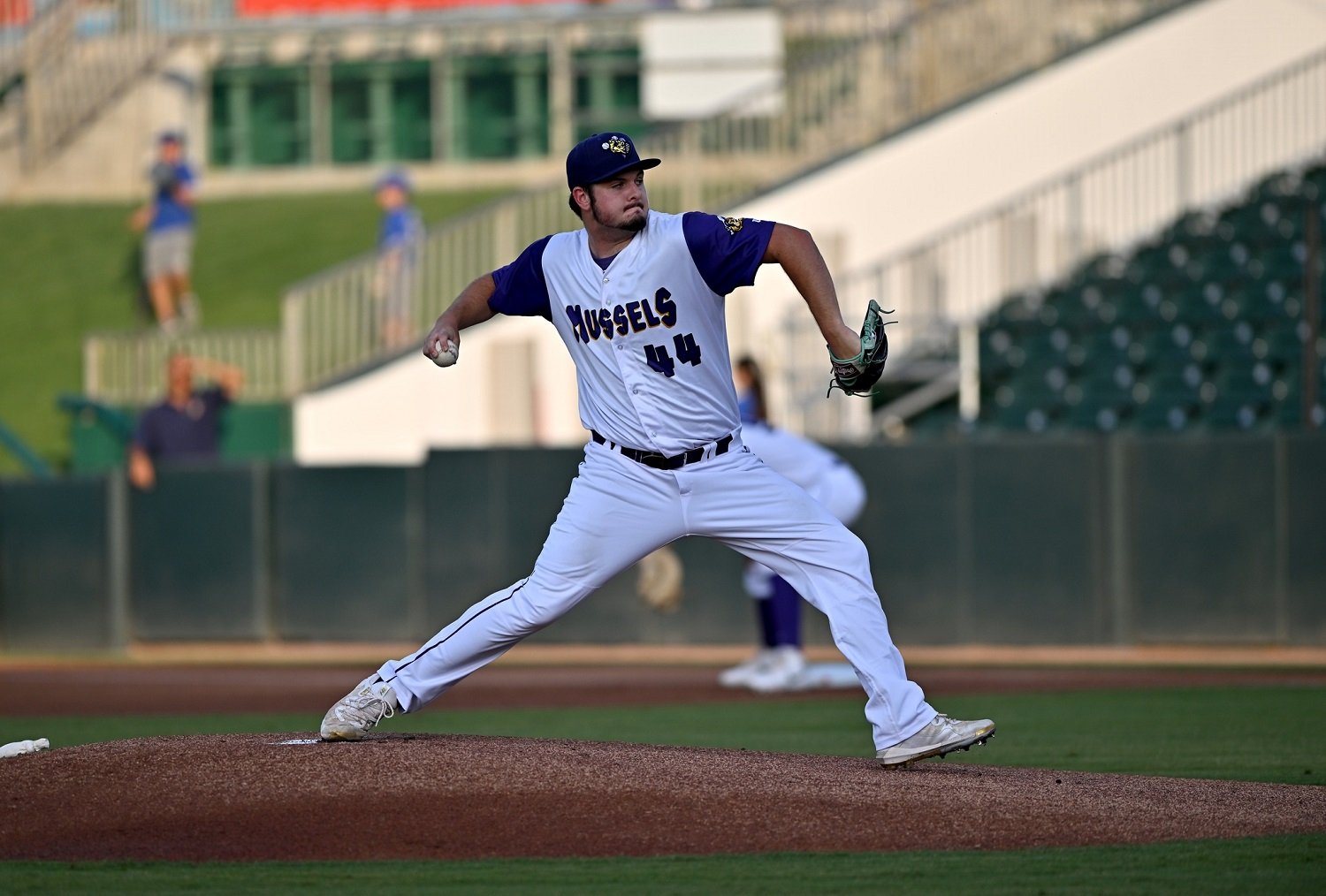 CURRENT W-L Records Minnesota Twins: 41-35 St. Paul Saints: 37-35 Wichita Wind Surge: 29-38 Cedar Rapids Kernels: 38-27 Fort Myers Mighty Mussels: 32-34 FCL Twins: 16-17 DSL Twins: 6-8 TRANSACTIONS LHP Kody Funderburk was officially recalled from the Saints after RHP Jay Jackson was DFAd on Thursday. Infielder Angel Del Rosario was activated from the Fort Myers Injured List. SAINTS SENTINEL St. Paul 4, Toledo 2 Box Score The Saints have found a variety ways to post wins of late. A lot has been due to the offense and power, but on Friday night at CHS, it was the pitching that got the job done and pushed them to their 10th straight win. In a bend-but-don't-break way. Kind of. Randy Dobnak made the start. He went five innings and despite five walks and three hits, he gave up just one run. He had four strikeouts. Ryan Jensen came in and in 1 2/3 innings, he gave up one run on zero hits. He had four walks and two strikeouts. Hobie Harris got four outs, gave up no runs and no hits, but he walked two. Ronny Henriquez came on to protect the lead in the ninth inning and earned his third save with a scoreless frame. So, yes, the Saints pitchers gave up just two runs on four hits, but they issued 12 walks and were able to get away with it in this game. They came through when needed. Toledo went just 1-for-9 with runners in scoring position and left 12 on base. Frankly, the Saints weren’t a whole lot better in the clutch. In fact, they were just 1-for-12 with runners in scoring position and left 11 runners on base. They certainly had chances. Down 1-0 in the bottom of the second inning, Diego A. Castillo and Patrick Winkel walked. Then Will Holland reached on a bunt single to load the bases. Anthony Prato walked to tie the game at 1-1. The Saints had bases loaded, nobody out and the top of the lineup coming up. However, Edouard Julien and Brooks Lee struck out and Matt Wallner flew out to end the inning. The Saints got a big hit in the fifth. With one out, Lee singled and then Matt Wallner hit his 18th homer to make it 3-1 Saints. Toledo scored one to cut the lead to 3-2, but the Saints added a run in the bottom of the eighth when Will Holland scored on a stolen base with a throwing error to make it 4-2. Castillo went 2-for-3 with a walk and his 10th double. Lee was 2-for-5. Holland went 2-for-4 with his 12th stolen base. WIND SURGE WISDOM Wichita 3, Arkansas 2 Box Score It was a Zebby Day for the Surge, but not in his normal role. Marco Raya made the start for Wichita. As per usual, he went three innings. He gave up two runs on three hits and two walks. He had four strikeouts. Cody Laweryson pitched a perfect fourth inning with three strikeouts. All 11 of his pitches were strikes. Then it was Zebby Time! The right-hander was fantastic. In five innings, he gave up no runs and just one hit. He did walk a batter, but he had six strikes as well. He improved to 2-1 while dropping his Double-A ERA to just 1.55. He struck out two batters in the ninth inning. The final batter of the game was ejected for his excessive disagreement. The Saints are watching... The Surge fell behind 1-0 after two innings. Wichita tied it up in the top of the third. Ben Ross walked with one out and stole second base. With two outs, Luke Keaschall grounded to shortstop, but a throwing error allowed Keaschall to reach and Ross to score. The Travels reclaimed the lead with a single run in the bottom of the third. Then came a bunch of zeroes. In the top of the seventh, Carson McCusker singled with one out. He advanced to second on a Dalton Shuffield walk. Ben Ross then drove him in with a single to left field that tied the game at two. Jorel Ortega drove a single to left that scored Shuffield and put the Surge ahead. The Surge had seven hits and four walks. Tanner Schobel had the lone extra base hit, his 10th double of the season. Shuffield went 2-for-3 with a walk. KERNELS NUGGETS Cedar Rapids 6, Peoria 5 Box Score Down a run heading into the bottom of the ninth, who played hero to help the Kernels to another win? Jeremy Lee made the start for the Kernels. He was charged with two runs on seven hits and two walks. He had five strikeouts. Both runs scored in the first inning. The Kernels responded with single runs in the second, third and fourth innings. In the second frame, Kevin Maitan’s third home run put the team on the scoreboard. In the third, it was a Rayne Doncon single that drove in Ricaro Olivar. In the fourth inning, it was Jay Harry’s turn. He launched his sixth home run of the season to put the Kenres ahead 3-2. Left Jordan Carr gave up three runs (2 earned) on two hits and two walks. He left with two runners on base. AJ Labas came in and allowed one of the two runners to score. He worked a scoreless seventh inning, but when the 7th Inning Stretch signing took place, the Kernels found themselves down by a score of 5-4. Then came Payton Eeles, and the legend continues. He knocked his first High-A homer to cut the deficit in half in the bottom of the seventh inning. Ricardo Velez has been fantastic all season. He worked two perfect innings and struck out three batters to send the game to the bottom of the ninth. Olivar led off with a walk. After one out, Doncon walked. After a pitching change, Nate Baez pinch hit for Agustin Ruiz. He singled to load the bases. Jay Harry came up and drove in Olivar with a sacrifice fly to tie the game. One batter later, Maitan reached on an error that allowed Doncon to score the walk-off, winning run. Maitan went 2-for-3 wth a walk and his third homer of the season. Doncon went 1-for-3 with two walks. MUSSEL MATTERS Fort Myers 8, St. Lucie 0 Box Score The Mussels showed their muscle offensively on their way to eight runs on 13 hits. However, when you throw a shutout, you guarantee a win and that we will write about you first! Spencer Bengard was the Twins 15th round pick in 2023 out of California Baptist. The 6-4, 220 pound right-hander has been nothing short of impressive this season with Fort Myers. In this one, he gave up just two singles over six scoreless innings. He hit a batter but walked none and struck out seven batters. He improves to 4-1 with a 1.23 ERA on the season. Paulshawn Pasqualotto, the team’s 12th round pick in 2023 out of California (Berkeley), came on and recorded the three-inning save. He gave up just one hit over those three innings, walked none and struck out six batters. Bengard threw 75 pitches. 55 were strikes. That’s 73.3% Pasqualotto threw strikes on 29 of 37 pitches. That’s 78.4% In total, of the 112 pitches thrown, 84 of them were strikes. That is 75.0% That is remarkable! OK, now to the offense. The Mussels got on the board in the top of the third inning. With two outs, Walker Jenkins and Poncho Ruiz singled. Rixon Wingrove followed with a ground-rule double to drive in Jenkins. In the fourth, they used some extra base hits to add to their lead. Carlos Aguiar led off with a double. With one out, Yohander Martinez’s first home of the season. Later, Ryan McCarthy and Jenkins scored on a Ruiz double. Just off the IL, Angel Del Rosario had a Little League homer. OK, it was a triple, but a throwing error allowed Del Rosario to race home with the sixth run of the game. In the eighth inning, Del Rosario and Jenkins each had an RBI single to make it 8-0. Poncho Ruiz was 2-for-4 with a walk and his 14th double. Walker Jenkins was 2-for-4 with a walk. Rixon Wingrove was 2-for-5 with his fifth and sixth doubles. Carlos Aguiar was 2-for-5 with his fifth double. Del Rosario was 2-for-4 with his first triple. Ryan McCarthy went 1-for-2 with two walks and his second double. COMPLEX CHRONICLES FCL Twins 3, FCL Red Sox 4 (10 innings) Box Score The Twins needed a big play to send the game to extra innings but then lost the game in the 10th inning. The key story from this game is that RHP Kyle Jones continued his rehab and looked really good. Scheduled to go to Wichita when deemed ready, Jones retired all nine batters he faced to cover three perfect innings. He had four strikeouts. Miguel Cordero came on and was charged with three runs on four hits and a walk over three innings. Yency De Jesus gave up three hits but no runs over two innings. Ezequiel Ventura pitched a scoreless ninth inning but allowed the Manfred Man to score in the top of the 10th inning to take a loss. He gave up zero hits and walked none. Down 2-0 in the bottom of the fourth, Yasser Mercedes hit a one-out single. After the second out, Hendry Chivilli walks. Jayson Bass followed with a single to score Mercedes. After a pitching change, Chivilli scored on a Wild Pitch. Down 3-2 going to the bottom of the ninth inning, Bass singled to lead off the inning. Next, Ricardo Pena drove him in with a double to tie the score. After an intentional walk, a single loaded the bases. Unfortunately a short fly out and a double play ended the threat. DOMINICAN DAILIES DSL Twins 9, DSL Diamondbacks Black 6 Box Score The Twins scored five runs in the fourth inning and single runs in four other innings and held on for the win. The big blow in the big inning came off of the bat of Daiber De Los Santos whose third home run of the season drove in three runs. Ricardo Paez went 2-for-3 in the game with a walk. He notched both his first double and his first professional home run in this one. Luis Fragoza went 2-for-3 with his first triple. He was also hit by a pitch and stole a base. Ruben Velazquez was 2-for-3 with a walk and his first two doubles. Eduardo Beltre walked three times. Christian Hernandez started the game for the Twins with four no-hit innings. He was charged with two runs (1 earned) on four walks and four strikeouts. Ramiro Villanueva pitched the fifth inning. He gave up three runs on four hits. Nestor Cafe recorded just two outs. He gave up a run as he walked four and struck out one. Fabian Herrera got a strikeout for the final out to earn the save in this rain-shortened game. TWINS DAILY MINOR LEAGUE PLAYERS OF THE DAY Pitcher of the Day – Spencer Bengard (Fort Myers) - 6 IP, 2 H, 0 ER, 0 BB, 7 K; 75 pitches, 55 strikes (73.3%) Hitter of the Day – Ricardo Paez (DSL Twins) - 2-for-3, 2B(1), HR(1), 3 R, RBI. PROSPECT SUMMARY Check out the Prospect Tracker for much more on the Twins Top 20 prospects after seeing how they did on Thursday. #1– Walker Jenkins (Fort Myers) – 2-for-4, BB, 2R, RBI, K #2 – Brooks Lee (St. Paul) – 2-for-5, R, K #5 – Gabriel Gonzalez (Cedar Rapids) – 1-for-5, CS (rehab FCL, DH) #6 – Marco Raya (Wichita) – 3 IP, 3 H, 2 ER, 2 BB, 4 K; 58 pitches, 37 strikes (63.8%) #8 – Austin Martin (Minnesota) – 2-for-3, BB, R (played CF) #9 – Luke Keaschall (Wichita) – 1-for-4, BB, 2K #13 – Tanner Schobel (Wichita) – 1-for-5, 2B(10), K #14 – Zebby Matthews (Wichita) – 5 IP, 1 H, 0 R, 1 BB, 6 K; 69 pitches, 49 strikes (71.0%) #20 – Ricardo Olivar (Cedar Rapids) – 1-for-4, BB, 2B(10), 2 R, K SATURDAY’S PROBABLE STARTERS Toledo @ St. Paul (6:37 PM CST) – RHP Caleb Boushley (7-1, 3.90 ERA) Wichita @ Arkansas (6:05 PM CST) – LHP Jaylen Nowlin (4-3, 3.44 ERA) Peoria @ Cedar Rapids (6:35 PM CST) – RHP Ty Langenberg (1-0, 5.40 ERA) Fort Myers @ St. Lucie (5:10 PM CST) – RHP Charlee Soto (0-2, 6.68 ERA) FCL Twins @ FCL Red Sox (9:00 AM CT) - TBD DSL Phillies White @ DSL Twins (9:00 AM CST) - TBD Please feel free to ask questions and discuss Friday’s games!
- 19 comments
-
- 4
-
-
-
- spencer bengard
- zebby matthews
- (and 5 more)
-
The Saints just keep on winning. A former first-round pick is finding his swing in Wichita. Cedar Rapids... well, Payton Eeles continues to rake after his promotion. Fort Myers got a tremendous start from a guy the organization signed about three weeks ago. A jam-packed minor league report for Wednesday. Image courtesy of Rob Thompson, St. Paul Saints CURRENT W-L Records Minnesota Twins: 41-33 St. Paul Saints: 35-35 Wichita Wind Surge: 28-37 Cedar Rapids Kernels: 37-27 Fort Myers Mighty Mussels: 30-34 FCL Twins: 16-15 DSL Twins: 5-7 TRANSACTIONS RHP Travis Adams was activated from the Development List. To make room, RHP Cory Lewis was transferred to the Development List. SAINTS SENTINEL St. Paul 8, Toledo 7 Box Score A five-run third inning, and a three-run seventh inning provided just enough offense for the Saints to hang on for the afternoon win at CHS Field. Down 2-0 going into the bottom of the third inning, Will Holland started things with a one-out double. Edouard Julien walked. After a double steal put runners on second and third, Brook’s Lee doubled to drive in both runners. After a strikeout, Yunior Severino walked. Jair Camargo then crushed an opposite-field homer to give the Saints a 5-2 lead. It was a bullpen game for the Saints. Ronny Henriquez started and gave up one run on two hits. Ryan Vilade hit a first-inning homer off of him. Jordan Balazovic came on and in 1 2/3 innings, he was charged with four runs on four hits and a walk. He had three strikeouts. Jeff Brigham came in and allowed an inherited runner to score and one more run on three hits over two innings. Nick Wittgren worked two innings out of the bullpen. He gave up a run on three hits. After the crowd sang “Take Me Out to the Ballgame,” the Saints again found themselves behind, this time by a score of 7-5 with the top of the lineup ready to hit. Julien started things with a walk. He went to third on Brooks Lee’s third double of the game. After a Matt Wallner walk, Severijno walked to drive in Julien. However, the next two batters got out without moving the runners. Fortunately, Diego A. Castillo came through with an infield single to score Brooks Lee and tie the game. The Saints took the lead when Wallner scored on a Wild Pitch. Now with the lead, Toby Gardenhire turned to Hobie Harris. He walked the first batter that he faced but then got three quick outs to end the eighth frame. In the ninth, Kody Funderburk came in. He got a strikeout, issued a walk, and then struck out the final two batters to end the game. Brooks Lee led the offense. He had three doubles in five at-bats. He had two RBI and scored two runs. Yunior Severino went 2-for-2 with two walks. Camargo’s home runs was his fifth of the season. WIND SURGE WISDOM Wichita 9, Arkansas 2 Box Score The Wind Surge jumped to an early lead with a four-run third inning. They added on from there. They also got some great pitching in this one to put together a very nice team win. Pierson Ohl has struggled to find the consistency that made him so great late last season with the Surge, but he knows how to pitch. In this game, he gave up one run on five hits over five innings. He walked one and struck out two batters. From there, the bullpen took over. John Stankiewicz gave up one hit over two scoreless innings. Regi Grace got the three batters he faced. Travis Floyd gave up one run on two hits in the ninth inning. With one out in the top of the third, Ben Ross singled and advanced to third base on a Dalton Shuffield double. Luke Keaschall lined a single to left to score Ross. Jake Rucker followed with a sacrifice fly to score Shuffield. After Jeferson Morales reached on an error, Aaron Sabato doubled to drive in two more runs. In the fifth inning, Sabato hit his seventh homer of the season to make it 5-0. In the sixth frame, Tanner Schobel had a leadoff single. He stayed at first base until there were two outs. That’s when Shuffield hit his first Wind Surge homer of the season which made it 7-1. In the ninth inning, the first two hitters (Shuffield and Keaschall) were hit by a pitch. With one out, Morales’s 13th double drove in both to give the Surge the 9-1 lead. Sabato has been playing very well of late. In this one, he was 2-for-5 with his eighth double, seventh homer, and three RBI. His six June homers is second to Matt Wallner's nine for the Saints. In his last eight games, he has hit .258/.303/.710 (1.013) with two doubles, four homers and 10 RBI. The six extra-base hits have come in his past four games, starting with his walkoff blast on Saturday. Morales was 2-for-5 and drove in two. Shuffield was 2-for-2 with a walk and was hit by a pitch. He scored three runs. KERNELS NUGGETS Cedar Rapids 0, Peoria 7 Box Score It was a bullpen game for the Kernels on Wednesday. Jacob Wosinski gave up three runs on four hits over the first two innings. Then Michael Paredes came on and struck out three batters over two scoreless innings. Juan Mendez gave up two runs on three hits in his inning. Rafael Marcano gave up two runs on four hits over two innings. He had two strikeouts. Juan Mercedes struck out three batters over the final two innings. Combined, they gave up seven runs on 14 hits. The offense was unable to tie things together in this game. They had seven hits in the game, but went 0-for-4 with runners in scoring position and left eight batters on base. Payton Eeles went 3-for-4 in his second game with the Kernels. Kevin Maitan went 2-for-4. MUSSEL MATTERS Fort Myers 3, St. Lucie 7 Box Score The Minnesota Twins signed Ricky Castro to a minor-league contract on May 29th. That same day, the Purdue and Tulane alum was added to the Fort Myers roster. In his first three appearances, he came in out of the bullpen. In his first outing, he struck out four batters in two innings. Next, he earned a three-inning save with four strikeouts. In his previous outing, he tossed three scoreless innings. So on this night in St. Lucie, he made his first start. Keeping to the pattern, Castro was bumped up to four innings. He gave up just one hit, walked none and struck out nine batters. In nearly Zebby Matthews-like fashion, he has issued just one walk and struck out 19 batters over his first 12 innings as a pro. Danny Moreno came in to start the fifth innings. He gave up three runs (1 earned) on two hits and two walks and recorded just one out. Ben Ethridge came on with the bases loaded and allowed one inherited runner to score. He went two more innings and gave up three runs on five hits. Nolan Santos came on and stranded a runner in the seventh. He gave up one run on two hits. Of the four outs he recorded, three came on strikeouts. Nick Lucky manufactured a run in the third inning. He singled and stole second base. After a walk, Lucky stole third base and scored on a ground out by Walker Jenkins. The run gave the Mussels a 1-0 lead. They didn’t score again until the ninth when they scored two runs that gave the final score of 7-3. With one out, Isaac Pena lined a single to center. He moved up a base on defensive indifference. Lucky then singled to right to score Pena. With two outs and after a Maddux Houghton single and a Walker Jenkins walk, Lucky scored on a balk. Lucky went 2-for-4, as did Matthew Clayton and Houghton.. Rixon Wingrove was 2-for-3 with a walk and his fourth double. Byron Chourio went 2-for-5. The Mussels had 11 hits and three walks, but they went just 1-for-13 with runners in scoring position. TWINS DAILY MINOR LEAGUE PLAYERS OF THE DAY Pitcher of the Day – Ricky Castro (Fort Myers) - 4 IP, 1 H, 0 ER, 0 BB, 9 K, 53 pitches, 38 strikes (71.7%) Hitter of the Day – Aaron Sabato (Wichita) - 2-for-5, 2B(8), HR(7), R, 3 RBI. PROSPECT SUMMARY Check out the Prospect Tracker for much more on the Twins Top 20 prospects after seeing how they did on Thursday. #1– Walker Jenkins (Fort Myers) – 0-for-4, BB, RBI #2 – Brooks Lee (St. Paul) – 3-for-5, 3-2B(4), 2 R, 2 RBI, K #9 – Luke Keaschall (Wichita) – 1-for-4, BB, 2 R, RBI, K #13 – Tanner Schobel (Wichita) – 1-for-4, R . #18 – Yunior Severino (St. Paul) – 2-for-2, 2 BB, R, RBI THURSDAY’S PROBABLE STARTERS Toledo @ St. Paul (7:07 PM CST) – RHP David Festa (2-2, 3.50 ERA) Wichita @ Arkansas (6:35 PM CST) – RHP Andrew Morris (2-1, 1.61 ERA) Peoria @ Cedar Rapids (6:35 PM CST) – RHP Jeremy Lee (0-3, 7.71 ERA) Fort Myers @ St. Lucie (5:05 PM CST) – RHP Tanner Hall (1-0, 2.63 ERA) FCL Twins @ FCL Rays (11:00 AM CT) - TBD DSL White Sox White@ DSL Twins (10:00 AM CST) - TBD Please feel free to ask questions and discuss Wednesday’s games! View full article
- 21 replies
-
- 1
-
-
- brooks lee
- aaron sabato
- (and 5 more)
-
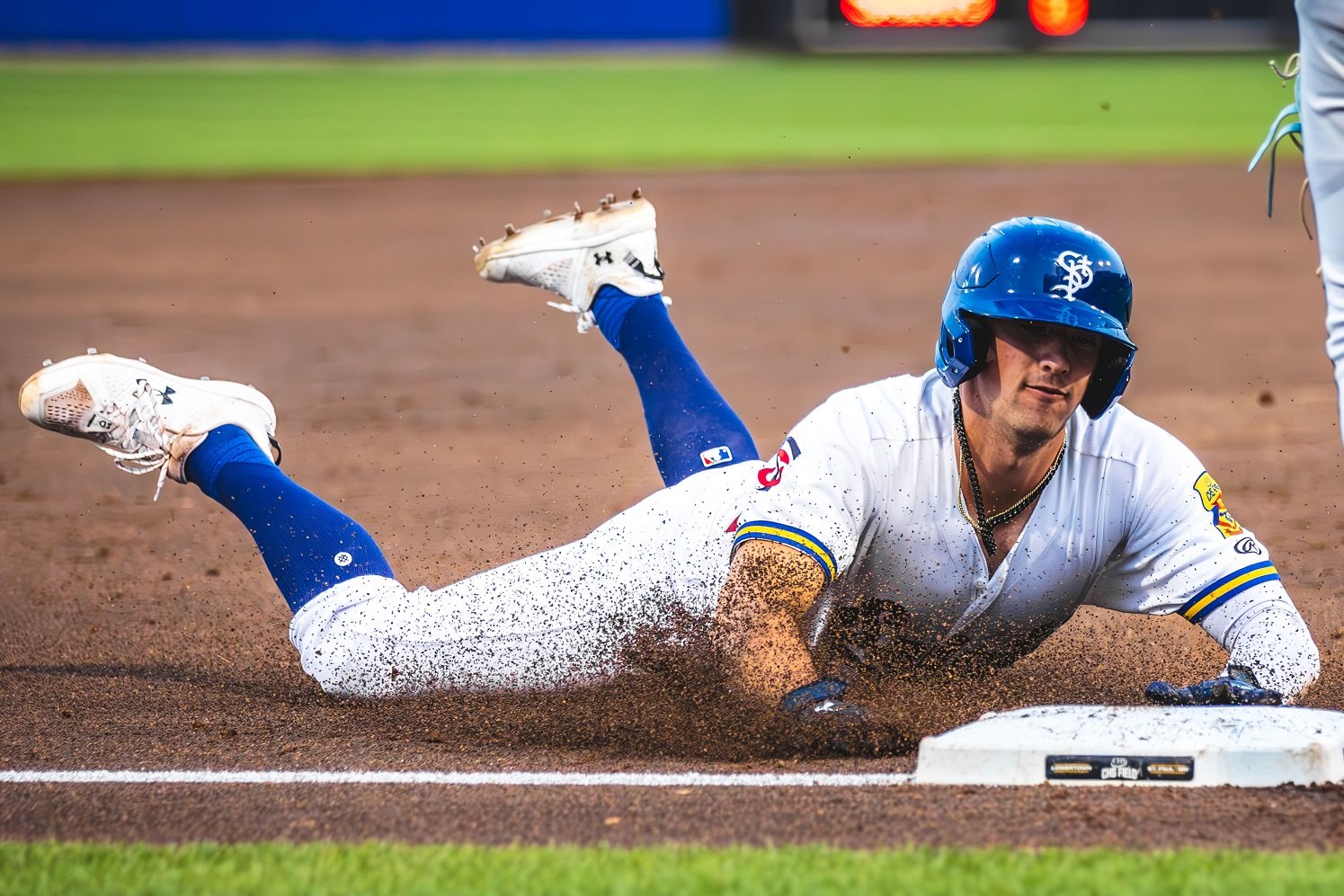 CURRENT W-L Records Minnesota Twins: 41-33 St. Paul Saints: 35-35 Wichita Wind Surge: 28-37 Cedar Rapids Kernels: 37-27 Fort Myers Mighty Mussels: 30-34 FCL Twins: 16-15 DSL Twins: 5-7 TRANSACTIONS RHP Travis Adams was activated from the Development List. To make room, RHP Cory Lewis was transferred to the Development List. SAINTS SENTINEL St. Paul 8, Toledo 7 Box Score A five-run third inning, and a three-run seventh inning provided just enough offense for the Saints to hang on for the afternoon win at CHS Field. Down 2-0 going into the bottom of the third inning, Will Holland started things with a one-out double. Edouard Julien walked. After a double steal put runners on second and third, Brook’s Lee doubled to drive in both runners. After a strikeout, Yunior Severino walked. Jair Camargo then crushed an opposite-field homer to give the Saints a 5-2 lead. It was a bullpen game for the Saints. Ronny Henriquez started and gave up one run on two hits. Ryan Vilade hit a first-inning homer off of him. Jordan Balazovic came on and in 1 2/3 innings, he was charged with four runs on four hits and a walk. He had three strikeouts. Jeff Brigham came in and allowed an inherited runner to score and one more run on three hits over two innings. Nick Wittgren worked two innings out of the bullpen. He gave up a run on three hits. After the crowd sang “Take Me Out to the Ballgame,” the Saints again found themselves behind, this time by a score of 7-5 with the top of the lineup ready to hit. Julien started things with a walk. He went to third on Brooks Lee’s third double of the game. After a Matt Wallner walk, Severijno walked to drive in Julien. However, the next two batters got out without moving the runners. Fortunately, Diego A. Castillo came through with an infield single to score Brooks Lee and tie the game. The Saints took the lead when Wallner scored on a Wild Pitch. Now with the lead, Toby Gardenhire turned to Hobie Harris. He walked the first batter that he faced but then got three quick outs to end the eighth frame. In the ninth, Kody Funderburk came in. He got a strikeout, issued a walk, and then struck out the final two batters to end the game. Brooks Lee led the offense. He had three doubles in five at-bats. He had two RBI and scored two runs. Yunior Severino went 2-for-2 with two walks. Camargo’s home runs was his fifth of the season. WIND SURGE WISDOM Wichita 9, Arkansas 2 Box Score The Wind Surge jumped to an early lead with a four-run third inning. They added on from there. They also got some great pitching in this one to put together a very nice team win. Pierson Ohl has struggled to find the consistency that made him so great late last season with the Surge, but he knows how to pitch. In this game, he gave up one run on five hits over five innings. He walked one and struck out two batters. From there, the bullpen took over. John Stankiewicz gave up one hit over two scoreless innings. Regi Grace got the three batters he faced. Travis Floyd gave up one run on two hits in the ninth inning. With one out in the top of the third, Ben Ross singled and advanced to third base on a Dalton Shuffield double. Luke Keaschall lined a single to left to score Ross. Jake Rucker followed with a sacrifice fly to score Shuffield. After Jeferson Morales reached on an error, Aaron Sabato doubled to drive in two more runs. In the fifth inning, Sabato hit his seventh homer of the season to make it 5-0. In the sixth frame, Tanner Schobel had a leadoff single. He stayed at first base until there were two outs. That’s when Shuffield hit his first Wind Surge homer of the season which made it 7-1. In the ninth inning, the first two hitters (Shuffield and Keaschall) were hit by a pitch. With one out, Morales’s 13th double drove in both to give the Surge the 9-1 lead. Sabato has been playing very well of late. In this one, he was 2-for-5 with his eighth double, seventh homer, and three RBI. His six June homers is second to Matt Wallner's nine for the Saints. In his last eight games, he has hit .258/.303/.710 (1.013) with two doubles, four homers and 10 RBI. The six extra-base hits have come in his past four games, starting with his walkoff blast on Saturday. Morales was 2-for-5 and drove in two. Shuffield was 2-for-2 with a walk and was hit by a pitch. He scored three runs. KERNELS NUGGETS Cedar Rapids 0, Peoria 7 Box Score It was a bullpen game for the Kernels on Wednesday. Jacob Wosinski gave up three runs on four hits over the first two innings. Then Michael Paredes came on and struck out three batters over two scoreless innings. Juan Mendez gave up two runs on three hits in his inning. Rafael Marcano gave up two runs on four hits over two innings. He had two strikeouts. Juan Mercedes struck out three batters over the final two innings. Combined, they gave up seven runs on 14 hits. The offense was unable to tie things together in this game. They had seven hits in the game, but went 0-for-4 with runners in scoring position and left eight batters on base. Payton Eeles went 3-for-4 in his second game with the Kernels. Kevin Maitan went 2-for-4. MUSSEL MATTERS Fort Myers 3, St. Lucie 7 Box Score The Minnesota Twins signed Ricky Castro to a minor-league contract on May 29th. That same day, the Purdue and Tulane alum was added to the Fort Myers roster. In his first three appearances, he came in out of the bullpen. In his first outing, he struck out four batters in two innings. Next, he earned a three-inning save with four strikeouts. In his previous outing, he tossed three scoreless innings. So on this night in St. Lucie, he made his first start. Keeping to the pattern, Castro was bumped up to four innings. He gave up just one hit, walked none and struck out nine batters. In nearly Zebby Matthews-like fashion, he has issued just one walk and struck out 19 batters over his first 12 innings as a pro. Danny Moreno came in to start the fifth innings. He gave up three runs (1 earned) on two hits and two walks and recorded just one out. Ben Ethridge came on with the bases loaded and allowed one inherited runner to score. He went two more innings and gave up three runs on five hits. Nolan Santos came on and stranded a runner in the seventh. He gave up one run on two hits. Of the four outs he recorded, three came on strikeouts. Nick Lucky manufactured a run in the third inning. He singled and stole second base. After a walk, Lucky stole third base and scored on a ground out by Walker Jenkins. The run gave the Mussels a 1-0 lead. They didn’t score again until the ninth when they scored two runs that gave the final score of 7-3. With one out, Isaac Pena lined a single to center. He moved up a base on defensive indifference. Lucky then singled to right to score Pena. With two outs and after a Maddux Houghton single and a Walker Jenkins walk, Lucky scored on a balk. Lucky went 2-for-4, as did Matthew Clayton and Houghton.. Rixon Wingrove was 2-for-3 with a walk and his fourth double. Byron Chourio went 2-for-5. The Mussels had 11 hits and three walks, but they went just 1-for-13 with runners in scoring position. TWINS DAILY MINOR LEAGUE PLAYERS OF THE DAY Pitcher of the Day – Ricky Castro (Fort Myers) - 4 IP, 1 H, 0 ER, 0 BB, 9 K, 53 pitches, 38 strikes (71.7%) Hitter of the Day – Aaron Sabato (Wichita) - 2-for-5, 2B(8), HR(7), R, 3 RBI. PROSPECT SUMMARY Check out the Prospect Tracker for much more on the Twins Top 20 prospects after seeing how they did on Thursday. #1– Walker Jenkins (Fort Myers) – 0-for-4, BB, RBI #2 – Brooks Lee (St. Paul) – 3-for-5, 3-2B(4), 2 R, 2 RBI, K #9 – Luke Keaschall (Wichita) – 1-for-4, BB, 2 R, RBI, K #13 – Tanner Schobel (Wichita) – 1-for-4, R . #18 – Yunior Severino (St. Paul) – 2-for-2, 2 BB, R, RBI THURSDAY’S PROBABLE STARTERS Toledo @ St. Paul (7:07 PM CST) – RHP David Festa (2-2, 3.50 ERA) Wichita @ Arkansas (6:35 PM CST) – RHP Andrew Morris (2-1, 1.61 ERA) Peoria @ Cedar Rapids (6:35 PM CST) – RHP Jeremy Lee (0-3, 7.71 ERA) Fort Myers @ St. Lucie (5:05 PM CST) – RHP Tanner Hall (1-0, 2.63 ERA) FCL Twins @ FCL Rays (11:00 AM CT) - TBD DSL White Sox White@ DSL Twins (10:00 AM CST) - TBD Please feel free to ask questions and discuss Wednesday’s games!
- 21 comments
-
- 3
-
-
- brooks lee
- aaron sabato
- (and 5 more)
-
Willie Mays - Compare to Twins HOFers
Seth Stohs replied to strumdatjag's topic in Minnesota Twins Talk
Willie Mays is the greatest player ever to play the game... -
Do we want Lee called up to fill the Kyle Farmer role, playing twice per week, mostly partial games? And, I like Eeles, great story so far... but hasn't it been one game. CR won. FM lost. But I'm not sure that is all about Eeles. He is a sparkplug though.
- 24 replies
-
- 7
-
-
- brooks lee
- christian macleod
- (and 2 more)
-
Ricardo Velez has been named the Minnesota Twins Minor League Relief Pitcher of the Month in both April and May this year. What does he throw? What has made him so successful this season? Seth caught up with the 25-year-old from Puerto Rico about the start to his season, going to college in Oklahoma, going to the USPBL, and finally signing with the Twins. View full video
-
Ricardo Velez has been named the Minnesota Twins Minor League Relief Pitcher of the Month in both April and May this year. What does he throw? What has made him so successful this season? Seth caught up with the 25-year-old from Puerto Rico about the start to his season, going to college in Oklahoma, going to the USPBL, and finally signing with the Twins.
-
I don't think there's anything to say formally who can or can't play there. But it is primarily for players signed from Spanish-speaking counties. 95% of the players there are from the DR or Venezuela, but they have players from other spanish-speaking countries. Looking back at players the Twins have signed from other places, I believe they're all gone to the FCL in Florida. Australia. Germany. South Africa. That's tough because players in the FCL are typically a little older, a little stronger and more advanced. High school draft picks are generally 18, compared to the international players who sign at 16 or 17, and they're listed at 6-1 and 145 pounds. It's a good transition level before going to the States. They take classes most afternoons, basic English
-
Saturday provided us with several impressive highlights. Randy Dobnak had his best start. Matt Wallner stayed hot. Zebby Matthews was on the mound again. Would he issue any walks? The Wind Surge were powered to a huge walkoff homer in extra innings. Kevin Maitan and Jay Harry led the Kernels, for whom good things came in threes. Spencer Bengard was treat for the Mighty Mussels. Image courtesy of Ed Bailey, Wichita Wind Surge Twins Minor League Report (6/13): CURRENT W-L Records Minnesota Twins: 38-32 St. Paul Saints: 32-35 Wichita Wind Surge: 26-36 Cedar Rapids Kernels: 35-26 Fort Myers Mighty Mussels: 30-30 FCL Twins: 14-12 DSL Twins: 4-5 TRANSACTIONS Kyle Jones was set to begin his rehab assignment in the FCL. However, the game was postponed. Sebastian Pulido, a RHP in the Dominican Summer League, was activated from the Restricted List. SAINTS SENTINEL St. Paul 3, Louisville 1 Box Score Randy Dobnak had easily his best start of the 2024 season. He’s been pitching well enough of late that it’s again fair to wonder aloud if he has a potential path back to the big leagues. On Saturday afternoon, “Dobber” gave up just two hits over six shutout innings. He walked one and had 10 strikeouts. Josh Winder came on and tossed two scoreless innings. Kody Funderburk got the ninth frame. He gave up a run on a hit and a hit batter. He had two strikeouts and earned his second save. Offensively, the Saints were again led by Matt Wallner. He put the Saints on the scoreboard in the fourth inning when he launched a 403-foot shot, at 109-mph to left-center field to make it a 1-0 lead. The Forest Lake native singled to lead off the top of the seventh inning and scored on a double by Jair Camargo. After a pitching change brought fellow 2019 Twins draft pick Casey Legumina into the game. He was greeted by a Tony Kemp sacrifice fly that drove in Yunior Severino with the third run. Wallner was 4-for-4 in the game and the homer was his 14th of the season. The Saints had just six hits in the game. Camargo’s double was his fifth of the season. WIND SURGE WISDOM Wichita 6, Midland 3 (11 innings) Box Score These teams were having so much fun in Wichita on Saturday night that they decided to play a couple of extra innings. The Surge broke through with three runs in the 11th to grab the win. Down 1-0 in the second inning, Luke Keaschall put the Wind Surge on the scoreboard with a double that drove in Jorel Ortega. Keaschall then scored on a Jake Rucker double. Midland reclaimed the lead with two runs in the top of the sixth, but a Jeferson Morales homer tied things at three in the bottom of the inning. That’s how the score remained until the 11th inning. Morales started the 11th inning as the Manfred Man on second base. With one out, Carson McCusker was hit by a pitch. That brought up Aaron Sabato who abruptly ended the ballgame with a three-run, walk-off homer. Sabato played hero, but the Surge gave up just three runs over 11 innings. Zebby Matthews started and gave up three runs on seven hits (including a home run) in six innings. He had seven strikeouts and - of course - no walks. The quick update? Matthews now has 70 strikeouts and just two walks over 58 1/3 innings. In that time, he has a combined 1.70 ERA (1.77 in AA, 1.59 in High-A). The team then got five innings of one-hit, shutout baseball from the bullpen. Miguel Rodriguez and Scott Engler each tossed two innings. Engler had four strikeouts. Jared Solomon walked two and struck out two in a scoreless 11th inning. Sabato and Morales were both 2-for-5 in the game. Morales’s homer was his fourth, and Sabato’s was his fifth of the season. Sabato also stole his fourth base this season. Keaschall went 2-for-4 with a walk and his sixth double since joining Wind Surge. KERNELS NUGGETS Cedar Rapids 10, Lansing 6 Box Score The Kernels jumped ahead early in this game. They had a 4-0 lead after two innings. However, the Lugnuts scored five in the bottom of the fourth inning. However, the Kernels responded with three runs in the top of the fifth and the top of the eighth innings and held on for the 10-6. The Kernels scored one in the first inning. With two outs, Jay Harry doubled to drive in Ricardo Olivar with the first run. They scored three quick runs in the second inning. Kevin Maitan singled and scored on a Jose Salas triple. Nate Baez stayed hot and hit a two-run homer. Lefty Jordan Carr made the start for the Kernels. He tossed three scoreless innings to start the game. He got the first out in the fourth inning but then gave up four straight hits, a fielder’s choice and another hit to tie the game at 4-4. Michael Paredes came on and allowed an inherited runner to score before the end of the inning. The Kernels quickly responded in the top of the fifth inning, with patience. Rayne Doncon, Olivar and Agustin Ruiz walked. With two outs, Maitan cleared the bases with a double. Again, the Kernels came up big with two outs. This time in the eighth inning. Rubel Cespedes singled, and Olivar followed with another walk. Harry tripled to drive them both in and then scored on a Ruiz single. Aside from the inherited runner scoring, Paredes was charged with no runs on two hits over 2 1/3 innings. Kyle Bischoff tossed two scoreless frames. The ninth inning was covered by Juan Mendez who gave up a run on two hits. Maitan led the way with a 4-for-5 game. He hit his third triple and drove in three runs. Harry drove in three runs with his 12th double and first triple. Kyle Hess had two hits. Olivar went 1-for-3 with two walks. MUSSEL MATTERS Fort Myers 11, Lakeland 3 Box Score The Mussels jumped out to an early lead with five runs over the game’s first two innings and then put the game out of reach with a five-run bottom of the seventh. The team fell behind 2-0 after one-half inning. The Mussels manufactured a run and then used some power to add on. Payton Eeles led off and was hit by a pitch. With one out, he stole second and then advanced to third on a fly out. He scored the first run on a single by Poncho Ruiz. Rixon Wingrove followed with a long home run to the right center field gap to give them a 3-2 lead. With two outs in the second inning, Matthew Clayton was hit by a pitch and Eeles walked. Walker Jenkins then drove in two runs with a single. Honestly, it’s a play you have to see to believe. Charlee Soto made the start for Fort Myers and completed the first four innings, a season high. He gave up three runs (1 earned) on four hits and a walk. He had five strikeouts. Spencer Bengard came in and continued to pitch as he has all season. He completed the final five innings without giving up another run. He gave up three hits, walked none and struck out five batters. With one out in the bottom of the seventh inning, Brandon Winokur was hit by a pitch. Ruiz and Wingrove followed with singles to lead the bases. A run scored on a fielder’s choice off the bat of Byron Chourio. Then with two outs, Carlos Aguiar doubled in two runs.Clayton, who was twice hit by a pitch in this game, followed with a two-run single. The Mussels added one more in the eighth inning. Winokur singled and scored on a Ruiz double. COMPLEX CHRONICLES FCL Twins, FCL Red Sox Box Score This game was postponed due to inclement weather in Fort Myers. It will be made up as part of a doubleheader next Friday. It’s been a rough weather week in south Florida. Most of the games this week were postponed DOMINICAN DAILIES DSL Twins 4, DSL Diamondbacks 6 Box Score The Twins took the early lead in this one. In the bottom of the first inning, a Yandro Hernandez single drove in Merphy Hernandez. Santiago Rojas started the game with four scoreless innings. He hit a batter in the third inning and gave up an infield single in the fourth frame. In the fifth, he gave up a leadoff walk. The runner stole second and after two outs, he scored on another single. Nestor Cafe came in and issued a walk and a stolen base, followed by a single that scored the second run off of Rojas and another run. By the time the third out occurred, the Twins trailed by a score of 4-1. Rojas’s final line included giving up two runs on two hits. He walked one, hit one and struck out six batters. Cafe went 1 1/3 innings. He gave up four runs (2 earned) on just one hit. He walked four and had two strikeouts. Cafe started the seventh inning but walked both batters he faced. Fabian Herrera came in and after a wild pitch, he recorded back-to-back strikeouts. However, a bloop single scored both of Cafe’s runners. In the bottom of the sixth inning, an infield single by Davirik Fuenmayor drove in a run. Down 6-2 going into the bottom of the seventh inning, Daiber De Los Santos led off with a solo homer, the first of his pro career. The Twins kept fighting and scored a second run on an error. In fact, they had the tying run on second base when the game ended. Yandro Hernandez went 2-for-4 with two stolen bases. Murphy Hernandez was 2-for-3 with a walk and three stolen bases. TWINS DAILY MINOR LEAGUE PLAYERS OF THE DAY Pitcher of the Day – a) Randy Dobnak (St. Paul) - 6 IP, 2 H, 0 ER, 1 BB, 10 K, 100 pitches, 67 strikes (67.0%) b) Spencer Bengard (Fort Myers) - 5 IP, 3 H, 0 ER, 0 BB, 5 K, 74 pitches, 53 strikes (71.6%) Hitter of the Day – Matt Wallner (St. Paul) - 4-for-4, HR(14), 2 R, RBI. Kevin Maitan (Cedar Rapids) - 4-for-5, 2B(3), R, 3 RBI, SB(2). PROSPECT SUMMARY Check out the Prospect Tracker for much more on the Twins Top 20 prospects after seeing how they did on Thursday. #1– Walker Jenkins (Fort Myers) – 1-for-4, 2 RBI #2 – Brooks Lee (St. Paul) – 0-for-4, K #7 – Charlee Soto (Fort Myers) – 4 IP, 4 H, 3 R, 1 ER, 1 BB, 5 K, 68 pitches, 46 strikes (67.6%) #9 – Luke Keaschall (Wichita) – 2-for-4, BB, 2B(6), R, RBI, SB(3). #10 – Brandon Winokur (Fort Myers) – 2-for-3, 2 R, #14 – Zebby Matthews (Wichita) – 6 IP, 7 H, 3 ER, 0 BB, 7 K, 81 pitches, 60 strikes (74.1%) #18 – Yunior Severino (St. Paul) – 0-for-3, 2 BB, RBI #20 – Ricardo Olivar (Cedar Rapids) – 1-for-3, 2 BB, 3 R, RBI, K. SUNDAY’S PROBABLE STARTERS St. Paul vs Louisville (12:05 PM CST) – RHP Caleb Boushley (6-1, 3.88 ERA) Midland @ Wichita (1:05 PM CST) – LHP Jaylen Nowlin (4-6, 4.06 ERA) Cedar Rapids @ Lansing (6:05 PM CST) – RHP Ty Langenberg (first Kernels start) Lakeland @ Fort Myers (DH @ 11:05 AM CST) – RHP Jose Olivares (1-0, 1.80 ERA), TBD Please feel free to ask questions and discuss Saturday’s games View full article

