RpR
-
Posts
9,942 -
Joined
-
Last visited
Content Type
Profiles
News
Minnesota Twins Videos
2026 Minnesota Twins Top Prospects Ranking
2022 Minnesota Twins Draft Picks
Minnesota Twins Free Agent & Trade Rumors, Notes, & Tidbits
Guides & Resources
2023 Minnesota Twins Draft Picks
The Minnesota Twins Players Project
2024 Minnesota Twins Draft Picks
2025 Minnesota Twins Draft Pick Tracker
2026 Minnesota Twins Draft Tracker: Picks & Bonuses
Forums
Blogs
Events
Store
Downloads
Gallery
Everything posted by RpR
-
Who Replaces Tristan Gray for his Paternity Leave?
RpR replied to stringer bell's topic in Minnesota Twins Talk
LOL, the only infield position he has play was First Base and his glove work makes Bell look like a Gold Glove. -
So many here called baseball fans, are like a baseball versions of fishmongers, they buy sell and toss they around in their heads, because it gives them an absurd feeling of authority.
- 95 replies
-
- 3
-

-
- andrew morris
- simeon woods richardson
- (and 4 more)
-
Former Twins. Where are They Now? 2026 Edition
RpR replied to stringer bell's topic in Minnesota Twins Talk

-
He is very good in Center Field, good in Right Field, and not good in Left Field. There is not a need for him and the regular season are not - try out - games .
-
La Tortuga Astudillo.
-
"What Must Matt Wallner Prove at Triple-A Before Returning to Minnesota?" To return to the Twins, he must show he is talented enough for MLB.
-
Astros (Burrows) vs Twins (Ryan): 5/20/26, 12:40pm
RpR replied to Brock Beauchamp's topic in Archived Game Threads
He was one of the very, very few rookies , I thought , would just continue from last year with his bat. -
Astros (Burrows) vs Twins (Ryan): 5/20/26, 12:40pm
RpR replied to Brock Beauchamp's topic in Archived Game Threads
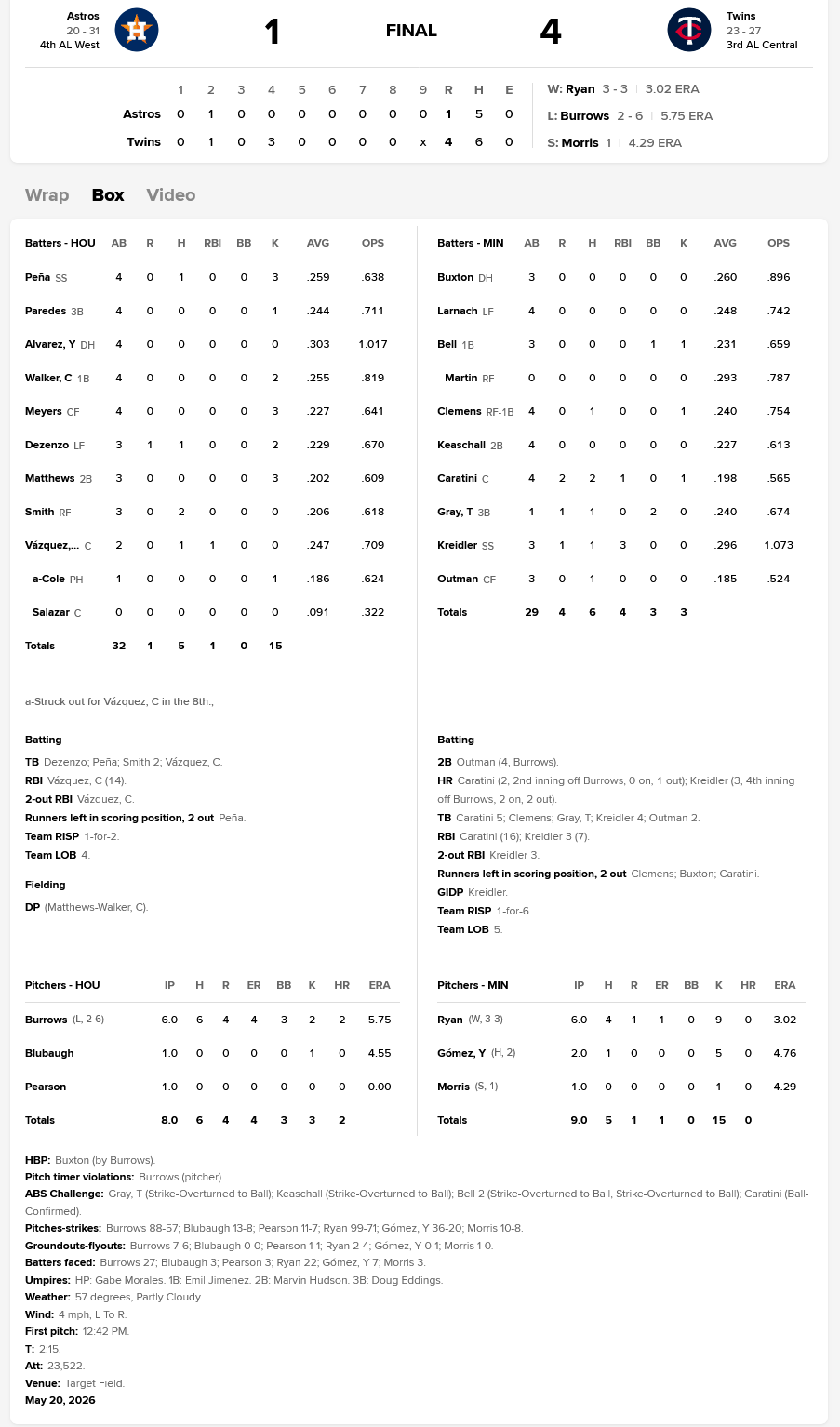
-
Astros (Burrows) vs Twins (Ryan): 5/20/26, 12:40pm
RpR replied to Brock Beauchamp's topic in Archived Game Threads
AH, Cold Spring Kegle Brau, a fantastic beer they refuse to bring back. I was at their October Fest years back, and drank several.. cups of beer served just for the event; I asked which one it was and the gent said it was Kegle Brau. I said this was great beer, were they going to start bottling it again; he said many have asked that and NO they were not. Also Fox Deluxe was far, far better than too many have belly ached about it. -
Astros (Burrows) vs Twins (Ryan): 5/20/26, 12:40pm
RpR replied to Brock Beauchamp's topic in Archived Game Threads
Or he could change is last name to Gordon. -
Astros (Burrows) vs Twins (Ryan): 5/20/26, 12:40pm
RpR replied to Brock Beauchamp's topic in Archived Game Threads
have been reading too many TD ratings.🙃 -
Astros (Burrows) vs Twins (Ryan): 5/20/26, 12:40pm
RpR replied to Brock Beauchamp's topic in Archived Game Threads
I never got there, but my one Grandfather did and he said, the beer they served at Brewery tours was the best beer he ever had. -
Astros (Burrows) vs Twins (Ryan): 5/20/26, 12:40pm
RpR replied to Brock Beauchamp's topic in Archived Game Threads
OH yes; until its main contributor died and it went out of print, I read the magazine, All About Beer regularly, and there opinions of some beers youts back then trashed were not as bad as those of pissed up college dudes.😆 -
Astros (Burrows) vs Twins (Ryan): 5/20/26, 12:40pm
RpR replied to Brock Beauchamp's topic in Archived Game Threads
Schmidt was SO common at keggers, I rarely bought it in bottles. -
Astros (Burrows) vs Twins (Ryan): 5/20/26, 12:40pm
RpR replied to Brock Beauchamp's topic in Archived Game Threads
The bell is tolling for the umpire. -
Astros (Burrows) vs Twins (Ryan): 5/20/26, 12:40pm
RpR replied to Brock Beauchamp's topic in Archived Game Threads
Wrong team, but I read recently that whom ever owns Schlitz Beer has ceased brewing it. I remember many years ago, that an article said they had changed the recipe back to the original and back then I drank a lot of beer and could taste the improvement. I will have to run to the local liquor store and by a pack for old times sake. -
Astros (Burrows) vs Twins (Ryan): 5/20/26, 12:40pm
RpR replied to Brock Beauchamp's topic in Archived Game Threads
Just think if his first name was Knuckleballo.... -
Astros (Burrows) vs Twins (Ryan): 5/20/26, 12:40pm
RpR replied to Brock Beauchamp's topic in Archived Game Threads
Every manager has to deal with the same, so they all are handicapped in reality, or it could be their idea of how to run a team. -
Astros (Burrows) vs Twins (Ryan): 5/20/26, 12:40pm
RpR replied to Brock Beauchamp's topic in Archived Game Threads
It is more common in baseball than fans want to know; look at how Gordon came up, hit .272 and faded into obscurity. -
Astros (Burrows) vs Twins (Ryan): 5/20/26, 12:40pm
RpR replied to Brock Beauchamp's topic in Archived Game Threads
Well, I was never a Larnach fan, but he is a Lot better than Wallner was, and he has his good moments. -
Astros (Burrows) vs Twins (Ryan): 5/20/26, 12:40pm
RpR replied to Brock Beauchamp's topic in Archived Game Threads
Thankyou! -
Astros (Burrows) vs Twins (Ryan): 5/20/26, 12:40pm
RpR replied to Brock Beauchamp's topic in Archived Game Threads
LOL, I watch cooking shows so I know what it means, but I actually do know what Lutefisk😁 tastes like; Lutefisk does not taste bad, it is the texture that many cannot tolerate.😁 -
Astros (Burrows) vs Twins (Ryan): 5/20/26, 12:40pm
RpR replied to Brock Beauchamp's topic in Archived Game Threads
It is only the fifth inning, do not know why, but it seems to me I have been watching long enough that it should be the seventh already. -
Astros (Burrows) vs Twins (Ryan): 5/20/26, 12:40pm
RpR replied to Brock Beauchamp's topic in Archived Game Threads
Umami, is that what Lutefisk tastes like?