



Andrew Thares
-
Posts
653 -
Joined
-
Last visited
Content Type
Profiles
News
Minnesota Twins Videos
2026 Minnesota Twins Top Prospects Ranking
2022 Minnesota Twins Draft Picks
Minnesota Twins Free Agent & Trade Rumors, Notes, & Tidbits
Guides & Resources
2023 Minnesota Twins Draft Picks
The Minnesota Twins Players Project
2024 Minnesota Twins Draft Picks
2025 Minnesota Twins Draft Pick Tracker
2026 Minnesota Twins Draft Tracker: Picks & Bonuses
Forums
Blogs
Events
Store
Downloads
Gallery
Everything posted by Andrew Thares
-
 MLB.com will be carrying a live stream of the draft that starts with a pre-draft show at 11:30 am CT. It’ll be awhile before the Twins pick again, however, as they had to forfeit their third-round pick when they signed Lance Lynn. From Yesterday Twins Select Trevor Larnach in the First Round of the 2018 Draft Twins Select Ryan Jeffers in the Second Round of the 2018 Draft It'll be some time before we know the amount Larnach and Jeffers sign for, but it’d be a good bet the Twins will have at least carried over some money from those selections to disperse to players who drop on Day 2. Here are the Twins selections for today and the bonus money attached to each pick: 4th Round: 124th Overall - $442,600 5th Round: 154th Overall - $330,400 6th Round: 184th Overall - $253,700 7th Round: 214th Overall - $198,700 8th Round: 244th Overall - $162,100 9th Round: 274th Overall - $146,500 10th Round: 304th Overall - $138,400 What do Scott Erickson, Eddie Rosario, Dave Goltz, Doug Mientkiewicz, Pat Neshek, LaTroy Hawkins, Mark Guthrie, Brad Radke, Brian Dozier, Steve Braun, Jeff Reboulet and Marty Cordova all have in common? The were all taken between rounds four and 10 of the draft. It’ll be exciting to see how things play out today. Please join in on the conversation and keep checking back, as this article will be updated each time the Twins make a selection. Draft Picks 4th Round: 124th Overall: DaShawn Keirsey, CF, Utah The Twins trend of taking college bats continues today as they take University of Utah outfielder DaShawn Keirsey with their first pick of Day Two. Unlike their two Day One picks, Keirsey is a player who has some defensive upside along with an excellent bat. https://twitter.com/TwinsHighlights/status/1004064546716307457 In all three years of his college career Keirsey was selected to both the PAC-12 All-Conference team and the PAC-12 All-Defensive team. Additionally, Keirsey is an outfielder who has almost exclusively played center field with the Utes. Offensively, Keirsey has done two things that you like to see from a college hitter. The first thing is he has always been a good hitter, having hit above .293 in each of his three seasons at Utah. The other thing Keirsey has done is improve each season. In Keirsey’s freshman year he had an OPS of .707, which he followed up with a .849 OPS last year. This year Keirsey has elevated his game even further with a .386/.440/.609 slash line for an OPS of 1.049. Keirsey dislocated his hip after crashing into the wall during his final game of the 2017 season. However, he came back this year and showed that he is healthy again. Hopefully this isn't an injury that has any lingering side effects for Keirsey down the road. 5th Round: 154th Overall: Cole Sands, RHP, Florida State It may have come four rounds later than initially expected, but the Twins finally took a college pitcher with their fifth-round pick in Florida State starter Cole Sands. Sands is a three-year starter at one of the premier college baseball programs in the country. https://twitter.com/TwinsHighlights/status/1004074342374879238 Sands is a right-handed pitcher with a three pitch mix. His fastball will sit in the 90-93 mph range and is a pitch that Sands can control. Sands also features a slider and a changeup as his secondary offerings. Of the two his slider is the better pitch, but both pitches have potential to be at least average pitches at the next level. The numbers at Florida State don’t exactly stand out for Sands. He has just a 4.73 ERA over 228 1/3 career innings pitched, and this year Sands’ ERA stood at 4.54 while pitching 75 1/3 innings. The thing that is encouraging is the improvement Sands has shown in both his strikeout rate and walk rate during each season in college. Since his freshman season, Sands has improved his strikeout rate from 16.1 percent up to 27.7 percent while his walk rate has reduced from 10.7 percent to 7.9 percent. Sands has also had two quality showings in the Cape Cod League. Between his freshman and sophomore seasons Sands had a 1.29 ERA over 14 innings, and he backed that up with a 3.68 ERA over 22 innings last summer. In total Sands had 42 strikeouts and nine walks over 36 innings pitched in the Cod. 6th Round, 184th Overall: Charles Mack, SS/3B, Williamsville East HS (NY) Mack is committed to Clemson, and by the sound of it came away really impressed with their program. He had offers from several other top colleges, including Vanderbilt, Virginia, Maryland, Mississippi State and Pittsburgh. A pick after taking their first college pitcher in the draft, the Twins take their first high school player in third baseman Charles Mack. Mack is a product out of Williamsville, New York which isn’t exactly a hot bed for high school talent. Mack is a strong left-handed hitter with some upside in the power department. This was probably the Twins biggest draw to Mack as he could be a 25-30 homer guy down the road. There have been some questions around Mack’s ability as an all-around hitter, but he has made some nice improvements with his swing that give him some promise. The biggest question with Mack entering the draft was which position will he play in the infield? Mack has mostly played short throughout his high school career but isn’t a guy many people thought would stick there. However, the Twins answered that question when the drafted him as a third baseman. On the mound his velocity was tracked as high as 85 mph a couple of years ago. If Mack has made some more improvements with his arm strength since then, he could very well have the arm to stick at third. 7th Round, 214th Overall: Josh Winder, RHP, Virginia Military Institute (VA) Standing 6-foot-5 and weighing in at 210 pounds, Winder has a build that scouts love for potential at the next level. of him pitching back in April.On the mound, Winder features a low 90’s fastball along with an above average slider. However, both pitches have shown some regression this year as his fastball was up near the mid-90’s last summer and his slider has taken a step back as well. This has caused Winder’s stock to take a drop this year after posting a 5.40 ERA this season. Through their first two pitchers taken in the draft, it appears that the Twins are looking for college arms that have slipped due to either injury or poor performance. This isn’t a bad strategy for them as both Winder and Cole Sands have some relative upside for college pitchers taken at this point in the draft, and neither should be that expensive to sign compared to a high school arm with similar upside. 8th Round, 244th Overall: Chris Williams, C, Clemson Much like Ryan Jeffers, Chris Williams is a power hitting college catcher, however, with Williams being a college senior he should come at a much cheaper price than Jeffers will. Williams also appears to be a better all-around athlete than Jeffers as he was a utility infielder before transitioning to catcher in 2017. Williams played his first year of college baseball in the JUCO ranks at Golden West College where he was named conference MVP before transferring to Clemson between his freshman and sophomore campaigns. In his three years at Clemson, Williams has belted 40 home runs including 18 this spring. Overall Williams had a slash line of .281/.401/.562, and led his team with 72 RBIs in just 63 games this year. Prior to this season, Williams was never a player who was known for having a patient approach at the plate, despite his power potential with the bat. However, this year Williams has shown some improvement in this area with a walk rate of nearly 15 percent. 9th Round, 274th Overall: Willie Joe Garry Jr., OF, Pascagoula HS The Twins went a little off the grid with their ninth-round pick in high school outfielder Willie Joe Garry Jr., as he didn’t even make the Baseball America Top 500 list. Garry is a toolsy outfielder out of the Mississippi high school ranks who really came on strong last year when had some strong performances while playing for his Perfect Game travel ball team the East Coast Sox. Garry’s play was strong enough for him to earn a few all-tournament team awards on the Perfect Game circuit. Garry has a wiry frame that is very projectable going forward with his value coming from his play in the outfield. He has plus speed and gets good reads off the bat. Offensively, Garry has good bat speed and could develop some power as he matures. If he can develop into a solid hitter, Garry has the potential to make it to have a successful big-league career. 10th Round, 304th Overall: Regi Grace, RHP, Madison Central HS With their last pick on day two, the Twins took another high school player out of Mississippi, this time right-handed pitcher Regi Grace. At 6’1” and 215 pounds, Grace is a strong kid who uses his body to generate velocity. Last fall, Grace had his fastball clocked in the low 90’s, but as a kid like this matures it’s entirely possible that he will continue to add more velocity. Grace also features an above-average slider that gives him a strong two-pitch mix. As with most picks at this point, it is all about potential and Grace is a guy with that. If he wants to become a starter he will need to develop a third pitch, but if not he could have to stuff to make a strong bullpen piece.
 -
 Some of the Twins’ most successful second-round draft picks include Frank Viola, Butch Wynegar, Scott Baker, Tim Teufel, Jacque Jones and Jesse Crain. Derek Falvey and the rest of the front office are hoping Ryan Jeffers someday joins that list. With their second-round pick, No. 59 overall, the Twins took Jeffers, who is a catcher out of UNC Wilmington. Some of the Twins’ most successful second-round draft picks include Frank Viola, Butch Wynegar, Scott Baker, Tim Teufel, Jacque Jones and Jesse Crain. Derek Falvey and the rest of the front office are hoping Ryan Jeffers someday joins that list. With their second-round pick, No. 59 overall, the Twins took Jeffers, who is a catcher out of UNC Wilmington. Jeffers isn’t the sexiest pick in the draft, but he might just be exactly the type of pick that we could have expected the Twins to take entering tonight. The Twins' limitations with their bonus pool were evident and this pick is most likely a move to save a little bit of money in that pool. As a player, Jeffers is an offense-first catcher whose numbers playing for UNC Wilmington will jump off the page. Here are his three-year career numbers in college. 542 PA; .322 AVG; .450 OBP; .616 SLG; 78 K; 85 BB; 44 2B; 2 3B; 27 HR This year, Jeffers hit .315/.460/.635 with 16 home runs and 50 RBIs this season. He also had 51 walks compared to just 44 strikeouts. He led the Colonial Athletic Association in home runs and on-base percentage. Even though Jeffers doesn’t play in one of the top tier baseball conferences, this is still production that you can't ignore, especially from a catcher. Jeffers was the offensive leader this season for a UNC-Wilmington team that won the Colonial Athletic Association this year, and advanced to the regional final before being knocked out by the South Carolina Gamecocks earlier today. With the Twins selecting Jeffers this early in the draft, it's apparent they believe in his ability to stay behind the plate. If so, this will be a great addition to the Twins farm system that is pretty thin in the backstop department. Behind the plate, he threw out just 12 of 48 base stealers (25 percent), but there's obviously a lot more that goes into catching than just throwing out runners. Jeffers also saw some time in the outfield, though he's a big guy, listed at 6-foot-4 and 228 pounds. Here's what Carlos Collazo of Baseball America had to say about Jeffers: https://twitter.com/CarlosACollazo/status/1003839354077315072 And here's a Tweet from Eric Longenhagen of FanGraphs: https://twitter.com/longenhagen/status/1003839632474177536 View full article
 -
Twins Select Ryan Jeffers in the Second Round of the 2018 Draft
Andrew Thares posted an article in Twins
 Jeffers isn’t the sexiest pick in the draft, but he might just be exactly the type of pick that we could have expected the Twins to take entering tonight. The Twins' limitations with their bonus pool were evident and this pick is most likely a move to save a little bit of money in that pool. As a player, Jeffers is an offense-first catcher whose numbers playing for UNC Wilmington will jump off the page. Here are his three-year career numbers in college. 542 PA; .322 AVG; .450 OBP; .616 SLG; 78 K; 85 BB; 44 2B; 2 3B; 27 HR This year, Jeffers hit .315/.460/.635 with 16 home runs and 50 RBIs this season. He also had 51 walks compared to just 44 strikeouts. He led the Colonial Athletic Association in home runs and on-base percentage. Even though Jeffers doesn’t play in one of the top tier baseball conferences, this is still production that you can't ignore, especially from a catcher. Jeffers was the offensive leader this season for a UNC-Wilmington team that won the Colonial Athletic Association this year, and advanced to the regional final before being knocked out by the South Carolina Gamecocks earlier today. With the Twins selecting Jeffers this early in the draft, it's apparent they believe in his ability to stay behind the plate. If so, this will be a great addition to the Twins farm system that is pretty thin in the backstop department. Behind the plate, he threw out just 12 of 48 base stealers (25 percent), but there's obviously a lot more that goes into catching than just throwing out runners. Jeffers also saw some time in the outfield, though he's a big guy, listed at 6-foot-4 and 228 pounds. Here's what Carlos Collazo of Baseball America had to say about Jeffers: https://twitter.com/CarlosACollazo/status/1003839354077315072 And here's a Tweet from Eric Longenhagen of FanGraphs: https://twitter.com/longenhagen/status/1003839632474177536
 -
Bob Jones (1966), Johnny Ard (1988), Torii Hunter (1993), Denard Span (2002), Trevor Plouffe (2004) and Chris Parmelee (2006) were all selected by the Minnesota Twins with the 20th overall pick in the MLB Draft. The Twins had the No. 20 pick once again this year, and selected outfielder Trevor Larnach of Oregon State. Bob Jones (1966), Johnny Ard (1988), Torii Hunter (1993), Denard Span (2002), Trevor Plouffe (2004) and Chris Parmelee (2006) were all selected by the Minnesota Twins with the 20th overall pick in the MLB Draft. The Twins had the No. 20 pick once again this year, and selected outfielder Trevor Larnach of Oregon State. There were a lot of rumors that the Twins were going to take a college pitcher in this draft, and when they had their selection at pick 20 they had plenty of college pitchers to choose from in guys like Shane McClanahan, Jackson Kowar and Ryan Rolison. However, the Twins ended up going with a college bat in Oregon State right-fielder Trevor Larnach (pronounced LAR-nick). How much of this pick was centered around the Twins limited bonus pool will remain to be seen, but it can be assumed that Larnach won’t be as expensive of a player as some of the other names that were available for the Twins to choose from. Entering the draft, I had Larnach ranked as my 23rd best prospect available, so it is not like the Twins are settling by any stretch of the imagination. Here is what I had to say about Larnach as part of my pre-draft scouting report. “Oregon State has had one of the most successful baseball programs over the last couple of years, and a big part of that has been on the bat of outfielder Trevor Larnach. Much like Virginia outfielder Adam Haseley did in last year’s draft, Larnach has shot up the draft boards upon seeing big improvements in his production in each of his three years in college. Larnach’s best tool going away is his bat. He has shown the ability to hit for average and get on base in the past, but this spring Larnach has finally shown the ability to hit for power that his body has suggested he has. So far this season, Larnach has belted 17 home runs after hitting just three combined in his first two seasons at Oregon State. In the outfield, Larnach projects as a right fielder. He isn’t the greatest athlete in the world and will most likely never best a plus defensive outfielder, but he does have a big arm that should allow him to make it as a right fielder.” As I mentioned Larnach is a player who has developed nicely during his three-year career at Oregon State. Here are his stat lines from each of his three college seasons. Freshman: 59 PA; .157 AVG; .271 OBP; .176 SLG; 15 K; 7 BB; 1 2B; 0 HR Sophomore: 248 PA; .303 AVG; .421 OBP; .429 SLG; 53 K; 39 BB; 16 2B; 3 HR Junior: 268 PA; .327 AVG; .455 OBP; .626 SLG; 53 K; 45 BB; 13 2B; 17 HR Here's some video of Larnach via the Pac-12 Networks YouTube account: As I mentioned previously, the Twins limitations with their bonus pool probably hand a big had in this pick. From the sounds of it the Twins already have a deal in place with Trevor Larnach and his agent. To me this suggests that the money was a driving factor in this pick. https://twitter.com/DanHayesMLB/status/1003809396206391297 Another thing this pick does is it adds depth to the top of the Twins farm system that is currently loaded. Right now, Larnach would slide in nicely alongside Alex Krilloff and Brent Rooker as one of the best outfield prospects in the organization. Larnach reminds me a lot of the Rooker pick from last season. Like Rooker, Larnach is a college hitter whose value is mostly tied up in his bat and not as much so in his fielding ability. Of the two, I believe that Larnach has a much better chance to stick as a corner outfielder. Here's some more video via Prospect Pipeline: View full article
-
2018 MLB Draft Day 1 Thread
Andrew Thares replied to Andrew Thares's topic in Twins Daily Front Page News
Its Show Time! -
Twins Select Trevor Larnach in the First Round of the 2018 Draft
Andrew Thares posted an article in Twins
 There were a lot of rumors that the Twins were going to take a college pitcher in this draft, and when they had their selection at pick 20 they had plenty of college pitchers to choose from in guys like Shane McClanahan, Jackson Kowar and Ryan Rolison. However, the Twins ended up going with a college bat in Oregon State right-fielder Trevor Larnach (pronounced LAR-nick). How much of this pick was centered around the Twins limited bonus pool will remain to be seen, but it can be assumed that Larnach won’t be as expensive of a player as some of the other names that were available for the Twins to choose from. Entering the draft, I had Larnach ranked as my 23rd best prospect available, so it is not like the Twins are settling by any stretch of the imagination. Here is what I had to say about Larnach as part of my pre-draft scouting report. “Oregon State has had one of the most successful baseball programs over the last couple of years, and a big part of that has been on the bat of outfielder Trevor Larnach. Much like Virginia outfielder Adam Haseley did in last year’s draft, Larnach has shot up the draft boards upon seeing big improvements in his production in each of his three years in college. Larnach’s best tool going away is his bat. He has shown the ability to hit for average and get on base in the past, but this spring Larnach has finally shown the ability to hit for power that his body has suggested he has. So far this season, Larnach has belted 17 home runs after hitting just three combined in his first two seasons at Oregon State. In the outfield, Larnach projects as a right fielder. He isn’t the greatest athlete in the world and will most likely never best a plus defensive outfielder, but he does have a big arm that should allow him to make it as a right fielder.” As I mentioned Larnach is a player who has developed nicely during his three-year career at Oregon State. Here are his stat lines from each of his three college seasons. Freshman: 59 PA; .157 AVG; .271 OBP; .176 SLG; 15 K; 7 BB; 1 2B; 0 HR Sophomore: 248 PA; .303 AVG; .421 OBP; .429 SLG; 53 K; 39 BB; 16 2B; 3 HR Junior: 268 PA; .327 AVG; .455 OBP; .626 SLG; 53 K; 45 BB; 13 2B; 17 HR Here's some video of Larnach via the Pac-12 Networks YouTube account: As I mentioned previously, the Twins limitations with their bonus pool probably hand a big had in this pick. From the sounds of it the Twins already have a deal in place with Trevor Larnach and his agent. To me this suggests that the money was a driving factor in this pick. https://twitter.com/DanHayesMLB/status/1003809396206391297 Another thing this pick does is it adds depth to the top of the Twins farm system that is currently loaded. Right now, Larnach would slide in nicely alongside Alex Krilloff and Brent Rooker as one of the best outfield prospects in the organization. Larnach reminds me a lot of the Rooker pick from last season. Like Rooker, Larnach is a college hitter whose value is mostly tied up in his bat and not as much so in his fielding ability. Of the two, I believe that Larnach has a much better chance to stick as a corner outfielder. Here's some more video via Prospect Pipeline:
 -
2018 MLB Draft Day 1 Thread
Andrew Thares replied to Andrew Thares's topic in Twins Daily Front Page News
Now lets see if they take advantage of it. -
2018 MLB Draft Day 1 Thread
Andrew Thares replied to Andrew Thares's topic in Twins Daily Front Page News
With 5 picks until the Twins pick my 5 best players available are: #4 Brady Singer #6 Matthew Liberatore #9 Shane McClanahan #10 Nolan Gorman #13 Ryan Rolison -
2018 MLB Draft Day 1 Thread
Andrew Thares replied to Andrew Thares's topic in Twins Daily Front Page News
Wow the Blue Jays drafting Jordan Groshans kinda surprises me. I guess why not give the kid a shot. -
2018 MLB Draft Day 1 Thread
Andrew Thares replied to Andrew Thares's topic in Twins Daily Front Page News
Or maybe not. I wonder if the low arm slot is scaring teams away. -
2018 MLB Draft Day 1 Thread
Andrew Thares replied to Andrew Thares's topic in Twins Daily Front Page News
I don't see Singer falling past Oakland. Billy Beane loves college pitchers, especially from Florida as he used both his first and second round picks in 2016 on a Gator pitcher in A.J. Puk and Logan Shore. -
2018 MLB Draft Day 1 Thread
Andrew Thares replied to Andrew Thares's topic in Twins Daily Front Page News
Last year MacKenzie Gore and now this year Ryan Weathers. The Padres really like high school left handers -
2018 MLB Draft Day 1 Thread
Andrew Thares replied to Andrew Thares's topic in Twins Daily Front Page News
I have been seeing a lot of people wanting the Twins to take a college catcher with their first round pick. While I would like that too, there just won't be anybody worth taking at pick 20. Joey Bart is the only college catcher that I think even deserves to be looked at for a first round pick, and he will most likely be off the board by pick #5. After that you get a few guys like Cal Raleigh, Grant Koch or JJ Schwarz, but those guys are all more like 3-5 round picks not 1st rounders. If the Twins do go catcher at pick 20, there are some great options in the high school ranks like Anthony Seigler, Noah Naylor or Will Banfield that I could see them taking. -
2018 MLB Draft Day 1 Thread
Andrew Thares replied to Andrew Thares's topic in Twins Daily Front Page News
Two Jared Mitchell and Randal Grichuk -
The Twins will only have two picks on Day 1 of the 2018 draft — Nos. 20 and 59 overall — but that doesn’t mean there is any lack of storylines to follow. How might the Twins navigate the draft? Considering their modest bonus pool, will they prioritize more signable college players over high-upside high schoolers? Come join in on the discussion as we gear up for the draft. Image courtesy of © Brad Rempel-USA TODAY Sports The Twins will only have two picks on Day 1 of the 2018 draft — Nos. 20 and 59 overall — but that doesn’t mean there is any lack of storylines to follow. How might the Twins navigate the draft? Considering their modest bonus pool, will they prioritize more signable college players over high-upside high schoolers? Come join in on the discussion as we gear up for the draft. The 2018 MLB Draft starts Monday night, and is available to watch on MLB Network or MLB.com starting at 5 pm CT. Day 1 includes the first two rounds (including the comp picks), so 78 total players will be drafted. Rounds 3-10 continue Tuesday before the draft concludes Wednesday with rounds 11-40. We'll get into some strategic moves the Twins may be considering a little later, but for now here is some additional pre-draft coverage from Twins Daily that you’ll want to check out: 2018 MLB Draft Top 50 Prospects: 1-10 2018 MLB Draft Top 50 Prospects: 11-20 2018 MLB Draft Top 50 Prospects: 21-30 2018 MLB Draft Top 50 Prospects: 31-40 2018 MLB Draft Top 50 Prospects: 41-50 2018 MLB Draft: Minnesota Connections While many of you have followed the MLB Draft for years and know what to expect going in, I am sure there are some that are not as familiar with the draft process and how it works. So, here is a brief breakdown of some of the things you need to know before the draft. The draft itself is made up of 40 rounds with a competitive balance round and a compensation round after both the first and second rounds. With the exception of the Competitive Balance picks, teams are not allowed to trade their draft picks. This means that that Twins, who have the 20th pick in the draft, will have the 20th pick in each subsequent round of the draft. Another wrinkle to the MLB Draft is that each team is awarded a certain amount of money (referred to as a bonus pool) that they can use to pay out to their picks in the first ten rounds of the draft. A team’s total bonus pool is based on which picks they have in the first ten rounds, as each pick has a dollar value attached to it. Teams can spend above or below that value for each pick, but the total value spent must remain below the total allotted amount or they will be assigned a penalty. If a team fails to sign one of their picks in the first ten rounds they lose the money that is attached to that pick. Also, if a team signs a player after round ten to a bonus of more than $100K, the extra amount comes out of their bonus pool. Here is a breakdown of each pick that the Twins have in the first ten rounds and the bonus pool money assigned to that pick. 1st Round: 20th Overall - $3,120,000 2nd Round: 59th Overall - $1,140,600 4th Round: 124th Overall - $442,600 5th Round: 154th Overall - $330,400 6th Round: 184th Overall - $253,700 7th Round: 214th Overall - $198,700 8th Round: 244th Overall - $162,100 9th Round: 274th Overall - $146,500 10th Round: 304th Overall - $138,400 Total Bonus Pool: $5,933,000 You may have noticed that the Twins do not have a pick in round three. This is a result of the Lance Lynn signing this offseason as he had turned down a qualifying offer from the St. Louis Cardinals before the Twins signed him. Additionally, the Twins initially had a pick in competitive balance round B (between rounds two and three). However, as part of the Phil Hughes trade from a week ago, that pick was sent to the San Diego Padres. UPDATE 1, 8:20 AM CT Here are links to some of the mock drafts that have been recently updated and the info on who the Twins are being projected to take at No. 20. Jonathan Mayo and Jim Callis of MLB.com: 20. Twins Mayo: Shane McClanahan, LHP, South Florida -- The Twins are said to be mostly looking at college arms or high school bats, so they could opt for someone like Naylor or Schnell in this spot. But we'll stick with college pitching and McClanahan, who has slid a bit because of command issues, but still has a plus-plus fastball from the left side. Callis: Jackson Kowar, RHP, Florida -- Minnesota could grab the last college pitcher from the second tier before they're all gone. The Twins could be the lone team to make California shortstop Osiris Johnson a first-rounder, and Denaburg, Larnach and Naylor also are possibilities.Baseball America staff: 20. Twins Ethan Hankins Forsyth Central HS, Cumming, Ga. RHP Notes: Hankins figures to be in play starting around No. 20 and shouldn’t get past 30, though if it weren’t for an injury this spring there would be no chance he makes it this far down the board. The Twins could be thrilled to get a pitcher with the best fastball in the prep class and advanced command of the pitch as well.Eric Longenhagen and Kiley McDaniel of Fangraphs: 20. Minnesota Twins – Brice Turang, SS, Santiago HS (CA) The Twins have been tied to all kinds of players but figure to be more value-oriented than focused on a specific demographic. Turang looked like a potential 1-1 guy a year ago, and he’s in play at a number of picks before and after this one.Mike Axisa of CBS Sports: 20. Minnesota Twins: OF Connor Scott, Plant HS (Florida) The Twins have gone heavy on high school players in recent years and, at this point, Scott is the best prep hitter still on the board. He's a potential four-tool player -- there are some questions about his long-term power potential -- with the kind of high-end tools and athleticism Minnesota has been targeting in recent years. Previous Mock Selection: LHP Ryan Weathers, Loretto HS (Tennessee)UPDATE 2, 9:25 AM CT The Twins have just the 26th largest bonus pool to work with in this year’s draft. This means that they won’t have a lot of flexibility when making their picks in the first few rounds. This drastically changes their draft strategy from a year ago when the Twins had the largest bonus pool to work with among all 30 teams. So, let’s take a look at a couple potential draft strategies that the Twins could employ this year. The Portfolio Approach The portfolio approach is a draft strategy that is based around the idea of trying to build depth from within your draft class by more evenly dispersing your bonus pool. The could mean that the Twins opt to pass on the best player available in the earlier rounds, and instead elect to draft a different player that they like whom will sign for a more economical dollar amount. This was the strategy that the Twins went with last year, and they pulled it off beautifully. For all we know, Royce Lewis may have been the highest rated player on the Twins board going in, but he wasn’t thought of that way on the national stage before-hand. This allowed the Twins to sign Lewis for a full $1 million below his slot value. The Twins then saved another $450K when they drafted Landon Leach with the first pick in the second round. These moves allowed the Twins to turn around and sign third round pick Blayne Enlow to a bonus of roughly $1.25 million above his slot value. Enlow was originally pegged as a first-round talent, but slipped in the draft when teams thought they would have difficulty signing him. If the Twins wish to take a similar approach this year, it will most likely mean that they will try to focus on the college ranks, as these players are often easier to sign at or below their slot value, as opposed to top tier high school players who usually take a little bit more money to sign. The Best Player Available Approach Unlike the portfolio approach, the best player available approach is centered around taking the player you think is most talented with the first few picks in the draft, even if that means spending more than your slot value in order to sign him. With the surplus of high school pitching that is available in the first round of this year’s draft, it’s quite possible that the highest rated player that the Twins have on their board when they make their selection at pick 20 is one of them. While it’s entirely possible that the Twins could sign one of them to a bonus at or around their slot value, it will most likely take more than the $3.1 million they have in the first round to get him to pass on an opportunity to pitch in college where he could continue to build his stock. If the Twins wish to go after one of these players, they will need to look to save money during some of their other picks in the first ten rounds. One of the more common ways that teams do this is by drafting college seniors as they can usually be signed at a bargain. This is because they don’t have the leverage of going back to college during the negotiation process. While most teams don’t begin taking college seniors until their ninth and tenth round picks, the Twins could try to select a couple college seniors in rounds 5-7 when the savings on their bonus pool is greater. UPDATE 3, 11:05 AM CT Twins Daily draft guru Jeremy Nygaard has been busy molding young minds both on and off the basketball court, so he's had to take a step back in his coverage this year. Thankfully, he found some time this morning to share some thoughts on Twitter. His prediction for the No. 20 pick is Canadian prep catcher Noah Naylor. Here's the string of Jeremy's Tweets below: https://twitter.com/jeremynygaard/status/1003665404932132864?s=19 UPDATE 4, 12:57 PM CT Perfect Game just released its most recent mock draft. Back on April 20, they were projecting the Twins would take high school right-hander Cole Winn out of California, then on May 10 they flipped to Ole Miss lefty Ryan Rolison. Their most recent mock prior to today was on May 24, where they had California high school shortstop Brice Turang going to Minnesota. They’ve got a new pick tabbed for the Twins in their final mock posted just a few minutes ago. 20. Minnesota Twins | Jackson Kowar, rhp, Florida Kowar is viewed as potentially having higher upside than teammate Brady Singer, but also a significantly lower floor and higher risk. This also may be a spot for SoCal prep shortstop Brice Turang, as well.UPDATE 5, 2:55 PM CT Baseball America just released its final mock draft, and has also now listed Kowar as the Twins' pick. 20. Twins Jackson Kowar Florida RHP Notes: The Twins could go with Gilbert if he gets here, but Kowar fits as well. They’d presumably also look long and hard before letting Mississippi lefthander Ryan Rolison get passed them, and there are still a number of high-upside prep arms Minnesota could target in this spot. View full article
-
 The 2018 MLB Draft starts Monday night, and is available to watch on MLB Network or MLB.com starting at 5 pm CT. Day 1 includes the first two rounds (including the comp picks), so 78 total players will be drafted. Rounds 3-10 continue Tuesday before the draft concludes Wednesday with rounds 11-40. We'll get into some strategic moves the Twins may be considering a little later, but for now here is some additional pre-draft coverage from Twins Daily that you’ll want to check out: 2018 MLB Draft Top 50 Prospects: 1-10 2018 MLB Draft Top 50 Prospects: 11-20 2018 MLB Draft Top 50 Prospects: 21-30 2018 MLB Draft Top 50 Prospects: 31-40 2018 MLB Draft Top 50 Prospects: 41-50 2018 MLB Draft: Minnesota Connections While many of you have followed the MLB Draft for years and know what to expect going in, I am sure there are some that are not as familiar with the draft process and how it works. So, here is a brief breakdown of some of the things you need to know before the draft. The draft itself is made up of 40 rounds with a competitive balance round and a compensation round after both the first and second rounds. With the exception of the Competitive Balance picks, teams are not allowed to trade their draft picks. This means that that Twins, who have the 20th pick in the draft, will have the 20th pick in each subsequent round of the draft. Another wrinkle to the MLB Draft is that each team is awarded a certain amount of money (referred to as a bonus pool) that they can use to pay out to their picks in the first ten rounds of the draft. A team’s total bonus pool is based on which picks they have in the first ten rounds, as each pick has a dollar value attached to it. Teams can spend above or below that value for each pick, but the total value spent must remain below the total allotted amount or they will be assigned a penalty. If a team fails to sign one of their picks in the first ten rounds they lose the money that is attached to that pick. Also, if a team signs a player after round ten to a bonus of more than $100K, the extra amount comes out of their bonus pool. Here is a breakdown of each pick that the Twins have in the first ten rounds and the bonus pool money assigned to that pick. 1st Round: 20th Overall - $3,120,000 2nd Round: 59th Overall - $1,140,600 4th Round: 124th Overall - $442,600 5th Round: 154th Overall - $330,400 6th Round: 184th Overall - $253,700 7th Round: 214th Overall - $198,700 8th Round: 244th Overall - $162,100 9th Round: 274th Overall - $146,500 10th Round: 304th Overall - $138,400 Total Bonus Pool: $5,933,000 You may have noticed that the Twins do not have a pick in round three. This is a result of the Lance Lynn signing this offseason as he had turned down a qualifying offer from the St. Louis Cardinals before the Twins signed him. Additionally, the Twins initially had a pick in competitive balance round B (between rounds two and three). However, as part of the Phil Hughes trade from a week ago, that pick was sent to the San Diego Padres. UPDATE 1, 8:20 AM CT Here are links to some of the mock drafts that have been recently updated and the info on who the Twins are being projected to take at No. 20. Jonathan Mayo and Jim Callis of MLB.com: 20. Twins Mayo: Shane McClanahan, LHP, South Florida -- The Twins are said to be mostly looking at college arms or high school bats, so they could opt for someone like Naylor or Schnell in this spot. But we'll stick with college pitching and McClanahan, who has slid a bit because of command issues, but still has a plus-plus fastball from the left side. Callis: Jackson Kowar, RHP, Florida -- Minnesota could grab the last college pitcher from the second tier before they're all gone. The Twins could be the lone team to make California shortstop Osiris Johnson a first-rounder, and Denaburg, Larnach and Naylor also are possibilities.Baseball America staff: 20. Twins Ethan Hankins Forsyth Central HS, Cumming, Ga. RHP Notes: Hankins figures to be in play starting around No. 20 and shouldn’t get past 30, though if it weren’t for an injury this spring there would be no chance he makes it this far down the board. The Twins could be thrilled to get a pitcher with the best fastball in the prep class and advanced command of the pitch as well.Eric Longenhagen and Kiley McDaniel of Fangraphs: 20. Minnesota Twins – Brice Turang, SS, Santiago HS (CA) The Twins have been tied to all kinds of players but figure to be more value-oriented than focused on a specific demographic. Turang looked like a potential 1-1 guy a year ago, and he’s in play at a number of picks before and after this one.Mike Axisa of CBS Sports: 20. Minnesota Twins: OF Connor Scott, Plant HS (Florida) The Twins have gone heavy on high school players in recent years and, at this point, Scott is the best prep hitter still on the board. He's a potential four-tool player -- there are some questions about his long-term power potential -- with the kind of high-end tools and athleticism Minnesota has been targeting in recent years. Previous Mock Selection: LHP Ryan Weathers, Loretto HS (Tennessee)UPDATE 2, 9:25 AM CT The Twins have just the 26th largest bonus pool to work with in this year’s draft. This means that they won’t have a lot of flexibility when making their picks in the first few rounds. This drastically changes their draft strategy from a year ago when the Twins had the largest bonus pool to work with among all 30 teams. So, let’s take a look at a couple potential draft strategies that the Twins could employ this year. The Portfolio Approach The portfolio approach is a draft strategy that is based around the idea of trying to build depth from within your draft class by more evenly dispersing your bonus pool. The could mean that the Twins opt to pass on the best player available in the earlier rounds, and instead elect to draft a different player that they like whom will sign for a more economical dollar amount. This was the strategy that the Twins went with last year, and they pulled it off beautifully. For all we know, Royce Lewis may have been the highest rated player on the Twins board going in, but he wasn’t thought of that way on the national stage before-hand. This allowed the Twins to sign Lewis for a full $1 million below his slot value. The Twins then saved another $450K when they drafted Landon Leach with the first pick in the second round. These moves allowed the Twins to turn around and sign third round pick Blayne Enlow to a bonus of roughly $1.25 million above his slot value. Enlow was originally pegged as a first-round talent, but slipped in the draft when teams thought they would have difficulty signing him. If the Twins wish to take a similar approach this year, it will most likely mean that they will try to focus on the college ranks, as these players are often easier to sign at or below their slot value, as opposed to top tier high school players who usually take a little bit more money to sign. The Best Player Available Approach Unlike the portfolio approach, the best player available approach is centered around taking the player you think is most talented with the first few picks in the draft, even if that means spending more than your slot value in order to sign him. With the surplus of high school pitching that is available in the first round of this year’s draft, it’s quite possible that the highest rated player that the Twins have on their board when they make their selection at pick 20 is one of them. While it’s entirely possible that the Twins could sign one of them to a bonus at or around their slot value, it will most likely take more than the $3.1 million they have in the first round to get him to pass on an opportunity to pitch in college where he could continue to build his stock. If the Twins wish to go after one of these players, they will need to look to save money during some of their other picks in the first ten rounds. One of the more common ways that teams do this is by drafting college seniors as they can usually be signed at a bargain. This is because they don’t have the leverage of going back to college during the negotiation process. While most teams don’t begin taking college seniors until their ninth and tenth round picks, the Twins could try to select a couple college seniors in rounds 5-7 when the savings on their bonus pool is greater. UPDATE 3, 11:05 AM CT Twins Daily draft guru Jeremy Nygaard has been busy molding young minds both on and off the basketball court, so he's had to take a step back in his coverage this year. Thankfully, he found some time this morning to share some thoughts on Twitter. His prediction for the No. 20 pick is Canadian prep catcher Noah Naylor. Here's the string of Jeremy's Tweets below: https://twitter.com/jeremynygaard/status/1003665404932132864?s=19 UPDATE 4, 12:57 PM CT Perfect Game just released its most recent mock draft. Back on April 20, they were projecting the Twins would take high school right-hander Cole Winn out of California, then on May 10 they flipped to Ole Miss lefty Ryan Rolison. Their most recent mock prior to today was on May 24, where they had California high school shortstop Brice Turang going to Minnesota. They’ve got a new pick tabbed for the Twins in their final mock posted just a few minutes ago. 20. Minnesota Twins | Jackson Kowar, rhp, Florida Kowar is viewed as potentially having higher upside than teammate Brady Singer, but also a significantly lower floor and higher risk. This also may be a spot for SoCal prep shortstop Brice Turang, as well.UPDATE 5, 2:55 PM CT Baseball America just released its final mock draft, and has also now listed Kowar as the Twins' pick. 20. Twins Jackson Kowar Florida RHP Notes: The Twins could go with Gilbert if he gets here, but Kowar fits as well. They’d presumably also look long and hard before letting Mississippi lefthander Ryan Rolison get passed them, and there are still a number of high-upside prep arms Minnesota could target in this spot.
 -
With the 2018 MLB Draft less than a week away, it is time to reveal my top ten prospects that are available in this year’s draft. While it’s hard to envision most of these guys being available when the Twins make their pick at 20, as it always the case with the MLB Draft a couple of these guys will likely slip and could be available when the Twins make their selection. So, let’s dive in and learn a little more about the top of the draft board. With the 2018 MLB Draft less than a week away, it is time to reveal my top ten prospects that are available in this year’s draft. While it’s hard to envision most of these guys being available when the Twins make their pick at 20, as it always the case with the MLB Draft a couple of these guys will likely slip and could be available when the Twins make their selection. So, let’s dive in and learn a little more about the top of the draft board. 10. Nolan Gorman, Sandra Day O’Connor (AZ) Pos: 3B | B/T: L/R | Height: 6’1” | Weight: 210 | Age: 18 Commitment: Arizona Scouting Grades Hit: 50 Power: 70 Run: 40 Arm: 55 Field: 50 Overall: 55 If you are looking for a player with raw power potential, then Nolan Gorman is your guy. He tore up the high school circuit last summer putting on an excellent showcase of power in numerous home run derbies. There is a fair amount of swing and miss in his game, and Gorman has shown some signs of struggling against breaking pitches so far this spring. There is also some debate around his ability to stay at third long term or if he will need to move to first. Though Gorman isn’t quite as big, Joey Gallo seems like a good comp for Nolan Gorman. Gorman’s home run and strikeout numbers shouldn’t ever be as extreme as Gallo’s, but he is absolutely a player a team will have to learn to live with the strikeouts in exchange for the production in the power department. 9. Shane McClanahan, South Florida Pos: LHP | Height: 6’1” | Weight: 185 | Age: 21 Previously Drafted: 26th Round, 2015 (NYM) Scouting Grades Fastball: 70 Slider: 50 Changeup: 60 Control: 50 Overall: 55 You don’t often find many left-handed pitchers with as much stuff as Shane McClanahan. He has one of the most electric fastballs of any college pitcher in this year’s draft as he can reach back and hit as high as 100 mph with it. McClanahan also has an average to slightly above-average slider along with an excellent changeup. This combination of stuff has lead him to striking out 38.5% of opposing batters this spring. The concern with McClanahan is with his delivery as he throws from more of a three-quarters slot and he has a lot of effort in his motion. This has created some control issues for McClanahan who is walking 5.55 batters per nine innings this season. The team that selects McClanahan is one that believes they can work with him on his delivery and bring down his walk rate in the minors. If they are successful you are looking at a top of the rotation starter. If not, McClanahan could still wind up as an effective piece in the back end of a bullpen. 8. Carter Stewart, Eau Gallie (FL) Pos: RHP | Height: 6’6” | Weight: 200 | Age: 18 Commitment: Mississippi State Scouting Grades Fastball: 65 Curveball: 75 Changeup: 50 Control: 50 Overall: 55 Last summer while I was an intern for TrackMan Baseball, there was one player whose radar data seemed to stick out above the rest, and that was Florida high school right-hander Carter Stewart. So, what makes this kid so special? It just so happens to be that Carter Stewart’s curveball has the highest spin rate on a pitch that TrackMan has ever recorded. This includes all Major League games and Minor League games, along with numerous other games tracked in Japan, Korea and at the collegiate and amateur levels. Not only does his curveball have tremendous spin, but Stewart has shown that he has good control for the pitch as well. Stewart has also elevated his fastball velocity this spring from the low 90’s it was at last summer to the mid-to-upper 90’s it is at now. This is what has helped Stewart separate himself from the other high school right-handers in this class. Based on pure potential, Stewart might have the highest ceiling of any pitcher in this class, and I originally had him ranked a little higher than eighth. However, due to the overwhelming lack of success that high school right-handed pitchers have had over the last 10 to 15 years, along with the fact that Stewart still hasn’t shown much of an ability to throw a changeup, I decided to move him down to number eight as the risk profile on him is still quite high. 7. Jonathan India, Florida Pos: 3B | B/T: R/R | Height: 6’1” | Weight: 195 | Age: 21 Previously Drafted: 26th Round, 2015 (MIL) Scouting Grades Hit: 55 Power: 55 Run: 55 Arm: 55 Field: 55 Overall: 55 It is hard to argue that there is another player that has done more to elevate his draft stock this year than Jonathan India. Coming into this season, India was thought of as second or third round pick at best, but now he has put himself firmly into the discussion as a top ten pick. India has had a monster season for the number one ranked and defending national champion Florida Gators. India currently holds a .362/.502/.723 slash line with 17 home runs. He currently leads the SEC in both on-base percentage and slugging-percentage, and both stats rank in the top seven nationally. India is also 11 for 13 on stolen base attempts this season. Another thing India has going for him is he is an excellent defender at third. Coming out of high school, India was actually a shortstop, and only moved over to third in college because Florida already had an elite defensive shortstop in Dalton Guthrie. Now that Guthrie is gone, India has spent some time at short this year and looked good, but if he winds up staying at third he will be a plus defender there. 6. Matthew Liberatore, Mountain Ridge (AZ) Pos: LHP | Height: 6’5” | Weight: 200 | Age: 18 Committed: Arizona Scouting Grades Fastball: 55 Curveball: 55 Slider: 50 Changeup: 55 Control: 55 Overall: 55 Capping off the list of superbly talented high school pitchers in this year’s class is left-hander Matthew Liberatore. Much like the top high school left-hander in last year’s draft, MacKenzie Gore, Liberatore has shown the ability to throw an assortment of plus secondary offerings with excellent control. However, Liberatore doesn’t quite have as electric of a fastball or curveball as Gore did, so he is down a peg from the guy I had as my second ranked player in last year’s draft. Liberatore has everything that scouts are looking for when they are evaluating a young pitcher. He has a projectable frame that could conceivable add a couple ticks to his 91-94 mph fastball. He has a clean delivery that allows him to have such great control of his pitches. Liberatore is also a guy who has learned how to pitch with four different pitches and not just sit back and say here hit this. While I have Liberatore ranked sixth, I wouldn’t at all be surprised if one of the teams with a top five pick absolutely falls in love with him and takes him off the board early. If not, I do not see Liberatore falling much past that and will almost certainly be off the board long before the Twins pick at 20. 5. Nick Madrigal, Oregon State Pos: 2B | B/T: R/R | Height: 5’8” | Weight: 165 | Age: 21 Previously Drafted: 17th Round, 2015 (CLE) Scouting Grades Hit: 65 Power: 40 Run: 60 Arm: 50 Field: 55 Overall: 55 There is almost no denying that Nick Madrigal has the best pure hit tool of any player available in the draft. After hitting .333 in his freshman season at Oregon State, Madrigal has backed that up by hitting .380 in 2017 and .395 so far this year. Madrigal is also an incredibly difficult hitter to strikeout, having done so just 5.5 percent of the time in his college career and just 3.7 percent of the time this season. Nick Madrigal has been drawing a lot of comparisons to the defending AL MVP Jose Altuve. Much of this stems from Madrigal’s size and hitting ability combination that is rarely seen. Madrigal also has a leg kick where he has a slight pause before bringing it back to the ground, much like Altuve does. However, one difference between the two is Madrigal will most likely never develop the 20-25 homer power that Altuve has. There are some scouts who believe that Madrigal has the range and fielding ability to make it as a shortstop, however there is some doubt that he has the arm to make it there. I would assume that Madrigal will be drafted as a second baseman, where he could be both a plus defender and plus hitter at the position. 4. Brady Singer, Florida Pos: RHP | Height: 6’5” | Weight: 180 | Age: 21 Previously Drafted: 2nd Round, 2015 (TOR) Scouting Grades Fastball: 60 Slider: 60 Changeup: 50 Control: 55 Overall: 55 Twins fans are probably more familiar with Jackson Kowar, who has been linked to the Twins in a few mock drafts of late, but what you might not realize is Kowar isn’t even the best pitcher on his own team in college. That title belongs to Brady Singer, who was recently named the SEC Pitcher of the Year. Singer’s fastball doesn’t top out at as high of a velocity as Kowar’s, as Singer will sit more 92-94 mph with it. However, what makes Singer’s fastball so effective is the extreme arm side run that he gets with it. I would venture to say that Singer’s fastball rivals that of Fernando Romero’s in terms of movement, though he has much better control of the pitch. Singer also complements his fastball with an excellent slider and an average changeup. One of the knocks on Singer is despite his 6’5” frame, he delivers the ball from a low three-quarters arm slot. While this plays a part in why he has so much movement on his fastball, teams are worried that it could potentially lead to injuries or control issues down the road. 3. Alec Bohm, Wichita State Pos: 3B | B/T: R/R | Height: 6’5” | Weight: 240 | Age: 21 Previously Drafted: Never Scouting Grades Hit: 55 Power: 60 Run: 45 Arm: 50 Field: 50 Overall: 55 Alec Bohm is a hitter that has always produced big numbers throughout his time in college. In all three of his seasons at Wichita State, Bohm has hit over .300 and has collected 33 home runs during that span. Bohm also had success in the Cape Cod League last summer where he finished second in the league with a .351 batting average and was in the top ten in the league with five home runs. Bohm has a big frame and uses it well with a pure stroke that helps him generate a lot of bat speed through the zone. This also give Bohm the rare ability to hit for power without striking out a lot. So far this season Bohm has drawn more walks (39) than he has strikeouts (28). There is some concern that Bohm lacks the athleticism and arm strength to stick at third long term. However, Bohm is a guy who has mostly filled out his body already, so he shouldn’t lose much for range, if any at all, as he develops through the minors. 2. Joey Bart, Georgia Tech Pos: C | B/T: R/R | Height: 6’3” | Weight: 225 | Age: 21 Previously Drafted: 27th Round, 2015 (TB) Scouting Grades Hit: 55 Power: 55 Run: 35 Arm: 60 Field: 55 Overall: 60 There isn’t a lot of debate over who is the best player in this draft, but if there is one other player I might consider taking with the first overall pick it is Georgia Tech catcher Joey Bart. As Twins fans, I’m sure I don’t need to tell you how big of an impact a game changing catcher can have on your organization, and that is exactly what Joey Bart is. Bart is a big and physical catcher whose bat profiles more as a corner infielder than a catcher. Bart has been a .300 hitter ever since he stepped on campus and this year he has taken his game to a whole new level with a .359/.471/.632 slash line. Another encouraging thing about Bart is he has grown into his power during the last few years. After hitting just one home run in his freshman season, Bart belted 13 home runs last year and has hit 16 more this season. What makes Bart so special is he isn’t just great standing beside the plate, he does an excellent job squatting behind the plate as well. Despite his large frame, Bart is pretty athletic behind the dish and has a cannon of an arm that keeps the run game in check. Bart is a rare exception in this day in age at the college level, in that he calls his own pitches as opposed to taking signs from one of the coaches. All of this helped Bart earn the ACC Defensive Player of the Year award this season. 1. Casey Mize, Auburn Pos: RHP | Height: 6’3” | Weight: 210 | Age: 21 Previously Drafted: Never Scouting Grades Fastball: 60 Slider: 60 Splitter: 70 Control: 65 Overall: 60 Unlike last year’s draft when the Twins could have chosen any of five different guys with the first overall pick, there is an almost unanimous opinion that Casey Mize will be the Tiger’s choice with the first pick in the draft. When breaking down Mize it is hard not to find something to dislike about him. He has a fastball that he throws in the mid-90’s, along with a slider that can be a wipeout pitch for him at times. However, his best pitch is his splitter that at times is unhittable. The one scare team’s have with him is a back injury that cause him to miss some time last season, but he has come back strong this year showing that he is healthy. Mize’s numbers at Auburn over the last couple of seasons have been gaudy to say the least. In 186 1/3 combined innings pitched, Mize has a 2.61 ERA. While this is impressive in it own right, the part that sticks out is his 249 strikeouts with only 19 walks. That is a strikeout to walk ratio of more than 13 to 1 over the course of a full major league season’s worth of innings and he has done it pitching in the best conference in college baseball. Previous Rankings 2018 MLB Draft Top 50 Prospects: 11-20 2018 MLB Draft Top 50 Prospects: 21-30 2018 MLB Draft Top 50 Prospect: 31-40 2018 MLB Draft Top 50 Prospects: 41-50 View full article
-
 10. Nolan Gorman, Sandra Day O’Connor (AZ) Pos: 3B | B/T: L/R | Height: 6’1” | Weight: 210 | Age: 18 Commitment: Arizona Scouting Grades Hit: 50 Power: 70 Run: 40 Arm: 55 Field: 50 Overall: 55 If you are looking for a player with raw power potential, then Nolan Gorman is your guy. He tore up the high school circuit last summer putting on an excellent showcase of power in numerous home run derbies. There is a fair amount of swing and miss in his game, and Gorman has shown some signs of struggling against breaking pitches so far this spring. There is also some debate around his ability to stay at third long term or if he will need to move to first. Though Gorman isn’t quite as big, Joey Gallo seems like a good comp for Nolan Gorman. Gorman’s home run and strikeout numbers shouldn’t ever be as extreme as Gallo’s, but he is absolutely a player a team will have to learn to live with the strikeouts in exchange for the production in the power department. 9. Shane McClanahan, South Florida Pos: LHP | Height: 6’1” | Weight: 185 | Age: 21 Previously Drafted: 26th Round, 2015 (NYM) Scouting Grades Fastball: 70 Slider: 50 Changeup: 60 Control: 50 Overall: 55 You don’t often find many left-handed pitchers with as much stuff as Shane McClanahan. He has one of the most electric fastballs of any college pitcher in this year’s draft as he can reach back and hit as high as 100 mph with it. McClanahan also has an average to slightly above-average slider along with an excellent changeup. This combination of stuff has lead him to striking out 38.5% of opposing batters this spring. The concern with McClanahan is with his delivery as he throws from more of a three-quarters slot and he has a lot of effort in his motion. This has created some control issues for McClanahan who is walking 5.55 batters per nine innings this season. The team that selects McClanahan is one that believes they can work with him on his delivery and bring down his walk rate in the minors. If they are successful you are looking at a top of the rotation starter. If not, McClanahan could still wind up as an effective piece in the back end of a bullpen. 8. Carter Stewart, Eau Gallie (FL) Pos: RHP | Height: 6’6” | Weight: 200 | Age: 18 Commitment: Mississippi State Scouting Grades Fastball: 65 Curveball: 75 Changeup: 50 Control: 50 Overall: 55 Last summer while I was an intern for TrackMan Baseball, there was one player whose radar data seemed to stick out above the rest, and that was Florida high school right-hander Carter Stewart. So, what makes this kid so special? It just so happens to be that Carter Stewart’s curveball has the highest spin rate on a pitch that TrackMan has ever recorded. This includes all Major League games and Minor League games, along with numerous other games tracked in Japan, Korea and at the collegiate and amateur levels. Not only does his curveball have tremendous spin, but Stewart has shown that he has good control for the pitch as well. Stewart has also elevated his fastball velocity this spring from the low 90’s it was at last summer to the mid-to-upper 90’s it is at now. This is what has helped Stewart separate himself from the other high school right-handers in this class. Based on pure potential, Stewart might have the highest ceiling of any pitcher in this class, and I originally had him ranked a little higher than eighth. However, due to the overwhelming lack of success that high school right-handed pitchers have had over the last 10 to 15 years, along with the fact that Stewart still hasn’t shown much of an ability to throw a changeup, I decided to move him down to number eight as the risk profile on him is still quite high. 7. Jonathan India, Florida Pos: 3B | B/T: R/R | Height: 6’1” | Weight: 195 | Age: 21 Previously Drafted: 26th Round, 2015 (MIL) Scouting Grades Hit: 55 Power: 55 Run: 55 Arm: 55 Field: 55 Overall: 55 It is hard to argue that there is another player that has done more to elevate his draft stock this year than Jonathan India. Coming into this season, India was thought of as second or third round pick at best, but now he has put himself firmly into the discussion as a top ten pick. India has had a monster season for the number one ranked and defending national champion Florida Gators. India currently holds a .362/.502/.723 slash line with 17 home runs. He currently leads the SEC in both on-base percentage and slugging-percentage, and both stats rank in the top seven nationally. India is also 11 for 13 on stolen base attempts this season. Another thing India has going for him is he is an excellent defender at third. Coming out of high school, India was actually a shortstop, and only moved over to third in college because Florida already had an elite defensive shortstop in Dalton Guthrie. Now that Guthrie is gone, India has spent some time at short this year and looked good, but if he winds up staying at third he will be a plus defender there. 6. Matthew Liberatore, Mountain Ridge (AZ) Pos: LHP | Height: 6’5” | Weight: 200 | Age: 18 Committed: Arizona Scouting Grades Fastball: 55 Curveball: 55 Slider: 50 Changeup: 55 Control: 55 Overall: 55 Capping off the list of superbly talented high school pitchers in this year’s class is left-hander Matthew Liberatore. Much like the top high school left-hander in last year’s draft, MacKenzie Gore, Liberatore has shown the ability to throw an assortment of plus secondary offerings with excellent control. However, Liberatore doesn’t quite have as electric of a fastball or curveball as Gore did, so he is down a peg from the guy I had as my second ranked player in last year’s draft. Liberatore has everything that scouts are looking for when they are evaluating a young pitcher. He has a projectable frame that could conceivable add a couple ticks to his 91-94 mph fastball. He has a clean delivery that allows him to have such great control of his pitches. Liberatore is also a guy who has learned how to pitch with four different pitches and not just sit back and say here hit this. While I have Liberatore ranked sixth, I wouldn’t at all be surprised if one of the teams with a top five pick absolutely falls in love with him and takes him off the board early. If not, I do not see Liberatore falling much past that and will almost certainly be off the board long before the Twins pick at 20. 5. Nick Madrigal, Oregon State Pos: 2B | B/T: R/R | Height: 5’8” | Weight: 165 | Age: 21 Previously Drafted: 17th Round, 2015 (CLE) Scouting Grades Hit: 65 Power: 40 Run: 60 Arm: 50 Field: 55 Overall: 55 There is almost no denying that Nick Madrigal has the best pure hit tool of any player available in the draft. After hitting .333 in his freshman season at Oregon State, Madrigal has backed that up by hitting .380 in 2017 and .395 so far this year. Madrigal is also an incredibly difficult hitter to strikeout, having done so just 5.5 percent of the time in his college career and just 3.7 percent of the time this season. Nick Madrigal has been drawing a lot of comparisons to the defending AL MVP Jose Altuve. Much of this stems from Madrigal’s size and hitting ability combination that is rarely seen. Madrigal also has a leg kick where he has a slight pause before bringing it back to the ground, much like Altuve does. However, one difference between the two is Madrigal will most likely never develop the 20-25 homer power that Altuve has. There are some scouts who believe that Madrigal has the range and fielding ability to make it as a shortstop, however there is some doubt that he has the arm to make it there. I would assume that Madrigal will be drafted as a second baseman, where he could be both a plus defender and plus hitter at the position. 4. Brady Singer, Florida Pos: RHP | Height: 6’5” | Weight: 180 | Age: 21 Previously Drafted: 2nd Round, 2015 (TOR) Scouting Grades Fastball: 60 Slider: 60 Changeup: 50 Control: 55 Overall: 55 Twins fans are probably more familiar with Jackson Kowar, who has been linked to the Twins in a few mock drafts of late, but what you might not realize is Kowar isn’t even the best pitcher on his own team in college. That title belongs to Brady Singer, who was recently named the SEC Pitcher of the Year. Singer’s fastball doesn’t top out at as high of a velocity as Kowar’s, as Singer will sit more 92-94 mph with it. However, what makes Singer’s fastball so effective is the extreme arm side run that he gets with it. I would venture to say that Singer’s fastball rivals that of Fernando Romero’s in terms of movement, though he has much better control of the pitch. Singer also complements his fastball with an excellent slider and an average changeup. One of the knocks on Singer is despite his 6’5” frame, he delivers the ball from a low three-quarters arm slot. While this plays a part in why he has so much movement on his fastball, teams are worried that it could potentially lead to injuries or control issues down the road. 3. Alec Bohm, Wichita State Pos: 3B | B/T: R/R | Height: 6’5” | Weight: 240 | Age: 21 Previously Drafted: Never Scouting Grades Hit: 55 Power: 60 Run: 45 Arm: 50 Field: 50 Overall: 55 Alec Bohm is a hitter that has always produced big numbers throughout his time in college. In all three of his seasons at Wichita State, Bohm has hit over .300 and has collected 33 home runs during that span. Bohm also had success in the Cape Cod League last summer where he finished second in the league with a .351 batting average and was in the top ten in the league with five home runs. Bohm has a big frame and uses it well with a pure stroke that helps him generate a lot of bat speed through the zone. This also give Bohm the rare ability to hit for power without striking out a lot. So far this season Bohm has drawn more walks (39) than he has strikeouts (28). There is some concern that Bohm lacks the athleticism and arm strength to stick at third long term. However, Bohm is a guy who has mostly filled out his body already, so he shouldn’t lose much for range, if any at all, as he develops through the minors. 2. Joey Bart, Georgia Tech Pos: C | B/T: R/R | Height: 6’3” | Weight: 225 | Age: 21 Previously Drafted: 27th Round, 2015 (TB) Scouting Grades Hit: 55 Power: 55 Run: 35 Arm: 60 Field: 55 Overall: 60 There isn’t a lot of debate over who is the best player in this draft, but if there is one other player I might consider taking with the first overall pick it is Georgia Tech catcher Joey Bart. As Twins fans, I’m sure I don’t need to tell you how big of an impact a game changing catcher can have on your organization, and that is exactly what Joey Bart is. Bart is a big and physical catcher whose bat profiles more as a corner infielder than a catcher. Bart has been a .300 hitter ever since he stepped on campus and this year he has taken his game to a whole new level with a .359/.471/.632 slash line. Another encouraging thing about Bart is he has grown into his power during the last few years. After hitting just one home run in his freshman season, Bart belted 13 home runs last year and has hit 16 more this season. What makes Bart so special is he isn’t just great standing beside the plate, he does an excellent job squatting behind the plate as well. Despite his large frame, Bart is pretty athletic behind the dish and has a cannon of an arm that keeps the run game in check. Bart is a rare exception in this day in age at the college level, in that he calls his own pitches as opposed to taking signs from one of the coaches. All of this helped Bart earn the ACC Defensive Player of the Year award this season. 1. Casey Mize, Auburn Pos: RHP | Height: 6’3” | Weight: 210 | Age: 21 Previously Drafted: Never Scouting Grades Fastball: 60 Slider: 60 Splitter: 70 Control: 65 Overall: 60 Unlike last year’s draft when the Twins could have chosen any of five different guys with the first overall pick, there is an almost unanimous opinion that Casey Mize will be the Tiger’s choice with the first pick in the draft. When breaking down Mize it is hard not to find something to dislike about him. He has a fastball that he throws in the mid-90’s, along with a slider that can be a wipeout pitch for him at times. However, his best pitch is his splitter that at times is unhittable. The one scare team’s have with him is a back injury that cause him to miss some time last season, but he has come back strong this year showing that he is healthy. Mize’s numbers at Auburn over the last couple of seasons have been gaudy to say the least. In 186 1/3 combined innings pitched, Mize has a 2.61 ERA. While this is impressive in it own right, the part that sticks out is his 249 strikeouts with only 19 walks. That is a strikeout to walk ratio of more than 13 to 1 over the course of a full major league season’s worth of innings and he has done it pitching in the best conference in college baseball. Previous Rankings 2018 MLB Draft Top 50 Prospects: 11-20 2018 MLB Draft Top 50 Prospects: 21-30 2018 MLB Draft Top 50 Prospect: 31-40 2018 MLB Draft Top 50 Prospects: 41-50
 -
We are now nearly two months into the season and the Twins' offense has been nothing short of atrocious so far. A big part of these struggles is their inability to put together the big inning. The Twins have not had a five-run inning since April 27th, against the Cincinnati Reds. So far this year the offense is averaging just 4.02 runs per game, exactly one run fewer than they averaged a year ago. While some of this can be blamed on injuries, the bulk of the blame goes to bad performances by a majority of the hitters up and down the lineup. Image courtesy of Jennifer Buchanan, USA TODAY We are now nearly two months into the season and the Twins' offense has been nothing short of atrocious so far. A big part of these struggles is their inability to put together the big inning. The Twins have not had a five-run inning since April 27th, against the Cincinnati Reds. So far this year the offense is averaging just 4.02 runs per game, exactly one run fewer than they averaged a year ago. While some of this can be blamed on injuries, the bulk of the blame goes to bad performances by a majority of the hitters up and down the lineup. Weekly Snapshot: Mon, 5/21 through Sun, 5/27 *** Record Last Week: 2-4 Run Differential Last Week: +1 (Overall -20) Standings: 3rd place in AL Central (3.5 GB) HIGHLIGHTS AKA, the pitchers. The Twins pitching staff has done the seemingly impossible this year by not being a total liability. In fact, of late they have actually been pretty good. It seems they were sparked by the promotion of Fernando Romero, who has been lights-out over his first five starts. The Twins rotation put out five quality starts in the six games this week. Overall, the starters combined for a 2.68 ERA over 40 1/3 innings pitched with 34 strikeouts and just six walks. Jose Berrios has returned to form with two more excellent starts this week. On Monday against the Tigers, Berrios gave up just two runs over eight innings while striking out nine. He followed that up with another gem on Sunday, this time giving up two runs over 7 1/3 with eight strikeouts. On Tuesday night, Lance Lynn had his best start in a Twins uniform. He looked sharp all night and most importantly he looked like he finally had control of his pitches. Lynn’s control has been a lot better going back a few starts. So far in May, he is walking just 3.1 batters per nine innings, down from the 8.75 he averaged in April. As good as the rotation was this week, the bullpen was even better. Overall, they combined to give up just two runs across 12 innings, and they did it with 14 strikeouts and just one walk. Even though he gave up the walk-off home run to Mike Zunino on Saturday night, Matt Magill continues to impress. So far this year Magill has worked 14 1/3 innings and given up three runs and walked just one hitter. LOWLIGHTS AKA, the hitters. As great as Twins pitching was this week, the hitters were equally awful. They managed to score just 16 runs all week and just six over the current four-game losing streak. What made the Twins offense so great during the second half of last season was the constant production they were getting up and down the lineup. So far this year that hasn’t been the case. Brian Dozier hasn’t been anywhere near the All-Star level player that he was over the last few seasons. Miguel Sano finally returned to the lineup Friday night, but he hasn’t had all that special of a season when healthy as his OPS hovers around .700. What’s really killing this team is the bottom of the order has turned into an almost guaranteed 1-2-3. Ehire Adrianza is batting just .214 with basically no power, and a below average walk rate. Bobby Wilson, who has been getting quite a bit of playing time since the Jason Castro injury, is just 4-for-28. However, the biggest hole in the lineup has come from Byron Buxton. Entering play on Sunday, Buxton had a wRC+ of 4, which ranked 312th out of the 313 MLB hitters with at least 80 plate appearances this year. That was before another 0-for-3. TRENDING STORYLINES The big news of the week came Sunday afternoon when the Twins parted ways with Phil Hughes by trading him to the San Diego Padres. Minnesota also sent the 74th pick in next week's draft to the Padres in exchange for Janigson Villalobos and $7.25 million in relief off the Hughes contract. The timetable on the return of Ervin Santana seemed to get pushed back yet again. Santana’s velocity has been down, sitting mostly in the upper 80s. As a result, Santana will make his next start down in Fort Myers. Trevor May seems set to make his long awaited return to the Twins next week when he is eligible to come off the 60-Day DL. In what will likely by his last rehab start on Sunday, May worked just 2 2/3 and gave up seven earned runs. DOWN ON THE FARM Nick Gordon received his much-anticipated promotion to AAA Rochester this week, and it's well-deserved, as Gordon had been hitting the cover off the ball for Chattanooga this year. In his 181 plate appearances with the Lookouts, Gordon had a .333/.381/.525 slash line with five home runs. He was also 7 for 9 on stolen base attempts, and was striking out just 15% of the time. Twins top prospect Royce Lewis broke out of a mini slump on Sunday afternoon, belting two home runs in game one of Cedar Rapids' doubleheader. He also made this spectacular running grab Saturday night, showing off just how much range he has, and why many people believe he will make it as a center fielder if he can’t stay at short. https://twitter.com/MiLB/status/1000598815399993345 Brent Rooker also had a big week. Heading into play on Sunday, Rooker had a .400/.478/.950 slash line with three home runs and two doubles. LOOKING AHEAD The Twins will finish up their road trip with a three-game series in Kansas City starting on Monday. This will be just the first time the Twins get to face the Royals this year. They will then return home to take on the Cleveland Indians in a big four-game set. MONDAY, 5/28: TWINS @ ROYALS – RHP Lance Lynn v. RHP Jakob Junis TUESDAY, 5/29: TWINS @ ROYALS – RHP Kyle Gibson v. LHP Danny Duffy WEDNESDAY, 5/30: TWINS @ ROYALS – RHP Fernando Romero v. RHP Brad Keller THURSDAY, 5/31: INDIANS @ TWINS – RHP Carlos Carrasco v. RHP Jake Odorizzi FRIDAY, 6/1: INDIANS @ TWINS – RHP Trevor Bauer v. RHP Jose Berrios SATURDAY, 6/2: INDIANS @ TWINS – RHP Adam Plutko v. RHP Lance Lynn SUNDAY, 6/3: INDIANS @ TWINS – RHP Mike Clevinger v. RHP Kyle Gibson Catch Up On Twins Daily Game Recaps Game 43 | MIN 4, DET 2: It’s All Coming Up Rosie Game 44 | MIN 6, DET 0: Lynn Shows Will to Win Game 45 | DET 4, MIN 1: Niko’s Revenge Game 46 | SEA 2, MIN 1: Paxton Outduels Romero Game 47 | SEA 4, MIN 3: Zuni-Not Again Game 48 | SEA 3, MIN 1: Worst Birthday Ever View full article
-
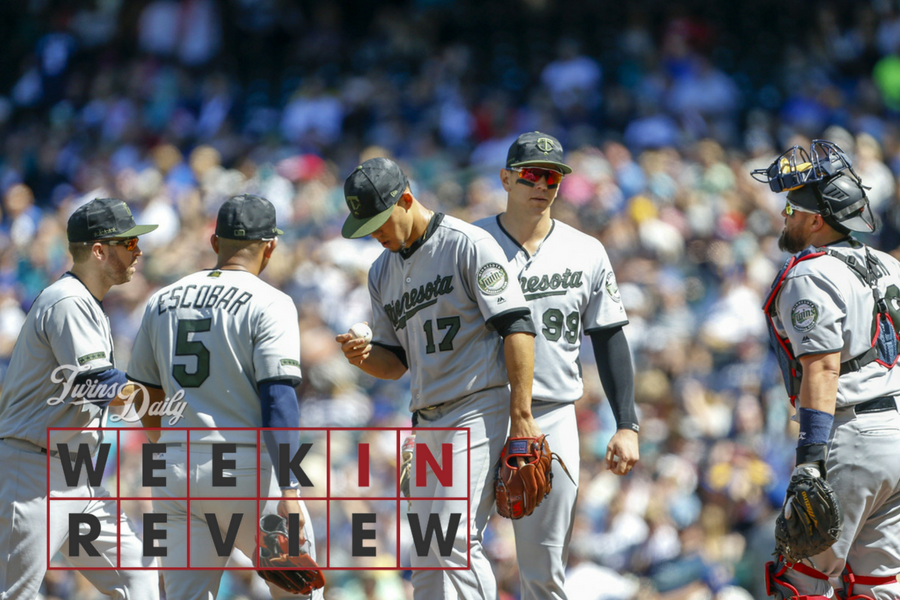 Weekly Snapshot: Mon, 5/21 through Sun, 5/27 *** Record Last Week: 2-4 Run Differential Last Week: +1 (Overall -20) Standings: 3rd place in AL Central (3.5 GB) HIGHLIGHTS AKA, the pitchers. The Twins pitching staff has done the seemingly impossible this year by not being a total liability. In fact, of late they have actually been pretty good. It seems they were sparked by the promotion of Fernando Romero, who has been lights-out over his first five starts. The Twins rotation put out five quality starts in the six games this week. Overall, the starters combined for a 2.68 ERA over 40 1/3 innings pitched with 34 strikeouts and just six walks. Jose Berrios has returned to form with two more excellent starts this week. On Monday against the Tigers, Berrios gave up just two runs over eight innings while striking out nine. He followed that up with another gem on Sunday, this time giving up two runs over 7 1/3 with eight strikeouts. On Tuesday night, Lance Lynn had his best start in a Twins uniform. He looked sharp all night and most importantly he looked like he finally had control of his pitches. Lynn’s control has been a lot better going back a few starts. So far in May, he is walking just 3.1 batters per nine innings, down from the 8.75 he averaged in April. As good as the rotation was this week, the bullpen was even better. Overall, they combined to give up just two runs across 12 innings, and they did it with 14 strikeouts and just one walk. Even though he gave up the walk-off home run to Mike Zunino on Saturday night, Matt Magill continues to impress. So far this year Magill has worked 14 1/3 innings and given up three runs and walked just one hitter. LOWLIGHTS AKA, the hitters. As great as Twins pitching was this week, the hitters were equally awful. They managed to score just 16 runs all week and just six over the current four-game losing streak. What made the Twins offense so great during the second half of last season was the constant production they were getting up and down the lineup. So far this year that hasn’t been the case. Brian Dozier hasn’t been anywhere near the All-Star level player that he was over the last few seasons. Miguel Sano finally returned to the lineup Friday night, but he hasn’t had all that special of a season when healthy as his OPS hovers around .700. What’s really killing this team is the bottom of the order has turned into an almost guaranteed 1-2-3. Ehire Adrianza is batting just .214 with basically no power, and a below average walk rate. Bobby Wilson, who has been getting quite a bit of playing time since the Jason Castro injury, is just 4-for-28. However, the biggest hole in the lineup has come from Byron Buxton. Entering play on Sunday, Buxton had a wRC+ of 4, which ranked 312th out of the 313 MLB hitters with at least 80 plate appearances this year. That was before another 0-for-3. TRENDING STORYLINES The big news of the week came Sunday afternoon when the Twins parted ways with Phil Hughes by trading him to the San Diego Padres. Minnesota also sent the 74th pick in next week's draft to the Padres in exchange for Janigson Villalobos and $7.25 million in relief off the Hughes contract. The timetable on the return of Ervin Santana seemed to get pushed back yet again. Santana’s velocity has been down, sitting mostly in the upper 80s. As a result, Santana will make his next start down in Fort Myers. Trevor May seems set to make his long awaited return to the Twins next week when he is eligible to come off the 60-Day DL. In what will likely by his last rehab start on Sunday, May worked just 2 2/3 and gave up seven earned runs. DOWN ON THE FARM Nick Gordon received his much-anticipated promotion to AAA Rochester this week, and it's well-deserved, as Gordon had been hitting the cover off the ball for Chattanooga this year. In his 181 plate appearances with the Lookouts, Gordon had a .333/.381/.525 slash line with five home runs. He was also 7 for 9 on stolen base attempts, and was striking out just 15% of the time. Twins top prospect Royce Lewis broke out of a mini slump on Sunday afternoon, belting two home runs in game one of Cedar Rapids' doubleheader. He also made this spectacular running grab Saturday night, showing off just how much range he has, and why many people believe he will make it as a center fielder if he can’t stay at short. https://twitter.com/MiLB/status/1000598815399993345 Brent Rooker also had a big week. Heading into play on Sunday, Rooker had a .400/.478/.950 slash line with three home runs and two doubles. LOOKING AHEAD The Twins will finish up their road trip with a three-game series in Kansas City starting on Monday. This will be just the first time the Twins get to face the Royals this year. They will then return home to take on the Cleveland Indians in a big four-game set. MONDAY, 5/28: TWINS @ ROYALS – RHP Lance Lynn v. RHP Jakob Junis TUESDAY, 5/29: TWINS @ ROYALS – RHP Kyle Gibson v. LHP Danny Duffy WEDNESDAY, 5/30: TWINS @ ROYALS – RHP Fernando Romero v. RHP Brad Keller THURSDAY, 5/31: INDIANS @ TWINS – RHP Carlos Carrasco v. RHP Jake Odorizzi FRIDAY, 6/1: INDIANS @ TWINS – RHP Trevor Bauer v. RHP Jose Berrios SATURDAY, 6/2: INDIANS @ TWINS – RHP Adam Plutko v. RHP Lance Lynn SUNDAY, 6/3: INDIANS @ TWINS – RHP Mike Clevinger v. RHP Kyle Gibson Catch Up On Twins Daily Game Recaps Game 43 | MIN 4, DET 2: It’s All Coming Up Rosie Game 44 | MIN 6, DET 0: Lynn Shows Will to Win Game 45 | DET 4, MIN 1: Niko’s Revenge Game 46 | SEA 2, MIN 1: Paxton Outduels Romero Game 47 | SEA 4, MIN 3: Zuni-Not Again Game 48 | SEA 3, MIN 1: Worst Birthday Ever
 -
2018 MLB Draft Top 50 Prospects: 11-20
Andrew Thares replied to Andrew Thares's topic in Twins Daily Front Page News
Really the only catcher I see going before the Twins pick at 20 is Georgia Tech catcher Joey Bart. After that there are three pretty good high school catchers that I have ranked between 32 and 39. The Twins should have their pick of the three if that's the way they want to go. -
We continue our countdown of the Top 50 Prospects in the 2018 MLB Draft by looking at the players ranked 11-20. During the last countdown we started seeing some more high school pitchers appearing and that trend will continue during this countdown. There are also a couple more college arms revealed in this list, which means that the Twins should have their pick of pitchers at pick number 20 if that is the route that they choose to go. Image courtesy of © Steven Branscombe-USA TODAY Sports We continue our countdown of the Top 50 Prospects in the 2018 MLB Draft by looking at the players ranked 11-20. During the last countdown we started seeing some more high school pitchers appearing and that trend will continue during this countdown. There are also a couple more college arms revealed in this list, which means that the Twins should have their pick of pitchers at pick number 20 if that is the route that they choose to go. 20. Cole Winn, Orange Lutheran (CA) Pos: RHP | Height: 6’2” | Weight: 195 | Age: 18 Commitment: Mississippi State Scouting Grades Fastball: 55 Curveball: 60 Slider: 50 Changeup: 50 Control: 55 Overall: 55 Cole Winn has vaulted himself into this group of high school pitching prospects with the very good spring that he has put together. His fastball is up to the mid-90s and he is now throwing both a slider and curveball. Of the two his 12-6 curveball is the better pitch and could be a wipeout pitch for Winn down the road. For a high school pitcher, Winn’s mechanics are about as clean as it gets. Winn has an over-the-top delivery that is very easy for him to repeat. This is what has helped Winn be so consistent, even after making the move from Colorado to California to face better competition. Winn doesn’t have as much upside as some of the other high school pitchers around this slot, however, with the track record of high profile high school pitchers not panning out, it might not be a bad idea to hedge your bet on a kid who has shown much more of an ability to pitch and not just throw at a young age. 19. Ryan Weathers, Loretto (TN) Pos: LHP | Height: 6’2” | Weight: 210 | Age: 18 Commitment: Vanderbilt Scouting Grades Fastball: 55 Curveball: 60 Changeup: 55 Control: 55 Overall: 55 Much like Cole Winn, Ryan Weathers is a high school pitcher who classifies into the high floor segment (at least as far as high school pitchers go). Weathers features a solid three-pitch mix and has excellent command of all three pitches. This bodes well for his chances at become a starter that the major league level. While Weathers doesn’t have an electric fastball that touches the mid to upper 90s, he is still an excellent athlete. Weathers is the son of former MLB reliever David Weathers, and was named the Tennessee State Basketball Tournament MVP after leading the Loretto High School boys basketball team to its first ever state championship. Weathers best pitch is his curveball which has a sharp downward action and is a pitch that Weathers can throw for a strike when he needs to. Even though he doesn’t possess an electric high velocity fastball, the combination of movement and control gives the pitch a plus grading. Weathers also mixes in a plus changeup that gives him a strong three-pitch mix. 18. Mason Denaburg, Merritt Island (FL) Pos: RHP | Height: 6’3” | Weight: 190 | Age: 18 Commitment: Florida Scouting Grades Fastball: 65 Curveball: 55 Changeup: 45 Control: 50 Overall: 55 Next on the list of high school pitchers is Mason Denaburg. Much like Ryan Weathers, Denaburg is a tremendous all-around athlete. He has excelled as both an outfielder and a pitcher up to this point and if he were to choose to go college he would have the opportunity to continue to do both. Pitching for the USA Baseball U18 National Team last summer, Denaburg’s fastball would touch as high as 97 mph coming out of the pen. As a starter, his fastball will sit more in the 94-96 range with tremendous late life that makes it a swing and miss pitch. Denaburg also pairs that with a plus curveball that has impressed scouts throughout the spring. As with any of these guys taken in the first-round, Denaburg will be given every opportunity to make it as a starter, but if he fails Denaburg could be well set up to make it as a reliever with his strong fastball-curveball combo. 17. Ethan Hankins, Forsyth Central (GA) Pos: RHP | Height: 6’6” | Weight: 200 | Age: 18 Commitment: Vanderbilt Scouting Grades Fastball: 70 Curveball: 50 Slider: 50 Changeup: 55 Control: 55 Overall: 55 Before suffering a shoulder injury earlier this spring, there was almost no question that Ethan Hankins’ fastball was the best pitch in the entire draft class. Its combination of upper-90s velocity with movement that Hankins had a lot of control of gave it a good running at receiving as high of a grade as Hunter Greene’s fastball did before last year’s draft. Unfortunately for Hankins, his fastball hasn’t quite been the same since he returned from his injury. This has caused Hankins to slip in the rankings after originally being thought of as the top high school arm in the draft and as a possibility to go number one overall. Hankins’ secondary offerings show signs of potential, but he still has a lot of work to do to become more consistent with those pitches. One thing that really impresses me with Hankins is the way he works on the mound. He is a pitcher who works very quickly and is constantly changing up his motion. This really messes with the timing of opposing hitters and it makes it difficult for them to get comfortable in the box. 16. Jackson Kowar, Florida Pos: RHP | Height: 6’5” | Weight: 180 | Age: 21 Previously Drafted: 40st Round, 2015 (DET) Scouting Grades Fastball: 60 Curveball: 50 Changeup: 65 Control: 50 Overall: 55 Jackson Kowar has been linked to the Minnesota Twins in multiple mock drafts of late. Kowar is yet another pitcher to come out of the University of Florida which has produced pitching talent hand over fist the last few years. Kowar will rely heavily on his fastball and changeup as his curveball can be inconsistent at times. His fastball will sit around 93-95 but he can pump it up to 97 when he needs it. Kowar’s changeup is easily his best pitch. He has the uncanny ability to throw it to both righties and lefties and will produce a lot of swing and miss with the pitch. Even though Kowar is a college pitcher, at 6’5” and 180 Kowar still has some projectability left in his frame. Kowar also has the type of delivery that scouts are looking for as it is very repeatable and doesn’t require a lot of effort. 15. Brice Turang, Santiago (CA) Pos: SS | B/T: L/R | Height: 6’1” | Weight: 165 | Age: 18 Commitment: LSU Scouting Grades Hit: 60 Power: 40 Run: 60 Arm: 55 Field: 60 Overall: 55 Brice Turang is the top shortstop available in a class that is very thin at the position. With that being the case, I wouldn’t be surprised if he goes a little earlier than some people expect as shortstop is a position that many teams like to stockpile in their farm systems. For a shortstop, Turang is an excellent hitter. He has a pure and quick swing that gives him the ability to pepper the ball to all parts of the field. He will never have much power but could be someone that develops into a 10-15 homer guy as he matures. Defensively, Turang is a safe bet to remain at short as he possesses both the range and arm desired for a guy to make it at the position. Turang is also refined mechanically at short, which is what separates him from some of the other high school shortstops in the class. 14. Kumar Rocker, North Oconee (GA) Pos: RHP | Height: 6’5” | Weight: 250 | Age: 18 Commitment: Vanderbilt Scouting Grades Fastball: 70 Slider: 60 Changeup: 50 Control: 50 Overall: 55 When it comes to raw stuff, Kumar Rocker is right there near the top of the list in this year’s draft. Rocker has a fastball that will sit in the 94-96 mph range and can pump up even higher when he needs it. Rocker also features a sharp breaking ball and an upper 80’s changeup. Rocker generates his power from his big lower frame. Rocker also comes from good athletic bloodlines as his father Tracy Rocker was a defensive lineman in the NFL and won the prestigious Lombardi award during his college career at Auburn. With Rocker’s combination of size and athleticism, it doesn’t take much in the way of effort for him when he pitches. However, the knock on Rocker is the question on his ability to develop into a pitcher as he begins facing more talent closer to his level. It is also hard to see continued development on his stuff as he has already filled out his body pretty well. 13. Ryan Rolison, Ole Miss Pos: LHP | Height: 6’2” | Weight: 195 | Age: 20 Previously Drafted: 37st Round, 2016 (SD) Scouting Grades Fastball: 55 Curveball: 55 Changeup: 50 Control: 50 Overall: 55 Compared to some of the other pitchers in the draft class, Ryan Rolison isn’t a guy who will exactly jump out at you. His will typically throw his fastball between 90-92 mph, though he still gets some swing and miss with it. Rolison’s best pitch is probably his curveball, which has potential to be a plus pitch for him. Rolison also has an average changeup, which gives him a complete three pitch mix. Rolison has had some success pitching against some of the best competition that college baseball has to offer in both the SEC and Cape Cod League. Despite being not being known as much of a stuff guy, Rolison has still had success striking out opposing hitters to the tune of 10.6 K/9 this spring. Rolison benefits from creating some deception on his pitches. As a lefty, Rolison will stand on the first base side of the rubber and has a cross-stepping delivery that allows him to release the ball from an angle that hitters aren’t used to. 12. Jarred Kelenic, Waukesha West (WI) Pos: OF | B/T: L/L | Height: 6’1” | Weight: 196 | Age: 18 Committed: Louisville Scouting Grades Hit: 60 Power: 50 Run: 55 Arm: 60 Field: 55 Overall: 55 Jarred Kelenic has grabbed some headlines for having the potential for being the first ever high school player drafted in the Top 10 out of the state of Wisconsin. There have been some varying opinions about Kelenic’s ability to stick as a top prospect as the track record for Wisconsin born players is bleak. Despite this, Kelenic has done an excellent job proving himself on the national level playing well for the USA Baseball 18U National Team. Kelenic has built himself a bit of a reputation for his incredible work ethic and raw passion for the game. It is foreseeable that Kelenic could add more power to his game and if he does he could be a true five-tool player. There is some debate over whether Kelenic has the range to stick in center or if he will need to move to a corner outfield position. Kelenic does have good speed but not quite the burning speed you see out of most MLB centerfielders. However, Kelenic does have great instincts in the outfield, so that could help make up for what he lacks in speed. 11. Travis Swaggerty, South Alabama Pos: OF | B/T: L/L | Height: 5’11” | Weight: 180 | Age: 20 Previously Drafted: Never Scouting Grades Hit: 55 Power: 50 Run: 60 Arm: 55 Field: 60 Overall: 55 Travis Swaggerty burst onto the scene last year after having a big sophomore campaign at South Alabama. He then followed it up during the summer as the center fielder on the Team USA Collegiate National Team where he had a slash line of .328/.449/.406 with six stolen bases over 19 games. There isn’t a lot of doubt about Swaggerty’s ability to stay at center field at the next level. He is a plus runner and an excellent defender, with an above-average arm for a center fielder. At the plate, Swaggerty brings a patient approach, walking more than 17 percent of the time in his college career. That along with his speed and ability to hit for average could make him an ideal leadoff hitter at the next level. Swaggerty also has a little bit of pop in his bat, hitting double-digit home runs in each of his last two seasons at South Alabama. Previous Rankings 2018 MLB Draft Top 50 Prospects: 21-30 2018 MLB Draft Top 50 Prospect: 31-40 2018 MLB Draft Top 50 Prospects: 41-50 View full article
-
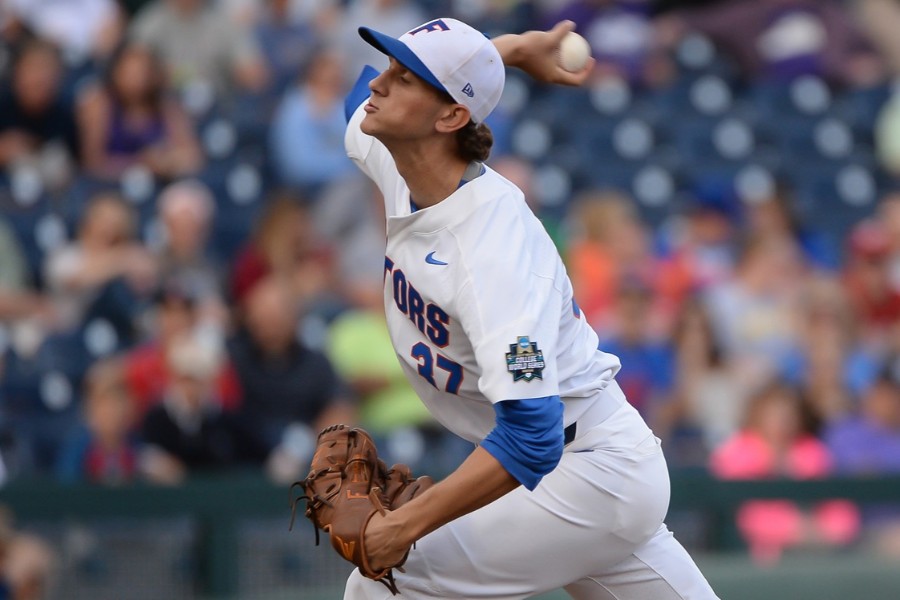 20. Cole Winn, Orange Lutheran (CA) Pos: RHP | Height: 6’2” | Weight: 195 | Age: 18 Commitment: Mississippi State Scouting Grades Fastball: 55 Curveball: 60 Slider: 50 Changeup: 50 Control: 55 Overall: 55 Cole Winn has vaulted himself into this group of high school pitching prospects with the very good spring that he has put together. His fastball is up to the mid-90s and he is now throwing both a slider and curveball. Of the two his 12-6 curveball is the better pitch and could be a wipeout pitch for Winn down the road. For a high school pitcher, Winn’s mechanics are about as clean as it gets. Winn has an over-the-top delivery that is very easy for him to repeat. This is what has helped Winn be so consistent, even after making the move from Colorado to California to face better competition. Winn doesn’t have as much upside as some of the other high school pitchers around this slot, however, with the track record of high profile high school pitchers not panning out, it might not be a bad idea to hedge your bet on a kid who has shown much more of an ability to pitch and not just throw at a young age. 19. Ryan Weathers, Loretto (TN) Pos: LHP | Height: 6’2” | Weight: 210 | Age: 18 Commitment: Vanderbilt Scouting Grades Fastball: 55 Curveball: 60 Changeup: 55 Control: 55 Overall: 55 Much like Cole Winn, Ryan Weathers is a high school pitcher who classifies into the high floor segment (at least as far as high school pitchers go). Weathers features a solid three-pitch mix and has excellent command of all three pitches. This bodes well for his chances at become a starter that the major league level. While Weathers doesn’t have an electric fastball that touches the mid to upper 90s, he is still an excellent athlete. Weathers is the son of former MLB reliever David Weathers, and was named the Tennessee State Basketball Tournament MVP after leading the Loretto High School boys basketball team to its first ever state championship. Weathers best pitch is his curveball which has a sharp downward action and is a pitch that Weathers can throw for a strike when he needs to. Even though he doesn’t possess an electric high velocity fastball, the combination of movement and control gives the pitch a plus grading. Weathers also mixes in a plus changeup that gives him a strong three-pitch mix. 18. Mason Denaburg, Merritt Island (FL) Pos: RHP | Height: 6’3” | Weight: 190 | Age: 18 Commitment: Florida Scouting Grades Fastball: 65 Curveball: 55 Changeup: 45 Control: 50 Overall: 55 Next on the list of high school pitchers is Mason Denaburg. Much like Ryan Weathers, Denaburg is a tremendous all-around athlete. He has excelled as both an outfielder and a pitcher up to this point and if he were to choose to go college he would have the opportunity to continue to do both. Pitching for the USA Baseball U18 National Team last summer, Denaburg’s fastball would touch as high as 97 mph coming out of the pen. As a starter, his fastball will sit more in the 94-96 range with tremendous late life that makes it a swing and miss pitch. Denaburg also pairs that with a plus curveball that has impressed scouts throughout the spring. As with any of these guys taken in the first-round, Denaburg will be given every opportunity to make it as a starter, but if he fails Denaburg could be well set up to make it as a reliever with his strong fastball-curveball combo. 17. Ethan Hankins, Forsyth Central (GA) Pos: RHP | Height: 6’6” | Weight: 200 | Age: 18 Commitment: Vanderbilt Scouting Grades Fastball: 70 Curveball: 50 Slider: 50 Changeup: 55 Control: 55 Overall: 55 Before suffering a shoulder injury earlier this spring, there was almost no question that Ethan Hankins’ fastball was the best pitch in the entire draft class. Its combination of upper-90s velocity with movement that Hankins had a lot of control of gave it a good running at receiving as high of a grade as Hunter Greene’s fastball did before last year’s draft. Unfortunately for Hankins, his fastball hasn’t quite been the same since he returned from his injury. This has caused Hankins to slip in the rankings after originally being thought of as the top high school arm in the draft and as a possibility to go number one overall. Hankins’ secondary offerings show signs of potential, but he still has a lot of work to do to become more consistent with those pitches. One thing that really impresses me with Hankins is the way he works on the mound. He is a pitcher who works very quickly and is constantly changing up his motion. This really messes with the timing of opposing hitters and it makes it difficult for them to get comfortable in the box. 16. Jackson Kowar, Florida Pos: RHP | Height: 6’5” | Weight: 180 | Age: 21 Previously Drafted: 40st Round, 2015 (DET) Scouting Grades Fastball: 60 Curveball: 50 Changeup: 65 Control: 50 Overall: 55 Jackson Kowar has been linked to the Minnesota Twins in multiple mock drafts of late. Kowar is yet another pitcher to come out of the University of Florida which has produced pitching talent hand over fist the last few years. Kowar will rely heavily on his fastball and changeup as his curveball can be inconsistent at times. His fastball will sit around 93-95 but he can pump it up to 97 when he needs it. Kowar’s changeup is easily his best pitch. He has the uncanny ability to throw it to both righties and lefties and will produce a lot of swing and miss with the pitch. Even though Kowar is a college pitcher, at 6’5” and 180 Kowar still has some projectability left in his frame. Kowar also has the type of delivery that scouts are looking for as it is very repeatable and doesn’t require a lot of effort. 15. Brice Turang, Santiago (CA) Pos: SS | B/T: L/R | Height: 6’1” | Weight: 165 | Age: 18 Commitment: LSU Scouting Grades Hit: 60 Power: 40 Run: 60 Arm: 55 Field: 60 Overall: 55 Brice Turang is the top shortstop available in a class that is very thin at the position. With that being the case, I wouldn’t be surprised if he goes a little earlier than some people expect as shortstop is a position that many teams like to stockpile in their farm systems. For a shortstop, Turang is an excellent hitter. He has a pure and quick swing that gives him the ability to pepper the ball to all parts of the field. He will never have much power but could be someone that develops into a 10-15 homer guy as he matures. Defensively, Turang is a safe bet to remain at short as he possesses both the range and arm desired for a guy to make it at the position. Turang is also refined mechanically at short, which is what separates him from some of the other high school shortstops in the class. 14. Kumar Rocker, North Oconee (GA) Pos: RHP | Height: 6’5” | Weight: 250 | Age: 18 Commitment: Vanderbilt Scouting Grades Fastball: 70 Slider: 60 Changeup: 50 Control: 50 Overall: 55 When it comes to raw stuff, Kumar Rocker is right there near the top of the list in this year’s draft. Rocker has a fastball that will sit in the 94-96 mph range and can pump up even higher when he needs it. Rocker also features a sharp breaking ball and an upper 80’s changeup. Rocker generates his power from his big lower frame. Rocker also comes from good athletic bloodlines as his father Tracy Rocker was a defensive lineman in the NFL and won the prestigious Lombardi award during his college career at Auburn. With Rocker’s combination of size and athleticism, it doesn’t take much in the way of effort for him when he pitches. However, the knock on Rocker is the question on his ability to develop into a pitcher as he begins facing more talent closer to his level. It is also hard to see continued development on his stuff as he has already filled out his body pretty well. 13. Ryan Rolison, Ole Miss Pos: LHP | Height: 6’2” | Weight: 195 | Age: 20 Previously Drafted: 37st Round, 2016 (SD) Scouting Grades Fastball: 55 Curveball: 55 Changeup: 50 Control: 50 Overall: 55 Compared to some of the other pitchers in the draft class, Ryan Rolison isn’t a guy who will exactly jump out at you. His will typically throw his fastball between 90-92 mph, though he still gets some swing and miss with it. Rolison’s best pitch is probably his curveball, which has potential to be a plus pitch for him. Rolison also has an average changeup, which gives him a complete three pitch mix. Rolison has had some success pitching against some of the best competition that college baseball has to offer in both the SEC and Cape Cod League. Despite being not being known as much of a stuff guy, Rolison has still had success striking out opposing hitters to the tune of 10.6 K/9 this spring. Rolison benefits from creating some deception on his pitches. As a lefty, Rolison will stand on the first base side of the rubber and has a cross-stepping delivery that allows him to release the ball from an angle that hitters aren’t used to. 12. Jarred Kelenic, Waukesha West (WI) Pos: OF | B/T: L/L | Height: 6’1” | Weight: 196 | Age: 18 Committed: Louisville Scouting Grades Hit: 60 Power: 50 Run: 55 Arm: 60 Field: 55 Overall: 55 Jarred Kelenic has grabbed some headlines for having the potential for being the first ever high school player drafted in the Top 10 out of the state of Wisconsin. There have been some varying opinions about Kelenic’s ability to stick as a top prospect as the track record for Wisconsin born players is bleak. Despite this, Kelenic has done an excellent job proving himself on the national level playing well for the USA Baseball 18U National Team. Kelenic has built himself a bit of a reputation for his incredible work ethic and raw passion for the game. It is foreseeable that Kelenic could add more power to his game and if he does he could be a true five-tool player. There is some debate over whether Kelenic has the range to stick in center or if he will need to move to a corner outfield position. Kelenic does have good speed but not quite the burning speed you see out of most MLB centerfielders. However, Kelenic does have great instincts in the outfield, so that could help make up for what he lacks in speed. 11. Travis Swaggerty, South Alabama Pos: OF | B/T: L/L | Height: 5’11” | Weight: 180 | Age: 20 Previously Drafted: Never Scouting Grades Hit: 55 Power: 50 Run: 60 Arm: 55 Field: 60 Overall: 55 Travis Swaggerty burst onto the scene last year after having a big sophomore campaign at South Alabama. He then followed it up during the summer as the center fielder on the Team USA Collegiate National Team where he had a slash line of .328/.449/.406 with six stolen bases over 19 games. There isn’t a lot of doubt about Swaggerty’s ability to stay at center field at the next level. He is a plus runner and an excellent defender, with an above-average arm for a center fielder. At the plate, Swaggerty brings a patient approach, walking more than 17 percent of the time in his college career. That along with his speed and ability to hit for average could make him an ideal leadoff hitter at the next level. Swaggerty also has a little bit of pop in his bat, hitting double-digit home runs in each of his last two seasons at South Alabama. Previous Rankings 2018 MLB Draft Top 50 Prospects: 21-30 2018 MLB Draft Top 50 Prospect: 31-40 2018 MLB Draft Top 50 Prospects: 41-50
 -
As we move forward in the rankings, we are starting to enter the prime territory of prospects that the Twins will have to choose from when they make their first selection at pick 20. The Twins will have a wide variety of players to choose from with this pick and where they decide to go will most likely impact how the rest of their draft goes as well. As we move forward in the rankings, we are starting to enter the prime territory of prospects that the Twins will have to choose from when they make their first selection at pick 20. The Twins will have a wide variety of players to choose from with this pick and where they decide to go will most likely impact how the rest of their draft goes as well. 30. Greyson Jenista, Wichita State Pos: 1B/OF | B/T: L/R | Height: 6’4” | Weight: 220 | Age: 21 Previously Drafted: Never Scouting Grades Hit: 50 Power: 55 Run: 55 Arm: 55 Field: 50 Overall: 50 For Greyson Jenista, where he might go in the draft will depend greatly on MLB teams thinking he has what it takes to make it as an outfielder. While Greyson’s bat is big enough to be worthy of an early round selection as a first baseman, he will bring a lot more value to a team if he can man a corner outfield position. Jenista has spent most of his college career at first, though he did get some playing time in center field last summer on his way to winning the Cape Cod League MVP. He has played a little bit of outfield for Wichita State again this year but has mostly gone back to playing first later in the season. Despite Jenista’s big frame, he has always been more of a high contact and on-base guy than a pure power hitter. In his three seasons at Wichita he has a career .320 batting average with a .433 on-base percentage, but he has only managed to hit 23 home runs. A far cry from the 50 fellow first base and corner outfield college slugger Seth Beer has hit. 29. Steele Walker, Oklahoma Pos: OF | B/T: L/L | Height: 5’11” | Weight: 190 | Age: 21 Previously Drafted: Never Scouting Grades Hit: 55 Power: 50 Run: 50 Arm: 45 Field: 50 Overall: 50 As yet another corner outfield prospect, what attracts scouts to Steele Walker is his overall production with the bat. Walker’s .364/.455/.631 slash line to go along with 13 home runs this season really jumps off the page. In 2016, Walker led the Northwoods League with a .406 batting average, which was nearly 50 points higher than the next closest hitter. Walker also had a little bit of power to go along with that, belting seven home runs and finishing fourth in the league with a .557 slugging percentage. Walker will most likely find his home in left field as he has neither the range for center nor the arm for right, but he should be a safe pick for whichever team picks him. 28. Nander De Sedas, Montverde (FL) Pos: SS | B/T: S/R | Height: 6’1” | Weight: 190 | Age: 18 Commitment: Florida State Scouting Grades Hit: 50 Power: 50 Run: 40 Arm: 60 Field: 50 Overall: 50 Nander De Sedas grew up playing baseball in Panama and had the opportunity to sign with an MLB team a couple of years ago as an international free agent when he reached the age of 16. Instead, De Sedas decided to move to the United States and enroll in Florida’s prestigious Montverde Academy. Now at 18, De Sedas is eligible to be taken in the MLB First-Year Player Draft. The biggest question for many teams is does De Sadas’ have the ability to stay at short? De Sedas is a very refined shortstop mechanically and has a big enough arm to play the position as well. However, some doubt that he will have the range to stay at short. De Sedas did run a respectable 6.67 yard-dash at the Perfect Game National Showcase last summer, but the question for De Sedas remains his ability to accelerate. If he can’t stay at short, De Sedas has the makings of an elite defensive third baseman. De Sedas has been working to improve as a switch hitter, but it remains pretty evident that his swing is much better from the right side of the plate than the left. While De Sedas has a quick and compact stroke as a righty, his swing from the left side can be slow and loopy. De Sedas will need continued work on that if he wishes to become a switch hitter long term. 27. Mike Vasil, Boston College HS (MA) Pos: RHP | Height: 6’4” | Weight: 210 | Age: 18 Commitment: Virginia Scouting Grades Fastball: 60 Curveball: 55 Changeup: 50 Control: 45 Overall: 50 Mike Vasil has all the makings of being this year’s Sam Carlson. As you recall, Carlson was a highly touted pitching prospect out of Burnsville, Minnesota last year, but fell to the 55th overall pick in the second-round. The same story might be true for Vasil this year. Vasil has all the makings of a top-tier pitching prospect. He has a projectable 6’4” frame and the potential to have three or four plus pitches down the road. The problem with Vasil, however, is since he comes from the Northeast, scouts haven’t had as many opportunities to see him. Additionally, Vasil suffered an injury early in the spring making it even harder for teams to get a good feel for him. There is no question that Vasil has the talent to be a first-round selection, but with the increased pressure on MLB teams getting their first-round pick correct, they might shy away from taking Vasil. I wouldn’t be surprised if he ends up going during the compensation or competitive balance rounds, or early in the second round to a team with a large bonus pool. 26. Grayson Rodriguez, Central Heights (TX) Pos: RHP | Height: 6’5” | Weight: 230 | Age: 18 Commitment: Texas A&M Scouting Grades Fastball: 65 Curveball: 50 Slider: 55 Changeup: 50 Control: 50 Overall: 50 We are starting to reach that range where all the big-bodied, right-handed high school pitching prospects with a big fastball reside, but teams don’t quite know what to make of it all. I know that seems like a very specific type of player but believe me there is usually a good handful of those players in every draft and this year’s class might be loaded more than ever. This spring, Rodriguez’s fastball velocity has been sitting in the mid to upper 90s, which is nearly a five mile per hour jump from last summer. This has caused him to shoot up many teams’ draft boards. Right now, his slider is considered to be his best secondary offering, but I believe that his sharp breaking 12-6 curveball will have more potential once he gains better control of it. Rodriguez has a unique delivery in that he has an exaggerated pause right before he lands with his front foot. As he gets more comfortable with his delivery I could see Rodriguez occasionally speeding up this part of his delivery to mess with the timing of opposing hitters. 25. Triston Casas, American Heritage (FL) Pos: 1B/3B | B/T: L/R | Height: 6’4” | Weight: 238 | Age: 18 Commitment: Miami (FL) Scouting Grades Hit: 45 Power: 55 Run: 40 Arm: 50 Field: 50 Overall: 50 It is hard to find many high school prospects who have as much raw power potential as Triston Casas has. Unlike Mike Vasil, Casas is a high school player that scouts are very familiar with. Casas has played on the Team USA U-18 National Team in each of the last two seasons and won the MVP of the U-18 World Cup in 2017. Casas does an excellent job of using his big 6’4” 238-pound frame to generate enormous amounts of power. Even with all that size, Casas has a lot of flexibility, which allows him to generate a lot of torque as he drives his hips trough the swing. Casas plays third now, but it is hard to imagine him being able to stick there long term. If teams see Casas becoming a first baseman it could drop his stock quite a bit. I would look for a team to take a shot at him late in the first round, but I wouldn’t be surprised if he slips due to defensive positioning concerns. 24. Jeremy Eierman, Missouri State Pos: SS | B/T: R/R | Height: 6’1” | Weight: 195 | Age: 21 Previously Drafted: Never Scouting Grades Hit: 45 Power: 55 Run: 55 Arm: 65 Field: 50 Overall: 50 It’s hard to imagine that there is a more toolsy college player in this year’s draft than Jeremy Eierman. As a shortstop, Eierman has a power profile that is rarely seen out of the position. In his not quite three-year college career Eierman has belted 41 home runs, including 23 in 2017. Eierman is also has plus speed that he uses very well on the base paths. In his career Eierman is 43 for 48 on stolen base attempts, which approaches Byron Buxton territory, who is 46 for 51 in his MLB career. Eierman also has a cannon of an arm over at short and is one of the biggest arms by an infielder in the draft class. Where the concern for Eierman comes in is his track record of struggling with a wood bat. In two seasons playing in the Cape Cod League, Eierman had a combined .535 OPS, and last summer on the USA Collegiate National Team he had .407 OPS over the span of 18 games. 23. Trevor Larnach, Oregon State Pos: OF | B/T: L/R | Height: 6’4” | Weight: 205 | Age: 21 Previously Drafted: 40th Round, 2015 (SD) Scouting Grades Hit: 55 Power: 50 Run: 40 Arm: 55 Field: 50 Overall: 50 Oregon State has had one of the most successful baseball programs over the last couple of years, and a big part of that has been on the bat of outfielder Trevor Larnach. Much like Virginia outfielder Adam Haseley did in last year’s draft, Larnach has shot up the draft boards upon seeing big improvements in his production in each of his three years in college. Larnach’s best tool going away is his bat. He has shown the ability to hit for average and get on base in the past, but this spring Larnach has finally shown the ability to hit for power that his body has suggested he has. So far this season, Larnach has belted 17 home runs after hitting just three combined in his first two seasons at Oregon State. In the outfield, Larnach projects as a right fielder. He isn’t the greatest athlete in the world and will most likely never best a plus defensive outfielder, but he does have a big arm that should allow him to make it as a right fielder. 22. Logan Gilbert, Stetson Pos: RHP | Height: 6’5” | Weight: 195 | Age: 21 Previously Drafted: Never Scouting Grades Fastball: 55 Slider: 55 Curveball: 50 Changeup: 55 Control: 50 Overall: 50 Among the players who could be available when the Twins make their first-round selection at 20, Logan Gilbert might be one of the safer bets that they have to choose from. Gilbert features a good mix of pitches that is headlined by his fastball, which was regularly sitting in the mid-90s last summer. Through his delivery, Gilbert does an excellent job of incorporating his lower half to gain momentum. In his leg kick he brings his foot back and drives forward with his hips, keeping his plant leg back as long as he can before driving it forward to supply extra power. His overall mechanics look relatively clean and he doesn’t have a lot of troubles repeating his delivery. While Stetson isn’t the big-name school you look for to produce major league talent, it has actually become a bit of a hot bed for starting pitching talent of late, as both Corey Kluber and Jacob deGrom played their college ball there. Gilbert also excelled in his experience facing the best college hitters in the country in the Cape Cod League last summer. Across eight starts Gilbert had a 1.93 ERA across 37 1/3 innings, to go along with 39 strikeouts and just six walks. 21. Connor Scott, Plant HS (FL) Pos: OF | B/T: L/L | Height: 6’4” | Weight: 180 | Age: 18 Commitment: Florida Scouting Grades Hit: 55 Power: 40 Run: 70 Arm: 60 Field: 50 Overall: 55 Connor Scott has all the makings of becoming a five-tool player as he matures. He already possesses a quality bat and has both an elite arm and speed in the outfield. At 6’4”, Scott also has the frame to become a solid power hitter as well. While Scott does have all these abilities, there is just something that doesn’t look quite natural with Scott. He has a bit of an unorthodox looking swing and isn’t a fluid runner. However, Scott is still a good hitter and an excellent runner. I would expect that coaches at the professional level will work with him as he progresses to get the most out of his abilities. If all doesn’t work out, Scott does have the ability to become a pitcher at the next level as well. His upside on the mound isn’t near that of what it is in the outfield, but Scott does have a low-to-mid 90s fastball with a decent breaking pitch to boot. View full article
-
 30. Greyson Jenista, Wichita State Pos: 1B/OF | B/T: L/R | Height: 6’4” | Weight: 220 | Age: 21 Previously Drafted: Never Scouting Grades Hit: 50 Power: 55 Run: 55 Arm: 55 Field: 50 Overall: 50 For Greyson Jenista, where he might go in the draft will depend greatly on MLB teams thinking he has what it takes to make it as an outfielder. While Greyson’s bat is big enough to be worthy of an early round selection as a first baseman, he will bring a lot more value to a team if he can man a corner outfield position. Jenista has spent most of his college career at first, though he did get some playing time in center field last summer on his way to winning the Cape Cod League MVP. He has played a little bit of outfield for Wichita State again this year but has mostly gone back to playing first later in the season. Despite Jenista’s big frame, he has always been more of a high contact and on-base guy than a pure power hitter. In his three seasons at Wichita he has a career .320 batting average with a .433 on-base percentage, but he has only managed to hit 23 home runs. A far cry from the 50 fellow first base and corner outfield college slugger Seth Beer has hit. 29. Steele Walker, Oklahoma Pos: OF | B/T: L/L | Height: 5’11” | Weight: 190 | Age: 21 Previously Drafted: Never Scouting Grades Hit: 55 Power: 50 Run: 50 Arm: 45 Field: 50 Overall: 50 As yet another corner outfield prospect, what attracts scouts to Steele Walker is his overall production with the bat. Walker’s .364/.455/.631 slash line to go along with 13 home runs this season really jumps off the page. In 2016, Walker led the Northwoods League with a .406 batting average, which was nearly 50 points higher than the next closest hitter. Walker also had a little bit of power to go along with that, belting seven home runs and finishing fourth in the league with a .557 slugging percentage. Walker will most likely find his home in left field as he has neither the range for center nor the arm for right, but he should be a safe pick for whichever team picks him. 28. Nander De Sedas, Montverde (FL) Pos: SS | B/T: S/R | Height: 6’1” | Weight: 190 | Age: 18 Commitment: Florida State Scouting Grades Hit: 50 Power: 50 Run: 40 Arm: 60 Field: 50 Overall: 50 Nander De Sedas grew up playing baseball in Panama and had the opportunity to sign with an MLB team a couple of years ago as an international free agent when he reached the age of 16. Instead, De Sedas decided to move to the United States and enroll in Florida’s prestigious Montverde Academy. Now at 18, De Sedas is eligible to be taken in the MLB First-Year Player Draft. The biggest question for many teams is does De Sadas’ have the ability to stay at short? De Sedas is a very refined shortstop mechanically and has a big enough arm to play the position as well. However, some doubt that he will have the range to stay at short. De Sedas did run a respectable 6.67 yard-dash at the Perfect Game National Showcase last summer, but the question for De Sedas remains his ability to accelerate. If he can’t stay at short, De Sedas has the makings of an elite defensive third baseman. De Sedas has been working to improve as a switch hitter, but it remains pretty evident that his swing is much better from the right side of the plate than the left. While De Sedas has a quick and compact stroke as a righty, his swing from the left side can be slow and loopy. De Sedas will need continued work on that if he wishes to become a switch hitter long term. 27. Mike Vasil, Boston College HS (MA) Pos: RHP | Height: 6’4” | Weight: 210 | Age: 18 Commitment: Virginia Scouting Grades Fastball: 60 Curveball: 55 Changeup: 50 Control: 45 Overall: 50 Mike Vasil has all the makings of being this year’s Sam Carlson. As you recall, Carlson was a highly touted pitching prospect out of Burnsville, Minnesota last year, but fell to the 55th overall pick in the second-round. The same story might be true for Vasil this year. Vasil has all the makings of a top-tier pitching prospect. He has a projectable 6’4” frame and the potential to have three or four plus pitches down the road. The problem with Vasil, however, is since he comes from the Northeast, scouts haven’t had as many opportunities to see him. Additionally, Vasil suffered an injury early in the spring making it even harder for teams to get a good feel for him. There is no question that Vasil has the talent to be a first-round selection, but with the increased pressure on MLB teams getting their first-round pick correct, they might shy away from taking Vasil. I wouldn’t be surprised if he ends up going during the compensation or competitive balance rounds, or early in the second round to a team with a large bonus pool. 26. Grayson Rodriguez, Central Heights (TX) Pos: RHP | Height: 6’5” | Weight: 230 | Age: 18 Commitment: Texas A&M Scouting Grades Fastball: 65 Curveball: 50 Slider: 55 Changeup: 50 Control: 50 Overall: 50 We are starting to reach that range where all the big-bodied, right-handed high school pitching prospects with a big fastball reside, but teams don’t quite know what to make of it all. I know that seems like a very specific type of player but believe me there is usually a good handful of those players in every draft and this year’s class might be loaded more than ever. This spring, Rodriguez’s fastball velocity has been sitting in the mid to upper 90s, which is nearly a five mile per hour jump from last summer. This has caused him to shoot up many teams’ draft boards. Right now, his slider is considered to be his best secondary offering, but I believe that his sharp breaking 12-6 curveball will have more potential once he gains better control of it. Rodriguez has a unique delivery in that he has an exaggerated pause right before he lands with his front foot. As he gets more comfortable with his delivery I could see Rodriguez occasionally speeding up this part of his delivery to mess with the timing of opposing hitters. 25. Triston Casas, American Heritage (FL) Pos: 1B/3B | B/T: L/R | Height: 6’4” | Weight: 238 | Age: 18 Commitment: Miami (FL) Scouting Grades Hit: 45 Power: 55 Run: 40 Arm: 50 Field: 50 Overall: 50 It is hard to find many high school prospects who have as much raw power potential as Triston Casas has. Unlike Mike Vasil, Casas is a high school player that scouts are very familiar with. Casas has played on the Team USA U-18 National Team in each of the last two seasons and won the MVP of the U-18 World Cup in 2017. Casas does an excellent job of using his big 6’4” 238-pound frame to generate enormous amounts of power. Even with all that size, Casas has a lot of flexibility, which allows him to generate a lot of torque as he drives his hips trough the swing. Casas plays third now, but it is hard to imagine him being able to stick there long term. If teams see Casas becoming a first baseman it could drop his stock quite a bit. I would look for a team to take a shot at him late in the first round, but I wouldn’t be surprised if he slips due to defensive positioning concerns. 24. Jeremy Eierman, Missouri State Pos: SS | B/T: R/R | Height: 6’1” | Weight: 195 | Age: 21 Previously Drafted: Never Scouting Grades Hit: 45 Power: 55 Run: 55 Arm: 65 Field: 50 Overall: 50 It’s hard to imagine that there is a more toolsy college player in this year’s draft than Jeremy Eierman. As a shortstop, Eierman has a power profile that is rarely seen out of the position. In his not quite three-year college career Eierman has belted 41 home runs, including 23 in 2017. Eierman is also has plus speed that he uses very well on the base paths. In his career Eierman is 43 for 48 on stolen base attempts, which approaches Byron Buxton territory, who is 46 for 51 in his MLB career. Eierman also has a cannon of an arm over at short and is one of the biggest arms by an infielder in the draft class. Where the concern for Eierman comes in is his track record of struggling with a wood bat. In two seasons playing in the Cape Cod League, Eierman had a combined .535 OPS, and last summer on the USA Collegiate National Team he had .407 OPS over the span of 18 games. 23. Trevor Larnach, Oregon State Pos: OF | B/T: L/R | Height: 6’4” | Weight: 205 | Age: 21 Previously Drafted: 40th Round, 2015 (SD) Scouting Grades Hit: 55 Power: 50 Run: 40 Arm: 55 Field: 50 Overall: 50 Oregon State has had one of the most successful baseball programs over the last couple of years, and a big part of that has been on the bat of outfielder Trevor Larnach. Much like Virginia outfielder Adam Haseley did in last year’s draft, Larnach has shot up the draft boards upon seeing big improvements in his production in each of his three years in college. Larnach’s best tool going away is his bat. He has shown the ability to hit for average and get on base in the past, but this spring Larnach has finally shown the ability to hit for power that his body has suggested he has. So far this season, Larnach has belted 17 home runs after hitting just three combined in his first two seasons at Oregon State. In the outfield, Larnach projects as a right fielder. He isn’t the greatest athlete in the world and will most likely never best a plus defensive outfielder, but he does have a big arm that should allow him to make it as a right fielder. 22. Logan Gilbert, Stetson Pos: RHP | Height: 6’5” | Weight: 195 | Age: 21 Previously Drafted: Never Scouting Grades Fastball: 55 Slider: 55 Curveball: 50 Changeup: 55 Control: 50 Overall: 50 Among the players who could be available when the Twins make their first-round selection at 20, Logan Gilbert might be one of the safer bets that they have to choose from. Gilbert features a good mix of pitches that is headlined by his fastball, which was regularly sitting in the mid-90s last summer. Through his delivery, Gilbert does an excellent job of incorporating his lower half to gain momentum. In his leg kick he brings his foot back and drives forward with his hips, keeping his plant leg back as long as he can before driving it forward to supply extra power. His overall mechanics look relatively clean and he doesn’t have a lot of troubles repeating his delivery. While Stetson isn’t the big-name school you look for to produce major league talent, it has actually become a bit of a hot bed for starting pitching talent of late, as both Corey Kluber and Jacob deGrom played their college ball there. Gilbert also excelled in his experience facing the best college hitters in the country in the Cape Cod League last summer. Across eight starts Gilbert had a 1.93 ERA across 37 1/3 innings, to go along with 39 strikeouts and just six walks. 21. Connor Scott, Plant HS (FL) Pos: OF | B/T: L/L | Height: 6’4” | Weight: 180 | Age: 18 Commitment: Florida Scouting Grades Hit: 55 Power: 40 Run: 70 Arm: 60 Field: 50 Overall: 55 Connor Scott has all the makings of becoming a five-tool player as he matures. He already possesses a quality bat and has both an elite arm and speed in the outfield. At 6’4”, Scott also has the frame to become a solid power hitter as well. While Scott does have all these abilities, there is just something that doesn’t look quite natural with Scott. He has a bit of an unorthodox looking swing and isn’t a fluid runner. However, Scott is still a good hitter and an excellent runner. I would expect that coaches at the professional level will work with him as he progresses to get the most out of his abilities. If all doesn’t work out, Scott does have the ability to become a pitcher at the next level as well. His upside on the mound isn’t near that of what it is in the outfield, but Scott does have a low-to-mid 90s fastball with a decent breaking pitch to boot.


