



Andrew Thares
-
Posts
653 -
Joined
-
Last visited
Content Type
Profiles
News
Minnesota Twins Videos
2026 Minnesota Twins Top Prospects Ranking
2022 Minnesota Twins Draft Picks
Minnesota Twins Free Agent & Trade Rumors, Notes, & Tidbits
Guides & Resources
2023 Minnesota Twins Draft Picks
The Minnesota Twins Players Project
2024 Minnesota Twins Draft Picks
2025 Minnesota Twins Draft Pick Tracker
2026 Minnesota Twins Draft Tracker: Picks & Bonuses
Forums
Blogs
Events
Store
Downloads
Gallery
Everything posted by Andrew Thares
-
 Now that the 2019 MLB Draft is behind us, it is time to sit back and wait for news on when each of the 41 picks will either sign or decided to forgo their opportunity to play with the Twins. As the signings start coming in, this page will consistently be updated, so be sure to check back to keep up to date with all of the signings. Now that the 2019 MLB Draft is behind us, it is time to sit back and wait for news on when each of the 41 picks will either sign or decided to forgo their opportunity to play with the Twins. As the signings start coming in, this page will consistently be updated, so be sure to check back to keep up to date with all of the signings. This year the Twins have a bonus pool allotment of $9,905,800 to spread amongst their 11 picks in the top 10 rounds. Any pick after round 10 can sign for a value up to $125,000 without it counting against their bonus pool. There is a reasonable chance that the Twins were able to save some money with their picks in the top 10 rounds, which will allow them the ability to extend some of that money to their picks picks in later rounds. Typically, teams will sign roughly 25 to 30 of their draft picks, though the Twins were able to sign 32 of their 39 draft picks in 2018. Let’s find out how many picks the Twins will sign this year? Bonus Pool Tracker: Top 10 Round Picks Signed: 11 | Bonus Pool Used: $9,905,800 | Bonus Pool Remaining: $0 Pick Signings: Round 1: Keoni Cavaco | SS/3B | Slot Value: $4,197,300 | Signed For: $4,050,000. https://twitter.com/Twins/status/1138561417098010630 Comp Balance Round A: Matt Wallner | OF | Slot Value: $1,906,800 | Signed For: $1,800,000 https://twitter.com/JeffDodson39/status/1140663886305288192 Round 2: Matt Canterino | RHP | Slot Value: $1,338,500 | Signed For: $1,100,000 https://twitter.com/DWolfsonKSTP/status/1139268406090354693 Round 3: Spencer Steer | SS | Slot Value: $657,600 | Signed For: $575,000 https://twitter.com/OregonBaseball/status/1141525154326913024 Round 4: Seth Gray | 3B | Slot Value: $483,000 | Signed For: $483,000 https://twitter.com/GrayJasongray18/status/1139367613337886721 Round 5: Will Holland | SS | Slot Value: $360,800 | Signed For: $575,000 Round 6: Sawyer Gipson | RHP | Slot Value: $274,800 | Signed For: $215,000 https://twitter.com/sawyergipson/status/1139707225520398339 Round 7: Anthony Prato | SS | Slot Value: $214,900 | Signed For: $274,800 Round 8: Casey Legumina | RHP | Slot Value: $173,000 | Signed For: $250,000 Round 9: Brent Headrick | LHP | Slot Value: $154,100 | Signed For: $130,000 https://twitter.com/LaVelleNeal/status/1139982823841030144 Round 10: Ben Gross | RHP | Slot Value: $145,000 | Signed For: $10,000 Round 11: Tanner Brubaker | RHP | Signed For: $200,000 Round 12: Sean Mooney | RHP | Signed For: $125,000 Round 13: Dylan Thomas | RHP | Signed For: $100,000 Round 14: Cody Laweryson | RHP | Signed For: $80,000 Round 15: Louie Varland | RHP | Signed For: $115,000 https://twitter.com/DWolfsonKSTP/status/1139158154892206081https://twitter.com/DWolfsonKSTP/status/1139158154892206081 Round 16: Ryan Shreve | RHP | Signed For: $50,000 Round 17: Antoine Jean | LHP | Signed For: Unsigned Round 18: Edouard Julien | 2B | Signed For: $493,000 https://twitter.com/BMattAU/status/1148683354075742213 Round 19: Niall Windeler | LHP | Signed For: $30,000 https://twitter.com/Windy_16/status/1138884039186759683 Round 20: Owen Griffith | RHP | Signed For: $70,000 Round 21: Bradley Hanner | RHP | Signed For: $10,000 https://twitter.com/1999bradleyh/status/1138897708822011904 Round 22: Rogelio Reyes | RHP | Signed For: $50,000 Round 23: Matthew Swain | RHP | Signed For: $1,000 Round 24: Trevor Jensen | 1B | Signed For: $1,000 https://twitter.com/GreenWaveBSB/status/1138885184244387840 Round 25: Nate Hadley | RHP | Signed For: $1,000 Round 26: Blake Robertson | 3B | Signed For: Unsigned Round 27: Parker Phillips | 1B | Signed For: $5,000 Round 28: Travis Phelps | RHP | Signed For: Unsigned Round 29: Alex Isola | C | Signed For: $70,000 Round 30: Tyler Beck | RHP | Signed For: $1,000 Round 31: Max Smith | OF | Signed For: $1,000 Round 32: Bryson Gandy | OF | Signed For: $25,000 https://twitter.com/_gandy2/status/1138882607343689729 Round 33: Kyle Schmidt | C | Signed For: $1,000 Round 34: Antoine Harris | RHP | Signed For: Unsigned Round 35: Drew Gilbert | LHP | Signed For: Unsigned Round 36: Will Frisch | RHP | Unsigned Round 37: Adrian Colon | OF | Unsigned Round 38: Zack Mathis | C | Unsigned Round 39: Jake Hirabayashi | 3B | Signed For: $1,000 Round 40: Logan Steenstra | SS | Signed For: Unsigned View full article
- 89 replies
-
- 3
-

-
- draft signing tracker
- mlb draft
- (and 1 more)
-
Max Kepler had himself quite the night, taking Indians All-Star pitcher Trevor Bauer deep three times in the Twins 5-4 win in Cleveland. Overall, Kepler finished the night going 4-for-4 with a walk, and out hitting the rest of the Twins team, who had just three hits, and equaling the number hits the Indians had on the night. After losing the first two games of the series, tonight felt like a big game for the Twins to keep the Indians from gaining any momentum as we head into the summer months. Sure an 8.5 game lead on the division is still pretty big, but 10.5 just feels so much bigger. Image courtesy of © David Richard-USA TODAY Sports Max Kepler had himself quite the night, taking Indians All-Star pitcher Trevor Bauer deep three times in the Twins 5-4 win in Cleveland. Overall, Kepler finished the night going 4-for-4 with a walk, and out hitting the rest of the Twins team, who had just three hits, and equaling the number hits the Indians had on the night. After losing the first two games of the series, tonight felt like a big game for the Twins to keep the Indians from gaining any momentum as we head into the summer months. Sure an 8.5 game lead on the division is still pretty big, but 10.5 just feels so much bigger. Box Score Berrios: 6.0 IP, 2 H, 1 ER, 1 BB, 6 K, 69.2% strikes (74 of 107 pitches) Home Runs: Kepler 3 (15) Multi-Hit Games: Kepler (4 for 4, 3 HR, BB) WPA of +0.1: Kepler .310; Berrios .229; Rogers .200 WPA of -0.1: Magill -.193 (Chart via FanGraphs) Kepler got the scoring going on the second pitch of the game when he ended his 0-for-21 streak with a solo shot. This was the third time this season that Kepler hit a first inning leadoff homerun for the Twins. https://twitter.com/Twins/status/1136773656049344513 Kepler added to the scoring again in the top of the third when he took Trevor Bauer deep for the second time tonight. This time it was on a two-strike slider after Kepler did a good job spoiling a couple good two-strike pitches from Bauer. https://twitter.com/fsnorth/status/1136782401768529920 The Twins struck again in the top of the fifth after Kepler leadoff the inning with a walk. Jorge Polanco then grounded into a fielder’s choice before Mitch Garver drove him in from first with an RBI double. In the seventh Kepler struck again for his third home run of the game, giving the Twins a 5-1 lead. https://twitter.com/fsnorth/status/1136802170697789440 For his second straight start Jose Berrios had a good outing to get the Twins back on their winning ways after a tough loss. Berrios absolutely shut down the Indians lineup for six plus innings tonight, but made just one mistake to Roberto Perez in the fifth inning that he drove over the wall in the right-center field gap. Berrios had the changeup working especially well, picking up four of his six strikeouts with it. Despite being over a hundred pitches through six innings, Rocco Baldelli left Berrios in to start the seventh. He did a good job getting Jose Ramirez to roll over on a changeup, but Jonathan Schoop bobbled the ball and Ramirez reached, ending the night for Berrios. Matt Magill came in to relieve Berrios, hoping to bounce back from his terrible outing on Sunday in Tampa. Unfortunately that wasn’t to be, as he walked Jordan Luplow on four pitches and gave up an RBI single to Tyler Naquin, causing Baldelli to go back to the pen to get Trevor May to get out of the jam. May came in doing his part, allowing just one run to score, on a sac-fly from Roberto Perez, before getting Leoyns Martin and Francisco Lindor to get out of the jam. Taylor Rogers came in to start the eighth inning and picked up a two inning save. Rogers looked unhittable getting each of the first five guys he faced out, three of which were via the strikeout. However, he made things interesting after he gave up a two-out home run to Oscar Mercado. Rogers shut the door on the Twins win on the next batter getting Roberto Perez to groundout. Postgame with Baldelli https://twitter.com/fsnorth/status/1136829468763230208 Bullpen Usage Here’s a quick look at the number of pitches thrown by the bullpen over the past five days: Next Three Games Fri at DET, 6:10 pm CT (TBD-Boyd) Sat at DET, 3:10 pm CT (Gibson-TBD) Sun at DET, 12:10 pm CT (Odorizzi-Carpenter) Last Game CLE 9, MIN 7: Bullpen Crumbles on Night Kimbrel Signs With Cubs View full article
- 57 replies
-
- 1
-
-
- minnesota twins
- max kepler
- (and 2 more)
-
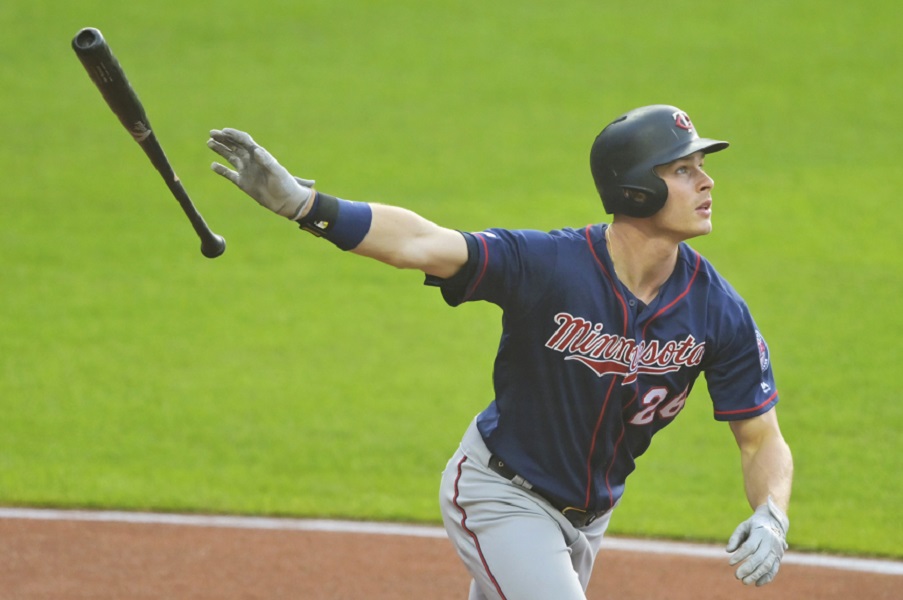 Box Score Berrios: 6.0 IP, 2 H, 1 ER, 1 BB, 6 K, 69.2% strikes (74 of 107 pitches) Home Runs: Kepler 3 (15) Multi-Hit Games: Kepler (4 for 4, 3 HR, BB) WPA of +0.1: Kepler .310; Berrios .229; Rogers .200 WPA of -0.1: Magill -.193 (Chart via FanGraphs) Kepler got the scoring going on the second pitch of the game when he ended his 0-for-21 streak with a solo shot. This was the third time this season that Kepler hit a first inning leadoff homerun for the Twins. https://twitter.com/Twins/status/1136773656049344513 Kepler added to the scoring again in the top of the third when he took Trevor Bauer deep for the second time tonight. This time it was on a two-strike slider after Kepler did a good job spoiling a couple good two-strike pitches from Bauer. https://twitter.com/fsnorth/status/1136782401768529920 The Twins struck again in the top of the fifth after Kepler leadoff the inning with a walk. Jorge Polanco then grounded into a fielder’s choice before Mitch Garver drove him in from first with an RBI double. In the seventh Kepler struck again for his third home run of the game, giving the Twins a 5-1 lead. https://twitter.com/fsnorth/status/1136802170697789440 For his second straight start Jose Berrios had a good outing to get the Twins back on their winning ways after a tough loss. Berrios absolutely shut down the Indians lineup for six plus innings tonight, but made just one mistake to Roberto Perez in the fifth inning that he drove over the wall in the right-center field gap. Berrios had the changeup working especially well, picking up four of his six strikeouts with it. Despite being over a hundred pitches through six innings, Rocco Baldelli left Berrios in to start the seventh. He did a good job getting Jose Ramirez to roll over on a changeup, but Jonathan Schoop bobbled the ball and Ramirez reached, ending the night for Berrios. Matt Magill came in to relieve Berrios, hoping to bounce back from his terrible outing on Sunday in Tampa. Unfortunately that wasn’t to be, as he walked Jordan Luplow on four pitches and gave up an RBI single to Tyler Naquin, causing Baldelli to go back to the pen to get Trevor May to get out of the jam. May came in doing his part, allowing just one run to score, on a sac-fly from Roberto Perez, before getting Leoyns Martin and Francisco Lindor to get out of the jam. Taylor Rogers came in to start the eighth inning and picked up a two inning save. Rogers looked unhittable getting each of the first five guys he faced out, three of which were via the strikeout. However, he made things interesting after he gave up a two-out home run to Oscar Mercado. Rogers shut the door on the Twins win on the next batter getting Roberto Perez to groundout. Postgame with Baldelli https://twitter.com/fsnorth/status/1136829468763230208 Bullpen Usage Here’s a quick look at the number of pitches thrown by the bullpen over the past five days: Next Three Games Fri at DET, 6:10 pm CT (TBD-Boyd) Sat at DET, 3:10 pm CT (Gibson-TBD) Sun at DET, 12:10 pm CT (Odorizzi-Carpenter) Last Game CLE 9, MIN 7: Bullpen Crumbles on Night Kimbrel Signs With Cubs
 -
Minnesota Twins 2019 MLB Draft Recap
Andrew Thares replied to Andrew Thares's topic in Twins Daily Front Page News
Good catch, it's been fixed. -
The 2019 MLB Draft is now in the review mirror, and the Minnesota Twins have selected 41 new prospects that they need to work on signing. After having just two picks in the top 100 in last year’s draft, the Twins had four picks in the top 100 this year, including three on day one of the draft. It was evident early on that the Twins had a specific game plan and stuck to it. The 2019 MLB Draft is now in the review mirror, and the Minnesota Twins have selected 41 new prospects that they need to work on signing. After having just two picks in the top 100 in last year’s draft, the Twins had four picks in the top 100 this year, including three on day one of the draft. It was evident early on that the Twins had a specific game plan and stuck to it. While other teams around the Twins, like the Mets, Marlins and White Sox, all had an aggressive strategy of taking a few high profile over slot players early, then drafting a bunch of college seniors in the rest of the first ten rounds to make the money work, the Twins decided to go with a quantity of potential quality approach. Often times in the draft the players that end up being the best guys weren’t the ones taken in the first couple of rounds, so by using this approach, the Twins acquired as many guys as they could who could potentially breakout. Keoni Cavaco The California high school third baseman was gaining a lot of steam in the week leading up to the draft, and it was rumored that the Twins were all in on him. As it turns out, that was exactly the case, as the Twins selected Cavaco with the 13th pick in the draft. Cavaco is a high upside player with plus power, run, fielding and throwing tools. The real question with Cavaco is around his ability to hit elite pitching. You can read more about Cavaco here. College Bats After the Twins took Cavaco in the first round, they developed a strategy around drafting college hitters during the early stages of the draft. From Competitive Balance Round A through round seven, the Twins had seven more picks, and used five of them on college hitters. The first college hitter they took was Southern Miss standout right fielder, and Forest Lake, MN native Matt Wallner. In 2016, Wallner was named Minnesota Mr. Baseball, and was taken by the Twins in the 32nd round of the draft, but went unsigned. Wallner has been quite the imposing presence in the Southern Miss lineup hitting .337 with 58 home runs in 189 career games. You can read more about Wallner here. After Wallner the Twins took Oregon shortstop Spencer Steer with their first pick on day two. In the fourth round they targeted Wright State third baseman Seth Gray. Gray was teammates at Wright State with Twins 2018 pick, and 2019 Midwest League All-Star, Gabe Snyder. In the 5th round they grabbed Auburn shortstop Will Holland. Before the 2019 season, Holland was considered to be a likely first round pick, but slid in the draft after having a poor spring. If he can regain his 2018 form, Holland could be a potential steal of this draft. In the seventh round the Twins took another college shortstop, this time it was UConn’s Anthony Prato. While it won’t be possible for all these guys to play short at the next level, I am a big fan of the Twins just bringing in some of the best athletes that they can, and then figure out where to put them all later. College Pitchers With their second round pick, the Twins took their first pitcher of the draft in Rice right-hander Matt Canterino. Canterino was a three year starter at Rice, and already has quite a bit of experience pitching, as he threw nearly 300 innings in his three years at Rice, and also played for both Team USA and in the Cape Cod League. You can read more about Canterino here. Once the Twins run on college hitters had ended, the Twins shifted their focus onto adding a stable of college pitchers to their farm system. In the 6th round they took Sawyer Gipson, a right-handed pitcher from Mercer. Then starting in the 8th round the Twins took nine consecutive college pitchers, with only one of them, Brent Headrick, being a lefty. One of the last pitchers the Twins took in this run was Concordia St. Paul’s own Louie Varland, who is a native of Maplewood, MN. Later Rounds In the 18th round, the Twins added part two of Auburn’s double play duo, as they took Will Holland’s teammate Edouard Julien. The Twins also drafted another pair of college teammates in UCLA’s Nate Hadley and Jake Hirabayashi , who were selected in the 25th and 39th rounds respectively. UCLA is the top ranked team in the NCAA tournament, and are facing off against Michigan this weekend for a spot in the College World Series. Keeping the teammates trend alive, the Twins took a pair of high school pitchers from Stillwater Area High School in the 35th and 36th rounds. The two pitchers, Drew Gilbert and Will Frisch are both committed to play college ball at Oregon State, the same school that Twins 2018 first round pick Trevor Larnach attended, and won a championship for last summer. One of the later round picks that I am particularly excited about is Austin Peay’s first baseman Parker Phillips. In three seasons of college ball, Phillips had a .319/.434/.673 slash line with 56 home runs, including 25 in 2019, which is the second most hit by any player in Division 1 college baseball this year. You can read scouting reports on all 41 Twins draft picks here: Twins Select Keoni Cavaco with 13th Overall Pick Twins Select Minnesotan Matt Wallner with 39th Overall Pick Twins Select Matt Canterino with 54th Overall Pick MLB Draft Day 1 Thread MLB Draft Day 2 Thread MLB Draft Day 3 Thread View full article
-
 While other teams around the Twins, like the Mets, Marlins and White Sox, all had an aggressive strategy of taking a few high profile over slot players early, then drafting a bunch of college seniors in the rest of the first ten rounds to make the money work, the Twins decided to go with a quantity of potential quality approach. Often times in the draft the players that end up being the best guys weren’t the ones taken in the first couple of rounds, so by using this approach, the Twins acquired as many guys as they could who could potentially breakout. Keoni Cavaco The California high school third baseman was gaining a lot of steam in the week leading up to the draft, and it was rumored that the Twins were all in on him. As it turns out, that was exactly the case, as the Twins selected Cavaco with the 13th pick in the draft. Cavaco is a high upside player with plus power, run, fielding and throwing tools. The real question with Cavaco is around his ability to hit elite pitching. You can read more about Cavaco here. College Bats After the Twins took Cavaco in the first round, they developed a strategy around drafting college hitters during the early stages of the draft. From Competitive Balance Round A through round seven, the Twins had seven more picks, and used five of them on college hitters. The first college hitter they took was Southern Miss standout right fielder, and Forest Lake, MN native Matt Wallner. In 2016, Wallner was named Minnesota Mr. Baseball, and was taken by the Twins in the 32nd round of the draft, but went unsigned. Wallner has been quite the imposing presence in the Southern Miss lineup hitting .337 with 58 home runs in 189 career games. You can read more about Wallner here. After Wallner the Twins took Oregon shortstop Spencer Steer with their first pick on day two. In the fourth round they targeted Wright State third baseman Seth Gray. Gray was teammates at Wright State with Twins 2018 pick, and 2019 Midwest League All-Star, Gabe Snyder. In the 5th round they grabbed Auburn shortstop Will Holland. Before the 2019 season, Holland was considered to be a likely first round pick, but slid in the draft after having a poor spring. If he can regain his 2018 form, Holland could be a potential steal of this draft. In the seventh round the Twins took another college shortstop, this time it was UConn’s Anthony Prato. While it won’t be possible for all these guys to play short at the next level, I am a big fan of the Twins just bringing in some of the best athletes that they can, and then figure out where to put them all later. College Pitchers With their second round pick, the Twins took their first pitcher of the draft in Rice right-hander Matt Canterino. Canterino was a three year starter at Rice, and already has quite a bit of experience pitching, as he threw nearly 300 innings in his three years at Rice, and also played for both Team USA and in the Cape Cod League. You can read more about Canterino here. Once the Twins run on college hitters had ended, the Twins shifted their focus onto adding a stable of college pitchers to their farm system. In the 6th round they took Sawyer Gipson, a right-handed pitcher from Mercer. Then starting in the 8th round the Twins took nine consecutive college pitchers, with only one of them, Brent Headrick, being a lefty. One of the last pitchers the Twins took in this run was Concordia St. Paul’s own Louie Varland, who is a native of Maplewood, MN. Later Rounds In the 18th round, the Twins added part two of Auburn’s double play duo, as they took Will Holland’s teammate Edouard Julien. The Twins also drafted another pair of college teammates in UCLA’s Nate Hadley and Jake Hirabayashi , who were selected in the 25th and 39th rounds respectively. UCLA is the top ranked team in the NCAA tournament, and are facing off against Michigan this weekend for a spot in the College World Series. Keeping the teammates trend alive, the Twins took a pair of high school pitchers from Stillwater Area High School in the 35th and 36th rounds. The two pitchers, Drew Gilbert and Will Frisch are both committed to play college ball at Oregon State, the same school that Twins 2018 first round pick Trevor Larnach attended, and won a championship for last summer. One of the later round picks that I am particularly excited about is Austin Peay’s first baseman Parker Phillips. In three seasons of college ball, Phillips had a .319/.434/.673 slash line with 56 home runs, including 25 in 2019, which is the second most hit by any player in Division 1 college baseball this year. You can read scouting reports on all 41 Twins draft picks here: Twins Select Keoni Cavaco with 13th Overall Pick Twins Select Minnesotan Matt Wallner with 39th Overall Pick Twins Select Matt Canterino with 54th Overall Pick MLB Draft Day 1 Thread MLB Draft Day 2 Thread MLB Draft Day 3 Thread
 -
MLB Draft Day 3 Thread
Andrew Thares replied to Andrew Thares's topic in Twins Daily Front Page News
Almost a definite no, most likely just throwing a bone to a couple of the top local prep pitchers. -
MLB Draft Day 3 Thread
Andrew Thares replied to Andrew Thares's topic in Twins Daily Front Page News
The Twins have selected pitchers from Stillwater high school in back to back rounds.- 111 replies
-
- 1
-
-
- mlb draft
- minnesota twins
- (and 1 more)
-
After taking a high upside high school third baseman in Keoni Cavaco with their first round pick, the Twins stuck to a strategy of picking only college players with their remaining 10 picks in the first two days of the draft. As a result, it is expected that the Twins might have some left over bonus pool money to try and make another splash or two in the early rounds of day three. Image courtesy of © Marilyn Indahl-USA TODAY Sports After taking a high upside high school third baseman in Keoni Cavaco with their first round pick, the Twins stuck to a strategy of picking only college players with their remaining 10 picks in the first two days of the draft. As a result, it is expected that the Twins might have some left over bonus pool money to try and make another splash or two in the early rounds of day three. Some notable recent Twins picks from these later rounds include Jason Kubel (12th round, 2000), Zack Granite (14th round, 2013), Danny Valencia (19th round, 2006) and Trevor Hildenberger (22nd round, 2014). Going back a little further you can find one of the greatest players in Twins history, as Kent Hrbek was drafted in the 17th round of the 1978 draft. Also, Eddie Guardado was a 21st rounder in 1990 and Corey Koskie was a 26th-round pick in 1994. The draft was scaled back to “only” 40 rounds in 2012. Get caught up on all the action from the first two days here MLB Draft Day 1 Thread MLB Draft Day 2 Thread Twins Picks From Day 1 Round 1: Keoni Cavaco Comp Balance Round A: Matt Wallner Round 2: Matt Canterino Twins Picks From Day 2 3rd Round: Spencer Steer 4th Round: Seth Gray 5th Round: Will Holland 6th Round: Sawyer Gipson 7th Round: Anthony Prato 8th Round: Casey Legumina 9th Round: Brent Headrick 10th Round: Ben Gross As we wait for Day 3 of the draft to start, here is a 3 1/2 minute press conference with Twins top pick Keoni Cavaco. In it, he said "I'm going pro, for sure" and that "my goal is to get there in three years or less." Day 3 Selections 11th Round: RHP Tanner Brubaker - UC-Irvine Tanner Brubaker bounce around quite a bit in his college career. He started at California Baptist, where he had a 12.00 ERA in six relief appearances. He then transferred to Saddleback College, where he transitioned well to a starting role. Brubaker then transferred again, this time to California-Irvine. In 12 starts this year for the Anteaters, Brubaker had a 2.99 ERA, with 50 strikeouts and 17 walks in 72 and 1/3 innings pitched. 12th Round: RHP Sean Mooney - St. Johns (NY) Sean Mooney was quite the accomplished pitcher in his career at St. Johns. In his freshman season he was named both Freshman of the Year and Big East Pitcher of the year. In his sophomore season Mooney was named a Second Team All-American by the American Baseball Coaches Association. This year Mooney made just nine starts before his season ended after having Tommy John surgery. In his career at St. Johns, Mooney pitch 244 and 2/3 innings with a 2.13 ERA and a 249 to 72 strikeout to walk ratio. 13th Round: RHP Dylan Thomas - U of Hawaii With their 13th round pick, the Twins took Dylan Thomas, who has been a dominate closer for the University of Hawaii over the past three seasons. Thomas was the 2017 Big West Conference Freshman Pitcher of the Year, and was named to an All-Big West team in each of his three year’s at Hawaii. In his career, Thomas has pitched 115 innings across 60 relief appearances and 3 starts, to the tune of a 1.96 ERA, with a 27.1% strikeout rate and just a 4.9% walk rate. 14th Round: RHP Cody Laweryson - U of Maine-Orono After working as a reliever in his first two seasons at Maine, Cody Lawyerson became a regular in the weekend starting rotation this spring. Lawyerson was very effective in this role as he had a 2.85 ERA across 14 starts, with 79 strikeouts and 23 walks. 15th Round: RHP Louie Varland - Concordia University St. Paul The Twins stayed home for their 15th round pick by taking Maplewood, MN native Louie Varland. Varland has pitched the last three years at Concordia St. Paul, and was quite the effective starter over the last two years for the Golden Bears. Overall, Varland had a 2.73 ERA with 131 strikeouts and 45 walks over 115 and 1/3 career innings. 16th Round: RHP Ryan Shreve - U of Pacific Ryan Shreve struggled as a starter to begin his college career at Pacific. He then transition to the bullpen where he found more success in his sophomore season. As a junior this spring, Shreve moved back into the rotation and had a great season, mostly because he found control of his pitches as he walked just 3.8% of the batters he faced. 17th Round: LHP Antoine Jean - Edouard Montpetit HS While still a pitcher, the Twins finally broke their trend of picking college pitchers, which had been the case for each of their previous nine selections, as they took a Canadian high school pitcher Antoine Jean in the 17th round. Jean is a commit to the University of Alabama, and it is a possibility that he will choose to go the college route to continue developing with an SEC school before he becomes draft eligible again in 2022. 18th Round: 2B Edouard Julien - Auburn The Twins first position player taken on Day 3 is the other half of Auburn’s double play duo Edouard Julien. Much like Will Holland, Julien has big tools that flash potentially great upside. Julien also saw his performance drop off a bit this spring after a great 2018 season. Last year, Julien had a .275/.398/.556 slash line with 17 home runs and seven stolen bases. This year, those numbers dropped to a .239/.371/.422 with eight home runs and three stolen bases. 19th Round: LHP Niall Windeler - U of British Columbia Niall Windeler is the third straight Canadian player that the Twins have taken. Windeler has been a very good starting pitcher over the last three years at UBC. For his career Windeler has a 3.37 ERA with 247 strikeouts and 86 walks across 251 innings pitched. 20th Round: RHP Owen Griffith - Clemson After a break for a few picks, the Twins are back on their train of picking college right handed pitchers by taking Clemson righty Owen Griffith. Griffith is strictly a reliever with some potential high upside as a strikeout pitcher. However, Griffith will need to gain better control of the strike zone if he is going to have success at the next level. 21st Round: RHP Bradley Hanner - Patrick Henry CC Bradley Hanner was one of the top recruits coming out of the state of Virginia in the 2017 high school class. Hanner choose to bypass the four-year college route and went to Patrick Henry Community College, making him eligible in this year’s draft. This spring for Patrick Henry, Hanner made 12 starts with a 4.04 ERA while striking out 69 batters in 69 innings. 22nd Round: RHP Rogelio Reyes - U of California After struggling in his freshman and sophomore years working as both a starter and a reliever for the Cal Bears, Rogelio Reyes found much more success in his junior year as a long relief option. I got the chance to watch Reyes pitch this spring, but it wasn’t the best of outings for him as he gave up two home runs in three plus innings of work in that outing against LSU. 23rd Round: RHP Matthew Swain - Georgia Gwinnett College Matthew Swain is a tall and projectable reliever who has the potential to strike a lot of hitters out, but struggles with his control at times. In two seasons pitching at Georgia Gwinnett, Swain has an ERA of 3.32 across 33 relief appearances. 24th Round: 1B Trevor Jensen - Tulane Trevor Jensen began his collegiate career playing at St. Petersburg College for two years before transferring to Tulane before the 2018 season. In his two years at Tulane, Jensen showed that he could hit for both average and power as he hit .317 with 16 home runs in 108 games. 25th Round: RHP Nate Hadley - UCLA Former Duluth Huskie Nathan Hadley has been a great asset out of the bullpen this season for the #1 ranked UCLA Bruins. Like many college relievers taken at this point in the draft, Hadley has high strikeout upside, but needs to refine his mechanics if we to gain the control necessary to play at the professional level. 26th Round: 3B Blake Robertson - Edmond Santa Fe HS At 6’5”, Blake Robertson is a tall third baseman with a big power bat and a strong arm. The Oklahoma native is committed to Oklahoma State, and it is likely that he with forgo signing with the Twins and be on campus in Stillwater this fall to pitch for the Cowboys. 27th Round: 1B Parker Phillips - Austin Peay Parker Phillips has absolutely raked in his three years at Austin Peay. Phillips was named a Louisville Slugger Freshman All-American in 2017 after hitting .328 with 12 home runs. He followed that up in his sophomore year by hitting .313 and increasing his home run total to 19. This spring Phillips increased his power numbers even more has he hit .316 with 25 home runs, which was the second most in Division 1 baseball this year. 28th Round: RHP Travis Phelps - Alvin HS (TX) Travis Phelps has a tall and projectable 6’4” and 195-pound frame that profiles very well to develop as he ages over the next couple of years. It is likely that Phelps won’t sign, but if he does he is just the kind of pitcher that the Twins minor league coaching staff could work with and potentially turn into a solid pitcher. 29th Round: C Alex Isola - TCU TCU Alex Isola began his college career as a Utah Ute. After getting very little playing time as a freshman Isola transferred to Yavapai College where he thrived hitting .367 with eight home runs. This earned him a scholarship offer to be the starting catcher for TCU this spring. In 54 games Isola was able to hit .267 with five home runs. 30th Round: RHP Tyler Beck - U of Tampa As a freshman Tyler Beck attended Pasco-Hernando State College, where he was effective as a starting pitcher. He then transfer to Tampa where he pitched as reliever the last two seasons. Beck struggled to a 6.35 ERA last year, but was much improved with a 2.17 ERA with 71 strikeouts and 19 walks in 54 innings of work out of the pen. 31st Round: OF Max Smith - UNLV Max Smith is a four-year senior right-fielder for the UNLV Rebels. Smith was primarly used as a bench player during his first two years in a Rebel uniform, but saw a lot of actions as the starting right-fielder for the last two years. During those two seasons Smith hit .302 with 19 home runs in 117 games. 32nd Round: OF Bryson Gandy - Lurleen B Wallace St JC In the 32nd round the Twins took a speedy outfielder from Lurleen B. Wallace Community College by the name of Bryson Gandy. This year Gandy has hit .364 with nine home runs and 18 stolen bases in 53 games. Gandy is also strikeout prone, having struck out 54 times this year. 33rd Round: C Kyle Schmidt - U of Richmond Kyle Schmidt split catching duties in his freshman season at the University of Richmond. However, since then Schmidt has been the primary starting catcher for the Spiders the last three years. As a hitter Schmidt has a high average and low power approach as he has hit .304 with just six home runs in his four collegiate seasons combined. 34th Round: RHP Antoine Harris - Chalmette HS (LA) Antoine Harris is yet another tall and projectable high school pitcher taken by the Twins in the later rounds of the draft. Harris is committed to play college ball at the University of New Orleans and it is likely that he will not end up signing with the Twins. 35th Round: LHP Drew Gilbert - Stillwater Area HS (MN) The first of two Stillwater Area High School pitchers taken in back-to-back rounds by the Twins this afternoon, Drew Gilbert is committed to pitch at Oregon State next year. Gilbert has a fastball that will sit in the low to mid 90’s. It will be fun to see how he develops over the next few years at Oregon State. 36th Round: RHP Will Frisch - Stillwater Area HS (MN) Will Frisch was the second of the two Stillwater Area High School pitchers the Twins took this afternoon. Like Gilbert, Frisch will also be heading to Oregon State to pitch this fall. While its extremely likely neither will end up signing with the Twins this summer it was a (in the words of Joe Mauer) pretty neat gesture by the Twins to recognize two local area players. 37th Round: OF Adrian Colon - Dr. Juan J. Osuna (PR) Adrian Colon is a high school outfielder that hails from the Puerto Rico ranks. Colon is a very toolsey player with big potential with both the bat and in the field defensively with his speed. If the Twins were able to get Colon into their system, he has the kind of raw tools that coaches dream about being able to mold into the kind of player they want him to be. 38th Round: C Zack Mathis - San Joaquin Delta College At San Joaquin Delta College Zack Mathis primarily played shortstop this past year. Additionally, Mathis played in the outfield for the Northwoods League Willmar Stingers last summer. However, the Twins see Mathis’ future at catcher. This season Mathis hit .351 with 10 home runs and 12 stolen bases over 48 games. 39th Round: 3B Jake Hirabayashi - UCLA Jake Hirabayashi has had a very up and down career at UCLA. After struggling for two seasons, Hirabayashi broke onto the scene in 2018 with a .280/.430/.410 slash line in 43 games for the Bruins. However, 2019 was a step back for Hirabayashi as he had just a .190/.296/.310 slash line in 37 games. 40th Round: SS Logan Steenstra - Cowley County CC Logan Steenstra is the son of former major league pitcher Kennie Steenstra. As a freashman this season Steenstra hit .306 with two home runs, 28 RBIs and three stolen bases. Steenstra also gave up a couple runs over two innings as a pitcher. View full article
- 111 replies
-
- 2
-
-
- mlb draft
- minnesota twins
- (and 1 more)
-
 Some notable recent Twins picks from these later rounds include Jason Kubel (12th round, 2000), Zack Granite (14th round, 2013), Danny Valencia (19th round, 2006) and Trevor Hildenberger (22nd round, 2014). Going back a little further you can find one of the greatest players in Twins history, as Kent Hrbek was drafted in the 17th round of the 1978 draft. Also, Eddie Guardado was a 21st rounder in 1990 and Corey Koskie was a 26th-round pick in 1994. The draft was scaled back to “only” 40 rounds in 2012. Get caught up on all the action from the first two days here MLB Draft Day 1 Thread MLB Draft Day 2 Thread Twins Picks From Day 1 Round 1: Keoni Cavaco Comp Balance Round A: Matt Wallner Round 2: Matt Canterino Twins Picks From Day 2 3rd Round: Spencer Steer 4th Round: Seth Gray 5th Round: Will Holland 6th Round: Sawyer Gipson 7th Round: Anthony Prato 8th Round: Casey Legumina 9th Round: Brent Headrick 10th Round: Ben Gross As we wait for Day 3 of the draft to start, here is a 3 1/2 minute press conference with Twins top pick Keoni Cavaco. In it, he said "I'm going pro, for sure" and that "my goal is to get there in three years or less." Day 3 Selections 11th Round: RHP Tanner Brubaker - UC-Irvine Tanner Brubaker bounce around quite a bit in his college career. He started at California Baptist, where he had a 12.00 ERA in six relief appearances. He then transferred to Saddleback College, where he transitioned well to a starting role. Brubaker then transferred again, this time to California-Irvine. In 12 starts this year for the Anteaters, Brubaker had a 2.99 ERA, with 50 strikeouts and 17 walks in 72 and 1/3 innings pitched. 12th Round: RHP Sean Mooney - St. Johns (NY) Sean Mooney was quite the accomplished pitcher in his career at St. Johns. In his freshman season he was named both Freshman of the Year and Big East Pitcher of the year. In his sophomore season Mooney was named a Second Team All-American by the American Baseball Coaches Association. This year Mooney made just nine starts before his season ended after having Tommy John surgery. In his career at St. Johns, Mooney pitch 244 and 2/3 innings with a 2.13 ERA and a 249 to 72 strikeout to walk ratio. 13th Round: RHP Dylan Thomas - U of Hawaii With their 13th round pick, the Twins took Dylan Thomas, who has been a dominate closer for the University of Hawaii over the past three seasons. Thomas was the 2017 Big West Conference Freshman Pitcher of the Year, and was named to an All-Big West team in each of his three year’s at Hawaii. In his career, Thomas has pitched 115 innings across 60 relief appearances and 3 starts, to the tune of a 1.96 ERA, with a 27.1% strikeout rate and just a 4.9% walk rate. 14th Round: RHP Cody Laweryson - U of Maine-Orono After working as a reliever in his first two seasons at Maine, Cody Lawyerson became a regular in the weekend starting rotation this spring. Lawyerson was very effective in this role as he had a 2.85 ERA across 14 starts, with 79 strikeouts and 23 walks. 15th Round: RHP Louie Varland - Concordia University St. Paul The Twins stayed home for their 15th round pick by taking Maplewood, MN native Louie Varland. Varland has pitched the last three years at Concordia St. Paul, and was quite the effective starter over the last two years for the Golden Bears. Overall, Varland had a 2.73 ERA with 131 strikeouts and 45 walks over 115 and 1/3 career innings. 16th Round: RHP Ryan Shreve - U of Pacific Ryan Shreve struggled as a starter to begin his college career at Pacific. He then transition to the bullpen where he found more success in his sophomore season. As a junior this spring, Shreve moved back into the rotation and had a great season, mostly because he found control of his pitches as he walked just 3.8% of the batters he faced. 17th Round: LHP Antoine Jean - Edouard Montpetit HS While still a pitcher, the Twins finally broke their trend of picking college pitchers, which had been the case for each of their previous nine selections, as they took a Canadian high school pitcher Antoine Jean in the 17th round. Jean is a commit to the University of Alabama, and it is a possibility that he will choose to go the college route to continue developing with an SEC school before he becomes draft eligible again in 2022. 18th Round: 2B Edouard Julien - Auburn The Twins first position player taken on Day 3 is the other half of Auburn’s double play duo Edouard Julien. Much like Will Holland, Julien has big tools that flash potentially great upside. Julien also saw his performance drop off a bit this spring after a great 2018 season. Last year, Julien had a .275/.398/.556 slash line with 17 home runs and seven stolen bases. This year, those numbers dropped to a .239/.371/.422 with eight home runs and three stolen bases. 19th Round: LHP Niall Windeler - U of British Columbia Niall Windeler is the third straight Canadian player that the Twins have taken. Windeler has been a very good starting pitcher over the last three years at UBC. For his career Windeler has a 3.37 ERA with 247 strikeouts and 86 walks across 251 innings pitched. 20th Round: RHP Owen Griffith - Clemson After a break for a few picks, the Twins are back on their train of picking college right handed pitchers by taking Clemson righty Owen Griffith. Griffith is strictly a reliever with some potential high upside as a strikeout pitcher. However, Griffith will need to gain better control of the strike zone if he is going to have success at the next level. 21st Round: RHP Bradley Hanner - Patrick Henry CC Bradley Hanner was one of the top recruits coming out of the state of Virginia in the 2017 high school class. Hanner choose to bypass the four-year college route and went to Patrick Henry Community College, making him eligible in this year’s draft. This spring for Patrick Henry, Hanner made 12 starts with a 4.04 ERA while striking out 69 batters in 69 innings. 22nd Round: RHP Rogelio Reyes - U of California After struggling in his freshman and sophomore years working as both a starter and a reliever for the Cal Bears, Rogelio Reyes found much more success in his junior year as a long relief option. I got the chance to watch Reyes pitch this spring, but it wasn’t the best of outings for him as he gave up two home runs in three plus innings of work in that outing against LSU. 23rd Round: RHP Matthew Swain - Georgia Gwinnett College Matthew Swain is a tall and projectable reliever who has the potential to strike a lot of hitters out, but struggles with his control at times. In two seasons pitching at Georgia Gwinnett, Swain has an ERA of 3.32 across 33 relief appearances. 24th Round: 1B Trevor Jensen - Tulane Trevor Jensen began his collegiate career playing at St. Petersburg College for two years before transferring to Tulane before the 2018 season. In his two years at Tulane, Jensen showed that he could hit for both average and power as he hit .317 with 16 home runs in 108 games. 25th Round: RHP Nate Hadley - UCLA Former Duluth Huskie Nathan Hadley has been a great asset out of the bullpen this season for the #1 ranked UCLA Bruins. Like many college relievers taken at this point in the draft, Hadley has high strikeout upside, but needs to refine his mechanics if we to gain the control necessary to play at the professional level. 26th Round: 3B Blake Robertson - Edmond Santa Fe HS At 6’5”, Blake Robertson is a tall third baseman with a big power bat and a strong arm. The Oklahoma native is committed to Oklahoma State, and it is likely that he with forgo signing with the Twins and be on campus in Stillwater this fall to pitch for the Cowboys. 27th Round: 1B Parker Phillips - Austin Peay Parker Phillips has absolutely raked in his three years at Austin Peay. Phillips was named a Louisville Slugger Freshman All-American in 2017 after hitting .328 with 12 home runs. He followed that up in his sophomore year by hitting .313 and increasing his home run total to 19. This spring Phillips increased his power numbers even more has he hit .316 with 25 home runs, which was the second most in Division 1 baseball this year. 28th Round: RHP Travis Phelps - Alvin HS (TX) Travis Phelps has a tall and projectable 6’4” and 195-pound frame that profiles very well to develop as he ages over the next couple of years. It is likely that Phelps won’t sign, but if he does he is just the kind of pitcher that the Twins minor league coaching staff could work with and potentially turn into a solid pitcher. 29th Round: C Alex Isola - TCU TCU Alex Isola began his college career as a Utah Ute. After getting very little playing time as a freshman Isola transferred to Yavapai College where he thrived hitting .367 with eight home runs. This earned him a scholarship offer to be the starting catcher for TCU this spring. In 54 games Isola was able to hit .267 with five home runs. 30th Round: RHP Tyler Beck - U of Tampa As a freshman Tyler Beck attended Pasco-Hernando State College, where he was effective as a starting pitcher. He then transfer to Tampa where he pitched as reliever the last two seasons. Beck struggled to a 6.35 ERA last year, but was much improved with a 2.17 ERA with 71 strikeouts and 19 walks in 54 innings of work out of the pen. 31st Round: OF Max Smith - UNLV Max Smith is a four-year senior right-fielder for the UNLV Rebels. Smith was primarly used as a bench player during his first two years in a Rebel uniform, but saw a lot of actions as the starting right-fielder for the last two years. During those two seasons Smith hit .302 with 19 home runs in 117 games. 32nd Round: OF Bryson Gandy - Lurleen B Wallace St JC In the 32nd round the Twins took a speedy outfielder from Lurleen B. Wallace Community College by the name of Bryson Gandy. This year Gandy has hit .364 with nine home runs and 18 stolen bases in 53 games. Gandy is also strikeout prone, having struck out 54 times this year. 33rd Round: C Kyle Schmidt - U of Richmond Kyle Schmidt split catching duties in his freshman season at the University of Richmond. However, since then Schmidt has been the primary starting catcher for the Spiders the last three years. As a hitter Schmidt has a high average and low power approach as he has hit .304 with just six home runs in his four collegiate seasons combined. 34th Round: RHP Antoine Harris - Chalmette HS (LA) Antoine Harris is yet another tall and projectable high school pitcher taken by the Twins in the later rounds of the draft. Harris is committed to play college ball at the University of New Orleans and it is likely that he will not end up signing with the Twins. 35th Round: LHP Drew Gilbert - Stillwater Area HS (MN) The first of two Stillwater Area High School pitchers taken in back-to-back rounds by the Twins this afternoon, Drew Gilbert is committed to pitch at Oregon State next year. Gilbert has a fastball that will sit in the low to mid 90’s. It will be fun to see how he develops over the next few years at Oregon State. 36th Round: RHP Will Frisch - Stillwater Area HS (MN) Will Frisch was the second of the two Stillwater Area High School pitchers the Twins took this afternoon. Like Gilbert, Frisch will also be heading to Oregon State to pitch this fall. While its extremely likely neither will end up signing with the Twins this summer it was a (in the words of Joe Mauer) pretty neat gesture by the Twins to recognize two local area players. 37th Round: OF Adrian Colon - Dr. Juan J. Osuna (PR) Adrian Colon is a high school outfielder that hails from the Puerto Rico ranks. Colon is a very toolsey player with big potential with both the bat and in the field defensively with his speed. If the Twins were able to get Colon into their system, he has the kind of raw tools that coaches dream about being able to mold into the kind of player they want him to be. 38th Round: C Zack Mathis - San Joaquin Delta College At San Joaquin Delta College Zack Mathis primarily played shortstop this past year. Additionally, Mathis played in the outfield for the Northwoods League Willmar Stingers last summer. However, the Twins see Mathis’ future at catcher. This season Mathis hit .351 with 10 home runs and 12 stolen bases over 48 games. 39th Round: 3B Jake Hirabayashi - UCLA Jake Hirabayashi has had a very up and down career at UCLA. After struggling for two seasons, Hirabayashi broke onto the scene in 2018 with a .280/.430/.410 slash line in 43 games for the Bruins. However, 2019 was a step back for Hirabayashi as he had just a .190/.296/.310 slash line in 37 games. 40th Round: SS Logan Steenstra - Cowley County CC Logan Steenstra is the son of former major league pitcher Kennie Steenstra. As a freashman this season Steenstra hit .306 with two home runs, 28 RBIs and three stolen bases. Steenstra also gave up a couple runs over two innings as a pitcher.
 -
2019 MLB Draft Day 2 Thread
Andrew Thares replied to Andrew Thares's topic in Twins Daily Front Page News
The Twins could also be looking to save money in the later rounds today to help add to the pool for a well above slot pick in the 3rd or 4th rounds. The still have roughly $2.5 M to play with for their picks today, in addition to any savings they had on their picks from last night. If they can take a college senior or two in the top 10 rounds (like they did with Chris Williams last year) that could save them a lot of money below slot value.- 171 replies
-
- 2
-
-
- keoni cavaco
- matt centerino
- (and 2 more)
-
The Minnesota Twins did a good job adding to their farm system with three picks on Day One of the Draft. With their first pick they took Keoni Cavaco, a high school third baseman from California. They then added a couple of Matts with the 39th and 54th overall picks. The first Matt being Matt Wallner, a Minnesota native who is a right fielder for Southern Mississippi. The second Matt was Matt Canterino, who is a right-handed pitcher from Rice University. Image courtesy of © David Berding-USA TODAY Sports The Minnesota Twins did a good job adding to their farm system with three picks on Day One of the Draft. With their first pick they took Keoni Cavaco, a high school third baseman from California. They then added a couple of Matts with the 39th and 54th overall picks. The first Matt being Matt Wallner, a Minnesota native who is a right fielder for Southern Mississippi. The second Matt was Matt Canterino, who is a right-handed pitcher from Rice University. From Yesterday Twins Select Keoni Cavaco with 13th Overall Pick Twins Select Minnesotan Matt Wallner with 39th Overall Pick Twins Select Matt Canterino with 54th Overall Pick The Twins are back in action with eight more picks today in rounds three through ten. Here is a breakdown what picks those are, and the bonus money attached to each pick. 3rd Round: 90th Overall - $657,600 4th Round: 119th Overall - $483,000 5th Round: 149th Overall - $360,800 6th Round: 179th Overall - $274,800 7th Round: 209th Overall - $214,900 8th Round: 239th Overall - $173,000 9th Round: 269th Overall - $154,100 10th Round: 299th Overall - $145,000 Please join in on the conversation and keep checking back, as this article will be updated each time the Twins make a selection. Draft Picks 3rd Round: 90th Overall - Spencer Steer | Oregon | Pos: SS Junior Oregon Shortstop Spencer Steer is a solid all-around player with no true standout tools. Steers best trait is probably his hit tool. Steer is a career .297 hitter with a .401 OBP, but hit just 12 home runs over three seasons for the Ducks. It is unlikely that Steer will stay at short long-term, but he has the defensive ability to be a plus defender at second. He could also make the move to third, but I don’t think he will provide the thump in the bat for third. https://twitter.com/BaseballAmerica/status/1135961592116498432 4th Round: 119th Overall - Seth Gray | Wright State | Pos: 3B Seth Gray will be reunited with his former Wright State teammate Gabe Snyder, who was the Twins 21st round pick in last year’s draft. Gray wasn’t a highly considered prospect entering this spring, but he broke out from a power standpoint this spring hitting 11 home runs, which more than doubled the total he hit in his freshman and sophomore years combined. This helped Gray raise his slugging percentage up from the roughly .410 he had in his first to seasons, up to .627 this year. 5th Round: 149th Overall - Will Holland | Auburn | Pos: SS Holland entered this season with a profile that had him projected to possibly be drafted within the first 20 overall picks. His junior season didn’t go as well as expected. After hitting .313/.406/.530 as a sophomore, Holland dropped all the way down to .248/.378/.416 this season. Holland has picked it up as of late hitting .367 over his last 16 games leading into this weekends Super Regional against UNC. On the MLB.com broadcast, Jim Callis called this pick “an absolute steal.” Hollad is another infielder who is known for his power. As you can see below, 2080 Baseball had Holland ranked as their No. 12 collegiate draft prospect back in February. https://twitter.com/2080ball/status/1096512676388368384 6th Round: 179th Overall - Sawyer Gipson | Mercer | Pos: RHP Under the current regime, the Twins have shown an affinity to draft pitchers based mostly around advanced metrics, and Sawyer Gipson fits right into that mold. At the face of it, you see Sawyer Gipson as a small school pitcher who has never had a season with an ERA below 5.20, but if you dive further into Gipson you can see what makes him so appealing is his excellent strikeout to walk ratio. In his three combined season at Mercer, Gipson has struck out 26.3% of opposing batters while only walking 5.9%. https://twitter.com/cdcole55/status/882098710431371265 7th Round: 209th Overall - Anthony Prato | UConn | Pos: SS Believe it or not, the Twins just took another college shortstop, making Anthony Prato number three on the day. Prato could very well be the best pure hitter and best athlete of the group, though he has the least amount of power potential. Prato is one of those players that knows his strengths, and tries to emphasize them on the baseball field. He is an on-base machine, having hit above .300 in all three years at UConn, with a career OBP of .401, including .441 this year. Prato also can do damage once he is on the base paths, stealing 47 bases in 178 career college games. 8th Round: 239th Overall - Casey Legumina | Gonzaga | Pos: RHP Casey Legumina only made four starts in 2019 before getting shut down with a forearm strain. In those four starts Legumina was pretty sharp, striking out 29 batters and walking eight in 24 innings. Legumina was solid out of the Bulldogs pen in 2018, with an ERA of 2.77 and a strikeout to walk ratio of 52 to 7 over 48 and 2/3 innings. Legumina has a strong fastball that he can pump up into the mid 90’s with a decent amount of arm side run. He also features a sharp breaking ball that can be an effective swing and miss pitch. 9th Round: 269th Overall - Brent Headrick | Illinois State | Pos: LHP Brent Headrick was the Friday night ace of an Illinois State team that won the Missouri Valley Conference Championship this year, and fell a game shy of advancing to the Super Regionals this upcoming weekend. Headrick was a three year starter for the Redbirds, but 2019 was easily his best of the three. In 96 innings pitched, across 16 starts, Headrick had a 3.47 ERA with a 115 to 31 strikeout to walk ratio. It should be noted that in three starts against NCAA tournament teams (Vanderbilt, Creighton & Indiana) Headrick gave up 21 runs (14 earned) in 14 and 1/3 innings pitched. https://twitter.com/Redbird_Pro/status/1130882053363458054 10th Round: 299th Overall - Ben Gross | Duke | Pos: RHP Ben Gross completes a perfect 8 for 8 day for college players selected by the Twins. Gross played his first three seasons of college baseball at Princeton, before becoming a grad transfer to Duke for 2019. Gross was a starter for the Princeton Tigers for two seasons, where he had a respectable 4.35 ERA while striking out just shy of a batter per inning. In his lone year at Duke Gross was inconsistent starting in the ACC, but managed to put together a 4.09 ERA while again striking out nearly a batter per inning. View full article
-
 From Yesterday Twins Select Keoni Cavaco with 13th Overall Pick Twins Select Minnesotan Matt Wallner with 39th Overall Pick Twins Select Matt Canterino with 54th Overall Pick The Twins are back in action with eight more picks today in rounds three through ten. Here is a breakdown what picks those are, and the bonus money attached to each pick. 3rd Round: 90th Overall - $657,600 4th Round: 119th Overall - $483,000 5th Round: 149th Overall - $360,800 6th Round: 179th Overall - $274,800 7th Round: 209th Overall - $214,900 8th Round: 239th Overall - $173,000 9th Round: 269th Overall - $154,100 10th Round: 299th Overall - $145,000 Please join in on the conversation and keep checking back, as this article will be updated each time the Twins make a selection. Draft Picks 3rd Round: 90th Overall - Spencer Steer | Oregon | Pos: SS Junior Oregon Shortstop Spencer Steer is a solid all-around player with no true standout tools. Steers best trait is probably his hit tool. Steer is a career .297 hitter with a .401 OBP, but hit just 12 home runs over three seasons for the Ducks. It is unlikely that Steer will stay at short long-term, but he has the defensive ability to be a plus defender at second. He could also make the move to third, but I don’t think he will provide the thump in the bat for third. https://twitter.com/BaseballAmerica/status/1135961592116498432 4th Round: 119th Overall - Seth Gray | Wright State | Pos: 3B Seth Gray will be reunited with his former Wright State teammate Gabe Snyder, who was the Twins 21st round pick in last year’s draft. Gray wasn’t a highly considered prospect entering this spring, but he broke out from a power standpoint this spring hitting 11 home runs, which more than doubled the total he hit in his freshman and sophomore years combined. This helped Gray raise his slugging percentage up from the roughly .410 he had in his first to seasons, up to .627 this year. 5th Round: 149th Overall - Will Holland | Auburn | Pos: SS Holland entered this season with a profile that had him projected to possibly be drafted within the first 20 overall picks. His junior season didn’t go as well as expected. After hitting .313/.406/.530 as a sophomore, Holland dropped all the way down to .248/.378/.416 this season. Holland has picked it up as of late hitting .367 over his last 16 games leading into this weekends Super Regional against UNC. On the MLB.com broadcast, Jim Callis called this pick “an absolute steal.” Hollad is another infielder who is known for his power. As you can see below, 2080 Baseball had Holland ranked as their No. 12 collegiate draft prospect back in February. https://twitter.com/2080ball/status/1096512676388368384 6th Round: 179th Overall - Sawyer Gipson | Mercer | Pos: RHP Under the current regime, the Twins have shown an affinity to draft pitchers based mostly around advanced metrics, and Sawyer Gipson fits right into that mold. At the face of it, you see Sawyer Gipson as a small school pitcher who has never had a season with an ERA below 5.20, but if you dive further into Gipson you can see what makes him so appealing is his excellent strikeout to walk ratio. In his three combined season at Mercer, Gipson has struck out 26.3% of opposing batters while only walking 5.9%. https://twitter.com/cdcole55/status/882098710431371265 7th Round: 209th Overall - Anthony Prato | UConn | Pos: SS Believe it or not, the Twins just took another college shortstop, making Anthony Prato number three on the day. Prato could very well be the best pure hitter and best athlete of the group, though he has the least amount of power potential. Prato is one of those players that knows his strengths, and tries to emphasize them on the baseball field. He is an on-base machine, having hit above .300 in all three years at UConn, with a career OBP of .401, including .441 this year. Prato also can do damage once he is on the base paths, stealing 47 bases in 178 career college games. 8th Round: 239th Overall - Casey Legumina | Gonzaga | Pos: RHP Casey Legumina only made four starts in 2019 before getting shut down with a forearm strain. In those four starts Legumina was pretty sharp, striking out 29 batters and walking eight in 24 innings. Legumina was solid out of the Bulldogs pen in 2018, with an ERA of 2.77 and a strikeout to walk ratio of 52 to 7 over 48 and 2/3 innings. Legumina has a strong fastball that he can pump up into the mid 90’s with a decent amount of arm side run. He also features a sharp breaking ball that can be an effective swing and miss pitch. 9th Round: 269th Overall - Brent Headrick | Illinois State | Pos: LHP Brent Headrick was the Friday night ace of an Illinois State team that won the Missouri Valley Conference Championship this year, and fell a game shy of advancing to the Super Regionals this upcoming weekend. Headrick was a three year starter for the Redbirds, but 2019 was easily his best of the three. In 96 innings pitched, across 16 starts, Headrick had a 3.47 ERA with a 115 to 31 strikeout to walk ratio. It should be noted that in three starts against NCAA tournament teams (Vanderbilt, Creighton & Indiana) Headrick gave up 21 runs (14 earned) in 14 and 1/3 innings pitched. https://twitter.com/Redbird_Pro/status/1130882053363458054 10th Round: 299th Overall - Ben Gross | Duke | Pos: RHP Ben Gross completes a perfect 8 for 8 day for college players selected by the Twins. Gross played his first three seasons of college baseball at Princeton, before becoming a grad transfer to Duke for 2019. Gross was a starter for the Princeton Tigers for two seasons, where he had a respectable 4.35 ERA while striking out just shy of a batter per inning. In his lone year at Duke Gross was inconsistent starting in the ACC, but managed to put together a 4.09 ERA while again striking out nearly a batter per inning.
 -
The Twins had the fifth pick in Competitive Balance Round A, and with that pick they chose Matt Wallner to go along with their first-round pick Keoni Cavaco. Matt Wallner is an Outfielder for Southern Mississippi and a Forest Lake, MN native. Wallner was the Twins 32nd Round Pick in the 2016 MLB Draft out of high school. Image courtesy of © David Berding-USA TODAY Sports The Twins had the fifth pick in Competitive Balance Round A, and with that pick they chose Matt Wallner to go along with their first-round pick Keoni Cavaco. Matt Wallner is an Outfielder for Southern Mississippi and a Forest Lake, MN native. Wallner was the Twins 32nd Round Pick in the 2016 MLB Draft out of high school. As was expected from a high school player taken in the 32nd round of the draft, Matt Wallner did not sign with the Minnesota Twins, and instead opted to go play college ball. Wallner was originally committed to go play for the University of North Dakota, but when they dropped their program during his senior year, Wallner switched his commitment to the University of Southern Mississippi. https://twitter.com/TwinsPics/status/1135747586290311169 Wallner was a standout player during his three seasons at Southern Miss. In his freshman season, Wallner dominated both at the plate and on the mound. With the bat, Wallner had a .336/.463/.655 slash line with 19 home runs and 63 RBIs in 66 games. On the mound Wallner made 9 appearances, throwing 14 and 2/3 innings with a 1.84 ERA and 15 strikeouts. Wallner thrived with his fastball that occasionally touched 97 mile per hour. For his efforts, Wallner was named the Conference USA Freshman of the Year. Wallner’s sophomore year at the plate was just as good as his freshman campaign, where Wallner had a slash line of .351/.474/.618 with 16 home runs and 67 RBIs in 62 games. On the mound Wallner didn’t quite have the same success as he put up a 7.98 ERA over 14 and 2/3 innings, effectively ending his pitching career. After giving up on pitching, and deciding to focus solely on hitting, Wallner saw an increase in his power production in his junior year. Again, Wallner had an incredible slash line of .323/.446/.681 while compiling 23 home runs (just 3 shy of 4th overall pick JJ Bleday for the most in Division 1 baseball), and another 60 RBIs in 61 games. ***Listen to Across the Meadow's breakdown of the Wallner pick.*** I had the opportunity to get a firsthand look a Matt Wallner this past weekend, as the Southern Miss Golden Eagles were the 3-seed in the Baton Rouge Regional. Wallner played well in his two games against Arizona State, homering in both games against them. However, he didn’t have much success against the much better LSU pitching staff. https://twitter.com/AndrewThares/status/1134977510465294337 In the field Wallner look quite fluid fielding fly balls. Wallner showed off his cannon of an arm on a couple throws, but one thing I noticed is it takes a little while for him to get the ball out of his hand. There was a couple of times I thought there might be a play at the base with Wallner’s arm, but the throws ended up being late after Wallner didn’t get the ball out of his hand quick enough. Overall, Wallner was quite the presence on the field, and I came away last weekend very impressed with him. View full article
-
Twins Select Minnesotan Matt Wallner with 39th Overall Pick
Andrew Thares posted an article in Minor Leagues
 As was expected from a high school player taken in the 32nd round of the draft, Matt Wallner did not sign with the Minnesota Twins, and instead opted to go play college ball. Wallner was originally committed to go play for the University of North Dakota, but when they dropped their program during his senior year, Wallner switched his commitment to the University of Southern Mississippi. https://twitter.com/TwinsPics/status/1135747586290311169 Wallner was a standout player during his three seasons at Southern Miss. In his freshman season, Wallner dominated both at the plate and on the mound. With the bat, Wallner had a .336/.463/.655 slash line with 19 home runs and 63 RBIs in 66 games. On the mound Wallner made 9 appearances, throwing 14 and 2/3 innings with a 1.84 ERA and 15 strikeouts. Wallner thrived with his fastball that occasionally touched 97 mile per hour. For his efforts, Wallner was named the Conference USA Freshman of the Year. Wallner’s sophomore year at the plate was just as good as his freshman campaign, where Wallner had a slash line of .351/.474/.618 with 16 home runs and 67 RBIs in 62 games. On the mound Wallner didn’t quite have the same success as he put up a 7.98 ERA over 14 and 2/3 innings, effectively ending his pitching career. After giving up on pitching, and deciding to focus solely on hitting, Wallner saw an increase in his power production in his junior year. Again, Wallner had an incredible slash line of .323/.446/.681 while compiling 23 home runs (just 3 shy of 4th overall pick JJ Bleday for the most in Division 1 baseball), and another 60 RBIs in 61 games. ***Listen to Across the Meadow's breakdown of the Wallner pick.*** I had the opportunity to get a firsthand look a Matt Wallner this past weekend, as the Southern Miss Golden Eagles were the 3-seed in the Baton Rouge Regional. Wallner played well in his two games against Arizona State, homering in both games against them. However, he didn’t have much success against the much better LSU pitching staff. https://twitter.com/AndrewThares/status/1134977510465294337 In the field Wallner look quite fluid fielding fly balls. Wallner showed off his cannon of an arm on a couple throws, but one thing I noticed is it takes a little while for him to get the ball out of his hand. There was a couple of times I thought there might be a play at the base with Wallner’s arm, but the throws ended up being late after Wallner didn’t get the ball out of his hand quick enough. Overall, Wallner was quite the presence on the field, and I came away last weekend very impressed with him.
 -
2019 MLB Draft Day 1 Thread
Andrew Thares replied to Andrew Thares's topic in Twins Daily Front Page News
I think Wallner would be an excellent pick for the Twins at 39. Like Cavaco he has great power upside and also has a tremendous arm that plays well in RF. Should fit well with the current Twins mold.- 192 replies
-
- 2
-
-
- keoni cavaco
- matt wallner
- (and 2 more)
-
I like the high upside that Cavaco has! You can never have too many high upside players in your system.
-
2019 MLB Draft Day 1 Thread
Andrew Thares replied to Andrew Thares's topic in Twins Daily Front Page News
Twins on the clock!- 192 replies
-
- 1
-
-
- keoni cavaco
- matt wallner
- (and 2 more)
-
2019 MLB Draft Day 1 Thread
Andrew Thares replied to Andrew Thares's topic in Twins Daily Front Page News
Any last minute predictions for the Twins pick at 13?- 192 replies
-
- 1
-
-
- keoni cavaco
- matt wallner
- (and 2 more)
-
Day number one of the 2019 MLB Draft is finally here, and it will feature Rounds 1 and 2 along with Competitive Balance Round A sandwiched between the first two rounds, along with Competitive Balance Round B which comes after the second round. On the night the Twins will have three picks at numbers 13, 39 and 54 overall. This is a great opportunity for the Twins to add even more talent to an already deep farm system. Image courtesy of © Jordan Johnson-USA TODAY Sports Day number one of the 2019 MLB Draft is finally here, and it will feature Rounds 1 and 2 along with Competitive Balance Round A sandwiched between the first two rounds, along with Competitive Balance Round B which comes after the second round. On the night the Twins will have three picks at numbers 13, 39 and 54 overall. This is a great opportunity for the Twins to add even more talent to an already deep farm system. Be Sure To Refresh the Page as We Will Be Making Updating Throughout the Night The draft itself will be available to watch on MLB Network or can be streamed on MLB.com starting at 6:00 pm CT on Monday night. The draft will continue for the rest of the week with rounds 3 through 10 taking place on Tuesday, and rounds 11 through 40 taking place on Wednesday. If you want to learn more about the players that the Twins could be selecting with their three picks tonight, I would recommend you check out some of the pre-draft coverage that has been posted on Twins Daily over the past couple of weeks. Twins Daily Staff Predictions for the Twins First Round Pick Twins Daily 2019 MLB Draft Top 50 Prospects: 1-10 Twins Daily 2019 MLB Draft Top 50 Prospects: 11-20 Twins Daily 2019 MLB Draft Top 50 Prospects: 21-30 Twins Daily 2019 MLB Draft Top 50 Prospects: 31-40 Twins Daily 2019 MLB Draft Top 50 Prospects: 41-50 While many of you have followed the MLB Draft for years and know what to expect going in, I am sure there are some that are not as familiar with the draft process and how it works. So, here is a brief breakdown of some of the things you need to know before the draft. The draft itself is made up of 40 rounds with a competitive balance round and a compensation round after both the first and second rounds. With the exception of the Competitive Balance picks, teams are not allowed to trade their draft picks. This means that that Twins, who have the 13th pick in the draft, will have the 13th pick in each subsequent round of the draft. Another wrinkle to the MLB Draft is that each team is awarded a certain amount of money (referred to as a bonus pool) that they can use to pay out as a signing bonus to their picks in the first ten rounds of the draft. A team’s total bonus pool is based on which picks they have in the first ten rounds, as each pick has a dollar value attached to it. Teams can spend above or below that value for each pick, but the total value spent must remain below the total allotted amount or they will be assigned a penalty. If a team fails to sign one of their picks in the first ten rounds, they lose the money that is attached to that pick. Also, if a team signs a player after round ten to a bonus of more than $125K, the extra amount comes out of their bonus pool. Here is a breakdown of each pick that the Twins have in the first ten rounds and the bonus pool money assigned to that pick. 1st Round: 13th Overall - $4,197,300 Comp Balance Round A: 39th Overall - $1,906,800 2nd Round: 54th Overall - $1,338,500 3rd Round: 90th Overall - $657,600 4th Round: 119th Overall - $483,000 5th Round: 149th Overall - $360,800 6th Round: 179th Overall - $274,800 7th Round: 209th Overall - $214,900 8th Round: 239th Overall - $173,000 9th Round: 269th Overall - $154,100 10th Round: 299th Overall - $145,000 Total Bonus Pool: $9,905,800 The Twins total bonus pool allotment is the 12th highest amount of any team in the draft and is up from the $5,933,000 they had in 2018, which ranked 26th. With more ammo to work with this year, it will be interesting to see how the Twins decide to attack the draft, as they can afford to be a little more aggressive than they were a year ago. Twins Selections 13th Overall - Keoni Cavaco | Eastlake HS (CA) | Pos: SS/3B Read More About Keoni Cavaco Here 39th Overall - Matt Wallner | Southern Miss | Pos: OF Read More About Matt Wallner Here 54th Overall - Matt Canterino | Rice | Pos: RHP Read More About Matt Canterino Here Twins Daily Top 5 Prospects Available (Live): 9. Matthew Allen | Seminole HS (FL) | Pos: RHP 29. Jack Leiter | Delbarton HS (NJ) | Pos: RHP 30. Maurice Hampton | Memphis University HS (TN) | Pos: OF 31. Tyler Callihan | Providence HS (FL) | Pos: 3B 33. Hunter Barco | Bolles HS (FL) | Pos: LHP MLB Draft 1st Round Selections: 1st Overall - Orioles | Adley Rutschman | Oregon State | Pos: C 2nd Overall - Royals | Bobby Witt Jr. | Colleyville Heritage HS (TX) | Pos: SS 3rd Overall - White Sox | Andrew Vaughn | Cal | Pos: 1B 4th Overall - Marlins | J.J. Bleday | Vanderbilt | Pos: OF 5th Overall - Tigers | Riley Greene | Hagerty HS (FL) | Pos: OF 6th Overall - Padres | C.J. Abrams | Blessed Trinity Catholic HS (GA) | Pos: SS 7th Overall - Reds | Nick Lodolo | TCU | Pos: LHP 8th Overall - Rangers | Josh Jung | Texas Tech | Pos: 3B 9th Overall - Braves | Shea Langeliers | Baylor | Pos: C 10th Overall - Giants | Hunter Bishop | Arizona State | Pos: OF 11th Overall - Blue Jays | Alek Manoah | West Virginia | Pos: RHP 12th Overall - Mets | Brett Baty | Lake Travis HS (TX) | Pos: 3B 13th Overall - Twins | Keoni Cavaco | Eastlake HS (CA) | Pos: SS/3B 14th Overall - Phillies | Bryson Stott | UNLV | Pos: SS 15th Overall - Angels | Will Wilson | N.C. State | Pos: SS 16th Overall - Diamondbacks | Corbin Carroll | Lakeside HS (WA) | Pos: OF 17th Overall - Nationals | Jackson Rutledge | San Jacinto JC | Pos: RHP 18th Overall - Pirates | Quinn Priester | Cary-Grove HS (IL) | Pos: RHP 19th Overall - Cardinals | Zack Thompson | Kentucky | Pos: LHP 20th Overall - Mariners | George Kirby | Elon | Pos: RHP 21st Overall - Braves | Braden Shewmake | Texas A&M | Pos: SS 22nd Overall - Rays | Greg Jones | UNC Wilmington | Pos: SS 23rd Overall - Rockies | Michael Toglia | UCLA | Pos: 1B 24th Overall - Indians | Daniel Espino | Georgia Premier Academy (GA) | Pos: RHP 25th Overall - Dodgers | Kody Hoese | Tulane | Pos: 3B 26th Overall - Diamondbacks | Blake Walston | New Hanover HS (NC) | Pos: LHP 27th Overall - Cubs | Ryan Jensen | Fresno State | Pos: RHP 28th Overall - Brewers | Ethan Small | Mississippi State | Pos: LHP 29th Overall - Athletics | Logan Davidson | Clemson | Pos: SS 30th Overall - Yankees | Anthony Volpe | Delbarton HS (NJ) | Pos: SS 31st Overall - Dodgers | Michael Busch | North Carolina | Pos: 2B 32nd Overall - Astros | Korey Lee | Califorina | Pos: C View full article
- 192 replies
-
- 2
-
-
- keoni cavaco
- matt wallner
- (and 2 more)
-
 Be Sure To Refresh the Page as We Will Be Making Updating Throughout the Night The draft itself will be available to watch on MLB Network or can be streamed on MLB.com starting at 6:00 pm CT on Monday night. The draft will continue for the rest of the week with rounds 3 through 10 taking place on Tuesday, and rounds 11 through 40 taking place on Wednesday. If you want to learn more about the players that the Twins could be selecting with their three picks tonight, I would recommend you check out some of the pre-draft coverage that has been posted on Twins Daily over the past couple of weeks. Twins Daily Staff Predictions for the Twins First Round Pick Twins Daily 2019 MLB Draft Top 50 Prospects: 1-10 Twins Daily 2019 MLB Draft Top 50 Prospects: 11-20 Twins Daily 2019 MLB Draft Top 50 Prospects: 21-30 Twins Daily 2019 MLB Draft Top 50 Prospects: 31-40 Twins Daily 2019 MLB Draft Top 50 Prospects: 41-50 While many of you have followed the MLB Draft for years and know what to expect going in, I am sure there are some that are not as familiar with the draft process and how it works. So, here is a brief breakdown of some of the things you need to know before the draft. The draft itself is made up of 40 rounds with a competitive balance round and a compensation round after both the first and second rounds. With the exception of the Competitive Balance picks, teams are not allowed to trade their draft picks. This means that that Twins, who have the 13th pick in the draft, will have the 13th pick in each subsequent round of the draft. Another wrinkle to the MLB Draft is that each team is awarded a certain amount of money (referred to as a bonus pool) that they can use to pay out as a signing bonus to their picks in the first ten rounds of the draft. A team’s total bonus pool is based on which picks they have in the first ten rounds, as each pick has a dollar value attached to it. Teams can spend above or below that value for each pick, but the total value spent must remain below the total allotted amount or they will be assigned a penalty. If a team fails to sign one of their picks in the first ten rounds, they lose the money that is attached to that pick. Also, if a team signs a player after round ten to a bonus of more than $125K, the extra amount comes out of their bonus pool. Here is a breakdown of each pick that the Twins have in the first ten rounds and the bonus pool money assigned to that pick. 1st Round: 13th Overall - $4,197,300 Comp Balance Round A: 39th Overall - $1,906,800 2nd Round: 54th Overall - $1,338,500 3rd Round: 90th Overall - $657,600 4th Round: 119th Overall - $483,000 5th Round: 149th Overall - $360,800 6th Round: 179th Overall - $274,800 7th Round: 209th Overall - $214,900 8th Round: 239th Overall - $173,000 9th Round: 269th Overall - $154,100 10th Round: 299th Overall - $145,000 Total Bonus Pool: $9,905,800 The Twins total bonus pool allotment is the 12th highest amount of any team in the draft and is up from the $5,933,000 they had in 2018, which ranked 26th. With more ammo to work with this year, it will be interesting to see how the Twins decide to attack the draft, as they can afford to be a little more aggressive than they were a year ago. Twins Selections 13th Overall - Keoni Cavaco | Eastlake HS (CA) | Pos: SS/3B Read More About Keoni Cavaco Here 39th Overall - Matt Wallner | Southern Miss | Pos: OF Read More About Matt Wallner Here 54th Overall - Matt Canterino | Rice | Pos: RHP Read More About Matt Canterino Here Twins Daily Top 5 Prospects Available (Live): 9. Matthew Allen | Seminole HS (FL) | Pos: RHP 29. Jack Leiter | Delbarton HS (NJ) | Pos: RHP 30. Maurice Hampton | Memphis University HS (TN) | Pos: OF 31. Tyler Callihan | Providence HS (FL) | Pos: 3B 33. Hunter Barco | Bolles HS (FL) | Pos: LHP MLB Draft 1st Round Selections: 1st Overall - Orioles | Adley Rutschman | Oregon State | Pos: C 2nd Overall - Royals | Bobby Witt Jr. | Colleyville Heritage HS (TX) | Pos: SS 3rd Overall - White Sox | Andrew Vaughn | Cal | Pos: 1B 4th Overall - Marlins | J.J. Bleday | Vanderbilt | Pos: OF 5th Overall - Tigers | Riley Greene | Hagerty HS (FL) | Pos: OF 6th Overall - Padres | C.J. Abrams | Blessed Trinity Catholic HS (GA) | Pos: SS 7th Overall - Reds | Nick Lodolo | TCU | Pos: LHP 8th Overall - Rangers | Josh Jung | Texas Tech | Pos: 3B 9th Overall - Braves | Shea Langeliers | Baylor | Pos: C 10th Overall - Giants | Hunter Bishop | Arizona State | Pos: OF 11th Overall - Blue Jays | Alek Manoah | West Virginia | Pos: RHP 12th Overall - Mets | Brett Baty | Lake Travis HS (TX) | Pos: 3B 13th Overall - Twins | Keoni Cavaco | Eastlake HS (CA) | Pos: SS/3B 14th Overall - Phillies | Bryson Stott | UNLV | Pos: SS 15th Overall - Angels | Will Wilson | N.C. State | Pos: SS 16th Overall - Diamondbacks | Corbin Carroll | Lakeside HS (WA) | Pos: OF 17th Overall - Nationals | Jackson Rutledge | San Jacinto JC | Pos: RHP 18th Overall - Pirates | Quinn Priester | Cary-Grove HS (IL) | Pos: RHP 19th Overall - Cardinals | Zack Thompson | Kentucky | Pos: LHP 20th Overall - Mariners | George Kirby | Elon | Pos: RHP 21st Overall - Braves | Braden Shewmake | Texas A&M | Pos: SS 22nd Overall - Rays | Greg Jones | UNC Wilmington | Pos: SS 23rd Overall - Rockies | Michael Toglia | UCLA | Pos: 1B 24th Overall - Indians | Daniel Espino | Georgia Premier Academy (GA) | Pos: RHP 25th Overall - Dodgers | Kody Hoese | Tulane | Pos: 3B 26th Overall - Diamondbacks | Blake Walston | New Hanover HS (NC) | Pos: LHP 27th Overall - Cubs | Ryan Jensen | Fresno State | Pos: RHP 28th Overall - Brewers | Ethan Small | Mississippi State | Pos: LHP 29th Overall - Athletics | Logan Davidson | Clemson | Pos: SS 30th Overall - Yankees | Anthony Volpe | Delbarton HS (NJ) | Pos: SS 31st Overall - Dodgers | Michael Busch | North Carolina | Pos: 2B 32nd Overall - Astros | Korey Lee | Califorina | Pos: C
 -
With so much excitement around the Minnesota Twins and the success they are having to start the season, it can be easy to forget that the MLB Draft is already here. In past years there was more excitement leading into the draft as it is where the Twins were building their future that Twins fans have been yearning for. Now that the future is here, it becomes so much more important for the Twins to get their first-round pick right, because they might not have the opportunity to select a guy in the top half of the first-round for the next few years. With so much excitement around the Minnesota Twins and the success they are having to start the season, it can be easy to forget that the MLB Draft is already here. In past years there was more excitement leading into the draft as it is where the Twins were building their future that Twins fans have been yearning for. Now that the future is here, it becomes so much more important for the Twins to get their first-round pick right, because they might not have the opportunity to select a guy in the top half of the first-round for the next few years. In the first two drafts under the new regime the Twins have shown an affection for drafting college hitters, as three of the four guys they have taken with their first two picks in each draft have been college hitters. The lone none college hitter being Royce Lewis. Do the Twins follow that trend again this year, or do they go in a different direction with pick number 13? Let’s see what the Twins Daily staff thinks about this. Andrew Thares I will start with my own prediction. If you read my draft prospect rankings you will know that I am very high on Georgia prep pitcher Daniel Espino, and I have him ranked 13th overall. However, as hard as it would be for me to pass on Espino, I am not the one making the pick, and my prediction is a reflection of that. That is why my prediction for who the Twins will take at number 13 is Baylor catcher Shea Langeliers. College catchers were a point of emphasis for the Twins in last year’s draft as they took three of them in the first 13 rounds. However, none of the three are anywhere near the talent defensively that Shea Langeliers is. Langeliers has the potential to be a perennial gold glove candidate behind the dish, and he can also contribute with the bat as he has a career .896 OPS and has hit at least 10 home runs in all three of his seasons at Baylor. Jeremy Nygaard I don't think the Twins will pass on Bryson Stott if he is still available, but he seems to have the right amount of helium that he's likely to hear his name called in the Top 10. It's possible that the Twins will have their pick of the college pitching litter - and they seem to be the highest on George Kirby and Alek Manoah. Drafting a pitcher in the first round hasn't been this front office's M.O., though, and drafting bats that can play has. Josh Jung has a bat that can play, so he'll be in the mix as well. The reality is that the Twins have the luxury to "draft best prospect available" due to the depth of their farm system. And they have the added bonus of an extra pick (and extra money), so if there is a guy they like more than the industry, they should have no reservations about taking him - Michael Busch? - and using the savings to draft a high schooler who might require a little extra money later. Tom Froemming My prediction: Logan Davidson, SS, Clemson The Twins have the 13th pick, so this might seem like a bit of a reach. Andrew had Davidson ranked at No. 23 on his list for the site, which is pretty consistent with where I've seen him elsewhere. MLB Pipeline has him at 22 and he's at No. 25 on FanGraphs' list. He's mostly billed as a low-ceiling, high-floor guy, but I see him as somebody the Twins could find very attractive. He's big for a shortstop, I'm not sure that'll be where he ends up when it's all said and done, but that's the ideal place to start. He's a switch hitter, and the plus part about that size is I think you can expect him to develop even more power. Most teams focus on getting the best available players in the draft, and rightly so, but I also believe Davidson could fit in nicely with the big picture. Yes, Jorge Polanco is signed long term, Nick Gordon is knocking on the door, Royce Lewis is still among the top prospects in all of baseball and Wander Javier is (finally) in full-season ball. The shortstop pipeline appears to be really strong, so adding a guy who's about to turn 22 in December to that mix may seem like overkill, no team has ever had too many shortstops. Davidson might end up at third base anyway, but the more exciting thing to think about is he could also develop into a really valuable trade chip in short order. It would be a bit on the conservative side, but I'm going with Davidson as my pick for who the Twins go with at No. 13. Nick Nelson We don't know who's going to be available when the Twins select at No. 13 overall, but we can safely say they'll have a bevy of projectable college arms to choose from. The 10-through-20 set of Andrew's pre-draft rankings included five such pitchers, including a 6-foot-8 JuCo right-hander named Jackson Rutledge who really intrigues me. But the Twins might be safer to go with a more polished and established option like Kentucky's Zack Thompson or TCU's Nick Lodolo. One way or another, I'd love to see the organization add a high-upside starter who can benefit from their improved development system and potentially rise fast. If the Twins can indeed settle into a groove of sustained contention, impactful arms will always be welcomed from the pipeline. Steven Buhr I’m admittedly far from an expert on the draft, but I usually tend to favor drafting the best athlete – the guy who has the best ceiling with at least a reasonable chance of getting close to that ceiling. This is almost always a position player. So, naturally, this year I’ve got my eyes on LHP Zack Thompson, the 21-year-old pitcher from Kentucky. We’ve been programmed for so long to think about the next “window of opportunity” for the Twins to be competitive, but it has become very clear that the next window of opportunity is already wide open and that means the focus now needs to shift to quality talent that can extend that window as long as possible. For me, that means it makes some sense to select the best starting pitcher you can find who has a legitimate shot at being a top-half-the-rotation arm. If he’s left-handed, so much the better. That’s how I land on Thompson. Lots of strikeouts from a fastball that gets into the mid 90s (hopefully, the Twins’ new pitching gurus can raise that a few ticks) and an even better slider. I read he’s had some injury issues, but finding pitchers that haven’t had any problems is tough to do. Let’s get this guy and push him aggressively (after at least a few weeks in Cedar Rapids with the Kernels, of course!) Cody Christie It's tough to predict what will happen when the Twins are sitting in the middle of the first round. Corbin Carroll isn't going to get past the Twins if he is still on the board. He is one of the best high school hitters in the class and his bat and athleticism will play well during his professional career. https://www.youtube.com/watch?v=ErAmgtk3mBQ As you can see there are a number off different ways the Twins might go in the draft. Will they take a player they can sign under slot value to save money for later picks, or will they get aggressive with their first-round pick and put all their eggs in that basket? Let us know who you think the Twins will take with the 13th overall pick in the draft. View full article
-
Twins Daily Staff Predictions for the Twins First Round Pick
Andrew Thares posted an article in Minor Leagues
 In the first two drafts under the new regime the Twins have shown an affection for drafting college hitters, as three of the four guys they have taken with their first two picks in each draft have been college hitters. The lone none college hitter being Royce Lewis. Do the Twins follow that trend again this year, or do they go in a different direction with pick number 13? Let’s see what the Twins Daily staff thinks about this. Andrew Thares I will start with my own prediction. If you read my draft prospect rankings you will know that I am very high on Georgia prep pitcher Daniel Espino, and I have him ranked 13th overall. However, as hard as it would be for me to pass on Espino, I am not the one making the pick, and my prediction is a reflection of that. That is why my prediction for who the Twins will take at number 13 is Baylor catcher Shea Langeliers. College catchers were a point of emphasis for the Twins in last year’s draft as they took three of them in the first 13 rounds. However, none of the three are anywhere near the talent defensively that Shea Langeliers is. Langeliers has the potential to be a perennial gold glove candidate behind the dish, and he can also contribute with the bat as he has a career .896 OPS and has hit at least 10 home runs in all three of his seasons at Baylor. Jeremy Nygaard I don't think the Twins will pass on Bryson Stott if he is still available, but he seems to have the right amount of helium that he's likely to hear his name called in the Top 10. It's possible that the Twins will have their pick of the college pitching litter - and they seem to be the highest on George Kirby and Alek Manoah. Drafting a pitcher in the first round hasn't been this front office's M.O., though, and drafting bats that can play has. Josh Jung has a bat that can play, so he'll be in the mix as well. The reality is that the Twins have the luxury to "draft best prospect available" due to the depth of their farm system. And they have the added bonus of an extra pick (and extra money), so if there is a guy they like more than the industry, they should have no reservations about taking him - Michael Busch? - and using the savings to draft a high schooler who might require a little extra money later. Tom Froemming My prediction: Logan Davidson, SS, Clemson The Twins have the 13th pick, so this might seem like a bit of a reach. Andrew had Davidson ranked at No. 23 on his list for the site, which is pretty consistent with where I've seen him elsewhere. MLB Pipeline has him at 22 and he's at No. 25 on FanGraphs' list. He's mostly billed as a low-ceiling, high-floor guy, but I see him as somebody the Twins could find very attractive. He's big for a shortstop, I'm not sure that'll be where he ends up when it's all said and done, but that's the ideal place to start. He's a switch hitter, and the plus part about that size is I think you can expect him to develop even more power. Most teams focus on getting the best available players in the draft, and rightly so, but I also believe Davidson could fit in nicely with the big picture. Yes, Jorge Polanco is signed long term, Nick Gordon is knocking on the door, Royce Lewis is still among the top prospects in all of baseball and Wander Javier is (finally) in full-season ball. The shortstop pipeline appears to be really strong, so adding a guy who's about to turn 22 in December to that mix may seem like overkill, no team has ever had too many shortstops. Davidson might end up at third base anyway, but the more exciting thing to think about is he could also develop into a really valuable trade chip in short order. It would be a bit on the conservative side, but I'm going with Davidson as my pick for who the Twins go with at No. 13. Nick Nelson We don't know who's going to be available when the Twins select at No. 13 overall, but we can safely say they'll have a bevy of projectable college arms to choose from. The 10-through-20 set of Andrew's pre-draft rankings included five such pitchers, including a 6-foot-8 JuCo right-hander named Jackson Rutledge who really intrigues me. But the Twins might be safer to go with a more polished and established option like Kentucky's Zack Thompson or TCU's Nick Lodolo. One way or another, I'd love to see the organization add a high-upside starter who can benefit from their improved development system and potentially rise fast. If the Twins can indeed settle into a groove of sustained contention, impactful arms will always be welcomed from the pipeline. Steven Buhr I’m admittedly far from an expert on the draft, but I usually tend to favor drafting the best athlete – the guy who has the best ceiling with at least a reasonable chance of getting close to that ceiling. This is almost always a position player. So, naturally, this year I’ve got my eyes on LHP Zack Thompson, the 21-year-old pitcher from Kentucky. We’ve been programmed for so long to think about the next “window of opportunity” for the Twins to be competitive, but it has become very clear that the next window of opportunity is already wide open and that means the focus now needs to shift to quality talent that can extend that window as long as possible. For me, that means it makes some sense to select the best starting pitcher you can find who has a legitimate shot at being a top-half-the-rotation arm. If he’s left-handed, so much the better. That’s how I land on Thompson. Lots of strikeouts from a fastball that gets into the mid 90s (hopefully, the Twins’ new pitching gurus can raise that a few ticks) and an even better slider. I read he’s had some injury issues, but finding pitchers that haven’t had any problems is tough to do. Let’s get this guy and push him aggressively (after at least a few weeks in Cedar Rapids with the Kernels, of course!) Cody Christie It's tough to predict what will happen when the Twins are sitting in the middle of the first round. Corbin Carroll isn't going to get past the Twins if he is still on the board. He is one of the best high school hitters in the class and his bat and athleticism will play well during his professional career. https://www.youtube.com/watch?v=ErAmgtk3mBQ As you can see there are a number off different ways the Twins might go in the draft. Will they take a player they can sign under slot value to save money for later picks, or will they get aggressive with their first-round pick and put all their eggs in that basket? Let us know who you think the Twins will take with the 13th overall pick in the draft.
 -
Well we have made it, here are the top 10 prospects available in the 2019 MLB Draft. The top 10 is very interesting this year as it features just one pitcher. The rest of the class is loaded at the top with position players, specifically shortstops and outfielders. Additionally, the player I have ranked at the top of the board could be one of the best prospects to enter the draft in the last five years. Well we have made it, here are the top 10 prospects available in the 2019 MLB Draft. The top 10 is very interesting this year as it features just one pitcher. The rest of the class is loaded at the top with position players, specifically shortstops and outfielders. Additionally, the player I have ranked at the top of the board could be one of the best prospects to enter the draft in the last five years. 10. Bryson Stott | UNLV | Pos: SS | B/T: L/R | Height: 6’3” | Weight: 195 | Age: 21 Previously Drafted: Never Scouting Grades Hit: 60 Power: 50 Run: 50 Arm: 55 Field: 55 Overall: 55 Bryson Stott is an interesting prospect because there are a couple of small question marks that could cause his draft stock to swing wildly on draft night. The first question is about Stott’s ability to stay at short. While it’s believed he can, if MLB teams don’t see that in his future he could slide dramatically as a third base prospect. The second, and bigger, question for Stott is what will he be able to develop in terms of power. Scott is an excellent on-base threat as he hits well for both average and has a great eye at the plate, resulting in a .461 OBP over the last two seasons. The encouraging part for Stott from the power department is that he has improved each season going from one home run as a freshman, to four home runs as a sophomore, and now ten home runs in his junior season. If you remember back to the 2017 draft, this was the exact same question around Adam Haseley, who progressed in the power department during his career at Virginia in the same way that Stott has at UNLV. Now two years later, Haseley has progressed all the way to AAA, and has hit at every level along the way. 9. Matthew Allen | Seminole HS (FL) | Pos: RHP | Height: 6’3” | Weight: 205 | Age: 18 Commitment: Florida Scouting Grades Fastball: 60 Curveball: 65 Changeup: 55 Control: 55 Overall: 55 It’s hard to believe that the highest ranked pitcher on the board comes in at number nine, but here we are. I flirted with the idea of moving Allen higher up in my rankings because I find it hard to believe that each of the first eight teams in the draft would all pass up on adding a pitcher, but at the end of the day I don’t think Allen deserves to be ranked higher than any of the eight position players I have ranked ahead of him. What I think makes Allen special enough to be the highest ranked pitcher in the draft is his combination of elite stuff and refined ability that allows me to project him as a future front of the rotation starter. His fastball will sit in the mid-90’s without needing much effort in his delivery to produce that power. Allen follows that up with a filthy 12-6 curveball, that might just develop into his best pitch. Finally, Allen also features a better changeup than you typically see from high school power pitchers. One thing that I could see causing Allen to fall in the draft is a high asking price for his signing bonus. This is typically the case for high school pitchers, as they tend to outprice themselves. If he were to fall, Allen has a strong backup plan in his commitment to the University of Florida, which has been a hotbed for producing first round pitching talent in recent years. 8. Riley Greene | Hagerty HS (FL) | Pos: OF | B/T: L/L | Height: 6’1” | Weight: 185 | Age: 18 Committed: Florida Scouting Grades Hit: 65 Power: 55 Run: 50 Arm: 50 Field: 50 Overall: 55 Riley Greene has been one of the names that has been circling the ranks for a couple of years now. With the success that he has had on the national level, Greene is widely considered to be one of the best, if not the best, all-around prep hitters in the class. The best way I can describe Greene is he is a pure hitter. His swing from the left side of the plate is a thing of beauty. He has the ability to drive the ball all over the field, and it has helped him be successful against many of the most talented high school arms in the country. Greene also generates a sneaky amount of bat speed that could help him develop his power numbers as he continues to grow. Defensively, I think Greene is limited to playing a corner outfield position. Some scouts might think he could stay in center, but I don’t think it is in the cards. Greene has a decent arm, and if he gets stronger could potentially play right field, but if not, I think he projects better as a left fielder with a great bat. 7. Corbin Carroll | Lakeside HS (WA) | Pos: OF | B/T: L/L | Height: 5’10” | Weight: 165 | Age: 18 Commitment: UCLA Scouting Grades Hit: 65 Power: 45 Run: 70 Arm: 50 Field: 60 Overall: 55 Some people look at Corbin Carroll’s small frame and think there isn’t much upside to his game offensively, but for me, when I’m looking at high school outfielders the first thing I look for is their all-around athletic ability, and that is something Carroll has plenty of. With his plus-plus speed, and great glove in center, Carroll might just be the best defensive center fielder in the draft. While excellent route running is an important factor, if you look at all the best defensive center fielders in the majors you will notice they all have something in common, speed. By drafting Carroll, at bare minimum you know you are taking a guy who can provide a lot of value with his glove alone, and I don’t think I need to tell Twins fans how valuable that can be. With the bat, Carroll isn’t quite at the same level as Riley Green from a power standpoint, but he is every bit the pure hitter. Carroll has an excellent all fields approach, along with a good eye at the plate that give him the potential to be a high OBP guy. 6. Hunter Bishop | Arizona State | Pos: OF | B/T: L/R | Height: 6’5” | Weight: 210 | Age: 20 Previously Drafted: 24th Round, 2016 (SD) Scouting Grades Hit: 55 Power: 65 Run: 55 Arm: 50 Field: 50 Overall: 55 While athleticism might be the most important trait I look for in a high school outfielder, for college outfielders it is the bat that I am most keen on. The reason for this is they have had three more years to develop physically, and prove themselves against higher level pitching. For Hunter Bishop, those three years are exactly what he needed to get to that point to show everyone how great of a hitter he is. Bishop’s first two seasons with the Sun Devils were pretty shaky. He was a solid hitter as a freshman, and then took a step back as a sophomore. However, this spring he has looked like an all new hitter. The power finally came, as Bishop has smacked 22 home runs to go along with 15 doubles and 4 triples in just 54 games. Bishop’s .765 slugging percentage is tied with another player still to come on this list for the sixth best in Division 1 baseball this year. Defensively there is still a question mark around where Bishop will end up. He currently plays a pretty good center field at Arizona State, which leads some to believe he can stick there despite his size. Personally, I think Bishop is destined to be a corner outfielder but give his ability with the bat that is just fine. 5. J.J. Bleday | Vanderbilt | Pos: OF | B/T: L/L | Height: 6’3” | Weight: 205 | Age: 21 Previously Drafted: 39th Round, 2016 (SD) Scouting Grades Hit: 60 Power: 60 Run: 45 Arm: 55 Field: 50 Overall: 55 I teased that there was another college hitter on this list who is tied with Hunter Bishop in slugging percentage, well J.J. Bleday is not him, as his .752 slugging percentage is ranked right behind Bishop’s in eighth place, and leads all hitters in the SEC by .126 points. Like Bishop, Bleday has shot up the draft rankings with his power breakout this spring. Between his freshman and sophomore year’s Bleday had just six home runs combined. So far this spring, Bleday has hit a Division 1 leading 26 home runs. Unlike Bishop, though, Bleday had shown that he was an excellent all-around hitter in this past as he had a 1.005 OPS in his sophomore season and followed that up with a .874 OPS in the Cape Cod League last summer. In the outfield, Bleday profiles as a corner outfielder. He isn’t the fastest of runners, and with the emphasis being placed on more speed in the outfield across the major leagues, I wouldn’t be surprised if one day Bleday has to move to first base. For now, however, Bleday still has a decent shot of staying in right field given his above-average arm. 4. Andrew Vaughn | Cal | Pos: 1B | B/T: R/R | Height: 6’0” | Weight: 215 | Age: 21 Previously Drafted: Never Scouting Grades Hit: 65 Power: 60 Run: 30 Arm: 50 Field: 50 Overall: 55 If you haven’t already, please go take a look at the numbers 2018 Golden Spikes Award winner Andrew Vaughn has put up in his three years at Cal. No really, go look, I will be here waiting for you when you return. Okay good, you’re back. Now that you have looked at his stats, I won’t waste your time telling you about his career .378/.498/.695 slash line and 50 career home runs to just 74 strikeouts all while playing in the PAC-12. It would be easy for me to do that, but I’m not gonna, because you deserve more than that. When you look at him, Vaughn doesn’t strike you as the big and tall power hitting first baseman that you have come to expect. However, that won’t slow Vaughn and his bat speed down. His swing is both compact and powerful, which is what allows him to hit all those dingers while not being all that susceptible. Vaughn has the bat to be considered for the top pick in the draft, it is the fact that he is limited defensively that knocks him down a peg. As we have seen in recent years, the value for power hitting 1B/DH types has fallen quite a bit as the increased focus on defensive metrics and positional flexibility has become so much more important. 3. C.J. Abrams | Blessed Trinity Catholic HS (GA) | Pos: SS | B/T: L/R | Height: 6’1” | Weight: 175 | Age: 18 Commitment: Alabama Scouting Grades Hit: 55 Power: 45 Run: 75 Arm: 55 Field: 55 Overall: 55 C.J. Abrams is one of those rare athletic talents that any organization would love to add to their farm system. He has tremendous speed that will help him contribute both defensively and on the base paths. This kind of raw athletic ability usually only comes around once every couple of years, so when the opportunity is there, it makes sense to take it. With the bat, Abrams has extremely quick hands that help generate better bat speed than you would expect from someone his size. This will help him as he adjusts to better pitching at the higher levels, and if all else fails, he is pretty good at laying a bunt down and beating it out for a hit (yes I am aware of what I just said). It remains to be seen if Abrams can remain at shortstop at the professional level. He has the plus range to play the position, but he is still very raw with the fundamentals of playing short. However, if all else fails Abrams would make an excellent center fielder, which he has already proven he can do last summer. 2. Bobby Witt Jr. | Colleyville Heritage HS (TX) | Pos: SS | B/T: R/R | Height: 6’1” | Weight: 185 | Age: 18 Commitment: Oklahoma Scouting Grades Hit: 55 Power: 55 Run: 55 Arm: 65 Field: 60 Overall: 60 While it is fair to say that most of the players in the top 10 could go in any order, I think it is probably somewhat safe to assume that Bobby Witt Jr. should go with the number two pick in the draft. At least, that is how I would pick it, without question. For me what establishes Witt as the second-best player in the draft is his excellent defensive ability at short, combined with a bat that could make Witt a plus hitter for both average and power. He also has great awareness of the strike zone, and doesn’t chase too many pitches outside the zone. When taking groundballs at short, Witt already looks like a refined professional at the position. He moves effortlessly to get to the ball, and he gets set with excellent mechanics. He has also shown of the ability to throw with both power and accuracy from multiple different arm angles, a skill that is needed at that position. 1. Adley Rutschman | Oregon State | Pos: C | B/T: S/R | Height: 6’2” | Weight: 215 | Age: 21 Previously Drafted: 40th Round, 2016 (SEA) Scouting Grades Hit: 65 Power: 60 Run: 40 Arm: 60 Field: 60 Overall: 65 While Casey Mize was also the consensus number one pick in last year’s draft, I think it is safe to say that it is even more the case for Adley Rutschman this year. Had Rutschman been available in last years draft, I think he would have gone ahead of Mize, and now a year later Rutschman has only improved his stock. As a catching prospect, I would rank Rutschman right up there with how Buster Posey and Joe Mauer were thought of when they were entering the draft process. Now, that is not a guarantee Rutschman will ever be Mauer or Posey, but given his potential both behind and beside the plate, he certainly has the potential to reach that level. I teased earlier about a college hitter being tied with Hunter Lee with a .765 slugging percentage, well Rutschman is that guy, and let me remined you yet again he is a catcher. Behind the plate, Rutschman has a cannon for an arm that lets him mow down runners. Rutschman is a very good athlete, which helps him with his agility, a very underrated skill for a catcher. I wouldn’t quite put him at the same defensive level as Shae Langeliers, but Rutschman could still one day become a Gold Glove-caliber catcher if he reaches his full potential. Rest of the 2019 MLB Draft Top 50 Twins Daily 2019 MLB Draft Top 50 Prospect: 11-20 Twins Daily 2019 MLB Draft Top 50 Prospect: 21-30 Twins Daily 2019 MLB Draft Top 50 Prospect: 31-40 Twins Daily 2019 MLB Draft Top 50 Prospect: 41-50 View full article
-
 10. Bryson Stott | UNLV | Pos: SS | B/T: L/R | Height: 6’3” | Weight: 195 | Age: 21 Previously Drafted: Never Scouting Grades Hit: 60 Power: 50 Run: 50 Arm: 55 Field: 55 Overall: 55 Bryson Stott is an interesting prospect because there are a couple of small question marks that could cause his draft stock to swing wildly on draft night. The first question is about Stott’s ability to stay at short. While it’s believed he can, if MLB teams don’t see that in his future he could slide dramatically as a third base prospect. The second, and bigger, question for Stott is what will he be able to develop in terms of power. Scott is an excellent on-base threat as he hits well for both average and has a great eye at the plate, resulting in a .461 OBP over the last two seasons. The encouraging part for Stott from the power department is that he has improved each season going from one home run as a freshman, to four home runs as a sophomore, and now ten home runs in his junior season. If you remember back to the 2017 draft, this was the exact same question around Adam Haseley, who progressed in the power department during his career at Virginia in the same way that Stott has at UNLV. Now two years later, Haseley has progressed all the way to AAA, and has hit at every level along the way. 9. Matthew Allen | Seminole HS (FL) | Pos: RHP | Height: 6’3” | Weight: 205 | Age: 18 Commitment: Florida Scouting Grades Fastball: 60 Curveball: 65 Changeup: 55 Control: 55 Overall: 55 It’s hard to believe that the highest ranked pitcher on the board comes in at number nine, but here we are. I flirted with the idea of moving Allen higher up in my rankings because I find it hard to believe that each of the first eight teams in the draft would all pass up on adding a pitcher, but at the end of the day I don’t think Allen deserves to be ranked higher than any of the eight position players I have ranked ahead of him. What I think makes Allen special enough to be the highest ranked pitcher in the draft is his combination of elite stuff and refined ability that allows me to project him as a future front of the rotation starter. His fastball will sit in the mid-90’s without needing much effort in his delivery to produce that power. Allen follows that up with a filthy 12-6 curveball, that might just develop into his best pitch. Finally, Allen also features a better changeup than you typically see from high school power pitchers. One thing that I could see causing Allen to fall in the draft is a high asking price for his signing bonus. This is typically the case for high school pitchers, as they tend to outprice themselves. If he were to fall, Allen has a strong backup plan in his commitment to the University of Florida, which has been a hotbed for producing first round pitching talent in recent years. 8. Riley Greene | Hagerty HS (FL) | Pos: OF | B/T: L/L | Height: 6’1” | Weight: 185 | Age: 18 Committed: Florida Scouting Grades Hit: 65 Power: 55 Run: 50 Arm: 50 Field: 50 Overall: 55 Riley Greene has been one of the names that has been circling the ranks for a couple of years now. With the success that he has had on the national level, Greene is widely considered to be one of the best, if not the best, all-around prep hitters in the class. The best way I can describe Greene is he is a pure hitter. His swing from the left side of the plate is a thing of beauty. He has the ability to drive the ball all over the field, and it has helped him be successful against many of the most talented high school arms in the country. Greene also generates a sneaky amount of bat speed that could help him develop his power numbers as he continues to grow. Defensively, I think Greene is limited to playing a corner outfield position. Some scouts might think he could stay in center, but I don’t think it is in the cards. Greene has a decent arm, and if he gets stronger could potentially play right field, but if not, I think he projects better as a left fielder with a great bat. 7. Corbin Carroll | Lakeside HS (WA) | Pos: OF | B/T: L/L | Height: 5’10” | Weight: 165 | Age: 18 Commitment: UCLA Scouting Grades Hit: 65 Power: 45 Run: 70 Arm: 50 Field: 60 Overall: 55 Some people look at Corbin Carroll’s small frame and think there isn’t much upside to his game offensively, but for me, when I’m looking at high school outfielders the first thing I look for is their all-around athletic ability, and that is something Carroll has plenty of. With his plus-plus speed, and great glove in center, Carroll might just be the best defensive center fielder in the draft. While excellent route running is an important factor, if you look at all the best defensive center fielders in the majors you will notice they all have something in common, speed. By drafting Carroll, at bare minimum you know you are taking a guy who can provide a lot of value with his glove alone, and I don’t think I need to tell Twins fans how valuable that can be. With the bat, Carroll isn’t quite at the same level as Riley Green from a power standpoint, but he is every bit the pure hitter. Carroll has an excellent all fields approach, along with a good eye at the plate that give him the potential to be a high OBP guy. 6. Hunter Bishop | Arizona State | Pos: OF | B/T: L/R | Height: 6’5” | Weight: 210 | Age: 20 Previously Drafted: 24th Round, 2016 (SD) Scouting Grades Hit: 55 Power: 65 Run: 55 Arm: 50 Field: 50 Overall: 55 While athleticism might be the most important trait I look for in a high school outfielder, for college outfielders it is the bat that I am most keen on. The reason for this is they have had three more years to develop physically, and prove themselves against higher level pitching. For Hunter Bishop, those three years are exactly what he needed to get to that point to show everyone how great of a hitter he is. Bishop’s first two seasons with the Sun Devils were pretty shaky. He was a solid hitter as a freshman, and then took a step back as a sophomore. However, this spring he has looked like an all new hitter. The power finally came, as Bishop has smacked 22 home runs to go along with 15 doubles and 4 triples in just 54 games. Bishop’s .765 slugging percentage is tied with another player still to come on this list for the sixth best in Division 1 baseball this year. Defensively there is still a question mark around where Bishop will end up. He currently plays a pretty good center field at Arizona State, which leads some to believe he can stick there despite his size. Personally, I think Bishop is destined to be a corner outfielder but give his ability with the bat that is just fine. 5. J.J. Bleday | Vanderbilt | Pos: OF | B/T: L/L | Height: 6’3” | Weight: 205 | Age: 21 Previously Drafted: 39th Round, 2016 (SD) Scouting Grades Hit: 60 Power: 60 Run: 45 Arm: 55 Field: 50 Overall: 55 I teased that there was another college hitter on this list who is tied with Hunter Bishop in slugging percentage, well J.J. Bleday is not him, as his .752 slugging percentage is ranked right behind Bishop’s in eighth place, and leads all hitters in the SEC by .126 points. Like Bishop, Bleday has shot up the draft rankings with his power breakout this spring. Between his freshman and sophomore year’s Bleday had just six home runs combined. So far this spring, Bleday has hit a Division 1 leading 26 home runs. Unlike Bishop, though, Bleday had shown that he was an excellent all-around hitter in this past as he had a 1.005 OPS in his sophomore season and followed that up with a .874 OPS in the Cape Cod League last summer. In the outfield, Bleday profiles as a corner outfielder. He isn’t the fastest of runners, and with the emphasis being placed on more speed in the outfield across the major leagues, I wouldn’t be surprised if one day Bleday has to move to first base. For now, however, Bleday still has a decent shot of staying in right field given his above-average arm. 4. Andrew Vaughn | Cal | Pos: 1B | B/T: R/R | Height: 6’0” | Weight: 215 | Age: 21 Previously Drafted: Never Scouting Grades Hit: 65 Power: 60 Run: 30 Arm: 50 Field: 50 Overall: 55 If you haven’t already, please go take a look at the numbers 2018 Golden Spikes Award winner Andrew Vaughn has put up in his three years at Cal. No really, go look, I will be here waiting for you when you return. Okay good, you’re back. Now that you have looked at his stats, I won’t waste your time telling you about his career .378/.498/.695 slash line and 50 career home runs to just 74 strikeouts all while playing in the PAC-12. It would be easy for me to do that, but I’m not gonna, because you deserve more than that. When you look at him, Vaughn doesn’t strike you as the big and tall power hitting first baseman that you have come to expect. However, that won’t slow Vaughn and his bat speed down. His swing is both compact and powerful, which is what allows him to hit all those dingers while not being all that susceptible. Vaughn has the bat to be considered for the top pick in the draft, it is the fact that he is limited defensively that knocks him down a peg. As we have seen in recent years, the value for power hitting 1B/DH types has fallen quite a bit as the increased focus on defensive metrics and positional flexibility has become so much more important. 3. C.J. Abrams | Blessed Trinity Catholic HS (GA) | Pos: SS | B/T: L/R | Height: 6’1” | Weight: 175 | Age: 18 Commitment: Alabama Scouting Grades Hit: 55 Power: 45 Run: 75 Arm: 55 Field: 55 Overall: 55 C.J. Abrams is one of those rare athletic talents that any organization would love to add to their farm system. He has tremendous speed that will help him contribute both defensively and on the base paths. This kind of raw athletic ability usually only comes around once every couple of years, so when the opportunity is there, it makes sense to take it. With the bat, Abrams has extremely quick hands that help generate better bat speed than you would expect from someone his size. This will help him as he adjusts to better pitching at the higher levels, and if all else fails, he is pretty good at laying a bunt down and beating it out for a hit (yes I am aware of what I just said). It remains to be seen if Abrams can remain at shortstop at the professional level. He has the plus range to play the position, but he is still very raw with the fundamentals of playing short. However, if all else fails Abrams would make an excellent center fielder, which he has already proven he can do last summer. 2. Bobby Witt Jr. | Colleyville Heritage HS (TX) | Pos: SS | B/T: R/R | Height: 6’1” | Weight: 185 | Age: 18 Commitment: Oklahoma Scouting Grades Hit: 55 Power: 55 Run: 55 Arm: 65 Field: 60 Overall: 60 While it is fair to say that most of the players in the top 10 could go in any order, I think it is probably somewhat safe to assume that Bobby Witt Jr. should go with the number two pick in the draft. At least, that is how I would pick it, without question. For me what establishes Witt as the second-best player in the draft is his excellent defensive ability at short, combined with a bat that could make Witt a plus hitter for both average and power. He also has great awareness of the strike zone, and doesn’t chase too many pitches outside the zone. When taking groundballs at short, Witt already looks like a refined professional at the position. He moves effortlessly to get to the ball, and he gets set with excellent mechanics. He has also shown of the ability to throw with both power and accuracy from multiple different arm angles, a skill that is needed at that position. 1. Adley Rutschman | Oregon State | Pos: C | B/T: S/R | Height: 6’2” | Weight: 215 | Age: 21 Previously Drafted: 40th Round, 2016 (SEA) Scouting Grades Hit: 65 Power: 60 Run: 40 Arm: 60 Field: 60 Overall: 65 While Casey Mize was also the consensus number one pick in last year’s draft, I think it is safe to say that it is even more the case for Adley Rutschman this year. Had Rutschman been available in last years draft, I think he would have gone ahead of Mize, and now a year later Rutschman has only improved his stock. As a catching prospect, I would rank Rutschman right up there with how Buster Posey and Joe Mauer were thought of when they were entering the draft process. Now, that is not a guarantee Rutschman will ever be Mauer or Posey, but given his potential both behind and beside the plate, he certainly has the potential to reach that level. I teased earlier about a college hitter being tied with Hunter Lee with a .765 slugging percentage, well Rutschman is that guy, and let me remined you yet again he is a catcher. Behind the plate, Rutschman has a cannon for an arm that lets him mow down runners. Rutschman is a very good athlete, which helps him with his agility, a very underrated skill for a catcher. I wouldn’t quite put him at the same defensive level as Shae Langeliers, but Rutschman could still one day become a Gold Glove-caliber catcher if he reaches his full potential. Rest of the 2019 MLB Draft Top 50 Twins Daily 2019 MLB Draft Top 50 Prospect: 11-20 Twins Daily 2019 MLB Draft Top 50 Prospect: 21-30 Twins Daily 2019 MLB Draft Top 50 Prospect: 31-40 Twins Daily 2019 MLB Draft Top 50 Prospect: 41-50

