



Andrew Thares
-
Posts
653 -
Joined
-
Last visited
Content Type
Profiles
News
Minnesota Twins Videos
2026 Minnesota Twins Top Prospects Ranking
2022 Minnesota Twins Draft Picks
Minnesota Twins Free Agent & Trade Rumors, Notes, & Tidbits
Guides & Resources
2023 Minnesota Twins Draft Picks
The Minnesota Twins Players Project
2024 Minnesota Twins Draft Picks
2025 Minnesota Twins Draft Pick Tracker
2026 Minnesota Twins Draft Tracker: Picks & Bonuses
Forums
Blogs
Events
Store
Downloads
Gallery
Everything posted by Andrew Thares
-

Twins Game Recap (8/20): Cruz Leads Twins Offensive Explosion
Andrew Thares posted an article in Twins
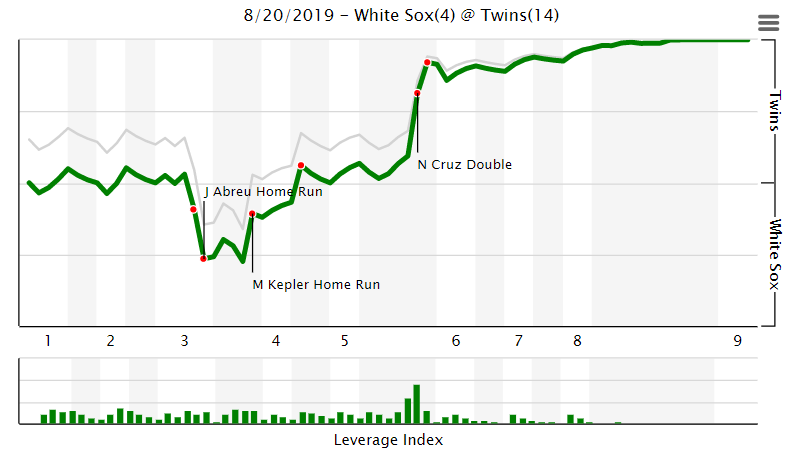 Box Score Pineda: 7 IP, 6 H, 4 ER, 0 BB, 4 K, 79.5% strikes (70 of 88 pitches) Home Runs: Kepler (34), Cruz (33), Polanco (19) Multi-Hit Games: Kepler (2 for 5, 2B, HR), Cruz (4 for 5, 3 2B, HR), Rosario (2 for 5) WPA of +0.1: Cruz .347, Kepler .176 WPA of -0.1: None The pitchers were in control of this game in its early stages, as they both breezed through the first couple of innings, facing just one more batter than the minimum between the two pitchers. However, that narrative took a 180 in the third inning, when both teams found their bats. In the top of the third, Michael Pineda was one out away from another quick inning, leaving just a runner on first. That all changed when Tim Anderson roped a double down the first-base line that ricocheted off the side wall, and away from Jake Cave, allowing Yolmer Sanchez to score from first. Jose Abreu followed that up with another third-inning home run, putting the White Sox 3-0. Mitch Garver led off the bottom of the third with a double into the right-center field gap, for the Twins first baserunner of the game. Garver advanced to third on a Marwin Gonzalez groundout, but was still standing there with two outs, after Jake Cave struck out. No worries though, as Max Kepler, who was back in the lineup after missing last night’s game as a result of the heat exhaustion he suffered over the weekend in Texas, came through with a two-out, two-run home run to cut the White Sox lead down to one. https://twitter.com/Twins/status/1163982251778068480 After a strong showing in his return from the injured list last night, Nelson Cruz showed everyone that the ruptured tendon in his left wrist wasn’t going to slow him down, as he took Reynaldo Lopez deep to left field, to tie the game at three. https://twitter.com/Twins/status/1163984405695737856 After tying the game up in the bottom of the fourth, Nelson Cruz gave the Twins their first lead of the game, just an inning later. A lead they would not look back from. The inning didn’t look like it was going to be anything much after Mitch Garver and Marwin Gonzalez both grounded out to leadoff the inning. Jake Cave then followed that up with an opposite field single, extending his modest hit streak to eight games. Max Kepler then nubbed the ball two feet in front of home plate, but the inning was kept alive when Jose Abreu inexplicably missed the catch on the throw to first. Jorge Polanco kept the inning going when he was hit by a pitch to load the bases for Nelson Cruz, who promptly delivered with a two-run double off the wall in right. On the very next pitch, Eddie Rosario followed that up with a base hit, bringing in both Polanco and Cruz to extend the Twins lead to four. Tim Anderson led off the top of the sixth inning with a home run, which was the fourth earned run allowed by Michael Pineda on the night. That marks just the second start for Pineda since the beginning of May, when he has allowed more than three earned runs. The Twins busted the game wide open with a seven-run inning in the bottom of the eighth. The inning was highlighted by two doubles from Nelson Cruz, a bases clearing double from C.J. Cron, RBI-doubles from both Miguel Sano and Max Kepler, and a two-run home run by Jorge Polanco. https://twitter.com/Twins/status/1164008893363687425 https://twitter.com/fsnorth/status/1164008567449407488 Bullpen Usage Here’s a quick look at the number of pitches thrown by the bullpen over the past five days: Next Three Games Wed vs CHW, 12:10 pm CT (Giolito-Odorizzi) Fri vs DET, 7:10 pm CT (TBD-TBD) Sat vs DET, 6:10 pm CT (TBD-TBD) Last Game Twins Game Recap (8/19): Twins Unable to Mount Comeback, Drop Series Opener 6-4
 -
I was able to find it on Fangraphs pretty easy. If you don’t have access to the Play Index, that could be hard to find on baseball reference.
-
Never The Twins have only had 8 seasons of a player hitting 40 home runs, and 7 of them were Harmon Killebrew. The other was Brian Dozier.
- 86 replies
-
- 14
-

-
- minnesota twins
- chicago white sox
- (and 2 more)
-
Monday night was a bit of a come down to earth for the Minnesota Twins, who cruised their way to a four-game sweep against the Texas Rangers over the weekend. However, the Twins jumped right back on the gas pedal last night again, putting up 14 runs on 10 extra-base hits against the Chicago White Sox. In New York, the Mets took care of business, beating the Cleveland Indians by a score of 9 to 2, which helped the Twins extend their lead in the division back up to three games. Image courtesy of FanGraphs Monday night was a bit of a come down to earth for the Minnesota Twins, who cruised their way to a four-game sweep against the Texas Rangers over the weekend. However, the Twins jumped right back on the gas pedal last night again, putting up 14 runs on 10 extra-base hits against the Chicago White Sox. In New York, the Mets took care of business, beating the Cleveland Indians by a score of 9 to 2, which helped the Twins extend their lead in the division back up to three games. Box Score Pineda: 7 IP, 6 H, 4 ER, 0 BB, 4 K, 79.5% strikes (70 of 88 pitches) Home Runs: Kepler (34), Cruz (33), Polanco (19) Multi-Hit Games: Kepler (2 for 5, 2B, HR), Cruz (4 for 5, 3 2B, HR), Rosario (2 for 5) WPA of +0.1: Cruz .347, Kepler .176 WPA of -0.1: None The pitchers were in control of this game in its early stages, as they both breezed through the first couple of innings, facing just one more batter than the minimum between the two pitchers. However, that narrative took a 180 in the third inning, when both teams found their bats. In the top of the third, Michael Pineda was one out away from another quick inning, leaving just a runner on first. That all changed when Tim Anderson roped a double down the first-base line that ricocheted off the side wall, and away from Jake Cave, allowing Yolmer Sanchez to score from first. Jose Abreu followed that up with another third-inning home run, putting the White Sox 3-0. Mitch Garver led off the bottom of the third with a double into the right-center field gap, for the Twins first baserunner of the game. Garver advanced to third on a Marwin Gonzalez groundout, but was still standing there with two outs, after Jake Cave struck out. No worries though, as Max Kepler, who was back in the lineup after missing last night’s game as a result of the heat exhaustion he suffered over the weekend in Texas, came through with a two-out, two-run home run to cut the White Sox lead down to one. https://twitter.com/Twins/status/1163982251778068480 After a strong showing in his return from the injured list last night, Nelson Cruz showed everyone that the ruptured tendon in his left wrist wasn’t going to slow him down, as he took Reynaldo Lopez deep to left field, to tie the game at three. https://twitter.com/Twins/status/1163984405695737856 After tying the game up in the bottom of the fourth, Nelson Cruz gave the Twins their first lead of the game, just an inning later. A lead they would not look back from. The inning didn’t look like it was going to be anything much after Mitch Garver and Marwin Gonzalez both grounded out to leadoff the inning. Jake Cave then followed that up with an opposite field single, extending his modest hit streak to eight games. Max Kepler then nubbed the ball two feet in front of home plate, but the inning was kept alive when Jose Abreu inexplicably missed the catch on the throw to first. Jorge Polanco kept the inning going when he was hit by a pitch to load the bases for Nelson Cruz, who promptly delivered with a two-run double off the wall in right. On the very next pitch, Eddie Rosario followed that up with a base hit, bringing in both Polanco and Cruz to extend the Twins lead to four. Tim Anderson led off the top of the sixth inning with a home run, which was the fourth earned run allowed by Michael Pineda on the night. That marks just the second start for Pineda since the beginning of May, when he has allowed more than three earned runs. The Twins busted the game wide open with a seven-run inning in the bottom of the eighth. The inning was highlighted by two doubles from Nelson Cruz, a bases clearing double from C.J. Cron, RBI-doubles from both Miguel Sano and Max Kepler, and a two-run home run by Jorge Polanco. https://twitter.com/Twins/status/1164008893363687425 https://twitter.com/fsnorth/status/1164008567449407488 Bullpen Usage Here’s a quick look at the number of pitches thrown by the bullpen over the past five days: Next Three Games Wed vs CHW, 12:10 pm CT (Giolito-Odorizzi) Fri vs DET, 7:10 pm CT (TBD-TBD) Sat vs DET, 6:10 pm CT (TBD-TBD) Last Game Twins Game Recap (8/19): Twins Unable to Mount Comeback, Drop Series Opener 6-4 View full article
- 86 replies
-
- 2
-
-
- minnesota twins
- chicago white sox
- (and 2 more)
-
In a season full of pleasant surprises for the Minnesota Twins, there are perhaps none more so than the play of third-year catcher Mitch Garver. After being thrust into a bigger role than expected in 2018, thanks to Jason Castro going down with a season-ending knee injury, Garver has settled back in this season, splitting time, almost 50/50, with Castro. As a result, the Twins have been able to keep Garver fresh, and leverage him in the best way possible, to maximize his abilities. Among the 29 catchers with at least 250 plate appearances this season, Garver’s 140 wRC+ is in a distant first place. This is helped, in large part, by the 23 home runs he has belted, which is second among all MLB catchers. However, Garver’s improvement at the plate isn’t the only step forward he has taken this year, as he has improved dramatically behind the plate, as well. Image courtesy of © Kim Klement-USA TODAY Sports In a season full of pleasant surprises for the Minnesota Twins, there are perhaps none more so than the play of third-year catcher Mitch Garver. After being thrust into a bigger role than expected in 2018, thanks to Jason Castro going down with a season-ending knee injury, Garver has settled back in this season, splitting time, almost 50/50, with Castro. As a result, the Twins have been able to keep Garver fresh, and leverage him in the best way possible, to maximize his abilities. Among the 29 catchers with at least 250 plate appearances this season, Garver’s 140 wRC+ is in a distant first place. This is helped, in large part, by the 23 home runs he has belted, which is second among all MLB catchers. However, Garver’s improvement at the plate isn’t the only step forward he has taken this year, as he has improved dramatically behind the plate, as well. During the offseason, and into spring training, we heard a lot about the work Twins Catching Coordinator Tanner Swanson, was putting in with Twins catchers to improve their defense behind the plate, specifically with regard to framing pitches in the strike zone. Mitch Garver was the main point of emphasis, as he was known for being a poor pitch framer as he was coming up through the minor leagues. This was apparent in his first full season in the bigs. Among the 60 qualified catchers in 2018 (who received at least six called pitches per team game), Garver ranked 58th, with a strike called rate of just 42 percent. However, Garver has made quite the improvement in 2019, as his strike called rate has jumped up to 47.7 percent, which ranks 34th, among the 59 catchers who qualify. While you still wouldn’t confuse Garver for one of the best pitch framers in the game, a jump from the bottom of the pack, all the way up to around league average, is a drastic improvement. Note, only pitches on or near the edge of the strike zone were included in this sample, as those are the ones where catcher framing is most evident. So, what changes has Mitch Garver made to improve his pitch framing abilities so much from one season to the next? The most apparent change is with Garver’s stance behind the plate. Here are a couple of clips, comparing Garver’s stance from last year to this year. Mitch Garver 2018 Mitch Garver 2019 From these clips, it is apparent that Garver has taken the new approach of going down to one knee, which allows him to get lower, as he receives the pitch. This helps Garver when he is trying to frame a low pitch, as the pitch appears to be higher to the umpire that it actually is, because Garver is catching pitches at the bottom of the strike zone at chest level, as opposed to stabbing down at the ball with his glove. That is, at least in theory, how it is supposed to work, but is this actually helping Garver better frame those lower pitches? Let’s go to the data, available on Baseball Savant, to find out. In the diagram below, there are three charts, illustrating three different areas surrounding the strike zone. The strike zone itself is represented by the green dotted rectangle, so the three zones are made up of areas that are half in, and half out, of the strike zone. In theory, the percentage of the called strikes, on non-swings, should be equivalent to the percentage of the area of the zone that is inside of the strike zone. For reference, among pitches that were not swung at, so far in 2019, 34 percent of pitches in Zone 17 have been called a strike, 50 percent of pitches in Zone 18 have been called a strike, and 26 percent of the pitches in Zone 19 have been called a strike. In 2018, Mitch Garver checked in well below average, as a pitch framer in each of these three zones, as he had a called strike percentage of just 28.4%, 33.7% and 15.2%, in zones 17, 18 and 19, respectively. Compared to other catchers in those zones, Garver ranked 47th in Zone 17, 59th in Zone 18, and 57th in Zone 19, among the 60 catchers who received enough pitches to qualify, in 2018. Clearly, Garver needed to improve his pitch framing abilities in the bottom part of the zone. Fast forward to 2019, and he has done exactly that. Garver’s called strike rate in Zone 17 is up to 36.8%, in Zone 18 it is up to 54.8%, and in Zone 19 it is up to 29.3%. Those percentages have Garver ranking 20th, 15th, and 21st, among the 59 qualified catchers, this season, in those three zones respectively. That is a remarkable improvement from one of the worst pitch framers at the bottom of the zone, to being well above-average after just one offseason’s worth of work. You really need to tip your cap to Garver, Tanner Swanson, and anyone else that played a part in improving his pitch framing abilities. With the looming reality that umpires may soon be no longer calling balls and strikes in major league baseball games, pitch framing might become a moot point in the not too distant future, but for now, it is still a very important part of the game, and one that can have a lot of impact on a pitching staff’s overall numbers. As Tanner Swanson and company continue to work with Mitch Garver, we might see even more improvements in his pitch framing abilities. View full article
- 3 replies
-
- 1
-
-
- mitch garver
- pitch framing
- (and 2 more)
-
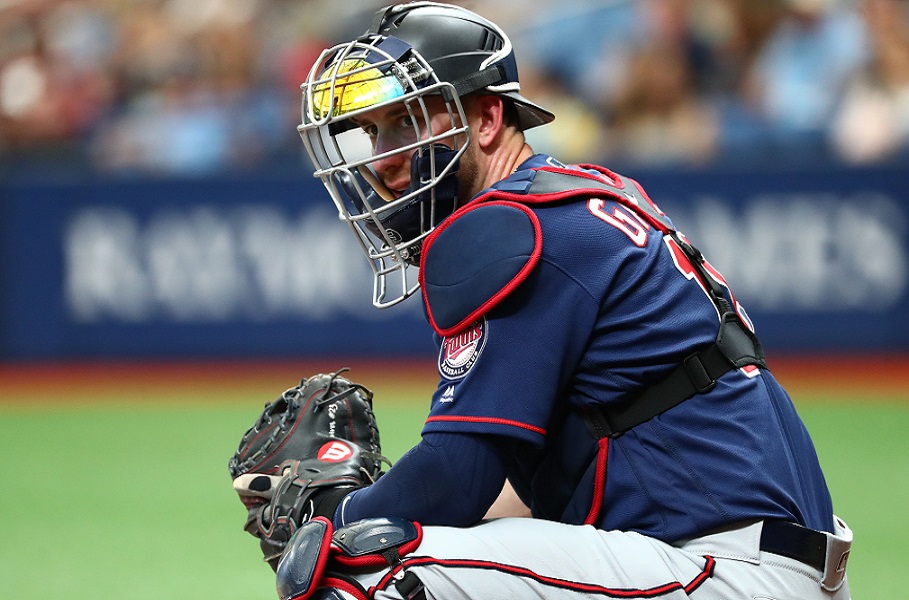 During the offseason, and into spring training, we heard a lot about the work Twins Catching Coordinator Tanner Swanson, was putting in with Twins catchers to improve their defense behind the plate, specifically with regard to framing pitches in the strike zone. Mitch Garver was the main point of emphasis, as he was known for being a poor pitch framer as he was coming up through the minor leagues. This was apparent in his first full season in the bigs. Among the 60 qualified catchers in 2018 (who received at least six called pitches per team game), Garver ranked 58th, with a strike called rate of just 42 percent. However, Garver has made quite the improvement in 2019, as his strike called rate has jumped up to 47.7 percent, which ranks 34th, among the 59 catchers who qualify. While you still wouldn’t confuse Garver for one of the best pitch framers in the game, a jump from the bottom of the pack, all the way up to around league average, is a drastic improvement. Note, only pitches on or near the edge of the strike zone were included in this sample, as those are the ones where catcher framing is most evident. So, what changes has Mitch Garver made to improve his pitch framing abilities so much from one season to the next? The most apparent change is with Garver’s stance behind the plate. Here are a couple of clips, comparing Garver’s stance from last year to this year. Mitch Garver 2018 Mitch Garver 2019 From these clips, it is apparent that Garver has taken the new approach of going down to one knee, which allows him to get lower, as he receives the pitch. This helps Garver when he is trying to frame a low pitch, as the pitch appears to be higher to the umpire that it actually is, because Garver is catching pitches at the bottom of the strike zone at chest level, as opposed to stabbing down at the ball with his glove. That is, at least in theory, how it is supposed to work, but is this actually helping Garver better frame those lower pitches? Let’s go to the data, available on Baseball Savant, to find out. In the diagram below, there are three charts, illustrating three different areas surrounding the strike zone. The strike zone itself is represented by the green dotted rectangle, so the three zones are made up of areas that are half in, and half out, of the strike zone. In theory, the percentage of the called strikes, on non-swings, should be equivalent to the percentage of the area of the zone that is inside of the strike zone. For reference, among pitches that were not swung at, so far in 2019, 34 percent of pitches in Zone 17 have been called a strike, 50 percent of pitches in Zone 18 have been called a strike, and 26 percent of the pitches in Zone 19 have been called a strike. In 2018, Mitch Garver checked in well below average, as a pitch framer in each of these three zones, as he had a called strike percentage of just 28.4%, 33.7% and 15.2%, in zones 17, 18 and 19, respectively. Compared to other catchers in those zones, Garver ranked 47th in Zone 17, 59th in Zone 18, and 57th in Zone 19, among the 60 catchers who received enough pitches to qualify, in 2018. Clearly, Garver needed to improve his pitch framing abilities in the bottom part of the zone. Fast forward to 2019, and he has done exactly that. Garver’s called strike rate in Zone 17 is up to 36.8%, in Zone 18 it is up to 54.8%, and in Zone 19 it is up to 29.3%. Those percentages have Garver ranking 20th, 15th, and 21st, among the 59 qualified catchers, this season, in those three zones respectively. That is a remarkable improvement from one of the worst pitch framers at the bottom of the zone, to being well above-average after just one offseason’s worth of work. You really need to tip your cap to Garver, Tanner Swanson, and anyone else that played a part in improving his pitch framing abilities. With the looming reality that umpires may soon be no longer calling balls and strikes in major league baseball games, pitch framing might become a moot point in the not too distant future, but for now, it is still a very important part of the game, and one that can have a lot of impact on a pitching staff’s overall numbers. As Tanner Swanson and company continue to work with Mitch Garver, we might see even more improvements in his pitch framing abilities.
 -
Just trying to get this up as quick as possible after the game, so the comment section can open up. I go back and make edits after it is up.
- 27 replies
-
- 7
-
-
- minnesota twins
- texas rangers
- (and 2 more)
-
After the Minnesota Twins took the first two games of the series, on Thursday and Friday night, they were looking to clinch the series win on Saturday, against the Texas Rangers. Despite yet another poor outing from Jose Berrios, the Twins were able to do just that, defeating Texas 12-7 thanks to yet another great offensive outburst from the lineup. With the New York Yankees taking care of business against the Cleveland Indians earlier today, the Twins lead, in the American League Central, is back up to 2.5 games. Image courtesy of FanGraphs After the Minnesota Twins took the first two games of the series, on Thursday and Friday night, they were looking to clinch the series win on Saturday, against the Texas Rangers. Despite yet another poor outing from Jose Berrios, the Twins were able to do just that, defeating Texas 12-7 thanks to yet another great offensive outburst from the lineup. With the New York Yankees taking care of business against the Cleveland Indians earlier today, the Twins lead, in the American League Central, is back up to 2.5 games. Box Score Berrios: 4.1 IP, 7 H, 3 ER, 3 BB, 6 K, 62.0% strikes (57 of 92 pitches) Home Runs: Cron (20), Sano (23) Multi-Hit Games: Kepler (2 for 5, BB), Sano (3 for 6, HR), Polanco (3 for 5, BB), Gonzalez (3 for 5), Cron (2 for 4, HR), Cave (3 for 5) WPA of +0.1: Duffey .208, May .156, Gonzalez .151, Cron .139 WPA of -0.1: Berrios -.366, It was a fast start for the Twins, who busted open the floodgates before the Rangers even came to the plate, scoring six, count’em six, runs in the top of the first inning. Max Kepler leadoff the inning with a groundout to Rangers second baseman Rougned Odor, but that was quickly followed by singles from Miguel Sano and Jorge Polanco. The inning looked like it was going to come to a quick end, however, when Eddie Rosario hit a groundball to Rangers first baseman Logan Forsythe. Forsythe went to second with the throw, getting Polanco, but the return throw was a little high, and deflected off the glove of Rangers pitcher Ariel Jurado, who was coving first on the play. With the extra life, the Twins took full advantage. Mitch Garver, Luis Arraez, and Marwin Gonzalez combined to go walk, single, double to bring the score to 4-0, Twins. C.J. Cron followed that up with his 20th home run of the season, tying the 1964 Twins for the team record, for the most players with 20 home runs in a season, at six. https://twitter.com/fsnorth/status/1162896319167385600 Old friend Danny Santana answered back in the bottom of the first with a two-run home run of his own, cutting the Twins lead back down to four. Believe it or not, Santana has morphed himself into a whole new hitter in 2019, as he has already hit 21 home runs this season. For comparison, Santana hit just 38 home runs in the nine combined season he played for the Twins, and their minor league affiliates, between 2008 and 2016. The Twins answered right back in the top of the second, adding a couple more runs, to extend their lead back up to six. With the top of the order leading off for the second straight inning, the Twins had three straight runners reach bases with nobody out. Eddie Rosario was able to drive in Kepler from third, with a sac-fly to Rangers center fielder Danny Santana. In the next at-bat, Mitch Garver was able to beat out a potential double-play ball, bringing in the Twins second run of the inning. Unfortunately for the Twins, the Rangers were up to the tasks tonight, as they themselves, punched right back in the bottom of the second. Rougned Odor drew a leadoff walk, which set the table for a rough inning for Jose Berrios, and the Twins defense. Logan Forsythe followed up the Odor walk by drilling a groundball to third baseman Miguel Sano. Sano was unable to field the grounder, and the Rangers quickly had runners on second and third with nobody out. After a Isiah Kiner-Falefa RBI-single, a Jose Trevino strikeout out, and a Shin-Soo Choo RBI-groundout, Danny Santana connected on his second, two-run home run of the evening, off of Jose Berrios. Due to the Sano error, none of the four Ranger runs in the second inning were earned. After a couple of loud innings to begin the ballgame, it was quiet for a couple innings, until the Twins were able to build on their lead in the fifth. With one out in the inning, the Twins were able to quickly load the bases for Max Kepler, who came through with an RBI-single. Unfortunately, that is all the Twins were able to get in the inning. In the bottom of the inning, the Rangers yet again showed they were up for the fight. After Jose Berrios finally retired Danny Santana to start the inning, he gave up a pair of singles and a pair of walks. That closed the book on Berrios for the night, and Tyler Duffey was brought in to protect a the Twins two-run lead, with the bases loaded and just one out, and that is exactly what he did, striking out Logan Forsythe and getting Isiah Kiner-Falefa to flyout to end the inning. There was some controversy from the Twins dugout in the top of the seventh inning. With one out, and nobody on, C.J. Cron hit a flyball down the right field line that was ruled foul, but upon further review, it appeared as though the ball was clearly fair. However, Rocco Baldelli was instructed not to challenge the call. This was a highly questionably call, not because it would have been an easy overturn, but because the game was in the seventh inning, so there was virtually no risk in challenging and getting the call wrong. This all became a moot point, when the Twins were able to tack on insurance runs in the eighth and ninth innings, thanks to a Mitch Garver RBI-single in the eighth, and this Miguel Sano two-run home run in the ninth. https://twitter.com/fsnorth/status/1162938203151581184 The bullpen was up to the task again tonight for the Twins, who pitch 4 and 2/3 scoreless innings. In addition to Tyler Duffey getting out of the jam earlier, Ryne Harper pitched a scoreless inning, Trevor May was dominant, pitching two perfect innings, and Zack Littell closed the door in the 9th. Bullpen Usage Here’s a quick look at the number of pitches thrown by the bullpen over the past five days: Next Three Games Sun at TEX, 2:05 pm CT (Perez-Lynn) Mon vs CHW, 7:10 pm CT (Nova-TBD) Tues vs CHW, 7:10 pm CT (Lopez-TBD) Last Game Twins Game Recap (8/16): Twins Prevail Behind Clutch Schoop HR, Great Bullpen Performance View full article
- 27 replies
-
- 1
-
-
- minnesota twins
- texas rangers
- (and 2 more)
-
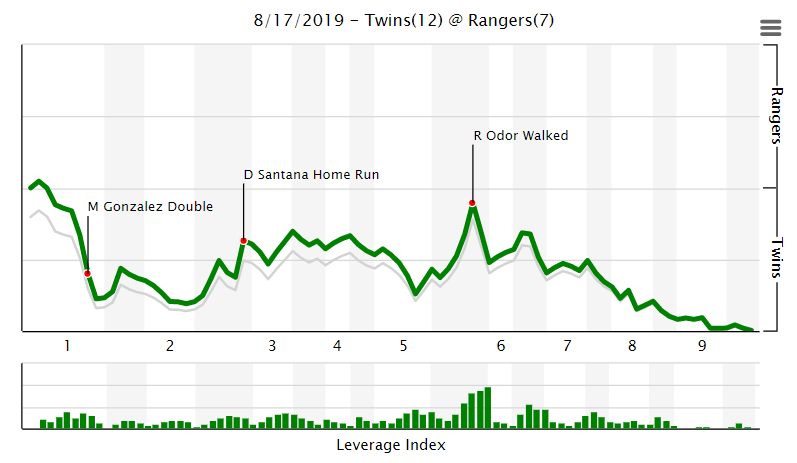 Box Score Berrios: 4.1 IP, 7 H, 3 ER, 3 BB, 6 K, 62.0% strikes (57 of 92 pitches) Home Runs: Cron (20), Sano (23) Multi-Hit Games: Kepler (2 for 5, BB), Sano (3 for 6, HR), Polanco (3 for 5, BB), Gonzalez (3 for 5), Cron (2 for 4, HR), Cave (3 for 5) WPA of +0.1: Duffey .208, May .156, Gonzalez .151, Cron .139 WPA of -0.1: Berrios -.366, It was a fast start for the Twins, who busted open the floodgates before the Rangers even came to the plate, scoring six, count’em six, runs in the top of the first inning. Max Kepler leadoff the inning with a groundout to Rangers second baseman Rougned Odor, but that was quickly followed by singles from Miguel Sano and Jorge Polanco. The inning looked like it was going to come to a quick end, however, when Eddie Rosario hit a groundball to Rangers first baseman Logan Forsythe. Forsythe went to second with the throw, getting Polanco, but the return throw was a little high, and deflected off the glove of Rangers pitcher Ariel Jurado, who was coving first on the play. With the extra life, the Twins took full advantage. Mitch Garver, Luis Arraez, and Marwin Gonzalez combined to go walk, single, double to bring the score to 4-0, Twins. C.J. Cron followed that up with his 20th home run of the season, tying the 1964 Twins for the team record, for the most players with 20 home runs in a season, at six. https://twitter.com/fsnorth/status/1162896319167385600 Old friend Danny Santana answered back in the bottom of the first with a two-run home run of his own, cutting the Twins lead back down to four. Believe it or not, Santana has morphed himself into a whole new hitter in 2019, as he has already hit 21 home runs this season. For comparison, Santana hit just 38 home runs in the nine combined season he played for the Twins, and their minor league affiliates, between 2008 and 2016. The Twins answered right back in the top of the second, adding a couple more runs, to extend their lead back up to six. With the top of the order leading off for the second straight inning, the Twins had three straight runners reach bases with nobody out. Eddie Rosario was able to drive in Kepler from third, with a sac-fly to Rangers center fielder Danny Santana. In the next at-bat, Mitch Garver was able to beat out a potential double-play ball, bringing in the Twins second run of the inning. Unfortunately for the Twins, the Rangers were up to the tasks tonight, as they themselves, punched right back in the bottom of the second. Rougned Odor drew a leadoff walk, which set the table for a rough inning for Jose Berrios, and the Twins defense. Logan Forsythe followed up the Odor walk by drilling a groundball to third baseman Miguel Sano. Sano was unable to field the grounder, and the Rangers quickly had runners on second and third with nobody out. After a Isiah Kiner-Falefa RBI-single, a Jose Trevino strikeout out, and a Shin-Soo Choo RBI-groundout, Danny Santana connected on his second, two-run home run of the evening, off of Jose Berrios. Due to the Sano error, none of the four Ranger runs in the second inning were earned. After a couple of loud innings to begin the ballgame, it was quiet for a couple innings, until the Twins were able to build on their lead in the fifth. With one out in the inning, the Twins were able to quickly load the bases for Max Kepler, who came through with an RBI-single. Unfortunately, that is all the Twins were able to get in the inning. In the bottom of the inning, the Rangers yet again showed they were up for the fight. After Jose Berrios finally retired Danny Santana to start the inning, he gave up a pair of singles and a pair of walks. That closed the book on Berrios for the night, and Tyler Duffey was brought in to protect a the Twins two-run lead, with the bases loaded and just one out, and that is exactly what he did, striking out Logan Forsythe and getting Isiah Kiner-Falefa to flyout to end the inning. There was some controversy from the Twins dugout in the top of the seventh inning. With one out, and nobody on, C.J. Cron hit a flyball down the right field line that was ruled foul, but upon further review, it appeared as though the ball was clearly fair. However, Rocco Baldelli was instructed not to challenge the call. This was a highly questionably call, not because it would have been an easy overturn, but because the game was in the seventh inning, so there was virtually no risk in challenging and getting the call wrong. This all became a moot point, when the Twins were able to tack on insurance runs in the eighth and ninth innings, thanks to a Mitch Garver RBI-single in the eighth, and this Miguel Sano two-run home run in the ninth. https://twitter.com/fsnorth/status/1162938203151581184 The bullpen was up to the task again tonight for the Twins, who pitch 4 and 2/3 scoreless innings. In addition to Tyler Duffey getting out of the jam earlier, Ryne Harper pitched a scoreless inning, Trevor May was dominant, pitching two perfect innings, and Zack Littell closed the door in the 9th. Bullpen Usage Here’s a quick look at the number of pitches thrown by the bullpen over the past five days: Next Three Games Sun at TEX, 2:05 pm CT (Perez-Lynn) Mon vs CHW, 7:10 pm CT (Nova-TBD) Tues vs CHW, 7:10 pm CT (Lopez-TBD) Last Game Twins Game Recap (8/16): Twins Prevail Behind Clutch Schoop HR, Great Bullpen Performance
 -
"Unwritten Rule" Gets Max Kepler Hit By A Pitch
Andrew Thares replied to John Bonnes's topic in Twins Daily Front Page News
I have no issue with what Cave did. The balance of the game might not be at stake, but the balance of Jake Cave's career is very much at stake in every plate appearance. Last time I checked, pitchers don't just start lobbing the ball over the plate when the game is out of hand, so why should we expect hitters to take the at-bat off? The only person at fault here is the Rangers pitcher, if he was indeed intentionally throwing at Kepler.- 93 replies
-
- 18
-
-
- jake cave
- max kepler
- (and 2 more)
-
After a brutal weekend series against the Cleveland Indians, the Minnesota Twins needed an easy win, along with some help from the Boston Red Sox, to regain the division lead. For a while it looked like that would be the case, as the Twins held a 4-1 lead over the Brewers and the Red Sox, a 6-1 lead over the Indians in the later innings. However, easy would not even come close to describing how things went down to give the Twins back the lead in the AL Central. Image courtesy of FanGraphs After a brutal weekend series against the Cleveland Indians, the Minnesota Twins needed an easy win, along with some help from the Boston Red Sox, to regain the division lead. For a while it looked like that would be the case, as the Twins held a 4-1 lead over the Brewers and the Red Sox, a 6-1 lead over the Indians in the later innings. However, easy would not even come close to describing how things went down to give the Twins back the lead in the AL Central. Box Score Perez: 6 IP, 6 H, 0 ER, 4 BB, 3 K, 61.4% strikes (54 of 88 pitches) Home Runs: Garver (22), Gonzalez (14) Multi-Hit Games: Rosario (2 for 4, BB), Gonzalez (2 for 4, HR) WPA of +0.1: Gonzalez .593, Perez .252, Rosario .153, Garver .128, WPA of -0.1: Harper -.670, Cron -.103 Martin Perez worked himself into a little bit of trouble in the first after allowing a couple of singles to Keston Hiura and Ryan Braun, though he was able to work out of it when Yasmani Grandal flew out to Eddie Rosario in left. The Twins were able to get a threat of their own going in the top of the second, thanks to a Luis Arraez base hit and a C.J. Cron hit-by-pitch, both coming with one out. However, with the game being played in a National League ballpark, the Twins' hopes of scoring in the inning relied almost entirely on the number eight hitter Marwin Gonzalez to come though with a hit. Once he flew out, Martin Perez, who has just one career hit, came to the plate and promptly struck out, ending the Twins threat. The Twins were able to get the scoring going in the top of the third thanks to a Max Kepler leadoff walk, followed by Mitch Garver blasting his 22nd home run of the season. Garver is now just three home runs behind Gary Sanchez for the most home runs by a catcher in the American League, despite having roughly 90 fewer plate appearances. https://twitter.com/Twins/status/1161442507810574336 After the Garver home run, the Twins bats were able to tack on another run. Eddie Rosario drew a rare walk, with one out in the inning, which was followed by a Miguel Sano groundball single, thanks to a lack of communication among the Brewers infielders. This set the table for Luis Arraez, who was able to bring Rosario in from third with an RBI-groundout. In the bottom of the third, the Brewers put together a two-out rally after a Ryan Braun walk and a Yasmani Grandal single. This brought Mike Moustakas to the plate, who appeared to have an RBI-single, before Jorge Polanco made this spectacular play to end the inning. https://twitter.com/AdamMcCalvy/status/1161446348148957185 After Martin Perez escaped unscathed through the first three innings, the Brewers were able to bring a run across the plate in the fourth. With one out, the Brewers number eight hitter, Hernan Perez singled, setting up an obvious bunt situation with Brewers pitcher Chase Anderson coming to the plate. Anderson was able to get the bunt down, and Martin Perez seemed to execute it perfectly, going to second to easily get the lead runner. However the throw from Perez sailed a bit and bounced off Jorge Polanco’s glove, and instead of a potential inning-ending double play, the Brewers had first and third with just one out. They were able to bring the run home on the next batter, when Lorenzo Cain just barely beat out the doubleplay relay throw. The Twins were able to extend their lead back up to three in the top of the seventh. Marwin Gonzalez got the inning started with a leadoff single, then Ehrie Adrianza came through with a pinch-hit RBI double. Unfortunately, Adrianza was stranded on the bases, preventing what could have been a big inning that could have burst the game open. That came back to haunt the Twins in the bottom of the inning, when Ryne Harper gave up four runs, without recording an out, capped off by this three-run home run by Yasmani Grandal. https://twitter.com/Brewers/status/1161469345798774784 To make matters worse, at that exact same moment, the Cleveland Indians came back from a 6-1 deficit to tie the game in the bottom of the ninth, thanks to a Francisco Lindor double. Fortunately for the Twins, the Red Sox were able to get out of the inning to force extras, where Jackie Bradley Jr. came up big with a go-ahead home run. In the bottom of the 10th, Andrew Cashner, of all people, came in and closed the door on the Indians loss. Back in Milwaukee, things still looked bleak for the Twins in the top of the eighth. Despite a leadoff double from Eddie Rosario, which was followed by a Miguel Sano walk, Luis Arraez and C.J. Cron were unable to even advance them. This set the table for one of the biggest at-bats for the Twins all season. With two-outs, and the tying run on second, the Brewers turned to shutdown closer Josh Hader to face Marwin Gonzalez, and on the first pitch, Gonzalez took Hader deep to left-center field for a three-run home run, putting the Twins back up by a score of 7-5. https://twitter.com/fsnorth/status/1161477762990792704 With Taylor Rogers apparently unavailable for tonight’s game, Rocco Baldelli had to turn to trade-deadline acquisitions Sam Dyson, who came back off the injured list tonight, and Sergio Romo, to close the door on the Twins victory. After Dyson went 1-2-3 in the bottom of the eighth, Romo was able to finish off the save in the ninth, giving the Twins one of their biggest wins of the season. https://twitter.com/fsnorth/status/1161487732868354051 Bullpen Usage Here’s a quick look at the number of pitches thrown by the bullpen over the past five days: Next Three Games Wed at MIL, 1:10 pm CT (Gibson-TBD) Thu at TEX, 7:05 pm CT (TBD-Payano) Fri at TEX, 7:05 pm CT (TBD-TBD) Last Game Twins Game Recap (8/11): Frustrating Loss Marred by Heartbreaking Moments View full article
- 46 replies
-
- 2
-
-
- minnesota twins
- milwaukee brewers
- (and 2 more)
-
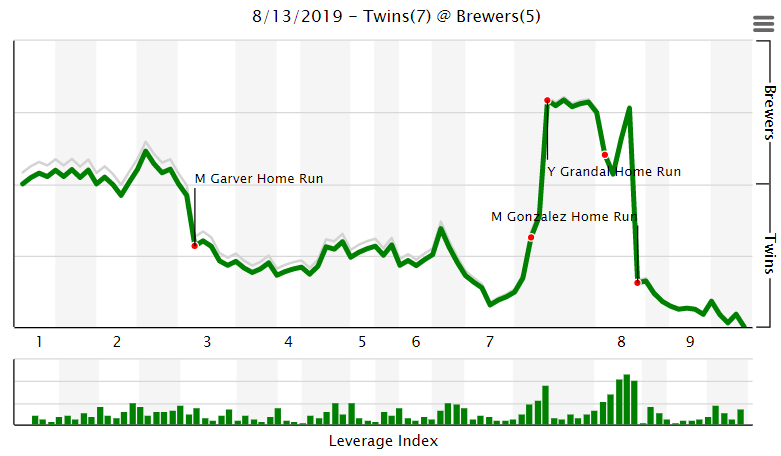 Box Score Perez: 6 IP, 6 H, 0 ER, 4 BB, 3 K, 61.4% strikes (54 of 88 pitches) Home Runs: Garver (22), Gonzalez (14) Multi-Hit Games: Rosario (2 for 4, BB), Gonzalez (2 for 4, HR) WPA of +0.1: Gonzalez .593, Perez .252, Rosario .153, Garver .128, WPA of -0.1: Harper -.670, Cron -.103 Martin Perez worked himself into a little bit of trouble in the first after allowing a couple of singles to Keston Hiura and Ryan Braun, though he was able to work out of it when Yasmani Grandal flew out to Eddie Rosario in left. The Twins were able to get a threat of their own going in the top of the second, thanks to a Luis Arraez base hit and a C.J. Cron hit-by-pitch, both coming with one out. However, with the game being played in a National League ballpark, the Twins' hopes of scoring in the inning relied almost entirely on the number eight hitter Marwin Gonzalez to come though with a hit. Once he flew out, Martin Perez, who has just one career hit, came to the plate and promptly struck out, ending the Twins threat. The Twins were able to get the scoring going in the top of the third thanks to a Max Kepler leadoff walk, followed by Mitch Garver blasting his 22nd home run of the season. Garver is now just three home runs behind Gary Sanchez for the most home runs by a catcher in the American League, despite having roughly 90 fewer plate appearances. https://twitter.com/Twins/status/1161442507810574336 After the Garver home run, the Twins bats were able to tack on another run. Eddie Rosario drew a rare walk, with one out in the inning, which was followed by a Miguel Sano groundball single, thanks to a lack of communication among the Brewers infielders. This set the table for Luis Arraez, who was able to bring Rosario in from third with an RBI-groundout. In the bottom of the third, the Brewers put together a two-out rally after a Ryan Braun walk and a Yasmani Grandal single. This brought Mike Moustakas to the plate, who appeared to have an RBI-single, before Jorge Polanco made this spectacular play to end the inning. https://twitter.com/AdamMcCalvy/status/1161446348148957185 After Martin Perez escaped unscathed through the first three innings, the Brewers were able to bring a run across the plate in the fourth. With one out, the Brewers number eight hitter, Hernan Perez singled, setting up an obvious bunt situation with Brewers pitcher Chase Anderson coming to the plate. Anderson was able to get the bunt down, and Martin Perez seemed to execute it perfectly, going to second to easily get the lead runner. However the throw from Perez sailed a bit and bounced off Jorge Polanco’s glove, and instead of a potential inning-ending double play, the Brewers had first and third with just one out. They were able to bring the run home on the next batter, when Lorenzo Cain just barely beat out the doubleplay relay throw. The Twins were able to extend their lead back up to three in the top of the seventh. Marwin Gonzalez got the inning started with a leadoff single, then Ehrie Adrianza came through with a pinch-hit RBI double. Unfortunately, Adrianza was stranded on the bases, preventing what could have been a big inning that could have burst the game open. That came back to haunt the Twins in the bottom of the inning, when Ryne Harper gave up four runs, without recording an out, capped off by this three-run home run by Yasmani Grandal. https://twitter.com/Brewers/status/1161469345798774784 To make matters worse, at that exact same moment, the Cleveland Indians came back from a 6-1 deficit to tie the game in the bottom of the ninth, thanks to a Francisco Lindor double. Fortunately for the Twins, the Red Sox were able to get out of the inning to force extras, where Jackie Bradley Jr. came up big with a go-ahead home run. In the bottom of the 10th, Andrew Cashner, of all people, came in and closed the door on the Indians loss. Back in Milwaukee, things still looked bleak for the Twins in the top of the eighth. Despite a leadoff double from Eddie Rosario, which was followed by a Miguel Sano walk, Luis Arraez and C.J. Cron were unable to even advance them. This set the table for one of the biggest at-bats for the Twins all season. With two-outs, and the tying run on second, the Brewers turned to shutdown closer Josh Hader to face Marwin Gonzalez, and on the first pitch, Gonzalez took Hader deep to left-center field for a three-run home run, putting the Twins back up by a score of 7-5. https://twitter.com/fsnorth/status/1161477762990792704 With Taylor Rogers apparently unavailable for tonight’s game, Rocco Baldelli had to turn to trade-deadline acquisitions Sam Dyson, who came back off the injured list tonight, and Sergio Romo, to close the door on the Twins victory. After Dyson went 1-2-3 in the bottom of the eighth, Romo was able to finish off the save in the ninth, giving the Twins one of their biggest wins of the season. https://twitter.com/fsnorth/status/1161487732868354051 Bullpen Usage Here’s a quick look at the number of pitches thrown by the bullpen over the past five days: Next Three Games Wed at MIL, 1:10 pm CT (Gibson-TBD) Thu at TEX, 7:05 pm CT (TBD-Payano) Fri at TEX, 7:05 pm CT (TBD-TBD) Last Game Twins Game Recap (8/11): Frustrating Loss Marred by Heartbreaking Moments
 -
To say it has been a rough go lately for Martin Perez would be putting it lightly. After posting a 2.95 ERA in 58 innings through May 23rd, the wheels have completely fallen off the wagon. In 12 starts since then, Perez has a 6.47 ERA in 64 innings pitched. Remarkably, the Twins are still 5-7 in those games, but if it weren’t for their great offense, things would be much worse for Perez and the Twins. That is why I fear that leaving Perez in the starting rotation is only tempting fate, and it might be a good time for the Twins to find a different role for him. Image courtesy of © Jordan Johnson-USA TODAY Sports To say it has been a rough go lately for Martin Perez would be putting it lightly. After posting a 2.95 ERA in 58 innings through May 23rd, the wheels have completely fallen off the wagon. In 12 starts since then, Perez has a 6.47 ERA in 64 innings pitched. Remarkably, the Twins are still 5-7 in those games, but if it weren’t for their great offense, things would be much worse for Perez and the Twins. That is why I fear that leaving Perez in the starting rotation is only tempting fate, and it might be a good time for the Twins to find a different role for him. When the Twins first signed Martin Perez, I was one of the people that was on board with this being a good signing, and during the first two months of his Twins tenure, he looked like an excellent addition to the starting rotation. However, in light of how Perez has pitched over the past two months, and given the sense of urgency the Twins are suddenly under, it might be best for them to find a new role for Perez, outside of the starting rotation. This could be a hard move for the Twins front office to make, as it would removing the one addition they made to the starting rotation this past winter, and that’s okay, but now is not the time for pride, now is the time to put the team in the best position to succeed for the stretch run. So, the question still remains, should the Twins take Perez out of the starting rotation? To answer that question, first we should take a look at what has caused Perez to fall off the map after his great start to the season. We will start by looking at the usually obvious culprit, velocity, specifically with his fastball. Perez is a fastball-heavy pitcher, who uses three fastball variations, a cutter, a sinker, and a four-seamer, which make up 73.1 percent of the pitches he has thrown this year. This makes Perez’s velocity an especially important part of his ability to pitch well. Below are a couple of charts, courtesy of Baseball Savant, featuring the month to month average velocity of Perez’s three different fastballs. The chart on the left conveys the decline in velocity that Perez has experienced in both his sinker and four-seamer, while the chart on the right illustrates the increase in velocity Perez has experienced with his cutter as the season has progressed. Now let’s compare those charts to the how hitters have hit each of those pitches this season, again on a month to month bases. Again, the chart on the left features Perez’s sinker and four-seamer, while the chart on the right features Perez’s cutter. This time, these charts show the wOBA Perez has allowed with each of these pitches on a month to month basis in 2019. By comparing these charts, we can gather some valuable information. First, the changes in velocity don’t seem to be having a great effect on Perez’s performance, at least not on his sinker and cutter, which make up just over 75 percent of the fastballs that he throws. Despite the decrease in sinker velocity, Perez’s sinker has actually seen gradual improvement as the season has progressed (except for his two starts so far in August). On the same theme, Perez hasn’t had nearly the same success with his newly introduced cutter as the season has progressed, despite the slight uptick in velocity on that pitch. How can we explain that? The answer to that question might be two-fold. The first, and perhaps most obvious answer is that during the first two months of the season opposing hitters were caught off guard by Martin Perez’s cutter, as it was a new pitch that he had never thrown before. However, after a couple months of success with this new pitch, opposing teams started to adjust by accounting for this pitch in Perez’s repertoire. Another explanation, which coincides with opposing teams adjusting to Perez’s cutter has been the decline of spin rate on the pitch. Here is yet another graph, courtesy of Baseball Savant, that shows the spin rate of Perez’s cutter on a month to month basis in 2019. The combination of these two changes has hindered Martin Perez’s effectiveness with the pitch that gave him his newfound success early on in the season. This is also evident in Perez’s swing and miss rate with his cutter, which has been cut in half over the last few months from where it was during April and May. Now that we see there is clear evidence that Martin Perez is no longer the same pitcher that he was at the beginning of the season, and his performance isn’t just some regression to the mean, it is evident that Perez is no longer pitching at the level that belongs to be in the starting rotation of a team that is in a neck and neck race for a division title. So, what are some of the other options the Twins have for not only Perez, but also the now-open spot in the rotation. First, we will start with how to fill Martin Perez’s current spot in the rotation. The two most likely candidates to fill that role are rookie lefties Devin Smeltzer and Lewis Thorpe. Smeltzer is currently filling in a spot in the rotation for Michael Pineda, who is in the Injured List. However, once Pineda returns from injury Smeltzer could easily transition over to Perez's spot in the rotation. Smeltzer has done an adequate job filling in when the Twins have needed him, but I don’t think he would be my first choice for the job. The pitcher I would turn to would be Lewis Thorpe. Thorpe has been one of the Twins top prospects for a couple of years now, and I think has much more upside potential than Smeltzer does. In five career seasons at the minor league level, Thorpe has a 3.50 ERA while striking out 10.8 batters per nine innings and walking just 2.9 batter per nine innings. So far, in four appearances at the MLB level, Thorpe has shown that he has the stuff to compete at this level. Here are some thoughts from Tom Froemming had on the subject a few nights ago. The next thing to figure out would be what to do with Martin Perez. While he has definitely struggled as a starting pitcher, I don’t think it would be the appropriate move to just cut bait by designating him for assignment. Instead, a better option would be to find a place for Perez to pitch out of the bullpen. With the right-handed heavy starting rotation, my ideal option would be to move him back to the role he served to start the year, which is as more of a dual starter to match up with someone in the rotation. For me, that choice would be Kyle Gibson. Gibson has had his fair share of struggles of late, and matching Perez with him could help boost both of their performances down the stretch. If Gibson knows he only needs to work through the lineup a couple times before handing the ball over to Perez, he could be more aggressive by showing his best stuff right from the get-go. Then, after Gibson gives them two turns through the lineup, go to Perez who will give the opposing hitters a completely different look from the mound, right as they are starting to adjust to Gibson. Will this solution guarantee success? No, probably not. However, this could be a better alternative than just throwing Perez out to the wolves every fifth day. Even if this change in strategy is ineffective in getting better results from Perez, at bare minimum, it limits the amount of impact that Perez’s poor performance has on the Twins over the final two months of the season. Given the Twins limited options to improve their pitching staff, post trade deadline, it is worth exploring all of their options internally to make improvements. View full article
-
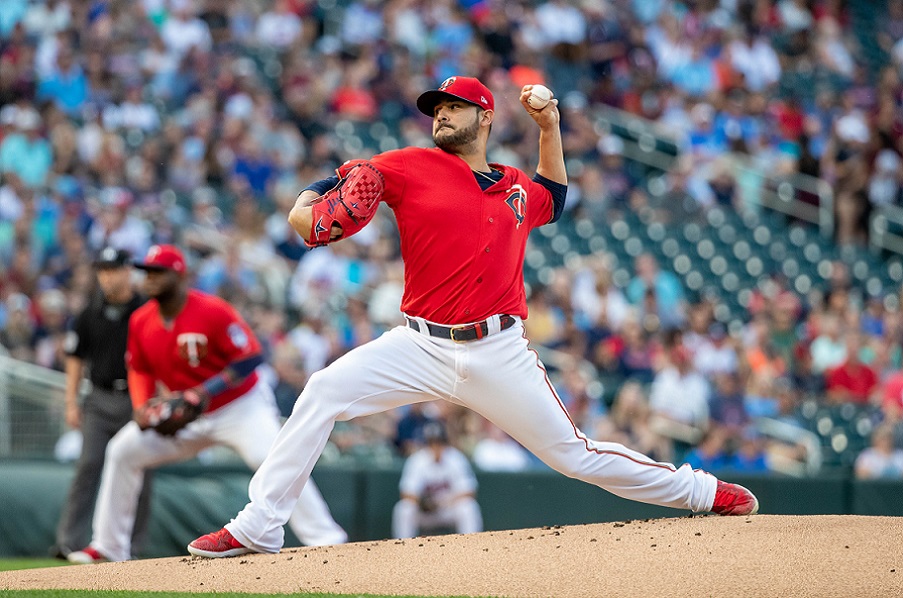 When the Twins first signed Martin Perez, I was one of the people that was on board with this being a good signing, and during the first two months of his Twins tenure, he looked like an excellent addition to the starting rotation. However, in light of how Perez has pitched over the past two months, and given the sense of urgency the Twins are suddenly under, it might be best for them to find a new role for Perez, outside of the starting rotation. This could be a hard move for the Twins front office to make, as it would removing the one addition they made to the starting rotation this past winter, and that’s okay, but now is not the time for pride, now is the time to put the team in the best position to succeed for the stretch run. So, the question still remains, should the Twins take Perez out of the starting rotation? To answer that question, first we should take a look at what has caused Perez to fall off the map after his great start to the season. We will start by looking at the usually obvious culprit, velocity, specifically with his fastball. Perez is a fastball-heavy pitcher, who uses three fastball variations, a cutter, a sinker, and a four-seamer, which make up 73.1 percent of the pitches he has thrown this year. This makes Perez’s velocity an especially important part of his ability to pitch well. Below are a couple of charts, courtesy of Baseball Savant, featuring the month to month average velocity of Perez’s three different fastballs. The chart on the left conveys the decline in velocity that Perez has experienced in both his sinker and four-seamer, while the chart on the right illustrates the increase in velocity Perez has experienced with his cutter as the season has progressed. Now let’s compare those charts to the how hitters have hit each of those pitches this season, again on a month to month bases. Again, the chart on the left features Perez’s sinker and four-seamer, while the chart on the right features Perez’s cutter. This time, these charts show the wOBA Perez has allowed with each of these pitches on a month to month basis in 2019. By comparing these charts, we can gather some valuable information. First, the changes in velocity don’t seem to be having a great effect on Perez’s performance, at least not on his sinker and cutter, which make up just over 75 percent of the fastballs that he throws. Despite the decrease in sinker velocity, Perez’s sinker has actually seen gradual improvement as the season has progressed (except for his two starts so far in August). On the same theme, Perez hasn’t had nearly the same success with his newly introduced cutter as the season has progressed, despite the slight uptick in velocity on that pitch. How can we explain that? The answer to that question might be two-fold. The first, and perhaps most obvious answer is that during the first two months of the season opposing hitters were caught off guard by Martin Perez’s cutter, as it was a new pitch that he had never thrown before. However, after a couple months of success with this new pitch, opposing teams started to adjust by accounting for this pitch in Perez’s repertoire. Another explanation, which coincides with opposing teams adjusting to Perez’s cutter has been the decline of spin rate on the pitch. Here is yet another graph, courtesy of Baseball Savant, that shows the spin rate of Perez’s cutter on a month to month basis in 2019. The combination of these two changes has hindered Martin Perez’s effectiveness with the pitch that gave him his newfound success early on in the season. This is also evident in Perez’s swing and miss rate with his cutter, which has been cut in half over the last few months from where it was during April and May. Now that we see there is clear evidence that Martin Perez is no longer the same pitcher that he was at the beginning of the season, and his performance isn’t just some regression to the mean, it is evident that Perez is no longer pitching at the level that belongs to be in the starting rotation of a team that is in a neck and neck race for a division title. So, what are some of the other options the Twins have for not only Perez, but also the now-open spot in the rotation. First, we will start with how to fill Martin Perez’s current spot in the rotation. The two most likely candidates to fill that role are rookie lefties Devin Smeltzer and Lewis Thorpe. Smeltzer is currently filling in a spot in the rotation for Michael Pineda, who is in the Injured List. However, once Pineda returns from injury Smeltzer could easily transition over to Perez's spot in the rotation. Smeltzer has done an adequate job filling in when the Twins have needed him, but I don’t think he would be my first choice for the job. The pitcher I would turn to would be Lewis Thorpe. Thorpe has been one of the Twins top prospects for a couple of years now, and I think has much more upside potential than Smeltzer does. In five career seasons at the minor league level, Thorpe has a 3.50 ERA while striking out 10.8 batters per nine innings and walking just 2.9 batter per nine innings. So far, in four appearances at the MLB level, Thorpe has shown that he has the stuff to compete at this level. Here are some thoughts from Tom Froemming had on the subject a few nights ago. The next thing to figure out would be what to do with Martin Perez. While he has definitely struggled as a starting pitcher, I don’t think it would be the appropriate move to just cut bait by designating him for assignment. Instead, a better option would be to find a place for Perez to pitch out of the bullpen. With the right-handed heavy starting rotation, my ideal option would be to move him back to the role he served to start the year, which is as more of a dual starter to match up with someone in the rotation. For me, that choice would be Kyle Gibson. Gibson has had his fair share of struggles of late, and matching Perez with him could help boost both of their performances down the stretch. If Gibson knows he only needs to work through the lineup a couple times before handing the ball over to Perez, he could be more aggressive by showing his best stuff right from the get-go. Then, after Gibson gives them two turns through the lineup, go to Perez who will give the opposing hitters a completely different look from the mound, right as they are starting to adjust to Gibson. Will this solution guarantee success? No, probably not. However, this could be a better alternative than just throwing Perez out to the wolves every fifth day. Even if this change in strategy is ineffective in getting better results from Perez, at bare minimum, it limits the amount of impact that Perez’s poor performance has on the Twins over the final two months of the season. Given the Twins limited options to improve their pitching staff, post trade deadline, it is worth exploring all of their options internally to make improvements.
 -
The night after the Minnesota Twins got their first walk-off home run of the season, they sent their ace to the mound to try and clinch the series against the National League East leading Atlanta Braves. That wasn't meant to be, as Jose Berrios had perhaps the worst night of his career, helping the Braves tie up the series at a game apiece with their 12 to 7 victory over the Twins. Image courtesy of FanGraphs The night after the Minnesota Twins got their first walk-off home run of the season, they sent their ace to the mound to try and clinch the series against the National League East leading Atlanta Braves. That wasn't meant to be, as Jose Berrios had perhaps the worst night of his career, helping the Braves tie up the series at a game apiece with their 12 to 7 victory over the Twins. Box Score Berrios: 5.2 IP, 9 H, 9 ER, 4 BB, 7 K, 64.9% strikes (63 of 97 pitches) Home Runs: Cruz 2 (32), Garver (21), Rosario (24) Multi-Hit Games: Cruz (4 for 5, 2 HR), Rosario (2 for 5, HR) WPA of +0.1: None WPA of -0.1: Berrios -.271 It didn’t take long for the Braves to respond to last night's walk-off home run, with a home run of their own. On the first pitch of the game, Ronald Acuna Jr. took Jose Berrios deep to give the Braves a quick 1-0 lead. I guess this is what Acuna was jogging in for last night while Miguel Sano’s home run was still in the air. The Braves were able to get to Berrios again in the top of the third. After an Acuna walk, and an Ozzie Albies single, Freddie Freeman went deep for the second time in this series. However, unlike the one last night that needed every inch to get over the wall in left, this one was crushed well over the center field wall. After adding another run in the fifth, the Braves blew the game open with six runs in the top of the sixth. The innings looked like it wasn’t going to amount to anything, as two of the first three Braves to come to the plate in the inning struck out. However, that was followed by the Braves going single, single, triple, single, double, single, before Adam Duvall struck out for the second time in the inning. When all was said and done, the Braves had an 11-0 lead, with nine earned runs charged to Jose Berrios. That is the most earned runs Berrios has allowed in his entire professional career. The bats finally woke up for the Twins in the bottom of the sixth inning. Nelson Cruz got the scoring going with this blast. https://twitter.com/Twins/status/1158925798998446080 After an Eddie Rosario single, Mitch Garver followed with a no-doubter of his own, trimming the Braves lead all the way down to… well 11-3. https://twitter.com/Twins/status/1158926606502694913 The Twins threatened with a couple of two-out walks later in the inning but were unable to tack on any more runs. However, the Twins weren’t done scoring quite yet. In the bottom of the seventh, Max Kepler and Jake Cave led off with a couple of singles, setting the stage for Nelson Cruz to hit his second home run of the night, and 16th home run since the All-Star Break. https://twitter.com/Twins/status/1158933217883381762 The Braves tacked on another run in the top of the eighth, thanks to three more hits from the middle of the Brave order. In the bottom of the ninth, Eddie Rosario took new Braves closer Shane Greene deep to the opposite field for the Twins fourth home run of the night. https://twitter.com/fsnorth/status/1158945107803922433 Bullpen Usage Here’s a quick look at the number of pitches thrown by the bullpen over the past five days: Next Three Games Wed vs ATL, 12:10 pm CT (Fried-Perez) Thu vs CLE, 7:10 pm CT (TBD-TBD) Fri vs CLE, 7:10 pm CT (TBD-TBD) Last Game Twins Game Recap (8/5): May Throws Fire, Sano Launches a Walk-Off Bomb in Twins Win View full article
- 24 replies
-
- 2
-
-
- minnesota twins
- atlanta braves
- (and 2 more)
-
Twins Game Recap (8/6): Berrios Bad Night Leads to Braves Blowout
Andrew Thares posted an article in Twins
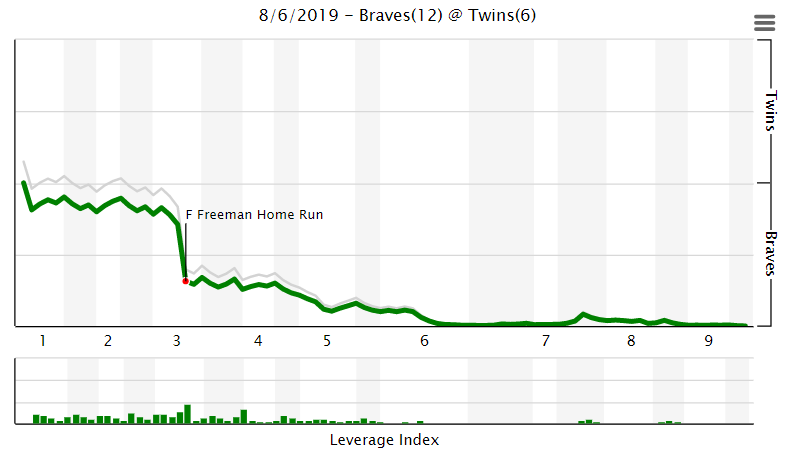 Box Score Berrios: 5.2 IP, 9 H, 9 ER, 4 BB, 7 K, 64.9% strikes (63 of 97 pitches) Home Runs: Cruz 2 (32), Garver (21), Rosario (24) Multi-Hit Games: Cruz (4 for 5, 2 HR), Rosario (2 for 5, HR) WPA of +0.1: None WPA of -0.1: Berrios -.271 It didn’t take long for the Braves to respond to last night's walk-off home run, with a home run of their own. On the first pitch of the game, Ronald Acuna Jr. took Jose Berrios deep to give the Braves a quick 1-0 lead. I guess this is what Acuna was jogging in for last night while Miguel Sano’s home run was still in the air. The Braves were able to get to Berrios again in the top of the third. After an Acuna walk, and an Ozzie Albies single, Freddie Freeman went deep for the second time in this series. However, unlike the one last night that needed every inch to get over the wall in left, this one was crushed well over the center field wall. After adding another run in the fifth, the Braves blew the game open with six runs in the top of the sixth. The innings looked like it wasn’t going to amount to anything, as two of the first three Braves to come to the plate in the inning struck out. However, that was followed by the Braves going single, single, triple, single, double, single, before Adam Duvall struck out for the second time in the inning. When all was said and done, the Braves had an 11-0 lead, with nine earned runs charged to Jose Berrios. That is the most earned runs Berrios has allowed in his entire professional career. The bats finally woke up for the Twins in the bottom of the sixth inning. Nelson Cruz got the scoring going with this blast. https://twitter.com/Twins/status/1158925798998446080 After an Eddie Rosario single, Mitch Garver followed with a no-doubter of his own, trimming the Braves lead all the way down to… well 11-3. https://twitter.com/Twins/status/1158926606502694913 The Twins threatened with a couple of two-out walks later in the inning but were unable to tack on any more runs. However, the Twins weren’t done scoring quite yet. In the bottom of the seventh, Max Kepler and Jake Cave led off with a couple of singles, setting the stage for Nelson Cruz to hit his second home run of the night, and 16th home run since the All-Star Break. https://twitter.com/Twins/status/1158933217883381762 The Braves tacked on another run in the top of the eighth, thanks to three more hits from the middle of the Brave order. In the bottom of the ninth, Eddie Rosario took new Braves closer Shane Greene deep to the opposite field for the Twins fourth home run of the night. https://twitter.com/fsnorth/status/1158945107803922433 Bullpen Usage Here’s a quick look at the number of pitches thrown by the bullpen over the past five days: Next Three Games Wed vs ATL, 12:10 pm CT (Fried-Perez) Thu vs CLE, 7:10 pm CT (TBD-TBD) Fri vs CLE, 7:10 pm CT (TBD-TBD) Last Game Twins Game Recap (8/5): May Throws Fire, Sano Launches a Walk-Off Bomb in Twins Win
 -
What Happened to Eddie Rosario’s Defense?
Andrew Thares replied to Andrew Thares's topic in Twins Daily Front Page News
This has been an ongoing issue with Rosario all season. I first noticed back in May that Rosario’s defense was down, but wanted to let the season played out more before I made anything of it. Sure the ankle injury has probably amplified the effect, but it was already an issue previously. -
What Happened to Eddie Rosario’s Defense?
Andrew Thares replied to Andrew Thares's topic in Twins Daily Front Page News
Every team has a lot more infield errors than outfield errors, that’s just how things work. Also just because the infield defense is a problem, doesn’t mean Eddie’s defense isn’t also a problem. If the bullpen is struggling, but so is the starting rotation, you wouldn’t say the bullpen isn’t an issue just because the rotation is a bigger problem.- 71 replies
-
- 10
-
-
- eddie rosario
- minnesota twins
- (and 2 more)
-
With all of the questions the Minnesota Twins have had surrounding most of their team over the past few years, one area of the team that has been steady has been the outfield. Sure, Byron Buxton has had his fair share of issues with the bat and staying healthy, but there has never been a question about him being the Twins center fielder, when healthy, thanks to his seemingly superhuman abilities to chase down flyballs. Additionally, the play of both Eddie Rosario and Max Kepler in the corners has given the Twins great stability. One of the hallmarks of this trio has been the great defense that they play collectively. However, while Buxton and Kepler have been able to maintain their high levels of defensive play, Eddie Rosario has taken a big step backward this year. Image courtesy of © David Berding-USA TODAY Sports With all of the questions the Minnesota Twins have had surrounding most of their team over the past few years, one area of the team that has been steady has been the outfield. Sure, Byron Buxton has had his fair share of issues with the bat and staying healthy, but there has never been a question about him being the Twins center fielder, when healthy, thanks to his seemingly superhuman abilities to chase down flyballs. Additionally, the play of both Eddie Rosario and Max Kepler in the corners has given the Twins great stability. One of the hallmarks of this trio has been the great defense that they play collectively. However, while Buxton and Kepler have been able to maintain their high levels of defensive play, Eddie Rosario has taken a big step backward this year. I will start this article by saying, I am only referencing fielding metrics generated by Statcast that are available on Baseball Savant. While many of the defensive metrics on sites like Fangraphs and Baseball Reference could be helpful, they are, at least for outfielders, outdated, and nowhere near as accurate for measuring an outfielder’s ability to track down flyballs as Statcast is. The reason for this is that Statcast actually tracks player and ball movements to quantify the time and distance that an outfielder has to track down a flyball, and calculates catch expectancy from that. Other metrics, like UZR and DRS, rely on the eye test from humans, which is a much less precise process. If you would like to read more about how the Statcast fielding metrics are calculated, you can do so here. That being said, let’s start diving into the numbers. We will start by looking at Eddie Rosario’s expected catch percentage vs. his actual catch percentage. So far this year Rosario has an expected catch percentage of 86 percent. That is to say, an average outfielder would catch 86 percent of the fly balls hit to Eddie Rosario this year. However, Rosario’s actual catch percentage stands at just 81 percent, giving Rosario a catch percent added of -5 percent. While this might not sound like a lot, it actually is. Among the 97 outfielders who have fielded at least 50 fly balls this year, only four outfielders have an expected catch percent added worse than Rosario's. This is a severe drop off from the +2 percent, -1 percent and -1 percent, that Rosario averaged in 2016, 2017 and 2018 respectively. Using these metrics, we can calculate Eddie Rosario’s outs above average. How this metric works is, if you have a fly ball hit to you that has a 75 percent catch probability, and you catch it, you get credit for 0.25 outs above average on that opportunity. However, if you fail to catch it, you get credit for -0.75 outs above average on that opportunity. In 2019, Rosario’s outs above average currently stands at -9 outs, which is on pace for 13.5 outs below average. For comparison, Byron Buxton currently has an outs above average of 12, which means Rosario has negated 75 percent of the value Buxton brings in the field defensively with his play in the field. So, what has caused Eddie Rosario to experience such a drastic drop off, from roughly league average outfielder, to one of the worst defensive outfielders in baseball? For that, we will need to dive even deeper. We will start by looking at Rosario’s sprint speed, which is another metric tracked by Statcast. This year, Rosario’s average sprint speed is 27.2 feet per second, which is roughly league average. However, from 2016 through 2018, Rosario averaged 28.0 feet per second. Again, for comparison, Byron Buxton’s sprint speed this year is 30.3 feet per second, so a 0.8 feet per second drop is a significant decline. However, there is more to being a good outfielder than just being able to run fast, though that does help a lot. Getting a good jump on the ball, getting up to speed quickly, and taking a good route to the ball are all important factors in being good at tracking down fly balls. Luckily, thanks to the player movement tracking technology, via Statcast, we can measure each of those factors, using some newly introduced metrics referred to as Reaction, Burst, and Route. We will start by looking at reaction, which measure the amount of ground an outfielder covers in the first 1.5 seconds after the pitch is thrown. From 2016 through 2018, Eddie Rosario measured in at 0.3 feet above the MLB average in reaction. However, in 2019 Rosario is at -0.8 feet below average in that initial reaction stage. The next metric we will look at is burst. Burst measures the feet that an outfielder covers from the 1.6 second mark, to the 3 second mark of the play. In other words, how fast the outfielder is accelerating. Again, looking back from 2016 through 2018, Rosario averaged 0.0 feet above average in burst, or exactly league average. That number has fallen all the way down to 1.2 feet below average in 2019. The final metric that we will look at is route, which measures the outfielder’s route efficiency, and how many extra feet they are needing to run by taking a poor route. From 2016 through 2018, Rosario gained 0.2 feet, per opportunity, on the average MLB outfielder due to taking good routes. In 2019, Rosario is gaining 0.3 feet per route above the average MLB outfielder. It is apparent that Rosario has taken a considerable step backward in not just sprint speed, but in his all-around athletic skills as well. So, the question is, how much has this hurt Rosario? The table below breaks down how many feet Rosario is losing, on a per fly ball basis, from where he was in the three previous seasons. The first thing to note from this table is the Feet Gained for the Feet Per Second category is multiplied by two, and there is a reason for this. For starters, the average fly ball is in the air for just shy of five seconds (4.97 seconds, to be exact), hence, the feet per second drop off is amplified the longer the ball is in the air. However, feet per second is measured while a player is at max speed, not while he is accelerating. Since it typically takes about three seconds between the release of the pitch, and the moment the fielder reaches max speed, the feet per second is not factored in until after that point. Therefore, the average fly ball hang time of five seconds, minus the three seconds it takes to reach max speed, gives us an average of two seconds at max speed per fly ball. After taking that into consideration, we can calculate the rest of the factors, and see that Eddie Rosario’s ability to track down a fly ball has gone down by an average of four feet per fly ball. While on most fly balls, four feet won’t make much of a difference, over the course of a season, the number of fly balls where the extra four feet would make the difference starts to add up. Knowing this, the Twins need to ask themselves, is this something they can work with Eddie Rosario on? Has he simply lost a step athletically that he might not recover, or is Rosario simply having an off season in the field? Whatever the answer is, it is important for the Twins to work with Rosario, so they can either help him improve, or start to factor in this decline for their future evaluations of Rosario as an all-around player. View full article
- 71 replies
-
- 5
-
-
- eddie rosario
- minnesota twins
- (and 2 more)
-
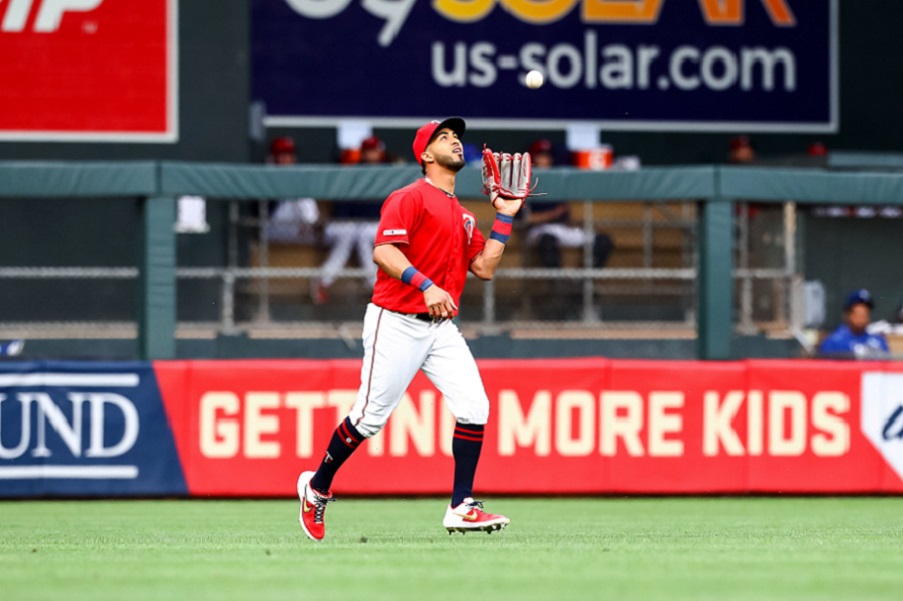 I will start this article by saying, I am only referencing fielding metrics generated by Statcast that are available on Baseball Savant. While many of the defensive metrics on sites like Fangraphs and Baseball Reference could be helpful, they are, at least for outfielders, outdated, and nowhere near as accurate for measuring an outfielder’s ability to track down flyballs as Statcast is. The reason for this is that Statcast actually tracks player and ball movements to quantify the time and distance that an outfielder has to track down a flyball, and calculates catch expectancy from that. Other metrics, like UZR and DRS, rely on the eye test from humans, which is a much less precise process. If you would like to read more about how the Statcast fielding metrics are calculated, you can do so here. That being said, let’s start diving into the numbers. We will start by looking at Eddie Rosario’s expected catch percentage vs. his actual catch percentage. So far this year Rosario has an expected catch percentage of 86 percent. That is to say, an average outfielder would catch 86 percent of the fly balls hit to Eddie Rosario this year. However, Rosario’s actual catch percentage stands at just 81 percent, giving Rosario a catch percent added of -5 percent. While this might not sound like a lot, it actually is. Among the 97 outfielders who have fielded at least 50 fly balls this year, only four outfielders have an expected catch percent added worse than Rosario's. This is a severe drop off from the +2 percent, -1 percent and -1 percent, that Rosario averaged in 2016, 2017 and 2018 respectively. Using these metrics, we can calculate Eddie Rosario’s outs above average. How this metric works is, if you have a fly ball hit to you that has a 75 percent catch probability, and you catch it, you get credit for 0.25 outs above average on that opportunity. However, if you fail to catch it, you get credit for -0.75 outs above average on that opportunity. In 2019, Rosario’s outs above average currently stands at -9 outs, which is on pace for 13.5 outs below average. For comparison, Byron Buxton currently has an outs above average of 12, which means Rosario has negated 75 percent of the value Buxton brings in the field defensively with his play in the field. So, what has caused Eddie Rosario to experience such a drastic drop off, from roughly league average outfielder, to one of the worst defensive outfielders in baseball? For that, we will need to dive even deeper. We will start by looking at Rosario’s sprint speed, which is another metric tracked by Statcast. This year, Rosario’s average sprint speed is 27.2 feet per second, which is roughly league average. However, from 2016 through 2018, Rosario averaged 28.0 feet per second. Again, for comparison, Byron Buxton’s sprint speed this year is 30.3 feet per second, so a 0.8 feet per second drop is a significant decline. However, there is more to being a good outfielder than just being able to run fast, though that does help a lot. Getting a good jump on the ball, getting up to speed quickly, and taking a good route to the ball are all important factors in being good at tracking down fly balls. Luckily, thanks to the player movement tracking technology, via Statcast, we can measure each of those factors, using some newly introduced metrics referred to as Reaction, Burst, and Route. We will start by looking at reaction, which measure the amount of ground an outfielder covers in the first 1.5 seconds after the pitch is thrown. From 2016 through 2018, Eddie Rosario measured in at 0.3 feet above the MLB average in reaction. However, in 2019 Rosario is at -0.8 feet below average in that initial reaction stage. The next metric we will look at is burst. Burst measures the feet that an outfielder covers from the 1.6 second mark, to the 3 second mark of the play. In other words, how fast the outfielder is accelerating. Again, looking back from 2016 through 2018, Rosario averaged 0.0 feet above average in burst, or exactly league average. That number has fallen all the way down to 1.2 feet below average in 2019. The final metric that we will look at is route, which measures the outfielder’s route efficiency, and how many extra feet they are needing to run by taking a poor route. From 2016 through 2018, Rosario gained 0.2 feet, per opportunity, on the average MLB outfielder due to taking good routes. In 2019, Rosario is gaining 0.3 feet per route above the average MLB outfielder. It is apparent that Rosario has taken a considerable step backward in not just sprint speed, but in his all-around athletic skills as well. So, the question is, how much has this hurt Rosario? The table below breaks down how many feet Rosario is losing, on a per fly ball basis, from where he was in the three previous seasons. The first thing to note from this table is the Feet Gained for the Feet Per Second category is multiplied by two, and there is a reason for this. For starters, the average fly ball is in the air for just shy of five seconds (4.97 seconds, to be exact), hence, the feet per second drop off is amplified the longer the ball is in the air. However, feet per second is measured while a player is at max speed, not while he is accelerating. Since it typically takes about three seconds between the release of the pitch, and the moment the fielder reaches max speed, the feet per second is not factored in until after that point. Therefore, the average fly ball hang time of five seconds, minus the three seconds it takes to reach max speed, gives us an average of two seconds at max speed per fly ball. After taking that into consideration, we can calculate the rest of the factors, and see that Eddie Rosario’s ability to track down a fly ball has gone down by an average of four feet per fly ball. While on most fly balls, four feet won’t make much of a difference, over the course of a season, the number of fly balls where the extra four feet would make the difference starts to add up. Knowing this, the Twins need to ask themselves, is this something they can work with Eddie Rosario on? Has he simply lost a step athletically that he might not recover, or is Rosario simply having an off season in the field? Whatever the answer is, it is important for the Twins to work with Rosario, so they can either help him improve, or start to factor in this decline for their future evaluations of Rosario as an all-around player.
 -
It seemed as though the Twins were sailing, on their way to their first series sweep since late May. They had a 4-1 lead entering the bottom of the ninth, with freshly acquired Sam Dyson coming onto the mound for what appeared was going to be an easy save against one of the worst hitting teams in the major leagues. That wasn’t the case, and when all was said and done, it was the Marlins who walked away with the victory. Image courtesy of Fangraphs It seemed as though the Twins were sailing, on their way to their first series sweep since late May. They had a 4-1 lead entering the bottom of the ninth, with freshly acquired Sam Dyson coming onto the mound for what appeared was going to be an easy save against one of the worst hitting teams in the major leagues. That wasn’t the case, and when all was said and done, it was the Marlins who walked away with the victory. Box Score Pineda: 6.0 IP, 7 H, 1 ER, 1 BB, 3 K, 72.5% strikes (58 of 80 pitches) Home Runs: Kepler (30) Multi-Hit Games: Kepler (2 for 6, HR), Buxton (2 for 5) WPA of +0.1: Buxton .249, Pineda .175, Harper .123, WPA of -0.1: Dyson -.448, -.254, Max Kepler gave the Twins a quick 1-0 lead, blasting the fourth pitch of the game over the fence in right field. It was already Kepler’s 30th home run of the season, 10 more than his previous career high he set last year. https://twitter.com/fsnorth/status/1156961457034035200 The Marlins were able to get that run back thanks to an RBI-triple from Miami outfielder Harold Ramirez. Byron Buxton gave it his best effort tracking the ball down in the right-centerfield gap, but it was just out of his reach. Michael Pineda did do a good job of preventing the Marlins from adding any more runs, as he got Cesar Puello to strike out, followed by an intentional walk of Bryan Holaday, to bring up Marlins pitcher Jordan Yamamoto, who Pineda got to ground out to end the inning. The Twins used some clever managing to help them put up a crooked inning in the top of the fourth. Eddie Rosario led off the inning with a strikeout, before Miguel Sano lined a double to left-field. That was followed by a Jason Castro strikeout and an Ehrie Adrianza hit-by-pitch. Here is where the clever move by Rocco Baldelli came into play. With two-outs and two runners on base, and the pitcher’s spot on deck, this was a prime situation for the Marlins to intentionally walk Byron Buxton. However, Baldelli sent Mitch Garver into the on-deck circle to signify that he was going to hit for Michale Pineda, even though it was only the fourth inning. The strategy worked, as the Marlins decided to pitch to Buxton, who promptly pulled a double that caught the chalk down the third base line, bringing both Sano and Adrianza around to score. Some great base running by Luis Arraez helped the Twins extend their lead in the top of the fifth. After reaching base with a one-out single, Arraez advanced to third on some gutsy base running after Jorge Polanco lined a hit to left field. Arraez then came in to score the Twins' fourth run of the game on a sac-fly from Eddie Rosario. Michael Pineda finished off yet another quality start today, after going six-innings and giving up just the one run in the second. Dating back to the beginning of May, Pineda has a 3.48 ERA across 88 innings pitched. Over that time he has 10 quality starts, and has gone at least five innings while allowing three ER or less in 14 of those 15 starts. Things were going as planned for the Twins through the later innings. Both Tyler Duffey and Sergio Romo worked scoreless innings, keeping the Twins lead of 4-1 heading into the bottom of the ninth. With Taylor Rogers having pitched in each of the last two ballgames, Rocco Baldelli was trying to avoid using him for the third day in a row to pick up the save. Instead, he chose to go with brand new Minnesota Twin, Sam Dyson, who had just arrived in at the ballpark about an hour or so after the game had started. Dyson came in, and proceeded to go walk, single, double, walk. Baldelli quickly got Rogers up and loose. He had to come in and protect what was now a two-run lead, with the bases loaded and nobody out. After Neil Walker singled up the middle to tie the game, Rogers was in even deeper trouble. However, Rogers did exactly what a relief ace is supposed to do and struck out the side to send the game to extra innings. The Twins hitters went dead quiet in extra innings, as not a single batter reached base in the 10th, 11th or 12th innings. Max Kepler put up a great 14 pitch at-bat in the 12th, and hit a deep drive into corner in right, but it was not enough, as it was caught on the warning track. This inability to get some big hits in extra innings came back to bite them, as Harold Ramirez connected on a Cody Stashak fastball to lead off the bottom of 12th and just like that the game was over. Bullpen Usage Here’s a quick look at the number of pitches thrown by the bullpen over the past five days: Next Three Games Fri vs KC, 7:10 pm CT (Sparkman-Perez) Sat vs KC, 6:10 pm CT (Duffey-Gibson) Sun vs KC, 1:10 pm CT (Keller-Odorizzi) Last Game Twins Game Recap (7/31): Berrios Throws Gem as Bombas Fly View full article
- 135 replies
-
- 2
-
-
- minnesota twins game recap
- twins vs marlins
- (and 2 more)
-
 Box Score Pineda: 6.0 IP, 7 H, 1 ER, 1 BB, 3 K, 72.5% strikes (58 of 80 pitches) Home Runs: Kepler (30) Multi-Hit Games: Kepler (2 for 6, HR), Buxton (2 for 5) WPA of +0.1: Buxton .249, Pineda .175, Harper .123, WPA of -0.1: Dyson -.448, -.254, Max Kepler gave the Twins a quick 1-0 lead, blasting the fourth pitch of the game over the fence in right field. It was already Kepler’s 30th home run of the season, 10 more than his previous career high he set last year. https://twitter.com/fsnorth/status/1156961457034035200 The Marlins were able to get that run back thanks to an RBI-triple from Miami outfielder Harold Ramirez. Byron Buxton gave it his best effort tracking the ball down in the right-centerfield gap, but it was just out of his reach. Michael Pineda did do a good job of preventing the Marlins from adding any more runs, as he got Cesar Puello to strike out, followed by an intentional walk of Bryan Holaday, to bring up Marlins pitcher Jordan Yamamoto, who Pineda got to ground out to end the inning. The Twins used some clever managing to help them put up a crooked inning in the top of the fourth. Eddie Rosario led off the inning with a strikeout, before Miguel Sano lined a double to left-field. That was followed by a Jason Castro strikeout and an Ehrie Adrianza hit-by-pitch. Here is where the clever move by Rocco Baldelli came into play. With two-outs and two runners on base, and the pitcher’s spot on deck, this was a prime situation for the Marlins to intentionally walk Byron Buxton. However, Baldelli sent Mitch Garver into the on-deck circle to signify that he was going to hit for Michale Pineda, even though it was only the fourth inning. The strategy worked, as the Marlins decided to pitch to Buxton, who promptly pulled a double that caught the chalk down the third base line, bringing both Sano and Adrianza around to score. Some great base running by Luis Arraez helped the Twins extend their lead in the top of the fifth. After reaching base with a one-out single, Arraez advanced to third on some gutsy base running after Jorge Polanco lined a hit to left field. Arraez then came in to score the Twins' fourth run of the game on a sac-fly from Eddie Rosario. Michael Pineda finished off yet another quality start today, after going six-innings and giving up just the one run in the second. Dating back to the beginning of May, Pineda has a 3.48 ERA across 88 innings pitched. Over that time he has 10 quality starts, and has gone at least five innings while allowing three ER or less in 14 of those 15 starts. Things were going as planned for the Twins through the later innings. Both Tyler Duffey and Sergio Romo worked scoreless innings, keeping the Twins lead of 4-1 heading into the bottom of the ninth. With Taylor Rogers having pitched in each of the last two ballgames, Rocco Baldelli was trying to avoid using him for the third day in a row to pick up the save. Instead, he chose to go with brand new Minnesota Twin, Sam Dyson, who had just arrived in at the ballpark about an hour or so after the game had started. Dyson came in, and proceeded to go walk, single, double, walk. Baldelli quickly got Rogers up and loose. He had to come in and protect what was now a two-run lead, with the bases loaded and nobody out. After Neil Walker singled up the middle to tie the game, Rogers was in even deeper trouble. However, Rogers did exactly what a relief ace is supposed to do and struck out the side to send the game to extra innings. The Twins hitters went dead quiet in extra innings, as not a single batter reached base in the 10th, 11th or 12th innings. Max Kepler put up a great 14 pitch at-bat in the 12th, and hit a deep drive into corner in right, but it was not enough, as it was caught on the warning track. This inability to get some big hits in extra innings came back to bite them, as Harold Ramirez connected on a Cody Stashak fastball to lead off the bottom of 12th and just like that the game was over. Bullpen Usage Here’s a quick look at the number of pitches thrown by the bullpen over the past five days: Next Three Games Fri vs KC, 7:10 pm CT (Sparkman-Perez) Sat vs KC, 6:10 pm CT (Duffey-Gibson) Sun vs KC, 1:10 pm CT (Keller-Odorizzi) Last Game Twins Game Recap (7/31): Berrios Throws Gem as Bombas Fly
 -
For about three hours this afternoon, leading up the to MLB trade deadline, it appeared as though the entire state of Minnesota was ready to storm 1 Twins Way like it was Area 51. Finally, Twins fans had a trade deadline where they weren’t sellers and they weren’t in between, no they were in full buy mode to give this team a better shot at winning the World Series, and what were they left with, Sergio Romo, a reliever who in his own right is a good addition to the bullpen, but by himself is a little underwhelming of a trade deadline. However, right before the clock struck zero, the Twins were able to acquire another addition to the bullpen in right-handed reliever Sam Dyson. Both Sergio Romo and Sam Dyson were featured in Twins Daily’s “Potential Twins Bullpen Target” series last month. Image courtesy of © Cody Glenn-USA TODAY Sports & © John Geliebter-USA TODAY Sports For about three hours this afternoon, leading up the to MLB trade deadline, it appeared as though the entire state of Minnesota was ready to storm 1 Twins Way like it was Area 51. Finally, Twins fans had a trade deadline where they weren’t sellers and they weren’t in between, no they were in full buy mode to give this team a better shot at winning the World Series, and what were they left with, Sergio Romo, a reliever who in his own right is a good addition to the bullpen, but by himself is a little underwhelming of a trade deadline. However, right before the clock struck zero, the Twins were able to acquire another addition to the bullpen in right-handed reliever Sam Dyson. Both Sergio Romo and Sam Dyson were featured in Twins Daily’s “Potential Twins Bullpen Target” series last month. Going into the deadline, many Twins fans had their sights set on adding a front of the rotation starting pitcher, along with a couple backend of the bullpen arms. As the deadline started to draw near it, was apparent that this wasn’t going to be the case, for not only the Twins, but for most of the teams looking to add pitching at the deadline. Some of the biggest named starting pitchers, like Noah Syndergaard, Madison Bumgarner, Matt Boyd, Robbie Ray or Mike Minor didn’t even get traded. The only big-name starting pitchers that go moved were Marcus Stroman, Trevor Bauer and Zack Greinke. Neither Bauer nor Greinke were ever really options for the Twins as the Indians weren’t going to deal Bauer to the Twins while they are in a division race together, and Zack Greinke wouldn’t waive his no trade clause for a potential trade to the Twins. This left Stroman, who was traded to the New York Mets in the biggest head scratcher at the deadline. Not only are the Mets not in contention this year, but the package they gave up to acquire Stroman could have easily been matched by the Twins with Jhoan Duran and Blayne Enlow. It sounded as though the Twins were in trade talks with the Blue Jays, but the Jays didn’t circle back to the Twins before making the deal with the Mets. It is unclear why this happened, or if the Twins were just unwilling to offer something that rivaled the Mets offer. The Twins were also reportedly interested in some of the big-name relievers on the trade market, which included Will Smith, Kirby Yates, Ken Giles, Felipe Vazquez, Edwin Diaz and Shane Greene. At the end of the day, the only one of those pitchers who actually got moved was Shane Greene, who really wasn’t much of an option for the Twins as the Tigers weren’t all that interested in making an interdivision trade. It is up for debate if the Twins could have been more aggressive to try and acquire one of these arms to assist the bullpen, but if nearly all of them didn’t get traded it probably suggests that the asking price was way too high, and could have been a trade the Twins would come to regret down the road, ala Matt Capps. Now that has been said, let’s move on from what the Twins didn’t acquire, and focus on what they did. I won’t spend a ton of time going over the Sergio Romo acquisition, as we already spent a bunch of time on that, but if you would like a more in-depth review of that trade you can find it here. The Twins also made a trade with the Milwaukee Brewers for a Double-A reliever named Marcos Diplan in exchange for cash considerations. In 2013, Diplan was consider the top available pitcher on the International Free Agent market. Fast-forward to 2019, and things haven’t exactly gone as planned for the now 22-year-old. In 57 and 2/3 innings at Double-A this year, Diplan has a 4.99 ERA (4.41 FIP) with a 9.8 K/9 and an extremely high 5.8 BB/9. The final trade that the Twins made before the deadline was perhaps their biggest, when the acquired Sam Dyson from the San Francisco Giants in exchange for Jaylin Davis, Prelander Berrroa and Kai-Wei Teng. In the Twins Daily Mid-Season Top 40 rankings, Davis was ranked as the 35th best prospect in the Twins system, while neither Berroa nor Teng were ranked. In all, it was more of a quantity over quality get for the Giants, which is exactly what the Twins were looking to do as they did not want to part with some of their higher ranked prospects. So, what are the Twins getting with their newly acquired piece to the bullpen? Sam Dyson is a 31-year-old right-handed reliever who has had his fare share of ups and downs during his MLB career. So far, this year has been more up than down for Dyson. In 51 innings, across 49 appearances, Dyson has a 2.47 ERA (2.74 FIP), with a respectable 8.2 K/9 an excellent 1.2 BB/9, which is the 5th lowest among qualified relievers in 2019. This has helped Dyson get a remarkably low .902 WHIP. This is not only lower than Taylor Rogers (1.027), but also lower than Dyson’s former teammate Will Smith (.906) and ranks 11th amongst qualified relievers this season. Relievers who can keep runners off the base paths late in games are the kind of low stress pitchers that Twins fans will need as we watch some of the highest stress Twins baseball in over a decade a few months from now. Despite being reliever, Sam Dyson uses a five-pitch mix, with his sinker being his most prominent pitch, which he throws about 45 percent of the time. Despite this, Dyson’s sinker appears to be his worst pitch, as opposing hitters have a .305 average and a .343 wOBA against his sinker, while Dyson isn’t giving up a batting average above .211 and a wOBA above .232 on any of his other pitches. It wouldn’t shock me if Wes Johnson and the Twins take a similar approach with Dyson that they have with some of their other pitchers, like Tyler Duffey, and faze out Dyson’s sinkers. Whether that happens mid-season is up in the air, but I wouldn’t be surprised if we hear rumors of the Twins tinkering with Dyson’s pitches next spring. Dyson also features both a cutter, which he throws about 25 percent of the time, and a four-seam fastball, which he throws roughly 13 percent of the time, to go along with his sinker. If the Twins were to make some changes with Dyson’s pitch selection this season, look for those to pitches start being used more often. A few weeks ago, our own Tom Froemming made a video pitch for why the Twins should acquire Sam Dyson. You can check out the video here. While you’re at it, make sure to go ahead and subscribe to Tom’s Youtube channel. He posts a bunch of excellent video content on Twins related topics, so if you can’t get enough Twins talk, this is a great place to go. Overall, Sam Dyson is another good addition by “Falvine” to Taylor Rogers and the rest of the Twins bullpen. On my personal reliver trust rankings, I have Dyson and Romo slotted in at second and third respectively. While neither will be the lights out relief ace, they are still big improvements on the Twins bullpen from where it stood a week ago. What are your thoughts? Did the Twins do enough to make you feel comfortable about their chances to take on the Yankees and Astros in October? Let us know in the comment section down below. Related Content Twins Acquire RHP Sam Dyson from Giants Twins Trade Lewin Diaz for RHP Sergio Romo, 2 Minor Leaguers View full article
- 93 replies
-
- 3
-
-
- sam dyson
- sergio romo
- (and 2 more)
-
 Going into the deadline, many Twins fans had their sights set on adding a front of the rotation starting pitcher, along with a couple backend of the bullpen arms. As the deadline started to draw near it, was apparent that this wasn’t going to be the case, for not only the Twins, but for most of the teams looking to add pitching at the deadline. Some of the biggest named starting pitchers, like Noah Syndergaard, Madison Bumgarner, Matt Boyd, Robbie Ray or Mike Minor didn’t even get traded. The only big-name starting pitchers that go moved were Marcus Stroman, Trevor Bauer and Zack Greinke. Neither Bauer nor Greinke were ever really options for the Twins as the Indians weren’t going to deal Bauer to the Twins while they are in a division race together, and Zack Greinke wouldn’t waive his no trade clause for a potential trade to the Twins. This left Stroman, who was traded to the New York Mets in the biggest head scratcher at the deadline. Not only are the Mets not in contention this year, but the package they gave up to acquire Stroman could have easily been matched by the Twins with Jhoan Duran and Blayne Enlow. It sounded as though the Twins were in trade talks with the Blue Jays, but the Jays didn’t circle back to the Twins before making the deal with the Mets. It is unclear why this happened, or if the Twins were just unwilling to offer something that rivaled the Mets offer. The Twins were also reportedly interested in some of the big-name relievers on the trade market, which included Will Smith, Kirby Yates, Ken Giles, Felipe Vazquez, Edwin Diaz and Shane Greene. At the end of the day, the only one of those pitchers who actually got moved was Shane Greene, who really wasn’t much of an option for the Twins as the Tigers weren’t all that interested in making an interdivision trade. It is up for debate if the Twins could have been more aggressive to try and acquire one of these arms to assist the bullpen, but if nearly all of them didn’t get traded it probably suggests that the asking price was way too high, and could have been a trade the Twins would come to regret down the road, ala Matt Capps. Now that has been said, let’s move on from what the Twins didn’t acquire, and focus on what they did. I won’t spend a ton of time going over the Sergio Romo acquisition, as we already spent a bunch of time on that, but if you would like a more in-depth review of that trade you can find it here. The Twins also made a trade with the Milwaukee Brewers for a Double-A reliever named Marcos Diplan in exchange for cash considerations. In 2013, Diplan was consider the top available pitcher on the International Free Agent market. Fast-forward to 2019, and things haven’t exactly gone as planned for the now 22-year-old. In 57 and 2/3 innings at Double-A this year, Diplan has a 4.99 ERA (4.41 FIP) with a 9.8 K/9 and an extremely high 5.8 BB/9. The final trade that the Twins made before the deadline was perhaps their biggest, when the acquired Sam Dyson from the San Francisco Giants in exchange for Jaylin Davis, Prelander Berrroa and Kai-Wei Teng. In the Twins Daily Mid-Season Top 40 rankings, Davis was ranked as the 35th best prospect in the Twins system, while neither Berroa nor Teng were ranked. In all, it was more of a quantity over quality get for the Giants, which is exactly what the Twins were looking to do as they did not want to part with some of their higher ranked prospects. So, what are the Twins getting with their newly acquired piece to the bullpen? Sam Dyson is a 31-year-old right-handed reliever who has had his fare share of ups and downs during his MLB career. So far, this year has been more up than down for Dyson. In 51 innings, across 49 appearances, Dyson has a 2.47 ERA (2.74 FIP), with a respectable 8.2 K/9 an excellent 1.2 BB/9, which is the 5th lowest among qualified relievers in 2019. This has helped Dyson get a remarkably low .902 WHIP. This is not only lower than Taylor Rogers (1.027), but also lower than Dyson’s former teammate Will Smith (.906) and ranks 11th amongst qualified relievers this season. Relievers who can keep runners off the base paths late in games are the kind of low stress pitchers that Twins fans will need as we watch some of the highest stress Twins baseball in over a decade a few months from now. Despite being reliever, Sam Dyson uses a five-pitch mix, with his sinker being his most prominent pitch, which he throws about 45 percent of the time. Despite this, Dyson’s sinker appears to be his worst pitch, as opposing hitters have a .305 average and a .343 wOBA against his sinker, while Dyson isn’t giving up a batting average above .211 and a wOBA above .232 on any of his other pitches. It wouldn’t shock me if Wes Johnson and the Twins take a similar approach with Dyson that they have with some of their other pitchers, like Tyler Duffey, and faze out Dyson’s sinkers. Whether that happens mid-season is up in the air, but I wouldn’t be surprised if we hear rumors of the Twins tinkering with Dyson’s pitches next spring. Dyson also features both a cutter, which he throws about 25 percent of the time, and a four-seam fastball, which he throws roughly 13 percent of the time, to go along with his sinker. If the Twins were to make some changes with Dyson’s pitch selection this season, look for those to pitches start being used more often. A few weeks ago, our own Tom Froemming made a video pitch for why the Twins should acquire Sam Dyson. You can check out the video here. While you’re at it, make sure to go ahead and subscribe to Tom’s Youtube channel. He posts a bunch of excellent video content on Twins related topics, so if you can’t get enough Twins talk, this is a great place to go. Overall, Sam Dyson is another good addition by “Falvine” to Taylor Rogers and the rest of the Twins bullpen. On my personal reliver trust rankings, I have Dyson and Romo slotted in at second and third respectively. While neither will be the lights out relief ace, they are still big improvements on the Twins bullpen from where it stood a week ago. What are your thoughts? Did the Twins do enough to make you feel comfortable about their chances to take on the Yankees and Astros in October? Let us know in the comment section down below. Related Content Twins Acquire RHP Sam Dyson from Giants Twins Trade Lewin Diaz for RHP Sergio Romo, 2 Minor Leaguers
 -
After taking three of four over the weekend in Chicago, the Minnesota Twins were looking to keep their good road trip going as the made the rare trip down to South Beach to play the Miami Marlins. Jake Odorizzi took the mound and was looking to bounce back after his terrible start last time out against the New York Yankees. He did just that, and lead the Twins to a 2-1 victory in game one of the series. Image courtesy of FanGraphs After taking three of four over the weekend in Chicago, the Minnesota Twins were looking to keep their good road trip going as the made the rare trip down to South Beach to play the Miami Marlins. Jake Odorizzi took the mound and was looking to bounce back after his terrible start last time out against the New York Yankees. He did just that, and lead the Twins to a 2-1 victory in game one of the series. Box Score Odorizzi: 5.2 IP, 4 H, 1 ER, 1 BB, 5 K, 66.0% strikes (68 of 103 pitches) Home Runs: Buxton (10) Multi-Hit Games: None WPA of +0.1: Odorizzi .200, Rogers .176, Duffey .141, Romo .129, Sano .114 WPA of -0.1: None There wasn’t a lot of action through the first couple innings of the game. Neither team was able to reach base during the first inning, and the first baserunner of the game was Miguel Sano who drew a one-out walk. He wouldn’t make it far, however, as he was thrown out on an inning-ending strike him out, thrown him out double play. The bottom of the second was going smoothly for Jake Odorizzi until Curtis Granderson hit a line drive into the left-centerfield gap. It appeared as though Eddie Rosario would have a play throw Granderson out at second, but he inexplicable misplayed the ball, allowing it to get past him and Granderson to advance to third on the error. Odorizzi was able to pick up Rosario by getting Harold Ramirez to fly out to end the inning. Byron Buxton got the scoring going in the top of the third when he hit a towering flyball over the fence in left-centerfield to give the Twins an early 1-0 lead. https://twitter.com/Twins/status/1156352497348468736 The Twins were able to add to their lead in the top of the fourth inning. Jorge Polanco started the inning with a leadoff walk, and looked for a second like the Twins might not be able to turn that walk into a run. Mitch Garver followed Polanco’s walk with a strikeout, and Edie Rosario proceeded to ground into a force out. Then on a 2-1 count, Miguel Sano drilled a double out to centerfield, bringing Rosario around to score from first. The bottom of the fourth was sailing along for Jake Odorizzi, like the rest of the game had up until that point. He got each of the first two hitters to flyout, before Starlin Castro stepped to the plate and roped a two-out single to the opposite field, setting the table for Curtis Granderson who pulled a double down the line that got all the way to the wall. The relay from Kepler to Arraez to Garver was a hair late and a hair offline, allowing Castro to slide in safely, cutting the Twins lead down to one. Jake Odorizzi was cruising along through five innings and into the sixth, and it appeared as though he was going complete six innings for the first time since June 15. However, that wasn’t meant to be, as with two outs in the sixth he walked Neil Walker, ending his night. Tyler Duffey came in and shut the door in the sixth by striking out Starlin Castro. He then followed that up with a 1-2-3 bottom of the seventh inning. Sergio Romo made his Twins debut in the bottom of the eighth against the team that just traded him away. Romo got both Cesar Puello and Miguel Rojas to flyout to begin the inning before he hit Brian Anderson on the first pitch of the plate appearance. Anderson was able to advance to second on a stolen base during the next at-bat but didn’t go any further as Romo ended the inning by getting Martin Prado to strikeout on a check swing that he couldn’t quite hold up on. The often animated Romo showed that he was pumped up to pitch for a competitive ball club again. https://twitter.com/fsnorth/status/1156385700775727104 After a much-needed week off, Taylor Rogers looked fresh in the ninth inning, going 1-2-3 to complete his 16th save of the season. With the Indians losing to Justin Verlander and the Houston Astros tonight, the Twins lead is back up to three games. During the game, it was announced that the Cleveland Indians had traded away Trevor Bauer as part of a three-team trade with the Cincinnati Reds and San Diego Padres. In return they received outfielders Yasiel Puig and Franmil Reyes. If you are unfamiliar with Reyes, he is one of the bright young stars in the game. In 185 career games, Reyes has already hit 43 home runs and has a wRC+ of 122. At just 24 years of age, Reyes might be a nemesis for the Twins in the years to come. Bullpen Usage Here’s a quick look at the number of pitches thrown by the bullpen over the past five days: Next Three Games Wed at MIA, 6:10 pm CT (Berrios-Alcantara) Thu at MIA, 11:10 am CT (Pineda-Yamamoto) Fri vs KC, 7:10 pm CT (Sparkman-Perez) Last Game Twins Game Recap (7/28): Bats Bounce Back Behind Gibson’s Strong Outing View full article
- 35 replies
-
- 3
-
-
- minnesota twins
- twins vs marlins
- (and 2 more)

