



Thiéres Rabelo
-
Posts
569 -
Joined
-
Last visited
Content Type
Profiles
News
Minnesota Twins Videos
2026 Minnesota Twins Top Prospects Ranking
2022 Minnesota Twins Draft Picks
Minnesota Twins Free Agent & Trade Rumors, Notes, & Tidbits
Guides & Resources
2023 Minnesota Twins Draft Picks
The Minnesota Twins Players Project
2024 Minnesota Twins Draft Picks
2025 Minnesota Twins Draft Pick Tracker
2026 Minnesota Twins Draft Tracker: Picks & Bonuses
Forums
Blogs
Events
Store
Downloads
Gallery
Everything posted by Thiéres Rabelo
-
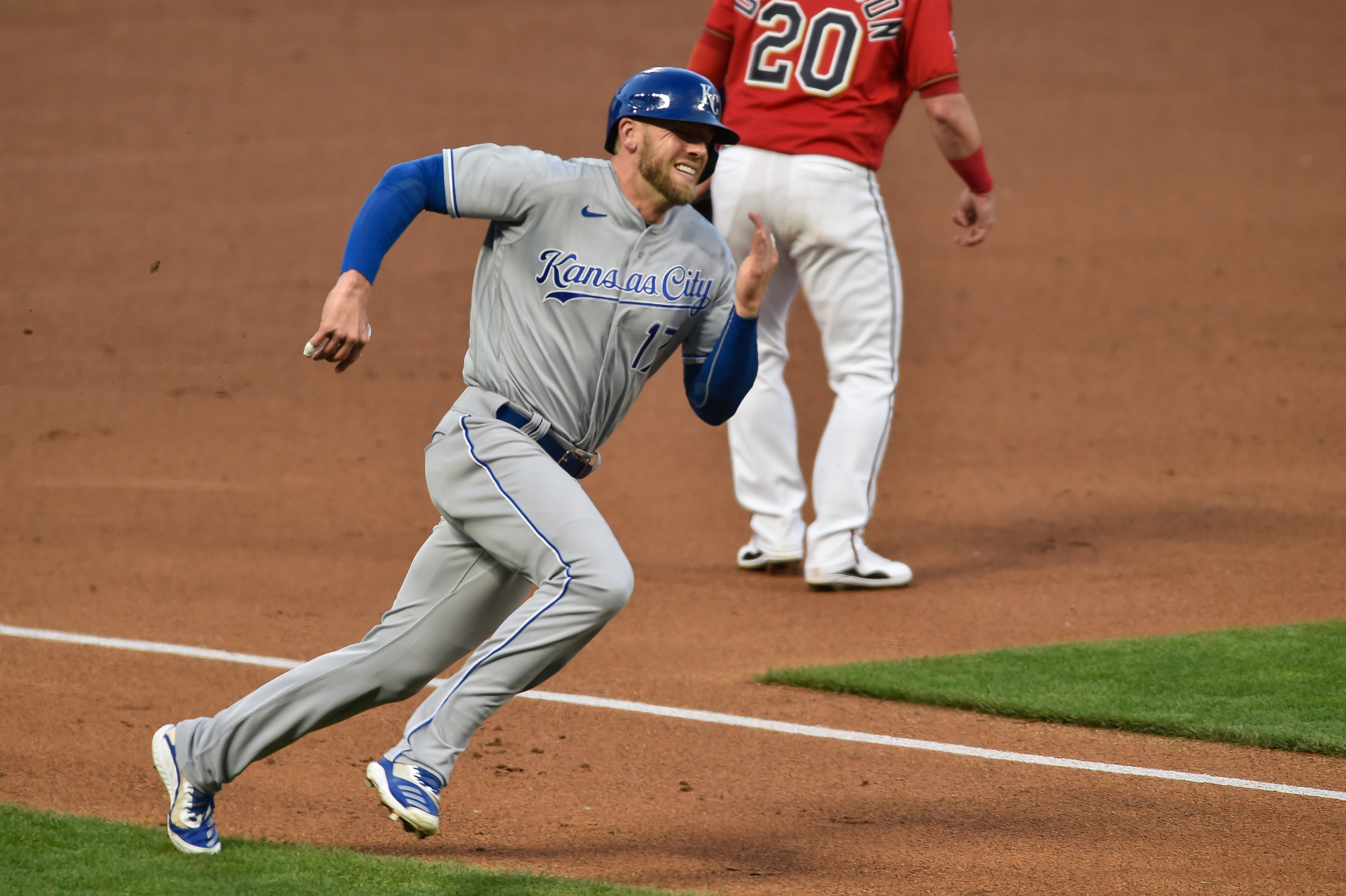 Box Score Dobnak: 6.0 IP, 9 H, 6 ER, 1 BB, 3 K Home Runs: Garver (8) Bottom 3 WPA: Dobnak -.252, Donaldson -.165, Kirilloff -.083 Win Probability Chart (via FanGraphs) Making his second one of the season, Dobber cruised through the first four innings of play on only 43 pitches, 27 of which went for strikes. Even though he still allowed a ton of hard-hit balls, only two of those actually became hits. Besides, the balls that weren’t hit hard were hit for really weak contact, as he averaged 87.8 exit velocity through four. It’s not like the offense was completely unproductive against Kris Bubic during that span, as three runners reached in the first, for instance. But the lefty did stabilize and had a positive stretch in which he retired seven out of eight consecutive batters. It was only in the fourth, when Mitch Garver hit this monster, 424-feet second-decker, that the game had its first run. Royals take the lead in the fifth, blow the game wide open in the seventh With only seven pitches, Dobnak retired the first two batters he faced in the fifth inning. Everything seemed fine, but, then, disaster struck. He gave up a walk to Hunter Dozier, before allowing three consecutive hits. The Royals scored three runs on a double from Michael Taylor and back-to-back singles from Whit Merrifield and Carlos Santana. The first Royal run came after a very aggressive send from the Royals’ third base coach, Vance Wilson. Garver couldn’t hold on to that pitch to the plate. With only 68 pitches, Dobnak was brought back to pitch the sixth and did a nice job again, appearing to be right back on track. He did give up a double to Adalberto Mondesí, but it was a quick, 12-pitch inning. Dobber was on his way to a quality start and more. But that was the closest he ever got. After yet another frustrating 1-2-3 inning from the offense against Bubic in the sixth, Dobber was back at it in the top of the seventh. But not for long, as he gave up three consecutive singles right away, to load the bases with no outs, which was enough for Rocco Baldelli to pull him. Cody Stashak came in and couldn’t take care of the inherited runners, as all of them scored on a double and a sac-fly. Giving up a walk and back-to-back singles of his own, Stashak allowed Kansas City to add two more runs, making it a five-run seventh inning, 8-1 Royals. The Twins nearly started a rally when Bubic was finally gone. Tyler Zuber came in in relief and gave up three consecutive one-out walks to load the bases. He was immediately removed from the game and Kyle Zimmer took over, facing pinch-hitter Trevor Larnach. He hit a flyball over Dozier’s head to drive in a run and keep the bases loaded for Josh Donaldson. Jorge Polanco scored from third during Donaldson’s at-bat, after a Zimmer wild pitch. So, the Twins were one hit away from cutting the Royal lead to only two. But that didn’t happen and they settled for two runs. Polanco reached for the third time of the night when he hit a leadoff double in the ninth. Larnach kept the rally going by drawing a two-out walk, with Donaldson on-deck. But the third baseman's struggles continued, as he struck out, to finish the night with 0-for-5 and two punch outs. Counting tonight, Donaldson has a .337 OPS in his last seven games. Postgame Interview Bullpen Usage Spreadsheet MON TUE WED THU FRI TOT Stashak 0 0 0 0 34 34 Robles 0 13 20 0 0 33 Farrell 16 0 0 0 17 33 Rogers 0 26 0 0 0 26 Colomé 8 13 0 0 0 21 Thielbar 0 2 16 0 0 18 Duffey 0 0 15 0 0 15 Alcala 14 0 0 0 0 14
 -
Randy Dobnak started out with four very solid innings, but then a couple of really bad ones, combined with yet another poor offensive display against a lefty, put the game out of reach for Minnesota. Box Score Dobnak: 6.0 IP, 9 H, 6 ER, 1 BB, 3 K Home Runs: Garver (8) Bottom 3 WPA: Dobnak -.252, Donaldson -.165, Kirilloff -.083 Win Probability Chart (via FanGraphs) Making his second one of the season, Dobber cruised through the first four innings of play on only 43 pitches, 27 of which went for strikes. Even though he still allowed a ton of hard-hit balls, only two of those actually became hits. Besides, the balls that weren’t hit hard were hit for really weak contact, as he averaged 87.8 exit velocity through four. It’s not like the offense was completely unproductive against Kris Bubic during that span, as three runners reached in the first, for instance. But the lefty did stabilize and had a positive stretch in which he retired seven out of eight consecutive batters. It was only in the fourth, when Mitch Garver hit this monster, 424-feet second-decker, that the game had its first run. Royals take the lead in the fifth, blow the game wide open in the seventh With only seven pitches, Dobnak retired the first two batters he faced in the fifth inning. Everything seemed fine, but, then, disaster struck. He gave up a walk to Hunter Dozier, before allowing three consecutive hits. The Royals scored three runs on a double from Michael Taylor and back-to-back singles from Whit Merrifield and Carlos Santana. The first Royal run came after a very aggressive send from the Royals’ third base coach, Vance Wilson. Garver couldn’t hold on to that pitch to the plate. With only 68 pitches, Dobnak was brought back to pitch the sixth and did a nice job again, appearing to be right back on track. He did give up a double to Adalberto Mondesí, but it was a quick, 12-pitch inning. Dobber was on his way to a quality start and more. But that was the closest he ever got. After yet another frustrating 1-2-3 inning from the offense against Bubic in the sixth, Dobber was back at it in the top of the seventh. But not for long, as he gave up three consecutive singles right away, to load the bases with no outs, which was enough for Rocco Baldelli to pull him. Cody Stashak came in and couldn’t take care of the inherited runners, as all of them scored on a double and a sac-fly. Giving up a walk and back-to-back singles of his own, Stashak allowed Kansas City to add two more runs, making it a five-run seventh inning, 8-1 Royals. The Twins nearly started a rally when Bubic was finally gone. Tyler Zuber came in in relief and gave up three consecutive one-out walks to load the bases. He was immediately removed from the game and Kyle Zimmer took over, facing pinch-hitter Trevor Larnach. He hit a flyball over Dozier’s head to drive in a run and keep the bases loaded for Josh Donaldson. Jorge Polanco scored from third during Donaldson’s at-bat, after a Zimmer wild pitch. So, the Twins were one hit away from cutting the Royal lead to only two. But that didn’t happen and they settled for two runs. Polanco reached for the third time of the night when he hit a leadoff double in the ninth. Larnach kept the rally going by drawing a two-out walk, with Donaldson on-deck. But the third baseman's struggles continued, as he struck out, to finish the night with 0-for-5 and two punch outs. Counting tonight, Donaldson has a .337 OPS in his last seven games. Postgame Interview Bullpen Usage Spreadsheet MON TUE WED THU FRI TOT Stashak 0 0 0 0 34 34 Robles 0 13 20 0 0 33 Farrell 16 0 0 0 17 33 Rogers 0 26 0 0 0 26 Colomé 8 13 0 0 0 21 Thielbar 0 2 16 0 0 18 Duffey 0 0 15 0 0 15 Alcala 14 0 0 0 0 14 View full article
-
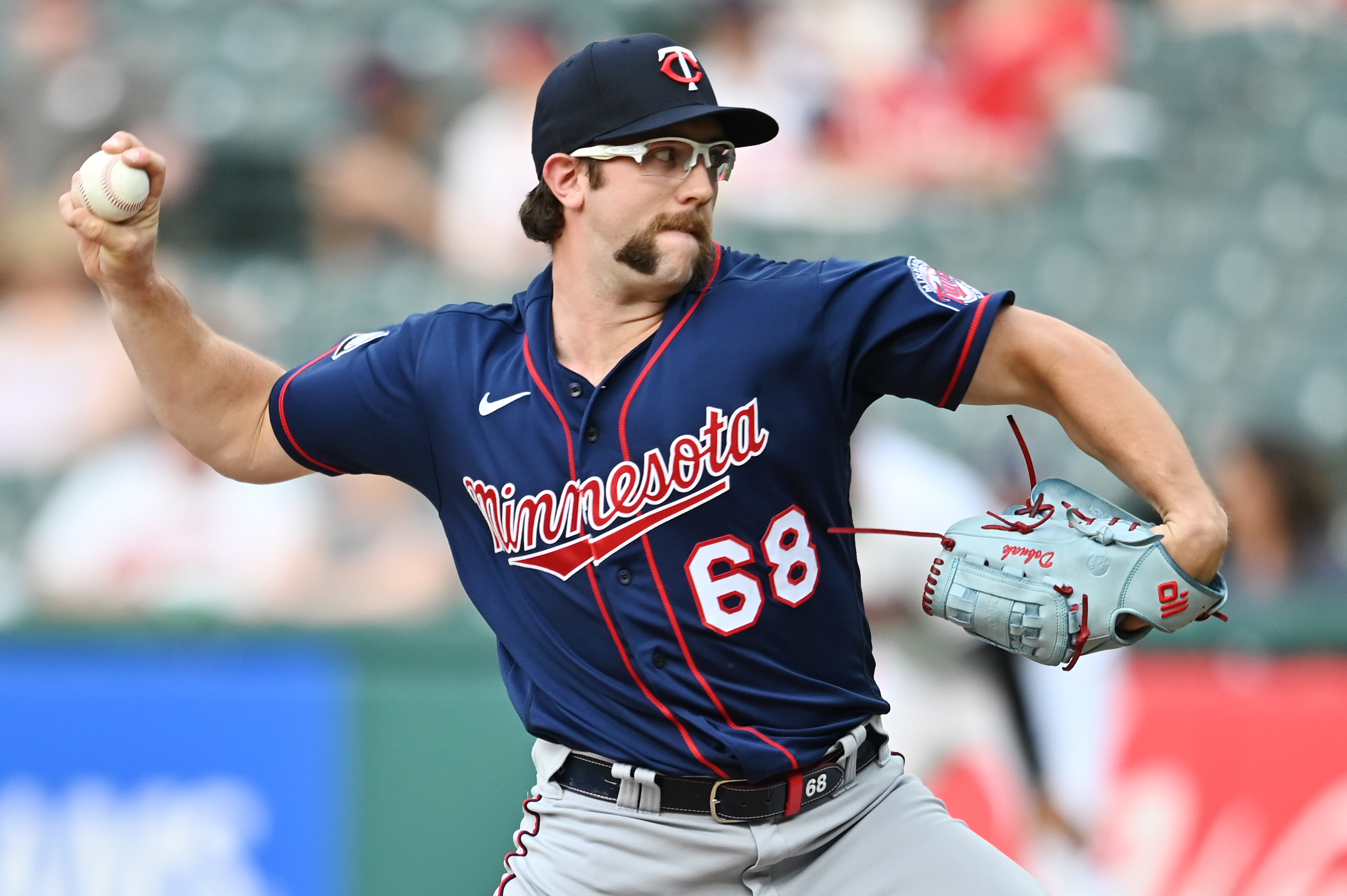 Box Score Dobnak: 6.0 IP, 3 H, 0 ER, 2 BB, 5 K Home Runs: Refsnyder (1) Top 3 WPA: Dobnak .170, Refsnyder .142, Kepler .071 Win Probability Chart (via FanGraphs) After seven unpleasant relief appearances that had him be optioned earlier this month, Randy Dobnak was called up from St. Paul this Friday to join the team in Cleveland. During his stint with the Saints, he had three starts, two of which were really solid, giving him a 3.38 ERA. From the looks of his outing tonight, the confidence he got from that Triple-A stint made all the difference. It only took Dobber 38 pitches to get through the first three innings, in which he retired nine of the eleven batters he faced. He allowed only one hit, to José Ramírez in the first, but that was it. The only other Cleveland runner to reach in that span did so with the help of a Luis Arráez fielding error. He missed bats quite nicely, causing Indian hitters to whiff four times. Also, he displayed an impressive improvement on his sinker, which touched 94mph on the radar gun. That’s nearly two miles per hour faster than the highest velocity he ever got from his two-seamer, back in 2019. At the top of the third, Rob Refsnyder hit his first home run as a Twin, to make it 1-0 Minnesota. That was home run number 60 for the Twins on the year, tying them for most in the American League with Boston. His command started to slightly fail him late in the third, as he got behind in the count twice. Cesar Hernández reached on an Arráez error and old friend Eddie Rosario had the chance to put Cleveland ahead. The former Twin got ahead on the count, 2-0, which could potentially destabilize Dobnak. But Rosie’s trademark impatience had him grounding out to end the inning. Out of a potential jam, Dobber was about to receive an incredible welcome back to the majors gift. The offense ambushes Cleveland pitching and scores nine runs in the fourth Not even in his wildest dreams could Dobnak have asked for a better return to the majors. The Twins offense ganged up on Cleveland starter Triston McKenzie, loading the bases twice in the inning before he could record a second out. A couple of walks and a single in between to open the inning allowed Trevor Larnach to push two runs across on a groundout. Startled, McKenzie couldn’t find the zone anymore, allowing Mitch Garver and Refsnyder to walk and reload them up, with only one out. McKenzie got pulled right there, but it was worthless. A single from Andrelton Simmons and a walk from Josh Donaldson and a double from Max Kepler scored four more runs against Cleveland reliever Phil Maton. Then, Alex Kirilloff joined the party. The Twins weren’t done and Miguel Sanó doubled to score Kirilloff from second, making it 10-0 Twins. Minnesota nearly batted around twice in the inning and every Twin but Arráez and Larnach reached on either a single or a walk. This was the first time in almost four years that the Twins scored nine runs in one inning. Now with substantial run support, Dobnak had the tranquility to go through the rest of his start unbothered. He wasn’t as sharp as in the first portion of the night, but he still delivered three scoreless innings, making this the third start of his career in which he pitched at least six innings without an earned run. The last time Dobber pitched at least six scoreless was on Aug. 5 of last year, against the Pirates. With the Twins rotation entering tonight’s game ranking dead last in the majors in fWAR during the month of May (-0.2), Dobnak just made his case for a permanent role in it. What do the Twins have to lose anyway? Minnesota’s bullpen had yet another good performance on the week. Entering tonight, according to FanGraphs, Twins relievers had produced 0.3 fWAR in the previous seven days, while also striking out a league’s second-best 12.5 batters per nine. Jorge Alcalá and Luke Farrell took care of business in relief of Dobnak and retired nine of the final eleven batters they faced. Postgame Interview Bullpen Usage Spreadsheet MON TUE WED THU FRI TOT Stashak 0 35 0 19 0 54 Rogers 0 27 0 22 0 49 Farrell 0 0 0 0 38 38 Alcala 18 0 7 0 10 35 Colomé 0 19 15 0 0 34 Robles 0 17 0 14 0 31 Duffey 0 5 0 25 0 30 Thielbar 0 0 10 0 0 10
 -
The offense took care of this game with an amazing nine-run fourth inning. But perhaps the greatest story of the night for the Twins was the incredibly solid start from Randy Dobnak, who alongside the bullpen helped Minnesota to shut out the Cleveland in the series opener. The Twins win back-to-back games for the first time since May 3. Box Score Dobnak: 6.0 IP, 3 H, 0 ER, 2 BB, 5 K Home Runs: Refsnyder (1) Top 3 WPA: Dobnak .170, Refsnyder .142, Kepler .071 Win Probability Chart (via FanGraphs) After seven unpleasant relief appearances that had him be optioned earlier this month, Randy Dobnak was called up from St. Paul this Friday to join the team in Cleveland. During his stint with the Saints, he had three starts, two of which were really solid, giving him a 3.38 ERA. From the looks of his outing tonight, the confidence he got from that Triple-A stint made all the difference. It only took Dobber 38 pitches to get through the first three innings, in which he retired nine of the eleven batters he faced. He allowed only one hit, to José Ramírez in the first, but that was it. The only other Cleveland runner to reach in that span did so with the help of a Luis Arráez fielding error. He missed bats quite nicely, causing Indian hitters to whiff four times. Also, he displayed an impressive improvement on his sinker, which touched 94mph on the radar gun. That’s nearly two miles per hour faster than the highest velocity he ever got from his two-seamer, back in 2019. At the top of the third, Rob Refsnyder hit his first home run as a Twin, to make it 1-0 Minnesota. That was home run number 60 for the Twins on the year, tying them for most in the American League with Boston. His command started to slightly fail him late in the third, as he got behind in the count twice. Cesar Hernández reached on an Arráez error and old friend Eddie Rosario had the chance to put Cleveland ahead. The former Twin got ahead on the count, 2-0, which could potentially destabilize Dobnak. But Rosie’s trademark impatience had him grounding out to end the inning. Out of a potential jam, Dobber was about to receive an incredible welcome back to the majors gift. The offense ambushes Cleveland pitching and scores nine runs in the fourth Not even in his wildest dreams could Dobnak have asked for a better return to the majors. The Twins offense ganged up on Cleveland starter Triston McKenzie, loading the bases twice in the inning before he could record a second out. A couple of walks and a single in between to open the inning allowed Trevor Larnach to push two runs across on a groundout. Startled, McKenzie couldn’t find the zone anymore, allowing Mitch Garver and Refsnyder to walk and reload them up, with only one out. McKenzie got pulled right there, but it was worthless. A single from Andrelton Simmons and a walk from Josh Donaldson and a double from Max Kepler scored four more runs against Cleveland reliever Phil Maton. Then, Alex Kirilloff joined the party. The Twins weren’t done and Miguel Sanó doubled to score Kirilloff from second, making it 10-0 Twins. Minnesota nearly batted around twice in the inning and every Twin but Arráez and Larnach reached on either a single or a walk. This was the first time in almost four years that the Twins scored nine runs in one inning. Now with substantial run support, Dobnak had the tranquility to go through the rest of his start unbothered. He wasn’t as sharp as in the first portion of the night, but he still delivered three scoreless innings, making this the third start of his career in which he pitched at least six innings without an earned run. The last time Dobber pitched at least six scoreless was on Aug. 5 of last year, against the Pirates. With the Twins rotation entering tonight’s game ranking dead last in the majors in fWAR during the month of May (-0.2), Dobnak just made his case for a permanent role in it. What do the Twins have to lose anyway? Minnesota’s bullpen had yet another good performance on the week. Entering tonight, according to FanGraphs, Twins relievers had produced 0.3 fWAR in the previous seven days, while also striking out a league’s second-best 12.5 batters per nine. Jorge Alcalá and Luke Farrell took care of business in relief of Dobnak and retired nine of the final eleven batters they faced. Postgame Interview Bullpen Usage Spreadsheet MON TUE WED THU FRI TOT Stashak 0 35 0 19 0 54 Rogers 0 27 0 22 0 49 Farrell 0 0 0 0 38 38 Alcala 18 0 7 0 10 35 Colomé 0 19 15 0 0 34 Robles 0 17 0 14 0 31 Duffey 0 5 0 25 0 30 Thielbar 0 0 10 0 0 10 View full article
-
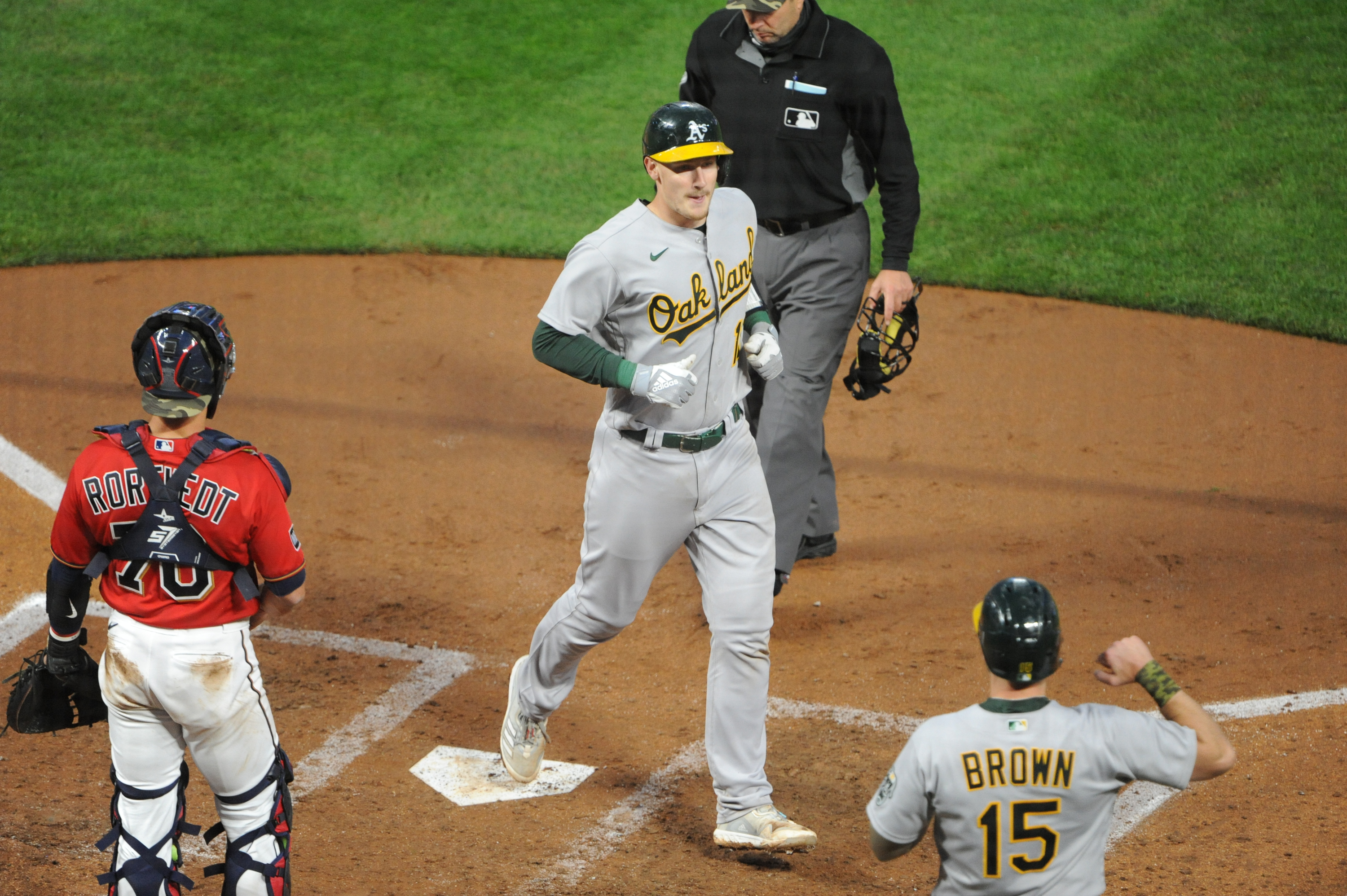 Box Score Shoemaker: 6.0 IP, 5 H, 5 ER, 2 BB, 4 K Home Runs: Donaldson (4) Bottom 3 WPA: Shoemaker -.166, Donaldson -132, Polanco -.092 Win Probability Chart (via FanGraphs) Shoemaker can’t benefit from the good defense behind him Matt Shoemaker had another awful start. The long ball really hurt him, again, as he gave up three extra-base hits, including three home runs. This shouldn’t come as a great surprise, since opposing hitters are posting a .518 SLG against him this year, a career-worst. He gave up a double during the first inning, but he went on to retire the next seven batters. Then Ramon Laureano hit a solo shot off of him in the third, to score the game’s first run. After going through the first two innings rather quietly, the offense immediately threatened, with Ben Rortvedt and Luis Arráez hitting back-to-back singles to open the bottom of the third. However, Minnesota was unable to capitalize. A’s starter Frankie Montas managed to dominate the Twins’ bats, limiting them to three hits in the first five innings. If the offense couldn’t help Shoemaker much, the defense behind him surely did all they could: But it wasn’t enough. Shoemaker gave up a leadoff walk in the fifth inning, which was followed by a two-run home run by catcher Sean Murphy. He then retired the next five batters, getting one out away from recording a quality start. But he walked Matt Champman in the sixth, before giving up a soul-crushing two-run, two-out home run, making it 5-0 Oakland. Shoemaker now accounts for ten of Minnesota’s league-worst 55 home runs allowed. Seventh inning rally falls short, A’s homer again Donaldson put the Twins on the board with a solo shot to lead off the bottom of the sixth, before Montas retired the side. Then, in the seventh, Willians Astudillo and Max Kepler renewed the hopes of Twins fans, when both of them reached to open the inning. Minnesota was one sing away from getting back in the game, but, again, they couldn’t capitalize. At this point, the Twins were 1-for-6 with runners in scoring position. Entering this game, Minnesota’s offense was posting a .652 OPS with men in scoring, one of their greatest struggles this season. Making his fourth appearance of the season for the Twins, Derek Law took over in the seventh and pitched a clean, 1-2-3 inning, in which he threw only sliders. 13 of them. But Mark Canha ended his scoreless streak by hitting a leadoff home run to open the eighth, making it 6-1 Oakland. He took care of the remaining batters, only giving up a walk to Chapman. After his two innings pitched tonight, Law has the second-best ERA (3.60) among active Twins relievers. Caleb Thielbar pitched a clean ninth, but the offense was quiet again in the bottom of the inning and that was the game. Postgame Interview Bullpen Usage Spreadsheet MON TUE WED THU FRI TOT Thielbar 0 41 0 0 29 70 Law 0 19 13 0 35 67 Anderson 0 0 54 0 0 54 Alcala 0 12 0 16 0 28 Rogers 0 0 0 20 0 20 Duffey 0 0 16 0 0 16 Colomé 0 0 15 0 0 15 Robles 0 0 0 12 0 12
 -
Once again the Twins offense was quiet and Matt Shoemaker, who was one out away from a quality start, ended up allowing five runs on three homers. Oakland crushed Minnesota to take the series opener at Target Field and the Twins now have the worst record in baseball. Box Score Shoemaker: 6.0 IP, 5 H, 5 ER, 2 BB, 4 K Home Runs: Donaldson (4) Bottom 3 WPA: Shoemaker -.166, Donaldson -132, Polanco -.092 Win Probability Chart (via FanGraphs) Shoemaker can’t benefit from the good defense behind him Matt Shoemaker had another awful start. The long ball really hurt him, again, as he gave up three extra-base hits, including three home runs. This shouldn’t come as a great surprise, since opposing hitters are posting a .518 SLG against him this year, a career-worst. He gave up a double during the first inning, but he went on to retire the next seven batters. Then Ramon Laureano hit a solo shot off of him in the third, to score the game’s first run. After going through the first two innings rather quietly, the offense immediately threatened, with Ben Rortvedt and Luis Arráez hitting back-to-back singles to open the bottom of the third. However, Minnesota was unable to capitalize. A’s starter Frankie Montas managed to dominate the Twins’ bats, limiting them to three hits in the first five innings. If the offense couldn’t help Shoemaker much, the defense behind him surely did all they could: But it wasn’t enough. Shoemaker gave up a leadoff walk in the fifth inning, which was followed by a two-run home run by catcher Sean Murphy. He then retired the next five batters, getting one out away from recording a quality start. But he walked Matt Champman in the sixth, before giving up a soul-crushing two-run, two-out home run, making it 5-0 Oakland. Shoemaker now accounts for ten of Minnesota’s league-worst 55 home runs allowed. Seventh inning rally falls short, A’s homer again Donaldson put the Twins on the board with a solo shot to lead off the bottom of the sixth, before Montas retired the side. Then, in the seventh, Willians Astudillo and Max Kepler renewed the hopes of Twins fans, when both of them reached to open the inning. Minnesota was one sing away from getting back in the game, but, again, they couldn’t capitalize. At this point, the Twins were 1-for-6 with runners in scoring position. Entering this game, Minnesota’s offense was posting a .652 OPS with men in scoring, one of their greatest struggles this season. Making his fourth appearance of the season for the Twins, Derek Law took over in the seventh and pitched a clean, 1-2-3 inning, in which he threw only sliders. 13 of them. But Mark Canha ended his scoreless streak by hitting a leadoff home run to open the eighth, making it 6-1 Oakland. He took care of the remaining batters, only giving up a walk to Chapman. After his two innings pitched tonight, Law has the second-best ERA (3.60) among active Twins relievers. Caleb Thielbar pitched a clean ninth, but the offense was quiet again in the bottom of the inning and that was the game. Postgame Interview Bullpen Usage Spreadsheet MON TUE WED THU FRI TOT Thielbar 0 41 0 0 29 70 Law 0 19 13 0 35 67 Anderson 0 0 54 0 0 54 Alcala 0 12 0 16 0 28 Rogers 0 0 0 20 0 20 Duffey 0 0 16 0 0 16 Colomé 0 0 15 0 0 15 Robles 0 0 0 12 0 12 View full article
-
Minnesota opened a three-game road series in Detroit, in a game with not one, but two rain delays. Struggling bats shook off their slumps and provided a late surge that helped the Twins snap a three-game losing streak. Shoemaker also delivered solid five scoreless innings and earned his second win as a Twin. Box Score Shoemaker: 5.0 IP, 4 H, 0 ER, 2 BB, 5 K Home Runs: Garlick (1), Polanco (2), Kepler (2) Top 3 WPA: Shoemaker .291, Polanco .238, Kepler .149 Win Probability Chart (via FanGraphs? Twins jump ahead with two quick solo homers The Twins offense put a couple of runs on the board really early. For the second consecutive time, Minnesota’s leadoff hitter smashed a homer to open the game. Kyle Garlick took Tigers’ starter Tarik Skubal deep on the fifth pitch he saw, to make it 1-0. Skubal bounced back and struck out the next three batters, but the damage had already been done. In spite of the much-needed early production, the overall struggle of some key pieces of the lineup continued. Garlick doubled in his second time up, but other than his two hits and that of Polanco’s, every other Twins hitter was retired during the first three innings of the game. The third Twin to record a hit in the night was Josh Donaldson and he did it unintentionally, trying to pull back mid-swing. Shoemaker tosses five shutout innings Fortunately, Shoemaker did his job very well. After an awful start in Kansas City last Saturday, Matt got back on track, keeping Detroit scoreless through four, before the game was interrupted by the rain in the middle of the fifth. His outing was in no way uneventful, though. Up until that moment, he had given up four hits and a total of five hard-hit balls. He pitched himself into a jam in the second when he gave up back-to-back singles to open the inning, but he managed to induce an inning-ending double play. That happened again later on, in the fourth, when he gave up a leadoff walk to Jeimer Candelario, followed by a Miguel Cabrera single that had nearly 106 mph exit velocity, sending Candelario to third. He managed to retire the next three batters to end the threat. After a 35-minute rain delay, Shoemaker came back anyway to pitch the fifth and get in line for his second win as a Twin. After retiring the first two batters quickly, he gave up a two-out walk to old friend Robbie Grossman but went on to strike out another former Twin in Jonathan Schoop to conclude his best start with Minnesota. Polanco, Sanó, Kepler show encouraging signs. The bullpen doesn’t Skubal didn’t come back for the sixth and the Twins immediately took advantage of that, facing righty Bryan Garcia and adding a couple more insurance runs. Polanco and Miguel Sanó drew back-to-back one-out walks, just to have Max Kepler single to center and bring Polanco home. Andrelton Simmons followed up with a groundout to score Sanó and just like that, the Twins were up 4-0. Before hitting that RBI-single, Kepler was riding a 1-for-13 funk in the last four games. Also, Sanó’s BB% for the season went up to 21.4% after that walk, by far the best season of his career on that front. If his bat was still cold, at least he had walks to show for. But things just can’t be easy for the 2021 Twins. Coming in for Shoemaker, Cody Stashak had four consecutive scoreless outings, possibly indicating that he could be trusted. After giving up a leadoff single to Candelario and a four-pitch walk to Cabrera, Stashak hung a changeup in the middle of the zone and Willi Castro crushed it, to put Detroit right back in the game with a three-run homer. All three hits that Stashak gave up in the sixth had at least 98.5 mph exit velocity, with Candelario’s nearly reaching 108 mph. The bottom of the lineup comes up big after a second rain delay The tarp came out again before the start of the seventh and this time the rain delay lasted over an hour. When play was resumed, Minnesota managed to manufacture a huge insurance run. Donaldson hit a one-out double, just before Mitch Garver drew his second walk of the night, to put two men on for Polanco. Jorge didn’t hesitate and jumped at the second pitch of the at-bat and doubled in the Twins’ fifth run of the night. This was Polanco’s second to-hit game of the week. Alexander Colomé pitched a scoreless, 1-2-3 inning in the bottom of the seventh and completed three consecutive outings without allowing a run. This had not happened so far this season. Then, to lead off the eighth, Kepler hit a clutch 422-feet bomb, to provide the Twins with more run support. And, hey, it was against a lefty! Hansel Robles came in to pitch a dominant eighth inning. But it didn’t look good at first, as he got ahead of Cabrera with a 0-2 count, but then lost him with four consecutive balls. But he pitched around that walk throwing ten strikes in the next 13 pitches, retiring the following three batters. His fastball averaged nearly 96 mph and he almost touched 98 mph at some point. Then it was Sanós turn. Donaldson reached for the third time in the game, now drawing a walk to open the top of the ninth. Tigers’ reliever Daniel Norris also gave up a walk to Polanco, before facing Sanó with two men on. Miguel had no mercy and hit an RBI-single that put the final numbers on the score. To guarantee the win, Caleb Thielbar pitched a quick, 1-2-3 ninth inning on 12 pitches. Bullpen Usage Spreadsheet Click here to see the bullpen usage over the past five days (link opens a Google Sheet). View full article
-
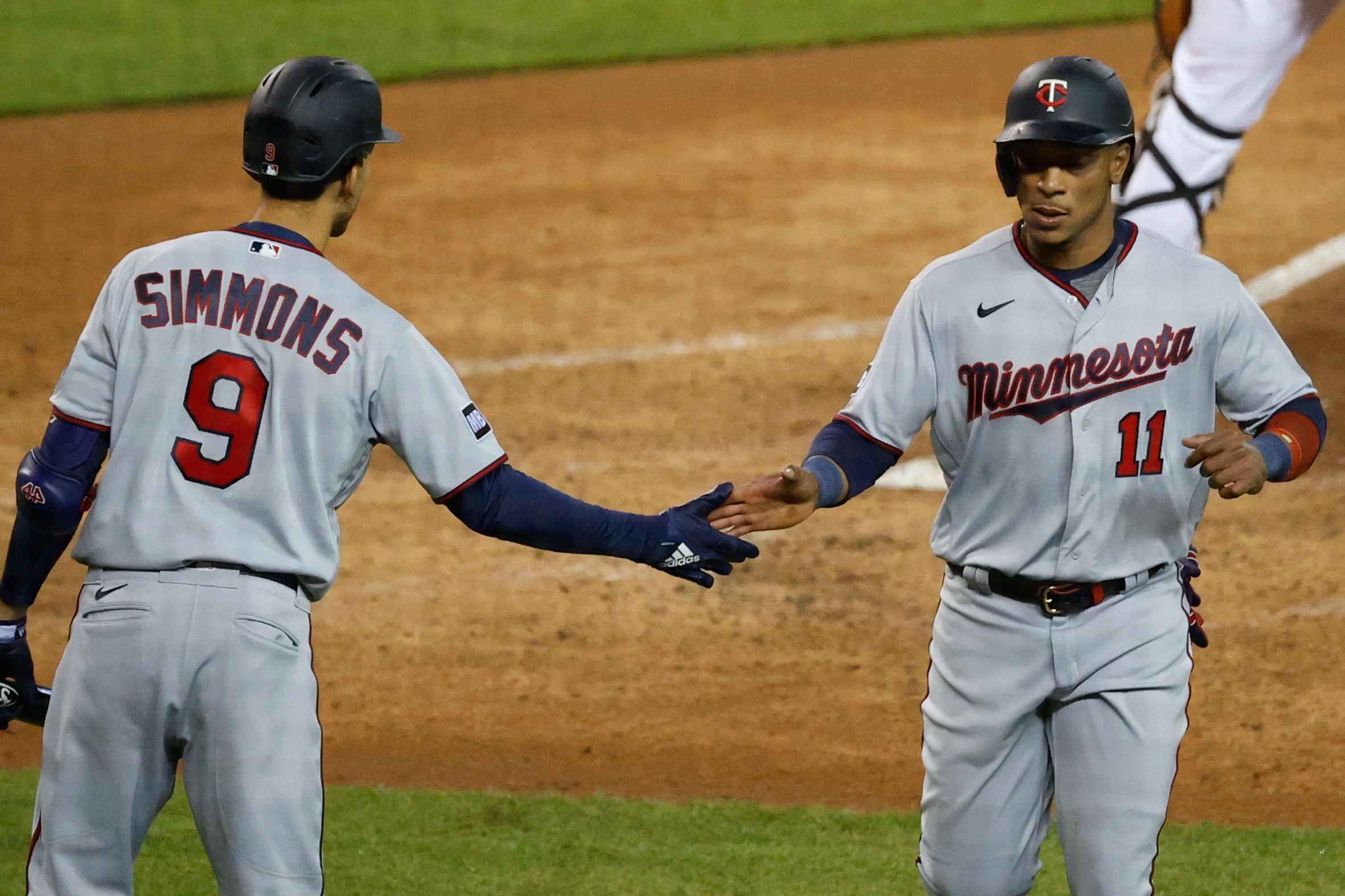 Box Score Shoemaker: 5.0 IP, 4 H, 0 ER, 2 BB, 5 K Home Runs: Garlick (1), Polanco (2), Kepler (2) Top 3 WPA: Shoemaker .291, Polanco .238, Kepler .149 Win Probability Chart (via FanGraphs? Twins jump ahead with two quick solo homers The Twins offense put a couple of runs on the board really early. For the second consecutive time, Minnesota’s leadoff hitter smashed a homer to open the game. Kyle Garlick took Tigers’ starter Tarik Skubal deep on the fifth pitch he saw, to make it 1-0. Skubal bounced back and struck out the next three batters, but the damage had already been done. In spite of the much-needed early production, the overall struggle of some key pieces of the lineup continued. Garlick doubled in his second time up, but other than his two hits and that of Polanco’s, every other Twins hitter was retired during the first three innings of the game. The third Twin to record a hit in the night was Josh Donaldson and he did it unintentionally, trying to pull back mid-swing. Shoemaker tosses five shutout innings Fortunately, Shoemaker did his job very well. After an awful start in Kansas City last Saturday, Matt got back on track, keeping Detroit scoreless through four, before the game was interrupted by the rain in the middle of the fifth. His outing was in no way uneventful, though. Up until that moment, he had given up four hits and a total of five hard-hit balls. He pitched himself into a jam in the second when he gave up back-to-back singles to open the inning, but he managed to induce an inning-ending double play. That happened again later on, in the fourth, when he gave up a leadoff walk to Jeimer Candelario, followed by a Miguel Cabrera single that had nearly 106 mph exit velocity, sending Candelario to third. He managed to retire the next three batters to end the threat. After a 35-minute rain delay, Shoemaker came back anyway to pitch the fifth and get in line for his second win as a Twin. After retiring the first two batters quickly, he gave up a two-out walk to old friend Robbie Grossman but went on to strike out another former Twin in Jonathan Schoop to conclude his best start with Minnesota. Polanco, Sanó, Kepler show encouraging signs. The bullpen doesn’t Skubal didn’t come back for the sixth and the Twins immediately took advantage of that, facing righty Bryan Garcia and adding a couple more insurance runs. Polanco and Miguel Sanó drew back-to-back one-out walks, just to have Max Kepler single to center and bring Polanco home. Andrelton Simmons followed up with a groundout to score Sanó and just like that, the Twins were up 4-0. Before hitting that RBI-single, Kepler was riding a 1-for-13 funk in the last four games. Also, Sanó’s BB% for the season went up to 21.4% after that walk, by far the best season of his career on that front. If his bat was still cold, at least he had walks to show for. But things just can’t be easy for the 2021 Twins. Coming in for Shoemaker, Cody Stashak had four consecutive scoreless outings, possibly indicating that he could be trusted. After giving up a leadoff single to Candelario and a four-pitch walk to Cabrera, Stashak hung a changeup in the middle of the zone and Willi Castro crushed it, to put Detroit right back in the game with a three-run homer. All three hits that Stashak gave up in the sixth had at least 98.5 mph exit velocity, with Candelario’s nearly reaching 108 mph. The bottom of the lineup comes up big after a second rain delay The tarp came out again before the start of the seventh and this time the rain delay lasted over an hour. When play was resumed, Minnesota managed to manufacture a huge insurance run. Donaldson hit a one-out double, just before Mitch Garver drew his second walk of the night, to put two men on for Polanco. Jorge didn’t hesitate and jumped at the second pitch of the at-bat and doubled in the Twins’ fifth run of the night. This was Polanco’s second to-hit game of the week. Alexander Colomé pitched a scoreless, 1-2-3 inning in the bottom of the seventh and completed three consecutive outings without allowing a run. This had not happened so far this season. Then, to lead off the eighth, Kepler hit a clutch 422-feet bomb, to provide the Twins with more run support. And, hey, it was against a lefty! Hansel Robles came in to pitch a dominant eighth inning. But it didn’t look good at first, as he got ahead of Cabrera with a 0-2 count, but then lost him with four consecutive balls. But he pitched around that walk throwing ten strikes in the next 13 pitches, retiring the following three batters. His fastball averaged nearly 96 mph and he almost touched 98 mph at some point. Then it was Sanós turn. Donaldson reached for the third time in the game, now drawing a walk to open the top of the ninth. Tigers’ reliever Daniel Norris also gave up a walk to Polanco, before facing Sanó with two men on. Miguel had no mercy and hit an RBI-single that put the final numbers on the score. To guarantee the win, Caleb Thielbar pitched a quick, 1-2-3 ninth inning on 12 pitches. Bullpen Usage Spreadsheet Click here to see the bullpen usage over the past five days (link opens a Google Sheet).
 -
Big Mike and the bullpen had a solid night, while Alex Kirilloff had the first huge game of his young career, homering twice and batting in four runs, to help the Twins win back-to-back games for the first time in over three weeks.Box Score Pineda: 5.0 IP, 3 H, 1 ER, 2 BB, 5 K Home Runs: Kirilloff 2 (2) Top 3 WPA: Pineda .185, Kirilloff .157, Arraez .058 Win Probability Chart (via FanGraphs): Download attachment: chart.png Reaching base has been one of the greatest struggles for the Twins this season. Before the game, only seven AL teams had a lower team on-base percentage than Minnesota (.304). Also, the team’s walk rate (7.5%) ranked sixth-worst in the majors. However, the lineup looked like a completely different one during the first couple of innings. Six different Twins reached safely in the first two innings, including three walks. They were threatening early, as Byron Buxton and Nelson Cruz got two-out single and walk, respectively. Alex Kirilloff then, in a preview of what was coming, scorched the first pitch he saw, for a 106 mph exit velocity and .970 xBA inning-ending flyout. Royals starter Brady Singer still struggled in the second and he soon loaded the bases after facing four batters. Ben Rortvedt, making his major league debut, worked a nice eight-pitch at-bat to draw a walk and juice them up for Luis Arráez. He got hit by a pitch on the shoulder, putting the Twins on the board. Then, this happened: Singer didn’t come back for the third and then things got interesting. Buxton and Cruz both drew walks against Royals reliever Tyler Zuber to open the third inning. Then Kirilloff destroyed a baseball, to go yard for the first time in his career! Michael Pineda couldn’t be happier. While the Twins lineup kept burning through the Royals pitching staff (including old friend Ervin Santana), Big Mike was putting together a nice start. He nearly had a perfect first time through the order, allowing only a bunt single to Andrew Benintendi after three innings, on 32 pitches. Things got a bit less smooth for him. It took Pineda more pitches (39) to pitch through the fourth and fifth innings than the previous three. Carlos Santana homered off of him in the fourth to put Kansas City on the board. Then, he got hit by a comebacker off Michael Taylor’s bat, which got him in the pitching arm. After a mound visit, he decided to continue pitching, and, in spite of giving up a walk, he managed to get the last out of the fifth. Fortunately, Pineda had some great defense behind him tonight. In that previous play, Jorge Polanco and Kirilloff played it out beautifully to retire Taylor. But one at-bat earlier, Buxton made this spectacular play, with only 35% catch probability: But that comebacker was probably the reason why Rocco Baldelli decided to pull Pineda off the game after five innings. It was, nonetheless, a solid start for him, finishing with only 71 pitches (42 strikes), while striking out five batters and walking just two. Also, Big Mike’s 28 sliders tonight produced a ridiculous 67% whiff. Before he was officially pulled, Kirilloff wanted to make sure he had enough run support to sustain the win. He took Santana deep in the bottom of the inning, for his second home run of the night, making it 5-1 Minnesota. This time, there was nothing Taylor could do to avoid it. In need of some good outings, the Twins bullpen didn’t disappoint at all tonight. Tyler Duffey, Hansel Robles, and Jorge Alcalá combined for three hitless innings allowing only one walk. Meanwhile, the offense managed to add four more runs during the eighth inning, against struggling Wade Davis. Aldrelton Simmons doubled to bring in Max Kepler and later scored himself when Rortvedt got his first career hit. Davis then loaded the bases before recording an out and two more runs came in. Rortvedt scored easily from third on a wild pitch and then Cruz hit a sac-fly to score Arráez, making it 9-1 Twins. Alcalá came back for the ninth and finished it up in seven pitches, pitching around a leadoff single and securing the win. Postgame Interview Bullpen Usage Spreadsheet Click here to see the bullpen usage over the past five days (link opens a Google Sheet). Click here to view the article
-
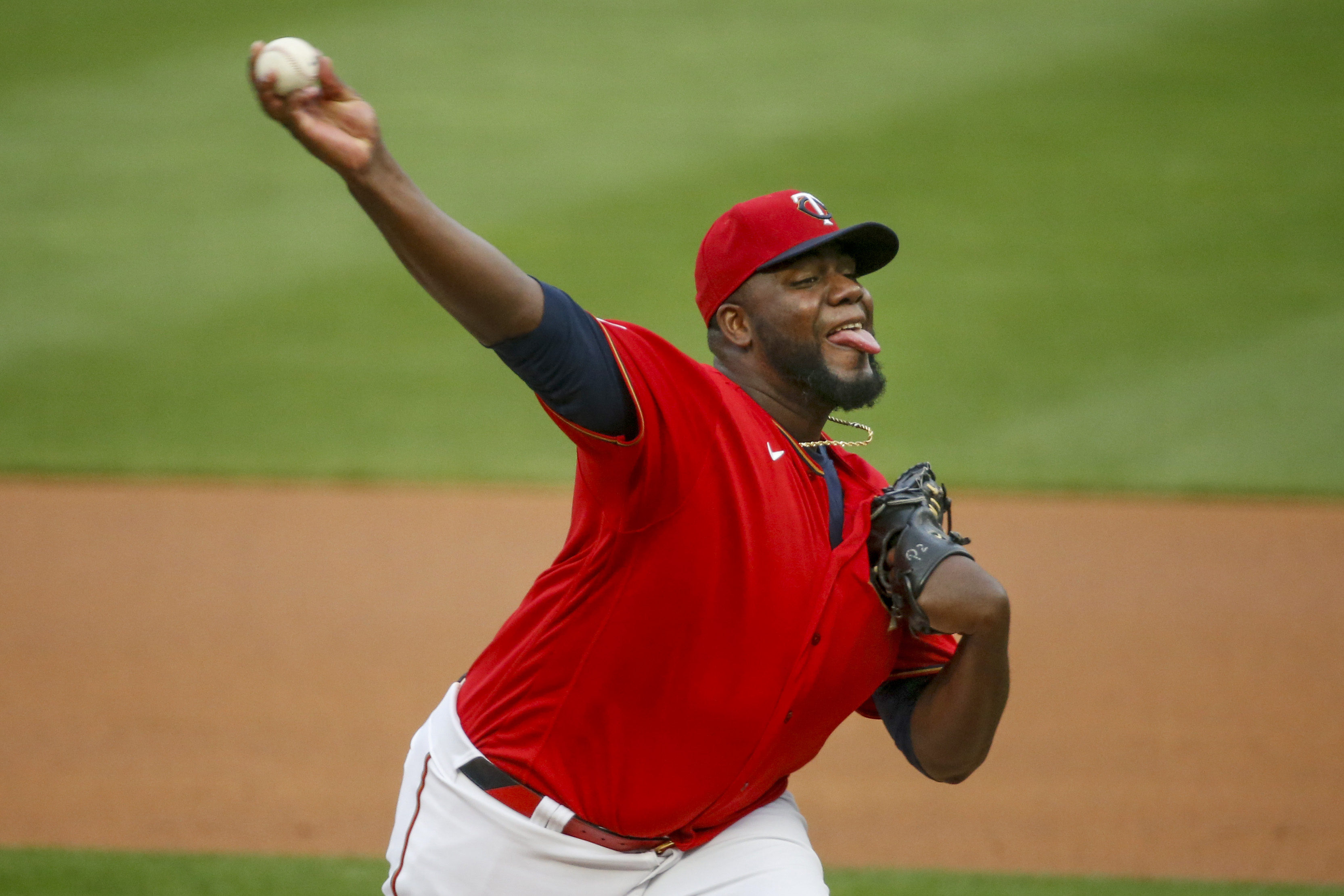 Box Score Pineda: 5.0 IP, 3 H, 1 ER, 2 BB, 5 K Home Runs: Kirilloff 2 (2) Top 3 WPA: Pineda .185, Kirilloff .157, Arraez .058 Win Probability Chart (via FanGraphs): Reaching base has been one of the greatest struggles for the Twins this season. Before the game, only seven AL teams had a lower team on-base percentage than Minnesota (.304). Also, the team’s walk rate (7.5%) ranked sixth-worst in the majors. However, the lineup looked like a completely different one during the first couple of innings. Six different Twins reached safely in the first two innings, including three walks. They were threatening early, as Byron Buxton and Nelson Cruz got two-out single and walk, respectively. Alex Kirilloff then, in a preview of what was coming, scorched the first pitch he saw, for a 106 mph exit velocity and .970 xBA inning-ending flyout. Royals starter Brady Singer still struggled in the second and he soon loaded the bases after facing four batters. Ben Rortvedt, making his major league debut, worked a nice eight-pitch at-bat to draw a walk and juice them up for Luis Arráez. He got hit by a pitch on the shoulder, putting the Twins on the board. Then, this happened: https://twitter.com/Nashwalker9/status/1388298021629202444 Singer didn’t come back for the third and then things got interesting. Buxton and Cruz both drew walks against Royals reliever Tyler Zuber to open the third inning. Then Kirilloff destroyed a baseball, to go yard for the first time in his career! https://twitter.com/BallySportsNOR/status/1388302083909107712 Michael Pineda couldn’t be happier. While the Twins lineup kept burning through the Royals pitching staff (including old friend Ervin Santana), Big Mike was putting together a nice start. He nearly had a perfect first time through the order, allowing only a bunt single to Andrew Benintendi after three innings, on 32 pitches. Things got a bit less smooth for him. It took Pineda more pitches (39) to pitch through the fourth and fifth innings than the previous three. Carlos Santana homered off of him in the fourth to put Kansas City on the board. Then, he got hit by a comebacker off Michael Taylor’s bat, which got him in the pitching arm. After a mound visit, he decided to continue pitching, and, in spite of giving up a walk, he managed to get the last out of the fifth. Fortunately, Pineda had some great defense behind him tonight. In that previous play, Jorge Polanco and Kirilloff played it out beautifully to retire Taylor. But one at-bat earlier, Buxton made this spectacular play, with only 35% catch probability: https://twitter.com/TwinsBrasil/status/1388309835012354049 But that comebacker was probably the reason why Rocco Baldelli decided to pull Pineda off the game after five innings. It was, nonetheless, a solid start for him, finishing with only 71 pitches (42 strikes), while striking out five batters and walking just two. Also, Big Mike’s 28 sliders tonight produced a ridiculous 67% whiff. Before he was officially pulled, Kirilloff wanted to make sure he had enough run support to sustain the win. He took Santana deep in the bottom of the inning, for his second home run of the night, making it 5-1 Minnesota. This time, there was nothing Taylor could do to avoid it. https://twitter.com/Nashwalker9/status/1388316061125259265 In need of some good outings, the Twins bullpen didn’t disappoint at all tonight. Tyler Duffey, Hansel Robles, and Jorge Alcalá combined for three hitless innings allowing only one walk. Meanwhile, the offense managed to add four more runs during the eighth inning, against struggling Wade Davis. Aldrelton Simmons doubled to bring in Max Kepler and later scored himself when Rortvedt got his first career hit. Davis then loaded the bases before recording an out and two more runs came in. Rortvedt scored easily from third on a wild pitch and then Cruz hit a sac-fly to score Arráez, making it 9-1 Twins. Alcalá came back for the ninth and finished it up in seven pitches, pitching around a leadoff single and securing the win. Postgame Interview Bullpen Usage Spreadsheet Click here to see the bullpen usage over the past five days (link opens a Google Sheet).
 -
J.A. Happ carried a no-hitter into the eighth inning Friday night and both Willians Astudillo and Jake Cave hit home runs. Who saw that coming!? Continue reading for more on tonight’s 2-0 Twins victory over Pittsburgh.Box Score Happ: 7.1 IP, 1 H, 0 ER, 2 BB, 3 K Home Runs: Astudillo (1), Cave (1) Top 3 WPA: Happ .406, Duffey .140, Astudillo .104 Win Probability Chart (via FanGraphs): Download attachment: chart.png Happ takes a no-hitter into the eighth We were all wondering how J.A. Happ’s outing would turn out to be, after ten days since his last start. I don’t think anyone imagined it would be this brilliant, as he took a no-hit bid into the eighth inning, on a little over 90 pitches, providing the Twins with his best start of the year. The lefty took care of the Pirate lineup with ease, as it took him only 75 pitches to pitch through the sixth. Even though he allowed six hard-hit balls throughout his start, the only time he came close to losing the no-no before the eighth was when Wilmer Difo actually reached first on a ground ball in the fifth but was then called out for batter interference. Minnesota caught a huge break there. The no-hit bid came to a conclusion in the eighth. Todd Frazier grounded out after jumping on the first pitch, Happ’s 88th of the game. Then, he did get ahead of Jacob Stallings next, 1-2, but three pitches later the catcher smacked a 106 mph double to corner left, ending Happs amazing start. Happ’s ERA is now down to 1.69 after three starts, which would be good for the ninth-best in the majors if he qualified. Bats pick up where they left off. Then slow down After the offense had an excruciatingly bad performance against the A’s on Tuesday’s doubleheader, failing to score and hitting a combined seven hits in the two games, they exploded for 12 runs scored on 18 hits during game three of the series. Tonight, they kept the ball rolling a bit, going for five hits in the first five innings. Two of these went yard. First, La Tortuga hit his first of the year in the third, chasing a fastball way outside the zone, in his best Eddie Rosario impression: The Twins threatened again in the fourth when Nelson Cruz hit a 116 mph rocket and was followed by an infield single by Byron Buxton. However, they stranded both runners. Then, in the fifth, it was time for Jake Cave to go oppo for his first of the year, making it 2-0 Twins: Donaldson had his first hitless game of the season, but even without a hit, his performance at the plate looked really good: As a matter of fact, after Cave’s home run in the fifth, Minnesota never got another hit, having its final 11 batters retired. Duffey, Rogers secure the W Fortunately, the lack of run support wasn’t a problem. Things didn’t start well when Tyler Duffey took over for Happ in the eighth, as he got ahead of Difo with 0-2 in the count, but then lost him after four consecutive balls. With two men on, we’ve all started having Oakland flashbacks. However, that was all the scare we had to experience. He was perfect after the walk, retiring the next two batters on five pitches and really showing his excitement after an inning-ending strikeout. He also struck out Phillip Evans to open the ninth, before Taylor Rogers took over. He took care of the last two batters with no problems, in spite of some hard-fought at bats. Postgame Interview Bullpen Usage Spreadsheet Click here to see the bullpen usage over the past five days (link opens a Google Sheet). Click here to view the article
-
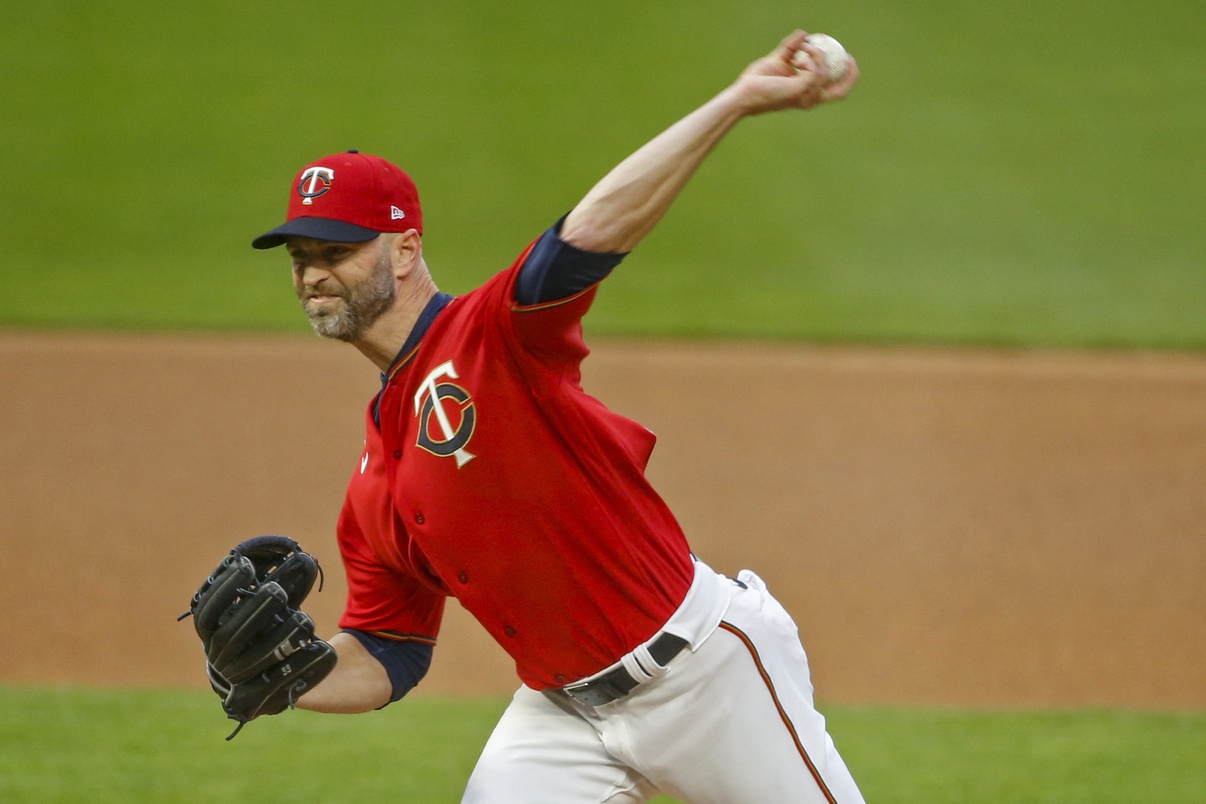 Box Score Happ: 7.1 IP, 1 H, 0 ER, 2 BB, 3 K Home Runs: Astudillo (1), Cave (1) Top 3 WPA: Happ .406, Duffey .140, Astudillo .104 Win Probability Chart (via FanGraphs): Happ takes a no-hitter into the eighth We were all wondering how J.A. Happ’s outing would turn out to be, after ten days since his last start. I don’t think anyone imagined it would be this brilliant, as he took a no-hit bid into the eighth inning, on a little over 90 pitches, providing the Twins with his best start of the year. The lefty took care of the Pirate lineup with ease, as it took him only 75 pitches to pitch through the sixth. Even though he allowed six hard-hit balls throughout his start, the only time he came close to losing the no-no before the eighth was when Wilmer Difo actually reached first on a ground ball in the fifth but was then called out for batter interference. Minnesota caught a huge break there. The no-hit bid came to a conclusion in the eighth. Todd Frazier grounded out after jumping on the first pitch, Happ’s 88th of the game. Then, he did get ahead of Jacob Stallings next, 1-2, but three pitches later the catcher smacked a 106 mph double to corner left, ending Happs amazing start. https://twitter.com/BallySportsNOR/status/1385787126487437317 Happ’s ERA is now down to 1.69 after three starts, which would be good for the ninth-best in the majors if he qualified. Bats pick up where they left off. Then slow down After the offense had an excruciatingly bad performance against the A’s on Tuesday’s doubleheader, failing to score and hitting a combined seven hits in the two games, they exploded for 12 runs scored on 18 hits during game three of the series. Tonight, they kept the ball rolling a bit, going for five hits in the first five innings. Two of these went yard. First, La Tortuga hit his first of the year in the third, chasing a fastball way outside the zone, in his best Eddie Rosario impression: https://twitter.com/BallySportsNOR/status/1385759121803198466 The Twins threatened again in the fourth when Nelson Cruz hit a 116 mph rocket and was followed by an infield single by Byron Buxton. However, they stranded both runners. Then, in the fifth, it was time for Jake Cave to go oppo for his first of the year, making it 2-0 Twins: https://twitter.com/BallySportsNOR/status/1385766800076443650 Donaldson had his first hitless game of the season, but even without a hit, his performance at the plate looked really good: https://twitter.com/AaronGleeman/status/1385769943195701251 As a matter of fact, after Cave’s home run in the fifth, Minnesota never got another hit, having its final 11 batters retired. Duffey, Rogers secure the W Fortunately, the lack of run support wasn’t a problem. Things didn’t start well when Tyler Duffey took over for Happ in the eighth, as he got ahead of Difo with 0-2 in the count, but then lost him after four consecutive balls. With two men on, we’ve all started having Oakland flashbacks. However, that was all the scare we had to experience. He was perfect after the walk, retiring the next two batters on five pitches and really showing his excitement after an inning-ending strikeout. He also struck out Phillip Evans to open the ninth, before Taylor Rogers took over. He took care of the last two batters with no problems, in spite of some hard-fought at bats. https://twitter.com/BallySportsNOR/status/1385783069970472965 Postgame Interview Bullpen Usage Spreadsheet Click here to see the bullpen usage over the past five days (link opens a Google Sheet).
 -
Thanks in large part to an epic Justin Upton grand slam, the Angels put together a six-run seventh inning to put tonight’s game out of reach. How out of reach? Willians Astudillo pitched.Box Score Thorpe: 4.0 IP, 3 H, 2 ER, 1 BB, 2 K Home Runs: None Bottom 3 WPA: Dobnak -.394, Cave -.178, Garlick -.149 Win Probability Chart (via FanGraphs): Download attachment: chart.png Thorpe starts off great, but can’t pitch past the fourth After an exciting Spring Training, Aussie Lewis Thorpe got called up to step in and take the mound in the series opener. His first impression couldn’t have been much better, as he cruised through the first on only ten pitches, nine of which were strikes. He struck out Mike Trout on three pitches to close out the inning, including a couple of nasty whiffs with his slider. Something Twins fans were looking forward to seeing in Thorpe’s repertoire was his new, improved four-seam fastball. During his impressive Spring Training, he showcased a much-improved velocity, topping out at 93 mph, after averaging 89.7 mph in 2020. However, that wasn’t the case tonight. Thorpe’s four-seamer averaged only 89.5 mph throughout this outing, topping at 91.5 mph. To make up for it, Thorpe relied on the next best thing on his arsenal, the slider. Half of his sixty pitches were sliders, a percentage nearly twice as big as his career average. They produced a total of 20 swings, eight of which were whiffs. He managed to pitch three very solid, scoreless innings, allowing only one hit. Then, disaster struck. After quickly retiring the first two batters in the fourth, Thorpe walked Trout after evening the count 2-2, and the Angels followed up with back to back hits and put the first two runs of the game on the board, Thorpe did get the last out of the inning, but he was done for the night, after having thrown nearly 72% strikes. After being dominated by Heaney, the Twins offense rallies against an old friend... Lefty Andrew Heaney had no trouble overpowering the Twins lineup like most lefties have been doing since the start of last season. With Byron Buxton (1.538 OPS against lefties this season) still unavailable due to hamstring mild strain, the Angels starter cruised through the first five innings, allowing only a hit and a couple of walks. He also induced three double plays. But then Jorge Polanco and Max Kepler both reached to open the sixth, causing Joe Maddon to pull Heaney. To relieve him, the Angels turned to Twins old friend Aaron Slegers, who was having a very solid start of the season. Mitch Garver didn’t care about that, though. And neither did Josh Donaldson. ...but then the bullpen gives the lead away, and more Randy Dobnak took over for Thorpe in the fifth and quickly pitched a 1-2-3 inning. Similar to tonight’s starter, Dobnak also had an amazing spring, but so far had failed to replicate that. But that fifth inning was the closest he got to anything resembling a good outing tonight. Facing the top of the Angels’ order, Dobber gave up back-to-back-to-back hits to open the sixth. The lead was gone after Trout singled to left, bringing home both runners. He retired the next three batters, which caused him to be brought back to the seventh. Nothing worked once again and, after giving up three more hits, including an RBI-single to David Fletcher, Rocco Baldelli decided he was done. Caleb Thielbar came in and was absolutely burnt by Angels bats. After striking out Shohei Ohtani, he decided to intentionally walk Trout and load the bases, to face Justin Upton with two outs. Bad call. Upton, who has a career .909 OPS against the Twins, mercilessly destroyed Thielbar’s 69 mph meatball, to hit a grand slam. Jared Walsh followed up with another homer, making it 10-3 Angels, after a six-run seventh inning. At least La Tortuga made some of us smile during this blowout. What’s next? Tomorrow night, at 8:07 pm C.T., Matt Shoemaker takes on the mound for game two, trying to get the 6-8 Twins back on track. However, the struggling offense will have to face another lefty in José Quintana. Bullpen Usage Spreadsheet Click here to see the bullpen usage over the past five days (link opens a Google Sheet). Click here to view the article
-
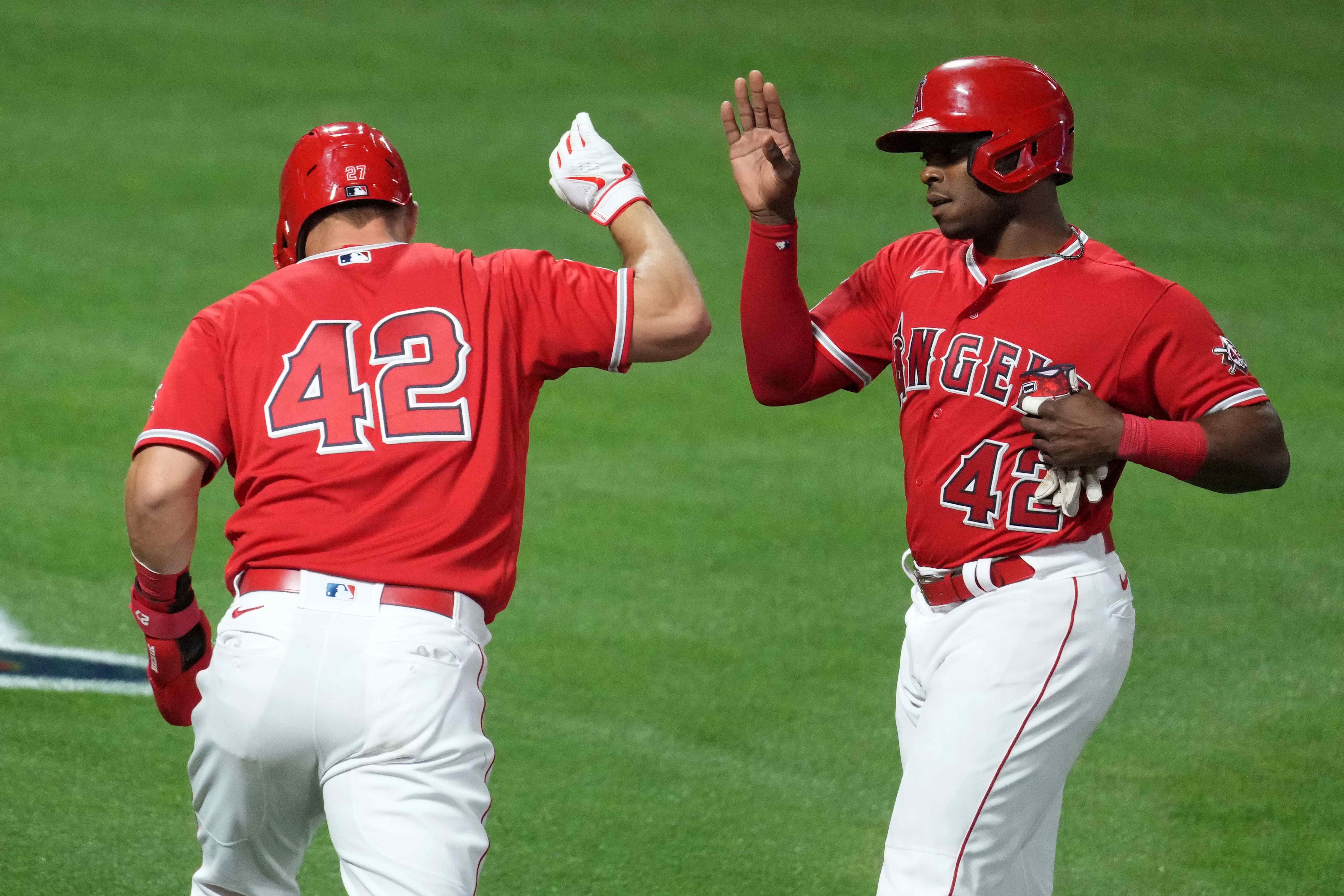 Box Score Thorpe: 4.0 IP, 3 H, 2 ER, 1 BB, 2 K Home Runs: None Bottom 3 WPA: Dobnak -.394, Cave -.178, Garlick -.149 Win Probability Chart (via FanGraphs): Thorpe starts off great, but can’t pitch past the fourth After an exciting Spring Training, Aussie Lewis Thorpe got called up to step in and take the mound in the series opener. His first impression couldn’t have been much better, as he cruised through the first on only ten pitches, nine of which were strikes. He struck out Mike Trout on three pitches to close out the inning, including a couple of nasty whiffs with his slider. https://twitter.com/TFTwins/status/1383240052461883401 Something Twins fans were looking forward to seeing in Thorpe’s repertoire was his new, improved four-seam fastball. During his impressive Spring Training, he showcased a much-improved velocity, topping out at 93 mph, after averaging 89.7 mph in 2020. However, that wasn’t the case tonight. Thorpe’s four-seamer averaged only 89.5 mph throughout this outing, topping at 91.5 mph. To make up for it, Thorpe relied on the next best thing on his arsenal, the slider. Half of his sixty pitches were sliders, a percentage nearly twice as big as his career average. They produced a total of 20 swings, eight of which were whiffs. He managed to pitch three very solid, scoreless innings, allowing only one hit. Then, disaster struck. After quickly retiring the first two batters in the fourth, Thorpe walked Trout after evening the count 2-2, and the Angels followed up with back to back hits and put the first two runs of the game on the board, Thorpe did get the last out of the inning, but he was done for the night, after having thrown nearly 72% strikes. After being dominated by Heaney, the Twins offense rallies against an old friend... Lefty Andrew Heaney had no trouble overpowering the Twins lineup like most lefties have been doing since the start of last season. With Byron Buxton (1.538 OPS against lefties this season) still unavailable due to hamstring mild strain, the Angels starter cruised through the first five innings, allowing only a hit and a couple of walks. He also induced three double plays. But then Jorge Polanco and Max Kepler both reached to open the sixth, causing Joe Maddon to pull Heaney. To relieve him, the Angels turned to Twins old friend Aaron Slegers, who was having a very solid start of the season. Mitch Garver didn’t care about that, though. https://twitter.com/BallySportsNOR/status/1383259181575065605 And neither did Josh Donaldson. https://twitter.com/BallySportsNOR/status/1383260073749667847 ...but then the bullpen gives the lead away, and more Randy Dobnak took over for Thorpe in the fifth and quickly pitched a 1-2-3 inning. Similar to tonight’s starter, Dobnak also had an amazing spring, but so far had failed to replicate that. But that fifth inning was the closest he got to anything resembling a good outing tonight. Facing the top of the Angels’ order, Dobber gave up back-to-back-to-back hits to open the sixth. The lead was gone after Trout singled to left, bringing home both runners. He retired the next three batters, which caused him to be brought back to the seventh. Nothing worked once again and, after giving up three more hits, including an RBI-single to David Fletcher, Rocco Baldelli decided he was done. Caleb Thielbar came in and was absolutely burnt by Angels bats. After striking out Shohei Ohtani, he decided to intentionally walk Trout and load the bases, to face Justin Upton with two outs. Bad call. Upton, who has a career .909 OPS against the Twins, mercilessly destroyed Thielbar’s 69 mph meatball, to hit a grand slam. Jared Walsh followed up with another homer, making it 10-3 Angels, after a six-run seventh inning. At least La Tortuga made some of us smile during this blowout. https://twitter.com/JomboyMedia/status/1383277917258407941 What’s next? Tomorrow night, at 8:07 pm C.T., Matt Shoemaker takes on the mound for game two, trying to get the 6-8 Twins back on track. However, the struggling offense will have to face another lefty in José Quintana. Bullpen Usage Spreadsheet Click here to see the bullpen usage over the past five days (link opens a Google Sheet).
 -
José Berríos finished last season on a high note, but the overall impression he made wasn’t the best. Many fans started questioning how good he actually is and started wondering about his future. Can he still be an ace? Today we look at three major leaguers who were having similar careers through age 26, to try to imagine what’s next for La Makina.At the start of 2020, many Twins fans had their hopes high that Berríos would continue to develop into an ace. Entering his age 26 season, he was coming off back-to-back All-Star Game appearances and had had some of his career-best numbers the year before. But things definitely didn’t go his way last season. To call La Makina’s 2020 disastrous might be a bit too much, especially if you consider the sample size. He didn’t have enough time to improve his overall numbers after his rough start, in which he had a 5.92 ERA in the first five starts. In spite of posting a 2.79 ERA in his final seven starts of the regular season and having his best postseason outing yet, overall, several of his numbers looked well worse than usual. Last year, Berríos had the highest walk-rate (9.6%) since his debut season and the highest hard hit-rate (39.7%) of his entire career. Also, his xBA (.249) and wOBA (.303), while not terrible, were both the highest since 2016. Talking about his traditional stats, the 4.00 ERA, 4.06 FIP, 1.317 WHIP and 109 ERA+ were all the worst in four years. Such regression, combined with Kenta Maeda’s stellar season, compelled a lot of Twins fans to simply rule Berríos out of the conversations for number one pitcher in the rotation. While this might’ve been true for most fans even before his disappointing 2020 season, maybe it’s a good moment to ask: what to expect from Berríos’ foreseeable future with Minnesota? Like Ted Schwerzler pointed out in his blog, Berríos is about to enter his prime and isn’t far from Cy Young contention, so extending him as soon as possible should make a lot of sense for the Twins. However, MLB.com’s Do-Hyoung Park believes it won’t be that easy to do so. Also, in his piece, he talks about how difficult it is to make any projections right now, so here’s an interesting way I found to speculate on what’s next on Berríos’ career. Using the Similarity Scores tool from Baseball Reference, here are three starting pitchers I found that were having similar careers to Berríos through the age 26. Pat Hentgen Here’s a guy who had some uncanny resemblances with Berríos, at least in the first years. He was drafted and developed by the Toronto Blue Jays and pitched for the club for nine seasons, from 1991 to 1999. He made it to the All-Star Game twice (1993 and 1994), but went on to have an abysmal 1995 season, posting a 5.11 ERA and allowing the most hits (236) and earned runs (114) in all of the majors. Entering the 1996 season, his career numbers were unimpressive, to say the least: 4.23 ERA, 4.54 FIP and 108 ERA+. But that didn’t stop him from getting right back on track and pitching his way to the AL Cy Young Award that very year. He did struggle for the remainder of his major league career, though, especially after having Tommy John Surgery in 2001. John Lackey The three-time World Series winner pitched four seasons until turning 26 and the start of his career in the majors wasn’t nearly as impressive as Berríos’ and Hentgen’s. In that span (from 2002 to 2005), he had a 4.15 ERA and 105 ERA+ in only 29 total starts. But things really picked up afterwards. In 2006 he had career numbers in bWAR (4.6), innings pitched (217 2/3) and ERA+ (127), only to improve each one of those even more in 2007 and finish third in the AL Cy Young voting, after leading the AL in ERA (3.01) and being named for his first All-Star Game. While he was never an ace, he had himself a very solid career from 2006 to 2017, pitching at least 160 innings in each season and having 3.84 ERA, 3.95 FIP and 111 ERA+ to show for it. Trevor Bauer The former Indian was first tested in the majors in 2012 and 2013, starting on only four games in each season. Taking over as one of Cleveland’s full time starters in 2014, he pitched four consecutive seasons with at least 26 starts. Unlike Berríos, he never impressed at all in his first years, having a career 4.36 ERA, 4.15 FIP and 99 ERA+ after his age 26 season (2017). But then, in 2018, he finally turned the corner and made it to his first All-Star Game and finished sixth in the AL Cy Young race, after posting a 2.21 ERA, leading the AL with 2.44 FIP and having a 196 ERA+. After a rough start to his Cincinnati Reds career, he went on to have a career year last season, with a league best 1.73 ERA, 2.88 FIP and 276 ERA+, winning the NL Cy Young Award. Similarity Scores are just fun coincidences to look at and of course they mean nothing for a player’s future. What we do know is that Berríos is a very hard-working kid, who’s earned himself the benefit of the doubt, even after a not ideal (and hopefully atypical) season. Whether he’s going to be an elite, top of the rotation starter and win Cy Young awards or just an OK number three guy shouldn’t matter for the decision of keeping him around or not. I think the Twins definitely should. What about you? MORE FROM TWINS DAILY — Latest Twins coverage from our writers — Recent Twins discussion in our forums — Follow Twins Daily via Twitter, Facebook or email Click here to view the article
-
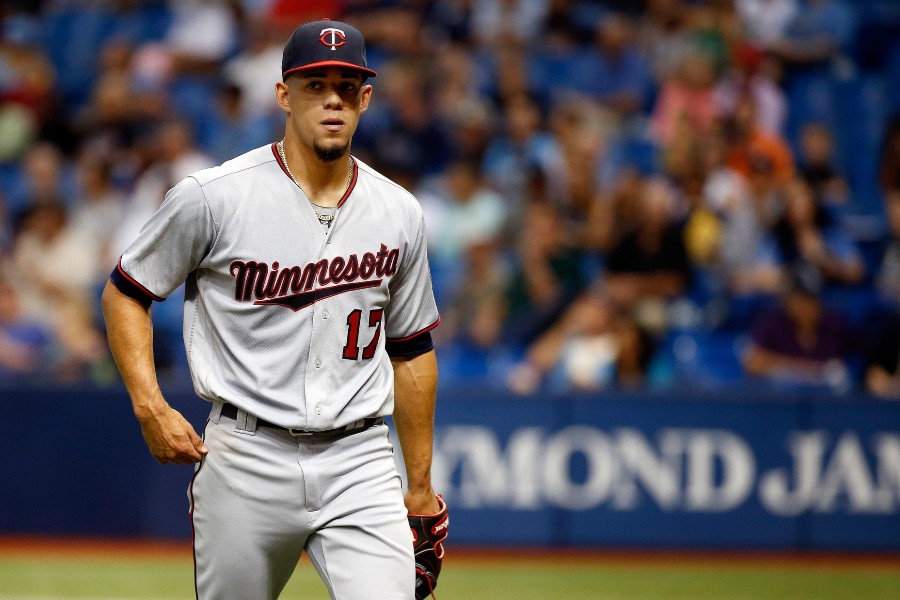 At the start of 2020, many Twins fans had their hopes high that Berríos would continue to develop into an ace. Entering his age 26 season, he was coming off back-to-back All-Star Game appearances and had had some of his career-best numbers the year before. But things definitely didn’t go his way last season. To call La Makina’s 2020 disastrous might be a bit too much, especially if you consider the sample size. He didn’t have enough time to improve his overall numbers after his rough start, in which he had a 5.92 ERA in the first five starts. In spite of posting a 2.79 ERA in his final seven starts of the regular season and having his best postseason outing yet, overall, several of his numbers looked well worse than usual. Last year, Berríos had the highest walk-rate (9.6%) since his debut season and the highest hard hit-rate (39.7%) of his entire career. Also, his xBA (.249) and wOBA (.303), while not terrible, were both the highest since 2016. Talking about his traditional stats, the 4.00 ERA, 4.06 FIP, 1.317 WHIP and 109 ERA+ were all the worst in four years. Such regression, combined with Kenta Maeda’s stellar season, compelled a lot of Twins fans to simply rule Berríos out of the conversations for number one pitcher in the rotation. While this might’ve been true for most fans even before his disappointing 2020 season, maybe it’s a good moment to ask: what to expect from Berríos’ foreseeable future with Minnesota? Like Ted Schwerzler pointed out in his blog, Berríos is about to enter his prime and isn’t far from Cy Young contention, so extending him as soon as possible should make a lot of sense for the Twins. However, MLB.com’s Do-Hyoung Park believes it won’t be that easy to do so. Also, in his piece, he talks about how difficult it is to make any projections right now, so here’s an interesting way I found to speculate on what’s next on Berríos’ career. Using the Similarity Scores tool from Baseball Reference, here are three starting pitchers I found that were having similar careers to Berríos through the age 26. Pat Hentgen Here’s a guy who had some uncanny resemblances with Berríos, at least in the first years. He was drafted and developed by the Toronto Blue Jays and pitched for the club for nine seasons, from 1991 to 1999. He made it to the All-Star Game twice (1993 and 1994), but went on to have an abysmal 1995 season, posting a 5.11 ERA and allowing the most hits (236) and earned runs (114) in all of the majors. Entering the 1996 season, his career numbers were unimpressive, to say the least: 4.23 ERA, 4.54 FIP and 108 ERA+. But that didn’t stop him from getting right back on track and pitching his way to the AL Cy Young Award that very year. He did struggle for the remainder of his major league career, though, especially after having Tommy John Surgery in 2001. John Lackey The three-time World Series winner pitched four seasons until turning 26 and the start of his career in the majors wasn’t nearly as impressive as Berríos’ and Hentgen’s. In that span (from 2002 to 2005), he had a 4.15 ERA and 105 ERA+ in only 29 total starts. But things really picked up afterwards. In 2006 he had career numbers in bWAR (4.6), innings pitched (217 2/3) and ERA+ (127), only to improve each one of those even more in 2007 and finish third in the AL Cy Young voting, after leading the AL in ERA (3.01) and being named for his first All-Star Game. While he was never an ace, he had himself a very solid career from 2006 to 2017, pitching at least 160 innings in each season and having 3.84 ERA, 3.95 FIP and 111 ERA+ to show for it. Trevor Bauer The former Indian was first tested in the majors in 2012 and 2013, starting on only four games in each season. Taking over as one of Cleveland’s full time starters in 2014, he pitched four consecutive seasons with at least 26 starts. Unlike Berríos, he never impressed at all in his first years, having a career 4.36 ERA, 4.15 FIP and 99 ERA+ after his age 26 season (2017). But then, in 2018, he finally turned the corner and made it to his first All-Star Game and finished sixth in the AL Cy Young race, after posting a 2.21 ERA, leading the AL with 2.44 FIP and having a 196 ERA+. After a rough start to his Cincinnati Reds career, he went on to have a career year last season, with a league best 1.73 ERA, 2.88 FIP and 276 ERA+, winning the NL Cy Young Award. Similarity Scores are just fun coincidences to look at and of course they mean nothing for a player’s future. What we do know is that Berríos is a very hard-working kid, who’s earned himself the benefit of the doubt, even after a not ideal (and hopefully atypical) season. Whether he’s going to be an elite, top of the rotation starter and win Cy Young awards or just an OK number three guy shouldn’t matter for the decision of keeping him around or not. I think the Twins definitely should. What about you? MORE FROM TWINS DAILY — Latest Twins coverage from our writers — Recent Twins discussion in our forums — Follow Twins Daily via Twitter, Facebook or email
 -
In his first game in more than two weeks, Luis Arráez recorded four hits, three of them doubles. His performance helped spark a victory that kept the Twins atop the American League Central. Home-field advantage in the first round of the playoffs has also been secured.Box Score Pineda: 4.0 IP, 4 H, 2 ER, 3 BB, 4 K Home Runs: None Top 3 WPA: Arráez .238, Gonzalez .094, Kepler .074 Rocco Baldelli said earlier this week that Michael Pineda was going to be the Twins starting pitcher in an eventual Game 3 of the Wild Card series, whomever they face. Even though there’s still no official announcement, he also said that this decision is unlikely to change. Naturally, Big Mike’s last regular season start would be his ‘final exam’ for the playoffs, even if he was not going to go the distance. However, he got off on the wrong foot, as it took him 34 pitches to end the first inning, nearly half of the total pitches he would throw in this game. He lacked command, throwing only two called strikes and giving up two walks, while also giving up a couple of hits that helped Cincinnati jump to a 2-0 lead right away. But that was all the struggle Pineda would go through in the night, as he smoothly pitched three scoreless innings next, allowing only two baserunners. Had he continued in the game, he was in good shape to near a quality start. It wasn’t an optimal outing, sure, but not a bad one either. Welcome back, Arráez! After missing 13 games due to a left knee tendinitis that had him placed on the 10-day Injured List, he was activated earlier today to resume his season and also get looked at for postseason purposes. Fortunately, he didn’t even come close to disappointing. The Twins would score five runs in the first five innings to take the lead and Arráez was directly involved in four of them. He hit a double in each of his first three at bats, setting a career high. He doubled in the first and was scored by a Nelson Cruz single; doubled in the third to score Max Kepler and scored on an Eddie Rosario single; and doubled again in the fifth, scoring Kepler once again. Kepler (twice) and Marwin González also joined the doubles party making it six overall for Minnesota. After his double, MarGo moved up on a sac-fly and scored on a rare wild pitch by Reds starter Luis Castillo. The bullpen was also tested With the early departure of Pineda, the Twins bullpen would go through another tough test to prepare for the playoffs. They had been kind of struggling as of late, having allowed three runs in each of the past three games. Granted, in one of those they had to pitch seven innings in relief of Homer Bailey on Tuesday, but still, some fans had their confidence shaken. Tyler Clippard and Cody Stashak delivered two perfect innings in the fifth and sixth, but Stashak ran into trouble to start the seventh, when he opened the inning by giving up back-to-back singles. Taylor Rogers took over and immediately gave up an RBI single and hit a batter, loading the bases with only one out, under a somewhat heavy rain. He put himself together and retired the final two batters of the inning and keep the Twins’ two-run lead. He came back to pitch the eighth and got two quick outs, making it the first time this season he pitched more than one inning in a game, ending his outing with 1 1/3 inning and not allowing an earned run. Tyler Duffey came in and concluded the top of the eighth with no problems. More doubles, more run support and more Arráez The offense showed up again in the bottom of the seventh, after the Reds shortened the distances. Ehire Adrianza led off the inning with another double, the eighth from Minnesota in the game (the club record, set last year, is nine). Kepler drew a walk after him and then Arráez got his fourth hit of the game and scored his countryman. Eddie Rosario flied out to center, but hit the ball deep enough to score Kepler and push the lead to four runs, 7-3 Twins, which ended up being the final score. After getting the last out in the eighth, Duffey came back and pitched an outstanding ninth, striking out the side in 13 pitches. The Twins even up the series and are still in control of their own destiny, with the magic number now at one. If they win the rubber game tomorrow, they’re going to be back-to-back AL Central champions for the first time in 10 years. But even if they end up losing first place, they have secured home-field advantage in the Wild Card Series earlier tonight, with the Indians’ 8-0 loss against Pittsburgh. Postgame Pint Check out tonight’s episode of Twins Daily’s Postgame Pint live stream on or Facebook. Bullpen Usage Spreadsheet Download attachment: Bullpen.png Click here to view the article
-
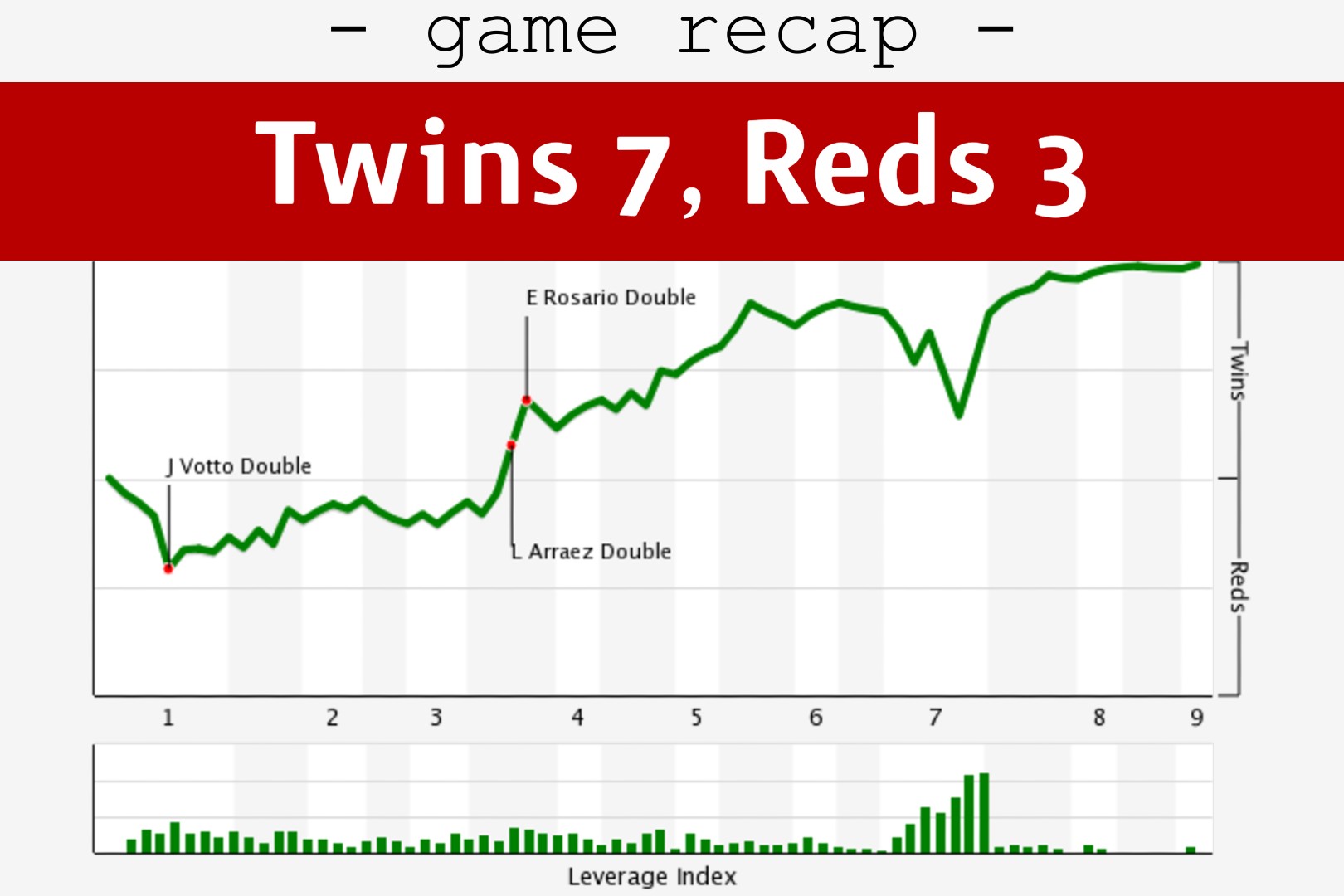 Box Score Pineda: 4.0 IP, 4 H, 2 ER, 3 BB, 4 K Home Runs: None Top 3 WPA: Arráez .238, Gonzalez .094, Kepler .074 Rocco Baldelli said earlier this week that Michael Pineda was going to be the Twins starting pitcher in an eventual Game 3 of the Wild Card series, whomever they face. Even though there’s still no official announcement, he also said that this decision is unlikely to change. Naturally, Big Mike’s last regular season start would be his ‘final exam’ for the playoffs, even if he was not going to go the distance. However, he got off on the wrong foot, as it took him 34 pitches to end the first inning, nearly half of the total pitches he would throw in this game. He lacked command, throwing only two called strikes and giving up two walks, while also giving up a couple of hits that helped Cincinnati jump to a 2-0 lead right away. But that was all the struggle Pineda would go through in the night, as he smoothly pitched three scoreless innings next, allowing only two baserunners. Had he continued in the game, he was in good shape to near a quality start. It wasn’t an optimal outing, sure, but not a bad one either. Welcome back, Arráez! After missing 13 games due to a left knee tendinitis that had him placed on the 10-day Injured List, he was activated earlier today to resume his season and also get looked at for postseason purposes. Fortunately, he didn’t even come close to disappointing. The Twins would score five runs in the first five innings to take the lead and Arráez was directly involved in four of them. He hit a double in each of his first three at bats, setting a career high. He doubled in the first and was scored by a Nelson Cruz single; doubled in the third to score Max Kepler and scored on an Eddie Rosario single; and doubled again in the fifth, scoring Kepler once again. Kepler (twice) and Marwin González also joined the doubles party making it six overall for Minnesota. After his double, MarGo moved up on a sac-fly and scored on a rare wild pitch by Reds starter Luis Castillo. https://twitter.com/fsnorth/status/1310011696669392896 The bullpen was also tested With the early departure of Pineda, the Twins bullpen would go through another tough test to prepare for the playoffs. They had been kind of struggling as of late, having allowed three runs in each of the past three games. Granted, in one of those they had to pitch seven innings in relief of Homer Bailey on Tuesday, but still, some fans had their confidence shaken. Tyler Clippard and Cody Stashak delivered two perfect innings in the fifth and sixth, but Stashak ran into trouble to start the seventh, when he opened the inning by giving up back-to-back singles. Taylor Rogers took over and immediately gave up an RBI single and hit a batter, loading the bases with only one out, under a somewhat heavy rain. He put himself together and retired the final two batters of the inning and keep the Twins’ two-run lead. He came back to pitch the eighth and got two quick outs, making it the first time this season he pitched more than one inning in a game, ending his outing with 1 1/3 inning and not allowing an earned run. Tyler Duffey came in and concluded the top of the eighth with no problems. More doubles, more run support and more Arráez The offense showed up again in the bottom of the seventh, after the Reds shortened the distances. Ehire Adrianza led off the inning with another double, the eighth from Minnesota in the game (the club record, set last year, is nine). Kepler drew a walk after him and then Arráez got his fourth hit of the game and scored his countryman. Eddie Rosario flied out to center, but hit the ball deep enough to score Kepler and push the lead to four runs, 7-3 Twins, which ended up being the final score. https://twitter.com/Twins/status/1310033254666457089 After getting the last out in the eighth, Duffey came back and pitched an outstanding ninth, striking out the side in 13 pitches. The Twins even up the series and are still in control of their own destiny, with the magic number now at one. If they win the rubber game tomorrow, they’re going to be back-to-back AL Central champions for the first time in 10 years. But even if they end up losing first place, they have secured home-field advantage in the Wild Card Series earlier tonight, with the Indians’ 8-0 loss against Pittsburgh. Postgame Pint Check out tonight’s episode of Twins Daily’s Postgame Pint live stream on or Facebook.https://www.youtube.com/watch?v=epYnjZPnsY0 Bullpen Usage Spreadsheet
 -
 Luis Arráez surprised many fans when he came up to the majors last year and played at batting title-worthy level. However, many of us decided to tread lightly, as his sample size last year wasn’t great. Now, he’s getting close to accumulating “full season” numbers and we decided to analyze how he’s performed so far.Currently Arráez has got 479 plate appearances as a major leaguer, nearing the minimum to qualify for a batting title, in a 162-game season. When comparing his two seasons (which we’re going to do shortly), we can find many aspects in which he’s had some regression, but also some improvements. Before we get to such comparison, let’s look at what he’s accomplished overall. In 122 games since making his MLB debut, Arráez has maintained a .323/.384/.414 (.798 OPS) slashline and, both, his wRC+ and OPS+ have been 116, which indicates that he’s been an above average hitter so far. Combining both seasons, his batting average is the fourth best in baseball (min. 450 PA) which is pretty impressive, if you ask me. But that’s not all. The young Venezuelan has also been one of the most disciplined batters in the league. Since the start of the 2019 season, his 8.4% strikeout rate (K%) ranks second best in baseball, while the 1.10 Walk-to-strikeout ratio (BB/K) ranks third. He’s been the best in baseball in Contact% (92.9), O-Contact% (89.2) and SwStr% (3.0). Only one other batter has had a better Z-Contact% than his (95.2). As we’re going to see next, some of his numbers this year were slightly worse than last year, but still, if he can pull off similar numbers over a full season, the Twins are in for a treat. Let’s dig some more to look in what things he’s regressed or improved this year, compared to last year. His regression Basically, Arráez has been striking out more and walking less this year. His ability to draw walks wasn’t good in the first place, with a 9.8% Walk rate (BB%) in 2019, but it’s gotten worse this year, dropping to 7.1%. He would rank 116th out of 146 qualified batters in that metric, if he qualified this season. His K% has also increased from 7.9% last year to 9.7% this year. But the good news here is that, in spite of the regression, his current rate would rank second best in the majors, if he qualified. Luck hasn’t been on his side when it comes to putting balls in play. His Batting average on balls in play (BABIP) has dropped from .355 last year to .319 this year. Shifting hasn’t played a role here, as opposing teams have shifted against him only 4.4% of the time, due to his constant opposite field hits. Besides, his Weighted on-base average (wOBA) against the shift this season has been .417, much better than the .290 when there’s no shift. His batting average also dropped considerably, from .334 last year to .288 this year. However, both his AVG and BABIP suffered because of a specific slump he went through in early August. In the 15 games before he was placed on the Injured List (dating exactly to Aug. 12), he slashed .358/.382/.434 (.816), with a .380 BABIP. So, it may be safe to say that his overall numbers were greatly affected by that one, short slump. His improvements We discussed how luck hasn’t been in Arráez’ side this year, when looking at his overall statistics. And another way to prove that is to look at how he’s fared in the expected outcome stats, which assess a player’s performance without taking into consideration defense and ballpark factors. They provide a more pure way to look at how right a player has done his part. Three major expected stats are used more frequently by Statcast, to show a player’s pure performance: Expected Batting Average (xBA), Expected Slugging (xSLG) and Expected Weighted On-Base Average (xwOBA). Arráez has improved in all of them this year! His xBA improved from .294 to .307, his xSLG from .417 to .457 and his xWOBA from .342 to .361. Each one of them is well above league average, too. In other words, Arráez has been doing all the right things at the plate and he is due to a growth in his productivity. You couldn’t expect better news on the verge of the postseason. Last, but not least, here’s where the second baseman improved the most this year: his defense. This year’s sample isn’t very long (however less than 40% shorter than last year’s), but Arráez has evolved from a well below average defender at second base into a decent one. Among all second basemen with at least 240 innings on the field, he ranks 7th in baseball in Defensive runs saved (DRS), with +2, and 9th in Ultimate zone rating (UZR), with +0.6. They improved from -8 DRS and -5 UZR last year. In conclusion, Luis Arráez hasn’t disappointed in his first “full season” in the majors. He seems to be on the right path to become one of the most important pieces of the team's long term future. But not only the long term. If he keeps up his most recent numbers, taking them into the postseason, he’s bound to be a great contributor to an eventual long playoff run. MORE FROM TWINS DAILY — Latest Twins coverage from our writers — Recent Twins discussion in our forums — Follow Twins Daily via Twitter, Facebook or email Click here to view the article
 -
 Currently Arráez has got 479 plate appearances as a major leaguer, nearing the minimum to qualify for a batting title, in a 162-game season. When comparing his two seasons (which we’re going to do shortly), we can find many aspects in which he’s had some regression, but also some improvements. Before we get to such comparison, let’s look at what he’s accomplished overall. In 122 games since making his MLB debut, Arráez has maintained a .323/.384/.414 (.798 OPS) slashline and, both, his wRC+ and OPS+ have been 116, which indicates that he’s been an above average hitter so far. Combining both seasons, his batting average is the fourth best in baseball (min. 450 PA) which is pretty impressive, if you ask me. But that’s not all. The young Venezuelan has also been one of the most disciplined batters in the league. Since the start of the 2019 season, his 8.4% strikeout rate (K%) ranks second best in baseball, while the 1.10 Walk-to-strikeout ratio (BB/K) ranks third. He’s been the best in baseball in Contact% (92.9), O-Contact% (89.2) and SwStr% (3.0). Only one other batter has had a better Z-Contact% than his (95.2). As we’re going to see next, some of his numbers this year were slightly worse than last year, but still, if he can pull off similar numbers over a full season, the Twins are in for a treat. Let’s dig some more to look in what things he’s regressed or improved this year, compared to last year. His regression Basically, Arráez has been striking out more and walking less this year. His ability to draw walks wasn’t good in the first place, with a 9.8% Walk rate (BB%) in 2019, but it’s gotten worse this year, dropping to 7.1%. He would rank 116th out of 146 qualified batters in that metric, if he qualified this season. His K% has also increased from 7.9% last year to 9.7% this year. But the good news here is that, in spite of the regression, his current rate would rank second best in the majors, if he qualified. Luck hasn’t been on his side when it comes to putting balls in play. His Batting average on balls in play (BABIP) has dropped from .355 last year to .319 this year. Shifting hasn’t played a role here, as opposing teams have shifted against him only 4.4% of the time, due to his constant opposite field hits. Besides, his Weighted on-base average (wOBA) against the shift this season has been .417, much better than the .290 when there’s no shift. His batting average also dropped considerably, from .334 last year to .288 this year. However, both his AVG and BABIP suffered because of a specific slump he went through in early August. In the 15 games before he was placed on the Injured List (dating exactly to Aug. 12), he slashed .358/.382/.434 (.816), with a .380 BABIP. So, it may be safe to say that his overall numbers were greatly affected by that one, short slump. His improvements We discussed how luck hasn’t been in Arráez’ side this year, when looking at his overall statistics. And another way to prove that is to look at how he’s fared in the expected outcome stats, which assess a player’s performance without taking into consideration defense and ballpark factors. They provide a more pure way to look at how right a player has done his part. Three major expected stats are used more frequently by Statcast, to show a player’s pure performance: Expected Batting Average (xBA), Expected Slugging (xSLG) and Expected Weighted On-Base Average (xwOBA). Arráez has improved in all of them this year! His xBA improved from .294 to .307, his xSLG from .417 to .457 and his xWOBA from .342 to .361. Each one of them is well above league average, too. In other words, Arráez has been doing all the right things at the plate and he is due to a growth in his productivity. You couldn’t expect better news on the verge of the postseason. Last, but not least, here’s where the second baseman improved the most this year: his defense. This year’s sample isn’t very long (however less than 40% shorter than last year’s), but Arráez has evolved from a well below average defender at second base into a decent one. Among all second basemen with at least 240 innings on the field, he ranks 7th in baseball in Defensive runs saved (DRS), with +2, and 9th in Ultimate zone rating (UZR), with +0.6. They improved from -8 DRS and -5 UZR last year. In conclusion, Luis Arráez hasn’t disappointed in his first “full season” in the majors. He seems to be on the right path to become one of the most important pieces of the team's long term future. But not only the long term. If he keeps up his most recent numbers, taking them into the postseason, he’s bound to be a great contributor to an eventual long playoff run. MORE FROM TWINS DAILY — Latest Twins coverage from our writers — Recent Twins discussion in our forums — Follow Twins Daily via Twitter, Facebook or email
 -
Rich Hill delivered his best start as a Twin, but Kyle Hendricks was even better. The Professor schooled the Twins’ lineup, allowing just three singles over eight shutout innings while striking out 10 batters. Jeremy Jeffress finished things off as the Twins were shutout for the second time this season.Box Score Hill: 7.0 IP, 3 H, 1 ER, 2 BB, 5 K Home Runs: None Bottom 3 WPA: Donaldson -.269, Rosario -.134 Sanó -.093 Twins fans’ confidence in Rich Hill as a reliable postseason starter took a minor hit after his lengthy first inning. Before recording the third out at 27 pitches, he walked the first two batters and gave up an RBI-single to Wilson Contreras. However, he settled in after allowing the run, retiring nine of the next ten batters, eight consecutive. The only baserunner he allowed in that span came on a bunt single in the third. He caught a break when home plate umpire Ángel Hernández made a terrible call on a clear hit by pitch, saying Kyle Schwarber leaned into the pitch. The problem was that Kyle Hendricks was pitching just as brilliantly, shutting out the Twins lineup for six innings in a little over 80 pitches. A leadoff single from Byron Buxton in the first posed a threat, as he ended up reaching third on a groundout and a wild pitch. Eddie Rosario worked out an unlikely walk to put men on the corners, but the Twins never capitalized. The first Minnesota hit after the second inning came in the sixth, when Josh Donaldson hit a bloop single that came off the bat at 74.5 MPH and had a .090 expected batting average, per Statcast. Hill continued to impress, pitching four more shutout innings. This was the first time he managed to pitch more than five innings in a Twin uniform, making it his best start in Minnesota, with a season high in pitches thrown (95). His season ERA has now dropped almost a full run in his last three starts. If injuries don’t get in his way, his progression may point out to the fact that he can be a real contributor in the postseason. Hendricks completed eight innings of shutout, so the Twins’ only hope to win it came against reliever Jeremy Jeffress in the ninth. Things then got interesting. Buxton drew his second walk of the season with a nice eight-pitch at bat, to leadoff the inning. Buxton is 61-for-70 in stolen base attempts over his career (.871 success rate) and Jeffress has a 56.9 GB% this year, 24th among the 177 qualified relievers this season. It's easy to look back and wonder why Rocco Baldelli didn't have Buxton running in that situation. Instead, Jeffress induced a double play against Donaldson. Nelson Cruz drew a walk, Rosario started out the next at bat nicely, getting ahead 3-0 in the count, but struck out to end the game. Bullpen Usage Spreadsheet Download attachment: Bullpen.png Click here to view the article
-
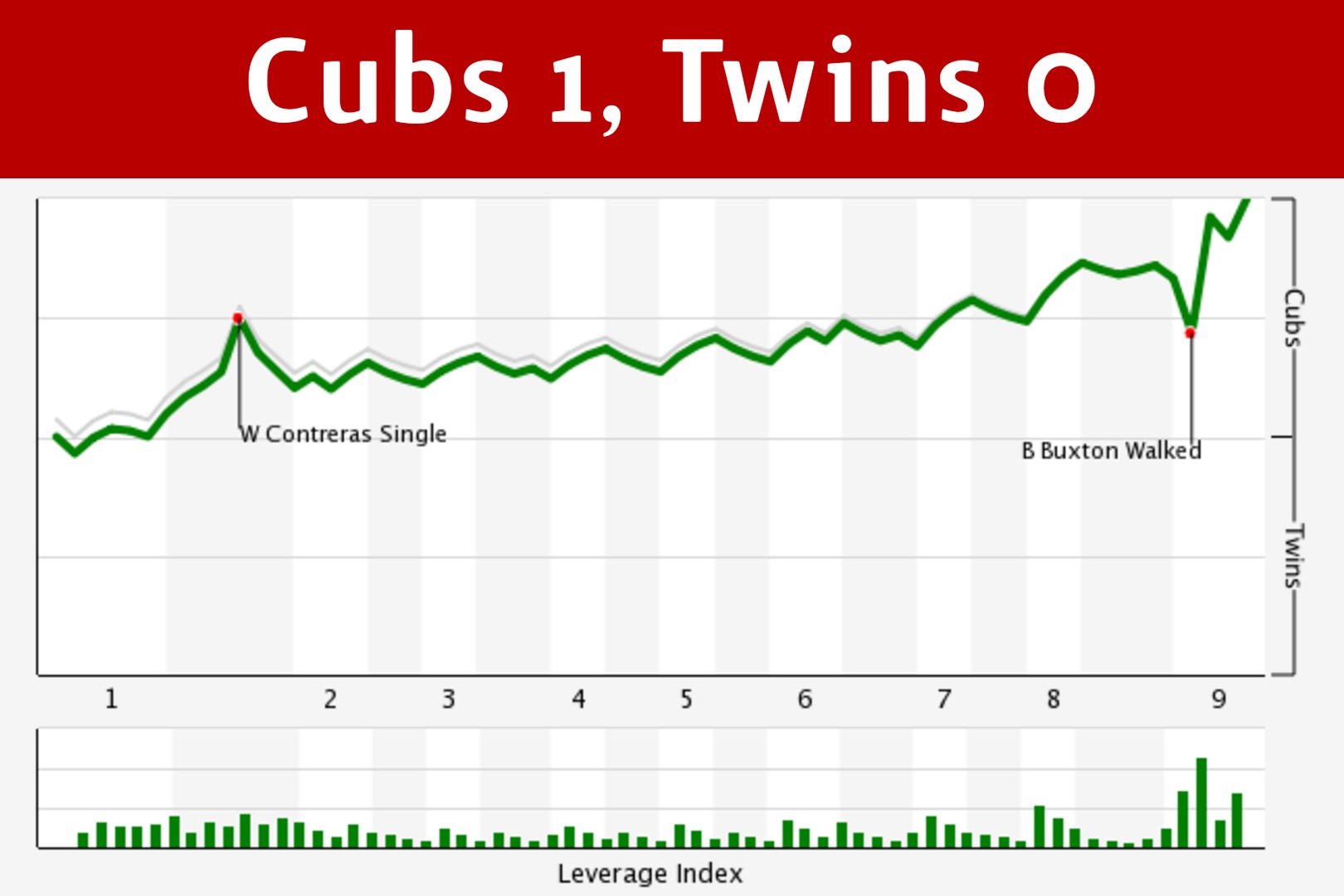 Box Score Hill: 7.0 IP, 3 H, 1 ER, 2 BB, 5 K Home Runs: None Bottom 3 WPA: Donaldson -.269, Rosario -.134 Sanó -.093 Twins fans’ confidence in Rich Hill as a reliable postseason starter took a minor hit after his lengthy first inning. Before recording the third out at 27 pitches, he walked the first two batters and gave up an RBI-single to Wilson Contreras. However, he settled in after allowing the run, retiring nine of the next ten batters, eight consecutive. The only baserunner he allowed in that span came on a bunt single in the third. He caught a break when home plate umpire Ángel Hernández made a terrible call on a clear hit by pitch, saying Kyle Schwarber leaned into the pitch. The problem was that Kyle Hendricks was pitching just as brilliantly, shutting out the Twins lineup for six innings in a little over 80 pitches. A leadoff single from Byron Buxton in the first posed a threat, as he ended up reaching third on a groundout and a wild pitch. Eddie Rosario worked out an unlikely walk to put men on the corners, but the Twins never capitalized. The first Minnesota hit after the second inning came in the sixth, when Josh Donaldson hit a bloop single that came off the bat at 74.5 MPH and had a .090 expected batting average, per Statcast. https://twitter.com/PitchingNinja/status/1307138737802031104 Hill continued to impress, pitching four more shutout innings. This was the first time he managed to pitch more than five innings in a Twin uniform, making it his best start in Minnesota, with a season high in pitches thrown (95). His season ERA has now dropped almost a full run in his last three starts. If injuries don’t get in his way, his progression may point out to the fact that he can be a real contributor in the postseason. Hendricks completed eight innings of shutout, so the Twins’ only hope to win it came against reliever Jeremy Jeffress in the ninth. Things then got interesting. Buxton drew his second walk of the season with a nice eight-pitch at bat, to leadoff the inning. Buxton is 61-for-70 in stolen base attempts over his career (.871 success rate) and Jeffress has a 56.9 GB% this year, 24th among the 177 qualified relievers this season. It's easy to look back and wonder why Rocco Baldelli didn't have Buxton running in that situation. Instead, Jeffress induced a double play against Donaldson. Nelson Cruz drew a walk, Rosario started out the next at bat nicely, getting ahead 3-0 in the count, but struck out to end the game. Bullpen Usage Spreadsheet
 -
The Twins’ lineup has been a sleeping giant for much of this season, but the Bomba Squad combined to blast five home runs against Cleveland tonight as they clinched the season series with a victory. Marwin Gonzalez, Willians Astudillo, Byron Buxton, Eddie Rosario and Miguel Sanó all went deep in this one.Box Score Hill: 5.0 IP, 4 H, 2 ER, 2 BB, 7 K Home Runs: Gonzalez (4), Astudillo (1), Buxton (8), Rosario (10), Sano (11) Top 3 WPA: Gonzalez .157, Buxton .109, Rosario .087 Win Probability Chart (via FanGraphs): Download attachment: Winchart.png Minnesota scored three runs in the second. First, a slumping Marwin González broke a five-game hitless streak, smashing a second decker to center right, also scoring Brent Rooker, who doubled before him. A couple of innings later, he picked up his second hit of the night, making it his first multi-hit game since Aug. 23. This was only the second game with a hit for MarGo this month. Also, coming into tonight’s game, González was slashing .061/.158/.061 in the previous 12 games. What a nice way to snap a slump. Willians Astudillo is living a completely opposite moment. He didn’t make his season debut until earlier this month, with tonight’s being only his sixth game of the season. Fortunately, he’s been scorching hot in that span and he hit his first home run of the season, giving the Twins back-to-back home runs and a 3-0 lead. It was a curious one, too. The ball came off his bat at 107.6 mph, the hardest hit ball of his career, but only with a 16 degree launch angle, the lowest of his career and tied for the lowest in baseball this season. Meanwhile, Rich Hill had no trouble pitching three scoreless innings to start the game, including an impressive performance in the second, in which he struck out the side, even though he fell behind in the count three times against the two batters he faced. But he pitched himself into a jam in the fourth, giving up a leadoff home run to José Ramírez that put Cleveland on the board, and then allowing Carlos Santana and Jordan Luplow to reach. The Indians came even closer with an Oscar Mercado sac fly that scored their second run, but “Dick Mountain” struck out the next batter to end the inning. Byron Buxton gave him a little breathing room in the bottom half of the inning, hitting a two-run bomb to center, his eighth of the year, pushing the lead back to three. Hill came back for a final inning and pitched a scoreless fifth, making this arguably his best start of the season. He struck out a season best seven batters and had his highest single game WPA in the year, at .083, per Fangraphs. His curveball was outstanding tonight, as it produced seven swings and misses and allowed only one hit. Mistakes lead to some drama Cleveland came back to score a couple of runs more, with the help of some sloppy defense. In the sixth, Matt Wisler gave up a leadoff walk to Santana, who advanced to second on a passed ball. Luplow then hit a ball well into deep center, but not long enough to become a homer. Buxton got under it to make a not so hard catch, but he lost track of the wall, this time expecting to hit it before he actually did, instead of crashing into it. While still in the air, he caught the ball, but dropped it, allowing Luplow to reach third and Santana to score. Tyler Clippard was pitching in the eighth and gave up a leadoff single to Ramírez, who later stole second and moved to third on a wild pitch. Tyler Duffey took over for his first outing in six days, to try and finish it, but a bad pitch led to a passed ball that allowed Ramírez to cut Minnesota’s lead to only one run. Eddie and Sanó to the rescue! Things didn’t look great to start the bottom half of the eighth, as the Indians got two quick outs against the top of the order. Home plate umpire Mark Carlson played a huge role in Josh Donaldson’s strikeout, with a terrible third strike call. But Nelson Cruz drew a vital four-pitch walk to keep the inning alive, allowing Eddie Rosario to jump on the first pitch and give the Twins some key run support. Still hitless on the night at that point, Miguel Sanó followed Rosie’s homer with a solo shot of his own, making it a four run lead for Minnesota. Miggy’s homer was the fifth in the game, a season high for the Twins. The previous high came on the first week of the season, when they hit four against the White Sox on July 26. Taylor Rogers closed out the game with an uneventful ninth, to secure the series win. Bullpen Usage Spreadsheet Download attachment: bullpen.png Postgame Pint Download The Postgame Pint Podcast You can also listen to the Postgame Pint and never miss another one. Just head over to our iTunes page and subscribe. Every morning you'll have a new episode waiting for you. Or listen wherever you download your favorite podcasts. Click here to view the article
-
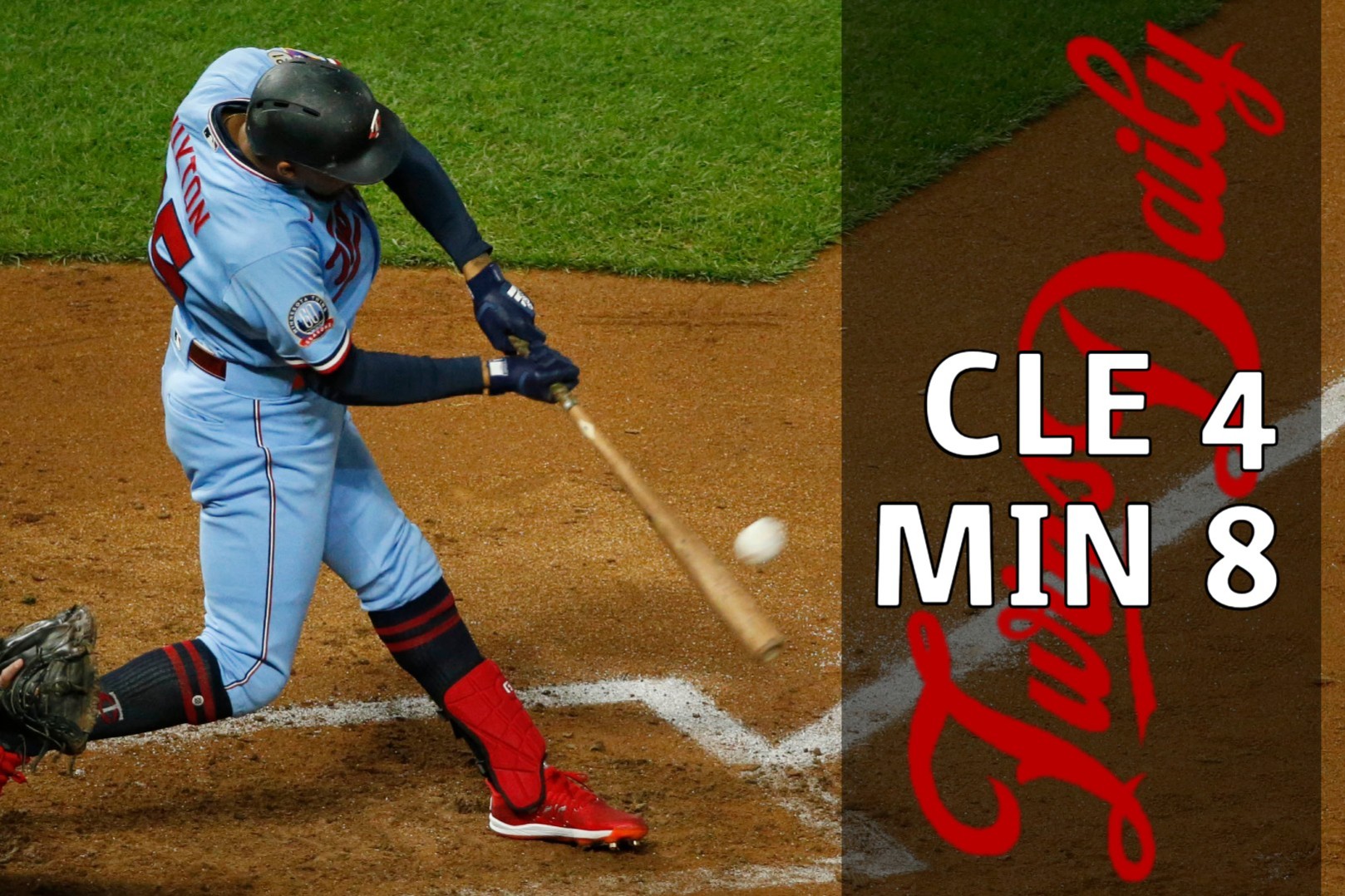 Box Score Hill: 5.0 IP, 4 H, 2 ER, 2 BB, 7 K Home Runs: Gonzalez (4), Astudillo (1), Buxton (8), Rosario (10), Sano (11) Top 3 WPA: Gonzalez .157, Buxton .109, Rosario .087 Win Probability Chart (via FanGraphs): Minnesota scored three runs in the second. First, a slumping Marwin González broke a five-game hitless streak, smashing a second decker to center right, also scoring Brent Rooker, who doubled before him. A couple of innings later, he picked up his second hit of the night, making it his first multi-hit game since Aug. 23. This was only the second game with a hit for MarGo this month. Also, coming into tonight’s game, González was slashing .061/.158/.061 in the previous 12 games. What a nice way to snap a slump. Willians Astudillo is living a completely opposite moment. He didn’t make his season debut until earlier this month, with tonight’s being only his sixth game of the season. Fortunately, he’s been scorching hot in that span and he hit his first home run of the season, giving the Twins back-to-back home runs and a 3-0 lead. It was a curious one, too. The ball came off his bat at 107.6 mph, the hardest hit ball of his career, but only with a 16 degree launch angle, the lowest of his career and tied for the lowest in baseball this season. Meanwhile, Rich Hill had no trouble pitching three scoreless innings to start the game, including an impressive performance in the second, in which he struck out the side, even though he fell behind in the count three times against the two batters he faced. But he pitched himself into a jam in the fourth, giving up a leadoff home run to José Ramírez that put Cleveland on the board, and then allowing Carlos Santana and Jordan Luplow to reach. The Indians came even closer with an Oscar Mercado sac fly that scored their second run, but “Dick Mountain” struck out the next batter to end the inning. Byron Buxton gave him a little breathing room in the bottom half of the inning, hitting a two-run bomb to center, his eighth of the year, pushing the lead back to three. https://twitter.com/Twins/status/1304955769369047041 Hill came back for a final inning and pitched a scoreless fifth, making this arguably his best start of the season. He struck out a season best seven batters and had his highest single game WPA in the year, at .083, per Fangraphs. His curveball was outstanding tonight, as it produced seven swings and misses and allowed only one hit. Mistakes lead to some drama Cleveland came back to score a couple of runs more, with the help of some sloppy defense. In the sixth, Matt Wisler gave up a leadoff walk to Santana, who advanced to second on a passed ball. Luplow then hit a ball well into deep center, but not long enough to become a homer. Buxton got under it to make a not so hard catch, but he lost track of the wall, this time expecting to hit it before he actually did, instead of crashing into it. While still in the air, he caught the ball, but dropped it, allowing Luplow to reach third and Santana to score. Tyler Clippard was pitching in the eighth and gave up a leadoff single to Ramírez, who later stole second and moved to third on a wild pitch. Tyler Duffey took over for his first outing in six days, to try and finish it, but a bad pitch led to a passed ball that allowed Ramírez to cut Minnesota’s lead to only one run. Eddie and Sanó to the rescue! Things didn’t look great to start the bottom half of the eighth, as the Indians got two quick outs against the top of the order. Home plate umpire Mark Carlson played a huge role in Josh Donaldson’s strikeout, with a terrible third strike call. But Nelson Cruz drew a vital four-pitch walk to keep the inning alive, allowing Eddie Rosario to jump on the first pitch and give the Twins some key run support. https://twitter.com/Twins/status/1304978137084768257 Still hitless on the night at that point, Miguel Sanó followed Rosie’s homer with a solo shot of his own, making it a four run lead for Minnesota. Miggy’s homer was the fifth in the game, a season high for the Twins. The previous high came on the first week of the season, when they hit four against the White Sox on July 26. Taylor Rogers closed out the game with an uneventful ninth, to secure the series win. Bullpen Usage Spreadsheet Postgame Pint https://www.youtube.com/watch?v=vzR4jtlRUNE Download The Postgame Pint Podcast You can also listen to the Postgame Pint and never miss another one. Just head over to our iTunes page and subscribe. Every morning you'll have a new episode waiting for you. Or listen wherever you download your favorite podcasts.
 -
The Twins’ lineup was quiet most of Saturday night's game, once again, but Miguel Sanó seemed to break the ice with a monster home run in the seventh inning. Sanó also drove in the game-tying run in the bottom of the ninth, and Byron Buxton walked it off by beating out an infield single.Box Score Maeda: 6.0 IP, 2 H, 3 ER, 1 BB, 8 K Home Runs: Sanó (9) Top 3 WPA: Sanó .597, Buxton .248, Donaldson .115 Win Probability Chart (via FanGraphs): Download attachment: Winchart.png Facing rookie lefty Tarik Skubal for the second time in the last seven days, the Twins offense experienced much of the same difficulties they’ve had throughout this year against southpaws. In fact, he had an even better game tonight. Skubal held the Twins hitless the first four innings, as he cruised to pitch six innings of one-run ball in under 80 pitches. It’s not like Kenta Maeda was much less impressive. He did allow a home run to center fielder Victor Reyes to leadoff the first inning, but bounced back brilliantly, retiring the following 18 batters he faced. Before the seventh, 75% of Maeda's pitches were strikes and he produced a lot of swings and misses, with 41% Whiff% on his swings. To try and help their starter, Twins bats managed to bring a runner across home plate in the fifth. Rookie right fielder Brent Rooker led off the inning with his second major league hit, jumping on a 0-2 fastball for a single. Jake Cave came in to run for him and was moved to third after a Miguel Sanó single. He scored on a fielder’s choice when Eddie Rosario grounded into a double play, tying it up. The game shifted to a different direction in the seventh. Maeda allowed the first two batters of the inning to reach, which ended the night for him. Tyler Clippard took over and after successfully stranding all six runners he previously inherited this year, he couldn’t pull it off this time. He gave up three consecutive hits and Detroit took a two-run lead. Even with the bases loaded, he managed to retire the next three batters to end the inning. Minnesota shortened the distances in the home half of the inning, with Sanó clobbering a two-out, 414-foot bomb to left. Jorge Alcalá had yet another impressive outing, pitching a couple of scoreless innings on 24 pitches and allowing the Twins to bat in the bottom of the ninth with a one-run deficit. This was the seventh time this season that he pitched at least two innings in a game, not allowing a run in any of them. The rally started when Tigers reliever José Cisnero allowed both Josh Donaldson and Nelson Cruz to reach to open the inning. Sanó got his third hit of the night with a ground ball to left, scoring pinch runner Ehire Adrianza. Eddie Rosario sent Cruz to third on a force play and later stole second, putting even more pressure on Cisnero. Then came Byron Buxton, still hitless on the night, and walked it off with his super human speed. Bullpen Usage Spreadsheet Download attachment: Bullpen.png Click here to view the article


