



Secondary User
-
Posts
284 -
Joined
-
Last visited
Content Type
Profiles
Minnesota Twins News, Rumors & Analysis
Minnesota Twins Videos
2026 Minnesota Twins Top Prospect Rankings
2022 Minnesota Twins Draft Picks & Signing Bonuses
Minnesota Twins Trade & Free Agent Rumors
Minnesota Twins Fan Guides & Resources
2023 Minnesota Twins Draft Picks & Signing Bonuses
The Minnesota Twins Players Project
2024 Minnesota Twins Draft Picks & Signing Bonuses
2025 Minnesota Twins Draft Picks & Signing Bonuses
2026 Minnesota Twins Draft Picks & Signing Bonuses
Forums
Blogs
Events
Store
Downloads
Gallery
Everything posted by Secondary User
-
Rockies seek pitching for Outfielder
Secondary User replied to Rosterman's topic in Minnesota Twins Talk
But an .877 OPS at AAA, and an .843 (in a much more modest Texas League) at AA are nothing to scoff at. Not sure when high .800s OPS became blasé......... The .803 was a low water mark for his entire minor league career. -
Rockies seek pitching for Outfielder
Secondary User replied to Rosterman's topic in Minnesota Twins Talk
Let's put it this way, I'd have much rather looked at a guy like Blackmon than Hunter..... Now, that obviously isn't an option at this point, but I don't think another having another option (particularly if the reports that the organization doesn't expect Buxton to be up this season are true) is a horrible thing. Particularly if the organization wanted to start Hicks in AAA (which I think would be wise). -
Ricky Nolasco: Back to the Future
Secondary User replied to Secondary User's topic in Twins Daily Front Page News
After the season Hughes had last year, I would be very concerned about Molitor's sanity if he wasn't starting the opening game. -
Rockies seek pitching for Outfielder
Secondary User replied to Rosterman's topic in Minnesota Twins Talk
Just depends on what you have to give up for him. Our outfield defense is a huge concern for me, and if the asking price were reasonable, and in the case of maybe Nolasco being involved in a trade, potentially freeing up cap room for another move, it could be worth looking at. -
Ricky Nolasco: Back to the Future
Secondary User replied to Secondary User's topic in Twins Daily Front Page News
Even if he's not facing 3s and 4s, the presence of Santana could hopefully have some emotional/psychological impact as well. Take some pressure off. How much affect that will have though, if it even has any, is tough to say.. -
Rockies seek pitching for Outfielder
Secondary User replied to Rosterman's topic in Minnesota Twins Talk
You have basically one full season that is driving the spread. in 2013, over a half season he hit .289 with a .772 OPS on the road for a sOPS+ of 131. And as I pointed out, he certainly performed well in his minor league career. He wasn't playing at Coors Field in those games. Is he an all-star caliber player worth giving up even someone like Gibson for? No. But doesn't he have the tools and potential to be a solid contributor? Absolutely. But we also have a similar player like that in the form of Hicks and guys with more potential coming as well. -
Rockies seek pitching for Outfielder
Secondary User replied to Rosterman's topic in Minnesota Twins Talk
Blackmon had a career .843 OPS in the minors and never was below .804 in his 6 minor league seasons. Robinson had a career .734 OPS and only cracked .800 twice in his 9 years. While Blackmon's production while he's been at Coor's is obviously inflated, he's still put up a 100+ OPS + the last two seasons and played par defense in a park that is difficult for outfielders (largest fair territory acreage in the league I believe). He has some upside even beyond what he's done up to this point in the majors. And as for the home or away splits, I would suggest looking at batted ball data and also pitch type data before you completely dismiss him. I could see a young guy who's still not great against major league breaking pitches doing very well at Coors (where breaking pitches aren't as effective) and struggling on the road (read this article if you want some understanding as to why, particularly taking note of the two tables in the pitch outcomes section about 3/4 the way down) -
Ricky Nolasco: Back to the Future
Secondary User replied to Secondary User's topic in Twins Daily Front Page News
It may not have come off how you wanted, but there is absolutely some truth to it. Metrics can only go so far into explaining outcomes, let alone predicting them. There are always going to be subtleties, intricacies and intangibles that just can't be quantified. People who use advanced statistics intelligently will always be open and honest with these 'flaws'. As an example: I'm not saying he has been a good pitcher over his career, just that his peripherals that have been shown to best correlate with success have been good. Maybe he has a tendency to alter his delivery every once in a while that makes it easy for a hitter to pick the ball up out of his hand. Maybe he gets frustrated, grips his pitches too tightly and it results in poor sequencing that inflates his ERA while his peripherals remain mostly untouched. There are all sorts of things that we just can't quantify that play a role in his performance. But as a fan (and a statistician by trade), looking at the situation from the outside, I work with what I have to try and give myself the best understanding and make the best predictions. And advanced statistics really do tell a very large part of the story of baseball. -
Ricky Nolasco: Back to the Future
Secondary User replied to Secondary User's topic in Twins Daily Front Page News
I'm trying to be optimistic about him. Honestly, when I look at all his peripherals, there really no reason is he shouldn't be a good pitcher. Early in his career, he was a bit of a flyball guy, but he seemed to have found a better GB/FB ratio until this season. His K% has been above average for a starter. His BB% below average. I just don't get it. Thanks for the input -
Trevor Plouffe's Improved Defense
Secondary User replied to Parker Hageman's topic in Twins Daily Front Page News
An interesting aspect is that Plouffe saw this improvement in a year in which he was probably gettin gless help over at 1B than he had in the past. Mauer is definitely athletic and will be more than compentent, but I don't think he was probably as good as Morneau in his first full season over there. -
Ricky Nolasco: Back to the Future
Secondary User replied to Secondary User's topic in Twins Daily Front Page News
Thanks to everyone for the compliments. As for this, that can be difficult to parse out. In 2008, when the Marlins had their best defensive season by the metrics, Nolasco had a BABIP of .273. Then again, Marlins starting pitchers had BABIP of .290, .292, .299, .307, .299, .295, .331, .295 from 2006-2013 respectively (starting with 2013, 2008 is bolded). There are some success stories with BABIP, and some failings. Between 2006 and 2013, 37 times a starting pitcher pitched more than 100 innings for the Marlins. 19 of them had BABIP above .300, and 18 of them had BABIP below. Guys like Anibal Sanchez, Nolasco, Dontrelle Willis had seasons where they were over, but no names like Scott Olson and Jacob Turner have had seasons significantly under .300 as well. Realistically, the answer is likely somewhere in the middle. That extra 2% of LDs Ricky puts up likely hurts him some, but he likely hasn't been helped by his defenses over his career either. -
For Ricky Nolasco, January 1st has a much different tenor in 2015 than it did in 2014. A year ago, Ricky had recently signed the largest free agent contract in Twins history (though that's not saying much) with the expectation of being a veteran presence to help stabilize a rotation that was in shambles. After a disastrous 2014 campaign, the idea that he doesn't deserve a spot in the opening day rotation has been tossed around by more than a few fans. Image courtesy of Credit: Jesse Johnson-USA TODAY Sports For Ricky Nolasco, January 1st has a much different tenor in 2015 than it did in 2014. A year ago, Ricky had recently signed the largest free agent contract in Twins history (though that's not saying much) with the expectation of being a veteran presence to help stabilize a rotation that was in shambles. After a disastrous 2014 campaign, the idea that he doesn't deserve a spot in the opening day rotation has been tossed around by more than a few fans. As time has passed, it's clear that Ricky Nolasco will be expected to be in the starting rotation, but what can be expected from him? When I have discussions about Nolasco, people are quick to point out his less than stellar career numbers. People point to his career (pre-2014) ERA of 4.37, and an ERA- of 108 (scaled to 100, lower is better). They mention that he has had as many seasons with an ERA over 5.00 as he had under 3.00 (two each). The idea is that Ricky Nolasco duped the Twins by having a strong year in a contract season, in the National League, no less, and that his 2014 results are a product of a less than stellar pitcher and moving to the tougher American League. But when you dig a little deeper, you see a bit of a different story. For example, Ricky had a pre-2014 FIP of 3.76, and a FIP- of 92 (scaled to 100, lower is better). For those unfamiliar with FIP and FIP-, I'd suggest reading this article on FIP, and this article on FIP-. Essentially, FIP attempts to look at what a pitcher's performance would be like with league average defense by looking at how the pitcher performed on the only outcomes he has the most control over: home runs, walks and strikeouts. So what does this say about Nolasco? Before 2014, Ricky Nolasco was very good when the ball wasn't put into play, less good when the ball was put into play. So is there something about Ricky's profile that makes him susceptible to under-performing his FIP? Is there something about the balls that were put into play that led his ERA to balloon? The first thing I looked at was his ball in play rates from 2006-2013 compared against qualified starters from that time span. This accounted for a list of 245 pitchers with about 790,000 batters faced and over 590,000 balls contacted (different from balls in play because balls contacted includes home runs). http://i.imgur.com/jqwmD4Z.jpg Unfortunately, this really didn't give any indication one way or the other. His ground ball rate (GB%) is slightly lower, and his fly ball rate (FB%) and line drive rate (LD%) are slightly higher, but his infield fly ball rate (IFFB%) is much higher than the total, though slightly lower than the average. GBs are significantly more likely to be outs and significantly less likely to be extra bases when compared to FBs and LDs, so being slightly on the wrong end of each of these does put him at some risk, but there aren't any drastic swings in either direction. It's also interesting to note that his GB% was 45.1%, 46.6% and 43.0% in 2011, 2012 and 2013 respectively, though he still underperformed his FIP by 0.65, 1.13 and 0.36 respectively. This graph also shows just how Nolasco has been able to put up a good FIP over the years. He is league average when it comes to HR/FB (and also HR%, though that didn't make the graph) while having better than average K% and BB%. But when you look at the defensive rankings (FanGraphs desciprtion) of the teams he played for, you begin to see some possible explanations: http://i.imgur.com/BvkPJAU.jpg Nolasco annually played in front of a bottom-third defense that cost the team runs. The one hiccup in this train of thought is that during his time with the Dodgers, he still had a 3.18 FIP and a 3.56 ERA despite playing in front of a stout Dodger defense. Then again, 80+ innings isn't a huge sampling, so it could be noise. So what does all of this mean for Ricky Nolasco going forward? Unfortunately, the outlook is bleak. The Twins defense in 2014 ranked 27th in the league with a DEF of -46.5. The infield appears passable. But the only significant positional player who was brought in was Torii Hunter, who doesn't figure to be much of an improvement on the field. What he may bring in leadership and as a mentor is difficult to quantify and predict. Of course, there is help on it's way in the form of Byron Buxton, and Eddie Rosario appears to have the athleticism to be an average to above-average corner outfielder. But with a likely outfield composed of Arcia and Hunter flanking Hicks/Schafer/Santana, even should Nolasco's FIP return to his career numbers, there's little hope in bucking the trend of his ERA trailing behind his FIP. View full article
-
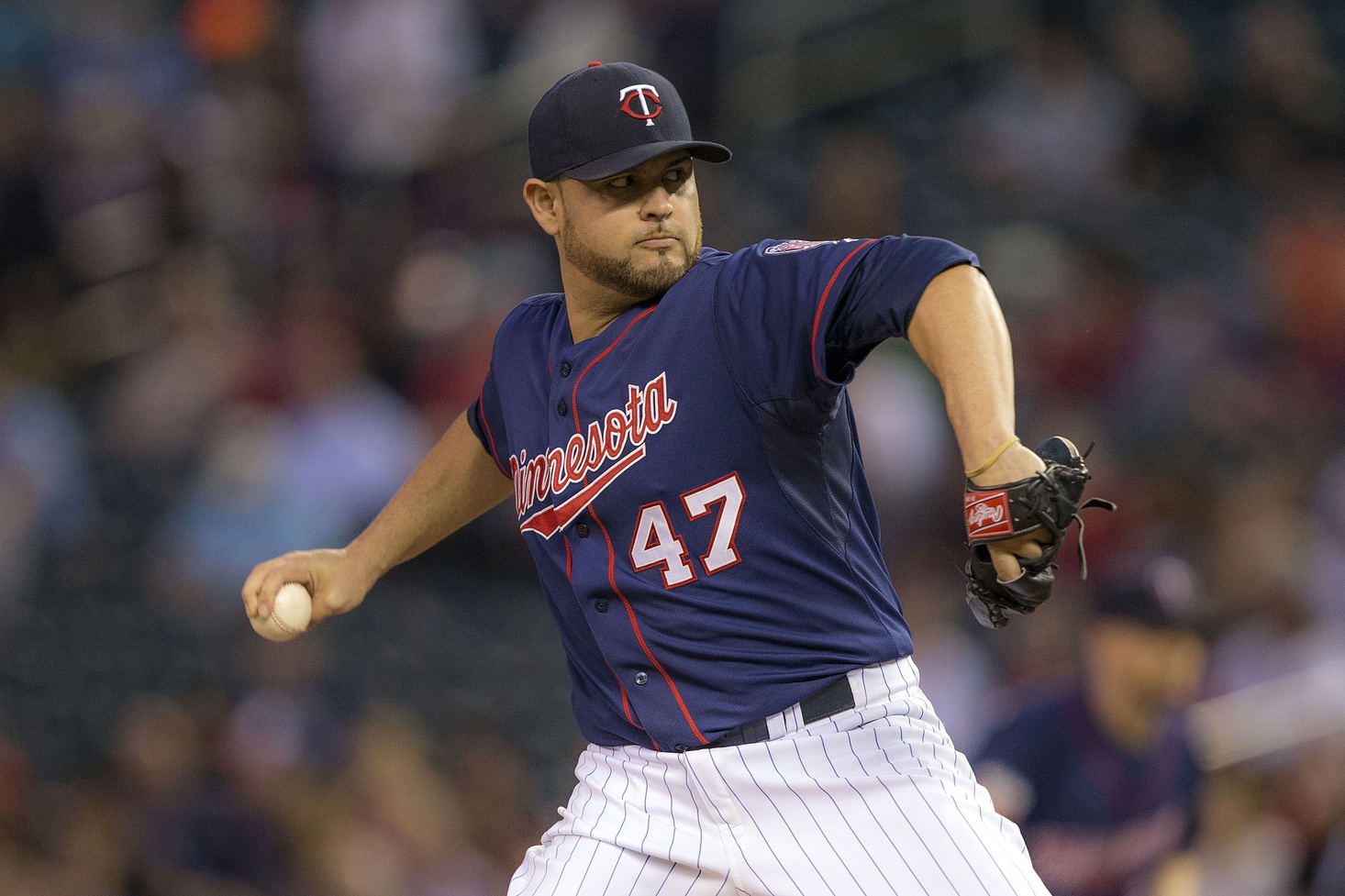 As time has passed, it's clear that Ricky Nolasco will be expected to be in the starting rotation, but what can be expected from him? When I have discussions about Nolasco, people are quick to point out his less than stellar career numbers. People point to his career (pre-2014) ERA of 4.37, and an ERA- of 108 (scaled to 100, lower is better). They mention that he has had as many seasons with an ERA over 5.00 as he had under 3.00 (two each). The idea is that Ricky Nolasco duped the Twins by having a strong year in a contract season, in the National League, no less, and that his 2014 results are a product of a less than stellar pitcher and moving to the tougher American League. But when you dig a little deeper, you see a bit of a different story. For example, Ricky had a pre-2014 FIP of 3.76, and a FIP- of 92 (scaled to 100, lower is better). For those unfamiliar with FIP and FIP-, I'd suggest reading this article on FIP, and this article on FIP-. Essentially, FIP attempts to look at what a pitcher's performance would be like with league average defense by looking at how the pitcher performed on the only outcomes he has the most control over: home runs, walks and strikeouts. So what does this say about Nolasco? Before 2014, Ricky Nolasco was very good when the ball wasn't put into play, less good when the ball was put into play. So is there something about Ricky's profile that makes him susceptible to under-performing his FIP? Is there something about the balls that were put into play that led his ERA to balloon? The first thing I looked at was his ball in play rates from 2006-2013 compared against qualified starters from that time span. This accounted for a list of 245 pitchers with about 790,000 batters faced and over 590,000 balls contacted (different from balls in play because balls contacted includes home runs). http://i.imgur.com/jqwmD4Z.jpg Unfortunately, this really didn't give any indication one way or the other. His ground ball rate (GB%) is slightly lower, and his fly ball rate (FB%) and line drive rate (LD%) are slightly higher, but his infield fly ball rate (IFFB%) is much higher than the total, though slightly lower than the average. GBs are significantly more likely to be outs and significantly less likely to be extra bases when compared to FBs and LDs, so being slightly on the wrong end of each of these does put him at some risk, but there aren't any drastic swings in either direction. It's also interesting to note that his GB% was 45.1%, 46.6% and 43.0% in 2011, 2012 and 2013 respectively, though he still underperformed his FIP by 0.65, 1.13 and 0.36 respectively. This graph also shows just how Nolasco has been able to put up a good FIP over the years. He is league average when it comes to HR/FB (and also HR%, though that didn't make the graph) while having better than average K% and BB%. But when you look at the defensive rankings (FanGraphs desciprtion) of the teams he played for, you begin to see some possible explanations: http://i.imgur.com/BvkPJAU.jpg Nolasco annually played in front of a bottom-third defense that cost the team runs. The one hiccup in this train of thought is that during his time with the Dodgers, he still had a 3.18 FIP and a 3.56 ERA despite playing in front of a stout Dodger defense. Then again, 80+ innings isn't a huge sampling, so it could be noise. So what does all of this mean for Ricky Nolasco going forward? Unfortunately, the outlook is bleak. The Twins defense in 2014 ranked 27th in the league with a DEF of -46.5. The infield appears passable. But the only significant positional player who was brought in was Torii Hunter, who doesn't figure to be much of an improvement on the field. What he may bring in leadership and as a mentor is difficult to quantify and predict. Of course, there is help on it's way in the form of Byron Buxton, and Eddie Rosario appears to have the athleticism to be an average to above-average corner outfielder. But with a likely outfield composed of Arcia and Hunter flanking Hicks/Schafer/Santana, even should Nolasco's FIP return to his career numbers, there's little hope in bucking the trend of his ERA trailing behind his FIP.
-
January 1st has a much different tenor in 2015 than it did in 2014 for Ricky Nolasco. A year ago, Ricky had recently signed the largest free agent contract in Twins history (though that's not saying much) with the expectation of being a veteran presence to help stabilize a rotation that was in shambles. After a disastrous 2014 campaign, suddenly the idea that he doesn't deserve a spot in the opening day rotation has been tossed around by more than a few fans. As time has passed, it's clear that Ricky Nolasco will be expected in the starting rotation, but what can be expected from him? When I have discussions about Ricky Nolasco, people are quick to point out his less than stellar career numbers. People point to his career (pre-2014) ERA of 4.37, and an ERA- of 108 (scaled to 100, lower is better). They mention that he has had as many seasons over a 5.00 ERA as he had under 3.00 (2 apiece). The idea is that Ricky Nolasco duped the Twins by having a strong year in a contract season, in the National League no less, and that his 2014 results are a product of a less than stellar pitcher and moving to the more vaunted American League. But when you dig a little deeper, you see a bit of a different story. For example, Ricky had a pre-2014 FIP of 3.76, and a FIP- of 92 (scaled to 100, lower is better). For those unfamiliar with FIP and FIP-, I'd suggest reading this article on FIP, and this article on FIP-. Essentially, FIP attempts to look at what a pitcher's performance would be like with league average defense by looking at how the pitcher performed on the only outcomes they have the most control over; home runs, walks and strike outs. So what does this say about Nolasco? Before 2014, Ricky Nolasco was better than average when the ball wasn't put into play. So is there something about Ricky's profile that makes him susceptible to under performing his FIP? Is there something about the balls that were put into play that led his ERA to balloon? First thing I looked at was his Ball in Play rates from 06-13 compared against qualified starters from that time span. This accounted for a list of 245 pitchers with over 790,000 batters faced and over 590,000 balls contacted (different from balls in play because balls contacted includes homeruns). http://i.imgur.com/jqwmD4Z.jpg Unfortunately, this really didn't give any indication one way or the other. His ground ball rate (GB%) is slightly lower and his flyball rate (FB%) and line drive rate (LD%) are slightly higher, but his infield fly ball rate (IFFB%) is much higher than the total, though slightly lower than the average. GBs are significantly more likely to be outs and significantly less likely to be extra bases when compared to FBs and LDs, so being slightly on the wrong end of each of these does put him at some risk, but there aren't any drastic swings in either direction. It's also interesting to note that his GB% was 45.1%, 46.6% and 43.0% in 2011, 12 and 13 respectively, though he still underperformed his FIP by 0.65, 1.13 and 0.36 respectively. This graph also shows just how Nolasco has been able to put up a good FIP over the years. He is league average when it somes to HR/FB (and also HR%, though that didn't make the graph) while having better than average K% and BB%. But when you look at the defensive rankings (Fangraphs descprtion) of the teams he played for, you begin to see some possible explanations: http://i.imgur.com/BvkPJAU.jpg Nolasco annually played in front of a bottom third defense that cost the team runs. The one hiccup in this train of thought is that during his time with the Dodgers, he still had a 3.18 FIP and a 3.56 ERA despite playing in front of a stout Dodger defense. Then again, 80+ innings isn't a huge sampling, so it could be noise. So what does all of this mean for Ricky Nolasco going forward? Unfortunately, the outlook is bleak. The Twins defense in 2014 ranked 27th in the league with a DEF of -46.5. The infield appears passable. But the only significant position player that was brought in was Torii Hunter, who doesn't figure to be much of an improvement on the field. What he may bring in leadership and as a mentor is difficult to quantify and predict. Of course, there is help on it's way in the form of Byron Buxton in center, and Rosario appears to have the athleticism to be an average to above average corner outfielder. But with a likely outfield composed of Arcia and Hunter flanking Hicks/Schafer/Santana in 2015, even should his FIP return to his career numbers, there's little hope in bucking the trend of his ERA trailing behind his FIP.
-
If evaluating them isn't an exact science, wouldn't you be better off with a quantity based argument?
-
The Elephant in the Room: Joe Mauer
Secondary User replied to strumdatjaguar's topic in Minnesota Twins Talk
You also have to consider the change in the run environment over that time. -
The Elephant in the Room: Joe Mauer
Secondary User replied to strumdatjaguar's topic in Minnesota Twins Talk
Mauer actually had his best season driving the ball over the last two years. His LD% was a career high 27% over the last two seasons, up from his career average of 21% in the years before that -
Gleeman & TheGeek, Episode 173: Talking Torii
Secondary User replied to John Bonnes's topic in Twins Daily Front Page News
If you don't want to discuss politics when you're watching baseball, be upset with Hunter for using his baseball profile to enter himself into the political forum. Berardino asked a question about a topic (and even kept it related to baseball) that is important to many people, many of whom are sports fans. Hunter is welcome to his opinions and his beliefs, but once he throws his hat into the political discussion on the subject, he opens himself to scrutiny and debate. -
The Elephant in the Room: Joe Mauer
Secondary User replied to strumdatjaguar's topic in Minnesota Twins Talk
The biggest concern for Joe over the last two years (even before the concussion), is that his K% is alarmingly high. If he gets his K% down to his career average of 11.8% (including the past two atrocious years, otherwise it's around 10%), he's hitting .304/.390/.403. If Mauer wants to fix Mauer, he needs to lose the Ks -
The Elephant in the Room: Joe Mauer
Secondary User replied to strumdatjaguar's topic in Minnesota Twins Talk
Looking at batting average on 1st or 2nd pitches is a deceiving statistic. You have to realize that you are reducing the negative results in your subset. You can't strike out on the 1st or 2nd pitch in the at bat. In 2014, the league-wide K% was 20%. So you're using batting average, which measures an entire at bat, while you're removing nearly 20% of possible negative results. This is going to cause your BA to (likely) be markedly higher than your overall BA. Since you're removing K's, you'd expect this number to look a lot more like BABIP, though even better since we're keeping HR in the equation. It essentially becomes a "batting average on balls made contact with" (BABMC) His BA on the first two pitches in the count is .385. Again, remember that we're basically removing the chance of striking out. Looking at his career BABMC, you get a value of .369. Some improvement, yes, but not colossal. Especially that when you consider the quality of pitchers who end up being susceptible to patterning like first pitch cookies. -
And as for Souhan, Rosen, et al being on Hunter's side, I can not stress enough reading THIS ARTICLE if you want to understand why Hunter lashed out at him and why some have such an issue with calling him a leader. Here's a couple of the key points
-
He's been in two locker room altercations, Called Dominican born players imposters, said he'd be uncomfortable with a gay teammates, and then endorsed a political candidate that believes a group of peolpe should be treated differently based on their sexual orientation. If Twins organization doesn't see these as divisive (especially when you couple it with the "he ruined it" finger pointing at the end of the press conference), then I have even less faith in their decision making abilities than before
-
Again....Hunter is being sold as a leader, both by the organization and by his own accord. He has a history of divisiveness. Asking him about that divisiveness is absolutely relevant if he wants to call himself a leader.
-
I don't doubt this is something that has been brought up already, but sadly I'm jumping in late and don't have the time at the moment to read through the whole conversation. Torii Hunter is being sold as a leader and mentor. He has a long history of being divisive both on and off the field. If he wants to be a leader, and not just someone that the media refers to as a leader because he's quick to give a quote after the game (read THIS if you want to understand that better), then his divisive actions are absolutely relevant to the discussion And if you want proof as to just what kind of a person Hunter actually is, notice at the end of the press conference, as everyone is breaking up, he looks at Berardino, points and says "He ruined it". If he can't handle a press conference where a pretty standard question about his crossover into the political sphere (and he absolutely acted like a bone head), I look forward to when the team is 18-36 and see who he starts pointing his finger at then.
-
Can someone please explain to me what Terry Ryan is thinking? For three years we've been rebuilding. Guys like Correia, Marquis and Pelfrey were brought in as payroll was slashed. And now, in the past 3 hours, two pieces of news have convinced me that they have absolutely no clue what they're doing. First, we signed Torii Hunter to a 10.5 million dollar one year contract. No, I didn't meant to write 1.5 million, or 0.5 million. It is a 10.5 million dollar contract. To improve one of the worst defensive outfields in the league , they signed a 39 year old right fielder that was the worst qualified defensive right fielder in the league . Or maybe they did it because they wanted someone to be a mentor. Ignoring how poorly that worked with the Jasons Bartlett and Kubel, they are bringing in a player with a troubling past to say the least. I can find no same baseball reason to sign Hunter, let alone to make him the third highest paid player on your team. Let that sink into your mind. 39 year old Torii Hunter is receiving the third highest salary among current players. The second decision, was to tender contacts to all 6 arbitration eligible players. Trevor Plouffe and Fien were no doubters in my mind, though Milone and Schafer seemed logical to be offered a contract given the lack of talent say their respective positions. But Nunez and Deunsing make no sense. What does Eduardo Nunez offer that Escobar doesn't as a utility guy (or Doug Bernier/James Beresford if they keep Santana in the outfield and Escobar at sorry)? Does it make any sense to pay a sub par lefty only reliever 2.5 million dollars while you leave players like Levi Michael, Adrian Salcedo, Jason Adam (a player you just traded for) unprotected? All he offers is innings pitched that could go to Caleb Thielbar, Aaron Thompson or Logan Darnell (or even Tommy Milone if he doesn't stick in the rotation) to see if they could provide at least the same mediocre results at 1/5th the cost. Instead, when you add in the addition of Hunter, Twins payroll will likely be sitting around 92 million. I wanted to believe, for once, that with multiple top tier pitching free agents and several second tier guys, that Terry Ryan would actually go out and make an aggressive attempt in free agency to bring in a high end free agent. Instead, we get to continue the Reunion Parade with, probably add a pitcher on looking to bounce back from injury (Likely on a similar one year deal near 10 million) while we hope that our pitching staff ascends to mediocrity from the scrap heap it's been over the last four years while we hope that our offense, which has several regression candidates (Hunter's continued slide into retirement included), can maintain itself. Not exactly a winning plan in my estimation. Can Terry Ryan's job security afford the hit of one more failing season? Because the path he seems to be leading us down may very well answer that question.

