Parker Hageman
-
Posts
4,152 -
Joined
-
Last visited
-
Days Won
6
Content Type
Profiles
Minnesota Twins News, Rumors & Analysis
Minnesota Twins Videos
2026 Minnesota Twins Top Prospect Rankings
2022 Minnesota Twins Draft Picks & Signing Bonuses
Minnesota Twins Trade & Free Agent Rumors
Minnesota Twins Fan Guides & Resources
2023 Minnesota Twins Draft Picks & Signing Bonuses
The Minnesota Twins Players Project
2024 Minnesota Twins Draft Picks & Signing Bonuses
2025 Minnesota Twins Draft Picks & Signing Bonuses
2026 Minnesota Twins Draft Picks & Signing Bonuses
Forums
Blogs
Events
Store
Downloads
Gallery
Everything posted by Parker Hageman
-
-

Article: Looking at Byron Buxton's Swing
Parker Hageman replied to Parker Hageman's topic in Twins Daily Front Page News
No, I do not thing the swing was change just because of the potential for a hit-and-run. If anything, the pitch selection may have been influenced but it does not appear to be a bad pitch to swing at (from this angle any way). You can review his other swings from that game here: -
Article: Looking at Byron Buxton's Swing
Parker Hageman replied to Parker Hageman's topic in Twins Daily Front Page News
Great thoughts overall. One thing I will point out is that Harper has a different approach in certain counts. Hitting instructor Bobby Tewksbary did an excellent breakdown on Harper and showed that during a two-strike approach, Harper switches to a toe-tap. -
You can view the page at http://twinsdaily.com/content.php/2648-Looking-at-Byron-Buxton-s-Swing
-
Byron Buxton, says ESPN.com’s Keith Law, is a prospect with more tools than Home Depot. OK, now that the requisite pun is out of the way, let’s delve into the nitty-gritty. After MLB.com anointed Buxton the number one prospect in all the land, Law’s Top 100 list concurred. As a 19-year-old, the center fielder smacked pitching around in the Midwest and Florida State Leagues to the tune of .334/.424/.520 with 12 home runs and 109 runs scored. An on-base menace, Buxton scampered around the bases with blinding speed and, defensively, he covered more real estate than is in the Alaskan wilderness. But it is perhaps the most difficult aspect of the game -- hitting -- that separates the elite prospects from the flamed-out Brandon Woods of the world. The game is organic and climbing the ladder involves making changes in approach and mechanics to ensure the stud high school/college player not only reaches but succeeds at the highest level of professional baseball. When it comes to Buxton, those changes are in process. As Law writes about Buxton: The bold section of his analysis is what jumped out at me. At midseason, I reviewed Buxton’s mechanics from the available video at the time, compared the changes made from his high school showcase days and concluded that he and the Twins had made some significant changes to his swing. To summarize, Buxton had eliminated his open stance and leg kick in favor of an in-line approach with a toe-touch stride. In theory this provides improved timing and greater contact ability with less body movement -- the “balanced through contact” part that Law referenced. http://oi41.tinypic.com/2rh39lu.jpg What was prominent but not mentioned was the fact that his back leg left the ground at contact. At that time, I did not see this as a flaw, per se. After all, there are some hitters who do quite well for themselves with this in their swing. Albert Pujols’ swing pulls his back foot off the ground and forward after contact. More pronounced, however, is the Washington Nationals’ Bryce Harper who displays this very trait in his swing perhaps more than anybody. http://gamereax.com/wp-content/uploads/2013/07/harperderbyswing.gif As you see at the point of contact, Harper’s back foot has left the ground by an inch or two. Though somewhat unorthodox, in an article published by Adam Kilgore of the Washington Post last year, biomechanics expect Glenn Fleisig explained why this move is beneficial for Harper: So, biomechanically speaking, the move in and of itself does not reduce power. The main difference between Harper and Buxton’s leg lifts was the weight transfer. In Harper’s case, you see that his front side has absorbed essentially all his weight. Buxton, on the other hand, lacks the max effort transfer and has a more balanced weight distribution making the leg lift something that could diminish his power. What’s more is that from the front view, it is noticeable that Buxton’s back leg slides out a bit, too. Over the course of last season, video of Buxton in Cedar Rapids and then Fort Myers showed the game’s top prospect demonstrating this back-leg lift in his swing, but there was evidence of it beginning to tone down in the Florida State League. It was not until clips of his performance in the Arizona Fall League that Buxton’s swing seemed different than that of his Midwest League. http://imageshack.com/a/img809/1010/4gl.gifhttp://imageshack.com/a/img829/952/s6u.gif From the Twins’ perspective, you can see why they would want to try to streamline Buxton’s mechanics. Any reduction of unnecessary movement will streamline the swing and provide Buxton -- who is graced with countless tools -- the opportunity to succeed at the major league level for a long time.
-
-
Article: Turning The Power Back On
Parker Hageman replied to Parker Hageman's topic in Twins Daily Front Page News
It is and I should probably elaborate on that statistic since it is behind a paywall. 272 feet the MLB average for all hitters on fly balls. For a frame of reference, Chris Davis led baseball with 300 feet on average on his fly balls. In that stat, it counts all fly balls: infield and outfield. Willingham hits a ton of infield fly balls so his fly ball distance number over his career has been slightly above average than some of the other players who have similar power figures. Being able to remove infield flies from that figure we find that Willingham's outfield fly ball distance differences are even more pronounced: 2013 - 267 2012 - 289 2011 - 288 2010 - 273 Notice the significant decline in distance between the two healthy years (2012, 2011) compared to the two injured seasons (2013, 2010). Don't get me wrong -- 5% is probably a usual rise-and-fall among players over different seasons but knowing there is an injury explains why the drop-off (sort of like knowing a pitcher had a shoulder injury and seeing a 2% decline in velocity). I hope that helps explain it better. -
You can view the page at http://twinsdaily.com/content.php/2644-Turning-The-Power-Back-On
-
Who knows why Josh Willingham left first base with the intention of stealing second base on April 27th, 2013. Coaches claim the thievery was not planned. It’s possible that with the left-handed Michael Kirkman on the mound, Willingham was fooled by his delivery or was caught leaning when the Ranger threw over to first. Either way, with his team up 4-0 -- thanks in part to his two-run home run two innings prior -- Willingham broke for second, took the base but aggravated his knee in the process. All for what? The knee, which he had injured in 2010 while with the Nationals, gave Willingham troubles the rest of last year. For the remainder of the season, the man who had punished pitching and made people think the concrete had finally settled at Target Field in 2012 hit a Punto-nian .200/.332/.336 over nearly 400 plate appearances. With the left knee out of commission -- the right-handed slugger’s front knee which absorbs the impact in his stride and weight transfer and twists violently when he is opening up his hips to turn on the ball -- Willingham’s power drained significantly. He hit just 14 home runs compared to the 35 he had in 2012. His standard fly ball distance dropped from 279 feet to 265 feet on average. Whether or not directly related to the knee injury, what gave Willingham the most trouble was doing anything with pitches on the outer-half of the strike zone. In 2012 he hit .217/.337/.422 with 22 extra base hits including 11 home runs on pitches on the outer-third of the plate. This past year he managed to produce just a .170/.296/.224 batting line that included nine extra base hits (all doubles). The heat maps and spray charts from ESPN’s Stats & Info Department show how much better Willingham was at hitting those pitches for power and driving the ball for distance. In 2012 his average fly ball distance on those pitches was 296 feet. Last year the average distance dropped to 255 feet. 2012 2013 Based on the heat map of his slugging percentage (left) it is clear Willingham thrived when being able to extend his hands on pitches up and out over the plate to drive the ball. In 2013, he was unable to get the desired results on the same pitches as he did in 2012. Interestingly enough, his contact rates in that location in these two seasons are very comparable but the production simply dropped off. It is indeed likely the knee was the catalyst for the plate coverage power drop-off, when we see that in both 2011 and 2009 he hit six home runs on the outer-half of the plate but in 2010, when he injured his knee and required surgery on his meniscus, he had just one home run and very little power (.277 slugging). The takeaway is that once healthy in 2011, Willingham’s power rebounded nicely (29 home runs, .477 slugging percentage overall). If healthy in 2014, the Twins should expect the home run power to return. All graphs and data provided by ESPN Stats & Info.
-
-
MLB.com’s Jonathan Mayo stumps for the Minnesota Twins as having the best offensive/pitching pairing in their farm system. Mayo’s colleague and Baseball America’s executive editor Jim Callis suggests that the Astros’ blessed combination of Carlos Correa and Mark Appel represent the best player/pitcher combination in the game, Mayo votes for the Twins’ duo of Byron Buxton and Alex Meyer. Says Mayo: For the Twins, this is a good argument to be involved. According to Mayo’s Top 100 prospect rankings, the Twins have Buxton as baseball’s top prospect with Miguel Sano just three spots behind him. Meyer does not rank as high as Appel but given Meyer’s upside says Mayo in addition to Buxton’s supreme talent provides the Twins with an advantage over the Astros. The Astros’ just beat out the Twins in ESPN.com’s prospect guru Keith Law’s Top Farm System rankings, with Houston claiming the number one position with the Twins right behind. (Oh, and as former Twins farm-hand Chris Cates pointed out, MLB.com originally had posted a picture of Buxton with Anthony Slama rather than Alex Meyer. Whoopsie-doodle.)
-
Mauer's injury seasons play a substantial role in his projection along with, I assume, the aging comparable players: Still, I can't see Mauer finishing anywhere south of 800.
-
Clay Davenport, a co-founder of Baseball Prospectus, has released his initial projections for the 2014 season and, ooh boy, the Twins are not faring well. According to his calculations, the Twins will finish the year in last in the AL Central and, once again, lose 90 games. http://claydavenport.com/projections/PROJHOME.shtml How is that possible? Offensively, Davenport expects the Twins to score just 669 runs – the lowest in the American League. Among those his system does not favor includes Kurt Suzuki (.233/.295/.350) as well as heavy regression for Joe Mauer (from an OPS of 880 to 765). Positively, his projections show Josh Willingham and Oswaldo Arica taking significant steps forward. On the other side of the ball, the projections suggest that the Twins will allow 752 runs – the second-highest total in the American League. As far as the pitching goes, the current four horsemen of the Twins rotation – Ricky Nolasco, Phil Hughes, Mike Pelfrey and Kevin Correia – are estimated to go 34-46 with a 4.45 ERA. The Twins have been vocal in saying that they are not finished shopping for the offseason so the projection could change but, as of right now, math is not in their corner.
-
No, it does not indicate that Carew's 1977 season was the best for a Twins' second baseman. It was the best season for a Twins player PERIOD.
-
You can view the page at http://twinsdaily.com/content.php/2633-Chuck-Knoblauch-Elected-to-Twins-Hall-of-Fame
-
The Twins announced today at their media luncheon that former second baseman Chuck Knoblauch has been elected to the Minnesota Twins Hall of Fame. Knoblauch, the 1991 American League Rookie of the Year, and was instrumental in the team's World Series run that season. Over his Twins career he hit .304/.391/.416 in 1,013 games and represented the team four times in the All-Star game (1992, 1994, 1996 and 1997). [PRBREAK][/PRBREAK]In 1994 he led the league in doubles (45), triples in 1996 (14) and his 140 runs scored in 1996 was the highest ever in a single-season by a Twins player. With the glove, he played outstanding defense, leading the league in Total Zone Runs in 1992 (8) and 1997 (17) and winning one Gold Glove. His 1996 season in which he posted 8.6 wins above replacement (via baseball-reference.com) still stands as the Twins' second best season as measured by that statistic (Rod Carew's 1977 season was the highest). His .391 on-base percentage is the fifth highest in the franchise history and third highest since the move to Minnesota. Of course, his public demands for a trade soured the fans on his overall talent and the eventual move to the New York Yankees further widened that chasm. The trade netted the Twins Eric Milton, Cristian Guzman and Brian Buchanan and Danny Mota but the likes of Ricky Ladee and Ramiro Mendoza were discussed prior to that. While in New York, Knoblauch was a part of three championship teams (1998, 1999 and 2000) but throwing issues from second necessitated a move to DH before relocating to third base. When he came back to the Metrodome he was booed loudly. In an infamous event, fans started throwing Dome Dogs and batteries while he was in left field. As you recall, Tom Kelly walked out to left field and scolded the Twins fans. After playing with the Yankees and the Royals, Knoblauch fell on some hard times after the game abandoned him. Regardless of his personal traits, Knoblauch's contributions to the game on the field make him deserving of the team's highest honor. (Seth Stohs contributed to this article)
-
You can view the page at http://twinsdaily.com/content.php/2630-Brewers-sign-Garza-to-deal-similar-to-Twins-Nolasco
-
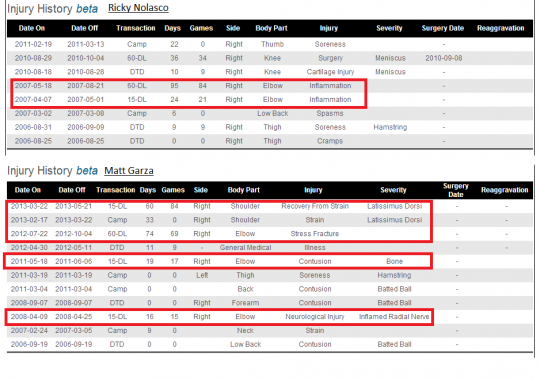
Sources indicate that the Milwaukee Brewers have now signed pitcher Matt Garza to the tune of four years, $52 million. This is notable for several reasons. The first being that this is a substantial savings from what he was originally projected as being worth going into the free agent season. At Twins Daily, we estimated that Garza would reach five years and $75 million in the Offseason Handbook. Instead, teams shied away from him. The second interesting piece is that this deal is basically the same one that the Twins gave starter Ricky Nolasco earlier in the winter (4 years, $49M + options). Comparatively, Garza, who is a year younger than Nolasco, has had a slightly better career. However according to Fangraphs.com, since 2010, the pair has been surprisingly similar. What you see is that while the raw numbers are very alike, Garza gets better marks for his ERA, xFIP and FIP for spending time in the American League while Nolasco has been in the National League. Of course, one of the biggest concerns of teams making these sizable investments is how a player will hold up over the course of that agreement. In Nolasco’s case, he has been rock solid over his career meanwhile Garza has been in-and-out of infirmaries for arm-related ailments (Nolasco’s have been mainly trunk and thigh). 1500ESPN.com's Darren Wolfson tweeted out today that the Twins were not in pursuit of Garza at the requested four-year rate, sticking firm to a potential two-year deal after signing Nolasco, Phil Hughes and Mike Pelfrey. Still, the question that will undoubtedly arise from Twins fans is -- should they have targeted Garza instead of Nolasco?
-
Brewers sign Garza to deal similar to Twins' Nolasco
Parker Hageman posted a blog entry in Over the Baggy
-
Sources indicate that the Milwaukee Brewers have now signed pitcher Matt Garza to the tune of four years, $52 million. This is notable for several reasons. The first being that this is a substantial savings from what he was originally projected as being worth going into the free agent season. At Twins Daily, we estimated that Garza would reach five years and $75 million. Instead, teams shied away from him. The second interesting piece is that this deal is basically the same one that the Twins gave starter Ricky Nolasco earlier in the winter (4 years, $49M + options). Comparatively, Garza, who is a year younger than Nolasco, has had a slightly better career. However, since 2010, the pair has been surprisingly similar: http://www.fangraphs.com/leaders.aspx?pos=all&stats=pit&lg=all&qual=0&type=1&season=2013&month=0&season1=2010&ind=0&team=0&rost=0&age=0&filter=&players=3340,3830 What you see is that while the raw numbers are very alike, Garza gets better marks for his ERA, xFIP and FIP for spending time in the American League while Nolasco has been in the National League. Of course, one of the biggest concerns by teams making these sizeable investments is how a player will hold up over the course of that agreement. In Nolasco’s case, he has been rock solid over his career meanwhile Garza has been in-and-out of infirmaries for arm-related ailments (Nolasco’s have been mainly truck and thigh). Should the Twins have waited for Garza at the same rate? What are your thoughts?
-
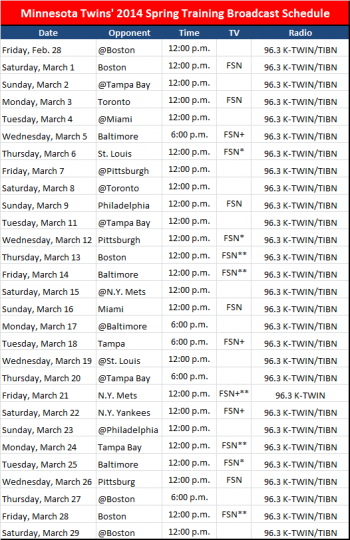
It's zero degrees in the Twin Cities right now but here are some warm vibes coming your way: The Minnesota Twins have announced their 2014 radio and TV schedules. Your first opportunity to see them on the screen is March 1st. Stay tuned, we may have to schedule our own Twins Daily Viewing Party at one of the area's gathering spots.
-
Here's Erickson (and Mark Rosen) reacting to his no-hitter: [video=youtube;2e16tpsA_yM]
-
Submit your questions for the #WinterMeltdown
Parker Hageman replied to Parker Hageman's topic in Minnesota Twins Talk
I want to ask Erickson how he went from a small workload in 1989 with the University of Arizona Wildcats and Visalia (169.2 innings) but then throwing a total of 214 innings in 1990 between Orlando & Minnesota. Then in 1991, after the fast start, his velocity falls off and, by the post-season, his catcher and manager are saying he wasn't the same pitcher he was at the beginning of the year. -
Submit your questions for the #WinterMeltdown
Parker Hageman replied to Parker Hageman's topic in Minnesota Twins Talk
612Brew is the beer sponsor. -
As part of the #WinterMeltdown event on Saturday, we will have a Q&A session with the panel of baseball representatives including Minnesota Twins' president Dave St. Peter, former Twins pitcher Scott Erickson and Pelotero director John Paley. Please use this thread as an opportunity to submit questions that will be asked of the panel this weekend. Our hopes are to be able to record that portion of the event and share it with those who are unable to attend in person.