



Parker Hageman
-
Posts
4,152 -
Joined
-
Last visited
-
Days Won
6
Content Type
Profiles
Minnesota Twins News, Rumors & Analysis
Minnesota Twins Videos
2026 Minnesota Twins Top Prospect Rankings
2022 Minnesota Twins Draft Picks & Signing Bonuses
Minnesota Twins Trade & Free Agent Rumors
Minnesota Twins Fan Guides & Resources
2023 Minnesota Twins Draft Picks & Signing Bonuses
The Minnesota Twins Players Project
2024 Minnesota Twins Draft Picks & Signing Bonuses
2025 Minnesota Twins Draft Picks & Signing Bonuses
2026 Minnesota Twins Draft Picks & Signing Bonuses
Forums
Blogs
Events
Store
Downloads
Gallery
Everything posted by Parker Hageman
-
According to TwinsDaily's Rochester correspondent Christopher Fee, the Twins have signed outfielder Chris Rahl to a minor league contract. Rahl, 29 years old, spent the last three years in the Nationals organization split between the Double-A and Triple-A levels. A fifth-round pick in 2005 by the Arizona Diamondbacks, tore up the California League in 2006 (.327/.369/.502 with 13 HR) but has settled into being a fairly average hitter over his nearly 4,000 minor league plate appearances (.281/.323/.426). While Rahl likely figures to be an organizational filler in Rochester, he has demonstrated that he is quite potent against left-handed pitching, hitting .336/.376/.544 with 10 home runs in 349 plate appearances since 2011.
-
 In their defense, I'm guessing any business/ball team would do the same...but I agree, it seems pretty irrelevant.
-
Hmm...#IfMLBwereWWE.... According to reports from Philly.com, a website called PWInsider.com has learned that the Minnesota Twins have filed an opposition against the WWE in their efforts to trademark the name "Bella Twins" -- a set of modeling and wrestling identical twins sisters. The report does not indicate as to why the Minnesota Twins are attempting to thwart the Vince McMahon-owned sports entertainment efforts, but the team have requested an extension and have until February 12th to file an opposition. Frankly, I do not think there will be a whole lot of people who will mistake these Twins for these twins. Both are sexy in their own ways.
-
You can view the page at http://twinsdaily.com/content.php?r=2485-Twins-prospect-Eddie-Rosario-tested-positive-for-banned-substance
-
Twins prospect Eddie Rosario tested positive for banned substance?
Parker Hageman posted an article in Twins
Reports from Puerto Rico suggest that Twins prospect Eddie Rosario has tested positive for a banned substance and could cost him a 50-game suspension in 2014. While the reports are still unconfirmed, according to an article in Sport LivePR from November 18, Rosario had informed his winter league team that he tested positive in a recent MLB drug test. [PRBREAK][/PRBREAK]According to Frankie Thon, the general manager of the team Rosario plays for, Rosario reportedly took some pills during his arm rehabilitation that were on the banned list. Thon also said that Rosario would be allowed to play in the offseason league due to a new agreement between the MLB and the winter leagues. Here is the explanation from the article through Google translation: Rosario spoke with the Puerto Rican website elnuevodia.com and said he was informed of the failed test after playing in the Arizona Fall League. The article also stated that his lawyers are currently appealing the suspension but Rosario believed there is little chance that the decision will be overturned. Rosario also said that the pills he took were they same kind he had taken in 2011 after he was struck in the face with a line drive while in Class A Beloit. The Twins outfield/second base prospect, who was recently named as Baseball Prospectus’ seventh rated prospect in the system, his coming off a solid year in which he hit .302/.350/.460 with 10 home runs and 32 doubles split between New Britain and Fort Myers. There is no official word on Rosario’s status from the Minnesota Twins. -
You can view the page at http://twinsdaily.com/content.php?r=2479-Twins-making-a-strong-push-for-Nolasco
-
-
Employment is not difficult to find if you are a moderately successfully and young starting pitcher in major league baseball. As an example, Ricky Nolasco has several four-year offers in discussion and, as Fox Sports’ Ken Rosenthal pointed out this morning, the Twins are making a strong push for his services. In a conversation last week his agent, Matt Sosnick, said Nolasco is seeking a five-year deal. While multiple teams are offering four-year deals it may be the team which submits a fifth year option that lands the free agent. “I look at options more about breaking a stalemate at the end of negotiation,” Sosnick said. “We’re talking to a lot of teams and we’re hoping to get five years on Nolasco. We’re talking with a lot of teams about a deal in the four-year range and what ends up happening is that if no one is willing to go to five year, people will use a club option for a fifth year.” The option year, Sosnick said, basically gives the pitcher some extra money in the form of a buyout but also provides the team an option to retain that pitcher’s services if they so desire. Based on reports that the Twins are making a “strong push” for Nolasco, it would be reasonable to assume the two sides are looking at the four-year plus option deal. Nolasco, who will be 31 in 2014, has been decisively average over his career but is coming off perhaps his best season since his age-25 season in 2008. Over his career, Nolasco’s actual numbers have performed worse than his projected numbers. His career ERA of 4.37 is significantly higher than what his 3.75 expected Fielding Independent rates would suggest. While his peripherals have been strong, his ability to strand runners once they reach base has been sub-par: His 69.2% left-on-base rate has been the sixth-lowest among starters since 2010 (minimum 500 innings pitched); part of the reason behind this is that, with runners on, Nolasco has a .288 average against (10th highest). To his credit, Nolasco’s seen a steady decline in his home run rate in each of the last three years, resulting in a career-low of 0.77 HR/9 this last season. One of the biggest changes in 2013 that may have played a role in this decrease was going inside with his fastball more often. In general Nolasco eschews the fastball (just 47% vs 50% league average frequency) for his secondary offerings, mostly his slider. The slider has been a very good pitch for him despite some scouts suggesting it has not been as sharp as it had been earlier in his career. This past season, he was able to induce more swing-and-misses on it but, judging by the drop in chases out of the zone, does not have the same bite it once did. Durability-wise, he is almost as stalwart as they come. Dating back to 2008, Nolasco has accumulated 1,151.1 innings – the 24th most in baseball over that time – placing him alongside other workhorses. In that stretch, he has no arms issues whatsoever, but a tear in his meniscus (knee) took him out for 46 days in 2010. Naturally, the argument could be made that all that was before he turned thirty and the mileage accumulated early in his career could eventually catch up to him on the wrong side of 30. As Twins general manager Terry Ryan said of signing thirty-year-old pitchers last month: “I’d be very careful. I’d be careful”, he said, reflecting on the free agent market, “Because you know what happens with 30-year-olds.” Ryan’s concern is merited, both because of injury and increasing ineffectiveness. Nolasco’s contract would extend him in Minnesota from his age-31 to age-35 season and while he has not shown any signs of arm problems, there are plenty of examples of breakdown from even the biggest workhorses in the stable. The Twins recently requested Johan Santana’s medical records but Santana, who had been a perennial 200-inning hurler, started to suffer a multitude of ailments at age 32 which kept his innings total from his age-32 to age-34 seasons to just 117 innings. Likewise, effectiveness wanes noticeably as starting pitchers begin to approach their mid-life crisis. According to research produced by Fangraph.com’s Bill Petti and Jeff Zimmerman, a starting pitcher’s skills begin diminishing after the age of thirty and continue to regress from that point forward: To be clear, this not meant as an indictment of a potential Nolasco signing, simply a warning of the price of doing business in the free agent market. As Ryan mentioned before, his ideal process of team building would be to avoid the aging talent for the younger arms. “In our position I’d rather go after an Alex Meyer, because we are more than one ace away,” Ryan said recently. “We’ve got a lot of work to do. You give me a No. 1 starting pitcher I’ll take him, but we finished 27 games behind the Tigers.” Obviously Nolasco does not project as an ‘ace’ or a number one starter (well, outside of the Twins rotation anyway) but he does provide the team with a valuable upgrade who can be filled in around moving forward. Alex Meyer, who has impressed during his time in Arizona this fall, could develop into the front-of-the-rotation type. With progress, Kyle Gibson has the potential of being a two or three in the rotation. A rotation of Meyer-Gibson-Nolasco plus others in 2015 does not sound too bad. Like Ryan said, the Twins have work to do and beginning with Nolasco is a decent start.
-
A contrarian perspective on Correia, Twins Sabermetrics use and the Front Office
Parker Hageman commented on Hugh Morris's blog entry in Blog Hugh Morris
Small quibble: I did the interview with Rob Antony that revealed he was not familiar with the FIP statistic. Gleeman's write-up (here: http://aarongleeman.com/2010/04/01/statistical-analysis-and-the-twins-together-at-last/) was based on my March 2010 interview in Ft Myers (here: http://www.startribune.com/sports/twins/blogs/88887222.html) which Rob Neyer then picked up. The remainder of the interview (including the FIP part) is at my former site OverTheBaggy which now redirects here. Again, small quibble but awesome stuff/thoughts. Thanks for posting here. -
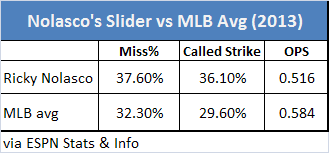
I may have a full report on Nolasco for my post tomorrow (or maybe some other topic) but this actually surprised me while culling the data: His slider is actually pretty good and has improved in 2013. This does not make him a good bet for a four or five year deal but it was surprising to learn that his secondary offering is much better than I had previously perceived.
-
See, here's a different kind of agent. http://www.tampabay.com/blogs/rays/agent-boras-joins-chorus-ripping-tampa-bay-market/2152283 Thanks everyone for the feedback. I realize everyone thinks they are playing an angle with the Twins stuff but I have my reservations about that. I also highly recommend you read Jerry Crasnick's book "Licenses To Deal" that was written about the SosnickCobbe group: http://www.amazon.com/License-Deal-Season-Maverick-Baseball-ebook/dp/B00CJFBXKU/ref=sr_1_1?ie=UTF8&qid=1384384509&sr=8-1&keywords=License+To+Deal
-
You can view the page at http://twinsdaily.com/content.php?r=2470-Ron-Gardenhire-discusses-Joe-Mauer-s-decision
-
The Twins surprised everyone yesterday but announcing that Joe Mauer has made the decision to relocate to first base after spending his career as one of the game’s best two-way catchers. Comments from Twins general manager Terry Ryan in October made it clear that the team was not totally anticipating Mauer’s move as they entered the planning season for 2014. In his address to the media yesterday, Mauer mentioned that there were occasions that he would take a foul tip and it extremely difficult for him to perform, even mentioning at one point that he had troubles feeling his hands gripping the bat after suffering his concussion. The move early in the offseason will allow the front office to address the issues that arise, namely finding another catcher. On MLBNetwork Radio’s Power Alley yesterday manager Ron Gardenhire shared his thoughts on the decision. In regards to how the decision was made: On how Joe Mauer was handling this: On Mauer’s ability to play first base: On who will replace Mauer behind the plate:
-
-
You can view the page at http://twinsdaily.com/content.php?r=2466-It-s-official-Twins-announce-Joe-Mauer-moves-to-first-base
-
It's official: Twins announce Joe Mauer move to first base
Parker Hageman posted an article in Twins
The Minnesota Twins' Dustin Morse announced via Twitter that the Twins will officially move Joe Mauer from catcher to first base for the 2014 season. In October, general manager Terry Ryan told Twins Daily in his offseason interview that the team was not planning for Mauer to move away from behind the plate and the transition from catching to first was ultimately Mauer's decision. "I'm not preparing for anything different than we prepared for last year," Ryan said. "That decision's still coming down to whether or not he wants to catch for sure. The good thing is he's, I would say, he's 95 percent right now, which is good. That's a decision that's going to come down on whether or not he wants to stay back there, and how much he wants to stay back there, and how much he wants to stay back there. But right now I'm preparing for him to be back there." The move obviously opens up questions as to the team's plans for catcher in 2014. Veteran Ryan Doumit also suffered a concussion that removed him from the position at the end of the year and Josmil Pinto, while promising in September, is still learning. Although Pinto's character and coachability have been lauded, there still is work defensively, said Ryan. "There were days that I was a little concerned. With any kid that comes up, you're not going to have a polished product," Ryan noted. In addition to Doumit and Pinto, Ryan mentioned minor leaguer Eric Fryer as a player who contributed positively in 2013 (albeit at the minor league level) and there are several free agent catching options available on the market. The team's official press release cites that while Mauer is symptom free from the concussion suffered late 2013, the increasingly inherent dangers of the position necessitated the move. -
The Minnesota Twins' Dustin Morse announced via Twitter that the Twins will officially move Joe Mauer from catcher to first base for the 2014 season. In October, general manager Terry Ryan told Twins Daily in his offseason interview that the team was not planning for Mauer to move away from behind the plate and the transition from catching to first may ultimately have been Joe Mauer's decision. "I'm not preparing for anything different than we prepared for last year," Ryan said. "That decision's still coming down to whether or not he wants to catch for sure. The good thing is he's, I would say, he's 95 percent right now, which is good. That's a decision that's going to come down on whether or not he wants to stay back there, and how much he wants to stay back there, and how much he wants to stay back there. But right now I'm preparing for him to be back there." The move obviously opens up questions as to the team's plans for catcher in 2014. Veteran Ryan Doumit also suffered a concussion that removed him from the position at the end of the year and Josmil Pinto, while promising in September, is still learning. Although Pinto's character and coachability have been lauded, there still is work defensively, said Ryan. "There were days that I was a little concerned. With any kid that comes up, you're not going to have a polished product," Ryan noted. In addition to Doumit and Pinto, Ryan mentioned minor leaguer Eric Fryer as a player who contributed positively in 2013, albeit at the minor league level, and there are several free agent catching options available on the market. The team's official press release cites that while Mauer is symptom free from the concussion suffered late 2013, the increasingly inherent dangers of the position necessitated the move.
-
ESPN.com's Jerry Crasnick tweeted out this morning that the Twins have signed former shortstop Jason Bartlett to a minor league deal which includes a spring training invite. Bartlett, who is a career .271/.336/.366 hitter, did not play in 2013. I assume this is a prelude to bringing back Johan Santana.
-
No, injuries and lack of playing time during the regular season is why Kepler is playing the fall league. Plus the Twins need to make a decision on placing him on the 40-man.
-
For multiple reasons, you are not going to get either side to state on the record dollar amounts in those circumstances.
-
Why is that valuable information? In the case of Willingham, it was same years, more dollars.
-
As far as I can tell, you have an inherent mistrust for people when they open their mouth (see your comment from the Terry Ryan interview: "I think the interview is just PR to mollify the choir so they stop singing off-key"). Do people who are being interviewed on the record speaking towards things that would benefit themselves or their interests? Absolutely. Sosnick may have been saying things to keep things smooth for future negotiations just like Ryan was not going to bash Gardenhire or Molitor. That said, I do believe Sosnick's comments reflect things I have heard from people across the industry: The Twins are a respected organization in baseball. It may not be viewed the same from a fan's perspective when you consider the on-field product as of late but insiders seem to agree that the Twins are a good organization across-the-board.
-
You can view the page at http://twinsdaily.com/content.php?r=2462-Thoughts-on-the-Twins-One-baseball-agent-s-perspective-on-Minnesota-s-front-office
-
Baseball agent Matt Sosnick speaks strongly of loyalty, honesty and trust in his industry. His agency, Sosnick Cobbe Sports, was grown from scratch in the hills above the San Francisco Bay and relies on building relationships, sticking with clients regardless of on-field performance and adheres to principles such as automatically dropping players who engage in detrimental activity like domestic violence. He discusses his clients as friends rather than means to a paycheck. Character above all. [PRBREAK][/PRBREAK] It probably should come as no surprise then that he holds the Minnesota Twins operations in high regard for similar reasons. When asked his perception of the organization, Sosnick raved. “First of all, I love the Twins,” he admitted. “I obviously have had lots of players who have run through there the past few years. I have [Josh] Willingham and [Ryan] Doumit. I have a very close relationship with both [assistant GM] Rob Antony and [vice president of player development] Mike Radcliff and there’s no GM that I respect more than Terry Ryan.” That may seem like an odd response from a person whose livelihood is tied to how much a team is willing pay for one of his clients and, so far, the Twins have not been exactly a blank check. In fact, Willingham’s 2012 contract has been the richest free agent contract the team has distributed to date. What is interesting is that had Willingham’s home been further west, he may never have been a Twin to begin with. When fans wonder why their team didn’t sign a particular free agent, there are factors that go beyond just the dollars and cents. As a free agent after the 2011 season, Sosnick fielded an offer from a West Coast team that was superior to that of the Twins. But Willingham, who calls Alabama home, opted to sign with Minnesota because it was in closer proximity to his family and turned down more money in the process. Willingham’s reign as the team’s highest compensated free agent may come to an end this winter and one of Sosnick’s other clients could be the one to dethrone him. Among the Sosnick Cobbe client list are Josh Johnson, Ricky Nolasco and Randy Messenger -- three pitchers in who the Twins have had varying degrees of interest. Under different circumstances, Johnson could have been the headliner of the offseason. At just 30 years old, Johnson has battled both shoulder inflammation (2011) and elbow issues (2013) that have curbed his innings over the past three seasons. More importantly, it has curbed teams’ appetite for doling out a large contract.. “He’s probably got the highest upside of any free agent pitcher,” says Sosnick, “but when you factor in the amount of games he started the last few years and the amount of different injuries he’s had you realize, in our case, our choice was to take a shot at a two or three-year deal or take a shot a one-year where we rebuild his value. There’s no question that we are going to go after a one-year and try to rebuild his value because he’s going to be treated as an injury liability -- even though I think he’s totally healthy right now -- but I understand that mindset.” While Johnson could profile as a top of the rotation arm, does a pitcher with his injury history make sense for the organization? Mike Radcliff does not seem to think so. According to the Pioneer Press’s Mike Berardino, Radcliff said that if Johnson’s asking price is $10 million or more, the club would likely pass. That said, the Twins severely lack an ace and Johnson could be that guy. As an agent, would Sosnick ever try to convince a team that Johnson, who is coming off a bad conventional season but demonstrated decent peripherals that may indicate a positive future, is the right fit for them? “I find that too presumptuous on my part. Am I really going to convince Mike Radcliff that his scouting analyses of a player are off because I tell him something -- given the fact that I’ve never scouted a player in my life and Mike’s done it professionally his whole life? I find the thought distasteful and if I put myself in the reverse situation I would be insulted. That’s not what I do.” Perhaps more conducive to the team’s long term vision is Sosnick’s other former Marlins pitcher, Nolasco. “[Nolasco’s] probably is the most sure thing in the marketplace and that comes without a qualifying offer. That’s a huge thing for a team to sign a guy who you can pencil in for 200 innings a year, never gets hurt and you don’t have to give up a draft pick for him.” Not having to surrender a draft pick means a lot to teams that, unlike the Twins, have unprotected first round picks which could make him more desirable. Sosnick says he and Nolasco are seeking a five-year deal, but currently are speaking with numerous teams about four years. During his interview for the Twins Daily Offseason Handbook, Ryan flinched at the thought of signing 30-year-old pitchers, stating that those over that age have a tendency to break down. With Nolasco seeking up to five years, his contract length may cause the team to balk. Still, as Sosnick hinted to Berardino, the Twins have expressed interest in the right-hander. And as Sosnick said there could be the possibility of using a club option in the contract to bridge the gap and protect the team in the event of an injury. The last notable free agent pitcher in the Sosnick Cobbe stable is Randy Messenger, who is coming off a strong stint in Japan. “Outside of [Masahiro Tanaka] who needs to get posted, Messenger’s a free agent in the States this year and he led the Japanese league last year in strikeouts, innings pitched and games started. He has really strong peripherals and ERA the last two years in Japan and was a totally dominant guy this year. He’s not a Tanaka but he’s the next best thing.” The Twins flirted with Messenger a bit last offseason but Messenger ultimately returned to Japan and had another strong season which could be emphasized since that Japanese league switched to a new baseball which increased the offensive production. Did Messenger notice the difference? “He did say that he felt like pitching to an ERA in the 2.00’s this year was more challenging than the two years before that. He felt like ERA-wise, it affected the ERA by a quarter of a point. So a 2.90 was about the equivalent of 2.65 in the past.” Messenger could turn into a Colby Lewis who refined his style in Japan before returning to the Texas Rangers and putting up impressive numbers. Maybe more importantly to a team not looking spend as much on one starting pitcher, Messenger should not command as much as Nolasco in dollars or years. When it comes to discussing contracts with the Twins, the front office avoids lengthy contracts with free agent pitchers. Still, Sosnick respects them all the same. “The Twins are run by the three guys I know -- Terry [Ryan], Rob [Antony] and Mike Radcliff -- and all three of them would be great GMs anywhere right now. They are great evaluators of talent, nice people, easy to do business with and honest. You won’t find three more honest guys then those three guys. The Twins are not as easy to do business with financially as the Yankees or Dodgers, they don’t have the same deep pockets, but we keep sending our guys to the Twins because they are honest, honorable people. The front office represents baseball as well as anybody does.” Sosnick’s relationship with the Twins organization goes beyond just his major league clients. In 2009, the Walnut Creek-based agency was representing who some scouts considered to be the best player to come from Europe in 16-year-old Max Kepler. There was plenty of interest in the toolsy, six-foot-four outfielder who was just a few months removed from growing his first facial hair. “When Max Kepler was out there,” Sosnick reminisced, “we had an offer that was higher than what the Twins’ final offer was and we had him go to the Twins because we really believed in their player development and a lot of that had to do with our relationship with Mike at the time.” Kepler has advanced slowly in the minor league system. At 20 years old he finished his first season at low-A (albeit injury-abbreviated) and has performed well in the Arizona Fall League despite unattractive numbers. As Baseball America’s John Manuel noted a few weeks ago the Twins expect to see the large statured Kepler add some power to his repertoire through additional conditioning this offseason resulting in more over-the-fence distance in 2014. In just a few seasons, Kepler could be patrolling a corner outfield spot in a Twins uniform and, reflecting back, Sosnick is happy with their decision to sign with Minnesota. “Kepler went to Minnesota because we like their player development,” he said, “we felt like they would do the best job of assimilating a 16-year-old from Germany. We made the right choice. He went to high school during the day and played in the afternoon and the Twins bent over backwards to make him as comfortable as possible. And it just reinforced the decision that we made.” Sosnick’s opinion of the Twins’ organization may or may not be shared throughout his industry. Then again, Sosnick’s approach does not seems shared by the rest of his industry. He and his agency remain committed to doing the best for the clients and place them in ideal situations -- like Willingham’s desire to remain closer to his family or considering Kepler’s comfort level -- rather than the ones that garner the most dollars.
